
By Roselyn Fauth

Screenshot of the sign design in progress by graphic artist Roselyn Fauth 2025.
Its been a few years of research by my father Geoff Cloake and I, and we are really excited to see it all come together for our signage for the Alexandra lifeboat shelter. I realise not everyone wants to stdy the timeline, so here is a story instead to help you imagine what happened.
This is not just a vessel... Imagine yourself standing on Timaru’s stony beach in 1860 as a storm rolls in. Six experienced Deal boatmen, known internationally for their surf-launching skill, attempt to reach the Wellington using a surfboat. The ship survives. Its rescuers do not. Two men drown and become the first recorded burials in Timaru’s cemetery. Would you have risked your life with no proper gear?
This was Timaru before the breakwater. This is why the Alexandra was ordered from Britain in 1862, because people like you would not stand by and watch more lives lost.
MODERN RESCUE ARRIVAL
The Alexandra Arrives, 1863
Smoke rises from the Herald in 1864. You rush to its aid with the new British Alexandra lifeboat. Your heart thumps as you imagine helping to launch it. This is the first time the vessel saves lives. It will not be the last.
1866: Rescue of the Prince Consort
Imagine racing towards the capsized ship. The waves are too heavy for a beach launch. No horses are available to pull the Alexandra, so with around forty others you haul it across the stony beach into water deep enough to launch. Two men are saved, and a third is dragged from the surf by a swimmer from the shore. Relief washes over you, along with the worry of how close disaster came.
THE DARKENING YEARS
Deaths and Disputes
Imagine the days when pay disputes, broken gear, or deadly seas intervene. You hear of a lifeboatman lost in the 1868 Miskin and Despatch wrecks. Duncan Cameron drowns in 1869 while trying to reach the Twilight with the Alexandra. Government and community donations pay for his burial.
1869: James Melville Balfour Lost to the Sea
The sea claims not only sailors but those working to safeguard them. James Balfour, New Zealand’s Colonial Marine Engineer, builds an experimental mole at Timaru to study drifting shingle. Travelling to Oamaru for a drowning victim’s funeral, he boards a surfboat to reach the SS Maori anchored off Timaru. The surfboat capsizes, and Balfour drowns at just thirty-eight.
1867–1869: Rocket Apparatus Arrives
Capt. Alexander Mills becomes harbourmaster in 1866. You watch as rescuers follow his orders to fire the new rocket apparatus from the shore to a ship. The first rocket fires too early, burning him badly. The second shoots perfectly and carries a line to the Collingwood. Every person aboard is brought in.
COMMUNITY STEPS IN
Women Begin Fundraising
You help the women who begin fundraising to support families, repair broken gear, replace equipment, and contribute to rocket apparatus costs. Their concerts, subscription lists, and sewing work become the backbone of Timaru’s rescue efforts.
1870: Lifeboat Service Reorganised
The Canterbury Provincial Government begins paying the Alexandra lifeboat crew, who now train regularly.
COURAGE AND CALAMITY
1870: Layard and Aurora Rescues
Imagine watching the rocket line bring all nine men ashore from the Layard in less than ten minutes, and seeing the Alexandra battle the sea to reach the Aurora and save four of her crew. For a moment, it feels as if you can outsmart the ocean. But you read reports that Timaru is gaining a reputation as a ship’s graveyard. The harbour must be made viable.
The Shipwreck Era Intensifies
The Isabella Ridley. The Craig Ellachie. The Fanny. The Glimpse. The Lapwing. Again and again, ships face danger, and lives are lost.
Melrose and Palmerston Tragedy
You join a human chain to help after the Melrose and Palmerston collide. The breeches buoy fails, and a rescuer, Capt. John Evans, drowns.
BLACK SUNDAY
Benvenue and City of Perth Disaster, 1882
The City of Cashmere and the Duke of Sutherland wreck earlier in the year, but it is the monstrous sea in May that wrecks the Benvenue and strands the City of Perth, sending news around the world.
At one point, men who have rowed out in small boats with Capt. Mills are in danger. Because the lifeboat crews have disbanded and the rocket brigade has taken over rescues, there is no official crew. Volunteers go to the rescue in the Alexandra lifeboat.
Imagine standing on the cliff with thousands of others, watching heroes pull men from the boiling sea. Capt. Mills later dies from exposure. Ten lives are lost. The disaster, remembered as Black Sunday, reinforces the urgency of investing in and constructing the harbour.
The public raise funds for a monument. James Balfour surveyed the coast and laid early conceptual groundwork for a harbour. John Goodall later designed plans that set development in motion for a viable port.
THE WRECKS CEASE. THE ALEXANDRA RETIRES.
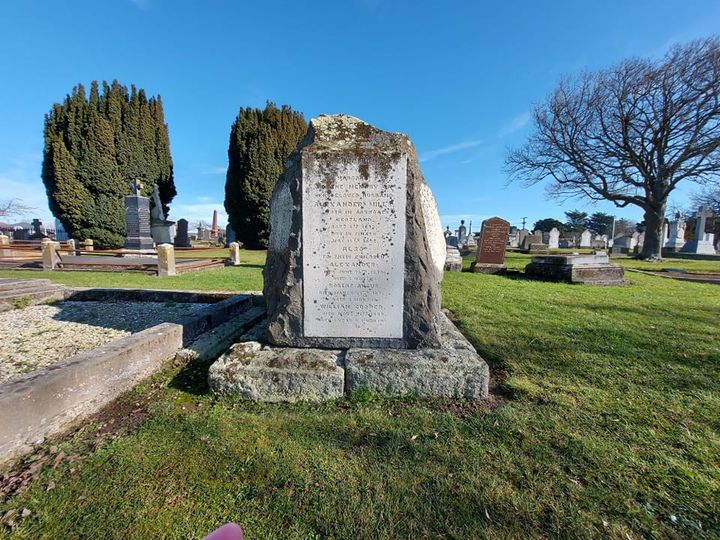
Imagine standing beside the Alexandra fifty years later as the community remembers Black Sunday and the lifeboat goes on display in 1932. You study the vessel’s curves, its scars, its scale.
The Alexandra is not just a lifeboat. It embodies every decision, every risk, every loss, and every act of courage that shaped Timaru’s maritime story.
More than 150 lives were saved by the Alexandra lifeboat and the Timaru Rocket Brigade.
Imagine being in their shoes...
Captain Henry Cain
After 30 years as a mariner, Capt. Cain moved to Timaru in 1857 to run a landing service at the foot of Strathallan Street, for Henry Le Cren. He and his wife Jane, lived in one of the first five European houses on the shore.
They welcomed 110 passengers from the Strathallan in 1869, the first immigrant ship direct from the UK to Timaru. In 1871, Jane, as mayoress, turned the first sod for the Timaru to Christchurch railway line. She died in 1878.
Capt. Cain managed Timaru’s landing services and welcomed the Alexandra lifeboat in 1863. He served as mayor from 1870 to 1873 and died in 1886, allegedly poisoned by his son-in-law.
Margaret, The Harbourmaster’s Wife
Living overlooking the harbour, Margaret may have seen Capt. Alexander Mills fly flags to instruct ships, keep a lookout, and summon rescues. Did they talk about his frustrations? Did he feel caught between the harbour boards, expectations who wanted ships close to shore for efficiency, yet he knew to keep ships far enough out sea to reduce the risks of danger in rough seas?
Capt. Mills was fired after the City of Cashmere wrecked and was reinstated before Black Sunday. He must have felt immense pressure to rescue the City of Perth, and relief to have the Alexandra lifeboat available. He died from exposure at age 48 after attempting to salvage the City of Perth.
While grieving, Margaret faced public scrutiny. An enquiry recommended restoring and training a lifeboat crew, which was ironic, as her husband had run paid crews until the service was defunded. Margaret died two years after Capt. Mills.
Capt. Alexander Mills witnessed many of Timaru’s shipwrecks as the harbourmaster.
The Designer of the Medals
Arthur L. Haylock designed it for The Masonic Lodge of St John, to present to the 43 involved in the rescue attempts of 14 May 1882.
He joined the Government Service and moved to Timaru, where he joined the Timaru Rocket Brigade.
He recorded first-hand recollections (c. 1877–1882) and later compiled records of shipwrecks and rescues.
The men recognised by the St John’s Masonic Lodge for their bravery in the Black Sunday rescue.
Forty received medals in person in August 1882: W. Collis, J. McIntosh, A. H. Turnbull, J. Cracknell, J. Thompson, G. Sunnaway, R. Collins, John Reid, J. Houlihan, M. Lekoy, J. A. Petterson, G. Findlay, C. Gruhm, J. Henneker, W. Halford, G. Shirtcliffe, W. Walls, R. H. Balsom, T. Hart, G. Davis, W. S. Smith, F. McKenzie, T. Morgan, C. Vogeler, P. Bradley, D. Bradley, S. J. Passmore, J. Crocombe, C. Moore, A. Schabb, T. Martin, M. Thompson, W. Oxby, I. J. Bradley, H. Trouselot, W. H. Walls, J. Isherwood, A. L. Haylock, John Ivey, and W. Budd.
Three were absent and their medals were sent to Scotland: G. Mentac, C. McDonald, and W. R. McAteer.
Reunited Rescuers 50 Years Later
They were not random bystanders. Isaac Bradley spent more than 50 years on the Timaru waterfront and became the marine superintendent for the Union Steam Ship Co. He and his brothers Philip and Dan (a trained Alexandra coxswain) all took part in the Black Sunday rescues, at times hauling each other from the surf.
Their brothers-in-law, George Sunnaway (professional boatman) and Carl Vogeler (Rocket Brigade), also helped that day.
Five members of one family were involved in the Black Sunday rescue effort.
In 1932, 50 years later, three surviving rescuers gathered for a photograph at the anniversary, when the old Alexandra lifeboat was put on display at Caroline Bay.
A Decider, David C. Turnbull
David was ten when he witnessed Black Sunday. He kept the distress bell as a reminder of how vulnerable we are at sea. He gave it to the South Canterbury Museum.
David’s father, Richard, was a merchant, councillor, and Member of Parliament who helped champion the breakwater for the new harbour, believing it would secure Timaru’s long-term viability and opportunity.
David’s firm, D. C. Turnbull and Co., gave him practical insight into sea trade and logistics. He served on the Harbour Board from 1895 until his death in 1931, helping to shape decisions on shipping, trade, and the operation of the port.
Timeline of the Alexandra Lifeboat
1820s–1840s Sealers work along the Timaru coast in the 1820s, followed by the Weller Brothers whalers, who establish a station in 1839.
1857 Captain Henry Cain establishes a landing service at the foot of Strathallan Street for Henry Le Cren.
1860 A small lifeboat arrives from Sydney to support early rescue efforts.
1861 Timaru is gazetted as a Port of Entry.
1854–1863 Queen Victoria grants the National Lifeboat Institution its Royal Charter in 1854, creating the RNLI. The RNLI promotes the new self-righting lifeboat designs that the Alexandra is later based on. Baroness Angela Burdett-Coutts, one of Victorian Britain’s leading philanthropists, funds lifeboat stations, equipment, and seafarers’ welfare, helping spread the improved RNLI designs internationally. Princess Alexandra, after whom Timaru’s lifeboat is named, marries Queen Victoria’s eldest son, Albert Edward, in 1863. She becomes Queen in 1901.
1862–1863 The lifeboat is ordered from Britain and built in 1862. It arrives in Timaru in 1863 and is christened Alexandra.
1863 The Alexandra is stored in a shed beside “Cain’s Landing Place” at the foot of Strathallan Street.
1864 the Government begins developing the landing service.
By 1870 A paid lifeboat crew is established and begins regular training. Captain Alexander Mills is appointed Chief Coxswain.
By 1871 The Alexandra has saved seven lives.
1873 The Independent Order of Good Templars forms the “Alexandra Lifeboat Lodge”, enrolling eighty members.
1875 The lifeboat crew’s monthly £1 allowance is cut, and they must volunteer their service. Women begin organising fundraising events to support the Lifeboat Lodge.
1866–1877 (Rocket Apparatus and Brigade) The rocket apparatus arrives in 1866 and is used in the rescue of the Prince Consort, although no official brigade exists at this stage. The Timaru Rocket Brigade is formally established in 1877.
1877 Public meetings and debates intensify pressure for harbour improvements. A major meeting in Richard Turnbull’s Hall draws about 600 people to support building a breakwater. Continued lobbying leads to the creation of the Timaru Harbour Board later that year.
1885 As harbour construction progresses, the lifeboat crew formally disband from active service.
1887 The Rocket Brigade disband. The harbour scheme is completed.
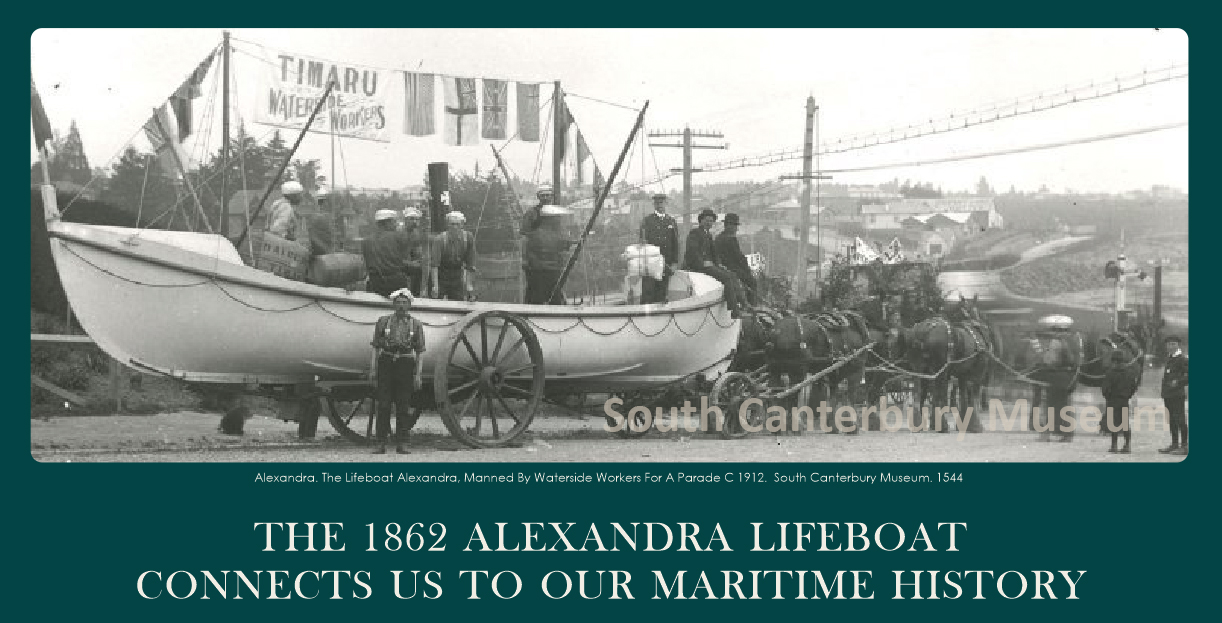
1912 Parade procession of the lifeboat with the Timaru Water Side Workers
1928 - Jubilee Procession in Timaru 13 July: ngataonga/F7142
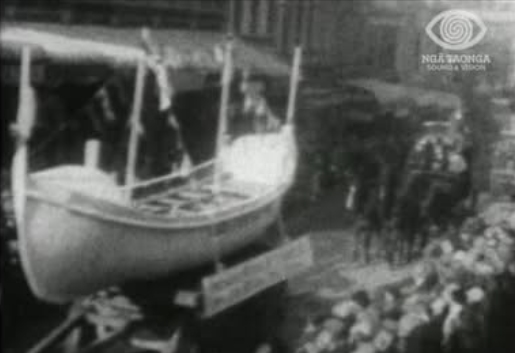
https://www.ngataonga.org.nz/search-use-collection/search/F7142/

The carriage had the axle straightened and the wheels were retracked. Here is the Alexandra Lifeboat on it's original carrage outside the Timaru Landing Services Building - Photograph by Philip Brownie. The Alexandra can justafiably be regarded as one New Zealand's most historic sailing vessels. There are few vessels older, perhaps only the Edwin Fox (1856). - Lifeboat Alexandra Conservation Plan Draft July 1997, Mariotime and Transportation Trust.
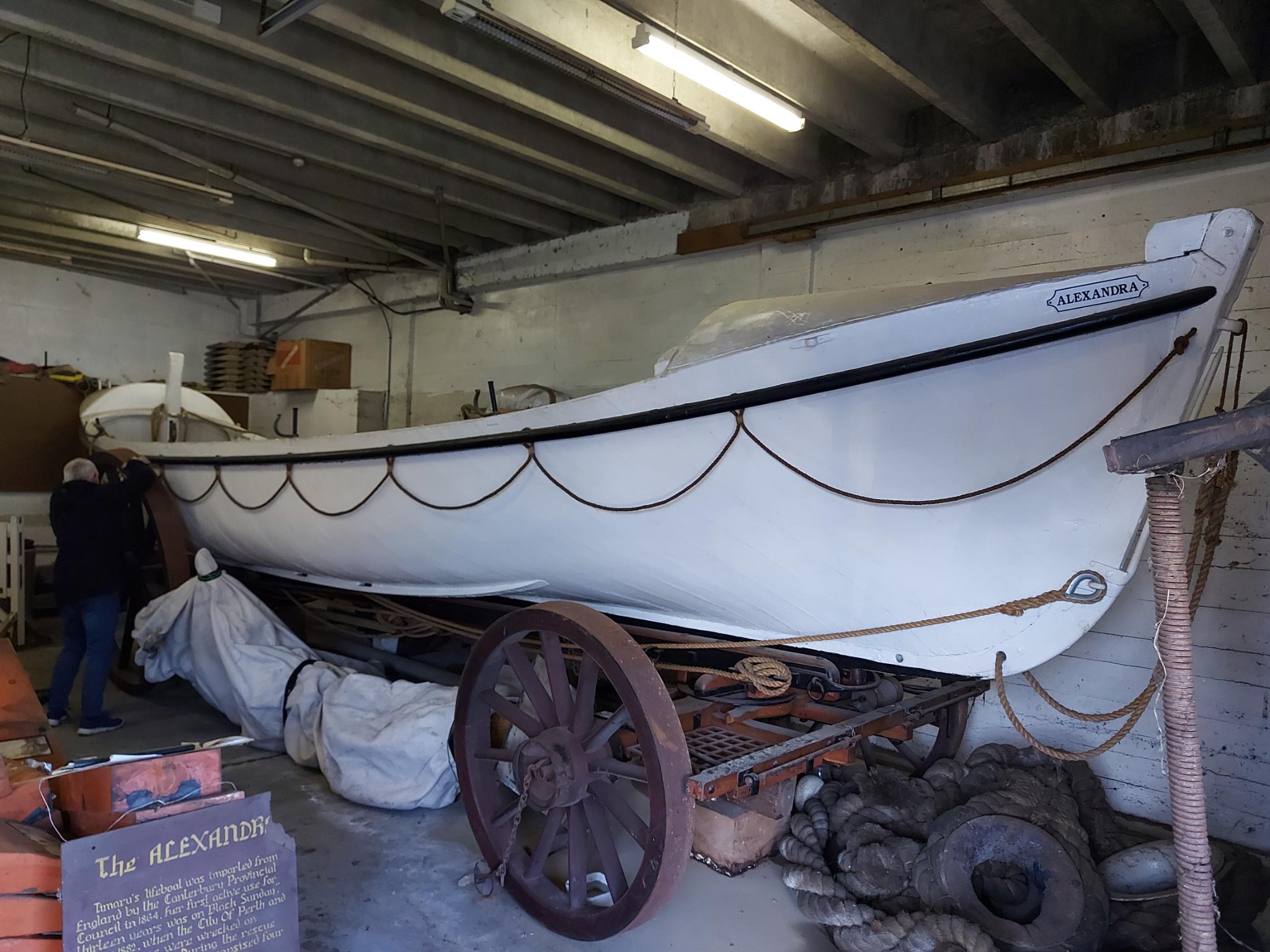
Learn more about our shipping past and visit the lifeboat at Caroline Bay. Play at the Caroline Bay Playground, which incorporates themes of our sea rescuers, pay tribute to the brave at the Perth Street Memorial, Visit the South Canterbury Museum to learn more, sit with Captain Cain outside the Timaru Landing Service Building and imagine being in his shoes and then pay your respects to those who rest from our maritime disasters at the Timaru Cemetery.

The race to the rescue mouse wheel being installed at the Caroline Bay Playground. Signwriting was designed by Roselyn Fauth to share maritime history of the area and inspire people to pretend they are on a sea rescue mission and play it out on the lifeboat swings and the rocket brigade themed zipline. The playground was championed by community volunteers CPlay, who raised the funds for the playground and helped to design it.
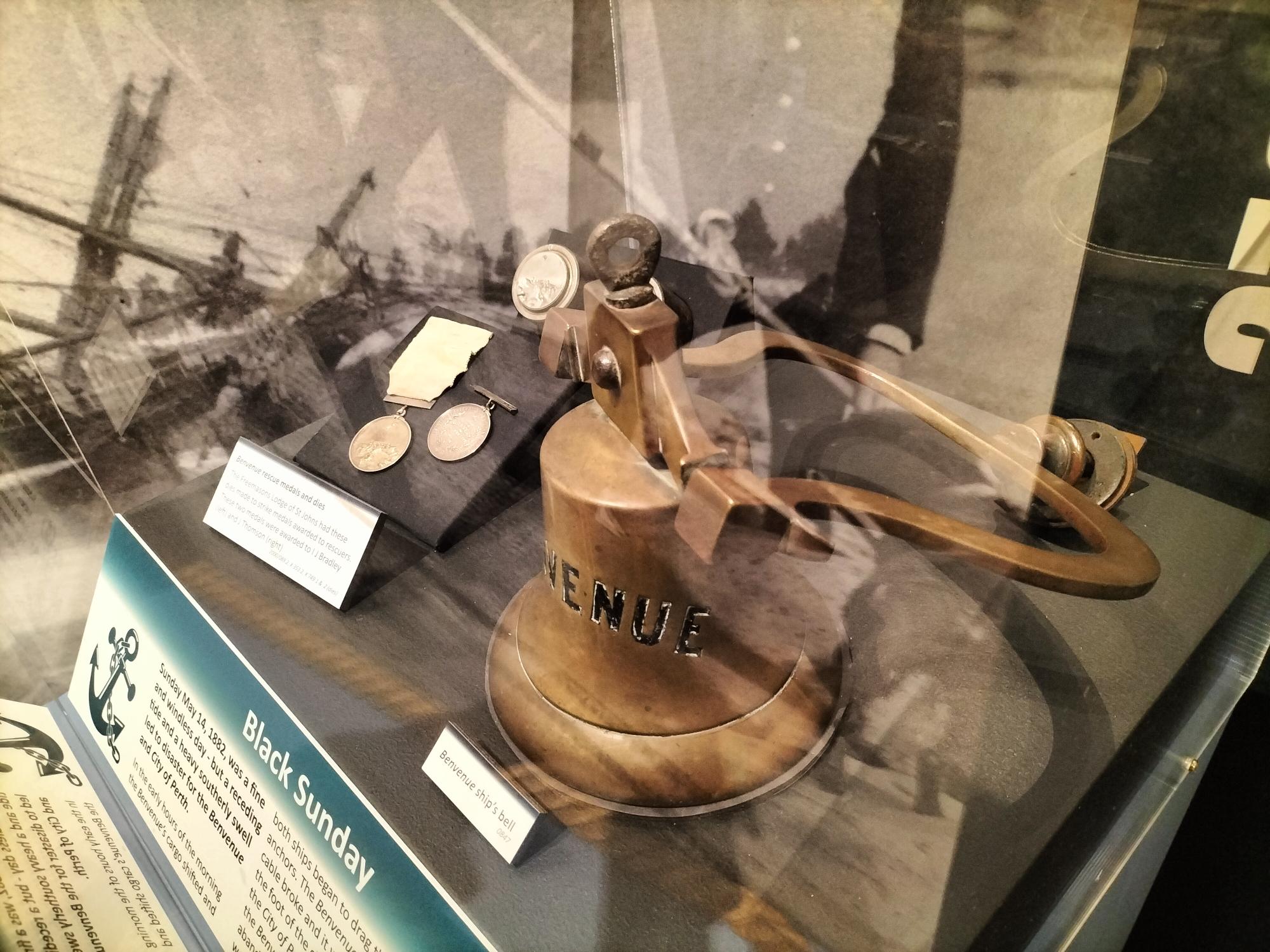
The Benvenue Bell on display at the South Canterbury Museum.
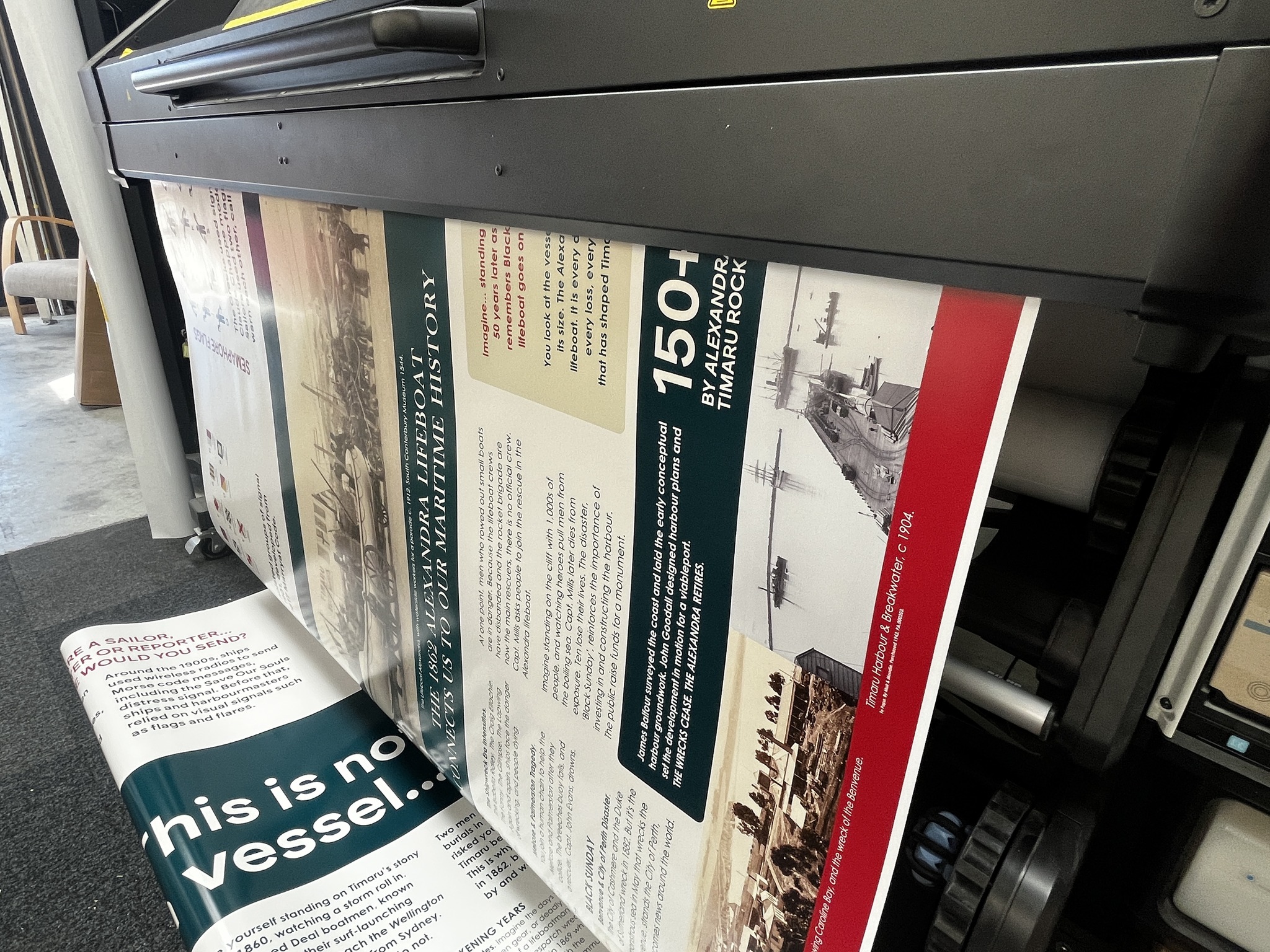
Photo supplied by Branded Kiwi, showing their printer creating the lifeboat signage that was designed by graphic artist Roselyn Fauth and Geoff Cloake
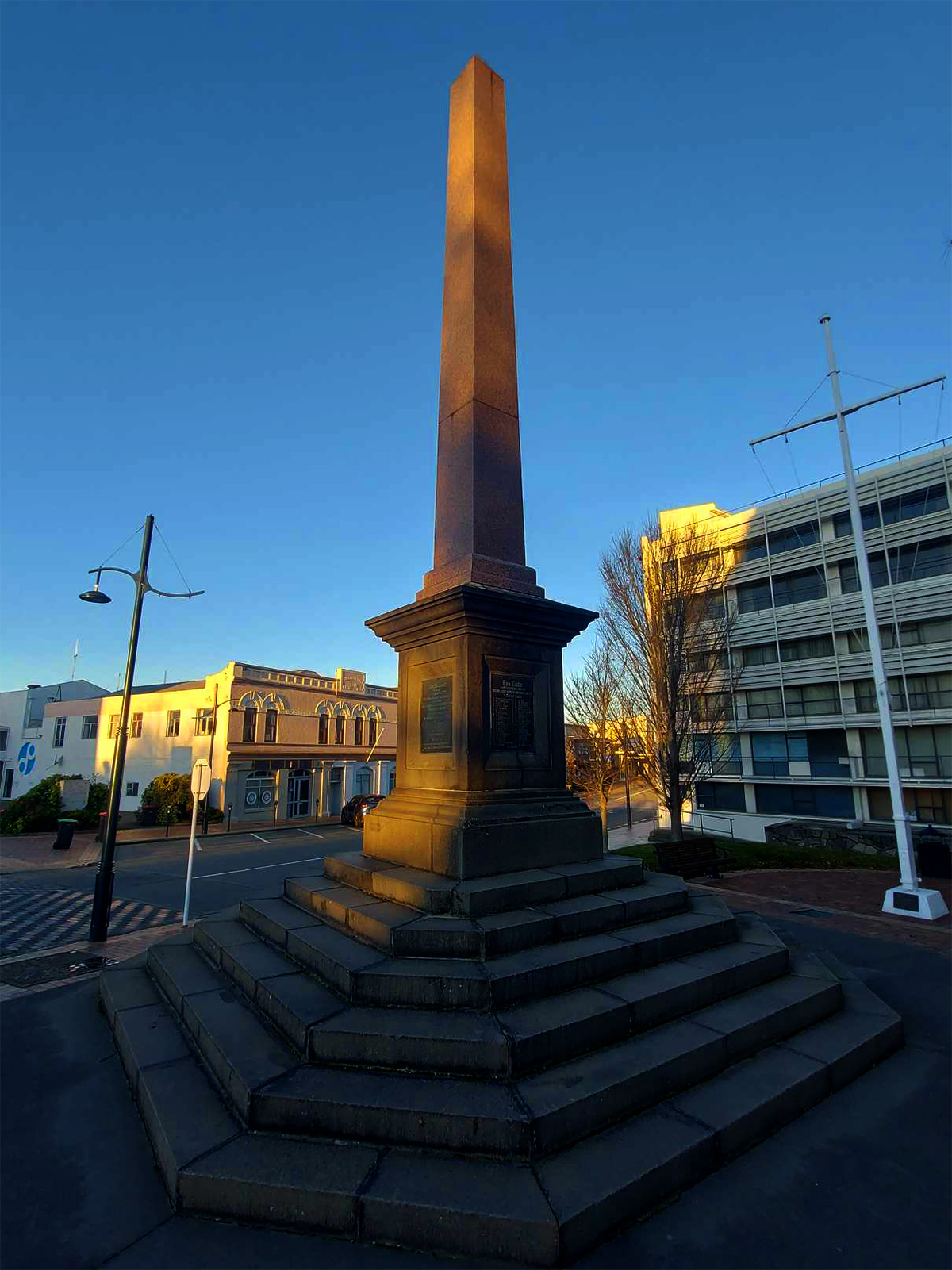
Benvenue Monument, Sophia Street, Timaru - Photograph Roselyn Fauth 2024
The monument that displays their names was raised by public subscription and completed 1885, the Wrecks/Benvenue Monument is an octagonal bluestone base, a polished dolerite pedestal, and a red Aberdeen granite obelisk nearly 10 m high. Designed by T. Roberts, erected by stonemason S. McBride; the obelisk arrived on the Allegiance (July 1885). Brass tablets (engraved by N. Wolfe) list the Nine, the survivors, and the ships’ details, opening with “Greater love hath no man…”. Its siting—opposite St Mary’s and the former Post Office—was deliberate and once controversial: remembrance belongs in the life of the town, not only the cemetery.
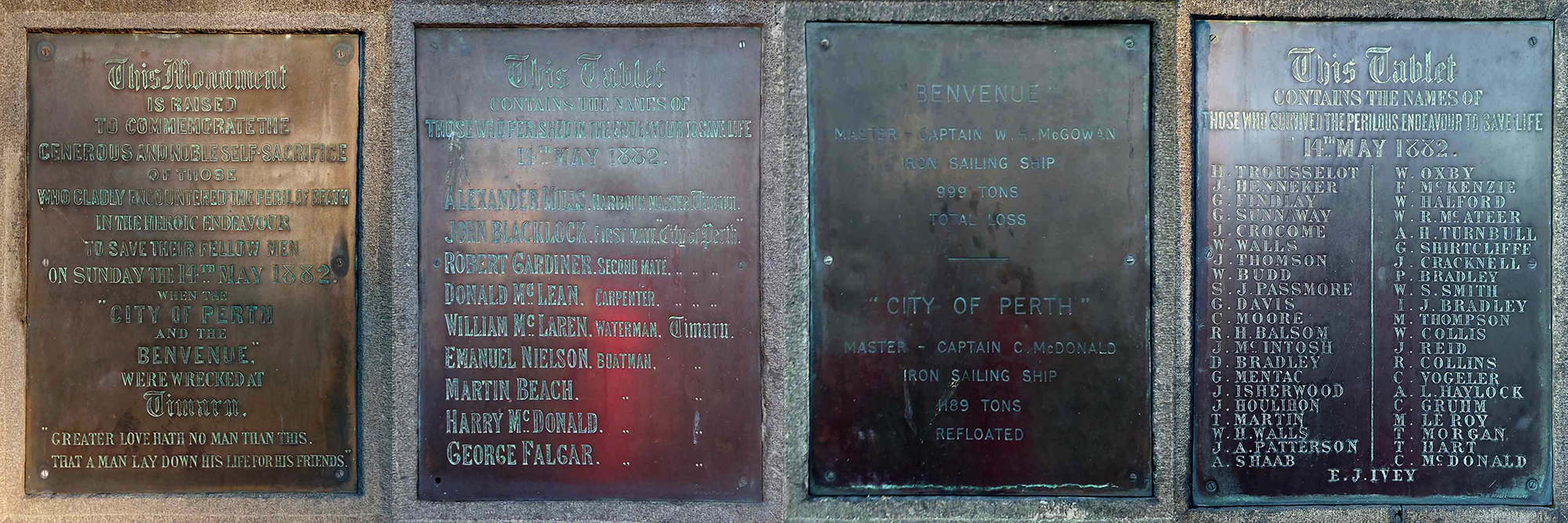
This memorial, paid for by public subscription, was constructed as a token of gratitude to those involved in an endeavor to rescue the crew of two ships, the Benvenue and the City of Perth that foundered off the coast of Timaru on 14 May 1882.
Plaque 1: This Monument is raised to commemorate the generous and noble self-sacrifice of those who gladly encountered the perils of death in the heroic endeavour to save their fellow men on Sunday the 14th May 1882 when the “City of Perth” and the “Benvenue” were wrecked at Timaru. “Greater love hath no man than this, that a man lay down his life for his friends.”
Plaque 2: This Tablet contains the names of those who perished in the heroic endeavour to save life 14th May 1882. Alexander Mills, Harbour Master, Timaru; John Blacklock, First Mate, “City of Perth”; Robert Gardiner, Second Mate; Donald McLean, Carpenter; William McLaren, Waterman, Timaru; Emanuel Nielson, Boatman; Martin Beach; Harry McDonald; George Falgar.
(A 10th person later died from injuries attributed to the Benvenue.)
Plaque 3: Benvenue, Master – Captain W. A. McGowan, iron sailing ship, 999 tons, total loss. “City of Perth”, Master – Captain C. McDonald, iron sailing ship, 489 tons, refloated.
Plaque 4: This Tablet contains the names of those who survived the perilous endeavour to save life 14th May 1882.
H. Trousselot; J. Henneker; G. Findlay; G. Sunnaway; J. Crocome; W. Walls; J. Thomson; W. Budd; S. J. Passmore; G. Davis; C. Moore; R. H. Balsom; J. McIntosh; D. Bradley; G. Mentac; J. Isherwood; J. Houlhon; T. Martin; W. H. Walls; J. A. Patterson; A. Shaab; W. Oxby; F. McKenzie; W. Halford; W. R. McAteer; A. H. Turnbull; G. Shirtcliffe; J. Cracknell; P. Bradley; W. S. Smith; I. J. Bradley; M. Thompson; W. Collis; J. Reid; R. Collins; C. Vogeler; A. L. Haylock; C. Gruhm; M. Le Roy; T. Morgan; T. Hart; C. McDonald; E. J. Ivey.

14/05/1932 Memorial service, 50th anniversary of the Benvenue wreck, 1932. Crowds assembled around the Benvenue Memorial, in Sophia Street Timaru, for a service marking the the 50th anniversary of the wreck of the Benvenue, dated 14th May 1932. In the left background the lifeboat Alexandra is visible. South Canterbury Musuem 1456. https://timdc.pastperfectonline.com/photo/D49F9CEB-DDDB-41F5-938D-879831741057
The nine who died (as recorded on the monument) + one who died later with health issues caused by Black Sunday.
- Captain Alexander Mills — Harbour Master, Timaru. Died from the effects of submersion/exposure after rescue work. Interred Timaru Cemetery, Row 9, Plot 99 (15 May 1882). Left wife Margaret (née Sinclair) and seven children.
- John Blacklock — First Mate, City of Perth. Severe compound fracture; died of injuries days later. Interred Timaru Cemetery, Row 20, Plot 227 (21 May 1882). Left widow & family in London.
- Robert Gardiner — Second Mate, City of Perth. Drowned in the rescue; contemporary accounts describe him giving up his turn to another man.
- Donald (David) McLean — Carpenter, City of Perth. Drowned after the ship’s lifeboat upset. Interred Timaru Cemetery, Row 20, Plot 226 (17 May 1882). Newspapers note wife & family “at Home.”
- William (John William) McLaren — Waterman, Timaru. Drowned during the rescue; body recovered at Dashing Rock (24 May). Body recovered 23 May near Dashing Rocks; identified by clothing and inquest held at the Melville Hotel. Left mother Mrs Menzies (London) and brother at the Cape of Good Hope.
- Emanuel (Emmanuel) Nielson — Boatman, Timaru (Swede). Drowned when the Harbourmaster’s whaleboat capsized.
- Martin Beach (Breach) — Boatman, Timaru. Drowned in the rescue. Early police notes suggested his body was among the first recovered; the adjourned inquest returned “body unknown” on one of the remains.
- Henry (Harry) McDonald — Boatman, Timaru. Drowned in the rescue. Grave not located online. Left wife & family in Timaru.
- George Falgar — Boatman, Timaru. Drowned after multiple capsizes; seen saved once, then lost when the lifeboat overturned again. Grave not located online. Left wife & children reported to be in destitute condition.

The large painting (about four feet in length) of the wreck of 'City of Perth' and 'Ben Venue' at Timaru hung for many years in the Farmers tearooms and now the painting is at the Port Company Offices, Timaru at Marine Parade. The plate below the painting read : The Wreck of the Ben Venue and City of Perth 14 th May 1882. Presented to The Port of Timaru Ltd. By Arthur Bradley. Last surviving son of Issac Bradley a member of the rescue crafts crew. Located at Prime Port - Photo by Roselyn Fauth.
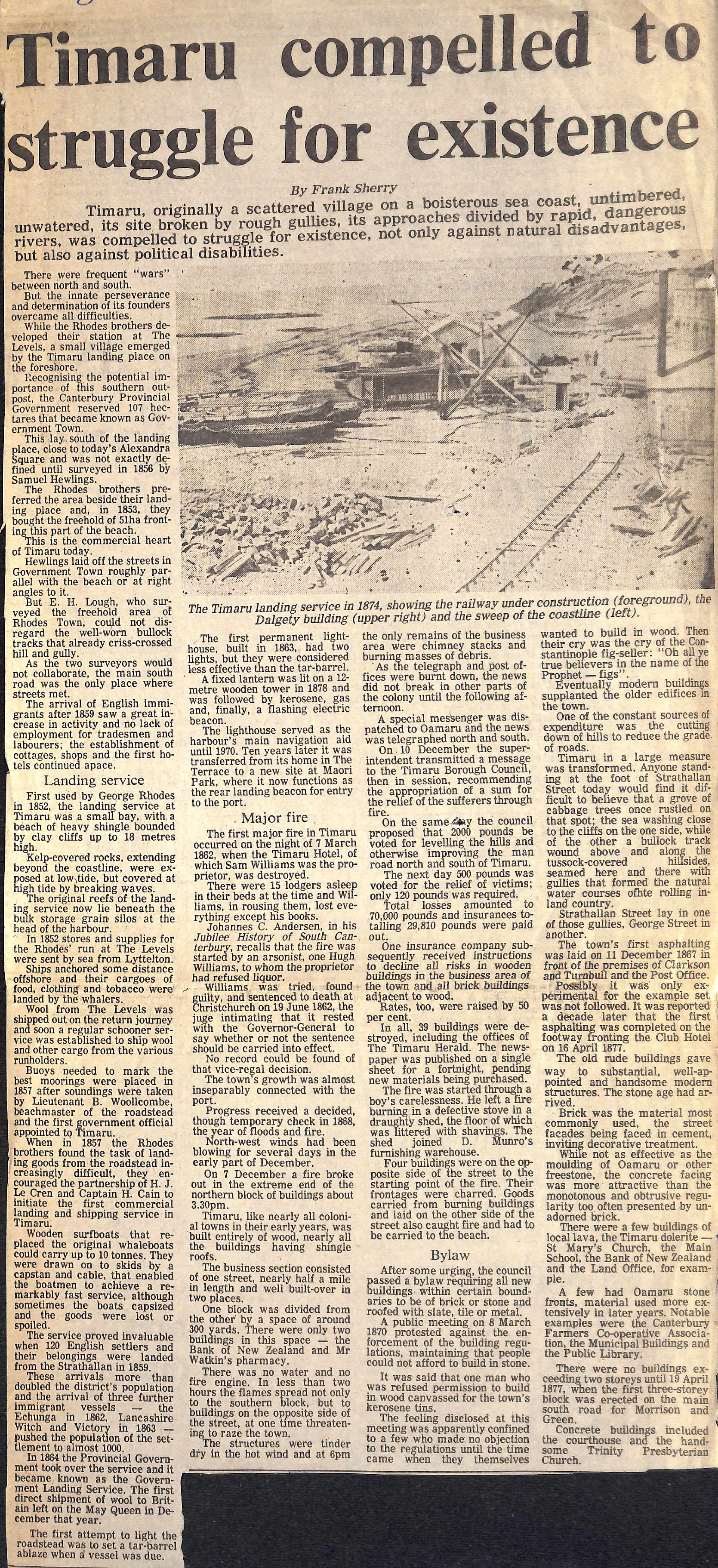
This photo shows the Timaru Landing Services Building when the landing service was operated infront of it. Timaru Herald, Timaru compelled to struggle for exsistence (06 Aug 1985). Aoraki Heritage Collection, accessed 23/06/2023, https://aorakiheritage.recollect.co.nz/nodes/view/799