

A medal that was up for auction: https://www.noble.com.au/auctions/lot?id=483721 The Freemasons of St Johns Lodge awarded medals for gallantry during the rescue on 3 July 1882.
At first glance, it is just silver. Small enough to pin to your chest. Smooth at the edges. The kind of object that might be catalogued, boxed, and eventually forgotten once its story is reduced to a label, or in this case appear in a online auction. But when you look closely, the medal begins is more than simple. It holds so many stories. Tales of the event that called on the brave, the people who struck the medal, designed it, awarded it, recieved it and cared for it all these years.
On one side, a lifeboat struggles in heavy seas. The waves rise higher than the vessel. Above it shines down the All-seeing Eye, the Eye of Providence. On the reverse, a wreath of laurel and oak encloses a name. Not a ship. Not a disaster. A person. The inscription records bravery in saving life in the Timaru roadstead.
It is only when you stare at the medal for a while that its weight becomes apparent.
This particular medal has travelled far. One example surfaced at auction in Australia more than a century later, catalogued and offered for sale. Another is held in national collections like Te Papa, which I can't show you because it is under copyright, and another is in the South Canterbury Museum. Each reappearance raises the same question... How did something made for a single event, a single act of thanks, come to live such a long and wandering life. The story it carries begins on Sunday 14 May 1882...

That day, a huge swell rolled into the Timaru roadstead. Within hours, two large ships were wrecked in quick succession. First the Benvenue, then the slightly larger City of Perth. Nine lives were lost. Among the dead were the port’s harbourmaster and five local watermen who had gone out in the surf to rescue others.
The Benvenue was a total loss. The City of Perth was later refloated and renamed the Turakina. The men were not so easily repaired.
This medal does not list the dead. Instead, it honours those who survived. Those who rowed into the surf and came back. Those who were injured, exhausted, and in some cases permanently changed by what they had done.
Three months later, on 3 July 1882, Timaru gathered to remember. Around 250 people filled St John’s Masonic Hall. Many were women. They had not rowed that day, but they had waited. Watched the sea. Counted boats returning, or not returning. They understood exactly what was being recognised.
The Freemasons of St John’s Lodge had commissioned medals to present to the men involved in the rescue attempts. This was a private award for gallantry, not a state honour. A community marking courage in its own way. The Worshipful Master spoke of faith, hope, and charity. Charity, he said, was the greatest of virtues. Faith was lost in sight. Hope ended in fulfilment. Charity endured beyond the grave.
Mrs Parsons presented the medals one by one, fastening each to a working man’s jacket. Some stepped forward on crutches. Others bore injuries that were not visible. Three recipients were absent entirely, having already returned to Scotland. Their medals would be sent after them, crossing the same sea they had once worked.
Each man, when pinned, turned to face the audience. Each offered thanks. Each expressed the same conviction. If it happened again, they would go out again.
One medal bore two clasps. George Sunnaway’s included the words “For additional bravery”.
Additional to what.
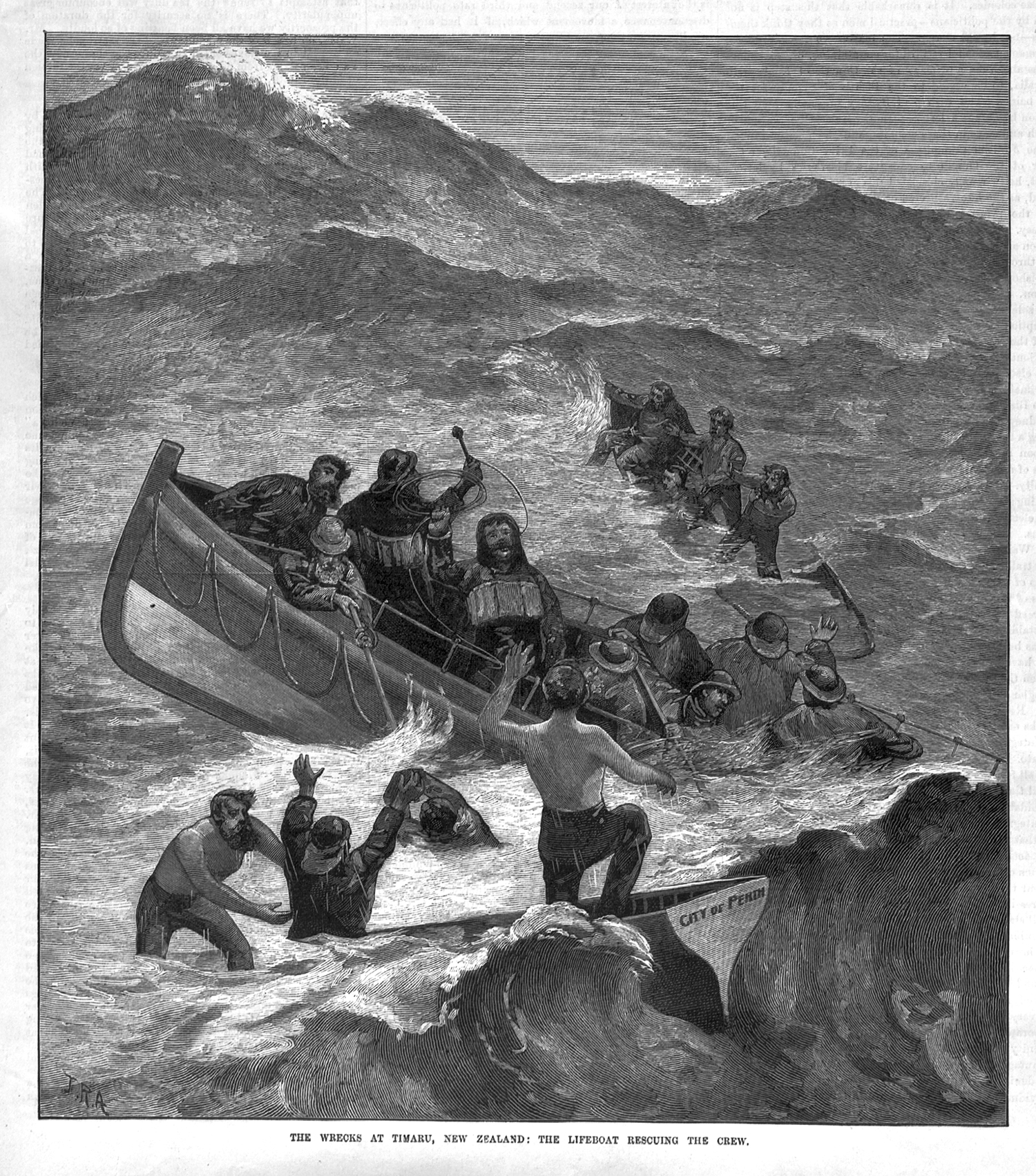
The wrecks at Timaru, New Zealand: Lifeboats rescuing sailors in heavy surf, one life boat named City of Perth. . Wood engraving by Ashton, Julian Rossi, 1851-1942 slv.vic.gov.au/permalink/f/1cl35st/SLV_ROSETTAIE670476
In total, forty-three men were recognised by the St John’s Masonic Lodge for their involvement in the rescue attempts on 14 May 1882. Forty received their medals in person in August 1882. Three were absent and their medals were sent to Scotland.
The list of names is long. W. Collis. J. McIntosh. A. H. Turnbull. Philip Bradley. Isaac James Bradley. And many others. Names that surface elsewhere in shipping records, court transcripts, and cemetery registers. Names belonging to working lives shaped by tide tables and weather. Men whose courage was never abstract. It was situational. Immediate. Necessary.
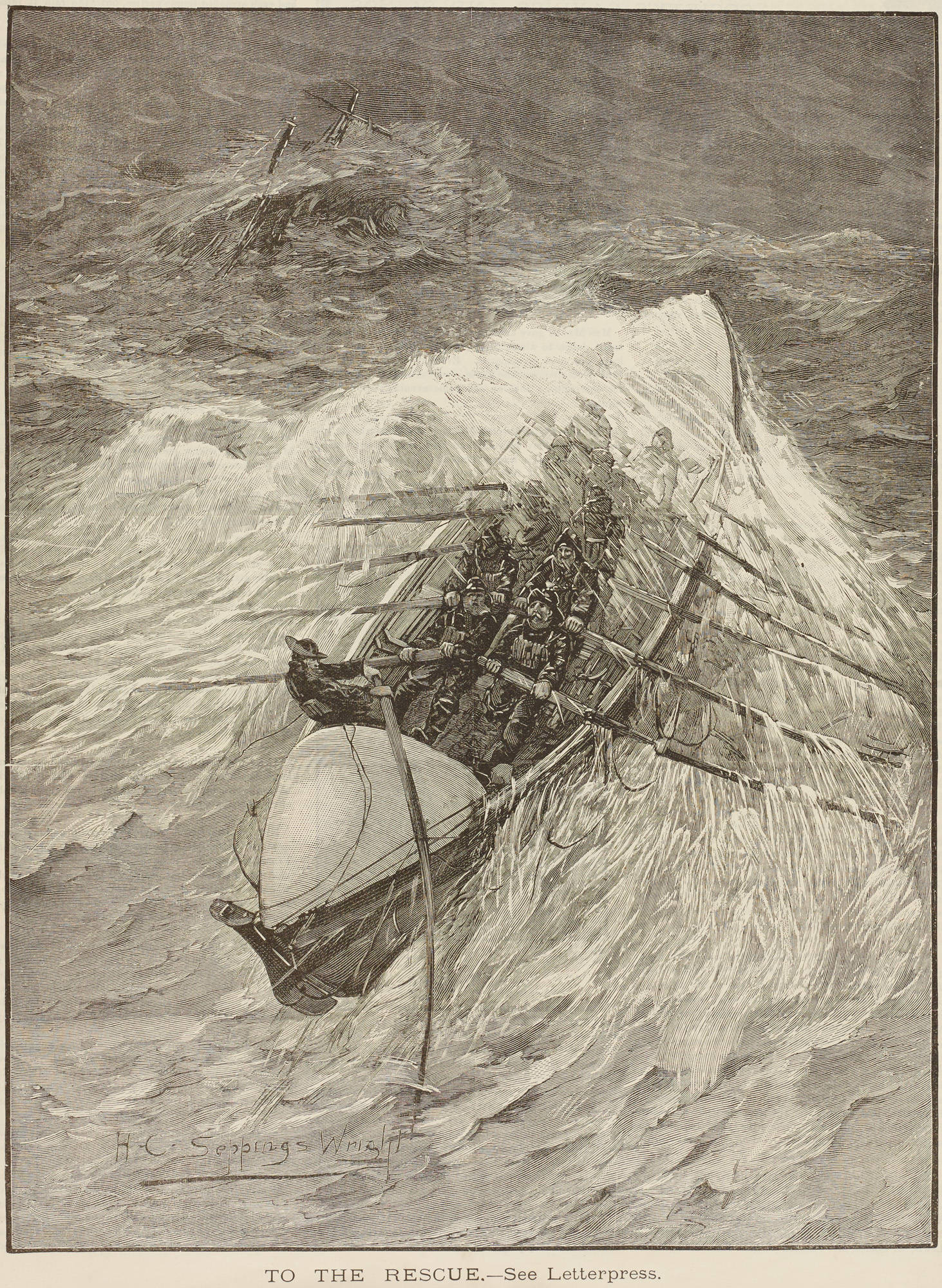
A lifeboat crew rowing to rescue shipwrecked sailors. published 1893-02-11 The New Zealand Graphic and Ladies Journal, 11 February 1893, p.121 - New Zealand Graphic; Wright, Henry Charles Seppings, 1849-1937 - Auckland Libraries Heritage Collections NZG-18930211-0121-01
Side Quest: Who was the artist behind the medals design?
The medal was designed by Arthur L. Haylock. Haylock had joined the Government Service and later moved to Timaru, where he became a member of the Timaru Rocket Brigade. The brigade’s role was to watch over vessels anchored in the roadstead, ready to act when ships were in trouble. Between about 1877 and 1882, Haylock recorded first-hand recollections of shipwrecks and rescues along the New Zealand coast. In later years, he compiled detailed records and drawings of maritime disasters. According to his daughter, Greata, he loved the sea deeply and made a large collection of sketches depicting shipwrecks and rescue scenes. This body of work is now held in the Alexander Turnbull Library.
His design for the medal reflects that lived experience. A small boat. An overwhelming sea. An eye that watches, but does not promise safety.
This medal does not tell us about everyone.
It does not tell us about Macdonald, who was killed when the lifeboat Alexandra was driven down onto a surf boat during the rescue. His death appears in other reports, other columns. Here, his absence is silent.
Objects like this medal often survive because they are portable. They move. They pass into private collections, auction rooms, museum stores. They acquire catalogue numbers and provenance notes.
Yet this one was never meant to be distant. It was meant to be worn. To be pinned close to the heart. To be heavy enough to remind its bearer, and everyone who saw it, that courage had a cost, and that sometimes the sea took more than it gave back.
Look again at the lifeboat engraved on its surface. It is small. The waves are not.
The medal does not promise rescue. It does not claim victory. It simply records that when the moment came, ordinary people did something extraordinary, and their community chose to remember.
That may be its greatest weight of all.
Side Quest: The Eye That Watches
If you pause over the medal for a moment, your eye is likely drawn upward, away from the lifeboat and the crashing waves, to a single watching eye suspended above the scene.
This is the All-seeing Eye, also known as the Eye of Providence.
Today, it can feel like a strange or even unsettling symbol, but in the nineteenth century its meaning was widely understood and deeply reassuring. The Eye of Providence came from Christian tradition, where it represented divine awareness and moral guidance. It was often shown within a triangle, symbolising the Holy Trinity, and surrounded by light, suggesting truth and clarity.
Freemasonry adopted the symbol as an ethical reminder rather than a promise of protection. The eye does not intervene. It watches. It affirms that human actions matter, even when outcomes are uncertain.
That distinction is important here.
On the Timaru medal, the eye does not calm the sea. The lifeboat remains small. The waves remain dangerous. What the symbol offers is recognition. It says that courage shown in chaos is seen and valued, even when lives are lost.
For the men who received the medal, this image would have carried a quiet reassurance. Not that they were safe. Not that the sea could be controlled. But that their decision to go out, knowing the risk, had moral weight beyond the moment itself.
Look again at the medal.
The eye is watching.
The waves are still rising.
And the lifeboat keeps going.

The large painting (about four feet in length) of the wreck of 'City of Perth' and 'Ben Venue' at Timaru hung for many years in the Farmers tearooms and now the painting is at the Port Company Offices, Timaru located along Marine Parade which is located near the distal end of the Port Loop Road a route to Caroline Bay and the harbour. The plate below the painting reads "Wreck of the Ben Venue and City of Perth on 14 May 1882, Presented to: The Port of Timaru Ltd. by Arthur Bradley. Last surviving son of Issac Bradley, A member of the rescue craft's crew." Photo by Roselyn Fauth with permission of PrimePort Timaru.

Illustrated Australian News - Melbourne Vic -1876-1889 Saturday 10 June 1882
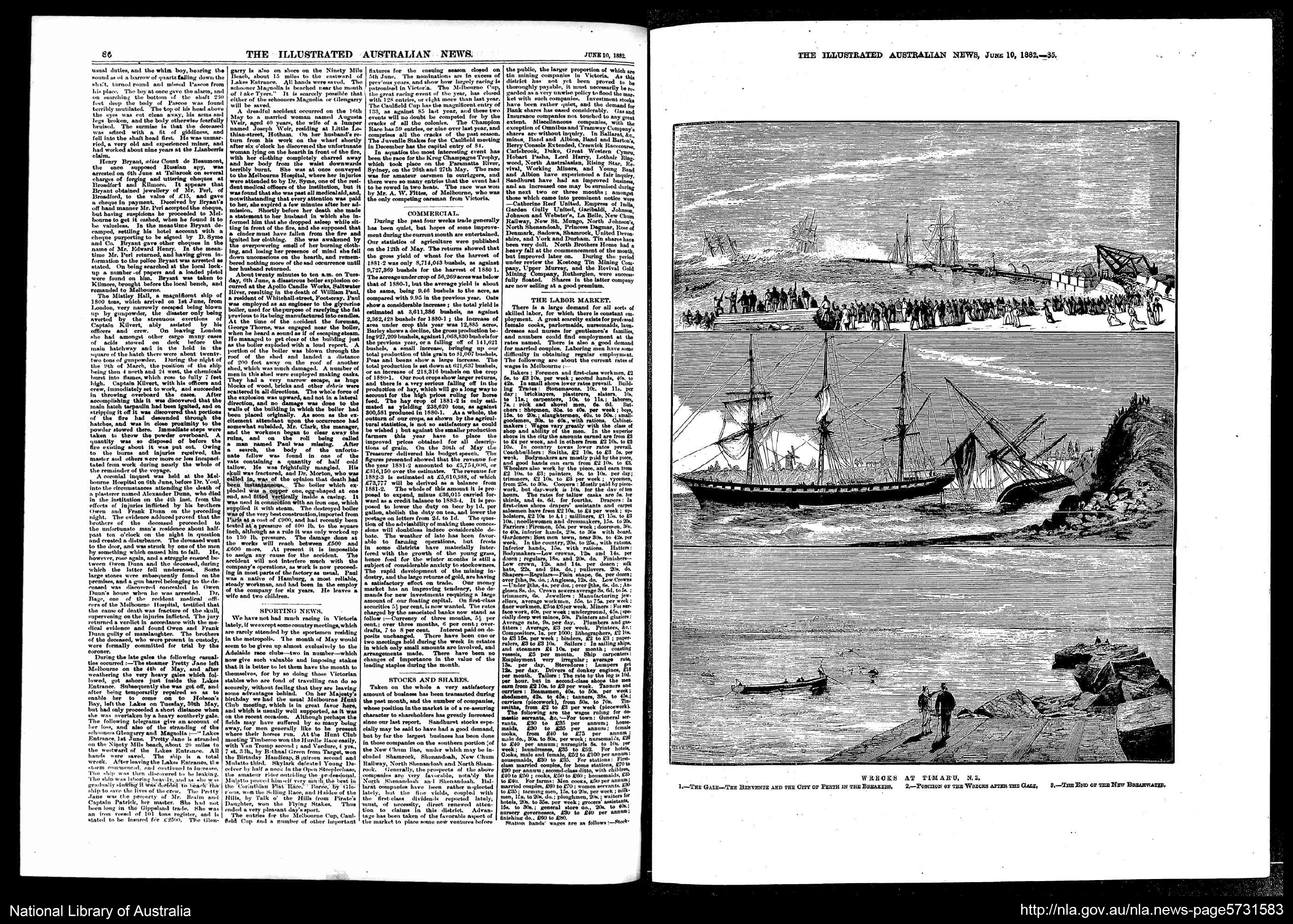
The above scan is of the Illustrated Australian News. It reports the Benvenue Shipwreck and includes three illustrations. (1882, June 10). Illustrated Australian News (Melbourne, Vic. : 1876 - 1889), p. 85. Retrieved December 10, 2025, from http://nla.gov.au/nla.news-page5731583
"BENVENUE MEMORIAL. From the late ’sixties till the early ’eighties, Timaru had a bad reputation among shipowners because of the great number of wrecks which occurred in the roadstead. Timaru was not really worse than some other New Zealand open ports, but the people here heard more of the higher insurance of vessels coming here than the high rates for other places.
The losses wore probably in most cases due to the vessels anchoring too close to the beach in order to reduce the work of lightering. The reports of early visitors declared the holding ground to he exceedingly good. Of 28 losses, seven were stranding's, and out of the first 23, totaling under 3500 tons, only one was over 500 tons. Two of the later wrecks were the “City of Perth” and the “Benvenue,” but the former was eventually refloated. Just as the early progress of the town received severe set-backs as a result of disastrous fires, so the prestige of the port- was seriously imperiled by this succession of wrecks.
The most memorable and the most spectacular of them was the stranding of the “City of Perth” and the loss of the “Benvenue,” on the afternoon of Sunday, May 14, 1882. On that fateful afternoon the then harbor master, throe members of the crew of the “City of Perth.” and five residents of Timaru lost their lives. The story of the light made by the boat crows to save the lives of the men on the ships is well-known to the older generation. The younger generation have oft-times heard it repeated, and they have before them as a constant reminder of the noble self-sacrifice made by the nine men on that Sunday afternoon the memorial situated at the junction of Perth and Sophia, Streets, almost opposite the “Herald" office. Greater love hath no man than this, That he lay down his life for his friends.
It was at midnight on Saturday, May 13, 1882, that the sea began to make, and it rapidly increased in force. The vessels-in port at the time were the Norwegian Braque “0. F. Fundi,” which was lying at the ballast ground- two miles out. the two Home boats, “City of Perth,” and “Benvenue,” in the inner harbor, and the schooners, “Kate McGregor” and “Julius Vogel” inside the breakwater.
The tide was then almost at the full, and as it. ebbed it increased in violence. At 8.30 on the Sunday morning, the “Benvenue” parted one of her cables, and she then flew a signal of distress. Two hours later came the signal “drifting,” and in' the early part of the afternoon the “Benvenue” crew left the vessel and made for the “City of Perth.” The doomed ship struck within fifty yards of the beach, gradually canting broadside on to the sea, by which she was soon lifted high and dry. The “Benvenue” was-an iron ship of 919 tons. register, and at the time of the disaster had a cargo of between 400 and 500 tons of coal. She subsequently became a total wreck, and the cliffs in the vicinity of the wreck were named Benvenue.
Hardly had the “Benvenue” struck when it was noticed that the “City of Perth” was adrift, and that she was asking for medical assistance. Four boats were soon seen leaving the vessel for the breakwater, one of these being from the “Benvenue.” The boats leached safety, when it was ascertained that the first- officer of “The City of Perth” had broken his leg in two places in- endeavoring to clear the cables. His injuries subsequently proved fatal.
The “City of Perth” hung to a single hawser for about half an hour, but then gradually drifted towards the bench, stern foremost, bringing up against the “Benvenue,” her stern touching the hitler.
It was while the vessel hung at the single hawser that, a series of disasters took place, disasters which made the day memorable on account of its misfortunes. While the vessel was straining at the hawser, the Harbour-Master at Timaru, Captain Alexander Mills, remarked that the vessel had been deserted, and lie got together a crew with the object of saving the ship.
The members of the crew were Captain Mills, Robert Collins, Martin Beach, John Reid, Emanuel Neilson, and Charles Moore. Captain McDonald, of the “City of Perth,” who was on shore at the time, evidently considered it his duty to go out to the vessel, and he did so, accompanied by Robert Gardiner, Philip Bradley, Michael Thompson, Isaac Bradley, William McLaren, and Walter Standlve. A third party, consisting of sailors of the “City of Perth,” also set off, and nil reached the vessel in safety.
Later the three boats made to return, and the foremost two had practically gained the shelter of the mole, when the third, containing the members of the ship's crew, turning too soon, came broadside on and was swamped.
The leading boats turned hack, and -had almost reached their objective, when they also wore 'overturned. 'The -spectators on shore were horror-stricken, hut they speedily launched the nhl life-boat, which had not been used since 18(J9. The crew consisted of La,, Bradley, A. J. Mclntosh, Andrew
Slniab, John Isherwood, J. Houlihan, Patrick Mc-Ateer, David Watson, and Thomas Martin. Splendidly handled, the life-boats reached the struggling men, and some of them were hauled on board. Caught by a huge wave, the boat was overturned, but she righted herself, and the men scrambled back. A second time she capsized, and yet a third. Bravely the crew persevered, however, until all were picked up none could be found, and then began the slow and anxious return to the shore. Fortune now held to the men, however, and eventually they reached safety.
Before the life-boat was launched, a surf-boat had been manned and an attempt made to reach the swamped boats, and three men from the latter were rescued. The surf-boat was manned by George Falgar, It. Wilson, William Oxby, J. Passmore, T. Hart, J. Croeomb, J. Thompson, W. Halford, W. Walls, T. Morgan, and W. Budd.
The surf-boat proved unwieldy in the heavy sea, and the members had to be rescued by a fresh volunteer crew in the life-boat.
This crew comprised G. Findlay, C. Grulnn, G. Sunnaway,- J. Cracknall, H. McDonald, J. Henicker, A. Turnbull, J. Ivey, and G. Shirtclifle. Before all the men were got out of the surfboat, it capsized, and one of its crew, George Falgar, was drowned. The life-boat came ashore, and returned with a fresh crew consisting of
F. McKenzie, J.' Le Roy, G. Sunnaway, W. M. Walls, H. Trusse'ot, C. Vogeler, and A. Blaylock. All the men, remaining on the surf-boat were rescued.
The saddest part of the story remains, and that is to record the names of the men who lost their, lives. They were Captain A. Mills, who .died an hour after reaching safety, Robert Gardiner, second mate of the “City of Berth,” Donald McLean, carpenter to that vessel, William McLaren, boat man, of Timaru, and Emanuel Nelson, Martin Beach, Harry McDonald, and George Falgar, boatmen', of 'Timaru. John Blacklock. first mate of the “City of Perth,” died of injuries.
It was to the memory of these men, and to those who gladly encountered the peril of death, that the monument was erected.
Timaru Herald. 13 July 1928
Page 9 (Supplement).
https://paperspast.natlib.govt.nz/.../timar.../1928/07/13/25
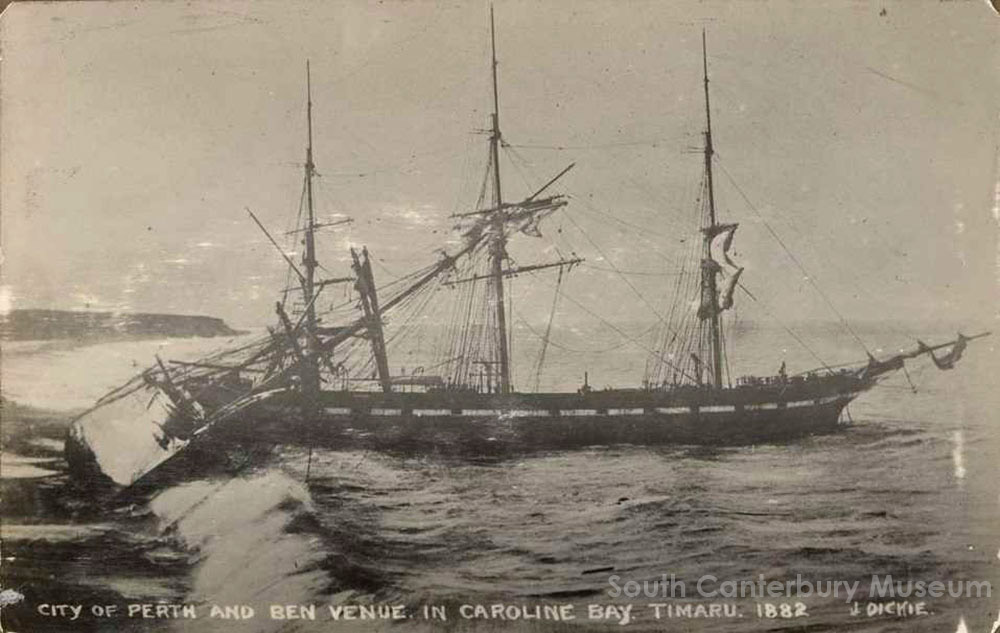
The Ben Venue (left) and City of Perth (right) ships in Caroline Bay. The Ben Venue was wrecked at Caroline Bay in May 1882. The city of Perth collided with the wreckage and also ran aground but was eventually refloated carrying over 5000 sacks of milling wheat from newly broken in farms of the area.Photographer J Dickie Courtesy South Canterbury Museum 2014/056.01
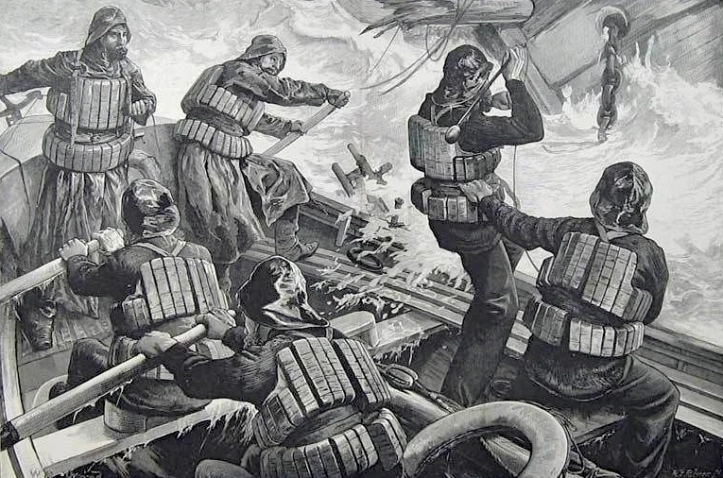
How the Illustrated London News saw rowing lifeboats in action. heartheboatsing.com/for-those-in-peril-on-the-sea/

The South Canterbury Museum has an exhibit that includes the Benvenue Bell and medals, the rocket brigade lifesaving launch and the canon that summoned the rocket brigade. Photograpy courtesy of Roselyn Fauth with permission from South Canterbury Musuem.