
Can you Help Me go on a carnival history hunt?
I will pop information here as I find it to work up a timeline and information of the carnival, its people and rides in Timaru, New Zealand.
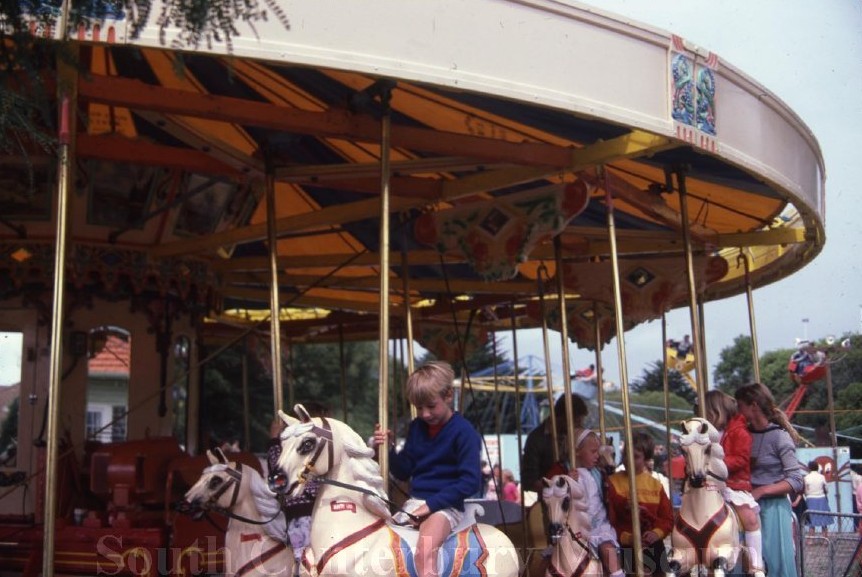
Help??? I’d love to learn more about our Caroline Bay merry-go-round, but I’ve got myself in a bit of a twist with conflicting information, so I thought I’d share what I’ve found so far and see what others might know...?
Over the years, many of us have grown up believing the merry-go-round is more than 150 years old, with hand-carved wooden horses said to have come from France. Timaru historian John Button, in Century of Carnivals: The Caroline Bay Story, suggests it may have been built around 1865, and it is often described as being unique in the Southern Hemisphere for its carved wooden horses. Button also records that Christchurch businessman John F Lumby held the licence to bring the merry-go-round and other rides down from Christchurch for the carnival, with the Caroline Bay Association purchasing it from him in 1969.
However, I’ve also come across a contemporary newspaper article via Papers Past that tells a slightly different story. An article titled “Vintage Merry-Go-Round As Popular As Ever” describes a merry-go-round that spent summers at Caroline Bay and travelled annually to the Timaru and Christchurch shows. According to this article, the ride was built in 1914 by F. Laurent Steam Merry-Go-Round Constructions in New South Wales. It says the ride was originally steam driven, later converted to electricity, built on a horse-drawn undercarriage with wooden spoked wheels, and featured a barrel organ. It also notes that the original steam organ was destroyed in a fire.
More recently, a Stuff article adds further technical detail, describing the carousel as originally steam driven and now hydraulically powered, with riveted construction, hardwood bearings, brass bushes and felt oilers. It confirms the carousel has 12 arms, stamped with Roman numerals, and that it continues to undergo regular engineering certification. The article also notes a full rebuild following mechanical issues during the 2020–2021 season, vandalism in 2012 when a carved horse’s head was broken off and later recovered, and that the carousel is considered unique in the Southern Hemisphere.
Alongside the written sources, community memory adds even more layers. Several people recall the carousel operating with a calliope or pipe organ into the mid to late 1960s, with one person remembering that the organ was later sold to a group connected with the Yaldhurst Transport Museum and dismantled for restoration. Others remember the painted horses with flowing manes, the four-seater cars, and the carousel as a fixture of childhood in the 1940s and 1950s, alongside the Ferris wheel and the Octopus. Humphies Engineering is also remembered as having cared for the carousel and other Caroline Bay attractions over many years.
So at the moment, we seem to have overlapping stories: a 1914 Australian-built steam merry-go-round documented in newspapers, a possibly older origin suggested by later historical research, and strong living memory of a ride that has been rebuilt, modified and cherished across generations.
If anyone knows more about the carousel’s horses, its organs, earlier rebuilds, or whether more than one machine has been involved over time, I’d love to hear from you. This feels like one of those Timaru stories where the truth is probably richer than a single neat answer.
Maybe someone has some great photos they would like yo shate to help me write a blog on the history of our Caroline Bay rides? Pretty please with a cherry on top?

CAROLINE BAY
Lindsay Crooks (1957-2005)
Untitled – Carnival Scene, 1983
Watercolour on paper
Aigantighe Art Gallery Collection 2009.4 (under copyright, please seek permission from the Aigantighe to reproduce).
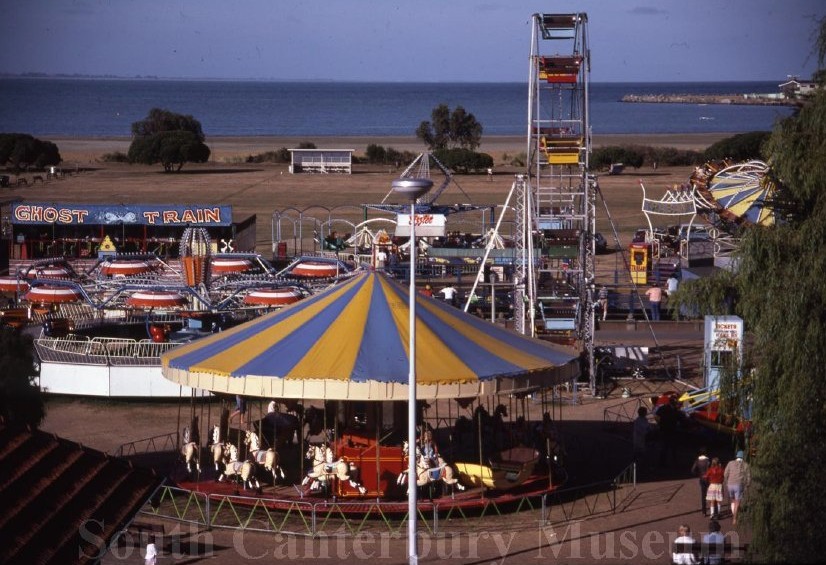
In this watercolour painting, Crooks brings a joyous vibrancy to a scene from Timaru’s iconic Caroline Bay Carnival. People watch brightly-coloured rides whirring through cheerfully coloured skies, capturing the special role that the Carnival played, and continues to play, in South Canterbury. The Carnival has been an annual Christmas event since 1911, and is the longest running event of its kind in New Zealand. It was established as part of plans to develop Timaru in the style of a European beachfront resort. Along with tearooms, swimming pools, tennis courts and the Soundshell, the Carnival was a major attraction, offering visitors to South Canterbury countless thrills every summer. Lindsay Crooks was born in Timaru in 1957 and attended Timaru Boy’s High School before moving to Dunedin to study fine arts at Otago Polytechnic. Upon graduating, Crooks pursued a career as a professional artist and exhibited widely around New Zealand throughout his life.
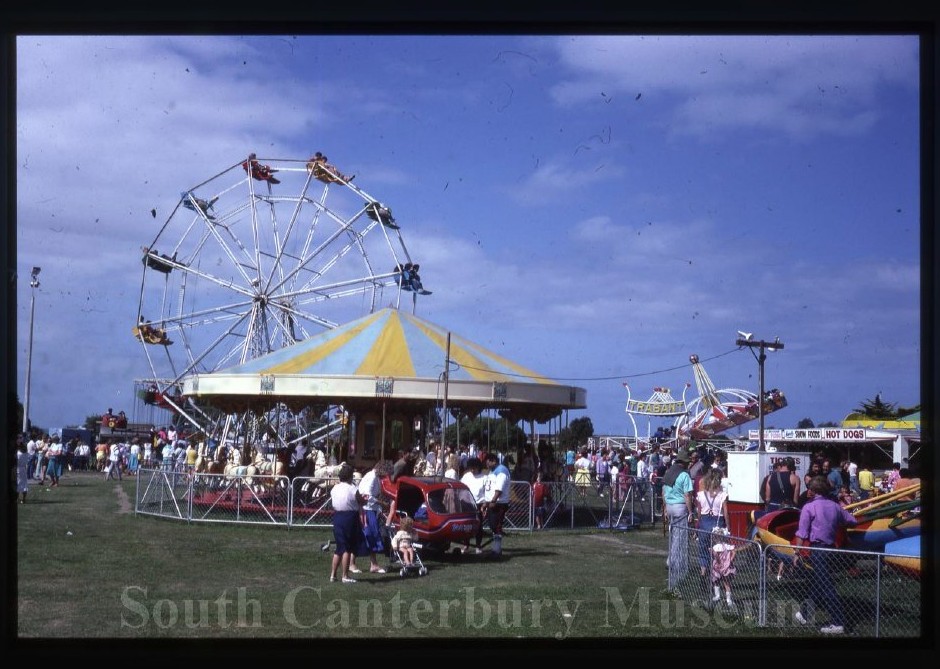
"A colour slide showing amusement rides at a Caroline Bay Carnival, Timaru, circa 1970. Visible are the ferris wheel, beyond the merry-go-round, and the Trabant (obscured)." - South Canterbury Museum 2020/064.03
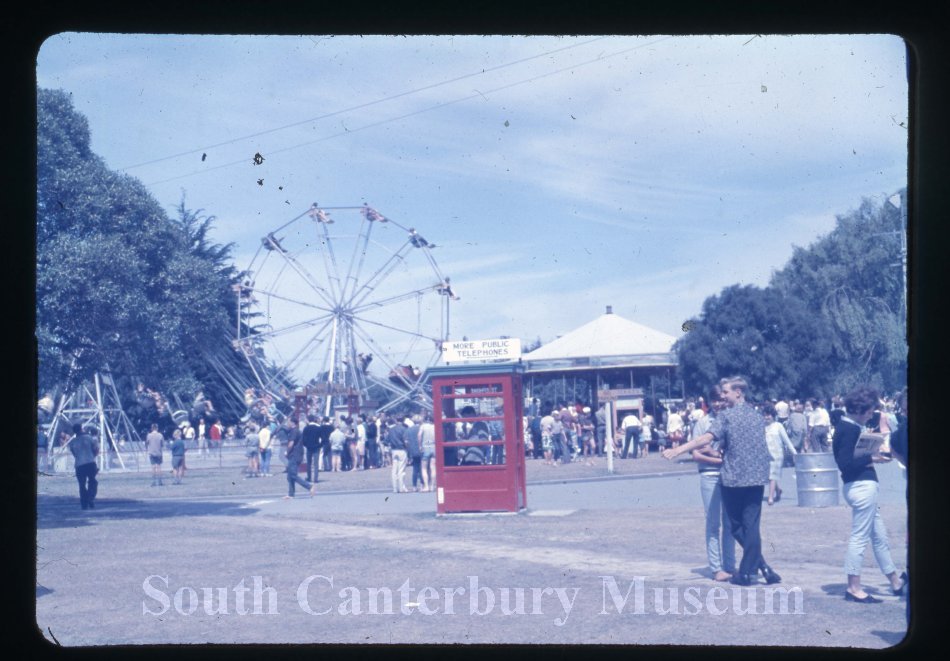
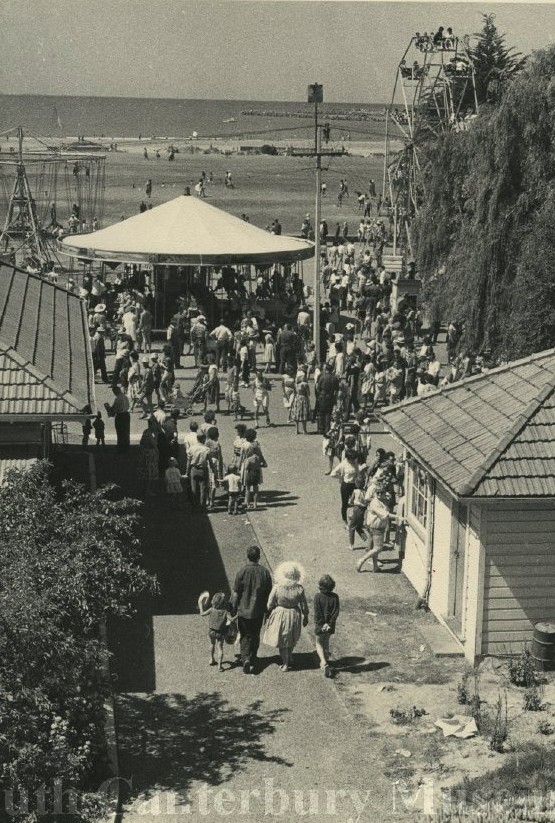
Crowds at the Caroline Bay Carnival amusement rides, circa 1960? South Canterbury Museum - 2016/071.018
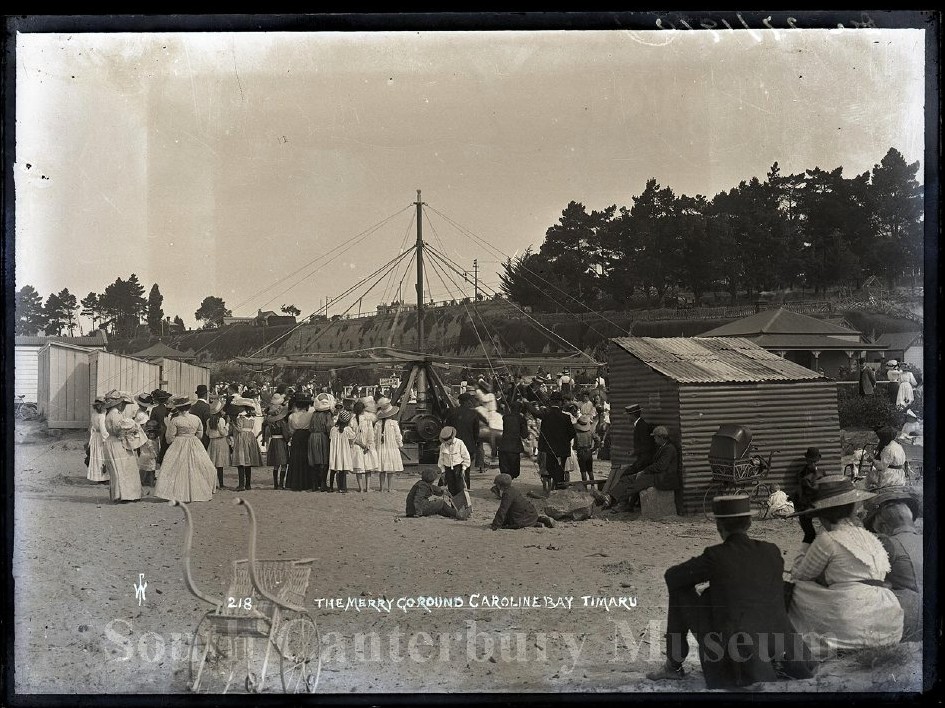
"Crowds pictured around the merry-go-round at Caroline Bay, Timaru, dated 27 December 1910. Shows the early amusement ride surrounded by children watching. bathing and other sheds are visible around the rides, as is the tearooms (in the background). Bears the date handwritten on the verso in the top left corner; "Dec 27 1910"." - South Canterbury Museum 1999/63.6
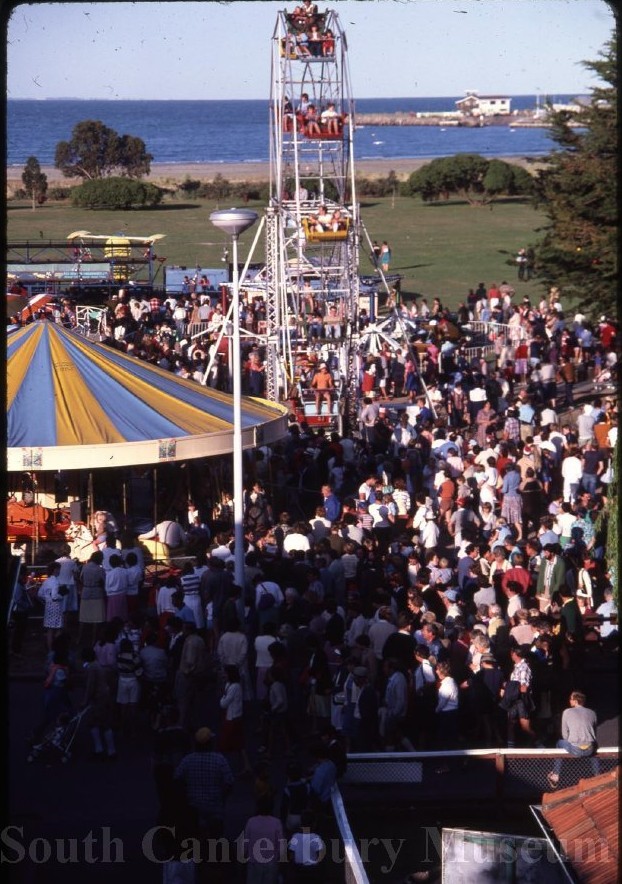
An undated slide showing crowds around the merry-go-round and ferris wheel at the Caroline Bay Carnival, Timaru, circa 1980. The slide mount bears a handwritten title and the photographer's stamp. - South Canterbury Museum - 2014/008.084
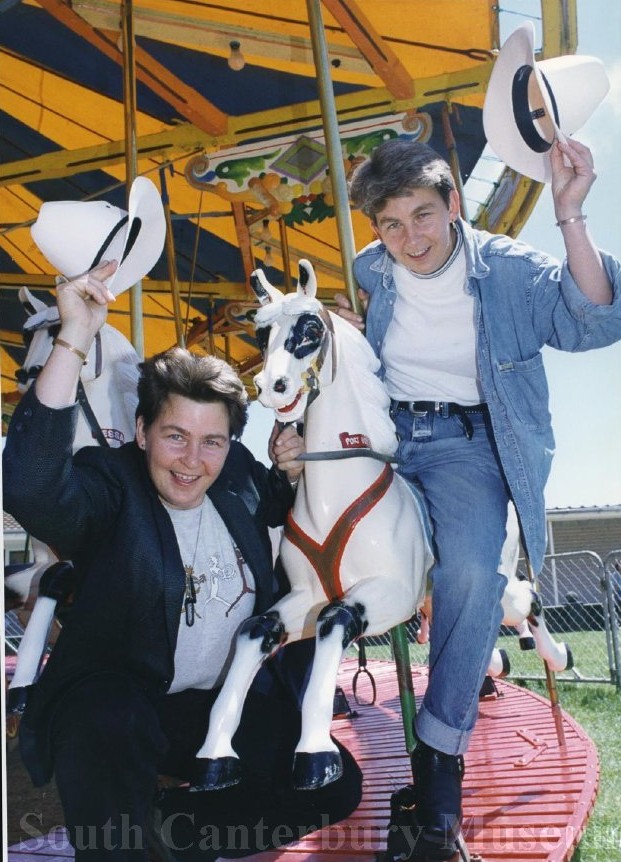
"Jools (right) and Linda (left) Topp of the 'Topp Twins', pictured on the Merry-go-round at Caroline Bay, Timaru, dated 28 December 1995." - South Canterbury Museum 2012/186.10117
Information shared on Facebook as leads:
Originally owned By the Lumby Family of Christchurch and Railed to Timaru each Christmas for the Carnival. When the Lumby Family retired/Died the Wheel ,Octopus. Chairoplane Merry go Round were sold to Caroline Bay Association and has been operated by them since, this being around 1977/78.
I have been told there was a family Lumby's who brought rides to Timaru. In Papers Past there is a article about the redistration as a private company:
The rides were originally owned by the Lumby family of Christchurch and were transported by rail to Timaru each Christmas for the Caroline Bay Carnival. When the Lumby family retired or passed away, the Ferris wheel, Octopus, Chair-O-Plane, and Merry-Go-Round were sold to the Caroline Bay Association. The Association has operated the rides since, from around 1977–1978.
https://paperspast.natlib.govt.nz/newspapers/TS19321210.2.160.23
Find a grave: https://www.findagrave.com/memorial/253664349/john-fortescue-lumby
John Fortescue Lumby
Birth unknown
Death 21 Nov 1965 Christchurch City, Canterbury, New Zealand
Burial Canterbury Memorial Gardens and Crematorium
Bromley, Christchurch City, Canterbury, New Zealand
Plot Garden Memorial Court B/A
Memorial ID 253664349
DEATH NOTICE LUMBY, John Fortescue - On November 21, 1965 at Christchurch, loved husband of the late Isabella Maud Lumby and loved father of Leslie and Mavis. At rest. Funeral service held on Tuesday. J. Lamb and Son Ltd.
Family Members
Spouse: Isabella Maud Hamilton Lumby 1884–1941
Children: George Lumby 1908–1908
Leslie Fortescue Lumby
unknown–1969
Information about the organ
Helen McFarlane - From Facebook Post Comment 11 Jan 2026
Oh yes there was organ music playing on it when we were children. The Yaldhurst Museum is just up the road I could find out about it maybe for you.
Garry Black - From Facebook Post Comment 11 Jan 2026
I remember it playing organ music when I was young in the early 70s. The music only played when it was turning. When it stopped, the music stopped. I recall the operator stood in the centre with a big lever to start and stop it.
Lorraine Cousins - From Facebook Post Comment 11 Jan 2026
I'm 65 and the merry go round has been around longer than me. It's been revamped due to its age.
Carol Skilling - From Facebook Post Comment 11 Jan 2026
Hubby says he heard of 2 attempts to recover the original steam engine that was buried on the bay, possible near were it operates....
Allan Workman - From Facebook Post Comment 11 Jan 2026
From memory the organ was on the back of a truck and there was a bearing failure, remember dad informing us one sunday night mid 70s. A lot of the gear was moved on ex WW2 trucks. Petrol.
Hugh Perry - From Facebook Post Comment 11 Jan 2026
I am sure I can recall It playing music from a barrel organ or similar. Looking at it's construction it looks like it was originally horse drawn. Maybe both accounts of its history are true! It originally being made much earlier than the second article would have us believe. Let's at least try to see if the two accounts of its history are able to be reconciled. There must be others still alive that are able to enlighten us young folks. I believe the two seperate accounts could well both be correct with sections of each being correct!
Maureen McKenzie - From Facebook Post Comment 11 Jan 2026
Does anyone remember the Water Shute? It must have been late 1930s or early 1940s. Was only there a couple of times when I was small. Watching them pull the boat up, people got on it and it came shutting down. Those waiting close by the pool were well splashed!
James Brown- From Facebook Post Comment 11 Jan 2026
Originally owned By the Lumby Family of Christchurch and Railed to Timaru each Christmas for the Carnival. When the Lumby Family retired/Died the Wheel ,Octopus. Chairoplane Merry go Round were sold to Caroline Bay Association and has been operated by them since, this being around 1977/78.
Christopher Templeton
Here are my organ notes.
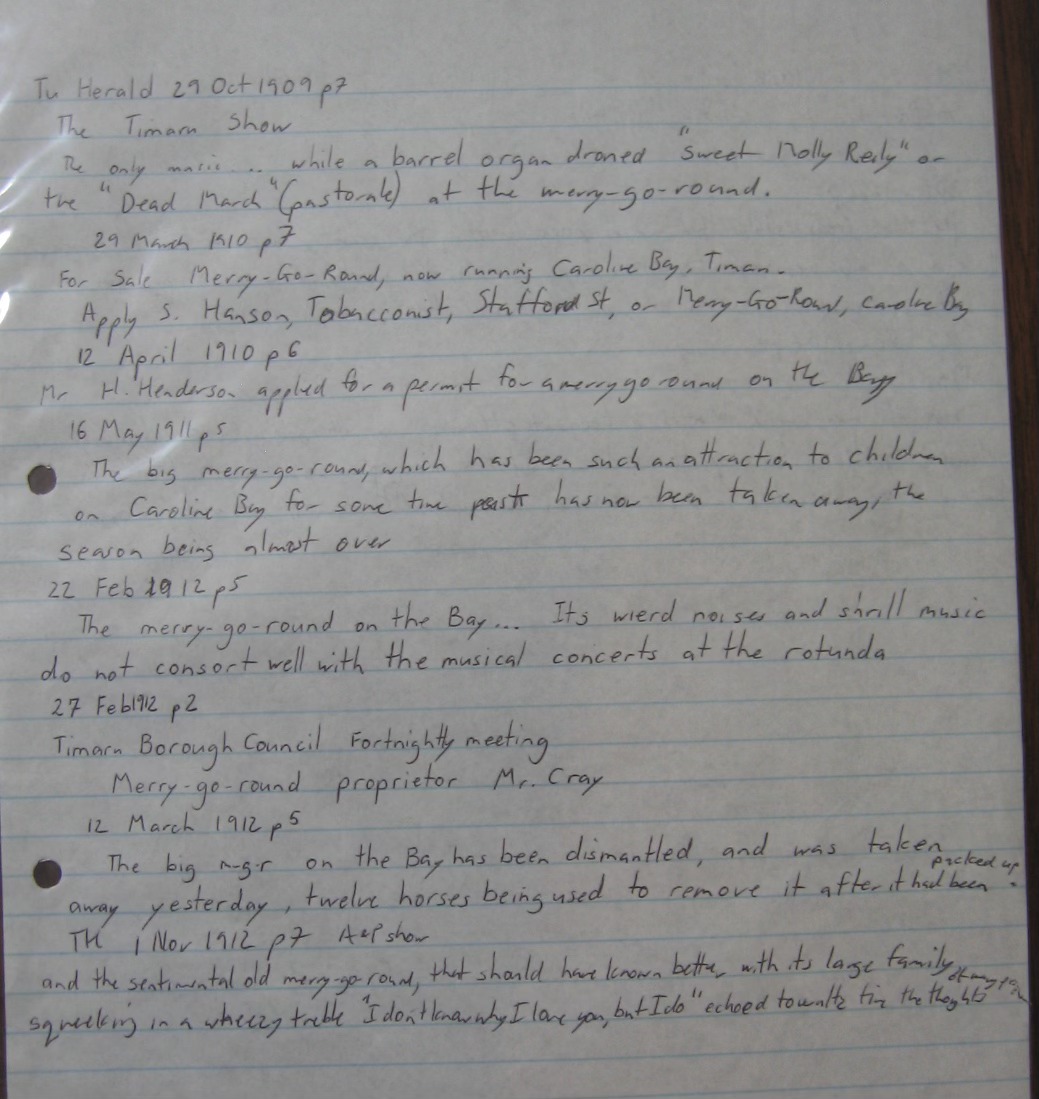
T. Herald 29 Oct 1909 p7
The Timaru Show
The only music … while a barrel organ droned “Sweet Molly Riley” or the “Dead March” (Pastorale) at the merry-go-round.
29 March 1910 p7
For Sale. Merry-Go-Round now running Caroline Bay, Timaru. Apply S. Hanson, Tobacconist, Stafford St, or Merry-Go-Round, Caroline Bay.
12 April 1910 p6
Mr H. Henderson applied for a permit for a merry-go-round on the Bay.
16 May 1911 p5
The big merry-go-round, which has been such an attraction to children on Caroline Bay for some time past has now been taken away, the season being almost over.
22 Feb 1912 p5
The merry-go-round on the Bay… Its weird noises and shrill music do not consort well with the musical concerts at the rotunda.
27 Feb 1912 p2
Timaru Borough Council fortnightly meeting Merry-go-round proprietor Mr Cray
12 March 1912 p5
The big n-g-r on the Bay has been dismantled, and was taken away yesterday, twelve horses being used to remove it after it had been… (partly obscured)
Th 1 Nov 1912 p7 – After show
and the sentimental old merry-go-round, that should have known better, with its large family, came squeaking in a wheezy falsetto “I don’t know why I love you, but I do” echoed towards the sky the melody
Caroline Bay Timeline
British Prime Minister Harold Macmillan in 1959, who declared Caroline Bay as one of the most beautiful views he had seen in the world.
BELOW is a GENERAL timeline - See Caroline Bay timeline (HPE #332190) for a full timeline
*** (T/L) - information copied from Caroline Bay Time Line put together from Timaru Herald extracts (or as stated) by Mark Denne.
1891 - Bathing sheds on bay. (T\L)
1892 - Sands of Caroline Bay extending. (T\L)
1897 - Top soil taken from railway cutting to be spread for grassed area on bay. (T\L)
1898 - Removal of clay bank between railway and Caroline Bay. (T\L)
1904 - Plants and Flax surviving on bay. (T\L)
1904 - 23 Dec - Band Rotunda opened. (T\L)
1905 - Nov - Tea Rooms opened. (T\L)
1905 - Bathing sheds on North Mole (mens) and on sands north of the tearooms.
1905 - 1000 shrubs planted on bay. (T\L)
1906 - Good progress on post and rail fence along esplanade donated by John Jackson (which replaces a barbed wire fence) (T\L)
1906 - Rustic fence erected on uppermost terrace bordering western end of bay, (T\L)
1910 - Ladies facilities north of the tearooms and caretakers cottage and west of where the pavillion is to be built.
1910 - Oct - Lawn between road and invert to be used as car park with charge 1/- per car.
1911 - Caroline Bay Association formed.
1911 - 14 Dec - Tender accepted for Piazza, (T\L)
1912 - 15 Feb - First "Grand Carnival" held at Caroline Bay in conjunction with opening of Marine Parade.
1912 - Feb - Piazza being built on the future site of the Sound Shell seating. (T\L); Swings and Seesaws on Bay now (T\L)
1912 - Big Merry-go-round on bay dismantled. (T\L)
1912 - Flag pole on bay on seaward side of band rotunda. (T\L)
1912 - Marine Parade opened (also known as North Mole) (T\L)
1912 - Oct - Tennis Courts nearing completion. (T\L)
1913 - Bathing Sheds built, Bay Hill improved and the Tennis Courts built.
1913 - Pavillion built - handed over to public October 1913.
1914 - Excursion trains brought large numbers of visitors to the Bay. By 1928-29, over 25,000 passengers arrived annually, with special platforms built for passengers to disembark directly at the Bay.
1915 - Clock on Band Rotunda. (T\L) - funded by public subscriptions and organized by local figures such as Major A.W. Wright and Dr. Thomas. The Palliser family also contributed to the Bay with a drinking fountain.
1915 - Childrens playground built.
1918 - Mobile bathings sheds sold off.
1918 - Caretaker instructed to plant Willow trees along main promenade.
1920 - Jul - Hot saltwater baths nearing completion. (T/L)
1928 - Roads and Pathways sealed.
1929 - Memorial Wall erected and the lawn areas extended.
1930 - Memorial and Sundial added.
1931 - Tearooms constructed
1936 - Soundshell built.
1937 - Soundshell built replacing the old Band Rotunda.
1939 - The Aviary built.
1939 - Near the childrens play area south end of bay, trees and shrubs have been planted in a plot protected by broom shelters. Also a broom shelter built for sunbathers near bathing sheds.
1939 - Area on the seaward side of the Memorial Wall planted in lawn at the south end.
1941 - May - NZD$500,000 given to the Patriotic Fund and the War Effort.
1941 - Bluestone 10 foot diameter "moon" seat recess being built south side of viaduct. 1955 - Bay Hall Extended.
1956 - Wishing well built above bay. (Bay Hill)
1957 - Jan - Piazza being demolished for stadium seating.
1958 - Soundshell stadium seating built on the site of the original Piazza.
1962 - Aug - Work starts on new paddling pool.
1963 - Skating Rink built.
1964 - Bathing sheds replaced; Paddling pool, water fountain and rock garden built.
1969 - Community Centre built.
1972 - Skating Rink shifted.
1981 - Old Aviary demolished and new one built.
1986 - Mini Golf course built.
1990 - Barbeque built
1992 - Entertainment Center built.
2000 - Purchased Copenhagen Cones and relocated to near the Mini Golf course, and built Petanque Courts next to Buzz Boats.
In Timaru's early days, before sewer pipes were laid in the growing town, night soil was dumped opposite where Sarah Street commenced. There were no railway lines and Caroline Bay hadn't
been formed. To disguise the area a small grove of macrocarpa trees were planted. When Mr A.E. Stan Hanan was Mayor in 1948 it was decided to remove the trees to improve the view and as the need for the trees had passed.
- Doug Shears, Tales of South Canterbury. Vol. 1 : Caroline Bay . Aoraki Heritage Collection, accessed 04/03/2025
, https://aorakiheritage.recollect.co.nz/nodes/view/8179
Timaru Herald 23-5-78
Licence fee waived for Bay rides. The Caroline Bay Association will be permitted to operate its riding devices on the Bay without paying a licence fee.
https://aorakiheritage.recollect.co.nz/nodes/view/348
Vintage carousel good for another century
The Timaru Herald
Keiller MacDuff
26 Nov 2021
A historic fairground attraction undergoing a complete overhaul at a Timaru engineering company ahead of storage following the cancellation of the 2021-22 Caroline Bay Carnival could yet make a summer appearance.
https://www.pressreader.com/new-zealand/the-timaru-herald/20211126/281509344454419
Timaru Herald 9-1-78
Ambitious Bay project
to follow carnival’s
record $64,000 takings
The Caroline Bay Carnival has been the most successful in the 66-year history of the Caroline Bay Association. Record takings of $64,105 were recorded, and the association hopes to plough this back into an ambitious project to revamp the viaduct entrance to the Bay.
When the fortnight-long carnival ended on Saturday night, the organisers were ecstatic with the response from the public and the takings which were about $6000 more than last year.
Fine weather and cheaper amusement rides were among the factors contributing to the increased attendance.
The association’s president, Mr W. A. Collins, said the takings were a record for any carnival and matched the association’s hoped for figure of about $65,000.
The money would all be ploughed back into improvements for the Bay, and he said the association already had a project in mind – to completely change the entrance from the viaduct at the bottom of Stafford Street.
SUNKEN AVIARY
He revealed that the association had plans drawn up for an ambitious $80,000 beautification project, which would include a sunken, free-flight bird aviary and cobblestone paths.
It was intended that the existing old toilets in this triangular area would be removed and the area given a “swept up” appearance.
Mr Collins said it was too soon to say whether the project would go ahead this year, as it still had to receive final approval from the association and had to go before the Timaru City Council for its consideration.
“If the City Council approves it we would do the work in stages. It would be a costly venture but we now have $64,000 towards the cost,” he said.
If official approval was given a start would be made on the work this year and something would be ready for the next carnival.
The association would be making an official approach to the City Council with the redevelopment plans soon, Mr Collins said.
RECORD CROWD
One of the carnival organisers, Mr P. Harris, said Saturday night’s crowd was a record for the whole carnival as more than 14,000 people were on the Bay.
The association, he said, was more than pleased with the attendance, which had been greater than previous carnivals.
“Cheaper rides have contributed to the response from the public and because of this more family groups have been coming down for the day.
“This carnival has been much more successful than the last one, though of course we also had the good weather to help us this time,” Mr Harris said.
Mr W. A. Collins
(photo caption)
The final two events of the carnival were held on Saturday. The Holiday Queen contest drew 20 entries, and a Timaru girl living in Christchurch, Susan Clough, was the winner.
Jeanette Troon was second and Nicola McEwing, both of Timaru, third.
The Cutie contest on Saturday morning attracted 53 entries from girls aged eight to 10 years. It was won by Keri Robson, of Dunedin, with Donna Marshall, of Timaru, second and Rachel Thomas, of Pareora, third.
One of the big attractions at the carnival was said yesterday to have caused some headaches for the organisers.
The amusement devices, purchased by the association last year, proved very popular because prices were more than halved.
However, Mr Collins said yesterday that there had been a lot of teething trouble with the rides.
He emphasised that there was never any danger to people on them, but many parts had to be replaced during regular checks on the machinery.
“Nothing was broken but our engineer on duty advised us that such and such a part might give trouble so we would replace it.”
Mr Collins said the association did not expect to show a profit on the rides for the next five years.
This was because the price had been kept as low as possible, but there was still regular maintenance required and many parts needed replacement.
He said it would take five years for the association to get the purchase price and maintenance costs back on the amusements.
Takings from the rides would not be known until later, he added, because they were being kept separate from the remainder of the carnival activities.
The devices had been operating at weekends before the carnival and would continue to operate until February.
Revenue from them would then be made public he said.
https://aorakiheritage.recollect.co.nz/nodes/view/335
A Century of Carnivals. The Caroline Bay Story. CAROLINE BAY ASSN
written by John Button (with thanks to Kevin Fahey who helped assemble and produce this book)
Facts, ordered broadly by time
Breakwater and harbour works (1879–1890)
- Tenders for the second breakwater section were called in 1879.
- The second section was completed in December 1880.
- Tenders for the third section were called in 1881.
- In 1882, the Timaru breakwater was described as NZ’s boldest engineering work after the Lyttelton tunnel.
- Dredging was discontinued before 1886.
- A rubble wall was completed in early 1890 to enclose the harbour from the north-west.
- The rubble wall unintentionally increased shoaling by creating still water.
- The original beach within the bay almost disappeared for a period.
Early civic beautification (pre-1894)
- Caroline Bay was used as a nightsoil disposal site for many years.
- W. Rutherford planted fir trees to screen the nightsoil chute.
- Public interest in beautification began to grow in the late 19th century.
Organised beautification efforts (1894–1897)
- In March 1894, Grandi, Bush and McQueen sought a foreshore lease to beautify the bay.
- Tree planting was approved.
- Public concern over sanitation near the baths was raised in August 1894.
- In May 1897, public meetings discussed cutting back cliffs and levelling spoil.
- David Stuart led a volunteer effort beginning in June 1897.
- The Harbour Board supplied timber for a protective seawall.
- Large volunteer “working bees” reshaped terraces along the bay.
- Volunteers came from many professions and backgrounds.
- The project was widely reported and celebrated in The Timaru Herald.
Transition to public works (1902 onwards)
- In 1902, James Craigie became Mayor.
- Beautification became a formal public project.
- The Borough received a rent-free lease of 94 acres covering the bay.
- A £10.10s prize was offered for the best beautification scheme.
- J. Morris’s scheme was adopted.
- £3,400 was spent on improvements over three to four years.
- The north mole was later transformed into a marine parade.
Railway and access (1876)
- The Christchurch–Timaru railway opened in 1876.
- Caroline Bay became the western boundary of the town.
- The railway enabled excursion trains, troop arrivals and ceremonial visits.
- The opening was celebrated with a major banquet on 4 February 1876.
Early swimming and bathing (1869–1911)
- The first bathing facility was a tent erected in October 1869.
- Public baths opened on 30 January 1877 but were destroyed by the sea.
- Bathing regulation disputes arose in 1889.
- Bathing times and dress were formally regulated.
- A public petition with 250 signatures opposed restrictions.
- The Borough eventually gained full control of the Bay.
- In August 1911, the Caroline Bay Association was formed.
Early 20th-century appearance
- By 1911–1916, Caroline Bay featured terraces, gardens, paths, rotunda, kiosk and seating.
- Horse-drawn mobile bathing sheds were in use.
- The bay was already a major recreational and social space before large-scale carnival development.
DETAILED FACTS IN CHRONOLOGICAL ORDER
1911
- An inaugural meeting to improve Caroline Bay was held.
- A steering committee was elected.
- View House was built by W.K. Macdonald to provide high-quality visitor accommodation.
1912
- The Hydro Grand Hotel overlooking Caroline Bay was built.
- The First Annual General Meeting of the Caroline Bay Association was held on 22 October 1912 in the Choral Hall.
- Over 500 members joined within one month.
- Membership structure and fees were formally established.
- The Association issued a Prospectus outlining major development goals.
- Planned developments included an esplanade, bathing facilities, hot salt-water baths, sports, playgrounds, concerts, tennis courts and bowling greens.
- Officers and committee structure were formally appointed.
1912–1913
- £400 was granted by the Borough Council and £150 donated by the Harbour Board.
- Permission was obtained to make improvements along the Benvenue Cliffs.
- Life buoys were installed in the bathing area with help from the Royal Humane Society.
- Open-air band concerts were held at the rotunda.
- Sporting and aquatic events were organised.
- Visitor reception services were developed for school parties and picnickers.
- An illustrated guide to Timaru was printed and 5,000 copies distributed.
Early 1910s
- Children’s play equipment such as swings and see-saws was installed.
- Hot salt-water baths were identified as a future goal.
- Private enterprise demonstrated feasibility through salt-water bath installations at the Hydro Grand.
1913–1914
- The North Mole was converted into a Marine Parade.
- £420 was spent fencing, seating and surfacing the Parade.
- A boating shed was erected and pleasure boats made available for hire.
- Tennis court construction began with Borough Council assistance.
- Road and fencing improvements were undertaken at the Benvenue Cliffs.
1914 onwards
- A bazaar raised over £1385 net profit, driven largely by a women-led committee.
- A piazza was built facing the band rotunda.
- Planning and fundraising began for a large pavilion.
Mid 1910s
- A pavilion was constructed at Caroline Bay.
- The pavilion was electrically lit, a notable innovation.
- The pavilion was designed for concerts, dances, entertainments and picture shows.
- Surrounding grounds were landscaped with lawns, gardens and a croquet green.
- Seating was installed through dances, donations and concerts.
- The pavilion was vested in the Borough Council for public use.
Later developments
- Improved bathing facilities were installed at the north end of the Bay.
- Bathing sheds were built along the Marine Parade.
- Tennis courts and Marine Parade became major attractions.
- Railways concessions were pursued to encourage summer visitors.
- A joint Association–Council committee was formed to manage the Bay.
- Income from Bay facilities was reinvested into further improvements.
Caroline Bay Rides and Carnival Timeline
29 October 1909
- The only music noted at the show came from a barrel organ at the merry-go-round.
- Tunes included “Sweet Molly Riley” and the “Dead March” (Pastorale).
- Indicates the presence of a mechanical merry-go-round as part of public entertainment.
29 March 1910
- A merry-go-round was operating at Caroline Bay, Timaru.
- Offered for sale by S. Hanson, tobacconist, Stafford Street.
- Prospective buyers could apply either at Hanson’s shop or directly at the merry-go-round at Caroline Bay.
12 April 1910
- Mr H. Henderson applied for a permit to operate a merry-go-round on Caroline Bay.
- Confirms local authority involvement and regulation of amusements on the Bay.
16 May 1911
- The large merry-go-round, described as a popular attraction for children, was removed from Caroline Bay.
- Removal occurred because the season was almost over, indicating seasonal operation.
22 February 1912
- The merry-go-round was criticised for its “weird noises and shrill music”.
- Comment noted that the sound did not consort well with musical concerts at the rotunda, highlighting tension between amusements and formal cultural events.
27 February 1912
- The merry-go-round proprietor was identified as Mr Cray.
- Confirms a named operator and ongoing council oversight.
12 March 1912
- The large merry-go-round on Caroline Bay was dismantled and taken away.
- Twelve horses were used to remove it, indicating the scale and weight of the structure.
- Removal followed the end of the season.
1 November 1912 (Thursday)
p7 – “After show” column
- A nostalgic and humorous reference to the “sentimental old merry-go-round”.
- Described as arriving with its “large family”, squeaking in a wheezy falsetto.
- Music included “I don’t know why I love you, but I do”, echoing skyward.
- Suggests both affection and mild mockery in public memory of the ride.
Caroline Bay Carnival and Modern Rides Era
9 January 1978
- Record carnival success
- The Caroline Bay Carnival recorded takings of $64,105, the highest in its 66-year history.
- Attendance increased due to fine weather and cheaper rides.
- Carnival ran for two weeks, ending on Saturday night.
- A record crowd of more than 14,000 people attended on one evening.
- Key people:
- Mr W. A. Collins, President, Caroline Bay Association
- Mr P. Harris, Carnival organiser
January 1978
- Event: Redevelopment plans announced
- The association planned an $80,000 beautification project at the Bay.
- Proposed works included:
- A sunken, free-flight bird aviary
- Cobblestone paths
- Removal of old public toilets
- Complete redesign of the viaduct entrance at the bottom of Stafford Street
- Project required approval from the Caroline Bay Association and Timaru City Council.
- Work would be staged if approved.
January 1978
Event: Amusement rides operation
- Amusement devices had been purchased by the association the previous year.
- Ride prices were more than halved, increasing popularity.
- Devices experienced teething troubles, though no safety issues were reported.
- Parts were replaced proactively following engineer inspections.
- The association did not expect a profit for five years, due to purchase and maintenance costs.
- Ride takings were kept separate from general carnival finances.
- Rides operated on weekends before the carnival and were to continue until February.
23 May 1978
- The Timaru City Council waived licence fees for Bay rides.
- The Caroline Bay Association was permitted to operate riding devices without paying a licence fee.
- Decision applied for two years.
Summary, what I have learned about the Merry-Go-Round at Caroline Bay so far
When you start reading old newspapers I have seen information mentioned much earlier than I realised.
In October 1909, during the Timaru Show, the Timaru Herald remarked that the only music came from a barrel organ at the merry-go-round. It droned, apparently, through Sweet Molly Riley and the Dead March. That wording has always made me pause. “Droned” is not a generous verb. There is no sense here of delight or nostalgia. Just sound, filling space.
By March 1910, the merry-go-round was established enough to be advertised for sale while still running at Caroline Bay. Apply to a tobacconist on Stafford Street, or simply find the ride itself. I like that detail. It tells you something about how present it was. You did not need directions.
Of course, it also needed permission. In April that year, Mr H. Henderson applied for a permit to operate a merry-go-round on the Bay. Caroline Bay has always been that sort of place. Loved, used, argued over, regulated. Even pleasure had paperwork.
By 1911 the ride was described as “the big merry-go-round”, and by then it was clearly popular with children. When it was removed in May, the paper explained that the season was almost over. That phrase comes up often in early Bay reporting. Almost over. Taken away. Returned again later. The rhythm of summer, long before anyone spoke about peak season.
Not everyone was pleased when it stayed. In February 1912, a complaint appeared noting that the merry-go-round’s weird noises and shrill music did not consort well with the musical concerts at the rotunda. I have read enough letters and notices from this period to recognise that tone. Mild irritation dressed up as civic concern. The Bay, even then, was expected to behave.
Later that month, at a Borough Council meeting, the merry-go-round proprietor was identified as Mr Cray. A small line, but an important one. These rides were not abstract amusements. Someone owned them. Someone hauled them in and out. Someone answered to council.
In March 1912, the big merry-go-round was dismantled and taken away. Twelve horses were used to remove it. I always stop at that detail. Twelve horses. It makes the ride suddenly solid and heavy, no longer whimsical. You can almost see the effort involved. And perhaps a few disappointed children standing well back, told to keep clear.
What I like most is that even after all this, the merry-go-round returned. In November 1912, an “After show” column referred to the sentimental old merry-go-round arriving again, squeaking in a wheezy falsetto and playing I don’t know why I love you, but I do. The columnist clearly thought it should have known better. But the tone is fond, whether the writer intended it or not.
I guess this is how our collective of memories click together.
When we jump forward to the 1970s, the scale has changed but the arguments feel familiar. By 1978, the Caroline Bay Carnival had been running for 66 years, and that summer it recorded takings of more than $64,000. Cheaper rides brought families down in large numbers. One Saturday night drew over 14,000 people.
Behind the scenes, the Caroline Bay Association was dealing with the same practicalities as their predecessors. Maintenance. Safety. Noise. Cost. The rides were popular but temperamental. Parts were replaced early, not because anything had failed, but because engineers advised caution. There would be no profit for years. Prices were kept low deliberately.
I think that decision was key.
Later that year, the Timaru City Council waived licence fees for Bay rides for two years. It was a quiet acknowledgement that these amusements were not an inconvenience to be tolerated, but part of what people expected Caroline Bay to be.
What strikes me, after reading all of this, is how often the merry-go-round is described through its sound, complaints, effort, crowds and rarely through joy itself. And yet joy is implied everywhere. In the fact that it keeps coming back. In the way writers assume everyone knows exactly which ride they mean.
People I’ve spoken to remember the rides differently. Not by date or cost, but by height, speed, smell, or fear. By being allowed on alone for the first time. By being told no.
The merry-go-round has never been the most important thing at Caroline Bay. But it has been one of the most persistent. Turning up, being argued over, packed away, hauled back, modernised, and kept deliberately affordable.
If you listen closely enough, through the layers of reporting and memory, you can still hear it. Not one tune, but many. Slightly out of time. Slightly too loud. And very hard to forget.
sources
a Century of Carnivals Book by John Button
https://natlib.govt.nz/records/21646907?search%5Bil%5D%5Bsubject%5D=Caroline+Bay+%28Timaru+District%2C+N.Z.%29+--+History&search%5Bpath%5D=items&utm
https://timdc.pastperfectonline.com/photo/467CABD1-8266-404A-A6AF-810740806868
https://timdc.pastperfectonline.com/bysearchterm?keyword=Caroline+Bay+Carnival%2C+Timaru&utm
https://aorakiheritage.recollect.co.nz/nodes/view/335
https://aorakiheritage.recollect.co.nz/nodes/view/348
https://showmensmuseum.org/carnival-and-circus-history/history-of-the-carnival-carousel/
From website: show Museum
History Of The Carnival Carousel
The carousel may be as much as 1,500 years old when baskets lashed to a center pole were used to spin riders around in a circle in ancient Byzantium. During the twelfth century in Turkey and Arabia, men and their horses played a game in which delicate balls filled with perfumed water were tossed between riders. Losers would sport a definite aroma, and winners were presumably the better horsemen. The game was called carosello, or little war in Italian. At the French court in about 1500, this game blossomed into an elaborate pageant with spectacularly outfitted horses and riders. Horsemen added the challenge of trying to lance a small ring while galloping at full tilt. If the rider snagged the ring, it pulled away from a tree or posts with a stream of ribbons behind it. Contestants could practice this game by mounting wooden “horses” that were legless and resembled vaults used in gymnastics and that were mounted to a circular platform. As the platform rotated, the riders would try to spear the brass ring.
Craftsmen observed this play among the nobility and began building platforms with wooden horses mounted on them for commoners and their children to ride. These carousels were quite small because the power source for turning the carousel was a mule, man, or horse. In 1866, Frederick Savage, an English engineer, combined steam power with his carousels and drew crowds to the European fairs he toured with his machine. Steam-driven carousels reached the United States in about 1880. Savage was also responsible for developing the system of overhead gears and cranks that allow the suspended horses to move up and down as the carousel turns and simulate an actual ride on horseback. As carousels became more popular, they acquired a number of names including karussell (Germany), carrousel and manages de chevaux (France), gallopers and roundabouts (England), and merry-go-rounds, whirligigs, spinning or flying jennies, dip-twisters, and flying horses (United States). Today, preservationists tend to prefer the name carousel over these others for its historic context.
The jewels of the carousel have always been the horses. Thanks to the stream of immigrants from Europe, the United States had a thriving carousel industry by the 1870s. Expert carvers, such as Gustav Dentzel from Germany, had practiced cabinetry and carousel crafting in their homelands and quickly established businesses in America. Carousel factories like The American Merry-Go-Round & Novelty Company were full-time manufacturers, but other makers including Charles Looff and Charles Dare in New York City, Dentzel in Philadelphia, and Allan Herschell in upper New York state transformed their furniture businesses and machine shops into at least parttime carousel production. Wood workers and carvers prided themselves on fashioning beautiful crested horses with flashing eyes, flying manes, realistic poses (for both standers and jumpers), and ornate ornamentation from flowers to heraldic crests, French fleurs-de-lys, jeweled saddles and tassels, and patriotic symbols like eagles and profiles of presidents. Of the carousel figures made in the United States, 80% were horses and 20% were made up of a menagerie. The Herschell-Spillman Company produced kangaroos, pigs, giraffes, sea monsters, frogs, and dogs and cats.
The carousel’s zenith in America was from about 1900 to the Depression. During this period, jobs were plentiful, motor transport was available, and amusements for the family were sought. Craftsmen were also still in demand, but as technology advanced, it also invaded the carousel business. Factories began to build cast aluminum horses (and animals cast in fiberglass and plastic soon followed), and the carvers had to find other trades. Repair work was available as the wooden horses aged, but often amusement park operators resorted to patchwork maintenance instead.
In the early 1970s, the National Carousel Association was formed. Today, only two or three carousel makers practice their craft in the United States although there are many hobbyists who carve their own horses and refurbish antiques.
The Basics of Carousel Operation
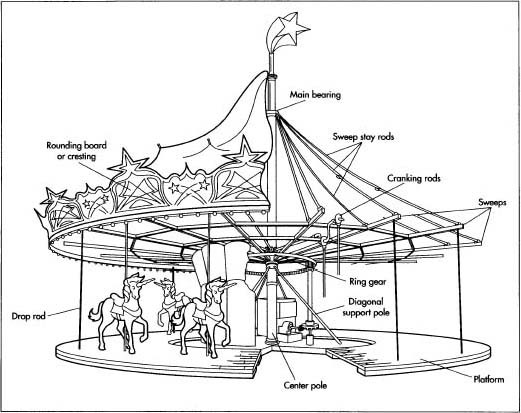
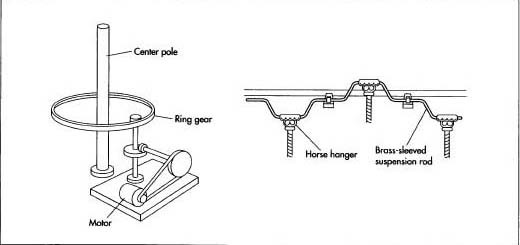
The carousel revolves around a stationary center pole made of metal or wood. An electric motor drives a small pulley that is controlled by a clutch for smooth starts. This pulley turns a drive belt and a larger pulley that turns a small-diameter, horizontal shaft. The end of the shaft is a pinion gear that turns a platform gear. The platform gear supports a vertical shaft that turns another pinion gear and final drive gear attached to the support beams of the carousel, called sweeps, which extend outward from the center pole like the ribs of an umbrella and support the platform, horses, and riders. The sweeps hold cranking rods that are turned by small gears at the inner ends that are driven by a stationary gear on the center pole. Horse hangers are suspended from the cranks, and as they turn, the horses move up and down about 30 times per minute. A typical carousel platform with horses and riders may weigh 10 tons and be driven by a 10-horsepower electric motor. After the motor’s revolutions are reduced by the series of gears, the riders on the outer row of mounts will gallop along at about 5-11 miles per hour.
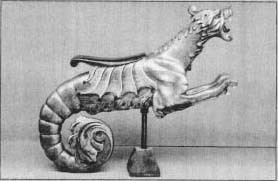
Carousels, with colorful figures attached to a revolving horizontal mechanism, have amused the masses since the end of the 1700s. By 1800, carousels were advertised as amusements as well as an activity that got the blood circulating. After the Civil War, a number of merry-go-round manufacturers started up businesses and popularized the carousel.
The griffin depicted here is the product of Hershell-Spillman Co. of North Tonawanda, NY, a well-known carousel manufacturer nearly a century ago. It is part of a 191 3 merry-go-round now operating six months of the year in Greenfield Village in Dearborn, Michigan. With its one-man band mechanism playing charming turn-of-the-century tunes, this carousel remains a great favorite. It was a “park-style model,” manufactured for permanent placement in a park. (Some, like one still operating in Story City, Iowa, were designed to travel and were not for permanent installation.) Children can ride horses, lions, tigers, zebras, and even leaping frogs—all exquisitely carved and painted. Today, carousel figures are treasured for their colorful beauty, and carousel figure collectors pay thousands of dollars for a single animal.
Nancy EV Bryk
Raw Materials
The two primary materials for a carousel are metal and wood. The metal mechanism includes the electric/hydraulic motor, gears, bearings, and crankshafts. Horse hangers and platform suspension rods are metal with brass sleeves, and the center pole is steel. The wood parts of the carousel include the
horses, which are carved from basswood, the oak platform, sweeps, rounding boards, panels, and mirror frames. The platform and various panels and gingerbread work were made of wood or plaster in the old days, and today they may be made of these same materials or may be cast in plastic or fiberglass. The tent-like top is made of canvas. Music is supplied by a band organ that is also electrically or mechanically powered and plays much like those of a player piano. Specialty manufacturers provide the organs.
Design
Design of a carousel begins in the middle at the center pole. A bearing at the top of the pole bears the entire weight of the carousel. The sweeps (arms or umbrella-like ribs) of the carousel are suspended from the top bearing, and two rods extending down from each sweep support the platform. About half-way down the center pole is a center bearing or hub that keep the works from shifting from side to side. The motor, of course, spins the whole umbrella structure around. From the midpoint, a series of diagonals keep the center pole aligned with a cross-brace that rests on the ground. A center pole that is 15 in (38.1 cm) in diameter will support about 50 horses and riders.
The Manufacturing
Process
The basic process of manufacturing a carousel has not changed despite the fact that few are built today. No new carousels
with wooden animals were made in the period from the 1930s to 1994, and only about 10 new wood-horse machines have been made in the United States in the last 60 years. All new wooden carousels are, therefore, custom-made, although refurbishing old machines is also a part of this industry.
- When a carousel builder receives an order, he works with the customer to determine the size of the machine based on cost and maintenance considerations. Most carousels today may be built from scratch or from refurbished mechanisms. In either case, today’s maker must be a metal fabricator with a shop to concoct the metal pieces. Traveling carousels can also be manufactured with little variation from those fixed in place except that the steel center pole is hinged so it will fold in half to be transported in a van. All the other pieces can be broken down by two men in about 3 hours and carried in a truck including a platform made in sections and the horses that have the metal hangers removed from them.
- The carousel builder purchases a band organ for the “new” carousel from a specialty manufacturer. Today, the Stinson Organ Company of Ohio is the only manufacturer to still make custom and productline band organs; five or six manufacturers including Wurlitzer made band organs during the heyday of the American carousel, and many other organs were imported. Band organs are played by air pushed by a bellows through wooden pipes, stops, and valves. Because the wood parts are highly subject to temperature and humidity changes, the organs are constantly out of tune and require considerable maintenance. They make music by forcing air through perforated paper rolls, much like a player piano, and the rolls cycle continuously from one to another, thanks to a device called a tracker frame developed by Wurlitzer. Although there is no sound like a real carousel band organ, maintenance costs often force buyers of “new” carousels to use tapes or compact discs for their music.
- The romance of the carousel rides with its animals, however, and the auction prices of up to $60,000 per horse for antique ponies have brought a new awareness to the importance of equipping a new carousel with the genuine article. Amateur carvers and woodworkers have also been attracted to the carving of carousel critters; and body blocks that include the body, head and neck, tail, and legs can be purchased in various sizes for carving.
- Assuming the carousel builder is carving a wooden horse from scratch, he chooses a size and weight suitable to the overall design of the carousel and selects an appropriate artistic design. This may be based on a theme for the carousel or on the customer’s favorite historic model. The outside of the carousel animal is called the “romance” side and is seen by onlookers. This display side is usually more ornately decorated than the inside. Many of the original carousel designers made full-scale sketches of their horses so that details were properly conceptualized and scaled and so that several carvers could work on parts of the same horse. Today, one-eighth scale models are sometimes made for the designer’s models and the customer’s approval.
- Full-scale paper patterns are glued to pieces of basswood to cut the body, legs, and other parts. Basswood is used because it is hard and close-grained, and the grain must run the length of the part for strength. A jigsaw or coping saw is used to cut the parts, and the parts are glued together to form the carving block. In the old days, the “glue-up” was done by a skilled craftsman who was an expert at the types of glue, amounts, and pressures required to prepare the carving block.
- Each carver has his own preferences for how to proceed with carving. Many start by using the paper patterns still glued to the animal to rough-cut the shapes, a process called boasting. Detailed carving follows, and this is usually done without reference to patterns but with a sense of the wood grain and the artistic creation that has been trapped in the wood. The completed carving block is sanded, and sometimes other small details are glued on. If the animal is for display, rather than for a working carousel, a base or stand suitable to the size and configuration of the beast is also made. A footrest is also made for each animal (unless it has stirrups or other substitutes), and these are carved and painted to match the animal. Preparation of a carousel animal up to the painting stage typically takes about 35 hours per animal.
- The carved horse is stained, primed and painted, and varnished to suit the design of the carousel. Platforms are painted to complement the carving, but overhangs are sometimes brightly colored to highlight the details of both the overhangs and the animals. Traditionally, the animals are painted bright colors, and the paints are chosen for durability and safety as well as appearance. Removal of old paint may be one of the most time-consuming tasks in refurbishing old animals; some have as many as 30 coats of paint that have filled the finely carved details. Dappling, addition of gold or silver leaf, placement of horsehair tails, and burnishing of metallic leaf provide other touches of realism and elegance. Rhinestones and other jewels are often added to the romance side of the finished horse.
The Future
According to carousel maker Chuck Kaparich, carousels and carousel animals are experiencing a resurgence. Thanks to the drawing power of the colorful carousel display and music, historic town centers and shopping malls are commissioning new carousels or refurbishing their old ones to attract customers to these areas. Kaparich expects the romance of the carousel to always remain with the American public, but, realistically, he acknowledges the limited demand and the likelihood that the present resurgence may only have a lifespan of 10 to 20 years before carousels are again temporarily forgotten. It is hoped that new generations of carousel aficionados will recall the current boom and add the magic of their mounts, music, and motion to a bank of undying memories.
Carousel Manufactures:
DENTZEL
Michael Dentzel, Gustav Dentzel’s father had been successfully carving carousels in Kreuznach, Germany since 1839. His father
thought that the carousel carving and traveling business were very tiring and hard work. Gustav was born about 1844 in Kreuznach, Germany. German born carousel maker sent to the U.S.A. by his father Michael with a carousel.
Gustav immigrated to Philadelphia in 1860 at the age of twenty and. Once in Philadelphia, Gustav opened a cabinet making shop. He was located on Germantown Avenue, in Philadelphia, Pennsylvania. After a seven year period of cabinet making, Gustav was bored and thought he would try his hand at carousel carvings since he had carved carousels for his father in Germany. He also became one of the earlier carousel builders founding Dentzel Carousel Company in Germantown – Philadelphia.
Gustav A. Dentzel constructed a small carousel to see how the public would react and toured the countryside with this small portable carousel. During his travels he discovered that people were eager to ride his galloping wooden horses.
The enthusiasm in 1867 for the carousel was overwhelming, and America’s pioneer carousel maker was in business. For Gustav Dentzel, America proved to be the ultimate land of opportunity. Having already supplied rotation by man and then by horsepower, he achieved another first by using steam power.
In 1867, he initiated America’s love affair with the carousel when he carved the country’s first merry-go-round. The animals are carved from laminated bass and linden wood. Gustav did not know at the time that he was laying the groundwork for one of today’s most desired and rare collectibles.
The company was carving and creating carousels from about 1870 until 1928. Dentzel carousels tend to be large park machines with a mixture of horses and other animals (menagerie). The animals are realistic and well carved. Although the company carved over a long period of time, the style of horses remained remarkably consistent with very few style changes after 1900. Although Dentzel carved menagerie carousels virtually from the beginning, it is widely (and mistakenly) believed that the menagerie animals were created by Salvatore Cernigliaro, Dentzel’s head carver from approximately 1903. Gustav Dentzel died in 1909 and was succeeded by his son, William. The company closed upon the death of William in 1928.
Dentzel Carousel Company North of Philadelphia. The carousel went through major updates in 1924, featuring the design it still has today.
The carousel was built “Philadelphia-style,” which means the animals are sculpted in vibrant, lifelike detail. The animals in the outer ring are stationary, while those on the inside rings rise and fall in a slow gallop. There are 52 hand-carved wooden animals in the menagerie, including 40 horses, four cats, two pigs, two goats and four rabbits. Dentzel’s head carver, Salvatore Cernigliaro, was famous for creating and hand-carving the rare “flirting rabbit,” where one paw is lifted up as if the rabbit is waving hello. The “flirting rabbit” on the original Dentzel Carousel is one of only three known to exist in the world. At Please Touch, a replica of the “flirting rabbit” is part of the animal menagerie. The standers, or outside row horses were originally designed and carved by Daniel Muller—considered to be one of the foremost carvers of his time. One of the most intriguing and unique features are the 1,296 lights that illuminate the carousel.
The Dentzel Company was founded in 1870 by Gustav Dentzel, a well-known German master carver who immigrated to the United States and began his business in 1867 in Philadelphia and Atlantic City. After Gustav’s death, his son William took over the company in 1909 until it closed at his death in 1928. The company was then sold to its Philadelphia competitor, the Philadelphia Toboggan Company—still in existence today, producing primarily roller coasters.
The Dentzel Carousel that would find a home at Woodside Park was a favorite of William Dentzel and was used as a sales model. The Dentzels would take potential customers to Woodside Park to view this gem of a carousel, and would very often receive an order for a new one based on its construction and design. William Dentzel, so proud of this carousel, had his initials carved on the lead horse.
After Woodside Park closed in 1955, the carousel was saved from oblivion by Frederick Fried, a carousel enthusiast, who put it in storage for several years until he briefly loaned it to the Music Circus in Lambertville, New Jersey. In 1965, the Smithsonian Institution purchased the carousel from Fried, with intent to refurbish and install it for use on the National Mall, near the Smithsonian Castle in Washington, D.C. The plan never came to fruition and for almost 40 years, the Woodside Park Dentzel Carousel remained in storage. A few of the characters were removed and placed on display at the National Museum of American History. In 2002, the Pennsylvania Historical and Museum Commission took ownership with plans to install the Dentzel Carousel outside the State Museum in Harrisburg, Pennsylvania.
See one
PHILADELPHIA TOBOGGAN COMPANY
PTC, as it is known, is one of the few carousel companies where the founders were not carvers. Accordingly, PTC went through many dramatic style changes with very little continuity from one head carver to the next. PTC also carved very natural looking horses; their later style included wonderfully carved armored and very sweet-faced horses. Early PTC carousels included menagerie animals, probably acquired from the E. Joy Morris factory. PTC also created a range of roller coasters which were more successful than the carousels. PTC numbered all its carousels at the factory and kept track of their whereabouts. A successor to the company is still in operation.
The most famous PTC carousel, and the only remaining PTC menagerie, is in Burlington, Colorado, very close to the Kansas border. A number of other PTC carousels still operate; more accessible PTCs are on the pier in Santa Monica, California, Six Flags, Atlanta, Georgia, and in Fall River, Massachusetts.
Major Carousel Builders and Carvers
Compiled from material by Brian Morgan (2001, updated 2015)
Overview: American Carousel Traditions and Styles
-
From the late 19th to early 20th centuries, carousel building in the United States became a highly specialised craft
-
Two dominant artistic and structural traditions emerged:
-
Coney Island Style
-
Philadelphia Style
-
-
A third major production influence came from North Tonawanda, New York, which focused on portability and travelling carnivals
-
Carousel production was closely linked to:
-
Skilled immigrant woodcarvers
-
Rail transport networks
-
The rise of travelling carnivals and permanent amusement parks
-
-
Knowledge of carousel history is supported by:
-
The National Carousel Association Census
-
Scholarly articles published in The Merry-Go-Roundup
-
The Coney Island Style (Primarily New York and New England)
-
Characterised by:
-
Highly flamboyant horses
-
Extensive use of jewels, gold leaf, and silver leaf
-
Elaborate mirrors and reflective surfaces on the carousel structure
-
-
Designed to:
-
Catch and reflect light
-
Create spectacle and drama
-
-
Associated mainly with permanent amusement parks and seaside resorts
Charles Looff
-
Earliest and most successful Coney Island–style carousel builder
-
Began operations in Coney Island, New York
-
Later moved his factory to:
-
Crescent Park, East Providence, Rhode Island
-
-
His Crescent Park carousel remains operational
-
In 1910, relocated family and factory to Long Beach, California
-
Remained active there until his death in 1918
-
Many later carousel carvers trained under Looff
-
Looff’s carving style evolved significantly over time
-
Style progression observable at:
-
Seaport Village, San Diego (early style)
-
Crescent Park, Rhode Island (mixed-era)
-
Spokane, Washington (late, highly elaborate style)
-
-
Looff continuously refined designs to outdo competitors
W. F. Mangels
-
William Mangels was a carousel builder, not a carver
-
Operated by:
-
Commissioning independent carvers
-
Installing finished animals on Mangels-built frames
-
-
Resulting carousels often identified by dual attributions:
-
e.g. Mangels/Illions
-
-
Carvers who worked under Mangels commissions included:
-
Stein & Goldstein
-
Illions
-
-
Other similar entrepreneurial builders included:
-
Kremer (Carmel)
-
T. M. Harton (Muller)
-
M. C. Illions (Marcus Illions)
-
Recognised as one of the two greatest carousel artists
-
Known for:
-
Extremely flamboyant horse heads
-
Highly decorated bodies
-
-
Personally carved all horse heads
-
First carved carousel horses in England
-
Later carved for Charles Looff in Brooklyn
-
Founded his own company in Brooklyn, New York, in 1909
-
Initially carved for Mangels, then independently
-
Three most spectacular carousels known as the “Supreme” models
-
All have since been dismantled
-
-
Surviving Illions carousels located at:
-
Agawam Amusement Park, Springfield, Massachusetts
-
Columbus Zoo, Ohio
-
-
Extensive information preserved through his descendants
Charles Carmel
-
Previously carved for Charles Looff
-
Later operated independently in Brooklyn, New York
-
Produced complete carousels primarily for Mangels
-
Known for:
-
Highly decorated animals
-
Fish-scale blankets
-
Armoured horses
-
Horses with lolling tongues
-
-
Style incorporates elements from multiple carving traditions
-
Notable surviving Carmel carousels located at:
-
Rye Playland, New York
-
Knoebels Grove, Elysburg, Pennsylvania
-
Murphy Brothers (Timothy and Bartholomew Murphy)
-
Active as:
-
Concessionaires
-
Carousel partners
-
Carousel builders using animals carved by others
-
-
Operated in:
-
New York
-
Connecticut
-
Rhode Island
-
Louisiana
-
-
Timothy Murphy:
-
Former carver
-
Carving foreman for Looff
-
Associated with Carmel
-
-
By 1903, listed as carousel manufacturers in New York City directories
-
Many mixed-style carousels previously misattributed are now tentatively believed to be Timothy Murphy carvings
-
Murphy-associated carousels operate at:
-
City Park, New Orleans
-
Lake Compounce, Connecticut
-
Lighthouse Point, Connecticut
-
Stein & Goldstein (S&G)
-
Operated in Brooklyn, New York, from approximately 1912
-
Founders:
-
Solomon Stein
-
Harry Goldstein
-
-
Carved for W. F. Mangels
-
Known characteristics:
-
Very large horses
-
Oversized heads and teeth
-
No forelocks
-
Large buckles
-
-
Horses often considered intimidating in appearance
-
Produced relatively few carousels
-
Surviving examples located at:
-
Central Park, New York
-
Bushnell Park, Hartford, Connecticut
-
-
Central Park carousel horses are larger than average
The Philadelphia Style
-
Characterised by:
-
Naturalistic, realistic depictions of animals
-
Emphasis on anatomical accuracy
-
-
Associated with park-based carousels rather than travelling fairs
Dentzel Company
-
Founded by Gustav Dentzel, a German immigrant
-
Active from approximately 1870 to 1928
-
Produced large park carousels
-
Carousels often included:
-
Horses
-
Menagerie animals
-
-
Animal carving style remained consistent after 1900
-
Common misconception that menagerie animals were carved by Salvatore Cernigliaro
-
Gustav Dentzel died in 1909
-
Succeeded by his son, William Dentzel
-
Company closed upon William’s death in 1928
-
Dentzel carousels widely distributed across:
-
United States
-
Canada
-
Philadelphia Toboggan Company (PTC)
-
Founders were builders, not carvers
-
Experienced frequent stylistic changes
-
Produced:
-
Naturalistic horses
-
Armoured and sweet-faced horses in later years
-
-
Early menagerie animals likely sourced from E. Joy Morris
-
More commercially successful as a roller coaster manufacturer
-
Numbered all carousels and tracked their locations
-
Successor company remains in operation
-
Largest PTC carousel:
-
PTC #17
-
Located at Six Flags Over Georgia
-
-
Only remaining PTC menagerie carousel:
-
Burlington, Colorado
-
-
Other operating PTC carousels located at:
-
Santa Monica Pier, California
-
Fall River, Massachusetts
-
Woodland Park Zoo, Seattle, Washington
-
D. C. Muller & Bro.
-
Operated by Daniel and Alfred Muller
-
Active from 1903 to 1917
-
Built approximately 12–16 carousels
-
Daniel Muller widely regarded as the greatest carousel animal carver
-
Known for:
-
Highly realistic carving
-
-
Only two complete Muller carousels remain:
-
Forest Park, Queens, New York
-
Cedar Point, Ohio
-
-
“Military Muller” style no longer exists as complete carousels
-
Muller brothers originally worked for Dentzel
-
Returned to Dentzel after closing their company
-
Muller influence visible in later Dentzel carousels
-
No evidence Muller carved for companies other than Muller and Dentzel
Long Family / Long–Leupold Carousels
-
Descended from English immigrant Edward Long
-
Family operated amusement parks and carousels
-
Between 1876 and 1903, produced eight carousels
-
All carved by Charles Leupold in Philadelphia
-
Most were operated by Long family parks in New England
-
Carousel #6 carved for Edward Long’s daughter in England
-
Carousel #8:
-
Operated at Bushkill Park, Easton, Pennsylvania
-
Later sold and placed in storage
-
Believed to still exist in storage
-
-
Long family descendants continue to operate:
-
Seabreeze Park, Rochester, New York
-
E. Joy Morris
-
Edward Joy Morris was a businessman and contractor
-
Entered amusement ride manufacturing around 1895
-
Produced:
-
Roller coasters
-
Chutes
-
Carousels
-
-
Maintained large inventory of carved animals
-
Not identified as a carousel manufacturer until 1989
-
Previously misattributed as early PTC
-
Sold facilities and inventory to PTC in 1903
-
Morris carvings formed the bulk of early PTC carousels
-
Last Morris carousel dismantled in 1989 at Lake Quassapaug, Connecticut
-
Continued to be listed in trade directories into the 1920s
Charles Leupold
-
One of the most influential carousel animal designers
-
Carved:
-
All eight Long family carousels
-
All E. Joy Morris carousels
-
-
Head carver for:
-
Dentzel
-
E. Joy Morris
-
-
Mentor and occasional carver for:
-
Daniel Muller
-
-
Established carving style for:
-
PTC #6, Burlington, Colorado
-
-
Son, Charles Frederick Leopold, also carved with major companies
-
Many early PTC and Dentzel carvings likely attributable to Leupold
North Tonawanda Carousel Makers (Summary)
-
Focused on Country Fair style
-
Emphasised:
-
Simplicity
-
Portability
-
-
Dominated inland and non-coastal regions
-
Closely associated with:
-
Allan Herschell
-
Armitage–Herschell
-
Herschell–Spillman
-
Spillman Engineering
-
C. W. Parker (Kansas)
-
Known as “The Kansas Colonel”
-
Early work copied North Tonawanda style
-
Later developed elongated, decorative horses
-
Based in:
-
Abilene, Kansas
-
Later Leavenworth, Kansas
-
-
Produced both portable and large park carousels
-
Widespread presence across:
-
Kansas
-
Midwest
-
Western United States
-
-
Surviving examples in:
-
Portland, Oregon
-
Burnaby, British Columbia
-
Waterloo, Wisconsin
-
Leavenworth, Kansas
-
-
C. W. Parker Carousel Museum opened in April 2005
Other Manufacturers and Carvers
U.S. Merry-Go-Round Company
-
Factory in Cincinnati, Ohio
-
Produced simple carousel designs
-
Two surviving operational carousels:
-
Albion, Pennsylvania
-
National Cathedral, Washington, D.C.
-
Charles Dare
-
Early American carousel manufacturer
-
Also produced rocking horses
-
Known for:
-
Very simple carvings
-
Marble eyes
-
-
Two surviving rideable carousels:
-
Watch Hill, Rhode Island
-
Oak Bluffs, Martha’s Vineyard, Massachusetts
-
Notable Individual Carvers
-
Salvatore Cernigliaro (Cherni) – Dentzel, PTC
-
John Zalar – Looff, PTC
-
Frank Carretta – PTC
-
Notable example:
-
Zalar carving on PTC #50, Hampton, Virginia (circa 1920)
-
Allan Herschell Company – Key Facts
General
-
Company name: Allan Herschell Company
-
Industry: Amusement ride manufacturing
-
Company type: Private company
-
Founded: 1915
-
Defunct: 1970
-
Fate: Merged with Chance Manufacturing (later Chance Rides)
-
Area served: Worldwide
-
Specialisation: Portable amusement rides, particularly carousels and roller coasters
-
Location founded: North Tonawanda, near Buffalo, New York, USA
Historical Background and Predecessor Companies
Armitage–Herschell Company (1872–1903)
-
Founded in 1872 by Allan Herschell and James Armitage
-
Originally operated as an iron foundry
-
Began producing hand-carved wooden carousels in 1883
-
Produced simple, portable “country fair”–style carousels
-
Herschell’s son William Herschell helped establish band-organ manufacturing in North Tonawanda
-
Backed the founding of the North Tonawanda Barrel Organ Factory in 1888
-
Declared bankruptcy in 1903 and ceased operations
Herschell–Spillman Company (1901–1916)
-
Founded in 1901 by Allan Herschell and his in-laws, the Spillman family
-
Purchased assets of Armitage–Herschell after its bankruptcy
-
Initially produced simple “country fair” carousels
-
Later expanded to larger, more elaborate park-style carousels, including menagerie designs
-
Built notable surviving carousels across the United States, including the Herschell–Spillman Noah’s Ark Carousel in Portland, Oregon
-
Also manufactured engines for early aviation and motor companies
-
Allan Herschell retired in 1911 due to declining health
-
Company renamed Spillman Engineering Company in 1916
-
Continued operating until 1945, when it was bought by the Allan Herschell Company
Allan Herschell Company (1915–1970)
https://en.wikipedia.org/wiki/Allan_Herschell_Company
https://www.carrouselmuseum.org/allan-herschell.html
-
Founded in 1915, after Allan Herschell came out of retirement
-
Operated in direct competition with Spillman Engineering
-
Specialised in:
-
Portable carousels
-
Horses with rigid poses, designed for easy transport
-
-
Manufactured over 3,000 carved wooden carousels
-
Exported rides to:
-
United States
-
Canada
-
Mexico
-
South Africa
-
India
-
-
Factory located on Thompson Street, North Tonawanda
-
Factory complex included:
-
Carving shop
-
Woodworking shop
-
Paint shop
-
Upholstery shop
-
Machine shop
-
Storage areas
-
Roundhouse for assembly and testing
-
-
Also developed non-carousel amusement rides, including:
-
Early children’s rides marketed as “Kiddieland”
-
Adult thrill rides such as Twister, Hurricane, Flying Bobs, and Sky Wheel
-
-
Company moved operations to Buffalo, New York in the 1950s
-
Merged with Chance Manufacturing of Wichita, Kansas in 1970
Herschell Carrousel Factory Museum
-
Located at the original Thompson Street factory site
-
Opened to the public in July 1983
-
Features a fully operational 1916 Allan Herschell carousel
-
Offers:
-
Exhibitions and demonstrations
-
Woodcarving programmes
-
Guided tours
-
Summer lecture series
-
Youth and community education programmes
-
-
The factory is one of the last surviving US sites where wooden carousel production occurred in a single complex
Surviving Rides
-
Numerous Allan Herschell Company rides still exist worldwide
-
The list of surviving rides is ongoing and incomplete
-
Examples are held in museums, parks, and heritage collections