
Born Belgium 1843 - Died in Naples in 1920.
Maurice de Harven Duval, born in Belgian, Flemish architect who arrived in Timaru in 1876, with his fiancée soon to follow.
Practised in Timaru between c.1877 and 1895 and over those 18 years produced stunning buildings and immersed himself in local cultural groups and his church. After a period of economic depression, he took his family back to Europe in 1894. He died in Naples in 1920.
FAREWELL TO MR. DUVAL
Yesterday afternoon, about twenty-five professional and business men, including a large proportion of builders and others connected with the building trade, assembled at the courthouse to make a presentation to Mr. Duval and formally bid him farewell, as he is about to leave the colony for his native land. Mr. D. Stuart presided and asked Mr. Howley to begin the proceedings by reading the address that had been prepared.
The address, which was very nicely written and illuminated by Mr. G. W. Wade, was as follows:
"To Maurice de Harven Duval, architect, Timaru. On the eve of your departure from Timaru, we take this opportunity of wishing you, Mrs. Duval, and family, farewell and Godspeed, and in doing so, express our sincerest wishes for your and their future welfare. We cannot but regret this, after your having resided amongst us for eighteen years, and we trust that wherever your lot may be cast, prosperity and happiness may be yours. The many kindnesses of yourself and family will long be remembered in the district, and we feel sure that those amiable characteristics which have won for you and them so many friends in the past will be sufficient passport in the future. In conclusion, we subscribe ourselves your friends and well-wishers."
A number of signatures were appended, commencing with that of the Mayor, though the list was not completed. The ornamentation of the address included a photograph of Mr. Duval, and for a tailpiece, a photographic "bit of Winchester."
The chairman, along with Messrs. J. Scott (Waihao), E. Hall, Major Bamfield, Messrs. Grandi, Craigie, Hardcastle, and Lough, spoke on the occasion. Mr. Stuart referred to his long acquaintance with Mr. Duval and the pleasure and profit he had derived from Mr. Duval's company through his varied attainments. Mr. Scott spoke at some length on the value Mr. Duval had been as an intellectual unit of society in Timaru, from the comprehensiveness and depth of his reading, especially in subjects political and historical. He also referred to what Mr. Duval had done to improve the architectural taste of South Canterbury, mentioning some of the schools he had built and the Timaru theatre, the nicest of its size in the colony.
Mr. Hall spoke of Mr. Duval's straightforwardness as a professional man. Major Bamfield expanded on a few points mentioned by Mr. Scott. Mr. Grandi reminded the company of the fine memorial Mr. Duval was leaving behind him in the convent building, whose interior, he was lately surprised to learn, was even of greater excellence than its noble exterior promised. Mr. Craigie spoke from extensive experience of the taste Mr. Duval had displayed in making his buildings suit the character of their purposes. Mr. Hardcastle added a few words on the good work their guest had done in cultivating a love of music in Timaru, and Mr. Lough mentioned the reformation he had produced in the character of public functions through his skill in organisation.
Very general regret was expressed at Mr. Duval's departure, and most cordial wishes were extended for his future prosperity and the happiness of himself and his amiable family. Mr. Duval's reply was much interrupted by emotion. He was, he assured them, very much surprised at such expressions of goodwill as had fallen from the speakers, and at such an honour being done to him by so many of his fellow citizens. As for the praises that had been bestowed upon his professional skill, he felt that the results were but poor specimens, as he had always had to work under the colonial rule of providing £30 worth of work at £20 expense. He hoped, however, that this colonial experience would be of some value in the future.
Though he had spent nearly half his life in Timaru, he could not see that anything he had done deserved this public recognition, and he was so overcome by it that he could not express his thanks. However, he must thank them gratefully for their kindness, on behalf of himself, his wife, and his children. He would preserve the token of goodwill they had given him, and he would never forget the many kindnesses he had met with from his old friends in Timaru.
At a later stage in the proceedings, Mr. Duval said that it was a great wrench to him having to leave Timaru after twenty years' residence, but, as he explained in some detail, it was impossible for five architects (to say nothing of numerous amateurs) to make a living in a town and district where there is but a moderate amount of work for one. The banks are all built, financial and commercial companies are all housed, and it was simply impossible to expect an expenditure of £25,000 a year on dwellings. That sum must be spent to give even a modest livelihood to five architects.
He had ascertained that there were no less than 253 professional architects advertising in New Zealand, and he was safe in saying that not more than £800,000 had been spent on buildings requiring an architect in the last ten years. In contrast, in Glasgow, there were only 47 architects in 1893, and that year £929,000 was spent on building. He was very sorry indeed to leave Timaru, but it was perfectly clear that with a family to provide for, it was impossible for him to remain, the professional outlook being a blank.
Mr. Duval repeated and reiterated his acknowledgments for the kindness shown him by the meeting. The chairman led the singing of "Auld Lang Syne," and this closed the proceedings. As the gathering broke up, a further surprise was sprung upon Mr. Duval, with Mr. Howley handing him a purse of sovereigns, which had been subscribed by a large number of friends.
https://paperspast.natlib.govt.nz/newspapers/THD18950615.2.23
Some of his notable church and Stafford Street designs:
1869 - St John the Evangelist Parish, Leeston, rural Selwyn area 5 December 1869. The original wooden church was replaced by a larger brick church which opened 1 April 1894. This gothic church was designed by Maurice de Harven Duval, a Belgian architect based in Timaru. The earlier church became a school and hall and was demolished in 1980.
1877 - The Theatre Royal was reconverted into a theatre in 1877 by Maurice Duval. Opening night 16 July.
1878 - Belford Steam Flour Mill
1879 - Catholic School, Timaru
1880 - Auctioneer rooms, George St -South Rd.
1881 - The Mechanics Institute, Timaru - a new brick building. Foundation stone laid 24 March. TH 25 march 1881
1881 - New theatre, 3 stories high, brick and stone, seating 900, frontage will comprise of three shops, each 18ft by 13ft, to the left Green's butcher shop
1882 - Repairs at Quin's Buildings, corner of George St. TH 13 Feb.
1882 - "Zealandia Butchery" for Peacock and Geaney, corner of Church and Sophia Sts.
1882 - New theatre for Moss Jonas. TH 26 June
1882 - Alternations of Timaru Borough school. TH 24 June
1882 - Shop, dwelling and stables for Messrs Peacock and Geaney. TH 10 Aug.
1883 - Waimataitai School Buildings in stone or brick
1883 -Theatre Royal
1884 - Alternations to Belford Mill, Timaru. TH March 1st
1884 - Alterations to store fronts at Bowker's Buildings. TH 9 Dec.
1885 - Main South Road, Davies and Murphy's drapers and clothiers building, 58ft frontage
1886 - opposite the Club Hotel, three stories, frontage 48ft on George St and 67 ft on Cain's terrace, with the base or plinth being local bluestone, with the rest brink, finished in cement. Street to the parapet is 64ft. 8' celler. The building on the corner of George St. and Cain's Terrace, once Werry's Private Guest Hotel was probably designed by Maurice Duval. Timaru Herald, 19 March 1886
1886 - Catholic Church, Timaru
1886 - Erection of a residence for A. Burnett, Esq. TH 17 July 1886
1886 - Quinn's buildings at the BNZ corner, frontage 71ft Cain's Terrace, 50ft corner of George st. Whale bones discovered here. The shop facing George St. is occupied by Mr O'Dowd, baker and confectioner. The shafts are Timaru bluestone, and the bases and capitals of Oamaru stone. Timaru Herald 30 December 1886, Page 3
The first St Mary’s church was opened in August 1890 at a cost of £1540, designed by Timaru architect Maurice de Harven Duval. It was built in four months by Timaru builder Jas. Delaney.
1890 - Criterion Hotel remodeled (aka the Excelsior Hotel cr George St and Stafford St) TH July28
Timaru Herald 21 Oct. 18891890 - Tenders invited for the erection in brick at Kingsdown for Mr. E.G. Kerr. TH. 21 Oct. "Harlau", 253 Beaconfield Rd, for E.G. Kerr. Its walls are made of triple brick.
1890 - The first stone church St Mary’s church in Chirstchurch was opened in August 1890 at a cost of £1540. It was designed by Timaru architect Maurice de Harven Duval. The church was built in four months by Timaru builder Jas. Delaney. Archbishop Redwood laid the foundation stone on April 20, 1890 and returned to open it on August 17, 1890. In spite of being intended as temporary, it survived as a church until 1956 when it was demolished to allow the building of a new church.
1891 - Clarendon Hotel
1891 - Cemetery Cottage
1892 - Erection of three shops in Stafford St. section 94. TH 5 Feb.
1892 - Rhodes's Building, Stafford St, north. Frontage 66ft. Concrete foundation with brick walls. Adjoins the Empire Hotel.
1893 - The Grange 1 Pages Rd, Timaru formerly known as the Elloughton Gardens Homestead. A grand 17 room mansion which Maurice Duval designed for the property in 1893 for William Grant.

This shop, dwelling, and stables were built for Messrs Peacock and Geaney (Zealandia Butchery) on the corner of Church and Sophia Streets in Timaru. The architect was M. de H. Duval who designed many buildings in Timaru's CBD, and South Canterbury Catholic churches.
This is a billhead from 1893 from the Thomas and Hardy-Johnston families: Papers - ourheritage.ac.nz | OUR Heritage, accessed July 20, 2021, https://otago.ourheritage.ac.nz/items/show/6107.
Rumour has it that when Cecil Wood whipped past in his motor car, it gave the butcher's horse a fright and meat spilled everywhere and the butcher came running out threatening to chop up Cecil's car!
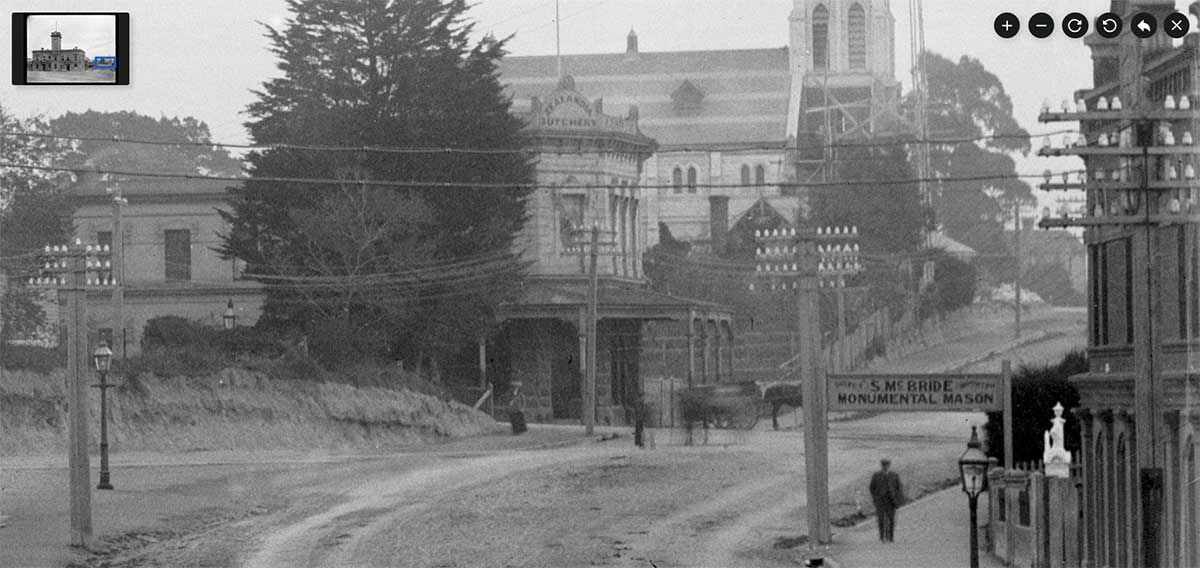
Screen shot zooming into a photo to see the detail - Post Office, Timaru, 8.54am, Timaru, by Muir & Moodie. Te Papa (C.014680) https://collections.tepapa.govt.nz/object/24118?page=1&rtp=1&ros=1&asr=1&assoc=all&mb=c

Duval. M. [ca. 1882]. Plans of St Mary’s Church, Nelson. Nelson Provincial Museum: NP6442.1.