

Timaru Main School War Memorial and Headmasters House - 2026 Roselyn Fauth
Location: Former Timaru Main School area, Grey Road / Arthur Street area
Access: Memorial visible from public edge, school site access by permission if required
Associated years: 1919, 1921, Second World War memory
Associated people/groups: Timaru Main School teachers and ex-pupils, Henry Lawson Leah, school children, families
Timaru Main School has one of the strongest school-war stories. NZ History records that about 360 teachers and ex-pupils served in the First World War, and 70 were killed. Timaru District Council’s heritage assessment gives more detail: a public meeting in July 1919 discussed an old boys’ memorial, the corner site was chosen so it could be viewed by the public, and in 1921 the memorial was erected to commemorate 70 former teachers and pupils who died and 361 others who served and returned.
This place also carries a Second World War childhood memory. A local oral-history recollection records children practising air raids at Timaru Main School, going into trenches dug in the school grounds, with chewing gum and corks used as part of the drill. That local memory should be labelled as oral history unless confirmed in school records. Nationally, school air raid trenches and drills are well documented. NZ History records that after Pearl Harbor, the policy shifted towards keeping children at school during attack, building trenches and holding routine air raid practices.
Find a WuHoo: This place links two generations: older pupils who went overseas, and younger pupils who practised for war coming home.

Side Quest: Timaru Main School History
Timaru Main School opened in October 1874 on its Arthur Street/Grey Road site, following an earlier Anglican church school founded in 1859. Its original bluestone Gothic Revival school building was designed by Francis J. Wilson in 1873–74, while the surviving headmaster’s house, later known as Bluestone House, was built in 1877–78. The school closed in 2004 after merging with Timaru West School to form Bluestone School.
Note: I was told that after the schools demolition, some of the bluestone that was part of the school was used to construct a picnic area at Patiti Point.
I was also told by an older lady that she can remember the drills as a child. If the siren went, they ran to Main School and practiced their war drill in a trench on the school grounds. She told me children wore linen pouches around their necks, inside was a cork and some chewing gum. The Gun was chewed and they put it in their ears, and then cork between their teeth. I asked her if she was scared at the time. She said no, they didn't really think about it. She said children just did what they were told to do in those days.
-
1859 The first formally controlled school in Timaru began under the Church of England. This predates the later bluestone Main School building. Background history from local account.
-
1870 Public pressure grew for a non-denominational public school and in 1872 A school site was approved at Wilson’s Paddock, bordered by North Street, Theodosia Street, Arthur Street and Grey Road.
-
1873–1874: Bluestone brought in for the original Timaru Main School building. the foundation stone was laid 1873 and the first classrooms opened in October 1874.
-
1878: The former Timaru Main School headmaster’s house was built on the same site. It is now listed as heritage item number 52.
-
10 July 1919: A meeting of “all householders and ex-pupils of the Timaru Main School” was held to discuss proposals for an old boys’ war memorial.
-
1919: Fundraising efforts began for the proposed Timaru Main School war memorial.
-
August 1920: It was decided to ask subscribers to support the proposal to erect a memorial obelisk. The corner of Grey Road and Arthur Street was chosen as the memorial site so that members of the public could easily view it
-
16 June 1921: The foundation stone of the memorial was laid. Scrolls containing the names of the servicemen were placed inside the foundation stone. 25 June 1921: The memorial was unveiled, nine days after the foundation stone was laid. The memorial commemorated 70 former teachers and pupils of Timaru Main School who died while serving in World War I. The memorial also recognised 361 former teachers and pupils who served in World War I and returned.
-
Post-1945, date unknown: Commemorative text for World War II was added to the memorial.
-
After 1945: The memorial came to commemorate those associated with Timaru Main School who served in both World War I and World War II. The memorial continues to be used for ANZAC Day commemorations.
-
1956: The original bluestone school demolished. At least some salvaged stone was reused at the Pātītī Point bluestone BBQ / barbecue area, a project championed by the Rotary Club of Timaru.
- 2004–2005 Timaru Main School and Timaru West School were merged, becoming Bluestone School on the Timaru West site.
-
In 2012 Buestone House was vacated because of earthquake-strength concerns.
-
17 October 2018: The Historic Heritage Item Record Form was completed by Dr Ann McEwan of Heritage Consultancy Services.
-
The memorial was identified as a Heritage Category B item as of 2026, the setting included the historic fencing on both Arthur Street and Grey Road, shared with the former headmaster’s house.

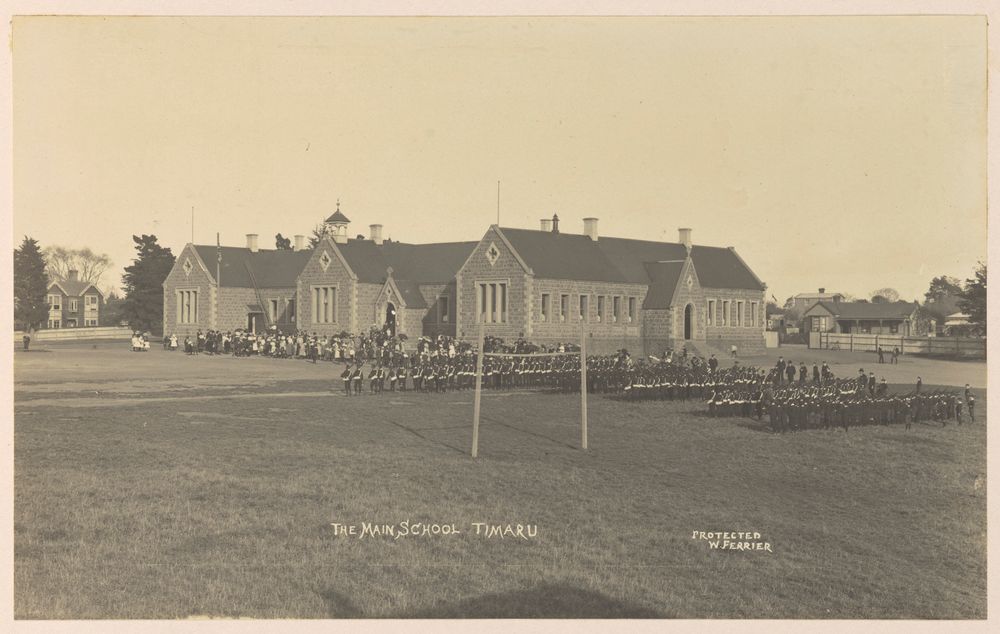
The Main School, Timaru, circa 1909, Timaru, by William Ferrier. Te Papa (O.051442)
Timaru Herald, 10 July 1919, p. 1
https://paperspast.natlib.govt.nz/newspapers/THD19190710.1.1
Timaru Herald, 11 July 1919, p. 3
https://paperspast.natlib.govt.nz/newspapers/THD19190711.1.3
Timaru Herald, 21 August 1919, p. 6
https://paperspast.natlib.govt.nz/newspapers/THD19190821.1.6
Timaru Herald, 27 September 1919, p. 2
https://paperspast.natlib.govt.nz/newspapers/THD19190927.1.2
Timaru Herald, 29 July 1920, p. 8
https://paperspast.natlib.govt.nz/newspapers/THD19200729.1.8
Timaru Herald, 26 August 1920, p. 7
https://paperspast.natlib.govt.nz/newspapers/THD19200826.1.7