
I thought it might be helpful to pull together a timeline of wars from the 1700s on for reference.
The timeline reminds us that New Zealands connection to war as a colony is impacted by many milestones in time. It helps us see when Timaru connected its war history to when men and women left for the Boer War, World War I or World War II.
From 1840, British imperial power changed the political and land framework of Aotearoa. There are many conflicts on Aotearoa New Zealand soil.
Please note that this timeline does not include conflict in New Zealand as I haven't researched this yet.
In South Canterbury, Timaru’s people were drawn into distant imperial and global wars. And while the distance felt physically far, as a British colony it could have felt very close to home for many. So Timaru’s war story is really a layered one: mana whenua, colonisation, land and settlement change, then service and remembrance in overseas wars.
1700 to 1721 Great Northern War reshapes power in northern and eastern Europe, especially Sweden and Russia.
1701 to 1714 War of the Spanish Succession, a dynastic European war with global colonial consequences.
1733 to 1738 War of the Polish Succession, showing how monarchy, territory, and alliance politics drove war.
1740 to 1748 War of the Austrian Succession and Silesian Wars, Prussia rises as a major European power.
1756 to 1763 Seven Years’ War, arguably the first truly global war, fought in Europe, North America, India, the Caribbean, and at sea.
1775 to 1783 American Revolutionary War, independence struggle becomes an international war involving Britain, France, Spain, and others.
1789 to 1799 French Revolution, political upheaval turns into revolutionary violence and European war.
1791 to 1804 Haitian Revolution, enslaved people overthrow colonial rule, creating Haiti.
1792 to 1815 French Revolutionary and Napoleonic Wars, mass mobilisation, nationalism, empire, and modern state warfare expand dramatically.
1810s to 1820s Latin American wars of independence, Spanish and Portuguese imperial control breaks down across the Americas.
1839 to 1860 Opium Wars, imperial trade, coercion, and unequal treaties reshape China’s relationship with Western powers.
1853 to 1856 Crimean War, Russia, the Ottoman Empire, Britain, France, and Sardinia clash, foreshadowing modern military logistics and media reporting.
1857 to 1858 Indian Rebellion, a major anti-colonial uprising against East India Company rule.
1861 to 1865 American Civil War, industrial-scale civil war over union, slavery, sovereignty, and national identity.
1860s to 1870s Wars of Italian and German unification, nationalism redraws Europe.
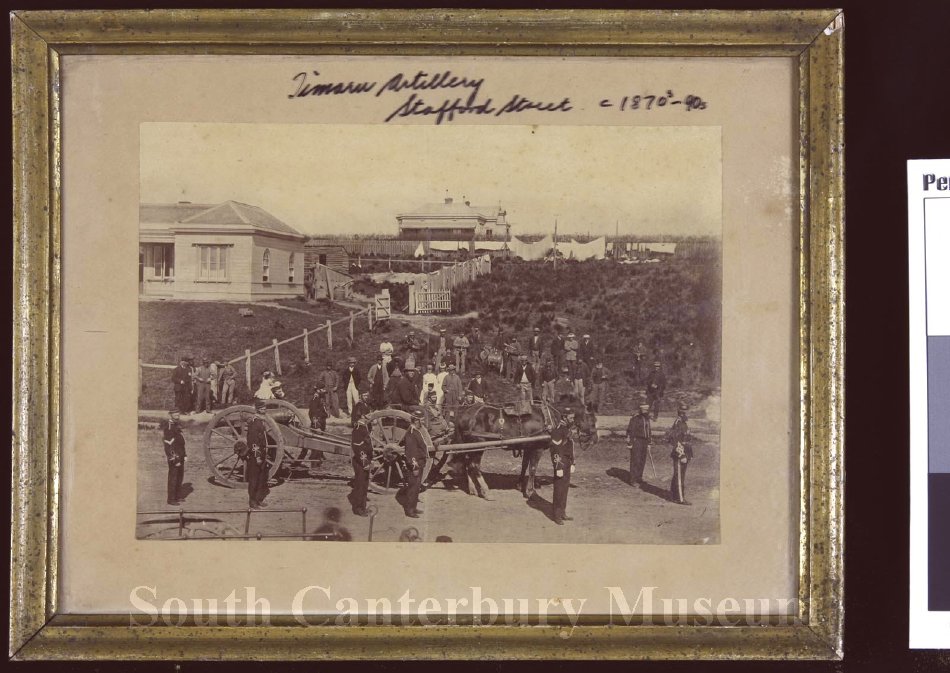
From the South Canterbury Museum "Framed picture of members of the Timaru Artillery with a cannon and ammunition carriage hitched to a single horse, probably taken in the 1870s or early 1880s. The image depicts the gun carriage with uniformed men (Timaru Volunteer Artillery) standing in what appears to be parade positions. A handful of onlookers stand on a gradual slope in the background. Beyond the crowd two houses also in appear, as does the days washing draped over a long fence and what appears to be a makeshift clothesline. A note in black felt on the glass above the print reads "Timaru Artillery Stafford Street c1870s-90s." Bears the label of J Moore (carver, guilder and picture framer of Gloucester) on the verso." South Canterbury Museum 1612E
1870 to 1871 Franco-Prussian War, Germany is unified and France is defeated, setting up tensions that later feed into 1914.
1898 to 1902 Spanish-American War, Philippine-American War, and South African War/Boer War, imperial conflict enters the modern media age.
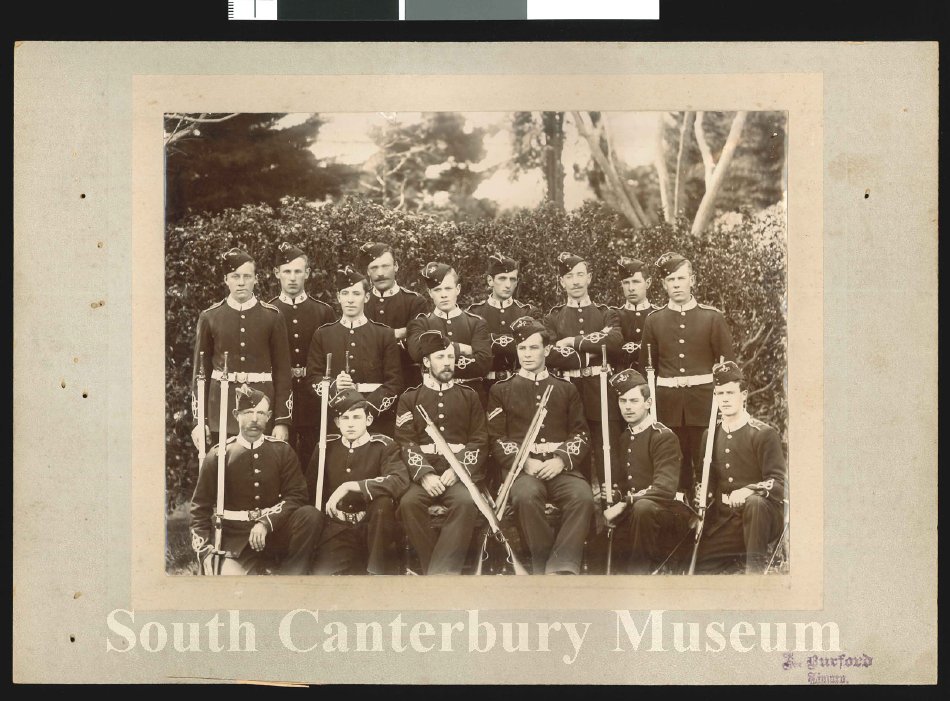
A formal portrait of men from a Timaru volunteer military unit, photographed by A. Burford in front of a hedge. The group has previously been identified as the South Canterbury Mounted Rifles, though handwritten notes on the reverse suggest it may include men from mixed local units, including the Timaru City Rifle Volunteers and Timaru Naval Artillery Volunteers.
The notes identify William “Billy” Byrne, third from left in the second row, as the first Timaru soldier to be killed in the South African War, and Corporal Thomas Sellwood, first on the left in the front row. The photograph reflects Timaru’s strong volunteer military tradition at the turn of the twentieth century.
South Canterbury Museum, Catalogue No. 1606.
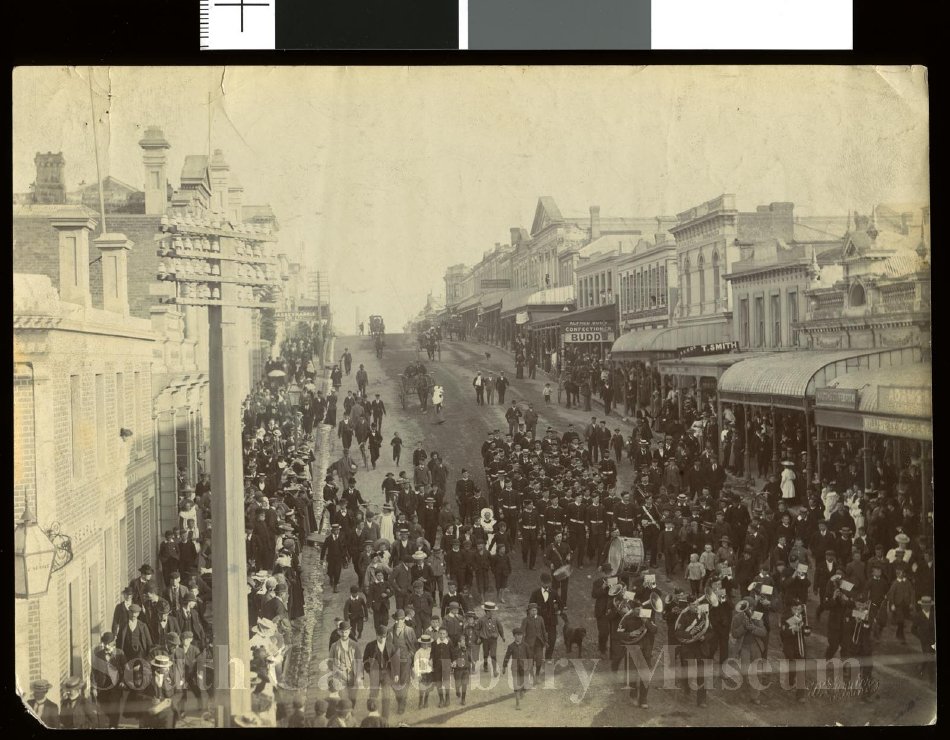
A procession held in honour of William (Billy) Byrne, a sergeant of the Timaru City Rifles, who was the first local man to join the first contingent of troops leaving for the Boer War in 1899. A band leads a formation of uniformed men down Stafford Street approaching the George Street intersection. According to the South Canterbury Museum, this is presumably the men are from the Timaru Rifles, with a small contingent of Port Guards at the rear. A large crowd watches from footpaths, or walk alongside the parade. Photographer Ferrier, William, Photographer, Timaru. South Canterbury Museum 1415
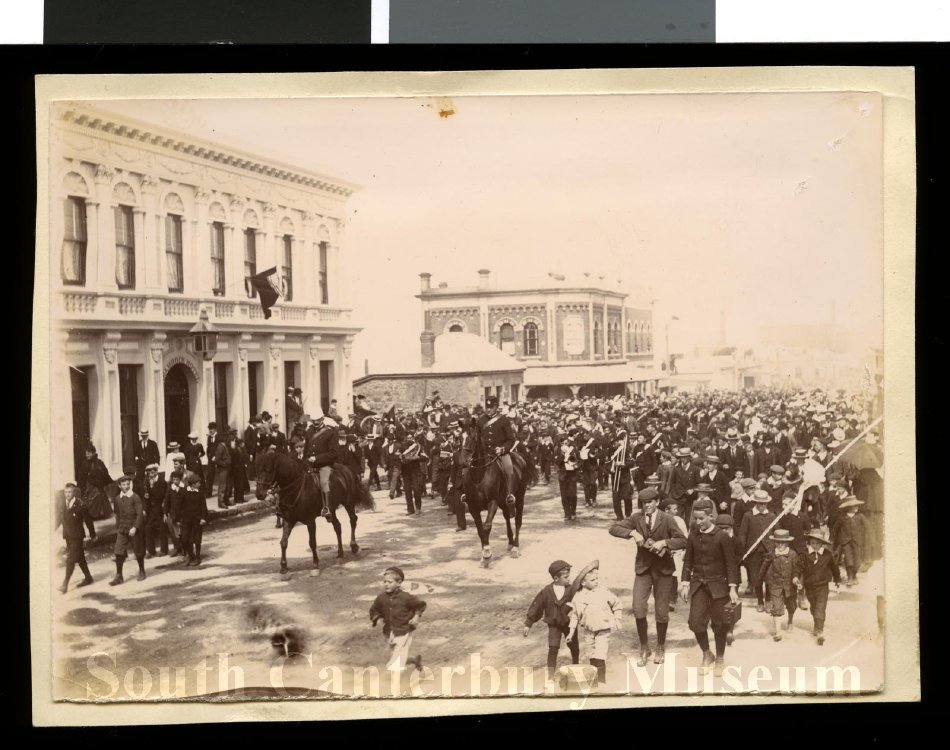
Imperial Indian Contingent at Timaru 4 March 1901 - South Canterbury Museum -1559
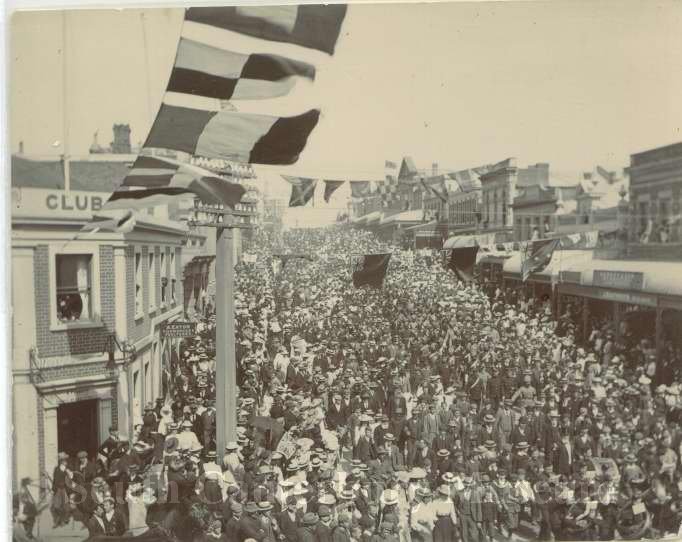
Imperial Indian Contingent at Timaru 4 March 1901 - South Canterbury Museum -1569
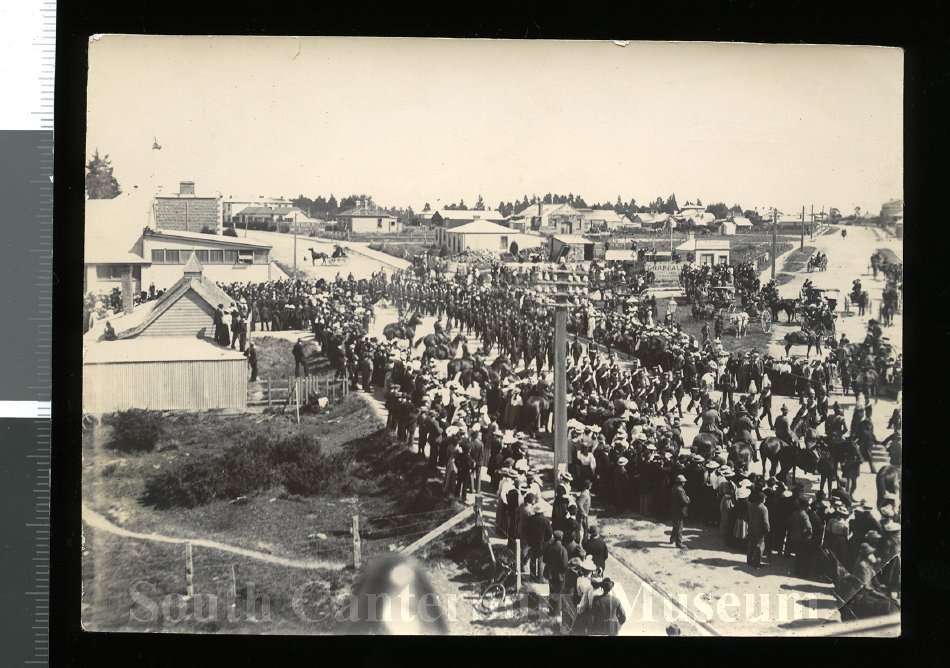
Military parade, High Street, Timaru Probably taken between 1885 and 1902 - South Canterbury Museum 1564
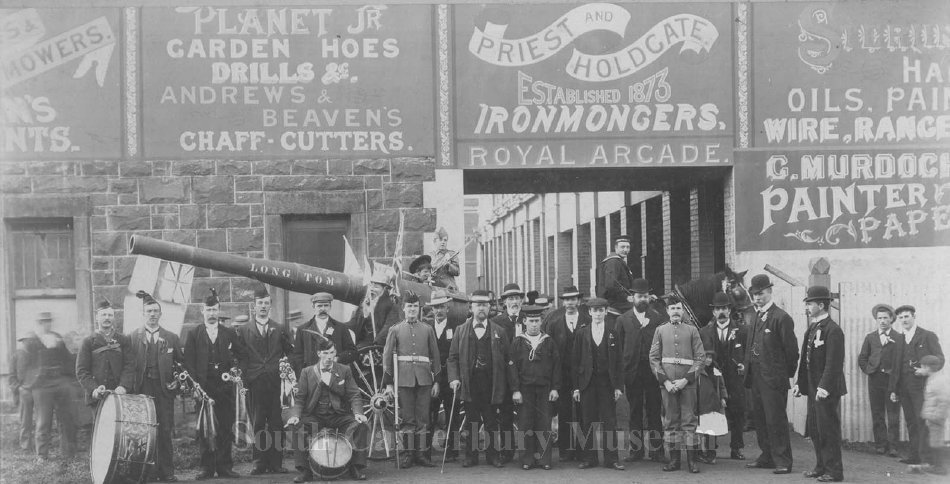
Pretoria Day June 7 1900 - 1477
1904 to 1905 Russo-Japanese War, Japan defeats Russia, signalling a major shift in global power.
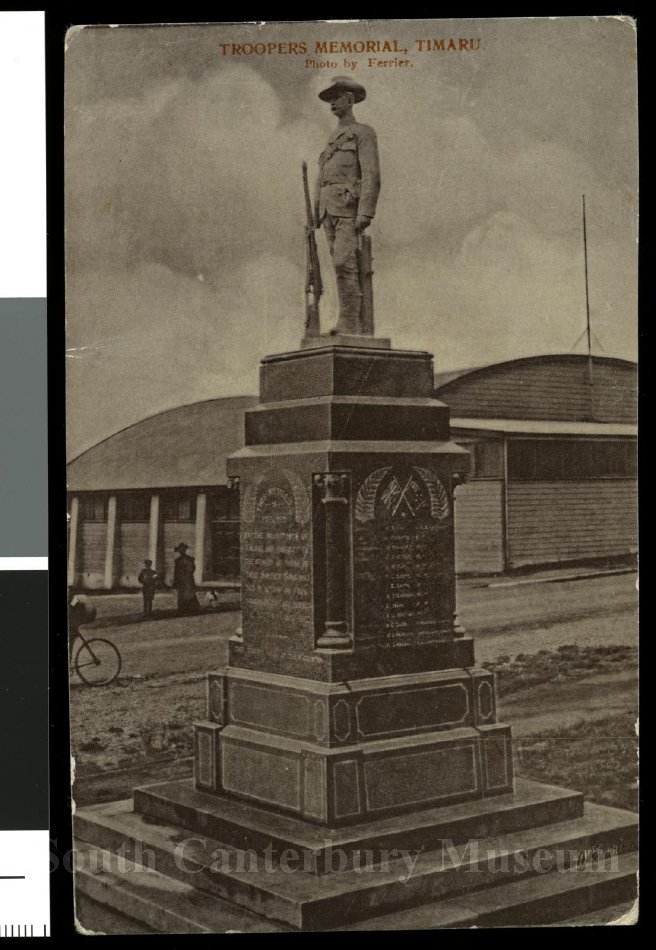
Postcard featuring the Trooper's memorial on the corner of High and King Streets, Timaru, circa 1905(?) opposite Alexandra Square before it was relocated. Depicts the memorial for troops who went to the Boer War. Note the Drill Hall in the background on High Street. The Troopers memorial was unveiled on 23 February 1905. Following the First World War the memorial was moved to its present site about 1929 to a triangle of grass bounded by King Street, Catherine Street and Memorial Avenue. Memorial Ave (previously Charles Street) now leads past the Troopers memorial to the cenotaph commemorating those lost in the Great War. Photographer Ferrier, William, Photographer, Timaru. Published by H J Anderson, No.1. South Canterbury Museum 1160
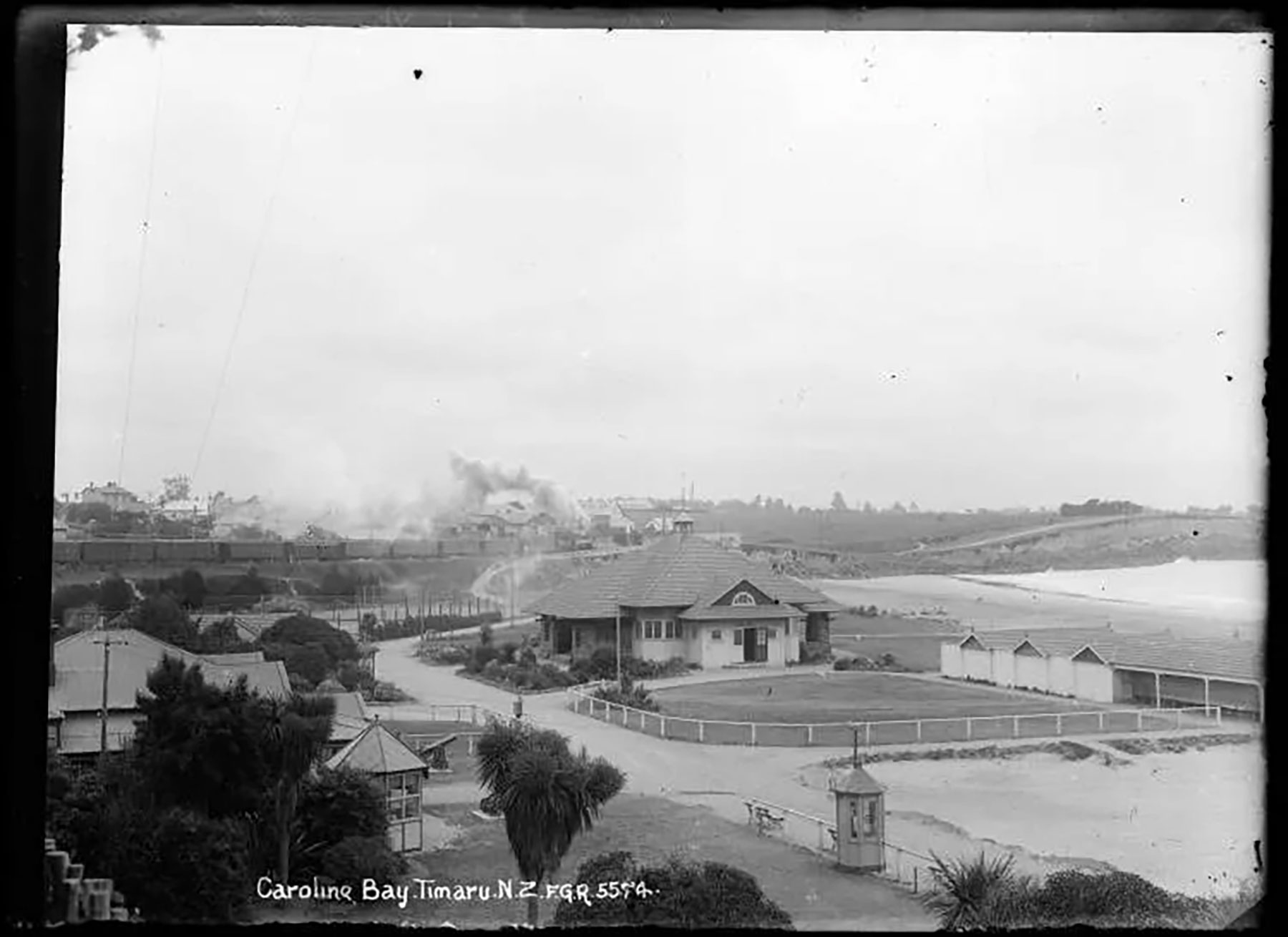
1910 - Looking north along Caroline Bay, Timaru. Showing The Pavilion (centre) and cannons. Over the roof of the Pavilion is the Midland Dairy Company's Palm Butter factory and to its left is Evans Street, with tennis courts beside. A train stretches across the picture from the left.
1912 to 1913 Balkan Wars, the Ottoman retreat from Europe increases instability before the First World War.
1914 to 1918 First World War, total war, trench warfare, genocide, empire collapse, and mass civilian impact.
The first South Canterbury contingent was farewelled at Timaru Railway Station, only a few weeks after war was declared. New Zealand troops sailed overseas. When the Ottoman Empire joined Germany, the troops landed in Egypt rather than continuing straight to Europe. By December The New Zealand Main Body arrived at Port Said, at the entrance to the Suez Canal.
New Zealand troops took part in the Gallipoli Campaign, later remembered as a disastrous campaign. After Gallipoli New Zealand forces reorganised. Most troops moved toward Europe, while many Mounted Rifle units remained in the Middle East. The majority of New Zealand troops went to fight on the Western Front in Europe, where the war had become a deadly stalemate of trenches and defences stretching about 700 kilometres. South Canterbury soldiers experienced both tragic defeat and costly success overseas.
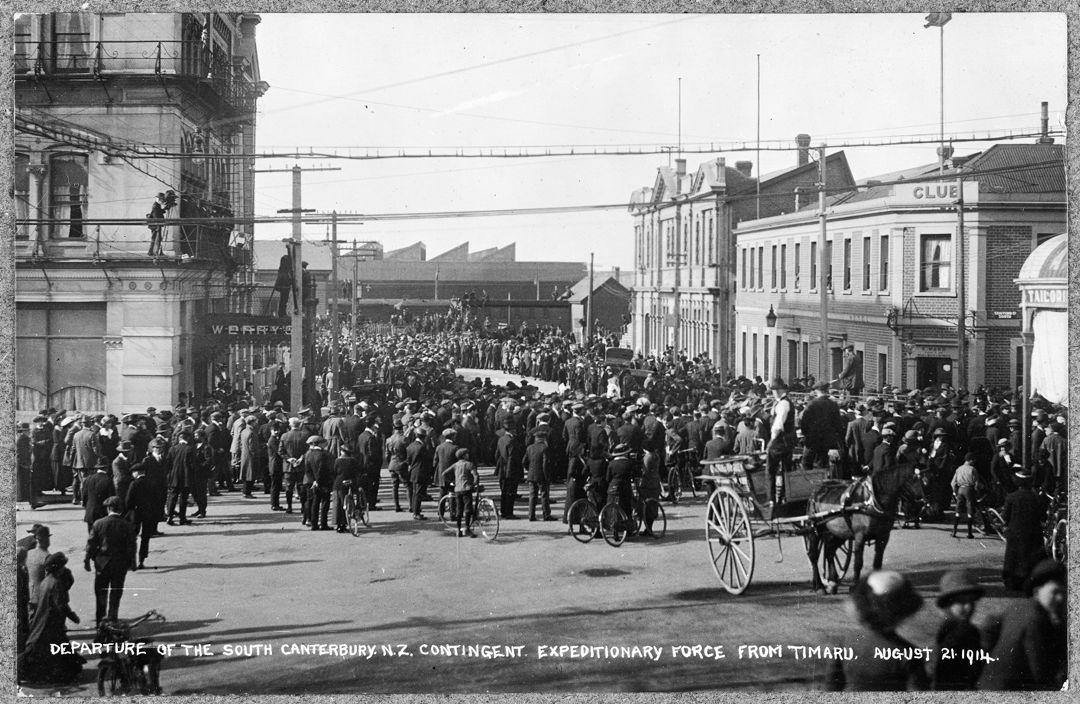
21 Aug 1914. Departure of the 2nd (South Canterbury) regiment from Timaru, during World War I. Young, J (Mrs) :Photographs of Otago, South Canterbury and Wellington. Ref: 1/2-049274-F. Alexander Turnbull Library, Wellington, New Zealand. /records/23136046
New Zealand’s involvement in one of the most devastating Western Front battles at Passchendaele.
At home, South Canterbury people supported the war effort from afar. Communities raised support, followed news from the front, and recorded the names of those who died. Local patriotic societies became important community organisers. The Timaru Patriotic Society was led by mayoress Florence Guinness from the council office. The Society gave gift parcels to departing troops and sent supplies overseas, including food, warm clothing and Christmas cakes. Other societies, guilds, schools, the Red Cross Society and St John Ambulance Association raised funds and gathered goods for military hospitals and wounded soldiers.
1916 The first Anzac Day was observed. At first it was more of a patriotic recruiting drive than the solemn commemoration it later became. The New Zealand Returned Soldiers’ Association was formed three days after the first Anzac Day to support former soldiers. The South Canterbury RSA was founded and set up clubrooms in Church Street, Timaru.
1918 World War I ended, leaving South Canterbury with grief, rolls of honour, returned soldiers, and lasting remembrance. More than 1000 South Cantabrians had been killed in the war. Many more later died from their wounds. 12 November 1918. Timaru heard the armistice news shortly after 9 am, signalled by the ringing of the firebell. People stopped work and filled the streets in celebration. An armistice celebration parade moved down Sophia Street, Timaru. Celebrations were held across South Canterbury. Pleasant Point held one of the largest celebrations in the town’s memory.
1918 Influenza Timaru Herald reported in November 1918 that Timaru Hospital was under pressure but improving, with volunteers helping and a tent hospital in the Park operating for influenza patients. The report distinguishes between Timaru Hospital itself and the Park marquees, suggesting an emergency overflow arrangement rather than a permanent hospital building. - https://paperspast.natlib.govt.nz/newspapers/THD19181119.2.20
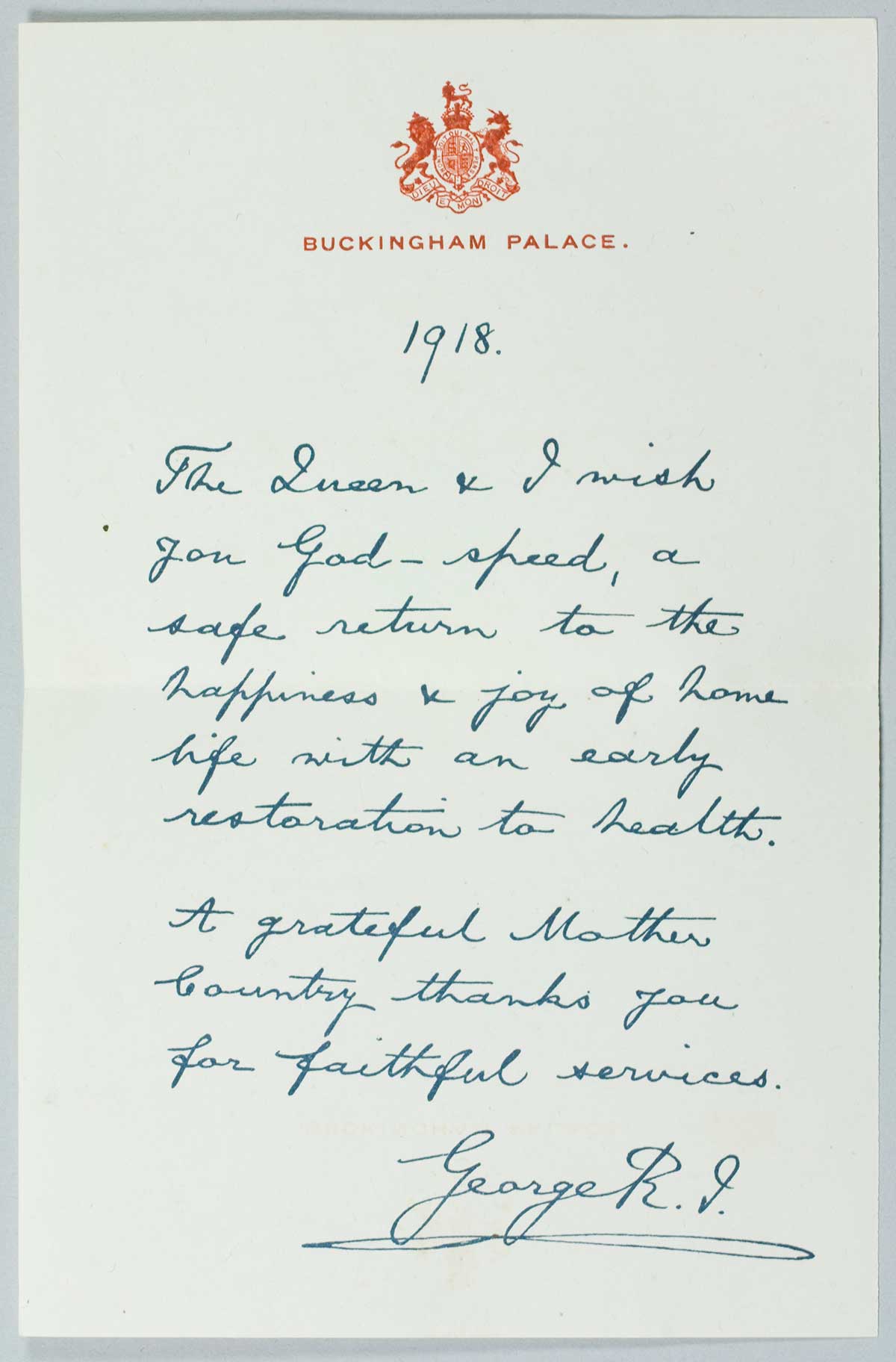
Letter of thanks for war service, 1918, Buckingham Palace, by George V, King of Great Britain. Gift of Cathryn Riley, 2012. Te Papa (GH022228)
1919 RSA branches had also formed at Temuka, Waimate and Geraldine. South Canterbury celebrated the signing of the peace treaty. Timaru was decorated and a large procession moved down Stafford Street. Fireworks and a bonfire were held at Caroline Bay. Around 6000 people gathered at Caroline Bay for a peace celebration Children’s Day.
Returning soldiers had to be reintegrated into civilian life. Government departments helped with training and employment. Disabled soldiers were taught skills to make products sold in special stores. A soldier-settlement farming scheme created about 186 local holdings, though some were unsuccessful.
Memorials were built across South Canterbury because most of the dead were buried overseas. They included obelisks, gates and other local forms of remembrance. Memorials appeared in almost every small settlement, showing the scale of grief across the province.
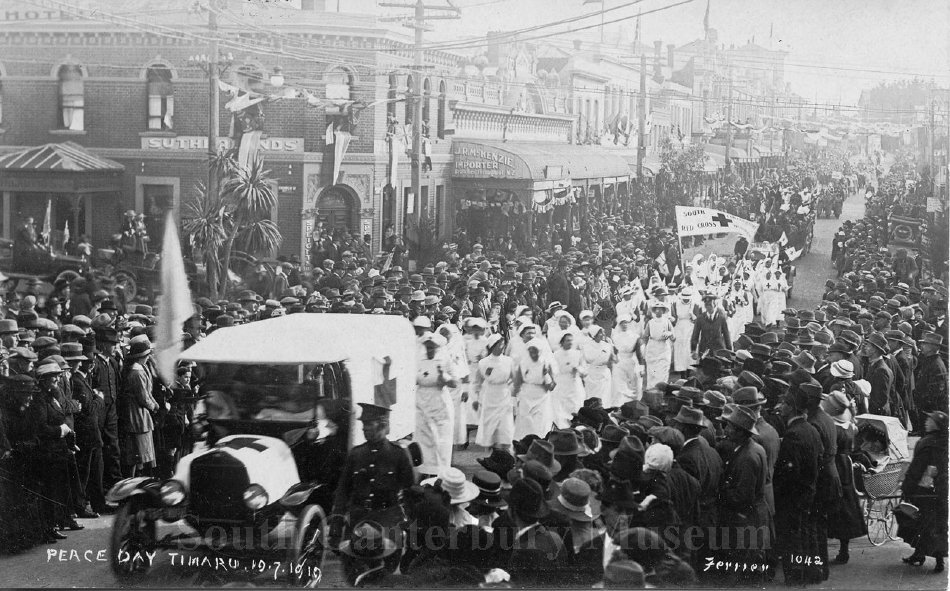
"A column of Red Cross nurses taking part in the Peace Celebration parade on Stafford Street, Timaru, 19 July 1919. Depicts the South Canterbury Red Cross personnel travelling southward on Stafford Street passing through the intersection with Church Street. They carry a Red Cross banner and appear to be led by an ambulance as they pass through a large crowd lining both sides of the street." - South Canterbury Museum. Peace Day Timaru 19-7-1919 - South Canterbury Museum 4315
1917 to 1923 Russian Revolution and Civil War, ideological conflict reshapes Russia and global politics.
1931 to 1945 Japanese expansion in Asia, including Manchuria and the Sino-Japanese War, becomes part of the wider Second World War.
1936 to 1939 Spanish Civil War, a rehearsal ground for fascist, communist, and democratic tensions before 1939.
1939 to 1945 Second World War, the largest war in history, including genocide, strategic bombing, atomic weapons, and the founding of the post-war international order.
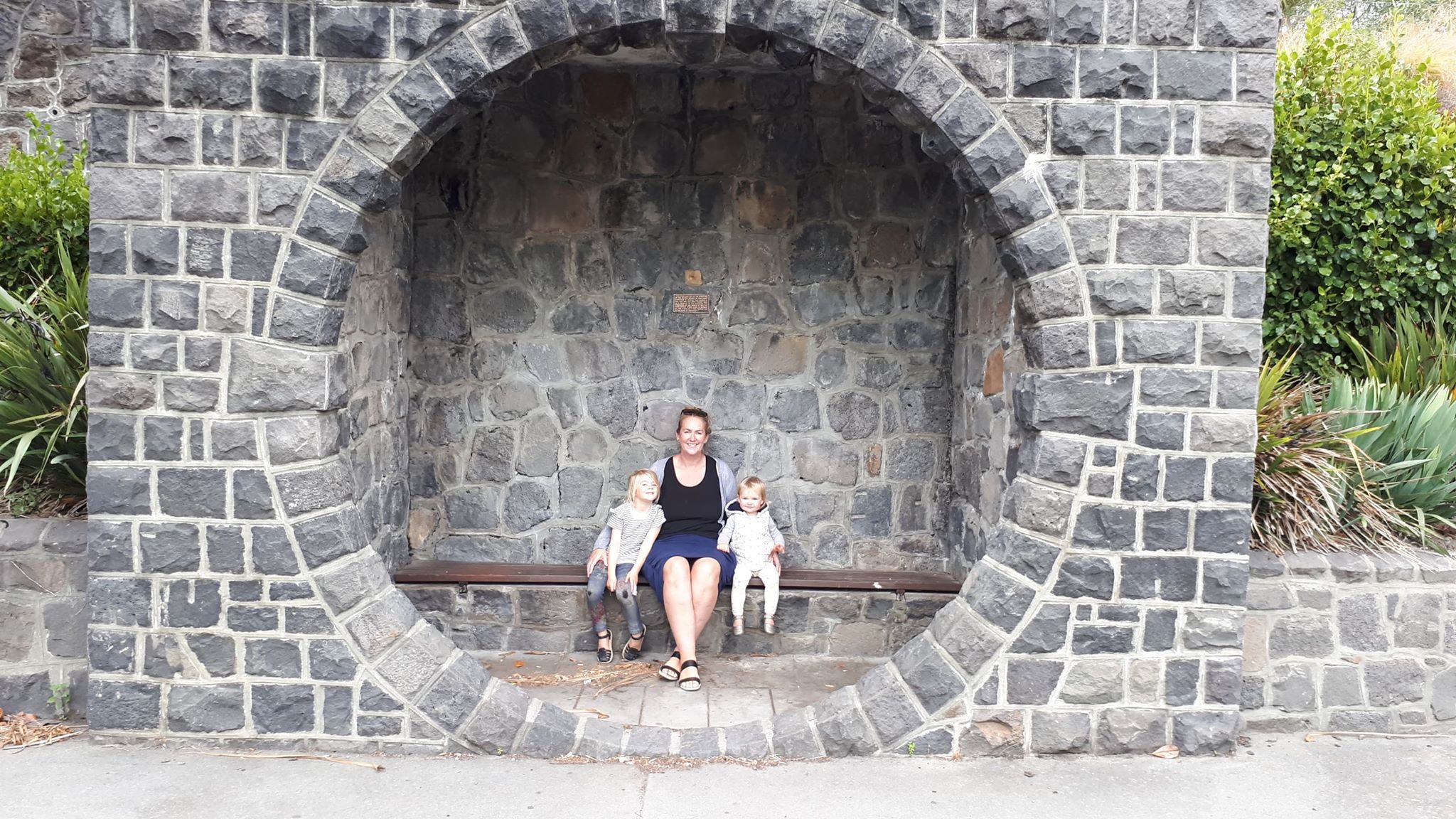
Embedded in the wall above the plaque is a brick from English Parliament buildings containing a bullet hole from an German aerial attack.
THIS STONE WAS PART OF THE STRUCTURE
OF THE BRITISH HOUSES OF PARLIAMENT
DAMAGED BY ENEMY AIR RAIDS IN
MAY 1941 AND HAS BEEN PLACED HERE
AS A TRIBUTE TO THE COURAGE AND
ENDURANCE OF THE PEOPLE OF ENGLAND
WHEN BRITAIN STOOD ALONE IN DEFENCE
OF HER RIGHT AS A FREE PEOPLE AND
IN THE CAUSE OF DEMOCRACY
1942 The Timaru Coast Defence/Artillery Battery at Bridge Road, Smithfield, was built in 1942–1943 after the army took over part of the Smithfield Freezing Works site during World War II. Completed by February 1943, it formed part of New Zealand’s coastal defence system and helped protect Timaru from possible enemy attack. The reinforced concrete battery included two gun emplacements, an observation post, and a munitions store. It was staffed by the 85th Heavy Coastal Battery, with 19 defence buildings and accommodation for more than 48 people on site. The camp closed in August 1944, and the battery was decommissioned in February 1945 when its guns and ammunition were removed. Today, it is recognised as a Heritage New Zealand Category 2 place and a Timaru District Council Category B heritage item.
1945 September, the Timaru Herald reported that the Timaru Borough Council proposed to build 50 houses using timber from Army huts. The first house had been built from the timber of six huts, and enough wood had been procured from Army huts to build the full 50 houses. The article says the scheme was an emergency response to the housing shortage for returned soldiers and others. https://paperspast.natlib.govt.nz/newspapers/THD19450929.2.18
1947 to 1949 Partition of India, Indo-Pakistani conflict, Chinese Civil War, and first Arab-Israeli War, new borders produce long-running disputes.
1950 to 1953 Korean War, one of the first major Cold War proxy wars.
1954 to 1975 Vietnam War and Indochina conflicts, decolonisation, communism, nationalism, and Cold War rivalry collide.
1954 to 1962 Algerian War of Independence, one of the defining anti-colonial wars against European rule.
1956 Suez Crisis, Britain and France’s imperial power visibly declines.
1962 to 1973 Sino-Indian War, Cuban Missile Crisis, Six-Day War, Bangladesh Liberation War, and Yom Kippur War, Cold War and regional conflicts overlap.
1975 to 1989 Lebanese Civil War, Cambodian genocide, Soviet-Afghan War, Iran-Iraq War, and wars in southern Africa, proxy war and civil war dominate.
1982 Falklands/Malvinas War, a short but symbolically powerful territorial war.
1990 to 1991 Gulf War, post-Cold War military coalition warfare begins.
1991 to 2001 Yugoslav Wars, ethnic nationalism, state collapse, genocide, and NATO intervention define post-Cold War Europe.
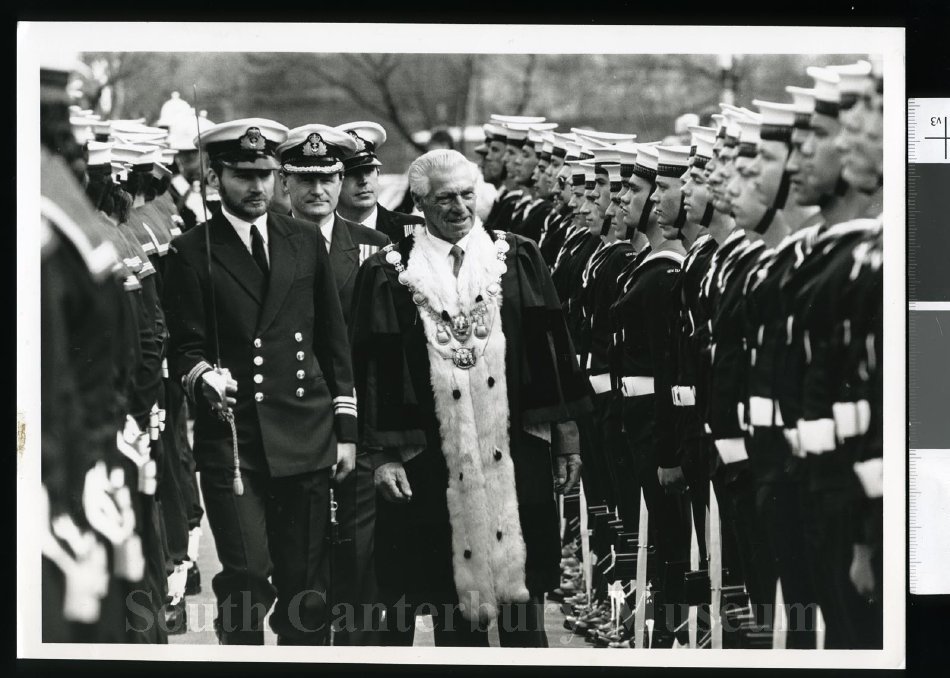
Timaru District Mayor Archie Houstoun inspecting sailors from the HMNZS Canterbury, dated 30 August 1991.
1994 Rwandan genocide, mass killing exposes the failure of international prevention.
1998 to 2003 Second Congo War, often called Africa’s Great War, involving multiple states and armed groups.
2001 to 2021 War in Afghanistan, launched after 9/11, becomes a long counterinsurgency and state-building war.
2003 to 2011, with aftermath Iraq War, invasion, occupation, insurgency, sectarian conflict, and regional destabilisation.
2008 Russo-Georgian War, Russia reasserts military force in the post-Soviet region.
2011 onward Arab Spring conflicts, especially Syria, Libya, and Yemen, show the modern pattern of civil war, foreign intervention, militias, and humanitarian disaster.
2014 onward Russo-Ukrainian War, beginning with Crimea and Donbas. CFR notes armed conflict in eastern Ukraine began in 2014 after Russia’s annexation of Crimea.
2014 The 100-year anniversary of World War I began. South Canterbury started a four-year period of remembrance. Centenary events were held across South Canterbury, often linked to major World War I anniversaries, such as the Gallipoli landings and the armistice. South Canterbury Museum played a leading role in the commemorations. The museum held exhibitions on different World War I themes, including the outbreak of war, Gallipoli, the Western Front, Timaru’s connection to HMS New Zealand, its ensign, and soldiers’ equipment. Museum education programmes helped local school students engage with the war’s history. A statue of a departing soldier was unveiled in Fairlie as part of local remembrance.
The South Canterbury WWOne Commemorative Committee Trust led wider community remembrance. It included representatives from local RSAs, South Canterbury Museum, Timaru District Council and military representatives. The Trust developed major community projects, including the White Crosses Project and interpretative panels. South Canterbury Museum led the development of SCRoll, an online database containing thousands of profiles of South Cantabrians who served in World War I.
2015 The White Crosses Project displayed crosses at Caroline Bay for Anzac Day, with one cross made for each local person who died in the conflict.
2017 During the museum’s Hell Let Loose exhibition on the Western Front, the museum’s temporary exhibition space became a theatre.
2018 South Canterbury Museum’s centennial exhibition programme concluded with Enduring the Inferno, which told the wider story of World War I in relation to South Canterbury. A touchscreen linked to the SCRoll database was used during the Enduring the Inferno exhibition. 11 November 2018 The anniversary of the armistice was marked in Timaru with a special dinner and auction. The dinner and auction raised money for a new museum in Le Quesnoy, France. At the end of the centenary period, the Trust funded a book based on South Canterbury Museum’s Enduring the Inferno exhibition. When the Trust was wound up, its remaining funds were gifted to Timaru District Council to help maintain the interpretative panels.
2020 Second Nagorno-Karabakh War, drones and rapid territorial change signal a new phase in regional warfare.
2022 onward Russia’s full-scale invasion of Ukraine, a major interstate war in Europe. CFR’s 2026 update describes the war as ongoing four years after the full-scale invasion.
2023 onward Israel-Hamas/Gaza war, Sudan’s civil war, and other severe conflicts underline that modern war is often urban, fragmented, civilian-heavy, and internationally entangled. CFR describes Sudan’s war as entering its fourth year, with nearly nine million internally displaced, and describes the October 2023 Hamas attack and Israel’s subsequent war declaration as the most significant escalation of the Israeli-Palestinian conflict in decades.