
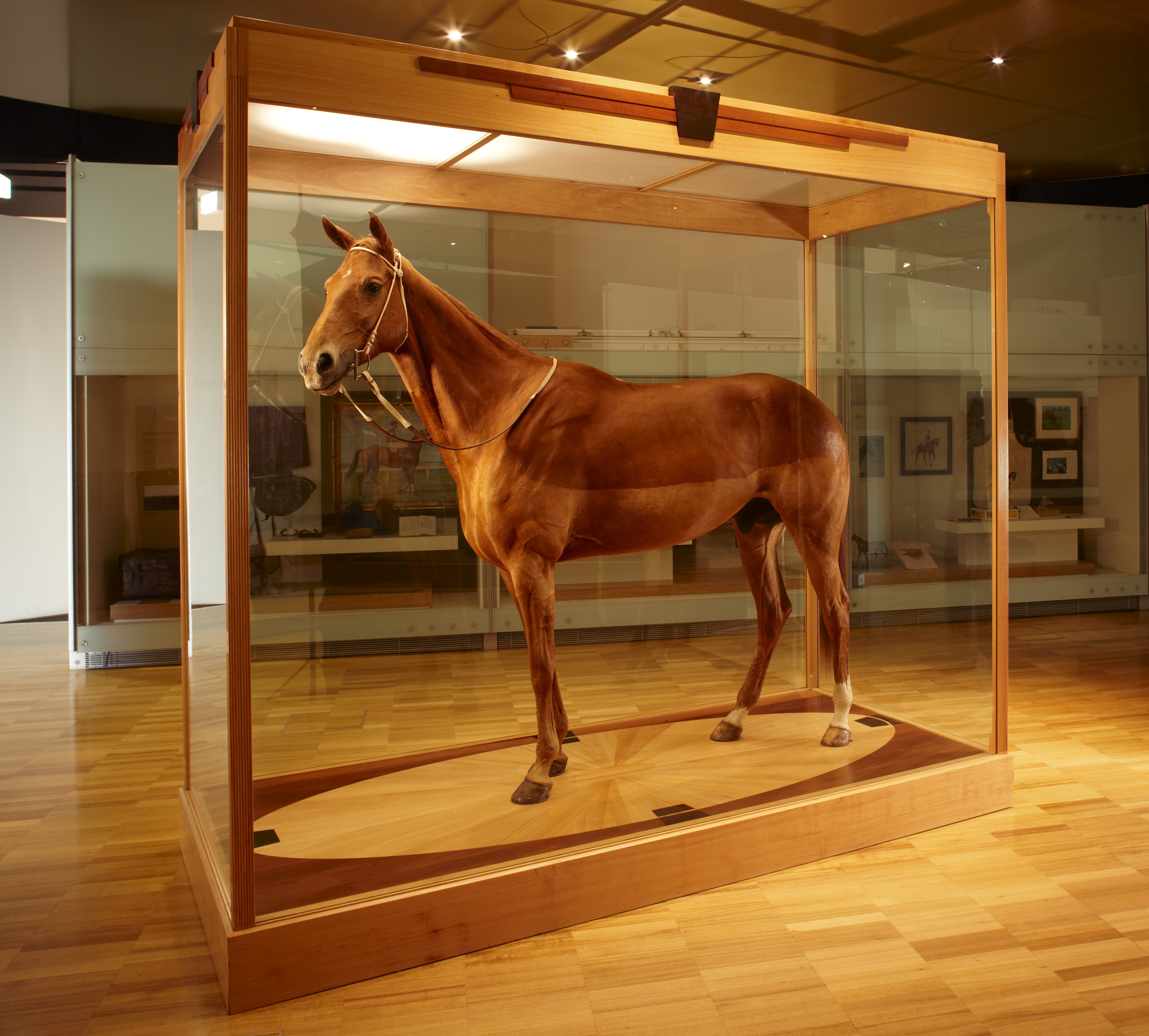
Phar Lap’s hide is currently on display at the Melbourne Museum, he stands 17.1 hands high. (Image: Museum Victoria 2009)
For generations, horses had powered everyday life.
They carried people, pulled carts, delivered goods and connected farms with Stafford Street, the railway and the port. Blacksmiths, saddlers, stables, carriers and horse dealers were part of the machinery of the CBD. But by the 1920s, hooves were increasingly sharing the road with tyres. Motor cars and trucks were changing how people travelled and how goods moved. The old horse-powered town was beginning to disappear.
Phar Lap was born between the two world wars, only eight years after the First World War ended. Then, as his racing career took off, the Great Depression hit. Money was tight, unemployment grew and newspapers and cinemas became important ways for people to follow stories far beyond their own town.
Into that world came a huge chestnut horse from South Canterbury.
Phar Lap became more than a racehorse. His victories gave people something to follow, argue about and celebrate during difficult years. Follow his story back through Timaru and you uncover something bigger: a CBD changing from hooves to tyres, and a community learning to live in a new modern world.
Horses arrived with South Canterbury’s pastoral settlers in the early 1850s. Timaru’s jockey club raced at Washdyke in 1860. In 1883, the Timaru Racecourse Reserve Act placed the public racecourse reserve under trustees. The course later became Phar Lap Raceway.
Phar Lap was born on 4 October 1926 at breeder Alexander Roberts’ 300-acre property at Seadown. As a young horse, Phar Lap was described as big, awkward and ungainly, and at the sales he was remembered as a poor walker who could even trip over himself. Roberts thought Phar Lap’s long legs might make him too slow to become a great racehorse, so he decided to sell him. He was sold at Trentham as Lot 41 and for 160 guineas, and sent to Australia. Another colt at the same sale sold for 2,300 guineas, showing just how little was expected of Phar Lap at the time.
Trainer Harry Telford adopted the name Phar Lap, said to mean “lightning” in Thai.
Phar Lap finished 9th out of 13 in his first race and did not win until his fifth start. He became an extraordinary champion, winning 37 of 51 starts, including the 1930 Melbourne Cup and the 1932 Agua Caliente Handicap in Mexico, then the richest race in the world. Phar Lap became famous not just because he won, but because he often beat very good horses convincingly.
His greatest years came during the Great Depression, when many families were struggling and his victories gave people something exciting to follow.
His rise coincided with a new age of mass media. Newspapers reported his races and radio carried the excitement live. Footage of Phar Lap was screened in New Zealand cinemas, helping turn the Timaru horse into an international sporting icon during the Great Depression. The race in Mexico was his only race in North America, and he died suddenly just 16 days later, on 5 April 1932, aged only five. Phar Lap died at Menlo Park, California, on 5 April 1932. Later testing of hair from his preserved hide found that he had ingested a lethal dose of arsenic shortly before his death. His sudden death shocked the public and helped turn a famous racehorse into a legend.
Today his skeleton is at Te Papa, his heart is in Canberra and his mounted hide is in Melbourne. South Canterbury remembers him at his Seadown birthplace and at the Phar Lap Raceway, Washdyke, Timaru, NZ.
At the Timaru memorial, his hoof is positioned over Timaru on a map of New Zealand, linking the world-famous racehorse back to where his story began.
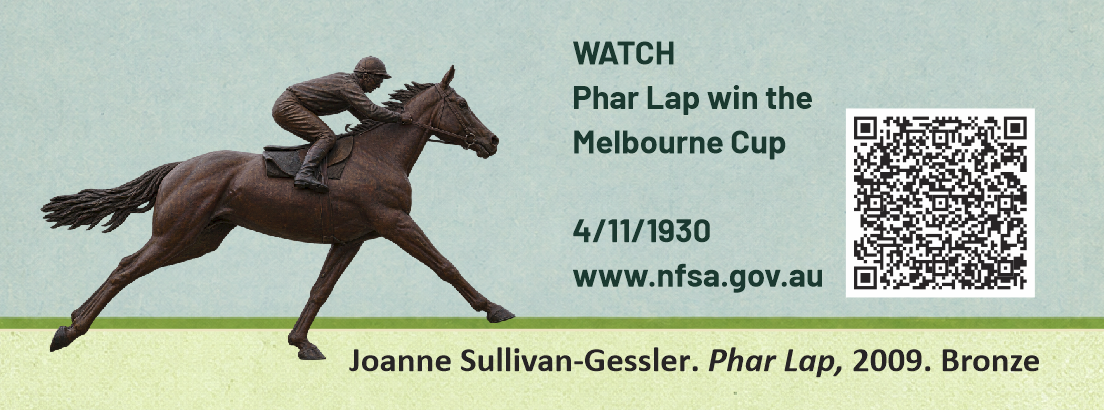
https://www.nfsa.gov.au/collection/item/phar-lap-wins-1930-melbourne-cup-tri-screen-view