
By Roselyn Fauth

People in the yard of The Pines on College Road in Timaru, home of the Bowker Family. Charles Bowker who owned The Pines, was a land agent in Timaru. - collection of Christchurch City Libraries. https://www.canterburystories.nz/collections/photohunt/2013/ccl-cs-14754 Charles Bowker died on 30 August 1915. He was buried at the Timaru Cemetery on 1 September 1915, recorded in the General Section (plot reference from the cemetery register).
This beauty of a home is no longer there. But a arch over the entrance to the Centennial Park does. A link to the Bowkers of Timaru. It was a while ago that I learned about them, so I thought I had better refresh my memory... The story starts with Charles Bowker, who arrived in Timaru in 1865 after a wandering early life through England, South Africa and Dunedin. His first work here was anything but easy. In one of his own recollections he described buying a bullock team to cart timber through bush tracks and along rough shingle roads. At one point the dray slid off near Aiken’s store and he needed several men to haul it back.
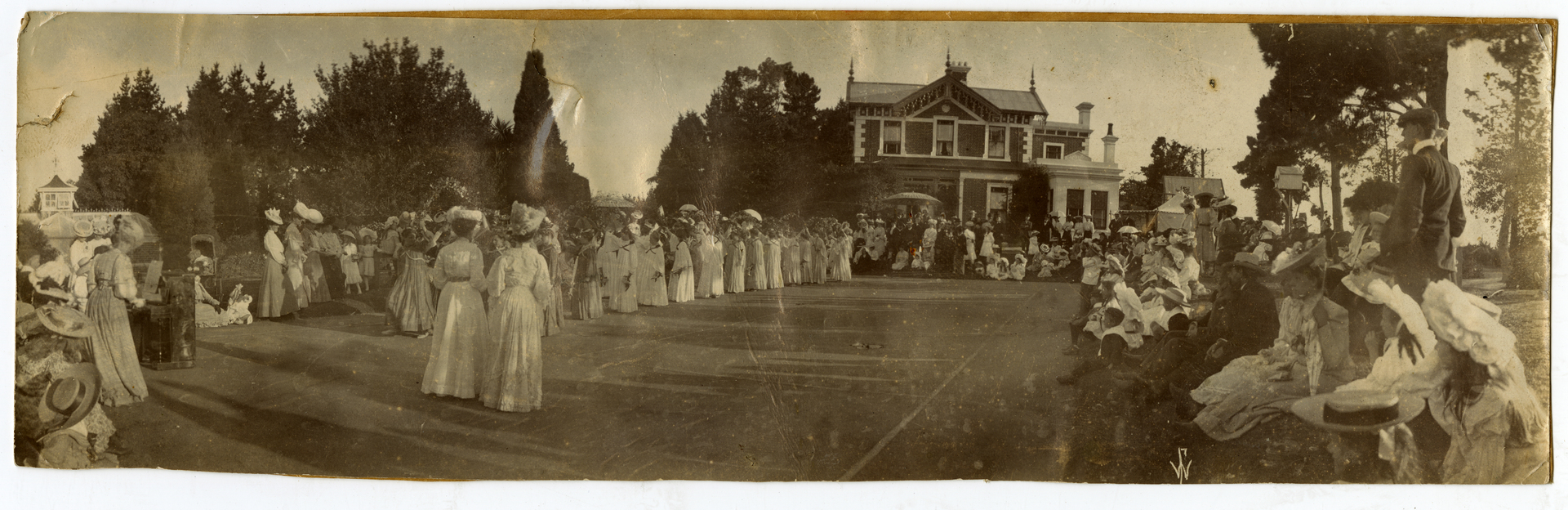
A crowd attending a garden party at The Pines on College Road in Timaru, the home of the Bowker Family.. Charles Bowker who owned the Pines, was a land agent in Timaru. Note on back of photo: The Pines, College Road November 29th 1906. Residence of W C Bowker, Timaru 1906. - Entry in the 2013 Christchurch City Libraries Photo Hunt https://www.canterburystories.nz/collections/photohunt/2013/ccl-cs-14551
Garden Party at the Pines - Bowker - 14551-CanterburyStories
Things steadied when Charles became manager of the drapery department at Clarkson and Turnbull’s general store at “The Corner.”
When the firm broke up, he purchased the boot side of the business and opened his own premises on Stafford Street. John Whittaker, who had managed the boot department, stayed with him as foreman and then tenant, running the business in Bowker’s shop for fifteen years.
It is surprising how much land Charles acquired over time. One of the more unusual stories came from an 1887 report, which mentioned him buying all the sections of a Cemetery Board reserve. This did not mean he bought cemetery plots. The Board owned extra blocks of ordinary land to sell or lease for income, and Charles bought the whole reserve. A paper road called Ashley Street ran through it, and he asked if the road could be added to his title. The Board agreed. It’s a good reminder that early Timaru’s map was still flexible, shaped by the people who were bold enough to ask.

Annie Elizabeth Bowker portrait. 1880s. Portrait of Annie Elizabeth (known as Elizabeth) Bowker, nee Whitla, was the wife of Charles Bowker of Timaru. Out of copyright thttps://discoverywall.nz/media/97011
This portrait shows Annie Elizabeth Bowker, known to her family simply as Elizabeth, the first wife of Timaru land broker Charles Bowker. Born Annie Elizabeth Whitla, she married Charles in the mid-19th century and became the mother of ten children, building a large, lively household during Timaru’s early settlement years.
She raised her young family at a time when Timaru was still rough around the edges, with new businesses opening, land being broken in, and early civic life beginning to take shape. The Bowker family later became well known for their hospitality at The Pines on College Road, but in these earlier years it was Elizabeth who held the growing household together.
This photograph dates from the 1880s, not long before her death. Elizabeth died in 1887, aged only in her forties, after a long struggle with tuberculosis. Her early passing changed the shape of the Bowker family, leaving Charles a widower with ten children and marking the end of a tender but often overlooked chapter in their story.
Although much of her life seems to have been lived within the home, Elizabeth’s legacy lives on through her children and grandchildren, and through the surviving records that reveal the strength and steadiness of a woman who helped build the foundations of one of Timaru’s early families.
Annie Elizabeth Bowker (née Whitla) died aged 43 of tuberculosis in 1887., 20 Aug 1887 and rests at the Timaru Cemetery in the General Section, Row 84, Plot 172.
George married Harriet Ann Warrington in 1892. Harriet stepped into a large blended household after Annie’s death — ten Bowker children, plus several still at home — and kept the family functioning through the 1890s and early 1900s.
You can work out the Bowker family story by looking at one row of the Timaru Cemetery. In Plot 173 lie Charles Bowker, his first wife Annie Elizabeth (née Whitla), and two of their children, Margaret Rebecca, who died at 22 in 1890, and Stanley John, who died at 22 in August 1915 just nine days before his father. Annie had already passed in 1887 at only 43, leaving Charles to raise their large family alone until he remarried in 1892. Directly beside them in Plot 174 rest Charles’s second wife, Harriet Ann (née Warrington), who lived to 79 and supported the Bowker household through its later years, and George Bowker, Charles and Annie’s well-known son whose gift of land helped form the entrance to Centennial Park. Further along the same row, in Plot 207, lies another daughter, Caroline Bowker, who lived into her seventies. Together these graves show the full arc of the Bowker family — early losses, a second marriage, long lives and short ones, and the quiet blending of two households whose members ultimately remained side by side.
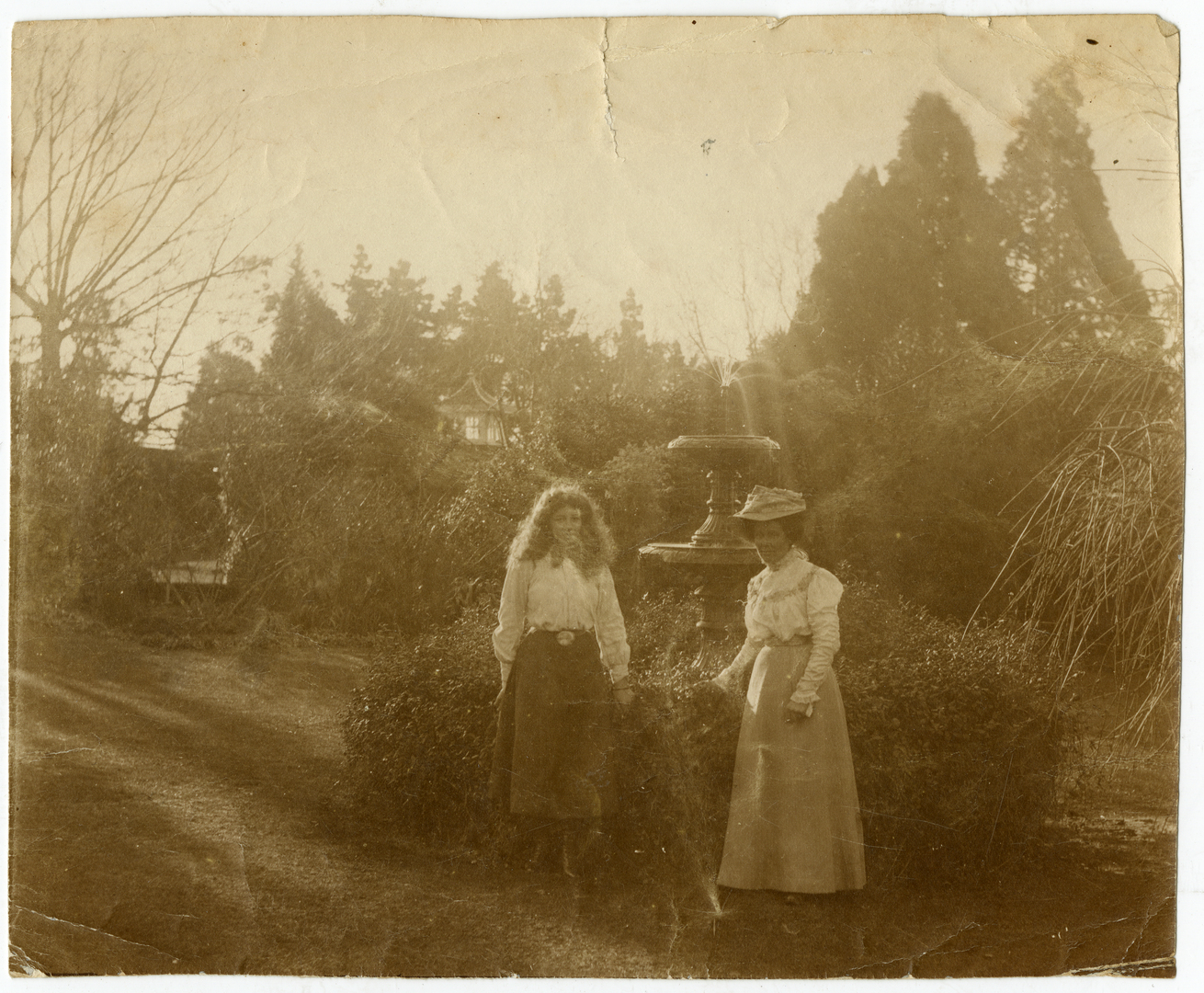
Two unidentified women in the garden of The Pines on College Road in Timaru, the home of the Bowker family. Entry in the 2013 Christchurch City Libraries Photo Hunt - https://www.canterburystories.nz/collections/photohunt/2013/ccl-cs-14757
Charles stepped frequently into civic affairs.
In 1903 he gifted a band rotunda to Timaru for Market Square and organised a design competition. Things became a little lively when the architect appointed as judge ended up designing the winning plan, prompting someone to write to the editor for clarification. That wasn’t the only time Bowker found himself in the paper. Another correspondent chided him for being “vindictive” after he complained, quite publicly, about delays in the service of a summons. He clearly expected things to happen promptly and wasn’t shy about saying so.
I think some of the most lovely parts of the Bowker story, centre around The Pines, the family home on College Road. It appeared in the newspapers over and over as the scene of community gatherings, church fêtes, musical afternoons and garden parties. Contemporary descriptions are lovely to read: shrubberies, a vinery, a conservatory, sweeping lawns, old oaks with wooden seats around them, and a summerhouse formed under a great weeping ash. Visitors admired the grounds so often that the papers almost sound proud on behalf of the town.
It seems the Pines was not just admired, it was shared. A Wesleyan fête held there drew hundreds of people, with floral marches, children’s dancing, decorated bicycles, music, and an afternoon tea line that kept the volunteers busy. Mr and Mrs Bowker were warmly thanked, and Charles replied that any trouble had been worth the pleasure it brought. One speaker even described Mrs Bowker as “a jolly good fellow,” which feels like one of the nicest compliments you could give.
In 1908 the wedding of their daughter Beatrice Bowker took place entirely on the lawn. Carpets ran from the house to the garden, daisies and rose petals marked the pathway, a Japanese umbrella sheltered the bridal couple, and the signing of the register took place inside a rustic tea kiosk hung with a floral bell. It must have been an extraordinary sight.
Charles died in 1915, leaving behind a life of steady work, civic scribbles in the letters-to-the-editor column, bold land dealings, and a garden that had become something of a local landmark.

Sons of Charles Bowker. 1910s A portraits of the sons of Charles Bowker at The Pines on College Road in Timaru."On back of photos: Charles, George, James, Thomas, Stanley, Vernon: Bowkers College Rd, Timaru. Stanley & Vernon were children of Charles' second marriage." No known copyright https://www.canterburystories.nz/collections/photohunt/2013/ccl-cs-14558?keys=Timaru&items_per_page=24
His son George Bowker, born in Timaru in 1877, took up the family’s role in civic life. He served on the Borough Council and the Licensing Committee, and developed a strong love of horticulture and birds. That interest shaped one of Timaru’s most distinctive public spaces.
Long before Centennial Park became the green basin we know today, it was shaped by forces far older than any of us. Around 2.5 million years ago, lava flowed from Waipouri’s Mt Horrible down to what is now the shoreline of Timaru. When it cooled, it formed the basalt that lies under much of the city. For decades, basalt from Centennial Park and neighbouring quarries was used in buildings, bridges, monuments, sea walls, harbour works and coastal protection. A lot of Timaru really is built from fire and stone.
The land for Centennial Park itself was later gifted to the city by George Bowker and the Timaru Harbour Board, to commemorate the 1840 centennial of New Zealand. The gateway off Church Street was erected by the City Council in thanks for their generosity. Today it’s easy to walk through that entrance without thinking about it, but once you know the story, the whole landscape feels different — part geology, part generosity, part Bowker.
So who were the Bowkers? They were builders, gardeners, organisers, hosts, fundraisers, steady workers, letter writers and land givers. They shaped the commercial heart of Stafford Street, opened their gardens to the town, contributed to churches and community groups, planted lasting greenery, and left a park and entranceway that many of us walk through without knowing the story behind it.
That is the joy of a Timaru history hunt. You follow a name, then a clue, and suddenly a whole family steps forward — textured, warm, a little fiery at times — and absolutely part of the story of the place we call home.
WuHoo Timaru — heritage hiding everywhere.
Side Quest: The Scenic Reserve Before It Became Centennial Park
Centennial Park feels so peaceful today that it’s easy to forget it began as something far more dramatic. Before it was a picnic spot, a walking track, or the place where kids learned to ride their bikes, it was a quarry gully shaped by fire, rock, and a surprising amount of quarrying.
Around 2.5 million years ago, lava from Mt Horrible flowed across the landscape and cooled into the basalt that still lies under much of Timaru. The Timaru Harbour Board later owned much of this land, and from the late 1800s the gully was heavily quarried to supply bluestone for the construction of the harbour. That stone was hauled out by small railways that once ran along Otipua Road, Wai-iti Road and James Street. Two of those old rail bridges across the Otipua Creek still survive, tucked into today’s walking tracks like relics from another world.
A facinating discovery came in 1889, when quarry workers removing rock for the North Mole, unearthed moa bones resting in clay from the Pliocene Age! Geologists believed the bones were among the oldest found to date. It is strange to think that the park we walk through today once revealed evidence of birds that vanished hundreds of years ago.
The reserve as we know it began to take shape in the 1930s, when the Borough Council negotiated to buy land from the Timaru Harbour Board and the King estate. And this is where George Bowker stepped into the story. About the same time, he donated 6.5 hectares of adjoining land near Otipua Road. His gift allowed for a central entrance to be formed opposite Church Street — the same one that became the Bowker Gates. The Council later acknowledged this generosity when the gates were officially erected in 1941.
In 1935 the Council sought advice from Dunedin landscape designer David Tannock, and with help from local horticultural and beautifying groups, trees and shrubs were planted, roads were formed, and the transformation from quarry gully to scenic reserve began. It was formally opened as the Scenic Reserve in 1938, then renamed Centennial Park in 1939 to mark the 100th anniversary of the Treaty of Waitangi.
Fast forward 50 years, and the park has taken shape thanks to a group of energetic locals over many years. In 1988 the Timaru Round Table launched an ambitious fundraising project to dam the Otipua Creek and create a lake. They raised $90,000, and by 1990 work had begun. The lake filled in May 1991, and volunteers planted 7,000 trees around the water’s edge.
Today Centennial Park feels like a natural part of Timaru’s landscape, but its history is written in so many layers... volcanic fire, quarry dust, railway embankments, donated land, community planting days, and one family’s quiet decision to give their land to the town.
Once you know the story, you can see the little hints of what used to be here, and the effort of the people who helped turn a quarry gully into one of Timaru’s favourite green spaces.


