
By Roselyn Fauth

A Corner of the Hospital Grounds, Timaru, 1900-1910, Timaru, by Alfred Hardy. Gift of Patricia M. Mitchell, 1989. Te Papa (PS.000598)
I didn’t really notice it until my Dutch family came to visit. We were halfway back from the medicinal garden at the Timaru Botanic Gardens to our car, when two of them, both young doctors, stopped and looked around. “You have a botanic garden right next to your hospital?” To them, it was unusual. Almost surprising. To me, it had always just been there.
That was a wee WuHoo moment.. where I realised how easily we stop seeing the things closest to us. And it sparked a question... Why are hospital and the gardens neighbours? Was it coincidence, convenience, or something more deliberate? As another year turns, I find myself thinking less about what needs to be added, and more about what deserves attention and care. The hospital and the gardens remind me that progress does not always mean replacing what came before. Sometimes it means remembering why it was put there in the first place. We now have a legacy legacy that began as a practical response to a problem, not a grand vision. While I hit publish on New Years Eve, I thank all those who have worked through the holiday season, especially our health care workers. I hope you get a chance to take a break and enjoy your neighbourhood as you prepare for the next phase of your shift. Here is my history hunt from a spark of curiosity...
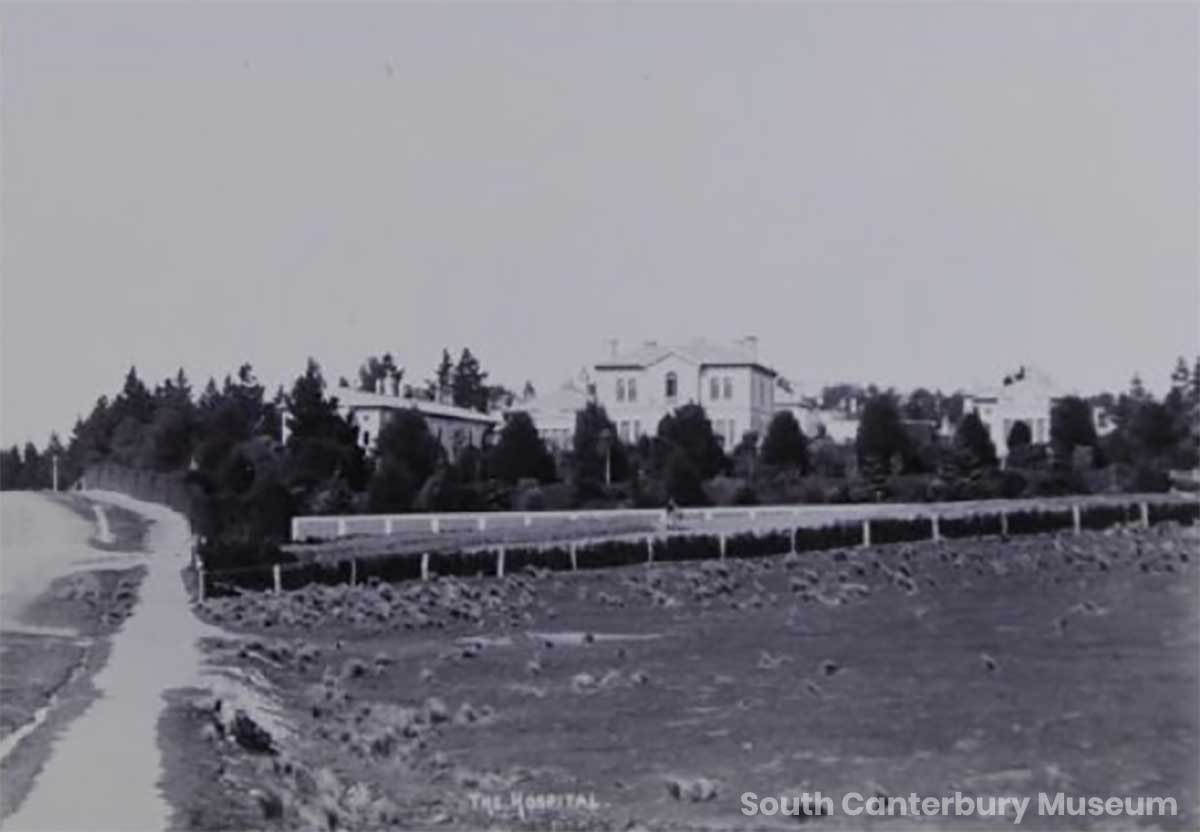
043-The-Hospital-on-Queen-Street-1887-1889-Sth-Canty-Museum-3867-1887-1889 South Canterbury Museum 3867
It was a garden before it was a hospital.
Timaru’s Botanic Gardens were established in 1864, making them one of the oldest botanic gardens in New Zealand. The Canterbury Provincial Government lifted land from what were then known as “waste land regulations”, and surveyor Samuel Hewlings set aside an area specifically for public gardens.
This was not decorative thinking. Across the nineteenth-century British world, botanic gardens were practical civic infrastructure. They were places for acclimatisation, education, scientific study, food production, and public wellbeing.
By 1867, the gardens were under the care of the Borough of Timaru Park Commissioners, and planting began the following year. Much of that early work relied on community effort. The Timaru Herald advertised for donations of trees, shrubs, bulbs and seeds. Physical labour was carried out by prisoners from the Timaru Gaol. Floral fetes raised funds.
Progress was steady rather than grand, even into the early 1900s, parts of the gardens were still leased for cropping and grazing. There used to be sheep, horses, deer and even a monkey! This was a working landscape, shaped gradually by the people of the town.

Frank Duncan & Co Ltd, Gardens Timaru NZ (1931). Aoraki Heritage Collection, accessed 31/12/2025, https://aorakiheritage.recollect.co.nz/nodes/view/31
At the same time, Timaru was learning how not to place a hospital... much of what I learned about Timaru’s first hospital comes from a detailed retrospective newspaper article published in June 1964, drawing together contemporary reports, correspondence and official findings. I have done my best to learn about this, though I am sure many readers will have more fun facts to add. I welcome you to share what you know too.
One of Timaru's earliest hospitals (if not the first) was built in 1864 near the corner of North Street and the West Belt, later Craigie Avenue, opposite what is now the Basilica on the highway. The site was described as being in a hollow, on damp and unhealthy ground.
The building itself was described as small and rudimentary, accommodating only five or six patients. Contemporary descriptions noted unfinished interiors, including unplastered ceilings and minimal furnishings. Public criticism followed.
The temporary appointment of Dr Duncan McLean, his replacement by Dr Christy, and McLean’s belief that political patronage was involved played out in letters published in the Timaru Herald. There was also criticism of the system under which the medical officer ordered drugs from a fixed allowance. Dr Christy responded by bringing a libel action against the newspaper, though it was abandoned before evidence was heard. The dispute led to a formal commission of inquiry, comprising Charles C. Bowen, C. Percy Cox and Dr Thomas Fisher. Their findings were clear. Hospital staff were praised for cleanliness and management, and the matron’s work was commended. Allegations of neglect were dismissed as unfounded and driven by jealousy.
But the site itself was condemned. The commission strongly recommended relocation, and so the shift south began. The Provincial Government set aside four acres in the Park Reserve in 1868 for permanent hospital use. Construction of a new hospital building began later that year, and in 1870 a larger hospital opened, capable of accommodating more than 30 patients.
This decision placed the hospital directly beside the established public green space we know as the Timaru Botanic Gardens.

View from the hospital over the helecopter pad to the trees at the Botanic Gardens - Supplied Dr Kelly Sweerus 2025
It was not accidental. It reflected contemporary medical thinking that access to fresh air, light and gardens supported recovery. Long before antibiotics and modern surgery, hospitals were designed around ventilation, outlook and environment. Timaru was not alone in this thinking. Christchurch Hospital, for example, was deliberately positioned beside Hagley Park, its buildings framed by open land and trees.
Over the following decades, the hospital and gardens evolved side by side.
The first glasshouse and conservatory were built in 1905. The Band Rotunda followed in 1912. During the Great Depression, unemployed men were engaged to carry out manual improvements, including hand-digging the duck ponds. Between 1936 and 1939, 20,000 daffodil bulbs were donated. In 1940, pupils from South School planted trees along Domain Avenue.
In 1938, further land was formally subdivided from the Botanic Gardens to allow for hospital expansion, cementing the shared boundary that remains today. Contemporary descriptions noted that this provided patients and visitors with a “lovely environment for rest, recuperation and reflection”.
The two sites grew together.

View North to the sea. Supplied by Doctor Kelly Sweerus office in 2025
Reading newspapers from 2000s however I noticed a change in ideas of medical care and progress. There is a really interesting newspaper supplement from August 2000, held in the Aoraki Heritage Collection, celebrating the redevelopment of Timaru Hospital. It radiates confidence and pride. The hospital is presented as modern, efficient and reassuring. The focus is firmly on what happens within the hospital walls: consolidated services, improved patient flow, upgraded wards, new theatres, and interiors designed for privacy and dignity.
What I thought was interesting wasn't so much what they reported on, but what was not mentioned.
Despite the hospital’s proximity to the Botanic Gardens, there was no reference to landscape, outlook, or the restorative value of green space. Wellbeing was framed almost entirely in terms of buildings, technology and internal efficiency. I wonder if this was on purpose, a rejection of the earlier rest and recovery in fresh air ideas... either way I thought the absence was revealing. It is not a criticism, but a reminder that ideas about health evolve. In 2000, progress meant catching up with modern medicine and service delivery.
My dad often reminds me how as a kid he slept with the windows open all through the year, babies were often rugged up, but left to snooze outside. I wondered if there is some truth to these gut instincts, so I found some thesis online that walked me through how modern research has caught up with what earlier generations understood intuitively.
Studies consistently show that access to green space reduces stress, improves mood, and supports emotional regulation for patients, visitors and staff. Views of nature have been linked to shorter hospital stays and reduced reliance on pain medication.
In 2013, landscape architect Kelly Martin studied how hospital healing gardens affect visitors and staff, not just patients. People who had access to a garden reported feeling calmer, less stressed, more able to cope. Staff described improved mood and emotional regulation. Visitors felt more grounded at moments when they were often anxious or overwhelmed. I often see staff resting on a bench under a rata tree. I wonder if they are intuitively drawn here because of the tree?
Research by Roger Ulrich, often cited as foundational, showed patients recovering from surgery needed less pain medication and went home sooner when they could see trees through a window. Not a park visit. Just a view. It feels almost too simple, until you remember how your body responds when your eyes rest on leaves moving in the breeze.
A thesis by Clare Cooper Marcus and Marni Barnes’ explains how healing gardens work best when they are legible and welcoming. Botanic gardens are particularly effective in healthcare settings because they are structured and legible environments. Clear paths and labelled plants provide orientation and calm at times when people are often anxious or overwhelmed. Nature can support dignity, emotional resilience, and recovery, not just for patients, but for everyone who passes through a hospital.
It would be interesting to talk to medical professionals today to hear their thoughts on this. Are patients encouraged to have a wheelchair ride round the gardens? Are patients reminded about the benefits of a garden stroll?
A 2023 design framework published in Frontiers in Public Health describes healing gardens as cost-effective, non-invasive interventions and recommends integrating them directly into hospital planning rather than treating them as optional extras. It is interesting to validate that what was once instinctive is now measurable.
After my little wander through the gardens yesterday and a history hunt this morning... I have realised there is a relationship worth protecting... Today, Timaru Hospital and the Botanic Gardens continue to function as a shared landscape of care. In 2014, the gardens were recognised as a Garden of National Significance, acknowledging more than 150 years of continuous public stewardship. The decision to place a hospital beside a botanic garden was not decorative or accidental. It was shaped by hard experience, public scrutiny, and an early understanding that place matters.
While I am sure it was well considered and the cafe was relocated to where it was for lots of good reasons. I was personally disappointed that the hospitals new cafe didn't look out and connect to the gardens. I would have preferred to have had a cuppa looking out to trees rather than all those who came and left the hospital threshold. This week history has reminded me to pop to the gardens more often. I don't have to have a huge walk, I could just pick off one section and explore it more thoroughly. Hunt for the John Lennon Tree by the tennis courts, read the plaques of trees near by, investigate the war memorial, sniff some roses, study the plants in the medicinal garden, enjoy the earthy smells at the fernery and conservatory... My visiting family found it strange how few people were at the Timaru Botanic Gardens when we visited. Obviously if we were Amsterdam the area would be packed. I'm grateful that I can sometimes feel like I have the huge space to myself. Its a peaceful space to relax, rewind, be curious, recover and recharge.

Photo from Doctor Kelly Sweerus office in 2025 overlooking the carpark, the rata tree and the Timaru botanic Gardens.
In 1864, Timaru set aside land for everyone.
In 1868, it chose to heal beside it.
Those were values are visible by two neighbours in the landscape.
As our health system continues to evolve, perhaps the question is not just how we modernise, but what we can also bring with us from the past along the way.
So next time you’re at the hospital, take the path into the gardens. Sit for a moment if you can.
The trees are much taller now, waiting for you to walk past or sit under them.
Thank you to the Timaru District Council for maintaining the park.
when so many of us have smaller home sections and lack space for large trees and gardens, I am grateful I can experience this at the Timaru Botanic Gardens.

The corner of the reserve for the Timaru Botanic Gardens was carved off for a new hospital as seen here in this survey in the 1870s.

Timaru's first hospital emerged not from a grand governmental plan, but from the persistent advocacy of civic leaders like Belfield Woollcombe, responding to urgent health needs. Though modest in size and imperfect in location, the 1862 hospital marked the start of organized medical care in the region... a foundation that would grow into the Timaru Hospital we know today. I just assumed that nursing was a centuries old perfession, in today's deep dive, I have learned it is far more recent and through the work of the community we have saved many lives and improved the standard of care for those who became unwell, and in prevention too.

Established and stunning variety of trees at Timaru Botanic Gardens - Roselyn Fauth

Gardens, Timaru, 1912, Timaru, by Muir & Moodie. Purchased 1998 with New Zealand Lottery Grants Board funds. Te Papa (PS.002216). During the depression (early 1930s) the council reduced wages and expenditure. Unemployed men were engaged for manual work, including improving the two duck ponds by digging them out by hand. Between 1936 and 1939, 20,000 daffodil bulbs were donated to the gardens and a few years later, in 1940, pupils of South School planted 60 trees along the Domain Avenue frontage of the gardens.

Gardens, Timaru, 1912, Timaru, by Muir & Moodie. Te Papa (O.001833)

Gardens, Timaru, 1911, Timaru, by Muir & Moodie. Te Papa (O.001835)

In the Gardens, Timaru, New Zealand, 1900-1910, Timaru, maker unknown. Gift of Patricia M. Mitchell, 1989. Te Papa (PS.000739)

The "Early Timaru Hospital" on Queen Street, Timaru, circa 1870. Depicts the Timaru's second hospital but the first on the Queen Street site. Construction of the bluestone building began in 1869 but the hospital was not occupied until 1870. South Canterbury Museum CN 1116.

Timaru Hostpital, 1880s, Dunedin, by Burton Brothers. Purchased 1999 with New Zealand Lottery Grants Board funds. Te Papa (O.034094)

In the Gardens, Timaru, New Zealand, 1900-1910, Timaru, maker unknown. Gift of Patricia M. Mitchell, 1989. Te Papa (PS.000739)
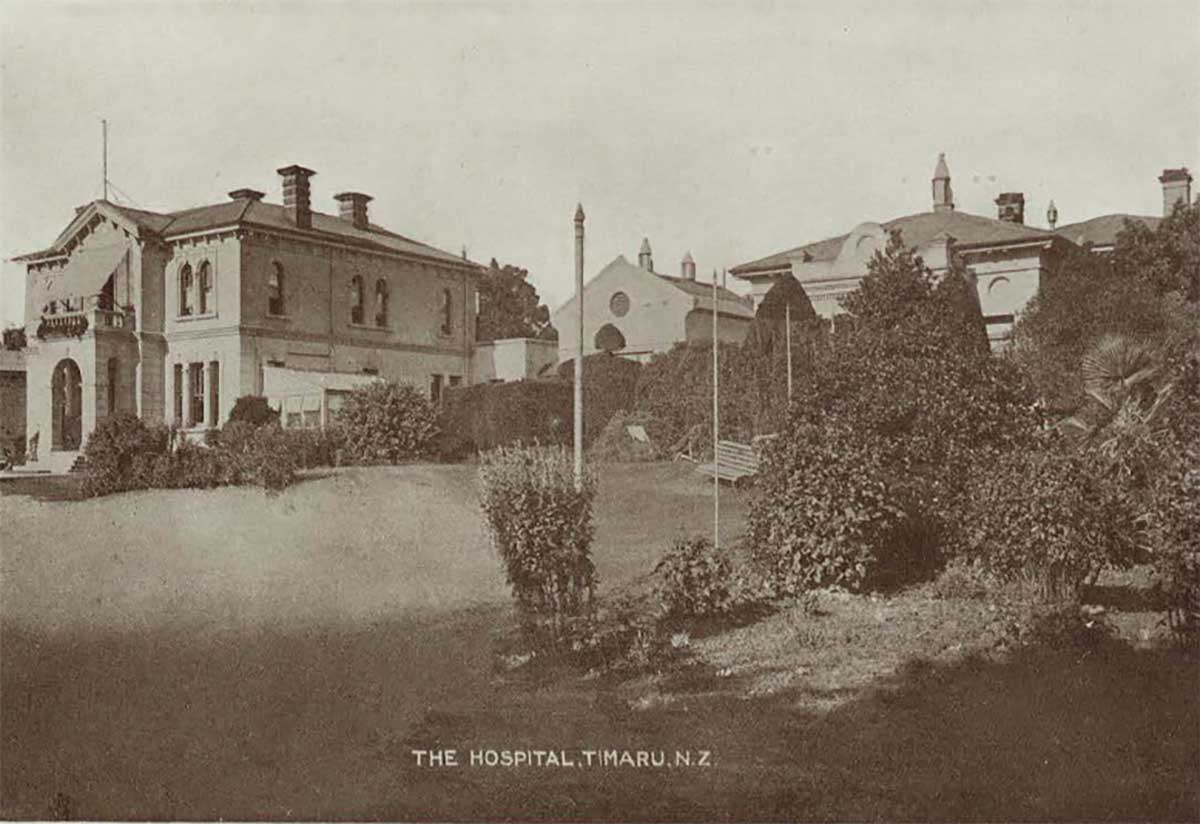
Picturesque Timaru. Aoraki Heritage Collection, accessed 10/05/2026, https://aorakiheritage.recollect.co.nz/nodes/view/8917

The Hospital, Timaru, N.Z., 1900-1910, Timaru, maker unknown. Gift of Patricia M. Mitchell, 1989. Te Papa (PS.000596)

Possibly about 1896 to 1899 "The town of Timaru is about 100 miles from Christchurch, and 128 from Dunedin, and is the principal town of South Canterbury. Among its fine buildings and institutions, there is not one of which the citizens are more proud than its Hospital, the subject of our illustration, and for convenience and good management, it can hold its own with any in the colony. It speaks well for a young colony, when the alleviation of the physical sufferings of its inhabitants is one of the first things to be provided.”
Christchurch City Libraries - The imperial album of New Zealand scenery, page 238 https://www.canterburystories.nz/collections/publications/imperialalbum/ccl-cs-39434 No known copyright
In 1938, more land for Timaru Hospital was subdivided off from the Botanic Gardens. The idea that green space supports healing was already well understood. Gardens give people somewhere to walk, sit, wait, breathe and think. They support patients, visitors and staff alike. There’s something about being around plants, and a gentle stroll. A lovely environment for rest, recuperation and reflection. It’s good for the soul.

1956 Timaru Hospital - PA-Group-00080 Whites Aviation Ltd Photographs- nlnzimage

Timaru Hosptial 1985 - Retrolens https://files.interpret.co.nz/Retrolens/Imagery/SN8472/Crown_8472_G_10/High.jpg


Timaru-Hosptial-c2000-data-linz-govt-nz https://data.linz.govt.nz/mapviewer
The J. C. McKenzie Block was formally opened around 1973–1974 (the article is consistent with mid-1970s inflation references and a start date of September 1971). That block is the same one later mentioned in your 1979 “Fountain to be Joint Effort” article — meaning the fountain was built directly in front of this new building’s forecourt only a few years after it opened. The architectural firm listed here, G. W. MacDonald, and contractor C. Lund and Son, could have been referenced or consulted again for the fountain installation in 1978–79. The description of the block’s forecourt and functional layout helps confirm the exact site where the fountain once stood — the public-facing entrance built with service access and parking in mind.
Hospitals and gardens belong together. When communities invest in nature within healthcare spaces, they invest in dignity, calm, and compassion.

Allison Lomax and Joe Butterfield posed at the fountain in the carpark area of Timaru Public Hospital dated 7 August 1996 - South Canterbury Museum

Postcard showing view of the curator's house at the Timaru Botanic Gardens. Aoraki Recollect


The Magnolia growing in the centre of the round-a-bout was presented by the Timaru Beautifying Society to commemorate the community work of Lois Thodey– President of the society 1977-1980. Lois Thodey was President of the Timaru Beautifying Society (or at least held a leadership role) during 1977-1980. She was honoured by the society for her community work afterwards (hence the memorial tree). The society itself had the fountain project as one of its major efforts, and thus it is very likely that Lois Thodey was involved with or at least aware of the fountain initiative. I wonder if she thought about the power of a garden and how it was healthy for us?

Survey Photography - 1956 Timaru Hospital. PA Group 00080 Whites Aviation Ltd Photographs. nlnzimage

https://collection.canterburymuseum.com/objects/971975/photograph-timaru-hospital

Timaru Public Hospital Celebrates Centenary: Modern Institution Today Serves Widespread District (26 Sep 1964). Aoraki Heritage Collection, https://aorakiheritage.recollect.co.nz/nodes/view/7699
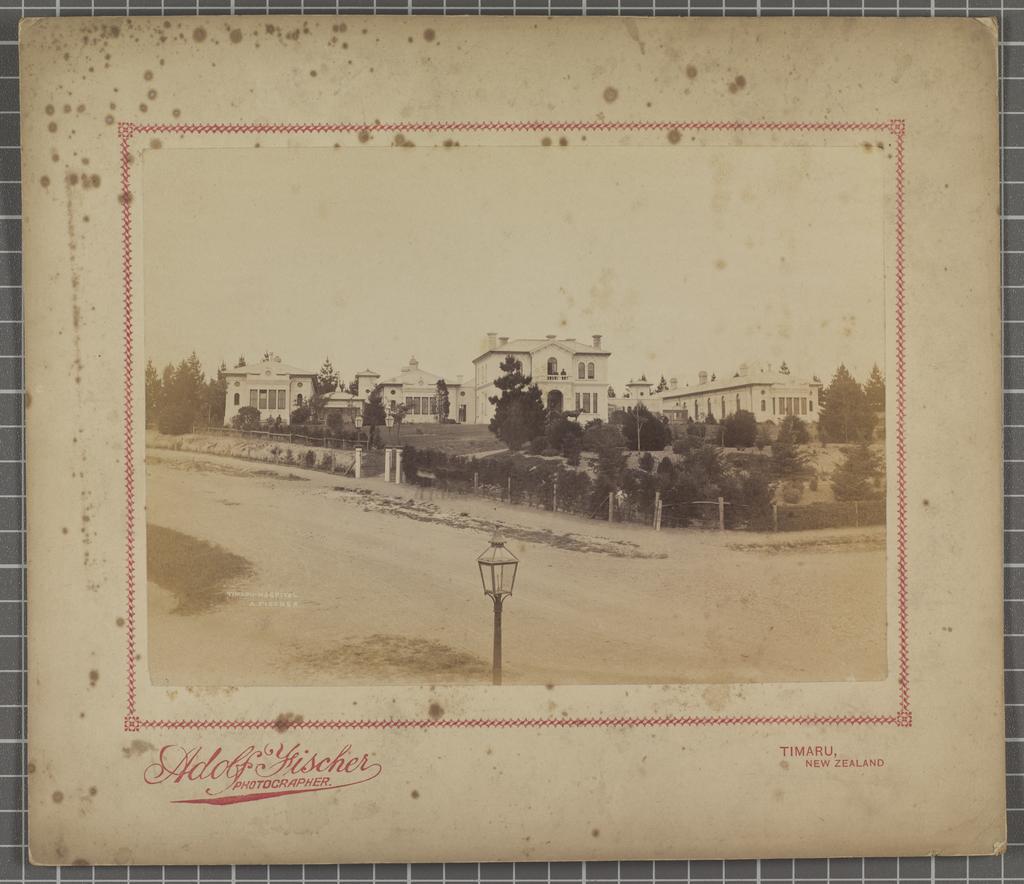 https://hocken.recollect.co.nz/nodes/view/55672
Fischer, Adolf, Timaru Hospital (1887-1899). Hocken Digital Collections, accessed 04/04/2026, https://hocken.recollect.co.nz/nodes/view/55672

Timaru Hospital Nurses Home c1920 - Post and Telegraph motorcycle and sidecar South Canterbury Museum 2021-057-02

Timaru Hospital during construction in 1972 - South Canterbury Museum t6155 1972

Hospital buildings Timaru probably taken in 1964 south Canterbury Museum 201407209

Hospital buildings Timaru probably taken in 1964 south Canterbury Museum 2014/072.10

Christchurch also paired their hosptial and gardens. This is an aerial view of Christchurch Hospital, Hagley Park and the surrounding area including the Christchurch Nurses Hostel, St Andrews Presbyterian Church, Aulsebrooks Biscuit Factory and Addington Cemetery. Christchurch Star: West / Hagley Park
Key theses and academic works on hospital healing gardens
Kelly Martin: Hospital Healing Garden Design and Emotional and Behavioral Responses of Visitors and Employees. Degree: Master of Science Institution: Auburn University, USA Year: 2013: https://etd.auburn.edu/bitstream/handle/10415/3462/K.%20Martin%20Thesis-%20Hospital%20Healing%20Gardens.pdf
This thesis directly examines how healing gardens affect patients, visitors and hospital staff, measuring emotional response, stress reduction and satisfaction. It is one of the strongest single thesis-level studies linking gardens and healthcare environments.
Clare Cooper Marcus and Marni Barnes: Healing Gardens: Therapeutic Benefits and Design Recommendations. Academic book drawing on multiple doctoral and master’s theses. Institutional context: University of California, Berkeley Full text (open access chapter PDF): https://escholarship.org/
While not a single thesis, this work synthesises decades of postgraduate research and is frequently cited in landscape architecture and healthcare design theses worldwide.
Ulrich, R. S: View Through a Window May Influence Recovery from Surgery. Type: Peer-reviewed study foundational to later theses. Institution: Texas A&M University. Year: 1984
https://www.science.org/doi/10.1126/science.6143402
This research underpins many later master’s and doctoral theses on healing environments. It demonstrated that patients with views of trees recovered faster and required less pain medication than those without.
Frontiers in Public Health – Design Framework. Authors: Multiple (international research team). Integrating Healing Gardens into General Hospitals: A Design Methodology: 2023
This article draws heavily on postgraduate research and proposes a structured methodology used in contemporary hospital design and landscape architecture theses.
https://www.frontiersin.org/journals/public-health/articles/10.3389/fpubh.2023.1288586/full
Therapeutic Hospital Gardens – Literature Review. Author: Various academic contributors. Type: Systematic literature review often used as a thesis foundation
This review collates findings from numerous master’s and doctoral theses and defines “therapeutic hospital gardens” as a recognised research field.