
By Roselyn Fauth

There is a thinning that can happen to history where names can fade, context loosen, and the everyday knowledge of who lived where, and why, slips into the past. This is why I love buildings and cemeteries. They are what phuysical things that can endure when memories do not.
I began my Larnach history hunt at the gate, giving a tap of my credit card in exchange for two tickets and entery to the grounds. At that point, my understanding of the family and their castle was shallow. I knew the outline of the story, but not much more.
The view from the top of the drive takes your breath away. Almost as much as the climb up the steps to the front door. Arrival requires effort. Their epic entrance steps are steep. I am sure this was all part of the architect Robert Lawson's vision to get a reaction from guests when they arrived.
We were greeted and reccomended to start in their musuem, and then left to wander. Room by room into a life lived before we explored and looked at their fancy home. This was not just the place where a wealthy man comissioned his castle, but a home for the the women who moved through these spaces daily. I'm not gonna lie the place is quite the spectacle... and I have learned so much more about women throught this history hunt.

William James Mudie Larnach was a banker, businessman, and politician. He moved comfortably through the goldfields of Australia and the corridors of power in New Zealand. He met Julius Vogel and Richard Seddon before any of them had settled into the kiwi roles history now assigns them. Their lives would remain intertwined. Politics, finance, ambition, and risk braided tightly together.
Larnach’s wealth rose quickly and later as I learned fell just as dramatically. He chaired banks, floated loans in London, helped launch refrigerated shipping, and bred prize stock on the Otago Peninsula. He also experienced collapse. Partnerships failed. The Colonial Bank was liquidated. The certainty of money proved as unstable as it was intoxicating.
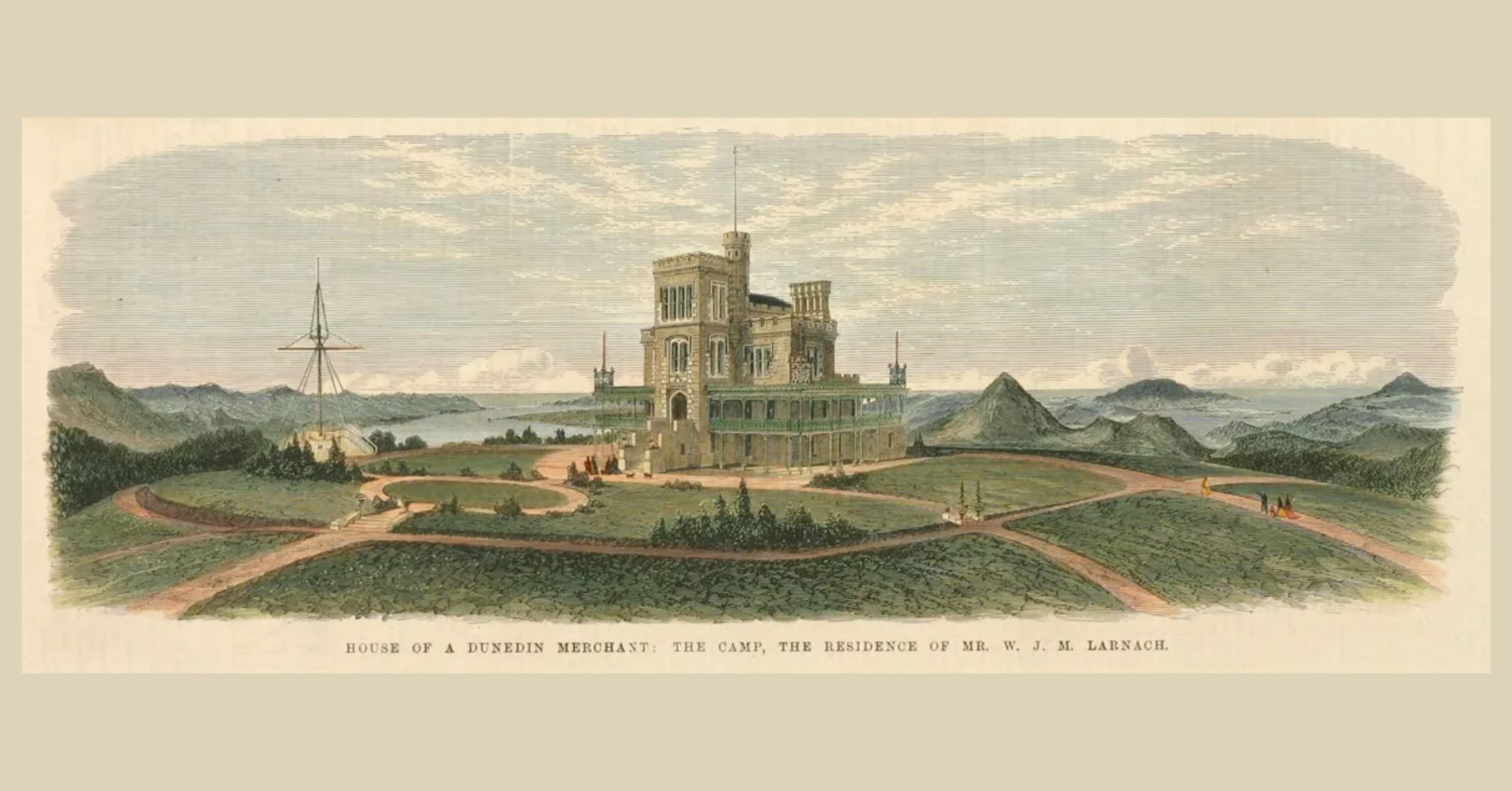
The Australasian Sketcher
The castle was part of that ascent of wealth and the show of it. Designed by architect Robert Arthur Lawson, it drew on European forms and imported materials, translated into local stone and labour. It was never just a residence. It was a statement of arrival. While it had some typical elements of a medieval castle or a residence of a Balmoral royal, I can't help but feel it was all for show, and that deep down I wonder how hard it might have been to keep up appearance and if the facade was fake.
William moved in with his wife Eliza, her sister Mary, and the children, Donald (the eldest at 14), Kate, Douglas, Colleen, and six year old Alice. Donald went to Christ College in Christchurch, while a goveness looked after the girls at home. Each had their own personal maid. The household was self-sufficient with produce from home farm. They often had friends and family come to stay, including four future Prime Ministers, Julius Vogel, Robert Stout, Richard Seddon, and Joseph Ward. The author who wrote the words for the New Zealand National Anthem is said to have written the poem 'Not understood' while staying here. And it was in the library where Stout and Seddon were reputed to debate the pros and cons of giving women the vote.

Left: Colleen Larnach and Elliot Hume on their wedding day. Right: Williams third wife and later widow Constance de Bathe Brandon Larnach. Their married in 1891 when she was 35 and he was 57. She wore a gorn of cream satin embossed with sprays of lily of the valley which had been fashioned at Kirkaldie of Stains. Larnarch too his new wife everywhere. He bought a house at 45 Molesworth St, Wellington and along with the Seddons, who lived next door, and the Ward family, they spent many evenings at home singing around the piano.

Left: Eliza Jane's sister, Mary Alleyne, who became the second Mrs Larnach. Centre: Eliza Jane Larnach (nee Guise), Williams's first wife. Right: Alice, Kate and Colleen Larnach.

Life at “The Camp” was a place where Larnach's women lived together in confined spaces. The men were frequently absent and while decisions were made away, the consequences were lived at home.


What I learned was the castles architecture tells only part of the story, and like Williams life at times, it was just a facade.
Eliza Jane Guise was born in Australia. Eliza married William Larnach in 1859. She bore six children in quick succession. She travelled when required, waited when left behind, and lived much of her married life separated from her husband as he pursued opportunity elsewhere. The interpretive signage at the castle suggests loneliness. It notes illness. It shows repeated pregnancy, long absences, and declining health.
In 1877 William, Eliza and her sister Mary went to Melbourne to go shopping. A year later they travelled to London and William bought a house in Kensington. The girls had a tutor while Douglas lived with his uncle and enjoyed an extravagant lifestyle. While in London another daughter, Gladys, was born to Eliza and William. Their older children stayed in Britian for their education, and William, Eliza, Mary and baby Gladys returned to New Zealand. It must have felt lonely in that big castle with out the children there.
In April 1880, as a way to cheer her up, William rented a town house for Eliza, her sister Mary and infant daughter. It was here, later that year while William was in Melbourne, that Eliza was to die suddenly and unexpectedly. Eliza died of a apoplectic fit (a stroke), aged just 38. Her death changed the famioly home and then cemetery landscape.
The tomb a 'sepulchral chapel' built in 1881 for her stands in Dunedin’s Northern Cemetery. Designed by robert Lawson, the same architect responsible for First Church of Otago, Timaru's Former Government Buildings and Post Office, and Larnach Castle. Her tomb is epic. It deliberately echoed the Gothic authority of Otago’s most important place of worship. At 17 metres high, it dominates the cemetery on Dunedin's hill. A private woman, whose life unfolded largely within domestic walls, was memorialised using the architectural language of public faith and civic permanence.

This was not a monument to William. It was a response to loss.
The tomb became a family archive. Mary Alleyne, Eliza’s sister and William’s second wife, is buried there. So is his eldest daughter Kate Emily Larnach, their daughter, who died of typhoid in Wellington in 1891 while volunteering at a Wellington hospital. William himself also rests there, having died by suicide in Parliament Buildings in 1898. He died intersate and his family was torn apart by legal battles over what little remained of his property. Their son Donald Guise Larnach followed, taking his own life in 1910. Williams third wife Constance de Bathe Larnich died in 1942 and is buried in Wellington's Bolton Street Cemetery.
At one point, the tomb was vandalised. The floor was disturbed. Coffins were exposed. Two skulls, marked with bullet holes, were stolen. They were later recovered and returned. In recent years, the structure has been restored through community funding and care. Stone repaired. Glass replaced. The site stabilised, not to erase what happened, but to allow it to remain legible.

Details of the tomb at the northern cemetery.

LEFT: Frist Church of Otago designed by Robert Lawson. RIGHT: The Larnarch Tomb at the Northern Cemetery also designed by Robert Lawson.

The First Church of Otago that the tomb was modeled off.

After the death of his first wife Eliza, William married Mary Alleyne. This marrage was only made legal by the Deceased Wife’s Sister Marriage Act of 1880. Assets were transferred into her name through a prenuptial agreement, a move shaped as much by fear of bankruptcy as by what I imagine would have been provision. Mary was left alone with staff and stepchildren while William was in Wellington. Williams second marriage to his first wifes sister, Mary Alleyne was only made legal because of the Deceased Wife’s Sister Marriage Act (1880). Mary Alleyne briefly held enormous legal power, but lived with little social authority, a reminder that Victorian law could protect assets far more effectively than it protected women. I wonder if Colleen and Alice resented Mary because the law positioned her as a threat to their lifestyle and inheritance. When property could only pass securely through marriage, women were forced into competition with one another. The ballroom at Larnarch castle was built in 1886, and my understanding was it was created to give his bored daughter something to do, and to host friends. In 1877 Eliza and Mary went to Melborune to go shopping. Sadly Mary died young too, from blood poisoning following surgery 1887.
His third wife, Constance de Bathe Brandon, married William in 1891. That same year William's daughter Kate died. She had been working as a volunteer at the a Wellington hospital and died of Typhoid. Her body was brought back to the castle and laid out in the Ballroom that her father had built for her. She lay in a glass coffin with a rose on her breast and was then buried by the family tomb by her mother.
Life at Larnarch became hostle. Constance's experience or marrage to William was very different for the two who had loved him before. Larnarch's children all expected him to provide for them forever and thought Constance would take all of their inheritance. She lived through the collapse and stress. William became thin and unwell. There were many strong rumours that his son Douglas was having an illicit affair with his stepmother Constance. Douglas had lived an extravagant lifestyle, well looked after by the family funds. This betrayl was to be the Larnrch's tragedy. William died 1898 by his own hand after shooting himself in the Committee Room J of the New Zealand House of Parliment. changes in law meant his mental state was recognised in ways earlier generations would not have allowed, shaping how what remained of the estate could be distributed. Even so, the family was torn apart by legal battles. Constance lived on until 1942.
Inside the castle, it is said that across the hall from where women gathered and waited, men debated the future of the country. In the library, Robert Stout and Richard Seddon are reputed to have argued the case for women’s suffrage. I thought it was pretty amazing to be able to stand in this same room and imagine what the women might have been able to hear through the walls. especially in a household sustained by women whose names rarely appear in political histories. the tour brochure points out that there were particular rooms for the women, they had their own lounge. It was across the hall in the library where the men would talk through it all.
I wonder if the converstations about womens rights, ever included the women in the house, or if they were missing in the room.
The Castle Became an Institution
By the early 1900s, Larnach Castle fell silent. Following William Larnach’s death and years of legal disputes over his estate, the property failed to sell. In 1906, the New Zealand Government purchased the castle as a practical response to overcrowding at Seacliff Mental Asylum.
In 1907, reports that the castle might house criminally insane inmates caused alarm among Otago Peninsula and Dunedin residents. Fears that the “most dangerous lunatics in the colony” would be confined there led to public protest and plans for an unclimbable fifteen-foot fence around the grounds. The scheme was abandoned, both due to opposition and the unsuitability of the building.
Instead, from 1907 to 1918, Larnach Castle operated as The Camp, an auxiliary institution housing elderly male patients transferred from Seacliff. Medical Superintendent Truby King later described the growing difficulties of maintaining the site. Built decades earlier and long neglected, the castle required constant repair, yet was never intended for prolonged institutional use. Conditions steadily deteriorated.
This chapter is often told in administrative terms, but it carries deeper resonance when viewed through the lives of the women connected to the castle. Once a family home shaped by women’s labour, care and domestic routines, its rooms were repurposed into wards and supervised spaces. Though largely absent from official records, women’s work remained essential elsewhere in the system, particularly in nursing, cleaning and caregiving roles that sustained such institutions.
In 1918, The Camp was closed and remaining patients were transferred back to Seacliff. The castle stood empty for several years, overseen by a government-funded caretaker, before being put to auction in 1927.
This period marks another transformation in the castle’s life, from home to institution and then to abandonment. It is a reminder that buildings absorb the values of their time, and that women’s lives — often hidden in the background — are deeply entwined with public policy, care, neglect and survival.
The story of the castle women does not end with the Larnachs.
In 1967, Margaret and Barry Barker purchased the castle and 35 acres of land. By then, the building had already passed through neglect, uncertainty, and reinvention. Tourism was fragile. Infrastructure was unreliable. The work of restoration unfolded slowly, alongside a changing country. Decimal currency. Political shifts. Rising interest rates. National grief.
Much of that work was domestic. Preparing rooms. Feeding visitors. Running tearooms. Doing the repetitive labour that makes a place usable rather than monumental. Over decades, the castle was held together through attention rather than wealth.
A century earlier, women lived here whose labour was absorbed into walls and floors and never recorded. In the late twentieth century, women once again did the work of holding the place together, this time with names attached, dates noted, photographs taken.
What remains now is not just a castle. It is shaped by ambition, wealth and showing off. Today this place survives because people stayed when leaving would have been easier.
Standing here today, it is possible to feel all of it at once. The grandeur. The grief. The effort. The decisions made more than once, to keep going.


