
By Roselyn Fauth

The tradition began in the mid-1970s, spearheaded by Tony Sleigh, then the City Electrical Engineer for the Timaru District Council. During a 1975 sabbatical in the UK, Sleigh was inspired by London's Regent Street Christmas lights. Upon returning, he proposed that Timaru develop its own high-quality street decorations—a novel idea in New Zealand at the time. Despite initial debates over costs and logistics, the Municipal Electricity Department (MED) supported the initiative by purchasing and gifting the lights to the city. Sleigh, alongside lighting expert Allan Shaw, oversaw the design and installation of the original star-themed displays, with moulds crafted in a Dunedin factory
I have a vivid memory of being in the car on Stafford Street and spying the dazzling glow of Stafford Street’s Christmas lights. It was magic, even half-asleep, because it needs to be reasonably late in Summer for the full effects of darkness and illumination to be just right. That glowing blur of the christmas whimsy colour was magical. It made the festive season feel like Christmas. And now I drive our two children down the street and get to enjoy their oohs and aahs as they experience the joy of the lights just like I used to. I love the hit of nostelga and I love sharing that moment together.
I actually wrote this blog last year. But a lot has happened in 12 months, so it needed an update. Join me on the history of our Christmas lights, how they came about, who paid for them and why they are appreicated today.

The south end of Stafford Street in Timaru, circa 1990. Taken in the evening, lit up by street and Christmas lights. Taken from the intersection with George Street. South Canterbury Museum L2012/007.007
Timaru’s relationship with light has always been shaped by effort, foresight and care.
Before electricity, light in the town was scarce. while today we might flick a switch to light a room, back in the 1860s lighting was carefully used. Early settlers would have relied on open fires, tallow candles, and oil lamps fuelled by animal fats, kerosene and sometimes whale oil marked key places after dark.
Lighting was expensive, dim and smoky. Outdoor night life was limited and streets were largely dark. This darkness shaped behaviour, including where people gathered, worked and socialised after dark.
Lamps outside hotels and public buildings helped people find shelter and navigate uneven, unlit streets. Light was practical, hard won and closely tied to safety.
Timaru’s first organised street lighting was not electric. Kerosene street lamps were installed in parts of the town in the 1870s and then lamps were manually lit each evening by a lamplighter and extinguished later. Lighting was patchy, and today if you hunt around our CBD our can find symbolic lamps that mark our civic progress towards a goal of full illumination. There are many newspaper articles that report on Borough councils debating cost, safety and “moral consequences”
Reefton was the first town in New Zealand (and the Southern Hemisphere) to have electric street and building lighting in 1888, setting a precedent for other towns and cities.
1906 marked a turning point when Timaru formally commits to a municipal electricity scheme. Electric street lighting began to replace kerosene lamps in central areas making lighting more uniform and permanent.
The impact meant more people were out in the dark, what were previously dark or discreet areas became visible. Policing and surveillance increased. And wome communities and occupations lost anonymity. Street lighting was deliberately used to “clean up” certain areas.

Detail showing a street light on Stafford Street, North, Timaru, 1905, Timaru, by Muir & Moodie. Purchased 1998 with New Zealand Lottery Grants Board funds. Te Papa (PS.001038)

Stafford Street, looking up, 1904, Timaru, by Muir & Moodie. Purchased 1998 with New Zealand Lottery Grants Board funds. Te Papa (PS.001032)

Ship Hotel, corner of Stafford & Strathallan Streets, Timaru, 1870s, Dunedin, by Burton Brothers. Te Papa (C.014591)

27 August 1975 Gas supply site in Timaru 109631_CCL-StarP-04331A - Christchurch City Libraries
Timaru’s original gas supply was produced locally as coal gas at the Timaru Gas Works, established in the late 1870s near the harbour to take advantage of easy coal delivery by sea.
Most of the coal was imported by sea through the Port of Timaru, particularly higher-quality bituminous coal from the West Coast of the South Island, including the Greymouth and Westport coalfields. This coal burned hotter and cleaner, making it well-suited for gas production, and Timaru’s position as a port town made coastal shipping the most efficient option.
Coal was heated in sealed retorts to produce gas, which was stored in large gas holders and distributed through underground pipes to light streets, homes, shops, hotels, and public buildings. It was operated as a municipal service under the Timaru Borough Council. Gas lighting transformed night-time safety and supported domestic cooking and heating well into the early twentieth century, even after electricity began to replace gas for street lighting.
Over time, coal gas production declined as electricity, LPG and reticulated natural gas took over, and the gasworks were eventually dismantled. The site has since been redeveloped, and today Timaru’s Mitre 10 Mega occupies the former gasworks site, a reminder of how the town’s industrial infrastructure has been layered and reused as Timaru has continued to grow.

1958 survey photograph from Retrolens shows the port CBD and the gas and coal works

The Timaru Gas Works and Willen Mill on the Corner of Perth and Arthur Streets. The gas tank was complete in 1901.Learn more andhere. - Alexander Turnbull Library G-8812-1/1
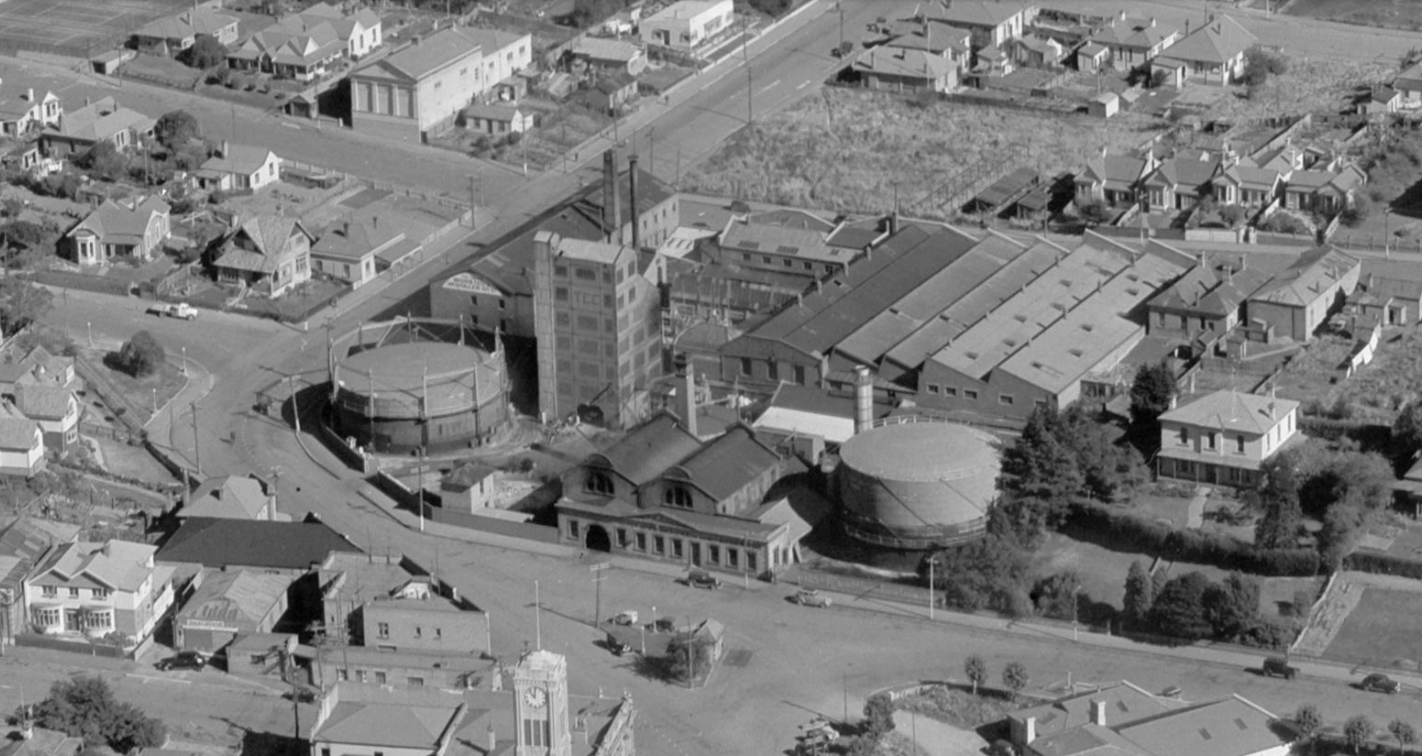
View to Timaru CBD and George Street in foreground joining with Arthur Street looking inland, South Canterbury Region. Whites Aviation Ltd: Photographs. Ref: WA-06399-F. Alexander Turnbull Library, Wellington, New Zealand. /records/30642594

Council To Close Gasworks: Special Meeting Decides Against Ratepayers' Poll (22 Jan 1964). Aoraki Heritage Collection, https://aorakiheritage.recollect.co.nz/nodes/view/4188
Summary of the newspaper article: On 22 January 1964, the Timaru City Council voted by seven votes to three to close the city’s gasworks following an 80-minute special meeting attended by 48 ratepayers, including eight women. The resolution was moved by the chairman of the gas committee, Cr J. S. Satterthwaite, and supported by councillors P. B. Foote, R. S. Morris, R. A. Holdgate, P. W. J. Cockerill, S. R. Bennett, and D. R. Dowell. An amendment calling for no action until a loan poll of ratepayers had been held was defeated, although it was supported by the Mayor, Mr C. E. Thomson, and Cr J. H. S. Hogg. Legal advice confirmed that the council was entitled to conduct a poll under the Gas Industry Act 1958, but councillors argued that time constraints made this impractical. The gasworks was described as having never functioned properly, with reconstruction estimated at £100,000 and a new plant estimated at £43,000, which would have required the installation of alternative plant and a delay of up to 15 months after tender acceptance. The council considered it essential that any solution be operational by the winter of 1965. At the time, the city held approximately 150,000 gallons of untreated tar due to a lack of processing equipment. The New Zealand Gas Council had offered financial assistance for reconstruction, and its consent was required for closure. The electrical engineer’s department advised it could absorb the gas load within 18 months if the gasworks closed. Council officers’ reports on the gasworks were ordered to be made public, while letters from the South Canterbury Electric-power Board and the Timaru Citizens’ Association were received without discussion.
Gasworks, labour and changing expectations
In Timaru and across South Canterbury, town gas works were established during the 1870s, as part of a wider push to modernise colonial towns. In Timaru, the Timaru Gas Company was formed in 1875, and gas lighting was introduced to streets and some commercial premises soon after. This marked a significant shift from earlier kerosene lamps and candlelight, and required substantial civic and private investment.
Gasworks were complex industrial operations. Coal had to be imported, unloaded and heated in retorts to produce gas, which was then stored, purified and distributed through an expanding network of underground pipes. The works required land, purpose-built buildings, skilled operators, stokers, maintenance crews and constant supervision. Gas lighting depended on daily labour, from production at the works to the lighting and extinguishing of lamps, leak repairs and pressure management. It was physically demanding, dirty and sometimes dangerous work, carried out largely out of public view but essential to the town’s functioning after dark.
For several decades, gas lighting transformed urban life in Timaru. Streets became safer and more navigable at night, businesses extended trading hours, and illuminated streets were seen as a sign of civic pride and progress. Yet gas lighting was never effortless. Supply interruptions, odours, leaks and public complaints were common, and the infrastructure required continuous maintenance and public funding.
From 1906, when Timaru Borough Council formally committed to a municipal electricity scheme, electric lighting began to replace gas as the preferred form of public illumination. Electric street lighting was progressively introduced during the 1910s, while domestic electricity followed more gradually, with early household connections often approached with caution and uncertainty.
As newer technologies were adopted, earlier lighting systems in Timaru and across South Canterbury were progressively decommissioned. Gas street lighting, once promoted as modern and efficient, became obsolete during the 1910s and 1920s. Redundant pipes, fittings and mains were either removed, capped, or left buried beneath streets as services were upgraded. In some cases, the recovery and sale of obsolete gas pipes generated modest financial returns, offsetting part of the cost of removal. While largely invisible today, these buried systems form an important physical record of earlier phases of urban development and reflect changing attitudes to technology, safety and public space.
The transition to electricity reshaped everyday expectations. Light no longer depended on flame, manual labour or constant vigilance, but on a switch. It is worth asking how residents experienced this change. Were people grateful for the simplicity and safety of electric lighting in their homes and streets, or did it quickly become an assumed convenience rather than a hard-won improvement? Today, with instant hot showers, illuminated streets and power available at all hours, it is easy to overlook the layers of labour, engineering, public investment and risk that underpin modern comfort. The story of Timaru’s gasworks reminds us that what feels ordinary now rests on a long and largely unseen history beneath our feet.

[Timaru, from Roman Catholic Tower], Dunedin, by Muir & Moodie. Te Papa (C.012821)
SPECIAL NOTICE FOR TIMARU.
The Union Electrical Co. desire to thank their numerous clients for the support accorded them during the year 1920, and take this opportunity to wish them, also future clients, every happiness and prosperity for the coming year, and hope by strict attention to the desires of all, to give the same satisfaction as they have given in the past. They desire to please, and are stocking the latest electrical fittings and accessories.
Every care will be taken on installations, most particularly in occupied premises—the honesty and integrity of every workman guaranteed.
Inquiries welcomed, and will be given strict attention. The Union Electrical Co. wish clients to note that they have received part of a large consignment of fancy glass shades, chosen for efficiency as well as appearance. A new line recently come to hand is some particularly choice fancy bead shades, all new designs, which merit the admiration of the most critical. These being an indent order, similar shades cannot be procured wholesale in New Zealand under their retail price.
To future clients: Satisfaction is our aim. We hope to merit yours.
Timaru Herald, Volume XCVIII, Issue 170137, 14 February 1921, Page 5

Detail showing a street light on Stafford Street, Stafford Street, Timaru, circa 1910, Timaru, by William Ferrier. Te Papa (O.051436)

Can you find original street lights?
The Stafford Street lighting used to be lit by hand. In 1871 Kerosene street lamps were installed and were soon credited with reducing the "menace of brothels' at Whales Creek".
For more than 100 years gas was piped from the gas works in Perth St to homes and businesses in the area between Hobbs St in the north, Broadway Ave in the west, Flinders St in the south, and throughout the inner-city area. In 1875 Timaru Gas Co was formed and nearly 9km of gas-iron pipes, the lights were converted to gas in 1876. The gas companies office was on George St where Mega Mitre 10 is today.
Electric light came in 1926. Before the streets were sealed, they would get very slippery and muddy when it rained, they would scoop the mud and put it along the side of the road, if you were not careful you could step knee deep into the mud in the dark.
Alpine Energy began in March 1906 when the Timaru Borough Council entered into a contract with Scott Brothers of Christchurch to light the town with electricity. The price for this contract was £750 per year for four hours of light per night – except when the moon shone. In 1915 the council purchased the Scott Brothers’ electricity generator and a year later another generator was installed and about 580 customers had been signed up. All electricity developments were in town until 1921 when a meeting of country delegates decided to form a South Canterbury Electric Power Board. The board set about forming a viable electricity supply enterprise across the province. The South Canterbury Electric Power Board and the Timaru Borough Council agreed for the power board to purchase the town supply. However, the town’s residents voted against the proposal. From that day, February 29, 1924, the Timaru Electricity Department and the power board continued on their separate paths. The Timaru Borough Council purchased all of its electricity from the SC Electric Power Board. This was from the Lake Coleridge power station supply which was made available at Temuka for distribution throughout Timaru and South Canterbury. The two organizations grew and developed in their separate franchise areas until the Government industry reforms of 1992 prompted the separate bodies to look again at the issue of amalgamation.Learn more
In 1970 Gas production from coal was stopped, and all gas will be produced by oil plants. This was located at Perth and Arthur Streets. At the time of demolition it was one of Timaru's tallest landmarks.
The former Timaru City Council-owned Municipal Electricity Department, which owned the pipes, merged with the South Canterbury Power Board to form Alpine Energy. Today Alpine Energy pays rent to the Council to have cable in about 10 kilometres of pipe between Pacific St and the southern end of King St. They range from 20 centimetres in diameter close to the old gas works, down to 3cm along smaller side streets.Learn more
Beside the two lights is a sculpture by Doug Neil. Rock of the Heartland. Basalt. 2008.

On the corner of Arthur and Butler Street Timaru are three old lamp posts - Photo Roselyn Fauth 2025

Detail showing a light at the Crown Hotel, Temuka, circa 1905, Dunedin, by Muir & Moodie. Te Papa (C.014351)
Electricity arrived in Timaru in the early twentieth century as a civic service. In 1906, the Timaru Borough Council contracted Scott Brothers of Christchurch to light the town with electricity for a few hours each night. Over time, the Council took ownership of the generators and expanded supply, laying the foundations for a municipal electricity system that served homes, businesses and public streets.
By the 1920s, bulk electricity was being supplied from Lake Coleridge, and the South Canterbury Electric Power Board was formed to extend power across the wider region. Within Timaru, the Municipal Electricity Department managed local distribution and street lighting. Electricity transformed night-time life. Streets became brighter and safer, shops stayed open later, and people lingered after dark. Turning on the lights was an event in itself.
As electric lighting became reliable, illumination moved beyond necessity. By the 1930s, Stafford Street was brightly lit on Christmas Eve, with coloured bulbs strung overhead and crowds filling the street. Christmas lighting became a shared experience, turning the main street into a place of celebration rather than simple passage.

Lamp hangs near the entrance of the Grosvenor Hotel in 2025 - Photo Roselyn Fauth


Left: Post Office, Timaru, circa 1904, Dunedin, by Muir & Moodie. Te Papa (C.014403) Right: The drinking fountain was relocated to the Timaru Botanic Gardens sunken garden. - Photo Roselyn Fauth 2025

South Canterbury Museum - Post Office Parade 1490

The Gloucester Gates form the main entrance to the Timaru Botanic Gardens at the corner of Queen Street and King Street. The ornate wrought-iron gates were officially opened in 1935 by Prince Henry, Duke of Gloucester, during a royal visit to New Zealand. They mark an important period in the development of the gardens as a civic and commemorative space in the early twentieth century, and remain one of the most recognizable historic features of the Botanic Gardens today. Local residents petitioned for some of the unsold Government Town land to be set aside for public gardens in 1864. It was put aside by surveyor Samuel Hewlings, and then three years later the Borough of Timaru Park Commissioners took charge and began planting. In 1872, £200 was allocated for a ranger’s cottage. Much of this planting was carried out by convicts from the old Timaru Gaol, particularly two very tall pines, known as the Prisoner Pines on the south boundary. This, and many other early planting works, community donations, and key structures have been added over time, such as the glasshouse in 1905, the Band Rotunda in 1912, and tennis courts and bowling green were established by 1916 - Photo Roselyn Fauth 2025


Royal Arcade lamp - Roselyn Fauth 2021
During World War II, lighting restrictions dimmed the town again. When those restrictions were lifted, newspapers noted a lift in community morale. By then, light had taken on emotional meaning. It represented reassurance, normality and hope.
This long history set the stage for a defining moment in the mid-1970s. In 1975, City Electrical Engineer Tony Sleigh returned from the United Kingdom inspired by London’s Regent Street lights. Working within Timaru’s Municipal Electricity Department, and with the support of the Municipal Electricity Department, star-shaped Christmas lights were designed, purchased and gifted to the city. They were simple, durable and intended to last. These were not throwaway decorations, but civic infrastructure, cared for year after year.
Over time, the display evolved. Angels were added later, designs were refreshed, and incandescent bulbs were replaced with LEDs. Responsibility for the network eventually passed through industry restructuring into what became Alpine Energy, but the tradition of caring for Timaru’s Christmas lights endured.
Today’s stars and angels sit at the end of a much longer story. A story that begins with lamps outside inns, passes through municipal ambition and hydroelectric power, and arrives at a shared choice to brighten the dark each December.
Christmas lights in Timaru are not just decoration. They are the visible expression of more than a century of public investment in light, community and wellbeing. They remind people of earlier Christmases, connect generations, and help Timaruvians feel that this is still their town, even as buildings, shops and people change.
In Timaru, lighting the streets has always been about more than seeing where you are going. It has been about looking after one another.

An undated slide with a time-lapse image showing the Christmas lights on Stafford Street, Timaru, circa 1980. Viewd from near the intersection with Canon Street, looking south. South Canterbury Museum 2014/008.099
Alpine Energy handled the annual setup and takedown of the lights. They’re not just thrown up for show – they’re installed with pride, cleaned, stored and restored every year so the whole town can shine again when December rolls around.

Stafford Street, Timaru, circa 1990. Taken near Newman's Music shop looking along the northern end of Stafford Street, decorated with Christmas lights across the road. South Canterbury Museum L2012/007.013
In recent years, the lights have had some serious company. You might have spotted the giant ten-metre Christmas tree standing tall at the Piazza, lit with hundreds of metres of string lights. It’s built to handle Timaru’s famous gusts and still looks beautiful, even in a southerly. (Don’t get me started on the Champagne Tree. It used to be Timaru’s tallest, a real icon, proudly crowned with a star each Christmas. Then, in a moment of Covid-era haste, down it came – chopped without ceremony. I was stuck at home in isolation, otherwise I’d have been down there chaining myself to it, no question. It deserved better.) The start was relocated in 2024 to a post at Caroline Bay, an iniative supported by a Timaru local as a gift to the community. Anyway... back to the story...

An undated postcard featuring a view of Stafford Street, Timaru, circa 1990 shows Stafford Street, Timaru's shopping centre and main thru fare decorated with the town's Christmas lights strung overhead. South Canterbury Museum
There’s the Christmas Lights Display and Competition, organised by the Timaru Christmas Parade Trust, which encouraged families and businesses to join in and light up their homes. It added a real community feel, and there’s something lovely about slowly cruising the suburbs with a thermos of hot chocolate, marvelling at everyone’s efforts. One display asked us to tune into their own radio station that blearred Sandstorm through the speakers while their house pulsated in christmas cheer. It was hilarious.
A “Glow Timaru” app wsa introduced ths year to make it easier to plan your light-hopping evenings. The app maps out all the lit-up homes across town, so you can make a real night of it. Just tap, drive and admire.
But even with all the bells and whistles, for me it always comes back to Stafford Street. That first sight of stars glowing above the road, the buildings bathed in festive warmth, and the hush of a Timaru evening holding it all together. There’s something special about a town that keeps traditions like this alive.
So next time you find yourself walking under those lights or driving along with the windows down, take a moment. Think of that spark that started it all, and the magic of it. Maybe even give your own little one’s eyes a gentle nudge open. They won’t want to miss it.

Stafford Street in the evening, lit by Christmas lights, Timaru, circa 1990. Taken south of the intersection with Church Street looking southward. South Canterbury Museum

Stafford Street Timaru, in the evening, lit up by street and Christmas lights, circa 1990. Taken outside the local Farmers store, looking southward along the street to the intersection with Strathallan Street. South Canterbury Museum L2012/007.050


I was so excited to stumble across the decorations in their store before they were installed. I got to get up close and study them in detail and really appreciate the design behind them. I think our angels are really special.

Timaru Christmas Lights - Geoff Cloake Dec 2018 - Christmas Lights at Stafford Street - Timaru - Photo by Geoff Cloake. Back in 1975, Tony Sleigh, who was then the City Electrical Engineer, travelled to the UK and saw the grandeur of London’s Regent Street lit up for Christmas. It struck a chord. He came home with the idea that little old Timaru could have its own beautiful street lights. And he was serious. He worked with the Municipal Electricity Department, who ended up buying and gifting the lights to the city. Moulds were made in Dunedin and stars were strung across Stafford Street. Those early lights weren’t flashy by today’s standards – they were simple, elegant and completely charming. And they caught on. More decorations were added, new designs introduced, and in time, the incandescent bulbs were swapped out for LEDs, bringing brighter colours and greater efficiency.

Did You Know?
- Tony Sleigh saw lights like these while in Europe and came back to Timaru to create the lights.
- The first lights were brighter than some shopfronts—businesses had to adjust!
- Moulds for the stars were crafted by a Dunedin factory known for stage props.
- These lights have outlasted 5 mayors and three civic restructurings!
- Community volunteers have played a key role in wrapping cables, testing bulbs, and decorating trees.
- A Tribute to Foresight and Festivity
- Thanks to the vision of Tony Sleigh and the enduring efforts of Alpine Energy, the Timaru District Council, and countless local volunteers, this glowing tradition continues to light up our hearts and streets each year.
https://www.pressreader.com/new-zealand/the-timaru-herald/20201226/281629602880361

Christmas in Timaru would not feel like Christmas for many of us without our annual parade. Ours has been built over many years by people wanting to volunteer to create some joy.
Behind Timaru’s Christmas Parade is the Timaru Christmas Parade Charitable Trust, which was established in 2009 to give structure, accountability and longevity to our much-loved community tradition.
The Trust’s founding trustees, Debra Jayne Still and Carmel Maree Brosnahan-Pye, laid the governance foundations in October 2009. Since then, a succession of volunteer trustees have stepped into the role, overseeing fundraising, compliance, sponsorship, logistics and the countless practical details that sit behind a single festive afternoon.
More recently, trustees including Teressa Dawn May, Adrian Martin Hall and Jarrod Bruce Lovely have carried that responsibility forward, supported by past trustees who each gave time and energy during their term. None of this work is particularly visible on parade day, but without it, the parade simply would not happen. I'm not sure what happened but there was a call for volunteers to join the trust, and the local Lions and Rotary service clubs stepped up offering a person from each club to join the trust with the support of the four clubs behind them. There is a huge amount of work that goes into the parades each year. And unless you have been involved behind the scenes you wouldn't really know what it takes to bring the community together for the free fun event.
Like the Christmas lights themselves, the parade is a collective effort. It relies on volunteers, service clubs, sponsors, council staff, emergency services, and families each year. The floats change, the route I think has remained the same, to create a moment of shared delight. Thank you to everyone who helps, supports and donates.
I realise that for retailers it means the road is closed for 1-2 hours. Thank you to the local businesses who join the Christmas spirit and work with the road closure for that time. Without some tolerance and partnership the parade couldn't happen.
All in all, I think this is how traditions endure. For me it, its not about the spectacle or the fanciest float, but more about people showing up, giving their time, doing the work, for families like ours to build festive feelings, a opportunity to relive our childhood memories and make new ones with our families.


Reliving my childhood with santa after the Christmas Parade 2025 - Photo by my dad Geoff Cloake who has been taking me to see Santa for many years

Making memories - we were invited to help on the day, and Annabelle got to join Santa on his sleigh. - Photo Geoff Cloake


Summer in Timaru would not be the same without decorations, parades and summer concerts brought to us by the Caroline Bay Association. I was so excited to see a epic crowd gather for Kaylee Bell in 2024, carrying on the traditions of gathering at the bay for entertainment and catch ups.

Kiss tribute concert in 2023

Our daughter Annabelle performing as a Christmas Belle with Bronze Beat dancers in 2025.

Timeline and Legacy of Timaru’s Christmas Lights
1975
– Tony Sleigh, Timaru’s City Electrical Engineer, is inspired by London’s Regent Street lights during a sabbatical in the UK.
– Returns with the idea that Timaru should have its own festive street decorations.
– Gains support from the Municipal Electricity Department (MED), who purchase and gift the lights to the city.
1976–1977
– Original light designs are created, featuring star-themed motifs.
– Moulds are fabricated in Dunedin, and the first decorations are installed across Stafford Street.
– Lights become an annual fixture, gaining popularity among residents.
1980s–1990s
– Additional decorations are added to expand the display.
– Community embraces the tradition, with increasing public anticipation each year.
2000s
– MED is restructured; Alpine Energy becomes responsible for maintenance and installation.
– Focus shifts to preserving and upgrading the displays for safety and longevity.
2010s
– Transition from incandescent bulbs to energy-efficient LED lights begins.
– Designs are refreshed, side lights added, and new elements introduced to enhance visual appeal.
2020
– Community efforts to decorate private homes are formally supported through a Christmas Lights Competition, run by the Timaru Christmas Parade Trust.
2023
– A 10-metre-tall Christmas tree is introduced at the Timaru Piazza.
– The tree features 275 metres of lights and becomes a central festive attraction.
– Designed to withstand 150 km/h winds, reflecting Timaru’s coastal climate.
2024
– “Glow Timaru” app is launched by a local developer.
– Offers a map of residential and public light displays, encouraging wider participation and evening outings around the city.

Sha Harber has been opening her garage display over the past 15 years “or so”, raising money for organisations such as South Canterbury Hospice, Child Cancer and Prostate Cancer. Harber says “tens of thousands” of dollars have been raised over the years, but 2021 was quiet because of Covid-19 with $2000 collected and $4000 realised in 2020.
https://www.stuff.co.nz/timaru-herald/life/130718765/garagefilled-christmas-lights-display-plugged-in-again

Making memories in 2024 - Photo Geoff Cloake

Making memories in 2022 - Photo Geoff Cloake

Timarus new 10 metre Christmas tree have been installed at its location on the Piazza the angels hover above Stafford St and the star shines over the city from the fire tower 2023. https://www.timaru.govt.nz/news/council-news/timaru-shines-even-brighter-this-festive-season

The Champagne Tree – Timaru’s Towering Redwood
At 34 metres tall, Timaru’s Wellingtonia gigantea – was known as the Champagne Tree – is was the tallest tree in the city with a story stretching back almost 150 years and begins with a seedling gifted to Elizabeth Rhodes by her husband George Rhodes, the runholder of The Levels station. The young couple were living at Linwood House at the time, which once stood where the Timaru District Council chambers are today.
After George’s death in 1864, Elizabeth eventually remarried in 1873. Her second husband, Arthur Perry, was a Timaru lawyer who owned a 12-acre estate known as Beverley. Located in what is now lower Wai-iti Road, Beverley was famed for its grand home and one of the finest gardens in New Zealand.
Elizabeth brought the three-year-old redwood with her to Beverley, reportedly transporting it across town in a wheelbarrow. Captain A. W. Wright of Craighead, confident it wouldn’t survive the move, bet her a case of champagne on its failure. He lost the bet.
The redwood not only survived but thrived, standing tall through generations of change, battering storms and the passing of time. It became affectionately known as the Champagne Tree, a name that still endures today.
The tree used to be visible from Caroline Bay and stands on the boundary of the Timaru RSA. Every year at Christmas, a light shined from its top – a small tradition that kept a legacy glowing through the holiday season.
Sir Edmund Hillary is even rumoured to have climbed it, adding a hint of legendary status to its already storied past.
The once-grand Beverley estate, with its renowned garden and pond, has long since disappeared – the pond was drained and the land subdivided, now forming part of Beverley Road. It’s unclear whether any of the original plantings remain, but the Champagne Tree stands as a living connection to that bygone era.
What do a redwood seedling and a case of champagne have in common? In this case – a bet, a wheelbarrow, and the spirit of Timaru.
However during the covid pandemic when many people were in self imposed isolation, the tree was destroyed and removed. The RSA had come into financial trouble and merged with the Timaru Town and Country Club. The sold the land and moved off the site making way for a developer to flatten the buildings and scrape the site clear for another chapter. There was an opportunity to bring the enormous tree down before the the site was developed with houses and I can imagine the developer wanted to remove the tree to improve the views for the future home owners. With no protection from council bi-laws the tree was felled. While there may have been some practical reasons, the tree was healthy, and it was said that other arbortrists would not fell the tree out of principal. There was a pouring of community outrage that a special link to our past was now lost. When the seedling was planted the Beverly Estate was like a large park, and the idea of large trees were sensible. As sites have been subdivided and filled in, it is harder and harder for large trees to survive in an urban environment.
History of Alpine Energy: Bringing Electricity to South Canterbury
"Electricity had performed great wonders and has become the tireless servant of man. The welcome clean heat which the electric stove provides, is generated far from home through the waters of Lake Coleridge, but in the not too far distant future it is hoped that South Canterbury will provide its own source of generation from the unfathomed depths of the great Lake Tekapo, in the Mackenzie Country - a vast, silent body of water possessed of the almost unlimited power, and patiently awaiting the call to the service of man."
This extract from the publication of the South Canterbury District Power Board November, 1923, when considered in conjunction with the present development of a chain of generating stations fed by the waters of Lake Tekapo, Pukaki and Ohau, exemplifies the foresight and judgment of those public spirited men who were the first involved in bringing power to South Canterbury.
In 2017 Alpine Energy owned and operated the electricity distribution network in South Canterbury, New Zealand. The network had a replacement value of some $150 million, and connected over 30,000 customers throughout the region with the seven local Transpower Grid Exit points (GXP’s) which are our point of supply for electricity. Alpine Energy was owned by its subsidiary contracting company NETcon which provides a wide range of network and electrical services, and had investments in Rockgas Timaru Ltd.
Their mission was to ensure continuing commercial success by providing: safe; reliable; and efficient energy delivery and infrastructure services with a vision to develop, operate, and maintain integrated energy delivery solutions for the benefit of our community.
Alpine Energy contracted NETcon to perform the asset maintenance on the Electricity Network. NETcon offered a range of professional services to Alpine Energy, including overhead, underground and earthing services. NETcon had a modern fleet, well equipped workshops and staff who knew their jobs. NETcon Limited was 100% owned by the electricity contracting company.
Alpine Energy was owned by the: Timaru District Council (47.5%), LineTrust South Canterbury (40%), Waimate District Council (7.54%), and the MacKenzie District Council (4.96%), which meant Alpine Energy was owned by the community they served.
Alpine Energy has an interest in two subsidiary companies, and one associate company.
Timaru Electricity Limited
100% owned by Alpine Energy - this company has not been trading since April 2007.
NETcon Limited
100% owned by Alpine Energy , a electricity contracting company
www.netcon.co.nz
Rockgas Timaru Limited
50% owned by Alpine Energy , a local LPG supplier
www.rockgas.co.nz
Line Trust South Canterbury. The Trust has a significant role in our community... looking after consumers' interests in Alpine Energy. The Trust owns 40% of Alpine Energy and pays its shareholder dividend to you! Line Trust South Canterbury was formed in 1992 when the South Canterbury Power Trust was resettled. It holds 40% of the shares in Alpine Energy Limited, the company who owns the electricity lines in South Canterbury region. Alpine’s network extends over all South Canterbury with a total length of lines exceeding 3,600 kilometres and connecting over 27,000 consumers and is valued at approximately $90 million. The Trust receives dividends from Alpine Energy that is paid to the shareholders quarterly. The Trustees distribute the 90% of its profits, after deducting the Trust’s running expenses, by arranging a credit on consumers’ electricity accounts.
www.linetrustsc.co.nz
The Electricity Authority The Electricity Authority was established in 2010. It regulates the electricity market, in which we are a participant, by developing and setting the market rules, enforcing and administering those rules, and monitoring market performance. You can learn more about the EA and how it operates by clicking the link below.
www.ea.govt.nz
Community organisations that Alpine has in the past and currently supported in 2017:
Aoraki Secondary Schools Sport - sports directors
Tennis South Canterbury – junior tennis programme
Rugby South Canterbury
South Canterbury Drama League
South Island Masters Games
Netball South Canterbury - Development Officer
SC Hockey - coaching and development programme
Caroline Bay Association - Talent Quest
Aoraki Development Trust - Business Excellence Awards
Life Education Trust - Harold Club
Geraldine Festival of the Arts
SC Hospice - Wine, Food and Music Festival
SC Basketball - Development Officer
Central South Island Science and Technology Fair
Southern Alps Country Music Awards
Rotary Cub of Timaru - Charity Auction and Entertainment
Pleasant Point Gymkhana - "Get to the Point" day
Alpine Energy 12 hour mountain-bike race
SC Primary Schools Gymnastics Festival
Timaru South Rotary - Carols by Candlelight
Alpine Energy Mt Peel Mountainbike Marathon 2014
Sport South Canterbury - South Canterbury Sports Awards
SC Women’s Bowling Tournament
InHarmony Singing Group - Christmas on the Bay Variety Concert
Waimate Competitions Society - Highland Dancing Festival
Waimate Competitions Society - Junior Country Music Awards
Waimate Caledonian Society - criterium and games
Alpine Energy Winchester Show
Rotary Club of Timaru North - Hadlow to Harbour Fun Run
Aoraki Mathematics Association - Aoraki Math Competition
Tennis Seniors South Canterbury – tournament
SC International Science Festival
Pleasant Point Historical Railway Society Inc
Timaru Horticultural Society Inc
South Canterbury Arts Society Annual Arts Award
Lake Tekapo Footbridge Society
2016 SI Dahlia event
SC Rose Society
Timaru Horticultural Society
Aorangi Eagles
Twizel Salmon & Wine Festival
Lake Tekapo Recreation Park
Lake Tekapo Solar Challenge
Geraldine Winterlights Festival 2015
SI Secondary Sports Netball Championship
ESITO Excellence Awards
SC Roller Skating - new building
Aoraki International Dark Sky Reserve Board - Starlight Festival
South Cantebury Basketball Association
Canterbury Rural Fire
Timaru Bike Polo Club - world champs
Timaru Lions
SC Drama League
Pleasent Point Railway -signs
Aorangi Electrical Golf Tournament
Geraldine High School Electric Vehicle Team
Waimate Regent Theatre Trust
Timaru District Choir
World Busker Festival
SI Youth Librarians Conference
Mackenzie Shears
Roller Derby
In 2025 Alpine Energy chose not to support the Timaru Christmas Street decordations. At one point locals feared that it was an end of an era, and that the loss of support to many felt like a reflection of a sign of the times and the community in ressession. This was off the back of an accounting error that saw millions of dollars not properly invoiced and had to be refunded.
First electricity supply dates across the Power Board area
1924
5 February – First supply from Lake Coleridge reaches Timaru at 66,000 volts
December – Power available at the Timaru substation via Government supply
1925
March – Temuka
May – Geraldine
July – Orari and Winchester
1926
January – Milford, Clandeboye, Tripp Settlement, Speechleys Bridge, Shaws Road and Woodbury
February – Waimate and Orari Dairy Factory
July – Hilton and Waitohi
August – Pleasant Point
November – Pareora and Seadown
December – Totara Valley
1927
March – Gleniti line at Fairview
June – Morven and Cave
October – Salisbury
November – St Andrews
December – Springbrook
1928
February – Makikihi
March – Nukura
July – Peel Forest, Albert and Mawaro
December – Mount Nessing
1929
August – Otipua
1930
March – Kerrytown