
By Roselyn Fauth

A quick illustration of Shepherds corner by Roselyn Fauth.
I did not set out to write about Shepherd’s Corner... This story began as a side quest into the history of suicide law and how the legal system once shaped not only punishment, but how death itself was recorded. For centuries under English law, to take one’s own life was considered a crime, not against oneself, but against the Crown. A person did not fully own their body. Suicide was treated as theft of royal property.
The consequences were severe. A person found to have taken their own life while “of sound mind” could be denied burial in consecrated ground and instead buried at a crossroads, sometimes with a stake driven through the body so the soul could not rest. Property and assets were forfeited to the Crown, punishing families already in grief. Over time, the law softened. If a person was deemed mentally unwell, compassion could be extended and, after an inquest, their estate could pass to family in the usual way.
These legal distinctions mattered. They shaped coronial language, newspaper reporting, and public memory.
It was while working through this context that I came across a short nineteenth-century newspaper report describing the suicide of a man named J. Shepherd in Timaru. The name stopped me. Shepherd’s Corner, at the southern end of Stafford Street where it meets North Street, is one of Timaru’s most recognisable historic sites. The brick building that stands there today is firmly associated with James Shepherd, a respected merchant, councillor, and churchwarden who died in 1912.
And yet this Shepherd had died very differently. What followed was a deep dive through newspaper archives, police gazettes, bankruptcy notices, advertisements, and fire reports. Slowly, a clearer picture began to emerge, and I realised that there were two men. Uncle and nephew. Both grocers. Both operating in the same place. Their lives intersected at Shepherd’s Corner, but their stories are very different.

Shepherds corner in 1880s. James Shepherd's name appears over the store on the corner, while the next building bears the name "Shepherd's Building". The next block of buildings down bears the name "J Hitch". Stafford Street looking North, North Street corner on left". South Canterbury Musuem 2174. James Shepherd (1837–1912) was an early Timaru merchant and was a book keeper for George Rhodes of The Levels. He was a Timaru Borough councillor 1878–82 and a warden of St Mary’s Anglican Church, with a memorial brass inside St Mary’s. Shepherd chose this corner site when the town was subdivided because he believed it would sit at the meeting point of “Rhodes town” and “government town”. by early 1871 Shepherd had erected a timber building on the corner, and it was already being referred to as “Shepherd’s Corner”. James Martin Shepherd was the younger relative who traded from the corner briefly, and fell into bankruptcy after the fire. Daniel West was the architect of this building and called tenders in October 1880 for the replacement building. The first timber building was destroyed in a fire. This building dates to 1880–81 and is in a Victorian commercial classical mode. In 1907–1908, James Shepherd ran ads describing the shop as “THE OLDEST ESTABLISHED BUSINESS IN TIMARU”, including “Telephone 32”. The Councils Heritage report notes Shepherd’s estate was “considerable” and that it was subdivided in 1925.

I knew this corner growing up as The Timaru Saddlery (formerly Shepherds Grocery) at 36 Stafford Street. South Canterbury Musuem 2015/020.427
The established Shepherd
James Shepherd senior was born in 1837 and became one of Timaru’s most successful early merchants. He selected a prominent corner site at the junction of Stafford and North Streets, deliberately positioned at the meeting point of what were once known as Rhodes Town and Government Town. By the early 1870s he had erected a timber building on the site, already known as Shepherd’s Corner.
He expanded his business steadily, erecting brick shops along Stafford Street in the late 1870s. When fire destroyed the original timber corner building in June 1880, those brick shops survived. Later that year, tenders were called by local architect Daniel West for a new brick building on the corner site. The two-storey structure that stands today dates from 1880–81 and was designed in a Victorian commercial classical style intended to project confidence and permanence.
James Shepherd served as a Timaru Borough councillor from 1878 to 1882, was a warden of St Mary’s Anglican Church, and remained a prominent figure in the town. Advertisements in the Timaru Herald later described his business as “the oldest established” in Timaru. He died in 1912, leaving a substantial estate, and is commemorated by a memorial brass inside St Mary’s.
This is the Shepherd most people remember.

A map from 1875 showing the corner site. Rhodes Town, surveyed by the Rhodes brothers in 1853. Government Town, surveyed three years later. North Street divided them, and they later merged. North Street is like a historical fault line between private enterprise and government planning, and when you drive the road today that is why some of the intersections do not line up neatly. George Rhodes and his brothers profited from Timaru’s growth by selling their town-centre sections, and that they also shaped civic life, including St Mary’s. The Rhodes brothers developed their Timaru run in the early 1850s, naming it The Levels after their English home district. The Rhodes were not just “station people”, they were town-shapers through land ownership and subdivision. DNZB records that St Mary’s Church was built on land given by the Rhodes brothers and that George Rhodes was one of the first wardens. Shepherd’s Corner feel less like “one shopkeeper got lucky” and more like “a capable man leveraged the Rhodes world into a permanent town presence”.
The other Shepherd
James Martin Shepherd, his nephew, followed a more precarious path.
By 1880, James Martin Shepherd was operating a substantial general grocery store in Timaru. On 29 June 1880, newspapers reported that his wooden store on the main road was totally destroyed by fire at three o’clock in the morning. Although insured, Shepherd estimated his losses at between £400 and £500 beyond the insurance cover. It was a serious financial blow.
Over the next eighteen months, pressure mounted. On 23 November 1881, James Martin Shepherd uttered a forged promissory note for £250, purporting to be signed by Elizabeth Melton, to Anthony Christophers, agent for the Bank of New South Wales in Timaru. A warrant was later issued by the Timaru Bench, and his description appeared in the New Zealand Police Gazette in April 1882.
By early 1882, Shepherd had absconded. Newspapers described him as the “levanting Timaru storekeeper”, reporting that he had fled to San Francisco. Gossip-filled columns speculated about gifts given to companions, trustees attempting to recover assets, and creditors left unpaid.
In June 1882, notices in the South Canterbury Times advertised that J. M. Shepherd was “retiring and relinquishing the grocery business” and selling stock at heavy reductions. On the same day, formal bankruptcy notices appeared. James Martin Shepherd was adjudged bankrupt on 17 June 1882, and his property vested in the Official Assignee. The first meeting of creditors was scheduled for July.
He did not stay away for long. On 24 July 1882, the Thames Star reported that James Martin Shepherd had been arrested on board a mail steamer returning from San Francisco. He claimed to have been drunk for five weeks and said he intended to surrender himself. During his arrest, he fell into the water while stepping from the steamer to the police boat, dragging a constable in with him. Both were rescued.
Shepherd was returned to Timaru and committed for trial on six charges of forgery and uttering. He was released on bail. His uncle lived almost opposite the Supreme Court.
In December 1882, as the Supreme Court criminal sessions opened, James Martin Shepherd went into his uncle’s office shortly before eleven o’clock. A gunshot was heard minutes later. He was found dying on the floor, a revolver beside him. Despite prompt medical attention, he died. His body was removed to Stone’s Hotel, where an inquest was to be held. Newspapers noted that he had been advised his defence was hopeless and that his only chance lay in pleading guilty.
A later paper reports the verdict of the inquest; A later item (15 December 1882) reports the inquest outcome in one line: the jury found he “committed suicide while labouring under a fit of temporary insanity.”
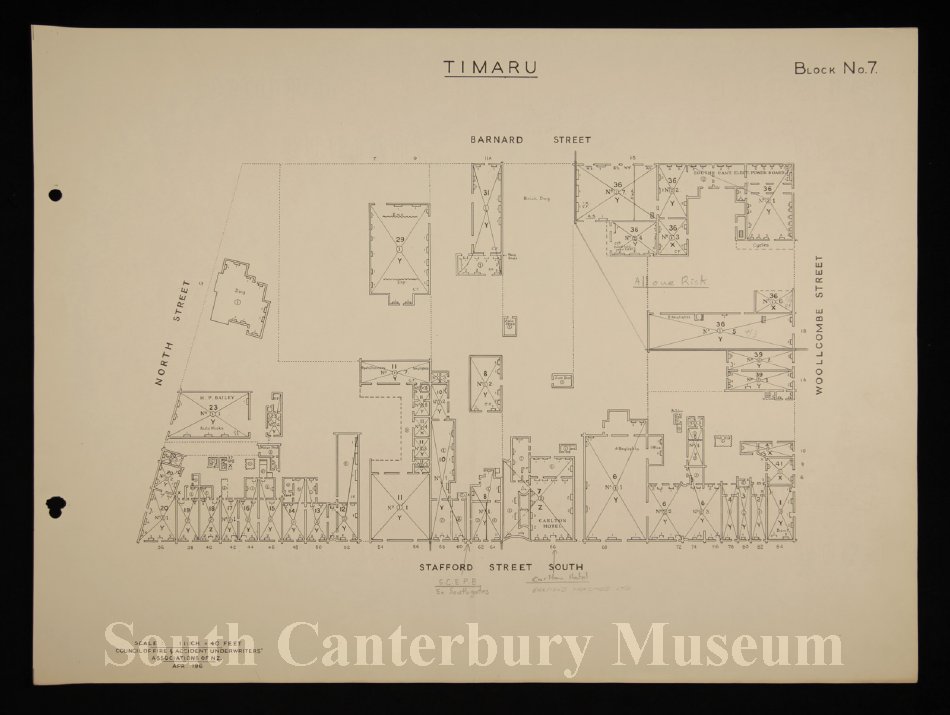
North and stafford street - Fire and Accident Underwriters Association block plans Timaru township 1959 - South Canterbury Museum 200200506b-10
https://timdc.pastperfectonline.com/archive/7FF6D8F5-F549-4C34-A0C3-449616265088
Two lives, one place
The tragedy of James Martin Shepherd sits uncomfortably close to the solid respectability of Shepherd’s Corner. It is precisely because the building endured that his story became obscured. His uncle resumed occupancy of the corner store in June 1882 and continued trading successfully. The name Shepherd remained attached to the site, but the younger man quietly disappeared from memory.
Standing at Shepherd’s Corner today, the building still does what it was designed to do. Its chamfered corner addresses both streets. Its parapet and cornice project confidence. The architectural language of Victorian commercial classicism reassures. It anchors the southern end of the Stafford Street heritage precinct and contributes strongly to Timaru’s sense of place.
From a civic heritage perspective, this is where the story becomes richer.
Buildings are so much more than containers for success stories. Their walls also absorb moments of crisis, failure, and grief. Shepherd’s Corner allows us to talk about how family businesses worked, how financial shocks such as fire could cascade into bankruptcy, how nineteenth-century law framed crime and suicide, and how public memory often privileges the respectable over the uncomfortable.
Knowing the wider story changes how we see the place. The courthouse along North Street is no longer just a neighbour. It becomes part of the geography of that final morning in 1882. The brickwork no longer speaks only of prosperity, but also of recovery after fire, and of a family stepping in to stabilise what had collapsed.
Heritage work asks us to slow down and look twice. To recognise that the past is layered and human. Shepherd’s Corner still anchors the street, but it also connects us to two lives shaped by the same place in very different ways.
That, perhaps, is why I really enjoy taking a closer look at our heritage facades.

Page 1 Advertisements Column 6
Timaru Herald, Volume XXXVI, Issue 2381, 10 May 1882, Page 1

TIMARU this day Auckland Star Volume XI Issue 3108 29 June 1880

(In nineteenth-century newspaper language, describing James Martin Shepherd as “the Levantine Timaru storekeeper” signalled that he had fled the town suddenly to avoid debts and legal consequences, framing him as an absconding debtor rather than simply a man in crisis.)
THE LEVANTING TIMARU STOREKEEPER.
Evening Star, Issue 5959, 18 April 1882, Page 4
The case of J. M. Shepherd, the levanting storekeeper of Timaru, will not soon be forgotten in that town. In connection with the affair a good story has reached our ears through a private channel. Shepherd had a bosom companion employed in a certain Government office in Timaru, where the hours are longer than the pay, and this “guide, philosopher, and friend” of the erratic storekeeper received several substantial proofs of his regard while they lived in Timaru together. But when Shepherd went up to Christchurch to have that surgical operation performed, and never came back, then came the tug of war for the faithful companion, who was sternly requested by the trustees in the estate to give up the money and valuables bestowed upon him by the generous but not too conscientious vendor of groceries. “From information they received” those trustees learned that Shepherd, ere he bid good-bye to Timaru, had donated to his friend over £100 in cash, to say nothing about a gold watch and chain and other trinkets. The recipient of the gifts was requested to attend a meeting of the creditors, and promised to do so; but instead of doing this he followed Shepherd’s example and disappeared. Where he has gone is not certain, but by those who ought to know something about it he is supposed to have gone to share the “exile” of his friend in San Francisco.—Ashburton paper.
We have heard that the levanteer had for a fellow passenger from Auckland his largest creditor in Dunedin, who, it may be presumed, is ignorant of the “bolt.” Pleasant company it may be imagined.

A STARTLING SUICIDE.
Evening Star, Issue 6162, 11 December 1882, Page 2
TIMARU, December 11.
A case of suicide occurred here at eleven o’clock. The criminal sessions had just opened, and one of the first cases on the calendar was that of J. M. Shepherd, the storekeeper who committed extensive frauds and levanted to San Francisco about six months ago. He returned to the Colony three months ago, crossing on his way the detective who was sent after him. He was arrested at Auckland and brought to Timaru, where he was committed for trial on six charges of forgery and uttering. Shepherd’s uncle resides almost opposite the Supreme Court, and Shepherd went into his office a little before eleven o’clock. A few minutes afterwards a shot fired in the office was heard, and people running into the place found Shepherd lying on the floor in a dying state. A revolver was beside him, and on examination it was found that he had shot himself through the heart. Medical assistance arrived promptly, but life was pronounced to be extinct. The body was removed to Stone’s Hotel, where an inquest will be held. It is stated that Shepherd, who was out on bail, had been advised that defence was useless, and the only chance was for him to plead guilty.
https://paperspast.natlib.govt.nz/newspapers/ESD18821211.2.16
Bruce Herald, Volume XV, Issue 1463, 15 December 1882, Page 2

https://paperspast.natlib.govt.nz/newspapers/BH18821215.2.7

Page 1 Advertisements Column 3 - Timaru Herald Volume XLIII Issue 3849 3 February 1887 Page 1
Sources
Auckland Star. “TIMARU, this day.” Auckland Star, Volume XI, Issue 3108, 29 June 1880, p. 2 https://paperspast.natlib.govt.nz/newspapers/AS18800629.2.17
Evening Star (Dunedin). “THE LEVANTING TIMARU STOREKEEPER.” Evening Star, Issue 5959, 18 April 1882, p. 4. https://paperspast.natlib.govt.nz/newspapers/ESD18820418.2.24
New Zealand Police Gazette. Offences Not Otherwise Described. New Zealand Police Gazette, Volume VI, Issue 8, 19 April 1882, p. 57. https://paperspast.natlib.govt.nz/periodicals/NZPG18820419.2.3
South Canterbury Times. Fire report, South Canterbury Times, 29 June 1880, p. 2. Bankruptcy and advertisements relating to James Martin Shepherd, South Canterbury Times, Issue 2879, 17 June 1882, p. 3 https://paperspast.natlib.govt.nz/newspapers/SCANT18820617.2.12.2
Thames Star. “A Penitent Absconder.” Thames Star, Volume XIII, Issue 4231, 24 July 1882, p. 2. https://paperspast.natlib.govt.nz/newspapers/THS18820724.2.8.1
United Press Association reports (various papers). “Suicide of the Timaru Levantine.” December 1882 (syndicated telegraph report)
Timaru District Council. Historic Heritage Item Record Form: Former James Shepherd’s Store, Shepherd’s Corner, Doc #1304548
Timaru Civic Trust https://www.timarucivictrust.co.nz/activities/shepherds-corner-building
There are four that are buried at the Timaru Cememtery with the name James Shepherd.
- Shepherd, James 75 Years 2 May 1912 - Timaru Cemetery - (this is the uncle, the established merchant tied to Shepherd’s Corner).
- Shepherd, James 82 Years 28 Dec 1973 - Timaru Cemetery aged 82 (born about 1891).
- Shepherd, James Barnett 78 Years 11 May 2012 - Timaru Cemetery aged 78 (born about 1933–34).
- Shepherd, James Martin 31 Years 11 Dec 1882 - Timaru Cemetery aged 31 (this is the nephew, the “levanting Timaru storekeeper” who died by suicide). (TDC details on his burial: James Martin Shepherd. Burial Date Dec 12, 1882 Age 31. Plot ID 21327. Burial ID 30121. Plot No 126. Row No 82. Section General. Cemetery Timaru Cemetery. Burial Type Burial. Status Occupied.) “The deceased went into his uncle’s office shortly before eleven o’clock, and a few minutes later a report was heard. On entering the room he was found lying on the floor with a revolver beside him. Medical aid was promptly obtained, but he expired shortly afterwards.”
Who is buried in Plot 194, Row 29, Timaru Cemetery
James Shepherd. Died: 2 May 1912. Buried: 5 May 1912. Age: 75. Born: c. 1836–1837. Cemetery: Timaru Cemetery, Section: General, Plot: 194, Row 29
Frances Irvine Shepherd. Died: 20 December 1915. Age at death: 73. Cemetery: Timaru Cemetery. Buried in the same plot as James Shepherd. Her age places her birth around 1841–1842.
Some of the historical material in this story touches on distress, loss, and suicide. If reading this has raised difficult feelings for you, you do not have to sit with them alone. Talking to someone you trust can make a real difference. In Aotearoa New Zealand, free and confidential support is available through 1737, call or text 1737 to speak with a trained counsellor at any time, day or night. You can also contact Lifeline on 0800 543 354 or text HELP to 4357, or talk with your GP or a local health professional. Reaching out is not a sign of weakness. It is a practical and human step, just as relevant now as compassion was missing in many parts of the past.
Side Quests: are there any women linked to this story?
Frances Irvine Shepherd (c.1841–1915)
Frances Irvine Shepherd was the wife of Timaru merchant James Shepherd and lived through the formative decades of the town’s commercial growth. Born around 1841, she arrived in a settlement still finding its feet and remained in Timaru for the rest of her life. Frances witnessed the early timber store at Shepherd’s Corner, the devastating fire of 1880, and the rebuilding of the brick premises that became a landmark at the southern end of Stafford Street. Frances survived her husband by three years and died in 1915, aged 73. She is buried alongside James in Timaru Cemetery.
Mrs Tichbon operated a millinery and fancy drapery business in Shepherd’s Buildings. She was trading publicly, advertising stock, and serving customers in one of Timaru’s busiest commercial locations. Like many women in nineteenth-century business, she appears in the record under her married title rather than her first name, a reminder of how women’s identities were often filtered through marital status even when they were running enterprises in their own right.
One woman is named directly in the legal record. Elizabeth Melton appears in the New Zealand Police Gazette as the person whose signature was allegedly forged on a promissory note for £250. Her name was sufficiently credible that it could be used to secure funds from the Bank of New South Wales in Timaru. That single fact suggests she was known, trusted, and financially legible in the town. Beyond that, the newspapers tell us nothing more about her. Whether she was a creditor, a client, a friend, or simply a convenient name remains unclear, but the impact of the forgery would have landed squarely on her reputation as well as her finances.
There are the women who must have been there, but scrolling through newspapers, they remain unnamed. Family members who witnessed financial collapse. Women who would have lived through the fire of 1880, the bankruptcy of 1882, and the shock of James Martin Shepherd’s death. Someone arranged his burial. Someone ensured there was a headstone.
Suicide legislation determined whether a family would lose property, whether a body could be buried decently, and whether grief could be expressed publicly or had to remain private. By 1882, the system allowed a measure of compassion that earlier generations had been denied. That shift mattered to the man who died and to the women who were left behind to manage the aftermath.
Side Quest: what is the history of the building?
Shepherd’s Corner, 36 Stafford Street and 11A North Street
At the southern gateway to Stafford Street, stands a building that anchored Timaru’s commercial life for generations at its southern end. Known for decades as Shepherd’s Corner, the former James Shepherd’s Store marks a place where two early town plans of the Rhodes and the Government met and where commerce followed.
James Shepherd arrived in Timaru in the 1860s and chose this corner as a strategic spot in a growing settlement. It sat at the junction of Rhodes Town and Government Town, two towns separated by North Street. One a private enterprise, the other laid out by the goverment.
By 1871 a timber store occupied the site, and by the late 1870s Shepherd had expanded with brick shops along Stafford Street. When a fire destroyed the original corner building in June 1880, Shepherd rebuilt.
The replacement was designed by local architect Daniel West and constructed in 1880–81. It is a robust Victorian commercial building, two storeys high, with a chamfered corner addressing both streets. Classical detailing gives it dignity rather than fuss. Rusticated plaster, arched first-floor windows framed by pilasters, a strong parapet and a suspended veranda all speak to prosperity and pride. Look closely and you’ll spot the small wreaths set into the entablature, a subtle flourish that rewards the observant passer-by.
These wreaths looks very similar to the Timaru Customhouse. I wonder if it was from the same mold, and is a interesting link between the two buildings designed by the same architect.
It’s a commercial building dressed in classical language
The classical elements do a lot of work:
- Solid parapet and strong cornice give the building a sense of permanence
- Engaged columns and pilasters frame the upper windows, lending order and respectability
- Arched first floor windows signal importance above street level, where offices or family spaces often sat
- The miniature wreaths between floors are refined, almost playful details that reward close looking
For a shopkeeper, this architecture says: reliable, prosperous, respectable. It’s branding, nineteenth century style.
It was designed to be seen from two towns at once constructed on a chamfered corner, which immediately tells you it was designed for visibility and status, not just utility. In the 1870s–80s this corner marked the meeting of Rhodes Town and Government Town.
Shepherd’s Corner was primarily a grocery and general store, supplying the everyday needs of Timaru residents. Goods sold there would have included food staples such as flour, tea, sugar and dried goods, along with household essentials like soap, candles and basic provisions. The wider Shepherd buildings also housed other retailers, including millinery and fancy drapery, showing the site functioned as a small commercial hub rather than a single shop. Trade was often conducted on credit as well as cash, reflecting the trust-based nature of nineteenth-century commerce. In later years the building adapted to new uses, including operating as a saddlery, continuing its long role as a practical, working retail space serving the town’s daily life.
James Shepherd was a Borough councillor and a warden of St Mary’s Church. Advertisements in the Timaru Herald later described his business as the oldest established in Timaru, a claim rooted in decades of continuous trade on this site. Even after his death in 1912, the corner retained its identity well into the twentieth century.
At the time of writing this, the building stood vacant. It forms part of a large cluster of heritage buildings along Stafford and North Streets, with the courthouse to the west and the former flour mills nearby. As a pre-1900 site, I wonder what treasures it could hold as archaeological potential beneath its floors.
Side Quest: What did Shepherd and the Rhodes have in common?
James Shepherd and the Rhodes family were part of the same early Timaru world, shaped by land, accounting, and governance.
Shepherd worked as a bookkeeper for George Rhodes of The Levels, placing him inside the administrative machinery of one of South Canterbury’s most influential early families. The Rhodes brothers had subdivided and sold land in what became known as Rhodes Town, laying out streets and sections before the government survey. When Timaru grew, it did so by stitching Rhodes Town and Government Town together, with North Street forming the seam.
Shepherd chose his shop site precisely at that seam. Shepherd’s Corner sits where private enterprise met government planning, mirroring the way both Shepherd and the Rhodes operated. They were practical men who understood that towns are built not only by vision, but by records, boundaries, and steady management.
They were also linked through St Mary’s Anglican Church. The Rhodes family donated land and helped establish the parish. James Shepherd later served as a church warden, a role involving property oversight, financial responsibility, and community trust. The church functioned as a civic as well as spiritual institution, binding together those shaping Timaru’s early life.
What Shepherd and the Rhodes shared was not social glamour, but infrastructure. They invested in permanence: land, buildings, books, and institutions. Their influence is still visible not in monuments alone, but in street layouts, corners that still matter, and a town that grew by joining two halves into one.
Side Quest: What was a church warden?
In nineteenth-century Timaru, a church warden was a working role, carrying responsibility and public trust. At St Mary’s Anglican Church, wardens were senior lay officers who helped run the parish. They were responsible for the practical side of church life: overseeing buildings and repairs, managing subscriptions and finances, and representing the congregation’s interests to the clergy. In a growing town, this could involve land, construction, and money, all areas that required steady judgement.
Being appointed a warden signalled more than religious commitment. It marked a person as reliable, solvent, and respected within the community. Wardens often overlapped with civic leadership, serving as councillors, committee members, or trustees elsewhere in town life.
For James Shepherd, serving as a warden placed him in Timaru’s moral and administrative centre. It helps explain how reputation, trust, and authority operated in parallel across business, church, and council, and why some people were better positioned than others to weather crisis. This explains why you didn’t apply for the role of church warden. You were chosen. One warden was typically nominated by the minister, and the other elected or agreed to by the congregation. In practice, both appointments reflected reputation rather than ambition.
To be considered, a man needed to be:
- financially stable
- known to handle money responsibly
- respectable in conduct
- embedded in local networks
- willing to give time and labour without pay
Merchants, accountants, landholders, and councillors were common choices because the role involved managing property, subscriptions, and practical decision-making.
For someone like James Shepherd, with bookkeeping experience, business standing, and civic involvement, becoming a church warden was a natural extension of his public role. It was not a reward so much as a responsibility, and once appointed, it reinforced his position as someone the town relied on.
What the Shepherds have taught me so far
The Shepherds have taught me that heritage is more than a single story, and that it can be made up of overlapping lives, shared places, and moments of both stability and collapse. At Shepherd’s Corner, two men carried the same name and traded from the same site, yet their paths diverged in ways that were shaped by family, fortune, law, and timing.
Looking closely at their stories has reminded me that buildings are not just markers of success. They also hold grief, failure, and recovery. They absorb the human consequences of fire, bankruptcy, legal judgement, and loss, even when those experiences are later smoothed over by respectability and time.
The Shepherds have shown me that memory is selective, and that what survives in public record often reflects comfort rather than truth. By slowing down and paying attention to what sits behind a familiar façade, we can begin to see the people who were protected, the people who were lost, and the quiet labour of those who carried on.
Heritage isn’t just about celebrating success. It’s about remembering people honestly.