
By Roselyn Fauth
The famous twin, the quieter story, and why public girls’ education matters

Tennis Team, 1900. Christina Cruickshank is identified as the teacher on the back right. Courtesy Timaru Girls’ High School Archives.
On this day, 1 January 1873, Dr Margaret Cruickshank and her twin sister Christina were born in Palmerston, Otago.
Margaret is the easier twin to find in public memory. In nearby Waimate, she is remembered by a magnificent marble monument, unveiled in 1923. She was the second woman in New Zealand to complete a medical course, and the first New Zealand woman to register as a doctor. She served the Waimate community for more than twenty years, and died in 1918 after caring for others during the influenza pandemic.
Her statue was raised in an era when public monuments to women were rare. If women appeared in stone or marble, they were usually royal. Margaret’s memorial is one of New Zealand’s few public monuments to a woman other than Queen Victoria.
There are plenty of history websites where you can learn about Dr Margaret Cruickshank. There are fewer places where Christina gets the same attention.
So this blog is about Christina... because Christina’s story shows us something different. It tells us about women in the margins of public memory. It tells us about girls’ education. It tells us about Timaru Girls’ High School’s place in a much bigger story: the long push for women to enter universities, gain qualifications, teach serious subjects, lead schools, and break through ceilings that were not always made of glass. Sometimes they were made of money, expectation, curriculum, distance, and doubt...
Christina does not stand in Seddon Square in marble like her twin sister.
She appears instead in school records, old newspaper reports, and a Timaru Girls’ High School tennis photograph from 1900. She is there on the back right, identified as the teacher. Here she pose's for a photo with a group of woman who were girls at the start of a new century.
Christina and Margaret were the eldest children in a family of seven. When they were ten, their mother became ill and died. With five younger children at home, the twins had to help the family keep going. So, instead of one missing out, Christina and Margaret took turns going to school, so one while one went to class, the other could stay at home. Then, in the evening, the sister who had been at school taught the other what she had missed.
Before Christina became a teacher, she knew what it meant to miss out on a lesson, and I wonder from teaching her sister and vice versa, if this is how she also learned what it meant to share and teach a lesson.
That detail tells us a lot about the world they were growing up in. Education mattered, but it could be interrupted by duty, family need, illness, cost, and expectation. For girls, I suspect those interruptions were often treated as ordinary.
However, as this blog unfolds you too will learn how Christina and Margaret did not let them be ordinary.
The twin sisters went on to Otago Girls’ High School, where they became joint duxes in 1891. As you know, it is a real honour to become Dux of your school, this achievement will be acknowledged in the schools history as a measure of success as the top academic student of that year. One could have taken out the top spot, but that year, the honour was shared.
Public High School opportunities in New Zealand for women in the 1880s was only just getting established. Otago Girls' High School's claim to fame was that they were the first public educator for women in the Southern Hemisphere when the gates opened. Timaru Girls' High was hot on the heels opening a few years later during the very early wave of high school public schools opening across the country.
From their high school days, Margaret chose to study medicine. Christina chose to study education.
New Zealand women had only just begun graduating from university at this time. Kate Edger became the first woman in New Zealand to gain a university degree in 1877. Helen Connon followed soon after, becoming the first woman in the British Empire to gain an honours degree in 1881. When Christina moved through university in the 1890s, women with degrees were still part of a pioneering generation.
For many early colonial families the education options were pretty limited to private educators in South Canterbury, to shipping kids to boarding school in Britain, or finding private educators to join house holds. While it is obvious to us today how important education is for all, at this time, there were many who believed women's roles were in the home, and higher qualifications and careers for the females were not normal. So while doors were opening, there were plenty of glass ceilings that women had to break.
Christina gained university qualifications, including an MA and MSc from the University of Otago.
She was a woman with advanced university training in science and mathematics at a time when girls’ education was still shaped by narrow ideas about what women were expected to become. Early in the twentieth century, many girls were still steered towards domestic subjects, while boys were more likely to be offered the subjects thought to lead to trades, professions, science, agriculture, and public life.

View of Timaru Girls' High School from above in 1955 (09 Apr 1955). Aoraki Heritage Collection, https://aorakiheritage.recollect.co.nz/nodes/view/1731
This is where Timaru Girls’ High School becomes more than a location in Christina’s story, and is part of the point.
Timaru Girls’ High School was already connected to women who believed girls deserved serious education. Mary Jane McLean, the school’s first principal after Timaru High School was divided into separate boys’ and girls’ schools, had studied at Canterbury College and taken college honours in botany and biology. She was another example of a university-educated woman helping shape what girls’ education could be.
So Christina was not completely alone. This is really important. We do not need to force her into being “the first” to see why she mattered. In fact, the more powerful story is that she was part of something bigger: an early network of women who had pushed into university learning and then carried that learning back into schools for girls.
Christina was part of one of New Zealand’s early generations of university-trained women in science and mathematics. And for five years in the early 1900s, she taught at Timaru Girls’ High School.
For a while, she was here, she was not only someone’s twin sister. She was a key teacher in a classroom of an all girls school.
She would have marked work, explained lessons, expected effort, and noticed which girls needed encouragement as much as correction. She would have been one of the women standing between old expectations and new possibilities.
A 1910 report later described Christina as a woman of “lofty ideals”. The Lady Principal of Timaru Girls’ High School said Miss Cruickshank had the gift of creating “genuine enthusiasm” in her pupils.
I like that description. It does not just say she was clever... although she clearly was. It says she could make other people care about learning too.
That is a different gift. And it fits beautifully with Timaru Girls’ High School’s motto: Knowledge is Power — Scientia Potestas Est — Mā te Mātauranga te Mana.
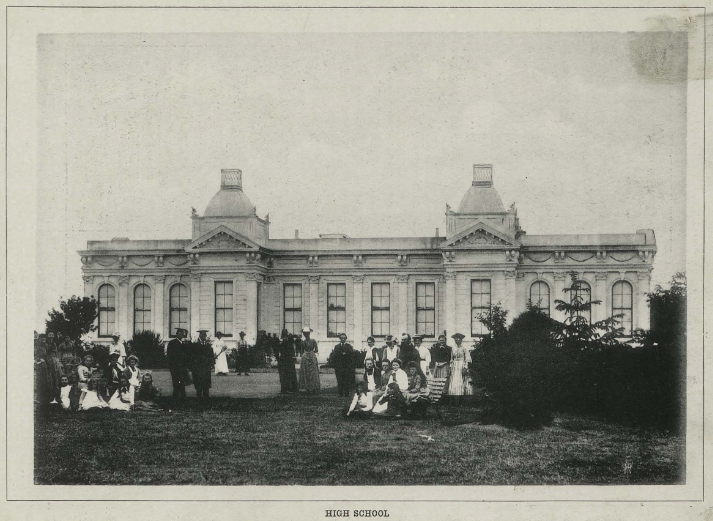
William Ferrier, Album of Views Timaru & District Descriptive & Illustrated. Aoraki Heritage Collection, accessed 04/05/2026, https://aorakiheritage.recollect.co.nz/nodes/view/168 Book of photographs of Timaru and surrounding districts, published by William Ferrier, a well known local photographer, and Thomas Wagstaff, a local bookseller and stationer. Date of Publication 1904. Publisher W Ferrier & T Wagstaff
Sometimes a school motto can become so familiar that we stop noticing it. But Christina’s life makes it feel practical.
Knowledge was power when she and Margaret taught each other after missing school.
Knowledge was power when she earned her degrees.
Knowledge was power when she stood in front of girls at Timaru Girls’ High School and showed, simply by being there, that women could be scholars, science graduates, teachers, and leaders.

Timaru, New Zealand, circa 1910, Timaru, by William Ferrier, F.W. Hutton & Co. Gift of Lord Kitchener, 1960. Te Papa (AL.000566)
This is why public girls’ education matters.
It is not just about buildings, uniforms, timetables, or exam results. At its best, public girls’ education is a promise. It says a girl’s mind is not an extra. It is not a luxury. It is not something to be fitted in after everyone else’s needs have been met. It is a public good.
A school like Timaru Girls’ High School gives that promise a place to live. It creates a space where girls can see themselves as leaders, learners, thinkers, scientists, artists, athletes, friends, citizens, and future professionals. It gives them rooms where they are expected to speak, try, question, lead, and belong.
Christina Cruickshank’s story belongs in that space. After Timaru, her influence widened. She became headmistress of Southland Girls’ High School in Invercargill, and later principal of Wanganui Girls’ College, where she led for many years.
That is the kind of legacy teachers often leave.
Not always in statues.
Not always in headlines.
Sometimes it is left in the memory of a student who never forgot the person who expected more of her.
Sometimes it is left in a school culture... the confidence of girls who grow up believing that knowledge belongs to them.

Where the Cruickshank Twins, Teachers and Healers rest in their graves in the Old Cemetery of Waimate. Twin girls born on New Year’s Day 1873 in Palmerston, Otago to George and Elizabeth Cruickshank (nee Taggart). - Photo Roselyn Fauth. FUNERAL OF MISS C. M. CRUICKSHANK Miss Christina Murray Cruickshank, whose death recently occurred in Christchurch, was buried in Waimate on Saturday alongside her sister, Dr. Margaret Cruickshank. The service at the graveside was conducted by the Rev. L. Robertson, of Christchurch. Dr. Cruickshank won a high place in the regard of Waimate people through her work during the influenza epidemic in 1918. She died as a result of that work, and a monument in Waimate commemorates her name. Her sister, now buried beside her, had a distinguished academic career. - TIMARU HERALD, VOLUME CXLVII, ISSUE 21507, 21 NOVEMBER 1939, PAGE 3
Christina died in 1939 and was buried at her sisters grave in Waimate. Almost 21 years after Margaret.
Margaret’s story is extraordinary. She deserves every bit of the respect she receives. She served her community, broke barriers in medicine, and paid an enormous personal cost during the 1918 influenza pandemic.
Christina deserves to be seen too. Her life reminds us that there is more than one way to serve a community. What a gift it must have felt like to give girls the knowledge and confidence to step into wider lives.
And perhaps that is why Christina’s story belongs so naturally with Timaru Girls’ High School, and why she pulls at my heart strings as an "Old Girl' of the school.
She helps us see the women who stood in the margins of photographs, school rolls, and old newspaper columns, but who were quietly changing what girls could imagine for themselves.
For a student today, Christina’s story says: you are not the first girl to sit in a classroom and wonder what you might become. Others wondered too. Others pushed doors open. Others stood at the front of the room and made learning feel possible.
Long before Knowledge is Power was something students walked past on a crest or read on a school website, Christina Cruickshank was living it.
She had fought for knowledge with her sister and found a way to make it work. She shared what she learned with her sister, and then she spent her working life passing it on.
Not all history stands on a plinth.
Some of it stands in the memory of a school.

Margaret Cruickshank memorial at Seddon Square, Waimate unveiled on 25 July 1923. Dr Cruickshank is shown in academic robes, holding a Bible, symbolising both her scholarly achievement and moral commitment. Erected in New Zealand to honour a female doctor. It was one of the earliest public statues in the country dedicated to a woman, as a tribute to her service during the 1918 influenza pandemic and her legacy as a medical pioneer. The sculptor was William Trethewey (1892–1956) was a New Zealand-born artist, he also created the Nurses’ Memorial Chapel reredos in Christchurch and the Citizens’ War Memorial in Cathedral Square. Engraved on the monument are the words, 'The Beloved Physician / Faithful unto Death.' - Photo Roselyn Fauth


Waimate Hospital Nursing Staff including Dr Barclay Includes Matron Mander Nurse Gorman Warder Penrose, Nurse Watt tall nurse standing centre of back row Nurse Neal Nurse Detford Waimate Museum P1374

Woman's Medical College of Pennsylvania in 1886: Anandibai Joshee from India (left) with Kei Okami from Japan (center) and Sabat Islambooly from Syria (right). All three completed their medical studies and each of them was the first woman from their respective countries to obtain a degree in Western medicine.. drexel.primo.exlibrisgroup.com/a991015136504704721, Public Domain
Sources for Christina and Margaret Cruickshank
Te Ara / Dictionary of New Zealand Biography — Margaret Barnet Cruickshank (Birth date, parents, Christina’s name, alternate school attendance, joint dux, Christina’s MA/MSc, Margaret’s medical career.)
https://teara.govt.nz/en/biographies/3c41/cruickshank-margaret-barnet
NZ History — Margaret Cruickshank (Margaret as New Zealand’s first registered woman doctor, Waimate career, 1918 influenza pandemic, twin Christina).
https://nzhistory.govt.nz/people/margaret-cruickshank
NZ History — New Zealand’s first woman doctor registered (Margaret being the second woman to complete a medical course in New Zealand, and first New Zealand woman to register as a doctor).
https://nzhistory.govt.nz/nzs-first-registered-woman-doctor-margaret-cruickshank
NZ History — Margaret Cruickshank memorial (the 1923 Waimate memorial statue).
https://nzhistory.govt.nz/media/photo/margaret-cruickshank-memorial
Te Ara — Statue of Margaret Cruickshank, Waimate (The statue being one of New Zealand’s few memorials to a woman other than Queen Victoria).
https://teara.govt.nz/en/photograph/32564/statue-of-margaret-cruickshank-waimate
NZ History — First woman graduates from a New Zealand university (Kate Edger, Helen Connon, and the early women’s university context).
https://nzhistory.govt.nz/first-woman-graduates-new-zealand-university
NZ History — Kate Edger (Kate Edger as the first woman in New Zealand to gain a university degree).
https://nzhistory.govt.nz/people/kate-edger
NZ History — First woman Master of Arts in British Empire graduates
Use this for: Helen Connon as the first woman in the British Empire to gain a Master of Arts degree.
https://nzhistory.govt.nz/page/first-woman-master-arts-british-empire-graduates
NZ History — Education: girls and women (Wider context about girls’ and women’s education in New Zealand).
https://nzhistory.govt.nz/women-together/theme/education-girls-and-women
ERIC — Ruth Fry, It’s Different for Daughters (The claim that girls often received less mathematics and science teaching in the early twentieth century).
https://eric.ed.gov/?id=ED363528
Sources for Timaru Girls’ High School and local context
Timaru Girls’ High School archive article — “A Little History”
Christina Cruickshank MA MSc being on staff at Timaru Girls’ High School from approximately 1900–1905.
https://hail.to/timaru-girls-high-school/article/yeDmbtN
WuHoo Timaru — The Cruickshank Twins, Teachers and Healers
The 1900 tennis team photograph, Christina’s Timaru Girls’ High School connection, and the quoted 1910 description of her teaching influence.
https://wuhootimaru.co.nz/blog/900-the-cruickshank-twins-teachers-and-healers
Timaru Girls’ High School official website
The motto Knowledge is Power — Scientia Potestas Est — Mā te Mātauranga te Mana, and the school’s current public values.
https://www.timarugirls.school.nz/
Te Ara / Dictionary of New Zealand Biography — Mary Jane McLean
Mary McLean’s Timaru connection, university education, honours in botany and biology, and role as principal of Timaru Girls’ High School after the school division in 1898.
https://teara.govt.nz/en/biographies/3m26/mclean-mary-jane
NZ History — Margaret Cruickshank graduation photograph - Margaret at graduation.
https://nzhistory.govt.nz/media/photo/margaret-cruickshank
Timaru District Council — Dr Margaret Barnett Cruickshank
Useful local-government source