
By Roselyn Fauth

Samuel McBride was one of South Canterbury’s key makers of memory in stone. Born in Dumfries and settled in Timaru in the early 1870s, he moved from stone-house work into monumental masonry and later general contracting. His known work links shipwreck grief, South African War commemoration, school memory, church foundations, civic architecture, cemetery craft and family mourning. His Sophia Street yard stood opposite the Wrecks Monument, one of his own major works, while his family’s repeated losses are gathered in Row 91 of Timaru Cemetery.. McBride’s work brought together local stone and imported memory materials. Newspaper advertisements in the 1930s and 1940s include the contact details 29 Sophia Street, Timaru, with telephone number 572 for “S. McBride, Established 1874” Timaru township. The Press (Newspaper) :Negatives. Ref: 1/1-008713-G. Alexander Turnbull Library, Wellington, New Zealand. /records/29947494 - https://paperspast.natlib.govt.nz/newspapers/THD19380913.2.3.1
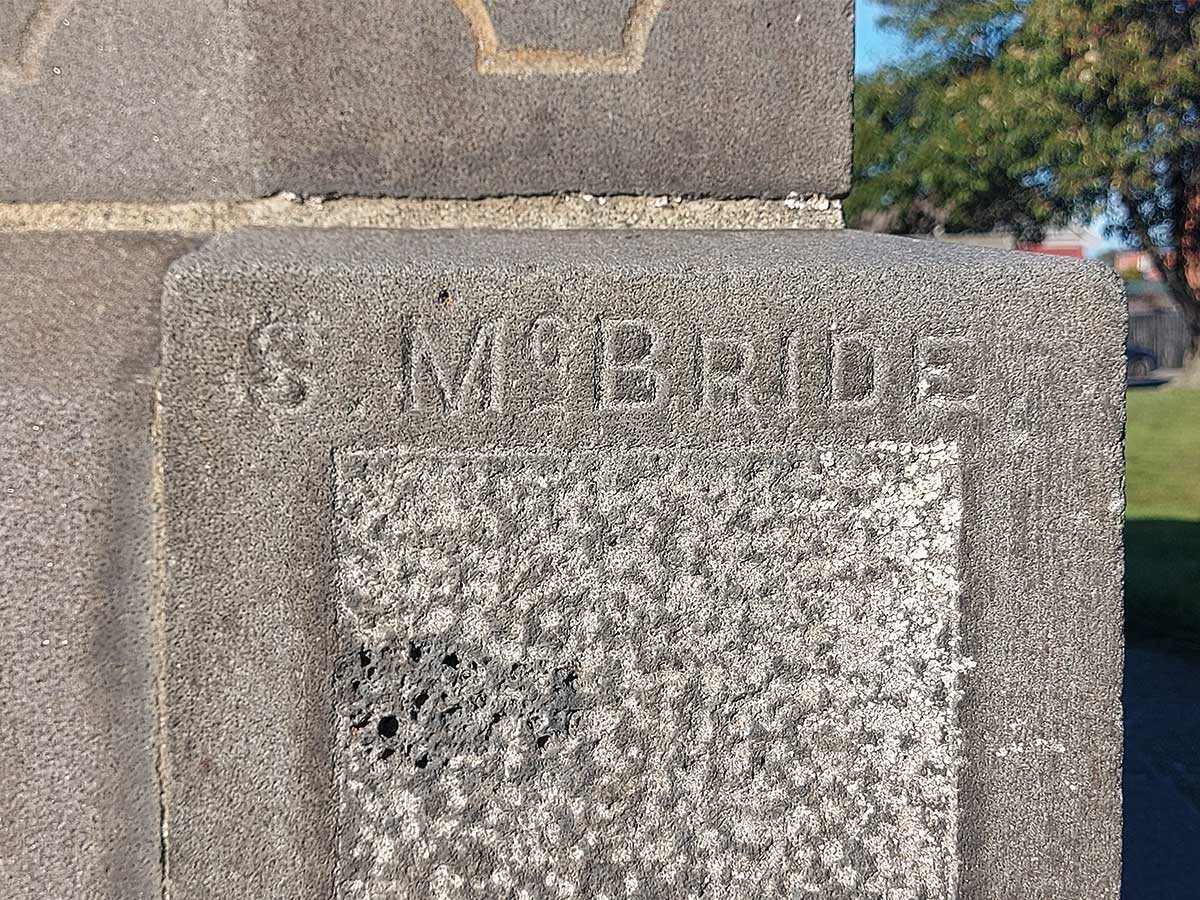
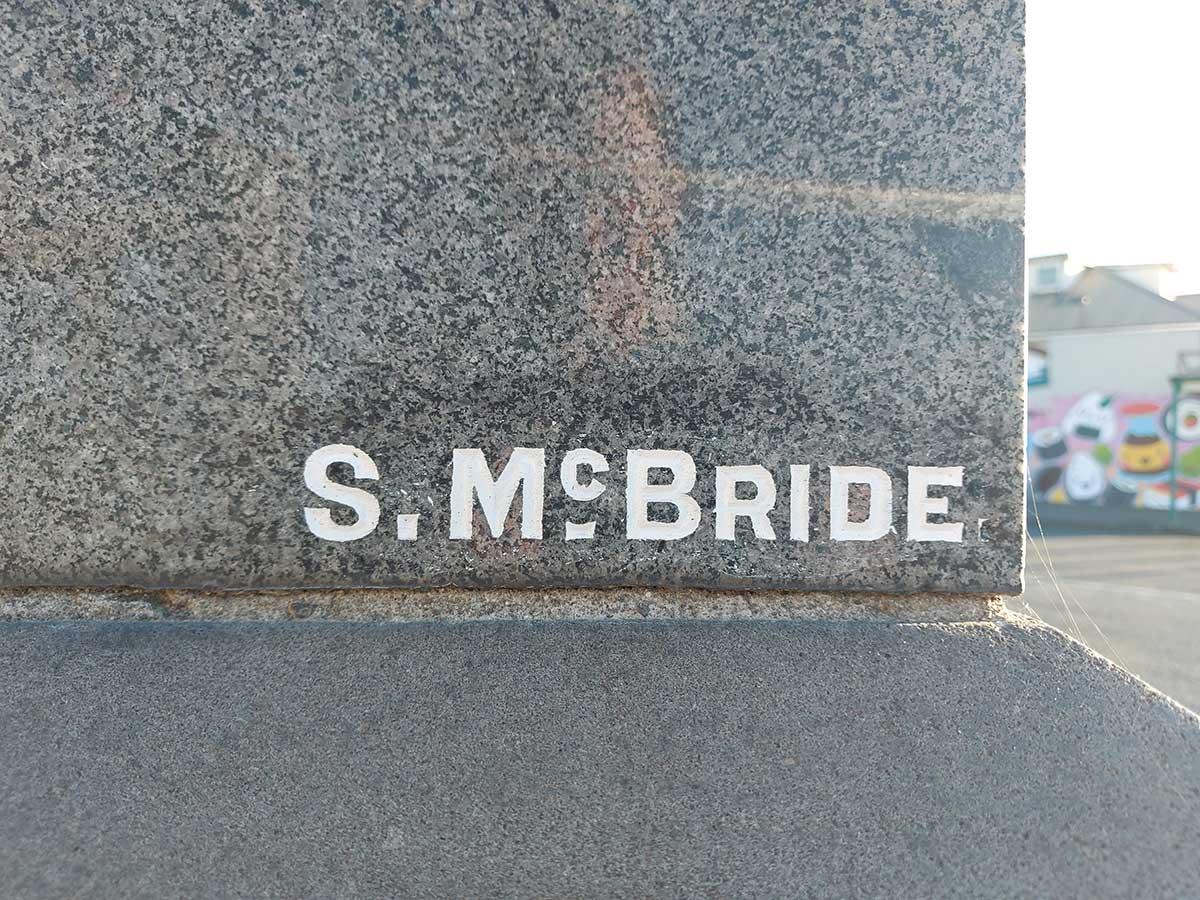
When I was taking cemetery tours in Timaru, people began noticing a name carved low on old headstones: McBride. At first glance, it can look like the name of the person buried there. But on many old stones, a small name near the base, side or plinth is something else. It is the mason’s mark. It is the signature of the person or firm that made the memorial.
That realisation opened up a much bigger story... Because McBride is not only a name you might notice on cemetery headstones. Samuel McBride helped shape some of South Canterbury’s most important civic, church and public memorials. His work appears in the places where Timaru and surrounding communities remembered disaster, war, school service, faith, empire, family and grief.
So who was McBride?
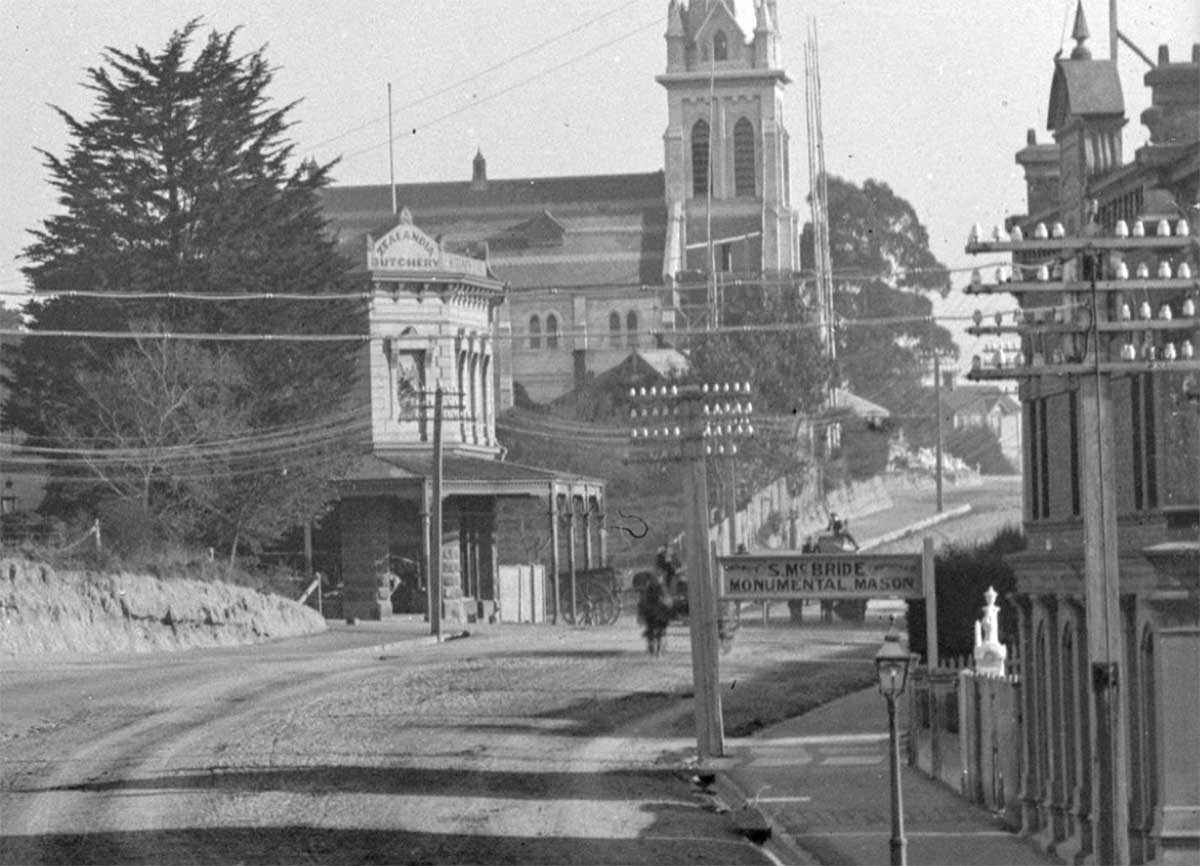
Samuel McBride was a Scottish stonemason who settled in Timaru in the early 1870s
Samuel McBride was born in Scotland. His obituary identifies him as a native of Dumfries. It says he came to New Zealand as a young man, settled in Timaru, first worked on stone houses, and then established himself as a monumental mason. The obituary describes him as a “well-known builder and monumental mason” and says he left Timaru many monuments to his “skill, enterprise, and integrity”.
There is a small date issue. Some sources point to 1871 as the beginning of his work in South Canterbury, while later business history and advertisements use 1874 as the establishment date for the McBride monumental masonry business. The safest wording is that Samuel settled in Timaru in the early 1870s, and that 1874 became the establishment date attached to the McBride business name. McBride’s Monumental Masons still traces the business back to Samuel and says many striking headstones in Timaru Cemetery were crafted by him.
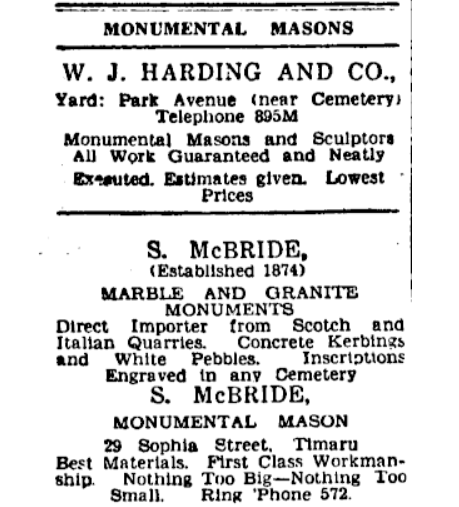
Mason adverts Timaru Herald Volume CXLV Issue 21140 13 September 1938 Page 1. The other major name emerging is W. J. Harding & Co. They advertised in the 1920s and 1930s as Monumental Masons and Sculptors, with a yard on Park Avenue near the cemetery, phone 895M.
Timaru’s early memory was shaped by the sea, the harbour and public loss
To understand McBride, we need to understand Timaru.
In the 1850s, 1860s and 1870s, Timaru grew around shipping, landing services, surf boats, farming, merchants, churches, schools and public buildings. Large ships anchored offshore. Goods and people were brought in by smaller boats. The sea was work, income, danger and identity.
That danger became painfully visible on 14 May 1882, when the Benvenue and City of Perth were wrecked at Timaru. Rescue boats capsized in heavy seas. Nine men died. The event became one of the defining public tragedies of early Timaru. NZ History describes the shipwreck memorial as a public subscription memorial raised as a token of gratitude to those involved in the rescue efforts.
The Wrecks Monument made the 1882 shipwreck disaster part of Timaru’s public identity
The Wrecks Monument, also known as the Benvenue and City of Perth Memorial, is one of Samuel McBride’s most important known works.
The monument was built in stages. The base was installed in 1883. The obelisk arrived from Scotland and was erected in 1885. Timaru District’s heritage assessment identifies Samuel McBride as the local stonemason and records that the original bronze plates were engraved by N. Wolfe of Christchurch.
This was not just a stone marker. It was a civic decision.
Timaru chose to place grief, rescue and gratitude in public space. The monument made the danger of the harbour part of the town’s visible identity. It was not hidden away. It stood where people would pass it, read it and remember.
McBride’s own yard was associated with Sophia Street, near or opposite this memorial. That image is powerful: the monumental mason’s working life stood beside one of the public memories he helped create. The National Library identifies Samuel McBride as a monumental mason on Sophia Street and possibly Stafford Street, Timaru.
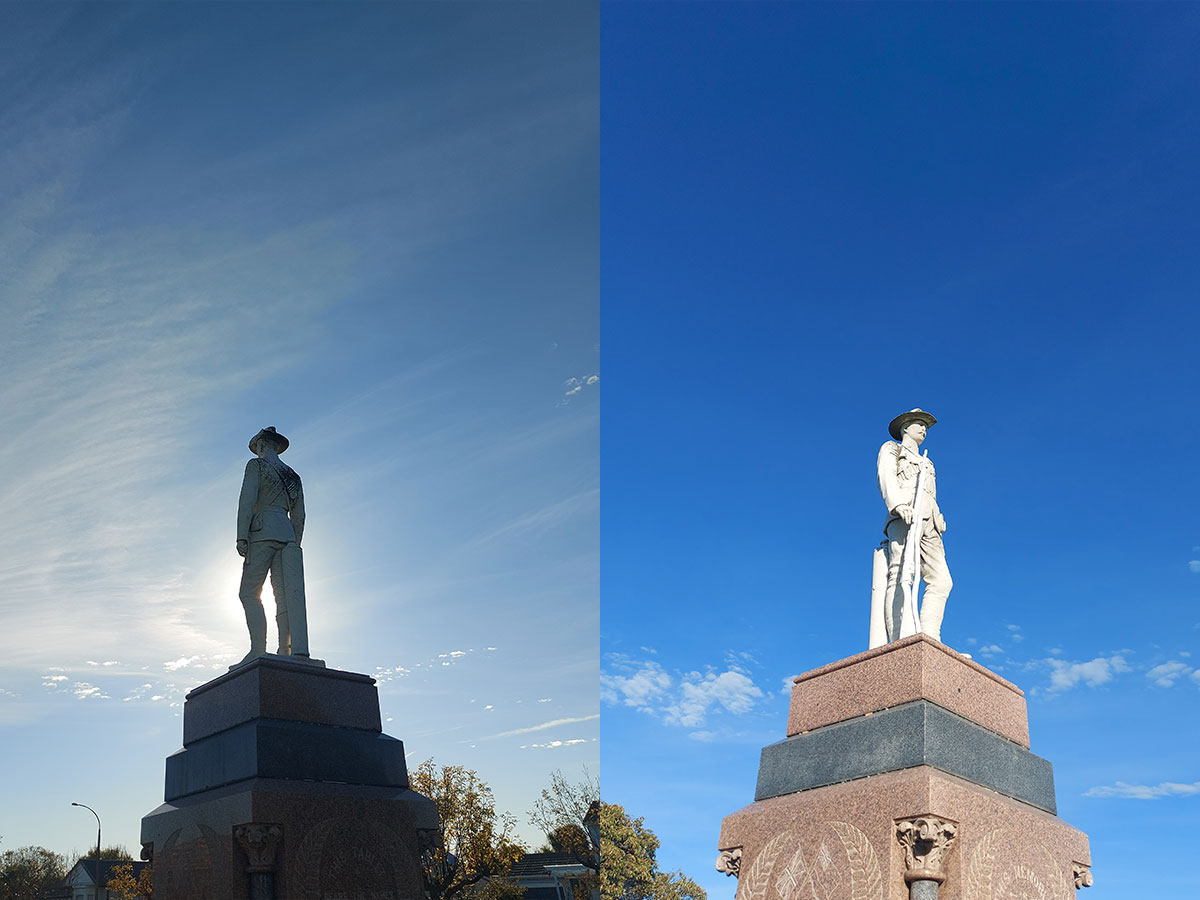
Troopers Memorial in Timaru was originally infront of the army barraks on High Street and Mill Street and then was relocated to the northern end of Memorial Ave. - Photos Roselyn Fauth 2026. On the corner of Arthur Street and Grey Road is a granite and bluestone (basalt) concrete form this Classical obelisk. Addition of World War II commemorative text (date unknown, post-1945). This is adjacent to the former Timaru Main School headmaster’s house. This area used to be Timaru Main School, which is why the 1921 monument is located here to commemorate the 70 former teachers and pupils who died serving in World War I and the 361 others who fought and returned.

Former Timaru Main School War Memorial and Headmasters House 2026 Photo RFauth
The Troopers’ Memorial placed Timaru inside South African War memory before Anzac
Samuel McBride’s best-known war memorial work is the Timaru Troopers’ Memorial, built to remember local men who died during the South African War of 1899 to 1902.
Designs were invited in 1903. The memorial was completed in 1904 and unveiled on 23 February 1905. Timaru District records it as an ornamental figurative memorial designed by local stonemason Samuel McBride using imported and local components. The assessment says McBride undertook the foundation work and assembled the memorial.
This needs careful wording. McBride did not carve the soldier figure himself. Heritage New Zealand records that Italian sculptors made the marble figure, based on a photograph of a trooper in full military gear. McBride was the contractor and prepared the granite base. By late October 1904, the public could view the memorial at his Sophia Street yard before it was unveiled.
The materials tell their own story. The marble came from Carrara, Italy. The granite came from Aberdeen, Scotland. McBride’s work made those global materials local. He helped turn imported stone into a Timaru memorial.
After the South African War ended in 1902, towns across New Zealand raised memorials to local soldiers. Te Ara records that about 50 South African War memorials were erected in New Zealand, reflecting pride in local men who had served or died in South Africa.
Pareora shows McBride’s work reached rural South Canterbury
McBride’s South African War memorial work was not limited to Timaru.
The Pareora South African War Memorial honoured William Nelthorpe Moffatt, John Butler and Thomas Lorrimer Scott, who died fighting in South Africa. NZ History records that the memorial was built by “S McBride” of Timaru.
This matters because Pareora was a rural district community. Its memorial shows that remembrance did not belong only to towns. Smaller communities also wanted their dead named, dignified and placed into public memory.
Gleniti School shows memory at a small and personal scale
One of McBride’s most moving works is not a large monument. It is a school plaque.
The former Wai-iti / Gleniti School opened in 1879. In December 1902, Lady Ranfurly, wife of the Governor of New Zealand, unveiled a memorial plaque at the school to William Matthews, who drowned while serving in the South African War in 1901. Timaru District records that the plaque was designed and made by Samuel McBride, who was also chairman of the Gleniti School committee.
This changes how we see him.
At Gleniti, McBride was not only a paid craftsman. He was part of the local community. He was a school committee chairman helping that community honour one of its own.
It also reminds us that women were central to memorial culture, even when men’s names were usually carved in stone. Lady Ranfurly’s unveiling gave public ceremony and official recognition to the plaque.
St Peter’s Anglican Church in Temuka shows McBride’s skill as an architectural stonemason
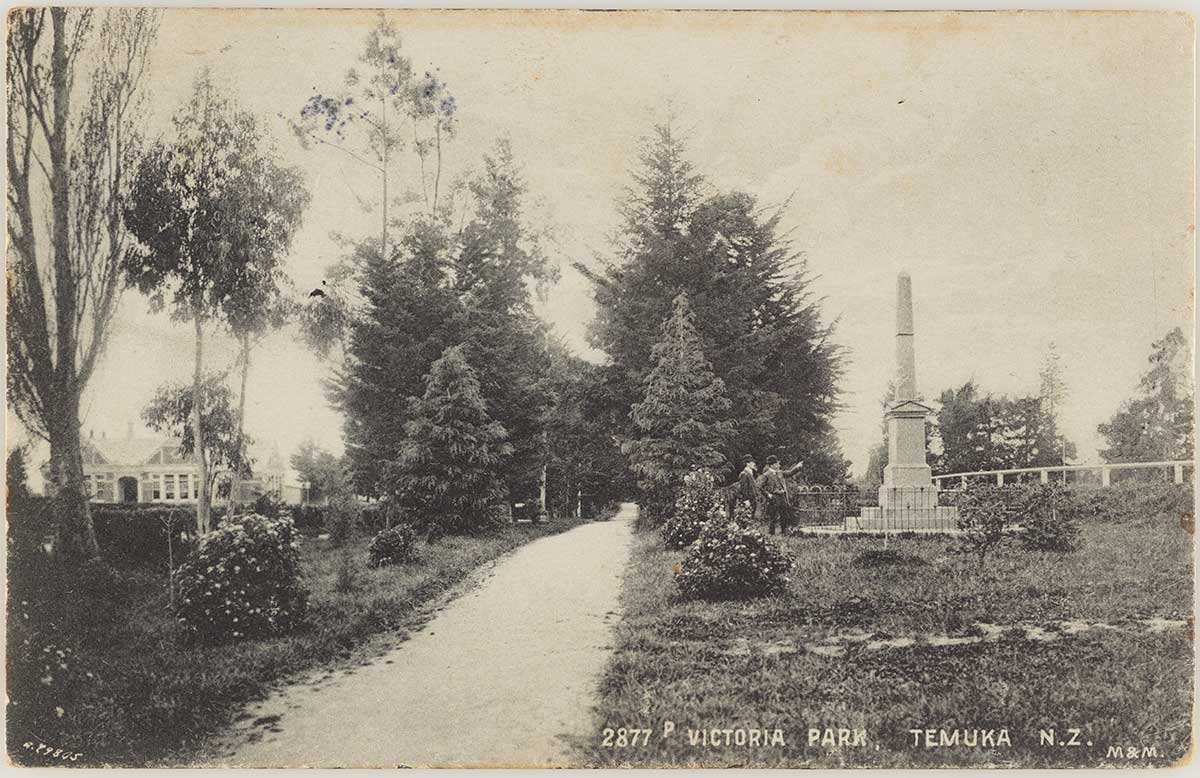
Victoria Park, Temuka, 1906-1912, Temuka, by Muir & Moodie. Purchased 1998 with New Zealand Lottery Grants Board funds. Te Papa (PS.001875)

Timaru Main School War Memorial and Headmasters House - 2026 Roselyn Fauth
McBride’s work was not limited to graves and memorials.
After the earlier Anglican church in Temuka was destroyed by fire in 1897, plans began for a new St Peter’s Anglican Church. By 1898, Timaru architect James S. Turnbull had been appointed. Mrs Hayhurst senior gifted the site. S. McBride was appointed builder. The foundation stone was laid on 29 June 1898, and the church opened exactly one year later, on 29 June 1899.
The conservation-plan material records that McBride completed the stonework, while Messrs Clinch and Lloyd of Temuka completed the woodwork. The church was built in Timaru bluestone, with Kakahu stone facings, copings and internal lining.
St Peter’s also brings women strongly into the story. The church history records women giving land, furnishings, carvings, altar rails, fundraising and long-term support. Built heritage was not only made by architects and tradesmen. It was also made possible by women’s land gifts, fundraising, craft, ceremony and memory work.
St Mary’s, the Timaru Public Library and St Monica’s show the range of McBride’s work
McBride’s obituary names the chancel and tower of St Mary’s Anglican Church as standing evidence of his ability as a builder. Other heritage material records that he built the tower and chancel of St Mary’s in 1907 to 1909. The careful wording is that McBride was connected with the tower and chancel additions, not the whole church.
He also worked on civic stonework. Timaru District records that local stonemason Samuel McBride undertook the stonework for the original Timaru Public Library building, constructed in 1908 to 1909. That building was one of New Zealand’s Carnegie libraries.
At St Monica’s Catholic Church at Cave, McBride appears as a donor as well as a mason. Bishop Grimes laid the foundation stone on 21 May 1911, in front of more than 400 people, and Timaru District records that monumental mason Samuel McBride of Timaru gifted the foundation stone.
In 1912, the King George V Coronation Memorial was erected in Temuka Domain to mark the coronation of King George V in 1911. Timaru District records that it was designed by James Turnbull, with stone construction and detailing by Samuel McBride.
These works show the range of his craft: disaster memorials, war memorials, school plaques, church stonework, civic buildings, foundation stones and imperial commemoration.
Pleasant Point is linked to the McBride name
The Pleasant Point War Memorial was unveiled in 1921 by local MP T. D. Burnett. Timaru District heritage material attributes its stonework to Samuel McBride and links McBride with the Wrecks Monument, Troopers’ Memorial and St Mary’s additions.
But Samuel McBride died in 1916. The Pleasant Point War Memorial is attributed in heritage material to Samuel McBride, but because it was unveiled after his death, this probably refers to the McBride firm or workshop tradition unless a primary source identifies the actual maker.
The McBride business continued after Samuel’s death
Samuel died in 1916, but the S. McBride name continued.
Later advertisements still used the McBride name and the 1874 establishment date. A 1940 advertisement placed S. McBride at 29 Sophia Street, described the firm as a direct importer from Scottish and Italian quarries, and offered inscriptions in any cemetery.
The modern McBride’s Monumental Masons history says that in 1974, Arnold Earl owned McBride Monumental Masons on Sophia Street, in premises now occupied by Pope Print. Later owners included the O’Reillys, Hall and Moore Funerals, and Aoraki.
I do not yet know is exactly who managed the firm between 1916 and the later named owners.
John and Robert McBride show that the trade continued through Samuel’s sons
At least two of Samuel McBride’s sons worked in stone or monumental masonry.
John McBride, son of Samuel McBride and his first wife Hannah Banks, was recorded by South Canterbury Museum as a monumental mason before and after war service.
Robert McBride, son of Samuel and his second wife Frances Elizabeth Jenkins, was recorded by South Canterbury Museum as a stone mason at enlistment and later as a monumental mason.
This proves the craft continued in the family. It does not yet prove which son, if either, formally ran the firm after Samuel’s death.
Row 91 in Timaru Cemetery is the private heart of the story
The most moving part of this story is the McBride family cluster in Row 91 of Timaru Cemetery.
These details come from Timaru District cemetery records gathered during this research.
Row 91, Plot 227
Hannah Banks McBride, Samuel’s first wife, buried 26 December 1892, aged 46.
Row 91, Plot 228
Peter McBride, died 31 January 1898, interred 1 February 1898, aged 24.
Samuel McBride junior, died 9 February 1912, interred 11 February 1912, aged 25.
Row 91, Plot 253
Frances Elizabeth McBride, Samuel’s second wife, died 14 September 1949, aged 84.
Norman McLeod McBride, died 29 November 1930, interred 1 December 1930, aged 25.
Infant McBride, interred 20 June 1919. Parentage not yet confirmed.
Row 91, Plot 254
Samuel McBride senior, died 1916, aged 68.
Andrew McBride, died 26 August 1918, aged 21.
Hannah Banks Kernick, née McBride, died 2 February 1932, aged 47.
Jean Catherine McBride, died 28 September 1957, interred 30 September 1957, aged 50.
Andrew McBride needs careful interpretation. South Canterbury Museum and Every One Remembered record him as a son of Samuel and Frances Elizabeth McBride, killed in France in 1918, and buried at Vaulx Hill Cemetery, Pas de Calais. His appearance in the Timaru Cemetery family plot is best understood as a family memorial inscription or cemetery record, not as proof that his body was buried in Timaru.
Hannah, Frances and the daughters remind us that memory was carried by women too
Hannah Banks McBride should not be treated as a background figure. She was Samuel’s first wife. She migrated, mothered, settled and died before many of Samuel’s best-known public works were completed. Her death in 1892, aged 46, appears to anchor the McBride family presence in Row 91.
Her daughter later carried her name forward: Hannah Banks McBride, who became Hannah Banks Kernick. South Canterbury Museum records that Hannah Banks McBride married Alfred Bertie Kernick at Chalmers Church, Timaru, on 1 January 1908. Their son Keith Bertram Kernick was born in Timaru on 2 February 1909.
Frances Elizabeth Jenkins McBride carried the second family line after Samuel’s death. She lived until 1949, more than thirty years after Samuel died, and lived through Andrew’s death in France, the infant burial in 1919, and Norman McLeod McBride’s death in 1930.
Samuel’s obituary said he was survived by seven daughters. Daughters can disappear from trade histories unless we deliberately look for them. Hannah Banks Kernick, Jean Catherine McBride, Margaret Dinsmore McBride and Frances Elizabeth McBride junior all belong in this story, even where more research is still needed.
Women carried names, grief, household memory, family links and often the emotional labour of remembrance.
Look for the maker’s mark behind the memory
McBride was not the only monumental mason in Timaru. Other firms, including W. J. Harding and Co., also worked in the monumental trade. But the McBride name appears again and again in the landscape of South Canterbury memory.
It is on cemetery stones.
It is in civic memorials.
It is in church stonework.
It is in school memory.
It is in the quiet records of Row 91.
When I first noticed people seeing the name McBride on cemetery tours, I realised many did not know they were often looking at the maker, not the person buried there.
That is what makes the mark so fascinating.
It is a little signature behind the grief.
The man who made memorials for others also knew what it was to need them
For all the monuments Samuel McBride helped raise, I wonder how many people notice his own memorial in Timaru Cemetery.
When his first wife, Hannah Banks McBride, died in 1892, did he know exactly what he wanted for her stone? Did he think, even then, that one day this family place in Row 91 would become his own resting place too?
McBride is present in so many of our built history memorials. Yet he also rests quietly within the same landscape of remembrance he helped create.
Next time you look at a monument, a church stone, a public memorial or an old headstone, look closer. Along the base, the side, or the careful stonework, you may find the maker’s mark behind the memory:
McBride.
Some of McBrides known works and linked sites
Wrecks Monument / Benvenue and City of Perth Memorial, corner Perth and Sophia Streets
1883 to 1885
McBride's role: Stonemason. Designed by Thomas Roberts, built by McBride
This is one of Timaru’s most important maritime memory sites. It commemorates the 14 May 1882 disaster, when the Benvenue and City of Perth were wrecked and nine men died. The base was installed in 1883, the Aberdeen granite obelisk arrived from Scotland and was erected in 1885, and McBride later altered the setting of the bronze plaques.
Timaru Troopers’ Memorial / South African War Memorial
1904, unveiled 1905
McBride's role: Designer and contractor
The monument used local and imported components: bluestone, concrete, Aberdeen granite and Carrara marble. The soldier statue was made in Carrara, Italy, while McBride undertook the foundation work and assembled the memorial.
St Mary’s Anglican Church additions, Timaru
1907 to 1909
McBride's role: Contractor for tower and chancel works Timaru District heritage material says McBride was operating as a general contractor by the early twentieth century and built the tower and chancel of St Mary’s.
St Monica’s Catholic Church, Cave
1911
McBride's role: Donor of the foundation stone
The Timaru District heritage assessment says Bishop Grimes laid the foundation stone in 1911 and that Samuel McBride of Timaru gifted it. This is a lovely smaller lead, showing him not only as tradesman but as a contributor to Catholic community building in South Canterbury.
King George V Coronation Memorial, Temuka Domain
1912
McBride's role: Stonemason, with James Turnbull as designer
The assessment credits James Turnbull with the design and Samuel McBride with the stone construction and detailing. Materials included Aberdeen granite, marble and Timaru bluestone basalt.
Robert Burns statue setting, Timaru Botanic Gardens
1913
McBride's role: Likely associated through obituary reference, needs primary confirmation
His obituary refers to the “recently erected Burns statue in the Park” among local monuments to his skill. The statue itself was unveiled in May 1913 and had a white Carrara marble figure, bluestone base and grey Coromandel granite pedestal.
Pleasant Point War Memorial
1921
McBride's role: Stonemason
Although this is after Samuel’s death in 1916, the Timaru District assessment attributes the stonework to Samuel McBride. This may mean the firm, rather than Samuel personally, completed it. This needs checking against the 1921 Temuka Leader report and business succession records.
Early New Zealand grave markers were not always made from permanent materials, and that early stone monuments could be elaborate, including broken pillars, plinths, angels and other symbolic decoration. This gives us a useful national frame for reading Timaru Cemetery as a changing open air archive of taste, wealth, religion, grief and craft.