
By Roselyn Fauth

1909 Photograph taken by an unidentified photographer employed or contracted by 'The Press' newspaper of Christchurch.Stafford Street, Timaru, with carts, horses and people in the street. The Press (Newspaper) :Negatives. Ref: 1/1-008815-G. Alexander Turnbull Library, Wellington, New Zealand. /records/29944621
It started, as many good heritage rabbit holes do, with someone pointing at the ground... A friend drew my attention to the bluestone in our Timaru CBD footpaths. Not long after, a fellow Timaru Civic Trust board member pointed out the old bluestone cobbles at the former Timaru and Gladstone Board of Works Building on Stafford Street.
That small observation sent me off on one of those research side quests where one question becomes ten tabs open in my brain.
Where did the stone come from? Why was it used so much in Timaru? Who designed the buildings? Who actually built them? And what can a piece of dark volcanic rock tell us about the way a town grows up? Well it turns out, quite a lot.
Learning about bluestone is not just learning about our stone. It is learning about lava, labour, local government, fire, public works, skilled trades, ambition, debt, resilience and the people whose hands helped shape Timaru’s built heritage.
One of those people was Thomas Machin...
He was the son of Maria Gregory and Edward Machin in Surrey 1836. His dad was a London fishmonger. Thomas arrived in Canterbury as a young bricklayer. By the 1870s, he was helping construct some of Timaru’s most important nineteenth century buildings, including the former Timaru and Gladstone Board of Works Building at 95 Stafford Street.
His story takes us from Southwark to Stafford Street. From bricklaying to bluestone. From bankruptcy to architectural practice. From one man’s working life to a much bigger story about how Timaru learned to build itself.
So this is not just a blog about a man who lived here 150 years ago. It is a story about what happens when you look closely at the stones beneath your feet, and realise they are holding up more than a footpath. They are holding clues to who we were, how we made decisions, and what kind of place we might still choose to become.
To understand why this matters, we need to begin long before Thomas Machin arrived in New Zealand. Long before Stafford Street. Long before the Board of Works.
I think the best place to start if you haven't read my other blogs is with the stone itself.
About 2 to 2.5 million years ago, lava erupted from near Mt Horrible and reached the coast at Timaru, forming reefs that later helped shelter vessels. Te Ara records this volcanic story, while GeoTrips describes the Timaru Basalt flows as originating inland near Mt Horrible, then thinning towards the coast; the columnar joints formed as the lava cooled and contracted.
Thomas Machin’s own story began far from that volcanic coast.
Family history research identifies him as Thomas Machin, born in Southwark, London, in 1836, the son of Edward Machin, a fishmonger. In 1857 he married Annie Holmes at St Mary Magdalene, Bermondsey. Two years later, the young family left England for Canterbury on the ship Roman Emperor. The passenger list records the voyage from Gravesend on 1 October 1859 to Lyttelton on 26 January 1860. In steerage were Thomas Machin, aged 23, bricklayer; Anne Machin, aged 22; and their two year old daughter Anne.
It transit entry tells us that Machin did not arrive as a gentleman architect. He arrived as a tradie.
By the 1870s he was in Timaru, part of the practical building world that gave the young town its physical character. This was a town that knew the cost of fragile construction. The great fire of December 1868 had destroyed around 30 buildings in the town centre, and Timaru responded with a March 1869 bylaw requiring masonry construction in the central business district. The former Union Bank heritage record notes that this helped make Timaru bluestone one of the materials most closely identified with the town’s colonial building tradition.
The former Timaru and Gladstone Board of Works Building was built in 1874. Its Timaru District Council heritage record identifies it as an Italianate two storey building at 95 Stafford Street, designed by Thomas Roberts and built by contractor Thomas Machin. It was constructed from Timaru bluestone, or basalt, with brick, timber and corrugated metal. Its façade had an offset central entrance, arched upper windows, dressed surrounds, quoins, bracketed eaves and a proud name panel above the doorway.
Heritage New Zealand Pouhere Taonga lists the building as a Category 1 historic place, List Number 327, with original construction beginning in 1874.
The Timaru and Gladstone Board of Works was created in 1867 because South Canterbury wanted more control over its own public works. Roads, bridges and harbour works were not abstract political matters. They shaped whether wool, wheat, goods and people could move. They shaped whether the port could grow. They shaped whether Timaru could act like a regional centre, rather than a distant outpost waiting for decisions to be made elsewhere.
The Board first met in December 1867 and had power to spend revenue from land sales and other sources on public works such as roads, bridges and the harbour. Its purpose built office went up in Stafford Street in 1874, only two years before the Board disappeared when provincial government was abolished.
That makes the building more than a handsome old office... and a very important and tangible link to our civic history.
Who decides where public money goes? Who gets a road, a bridge, a harbour? How does a district argue that it understands its own needs better than a distant centre of power? These questions sound modern, but they were already built into Stafford Street in 1874.
the architect behind this build Thomas Roberts gave the Board of Works building its civic face. The contractor, Thomas Machin gave it the harder thing: construction. He had to turn drawings into stone, wages, cartage, all with weather and deadlines risking his likely aspirations of on time and on budget. And risk is where Machin’s story I think is really key to this blog.
In June 1876, the Timaru Herald advertised him as “T. Machin, Bricklayer and Builder” of Main South Road. A few days later, another advertisement placed him in a new brick building opposite the Timaru Hotel on Great South Road, selling kitchen ranges suitable for hotels, stations, gentlemen’s residences and working men’s cottages. He did not simply sell them. He undertook to set them himself and guarantee their proper working.
That small advertisement reveals Machin understood buildings from the inside out. Walls mattered, but so did heat, cooking, comfort and use. A hotel, cottage, station or residence had to work.
He knew this building was more than its architecture aesthetic, it needed to be workable for daily life.
Machin then worked again with Thomas Roberts on another major Stafford Street building, the former Union Bank of Australia at 119 Stafford Street. Built in 1876 to 1877, it was designed by Roberts and constructed by Machin in the Victorian commercial classical style. Its side and rear walls still show Timaru bluestone, and its materials included basalt, cement plaster, brick, slate and corrugated iron. The same heritage record notes that the bank completed its new premises in March 1877, with a contract worth about £3000.
Going by what I could find in papers past, that contract seems to have nearly swallowed him.
In June 1877, the Timaru Herald reported Machin in the District Court as a bankrupt. His evidence publicly exposed the tangled world of colonial contracting: overdrafts, sureties, bills of sale, stock in trade, contractor’s plant, household furniture, mortgages and money due on the new Union Bank contract.
A few weeks later, auctioneer Moss Jonas advertised freehold and leasehold properties for sale by instruction of the trustees in the estate of “Mr T. Machin, a debtor.” Among them was the large dwelling house at the corner of North and Le Cren Streets, recently occupied by Machin himself.
This is the human underside of heritage, where while the buildings might look rock solid, the lives behind them were often anything but. In one year, we see the full swing of Machin’s life: a man linked to some of Timaru’s most substantial buildings, while his own financial footing gave way.
Fortunately this was not the end of him and by February 1878, Machin was advertising from Heaton Street as “Thomas Machin, Architect,” inviting tenders for a villa residence near Timaru in brick or wood.
In the same advertising column, Thomas Roberts also appeared as an architect. Only a few years earlier, Machin had been constructing Roberts’ designs. Now he was appearing beside him in print as a designer in his own right.
This was possible in a period before architectural registration, when skilled builders could also practise as architects. The Queen’s Hotel heritage record makes this point directly, describing Machin as a local builder turned architect.
In 1878, he designed the Queen’s Hotel at 2 Barnard Street, with J. Simpson as builder. Thomas Bell Jones opened it opposite the Timaru Courthouse on 1 October that year. Its rounded corner, arched sash windows, rusticated ground floor and segmental pediment gave the justice precinct a confident hospitality neighbour. It was brick and cement plaster, rather than bluestone, reminding us that Machin was not simply a “bluestone man”. He belonged to Timaru’s broader masonry-building generation, able to work across stone, brick, plaster, timber and practical design.
The same heritage record notes that Machin later wrote to the Timaru Herald about hotel fire safety, including the danger of oversized cornices. It suggests the Queen’s Hotel may reflect his preference for life safety over excessive architectural ornament.
This clue suggests he had known the practical side of buildings. He had carried the risk of contracts. He had worked with stone, brick, timber, plant, ranges and creditors. When he became an architect, he did not leave the builder behind. He brought the builder with him.
His name also appears in the story of Bruce’s Royal Flouring Mills, later the Timaru Milling Company mill, at 4 Mill Street. Its heritage record identifies James Bruce as owner and designer, with Thomas Machin as contractor. Built in 1881 to 1882, the new flour and oatmeal mill became the first in New Zealand fitted with roller milling plant. The record also links Machin back to the Board of Works building and the former Union Bank, making him a thread through civic, commercial, hospitality and industrial Timaru.
This is why Thomas Machin is more than a name attached to an old building, and through him, we can see Timaru becoming itself.
We see geology becoming architecture. Lava from Mt Horrible becomes bluestone in Stafford Street. We see civic frustration becoming local government. A district wanting roads, bridges and a harbour creates a Board of Works. We see fire becoming policy. A timber town rebuilds in masonry. We see a working migrant becoming a contractor, then an architect. We see ambition, skill, debt, resilience and public purpose all held in the same wall.
For students, this is local civics in plain sight. The Social Sciences learning area asks young people to understand how societies work and how people participate in them, and the national curriculum refresh has identified Civics and Society as one of the strands. The Board of Works building lets us ask those questions right here, on Stafford Street. Who has power? How are decisions made? What infrastructure does a community need? What happens when local people push for a stronger voice?
For heritage advocates, it reminds us why old buildings matter. They are not simply attractive façades. They are records. Records of labour, materials, laws, arguments, disasters, recoveries and ambitions. They show us where we came from, but they also ask what kind of places we want to make next.
The former Timaru and Gladstone Board of Works Building is one of Timaru’s great civic witnesses. It tells us that a town is not built by scenery alone. It is built by meetings, tenders, laws, money, quarrels, stone, skill and people willing to argue for the infrastructure they need.
Look closely at the bluestone wall on Stafford Street and you are not just looking at rock.
You are looking at lava, labour, law, local government and a town learning how to build itself.
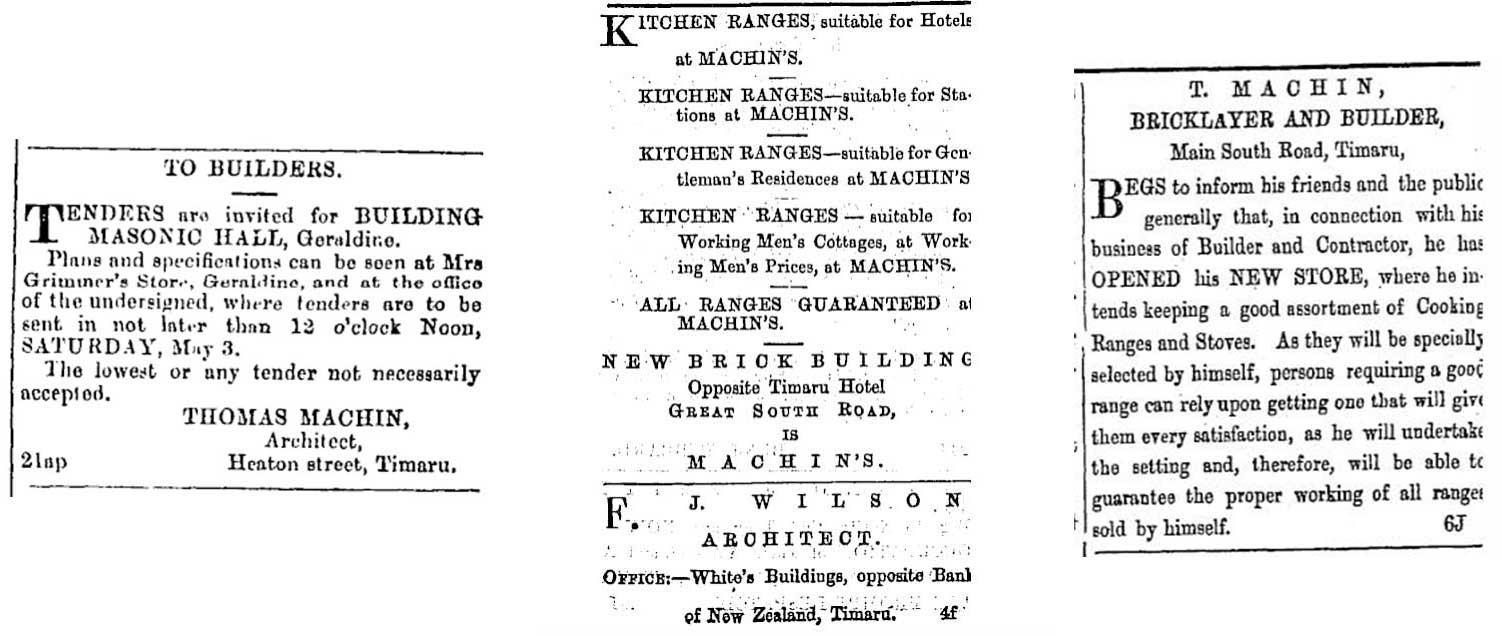
LEFT:Page 1 Advertisements Column 8 Timaru Herald, Volume XXX, Issue 1433, 25 April 1879, Page 1
CENTER: Machin Advert Timaru Heral 29 June 1876 Great South Road
RIGHT: Page 1 Advertisements Column 4. Timaru Herald, Volume XXIV, Issue 1453, 24 June 1876, Page 1
Side Quest: What as the the Timaru and Gladstone Board of Works Act
In 1867, a special law called the Timaru and Gladstone Board of Works Act created a regional Board of Works for South Canterbury. Its job was to help fund and organise major public infrastructure across the electoral districts of Timaru and Gladstone, including the road districts of Geraldine, Levels, Waimate and Mount Cook.
The Board was made up of representatives appointed by the Timaru Municipal Council and local Road Boards. It could oversee public works, enter contracts, manage funds and report annually on what had been built.
One of the most important parts of the Act was money. It directed one quarter of the gross land revenue from Crown land sales in the district towards local public works. This meant that income raised from land in South Canterbury could be used to improve South Canterbury.
The Act also set aside funding for major projects, including Timaru harbour works, a bridge over the Opihi River, and a bridge over the Rangitata River. In other words, this 1867 Act helped give the growing district the tools and funding it needed to build roads, bridges and harbour infrastructure at a crucial stage in its development.
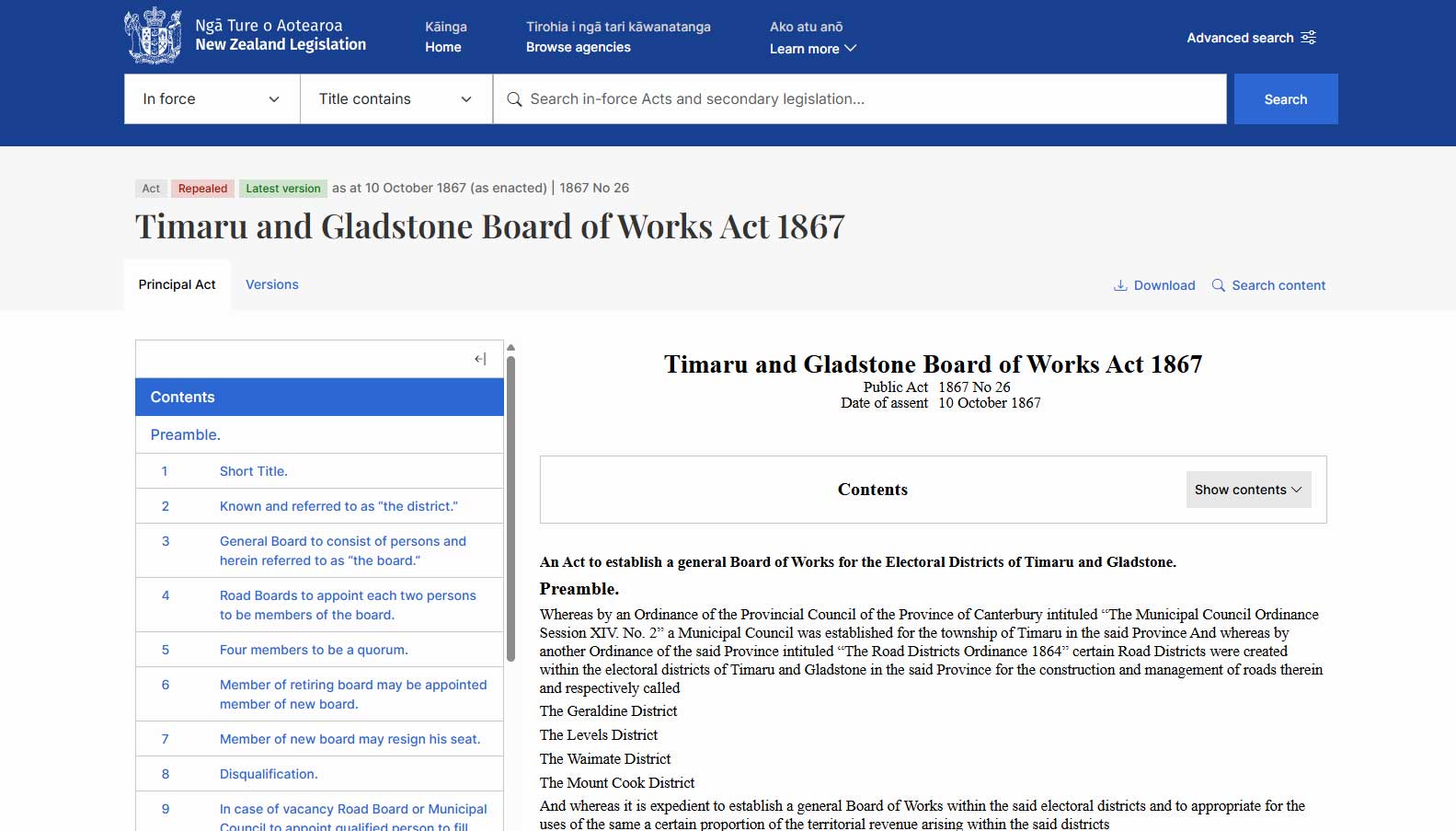
Did you know? The “Gladstone” in the Timaru and Gladstone Board of Works Act 1867 was not a local town name, but the name of a South Canterbury electoral district. It was almost certainly named after the British statesman William Ewart Gladstone, reflecting the way many colonial districts were given names connected to prominent figures in Britain. The Act joined the Timaru and Gladstone electoral districts together for public works purposes, helping South Canterbury secure funding for roads, bridges and harbour development.
Side Quest: Annie Holmes Machin
Behind Thomas Machin’s public life as bricklayer, contractor and later architect sits the quieter story of Annie Holmes. Annie appears to have been born in Sheerness, Kent, the daughter of William Holmes, a shipwright, and his wife Ann. That detail matters. If Thomas was the son of a London fishmonger, Annie came from another working maritime family, shaped by practical trades, docks, movement and labour.
In 1857, Annie Holmes married Thomas Machin at St Mary Magdalene, Bermondsey. He was a young builder. She was about twenty. Two years later, she left England with him and their small daughter Anne on the Roman Emperor, bound for Canterbury.
The passenger list includes Thomas Machin, 23, bricklayer. Anne Machin, 22. Anne Machin, 2. They travelled in steerage from Gravesend on 1 October 1859 and arrived at Lyttelton on 26 January 1860.
There is also a poignant family-history lead that Annie gave birth to a son during the voyage, later recorded as Thomas Dewar Machin, and that he died soon after the family reached Christchurch. This still needs verification through birth, baptism, death or burial records, but if confirmed, it adds a deeply human beginning to the Machins’ colonial life: arrival, hope, and grief all within weeks.
Annie went on to raise a large family through the Christchurch and Timaru years. While Thomas appears in newspapers as builder, contractor, bankrupt and architect, Annie’s life is harder to see. That is often the way with women in nineteenth-century records. Their labour held households together, but the public record usually noticed them only at marriage, childbirth, death, or through the careers of men around them.
And yet Annie’s story matters... She was there when Thomas moved from immigrant bricklayer to Timaru contractor. She was there when the family lived in the house at North and Le Cren Streets. She was there when bankruptcy reached not just his business, but household furniture, property and family security. She was there through the years when Timaru was rebuilding itself in brick and bluestone.
"Sections Nos. 31 and 36, containing 2 Acres, situate at the corners of North and LeCren-streets, together with a large and commodious Dwelling-house recently occupied by Mr T. Machin." - 1877 auction notice after Machin’s bankruptcy https://paperspast.natlib.govt.nz/newspapers/THD18770623.2.5.2 after his financial collapse as a contractor, he was advertising from Heaton Street as “Thomas Machin, Architect.
Later, Annie lived in Victoria, Australia. Her death notice in 1918 remembered her as the “relic” of Thomas Machin, an old-fashioned word meaning widow. But we should not let that be the whole of her identity.
Annie Holmes Machin was a migrant woman, a tradesman’s wife, a mother, and part of the domestic world behind Timaru’s public buildings. If Thomas helped build the walls, Annie’s life reminds us that every wall had a household behind it.
Side Quest: Pauline O’Keefe, an unverified lead
The possible second woman in Thomas Machin’s story is Pauline O’Keefe, but I need to do more research here to learn more. At this stage, Pauline should be treated as a research lead, not a confirmed wife. Some online family-tree material suggests Thomas Machin may have had a later marriage or association with Pauline O’Keefe in Victoria, around 1890. But the wording attached to that lead is uncertain, and we have not yet seen a Victorian marriage record, divorce record, death certificate, will, probate file or newspaper notice to prove it.
That matters because Annie Holmes was still alive until 1918, and her death notice described her as the widow, or “relic”, of Thomas Machin. That does not rule out estrangement, separation, or a later relationship, but it does mean we should not state that Pauline was his wife without proof.
Pauline’s possible appearance in the story may tell us something important, if I can verify it... If a record exists, it could open a window into Thomas Machin’s later Australian years: financial strain, relocation, family separation, possible new relationships, and the difficult final chapter of a man whose buildings outlasted his public memory. But until we can confirm her identity and relationship to him, Pauline must remain in the margins.
Source list for Thomas Machin, Timaru bluestone and the Board of Works
Core heritage sources
Timaru District Council Historic Heritage Assessment: Former Timaru and Gladstone Board of Works Building, 95 Stafford Street, Timaru
Use this for the key facts about the Board of Works building: built in 1874, Heritage New Zealand List Number 327/1, Category A locally, Thomas Roberts as architect, Thomas Machin as contractor, Italianate style, and Timaru bluestone/basalt construction. It also explains the purpose and significance of the Timaru and Gladstone Board of Works.
Full link: https://www.timaru.govt.nz/__data/assets/pdf_file/0005/673880/Historic-Heritage-Assessment-Report-HHI57-Former-Timaru-and-Gladstone-Board-of-Works-Building-Category-A.pdf
Heritage New Zealand Pouhere Taonga: Gladstone Board of Works Building, Former, List Number 327
Use this to confirm the national heritage listing and Category 1 status of the building.
Full link: https://www.heritage.org.nz/list-details/327/Listing
Timaru District Council Historic Heritage Assessment: Former Union Bank of Australia, 119 Stafford Street, Timaru
Use this for the former Union Bank facts: built 1876 to 1877, Thomas Roberts as architect, Thomas Machin as contractor, Victorian commercial classicism, Timaru bluestone construction, and the connection to post-1868 fire rebuilding.
Full link: https://www.timaru.govt.nz/__data/assets/pdf_file/0010/673894/Historic-Heritage-Assessment-Report-HHI71-Former-Union-Bank-of-Australia-Category-B-NEW.pdf
Timaru District Council Historic Heritage Assessment: Queen’s Hotel, 2 Barnard Street, Timaru
Use this for the Queen’s Hotel facts: built 1878, Thomas Machin as architect, J. Simpson as builder, commercial classicism, opened by Thomas Bell Jones on 1 October 1878, and Machin described as a local builder turned architect. It also notes Machin’s interest in hotel fire safety.
Full link: https://www.timaru.govt.nz/__data/assets/pdf_file/0006/673899/Historic-Heritage-Assessment-Report-HHI76-Queen-s-Hotel-Category-B-NEW.pdf
Timaru District Council Historic Heritage Assessment: Former Bruce’s Royal Flouring Mills / Timaru Milling Company Building, 4 Mill Street, Timaru
Use this for Machin’s later work as contractor on the Timaru Milling Company building, built 1881 to 1882. It also supports the point that his work extended beyond civic and commercial buildings into major industrial heritage.
Full link: https://www.timaru.govt.nz/__data/assets/pdf_file/0010/673876/Historic-Heritage-Assessment-Report-HHI53-Former-Bruces-Royal-Flouring-Mills-Timaru-Milling-Company-Building-Category-A.pdf
Heritage New Zealand Pouhere Taonga: Timaru Milling Company Building, List Number 239
Use this to confirm the national listing and Category 1 status of the Timaru Milling Company building.
Full link: https://www.heritage.org.nz/list-details/239/Listing
Geology and bluestone sources
Te Ara: South Canterbury region, Landscape and geology
Use this for the broad geological story: lava from near Mt Horrible reached the coast at Timaru around 2 to 2.5 million years ago, helping form reefs that later sheltered vessels.
Full link: https://teara.govt.nz/en/south-canterbury-region/page-2
GeoTrips: Timaru Basalt / Dashing Rocks area
Use this for more detail about the Timaru Basalt flows, their origin near Mt Horrible, and columnar jointing formed as lava cooled and contracted.
Full link: https://secure.geotrips.org.nz/trip.html?id=707
University of Otago: Wapouri / Mount Horrible, South Island’s youngest volcano
Use this as an extra geology source for Wapouri / Mount Horrible and the Timaru basalt volcanic episode.
Full link: https://www.otago.ac.nz/postgraduate-study/research-opportunities/wapouri-mount-horrible-south-islands-youngest-volcano
Newspaper and primary evidence sources
Roman Emperor passenger list, Gravesend to Lyttelton, 1859 to 1860
Use this for the migration anchor. It records Thomas Machin, aged 23, as a bricklayer, travelling with Anne Machin, aged 22, and Anne Machin, aged 2. The voyage was from Gravesend on 1 October 1859 to Lyttelton on 26 January 1860.
Online version often cited here: http://www.yesteryears.co.nz/shipping/passlists/romanemperor.html
Timaru Herald, 24 June 1876, Page 1, Advertisements, Column 4
Use this for Machin advertising as “T. Machin, Bricklayer and Builder,” Main South Road, Timaru, with a new store connected to his building and contracting business.
Full link: https://paperspast.natlib.govt.nz/newspapers/THD18760624.2.2.4
Timaru Herald, 29 June 1876, Page 1, Advertisements, Column 4
Use this for the kitchen ranges advertisement. It places Machin in a new brick building opposite the Timaru Hotel on Great South Road, selling ranges for hotels, stations, gentlemen’s residences and working men’s cottages.
Full link: https://paperspast.natlib.govt.nz/newspapers/THD18760629.2.2.4
Timaru Herald, 2 June 1877, Page 3, District Court
Use this for “In re Thomas Machin, a bankrupt.” This is the key source for the bankruptcy and the evidence about the Union Bank contract, creditors, stock-in-trade, contractor’s plant, household furniture and securities.
Full link: https://paperspast.natlib.govt.nz/newspapers/THD18770602.2.13
Timaru Herald, 23 June 1877, Page 2, Advertisements, Column 2
Use this for the Moss Jonas auction notice selling freehold and leasehold properties in the estate of “Mr T. Machin, a debtor,” including the large dwelling house at North and Le Cren Streets recently occupied by Machin.
Full link: https://paperspast.natlib.govt.nz/newspapers/THD18770623.2.5.2
Timaru Herald, 19 February 1878, Page 1, Advertisements, Column 7
Use this for Machin advertising as “Thomas Machin, Architect, Heaton-street, Timaru,” inviting tenders for a villa residence near Timaru in brick or wood. This is important evidence for his move from contractor to architect.
Full link: https://paperspast.natlib.govt.nz/newspapers/THD18780219.2.2.7
Timaru Herald, 21 March 1879, Page 1, Advertisements, Column 8
Use this for Machin advertising as architect from Heaton Street and calling tenders for a grain store near Albury.
Full link: https://paperspast.natlib.govt.nz/newspapers/THD18790321.2.2.8
Timaru Herald, 25 April 1879, Page 1, Advertisements, Column 8
Use this for Machin as architect, Heaton Street, calling tenders for the Geraldine Masonic Hall. This item also helps place him among other building professionals advertising at the time, including M. de H. Duval.
Full link: https://paperspast.natlib.govt.nz/newspapers/THD18790425.2.2.8
Timaru Herald, 30 April 1879, Page 1, Advertisements, Column 8
Use this for further evidence of Machin’s architectural practice and the wider professional building context in Timaru.
Full link: https://paperspast.natlib.govt.nz/newspapers/THD18790430.2.2.8
Timaru Herald, 6 November 1878, Page 1, Advertisements, Column 7
Use this for Machin, architect, Heaton Street, calling tenders for a shop and residence for Mr Jacob Hill on Main South Road.
Full link: https://paperspast.natlib.govt.nz/newspapers/THD18781106.2.2.7
Family-history sources to treat carefully
These are useful leads, but I would verify them against original birth, baptism, marriage, death, cemetery or probate records before presenting them as fully confirmed.
WikiTree: Thomas Machin
Useful for birth, baptism, marriage and death leads, including the claim that he was born in Southwark in 1836 and was the son of Edward Machin, fishmonger.
Full link: https://www.wikitree.com/wiki/Machin-62
WikiTree: Annie Holmes Machin
Useful for marriage, children, death and burial leads, including Annie’s 1918 death notice reference.
Full link: https://www.wikitree.com/wiki/Holmes-3878
Victorian BDM family history search
Use this to verify Thomas Machin’s and Annie Holmes Machin’s Victorian death registrations.
Full link: https://www.bdm.vic.gov.au/research-and-family-history/search-your-family-history
Trove, National Library of Australia
Use this for Australian newspaper notices, especially Annie Holmes Machin’s death notice and any later Thomas Machin references in Melbourne or South Yarra.
Full link: https://trove.nla.gov.au/
Curriculum and civics source
The New Zealand Curriculum: Social Sciences
Use this to support the blog’s education and civics framing, especially around how societies work, how people participate, and how local heritage can help students understand decision-making and place.
Full link: https://newzealandcurriculum.tahurangi.education.govt.nz/the-new-zealand-curriculum---social-sciences/5637209127.p
Working timeline: Thomas Machin, Timaru bluestone and the Board of Works
About 2 to 2.5 million years ago
Lava from near Mt Horrible reached the Timaru coast, helping form the reefs and basalt later known locally as Timaru bluestone. This gives the blog its deep-time beginning: before there was a town, there was lava.
1836
Thomas Machin was born in Southwark, London, according to family-history sources. His father is identified as Edward Machin, a fishmonger. This gives the story its human beginning: the son of a London fishmonger later helped build part of Timaru’s civic identity. This detail should be checked against the original baptism record before publication.
10 April 1857
Thomas Machin married Annie Holmes at St Mary Magdalene, Bermondsey, according to family-history sources and cited marriage-record details. This establishes his family life before emigration.
1 October 1859
Thomas, Anne and their daughter Anne sailed from Gravesend on the Roman Emperor. This is the beginning of the family’s migration story.
26 January 1860
The Roman Emperor arrived at Lyttelton. The passenger list records Thomas Machin, aged 23, as a bricklayer, travelling with Anne Machin, aged 22, and Anne Machin, aged 2. This is one of the strongest anchors in the story because it shows Machin arriving as a working tradesman, not as an architect.
20 January 1860 and February 1860
Family-history sources suggest Annie gave birth to a son, Thomas Dewar Machin, during the voyage, and that he died in Christchurch soon after arrival. This is a powerful human detail, but it still needs to be verified through birth, baptism, death or burial records before being used as confirmed fact.
1867
The Timaru and Gladstone Board of Works was established by Act of Parliament and first met in December. It had power to spend revenue on practical public works such as roads, bridges and harbour works. This is central to the blog’s civic-studies thread because it shows South Canterbury pushing for more local control over infrastructure.
7 December 1868
A major fire devastated Timaru’s town centre. This event helps explain why stone and brick became so important to the rebuilding of the CBD.
March 1869
A bylaw required masonry construction in the central business district after the 1868 fire. This connects disaster, regulation, planning, safety and Timaru’s later bluestone identity.
1874
The former Timaru and Gladstone Board of Works Building was erected at 95 Stafford Street. Thomas Roberts was the architect and Thomas Machin was the contractor. The building was Italianate in style and constructed using Timaru bluestone/basalt, with brick, timber and corrugated metal. This is the central built-heritage object of the blog.
1876
The Timaru and Gladstone Board of Works ceased when the provincial government system was abolished. This gives the building an added poignancy: it was built for a short-lived but important phase in local governance.
24 June 1876
Machin advertised in the Timaru Herald as “T. Machin, Bricklayer and Builder,” Main South Road, Timaru. The notice said he had opened a new store in connection with his building and contracting business. This shows him as a practical tradesman, contractor and businessman.
29 June 1876
Machin advertised kitchen ranges for hotels, stations, gentlemen’s residences and working men’s cottages from his new brick building opposite the Timaru Hotel on Great South Road. This is a lovely social-history detail because it shows him supplying the working heart of homes, hotels and stations.
1876 to 1877
The former Union Bank of Australia was built at 119 Stafford Street. Thomas Roberts was the architect and Thomas Machin was the contractor. The building was Victorian commercial classical in style, with Timaru bluestone exposed on the side and rear walls. This is the second major Roberts/Machin building in the story.
March 1877
The Union Bank completed its new Stafford Street premises. The contract was worth about £3000, but occupation was delayed after the contractor was declared insolvent. This connects the building directly to Machin’s financial collapse.
2 June 1877
The Timaru Herald reported the District Court case “In re Thomas Machin, a bankrupt.” Machin’s evidence mentioned the Union Bank contract, overdrafts, bills of sale, securities, stock-in-trade, contractor’s plant and household furniture. This adds tension and humanity to the story: the buildings were solid, but the contractor’s financial life was precarious.
23 June 1877
Moss Jonas advertised properties for sale by trustees in the estate of “Mr T. Machin, a debtor.” The properties included the large dwelling house at North and Le Cren Streets recently occupied by Machin. This shows the personal cost of bankruptcy.
19 February 1878
Machin advertised as “Thomas Machin, Architect, Heaton-street, Timaru,” inviting tenders for a villa residence near Timaru in brick or wood. This is a major turning point in the blog: after bankruptcy as a contractor, he appears in print as an architect.
1878
The Queen’s Hotel was built at 2 Barnard Street. Thomas Machin was the architect and J. Simpson was the builder. The building was commercial classical in style and made of brick, cement plaster and corrugated iron. This shows Machin as a designer, not only a contractor.
1 October 1878
Thomas Bell Jones opened the Queen’s Hotel opposite the Timaru Courthouse. This links Machin’s architectural work to Timaru’s justice precinct and the social life of the town centre.
1879
Machin continued advertising as an architect from Heaton Street. His notices included work such as a grain store near Albury and the Geraldine Masonic Hall. This shows that his architectural practice continued after the 1877 bankruptcy.
September 1879
The Queen’s Hotel heritage record says Machin wrote to the Timaru Herald about hotel fire safety and the danger of oversized cornices. This is an important interpretive clue: he valued practical design and life safety, not just ornament.
1881 to 1882
Bruce’s Royal Flouring Mills, later the Timaru Milling Company building, was erected at 4 Mill Street. James Bruce was the owner and designer, and Thomas Machin was the contractor. The mill became the first in New Zealand fitted with roller milling plant. This broadens Machin’s legacy from civic and commercial buildings to major industrial heritage.
1884 to 1887
Family-history sources suggest Machin later left Timaru and eventually moved to Australia. This is a useful lead, but still needs verification from shipping records, directories, electoral rolls or newspapers.
22 August 1908
Thomas Machin died in Victoria, Australia, according to family-history sources and Victorian death-registration references. This could be used as a closing note if verified through the Victorian BDM record.
14 May 1918
Annie Holmes Machin died at Armadale, Victoria. WikiTree cites a death notice in the Zeehan and Dundas Herald. This is useful for a later family-history follow-up, especially if the blog expands into Annie’s life and the Machin family story.