
By Roselyn Fauth
Timaru’s “independence” did not begin with fanfare, polished council chambers, or a settled main street. It began in a town that was still half made.
By the time Timaru became a borough in July 1868, it was already a busy little place of surf boats, timber yards, drapers, boarding houses, hotels, schools, banks, a newspaper office, and the Mechanics’ Institute. Ships still anchored offshore in the shelter of the reefs, and cargo had to be brought ashore through the landing service at the foot of Strathallan Street. By 1866, around 1,000 people lived here, but this was not yet a tidy, fully serviced township. It was a working port settlement, practical and ambitious, still finding its way.
In fact, Timaru was not even one tidy plan on paper. It had grown out of two separate townships. To the north was Rhodes Town, laid out by E. H. Lough on Rhodes land. To the south was the government town, surveyed by Samuel Hewlings. The two met at North Street, awkwardly enough that the roads still do not quite line up today. Stafford Street began as a cart track, and the commercial heart of the town grew around the practical business of landing goods and serving settlers, rather than around some ideal surveyor’s vision. Even the shape of Timaru tells a story of two places learning how to become one.
The Timaru Herald – Wednesday, January 14, 2009
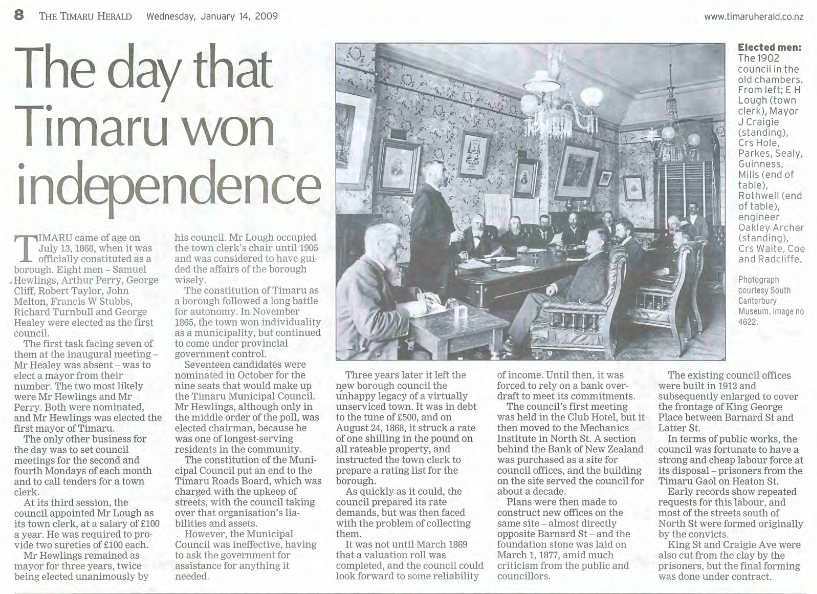
The push for borough status grew out of frustration. Timaru people had long felt the burden of distance from Canterbury’s provincial centre and wanted greater control over their own affairs. The Timaru Herald, first issued in June 1864, was founded to promote Timaru and Gladstone interests. That matters, because it reminds us that local independence was already being argued for in public well before the borough was proclaimed.
There had also been an earlier step. In November 1865, the first meeting of the Timaru Municipal Council was held at the Royal Hotel. It was a sign that the town was already trying to shape its own civic identity, but it was only a half step. The Municipal Council still lacked real freedom to act, and Timaru remained too dependent on provincial government. Local self government still felt out of reach.
That changed in 1868. A petition from Timaru householders was published in April, and the formal proclamation constituting Timaru as a borough was dated 13 July 1868. It appeared in the New Zealand Gazette on 16 July. A few weeks later, on 3 August, the first meeting of the new Borough Council was held at the Club Hotel. Before they could even elect a mayor, the councillors first had to make the legal declaration required under the Act. It is a small but telling detail. Timaru’s civic coming of age did not begin in grandeur. It began with procedure, paperwork, and a group of local men in a hotel room trying to do things properly.
Eight men were elected to the first council: Samuel Hewlings, Arthur Perry, George Cliff, Robert Taylor, John Melton, Francis W. Stubbs, Richard Turnbull, and George Healey. Seven were present at the inaugural meeting, with Mr Healey absent. Two names were put forward for mayor, Hewlings and Perry, and Samuel Hewlings was chosen as Timaru’s first mayor. It was a fitting choice. Hewlings was not only a civic figure. He was also one of the men who had helped lay out the place itself. In a very real sense, one of the surveyors who had helped put Timaru on the map was now being asked to help govern it.
The first council also says something important about the town. These were not detached men of theory. Arthur Perry was a solicitor. John Melton kept the Timaru Hotel and served as poundkeeper. Robert Taylor was an undertaker. Richard Turnbull was part of Clarkson and Turnbull. George Cliff was in the timber and coal trade. Francis Stubbs was involved in auctioneering and agency work. This was a council drawn directly from the everyday life of the settlement. These were men whose businesses depended on roads, rates, order, and growth.
There was little ceremony about the work ahead. The council fixed its meetings for the second and fourth Mondays of the month and called for tenders for a town clerk. At its third sitting, Mr Lough was appointed town clerk on a salary of £100 a year, and he would remain in that role until 1905. Hewlings stayed on as mayor for three years and was twice re-elected unanimously by his fellow councillors.
Yet the new borough inherited more problems than prestige. The earlier Municipal Council had taken over the responsibilities of the Timaru Roads Board, but it had struggled to do much without government help. By the time the borough council took charge, Timaru was left with a poorly serviced town and debts said to be around £500. On 24 August 1868, the new council struck a rate of one shilling in the pound on rateable property. Even then, collecting those rates proved difficult. It was not until March 1869 that a valuation roll was completed and the borough could begin to rely on something like a steady income. Until then, it had to lean on a bank overdraft to meet its commitments.
That is why the word “independence” needs a little honesty beside it. Borough status did not hand Timaru a finished town. It handed Timaru responsibility for its own problems. The first meeting may have been held at the Club Hotel, but the council soon moved to the Mechanics’ Institute in North Street. Later, land behind the Bank of New Zealand was bought as a site for council offices. The town was still improvising, still building, still trying to catch up with its own ambitions.
Life in Timaru in 1868 was not easy. Much of the hard physical work of forming the young town still had to be done. Early records show repeated requests for labour from the Timaru Gaol in Heaton Street, and prisoners were used to help form many of the streets south of North Street. King Street and Craigie Avenue were cut from the clay with prison labour before later work was done by contract. It is another reminder that this borough was not born polished. It was carved out, quite literally, by effort and necessity.
And then, only months after borough status was achieved, reality struck hard. In December 1868, a great fire tore through the business part of Timaru and destroyed more than 30 buildings. Reports at the time made it clear how poor the town’s water supply was. The new borough had gained the right to govern itself, but it had also inherited the burden of solving very real and urgent local problems.
So perhaps 13 July 1868 matters not because Timaru suddenly became grand, but because it became answerable to itself. It was the moment this rough, divided, ambitious little port settlement stopped waiting for others to shape its future. It was the day Timaru took charge of its own.
Primary and near-contemporary sources
Timaru Herald, 25 November 1865, “TIMARU”
This reports the first meeting of the newly formed Timaru Municipal Council at the Royal Hotel, which is important because it shows Timaru already trying a form of local self-government before borough status.
Link: https://paperspast.natlib.govt.nz/newspapers/THD18651125.2.5
Timaru Herald, 11 April 1868, petition for Timaru to be constituted a borough
This is a key source because it publishes the petition from inhabitant householders of Timaru and the Superintendent of Canterbury’s assent under the Municipal Corporations Act 1867.
Link: https://paperspast.natlib.govt.nz/newspapers/THD18680411.2.14.4
Timaru Herald, 1 August 1868, local news note on borough proclamation
This is useful because it states that the Government Gazette of 16 July 1868 proclaimed Timaru a borough under the Municipal Corporations Act 1867.
Link: https://paperspast.natlib.govt.nz/newspapers/THD18680801.2.17
Timaru Herald, 5 August 1868, “TIMARU BOROUGH COUNCIL. ELECTION OF MAYOR”
This is one of the most important pieces for the story. It reports the first meeting of the council under the Act, held at the Club Hotel, and records the election of Samuel Hewlings as mayor.
Link: https://paperspast.natlib.govt.nz/newspapers/THD18680805.2.10
Timaru Herald, 26 August 1868, borough council proceedings
This appears to be one of the key August council reports and is likely relevant for rates and early administration, though I have not yet extracted the full text because Papers Past blocked the page when opened directly.
Link: https://paperspast.natlib.govt.nz/newspapers/THD18680826.2.2.6
Star, 10 December 1868, “GREAT FIRE IN TIMARU”
This gives important context for what life was like in the new borough, especially the town’s vulnerability and the weakness of services such as water supply.
Link: https://paperspast.natlib.govt.nz/newspapers/TS18681210.2.14
Context and background sources
Te Ara, “Map of the Timaru townships”
This is crucial for explaining that Timaru grew from two separately laid-out townships: the northern one laid out by E. H. Lough and the southern one by Samuel Hewlings, meeting awkwardly at North Road.
Link: https://teara.govt.nz/en/zoomify/10791/map-of-the-timaru-townships
Te Ara, “Timaru and its port”
This gives strong overview context for population, the landing service, and the importance of the port economy. It notes that the first landing service opened in 1858, around 100 settlers arrived on the Strathallan in January 1859, and the population reached about 1,000 by 1866.
Link: https://teara.govt.nz/en/south-canterbury-region/page-6
Papers Past overview for the Timaru Herald
This is useful background because it confirms that the Timaru Herald was first issued on 11 June 1864 and was set up to promote Timaru and Gladstone interests against Canterbury provincial control.
Link: https://paperspast.natlib.govt.nz/newspapers/timaru-herald
Southern Provinces Almanac, 1868, Christchurch City Libraries
This is excellent for recreating what Timaru looked like in everyday life in 1868: trades, professions, businesses, institutions, and the wider Canterbury setting.
Link: https://christchurchcitylibraries.com/DigitalCollection/Publications/Directories/SouthernProvincesAlmanac/1868/
Direct PDF from the 1868 Southern Provinces Almanac
This is handy if you want to search or quote directly from the digitised pages.
Link: https://christchurchcitylibraries.com/DigitalCollection/Publications/Directories/SouthernProvincesAlmanac/1868/PDF/SPA-1868-0057.pdf
National Library authority record for Samuel Hewlings
This gives biographical support for Hewlings as a surveyor and confirms that in 1856 he laid out the southern part of Timaru.
Link: https://natlib.govt.nz/records/22364349
Your starting summary, “The day that Timaru won independence”
This is useful as a secondary local-history summary, especially for leads on the first councillors, town clerk, debt, and early rates, though I would still prefer to verify its details back against 1868 newspaper reports and council records.
Link: https://cplay.co.nz/stories/detailed-stories-to-share/403-the-day-that-timaru-won-independence
Working timeline
1853 — The Rhodes brothers acquired land to the north of the future borough, which was later laid out by E. H. Lough.
1856 — Samuel Hewlings laid out the southern part of Timaru on Crown land, while Lough was associated with the northern layout. This matters because the first mayor was also one of the men who physically shaped the town plan.
1858 — The first landing service opened at the bottom of Strathallan Street, showing how dependent early Timaru was on surf-boat port work and the sea.
January 1859 — About 100 British settlers arrived on the Strathallan, giving Timaru one of its first major population boosts.
11 June 1864 — The first issue of the Timaru Herald appeared. The paper was founded to promote Timaru and Gladstone interests against Canterbury provincial control, which is important political context for the borough story.
Before 1864 and into the 1860s — Timaru was effectively two townships stitched together, with the north laid out by Lough and the south by Hewlings, meeting at North Road. The misalignment of streets still tells that story.
25 November 1865 — The first meeting of the newly formed Timaru Municipal Council was held at the Royal Hotel. This shows Timaru had already begun seeking local civic identity before becoming a borough.
1866 — Timaru’s population was about 1,000. It was growing, but it was still a relatively rough port settlement rather than a fully serviced town.
11 April 1868 — The petition from inhabitant householders of Timaru asking that the town be constituted a borough was published, along with the Superintendent’s assent.
16 July 1868 — According to the Timaru Herald on 1 August, the Government Gazette of 16 July 1868 proclaimed Timaru a borough under the Municipal Corporations Act 1867.
3 August 1868 — The first meeting of the borough council was held at the Club Hotel. The report was published on 5 August 1868, and Samuel Hewlings was elected the first mayor, defeating Arthur Perry.
August 1868 — The new borough quickly moved from symbolism to practical pressures: council administration, legal formalities, and the likely beginnings of its first serious rates decisions. One likely key source here is the 26 August council report, which still needs a closer read from the scan.
Late 1868 — Local summaries of the borough’s early records say the council inherited a poorly serviced town and debt, and moved to strike a rate of one shilling in the pound. I would treat that as a good lead, but still worth checking back to the August 1868 newspapers or council minutes.
7 to 10 December 1868 — The great fire in Timaru destroyed more than 30 buildings and exposed how fragile the town’s services still were. This is very useful context for what “independence” actually looked like in practice.
By the late 1860s — Timaru’s leaders had begun to realise that the landing service system was constraining growth, helping to drive later harbour ambitions.