
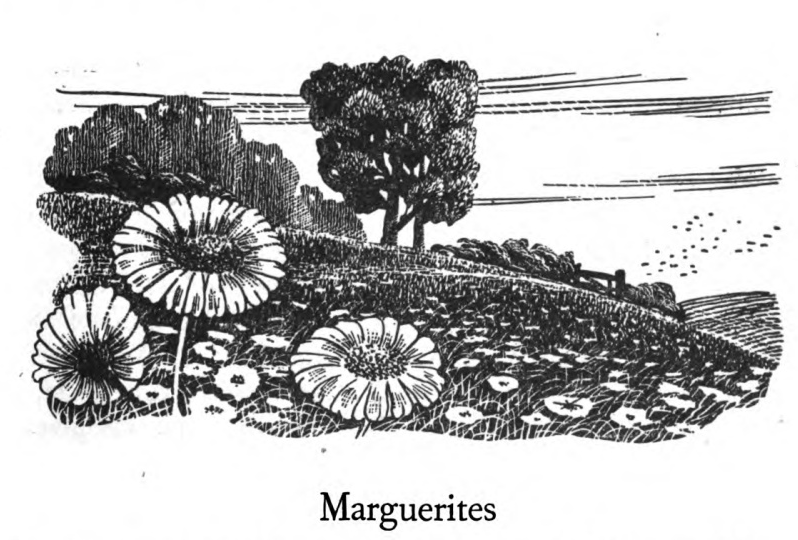
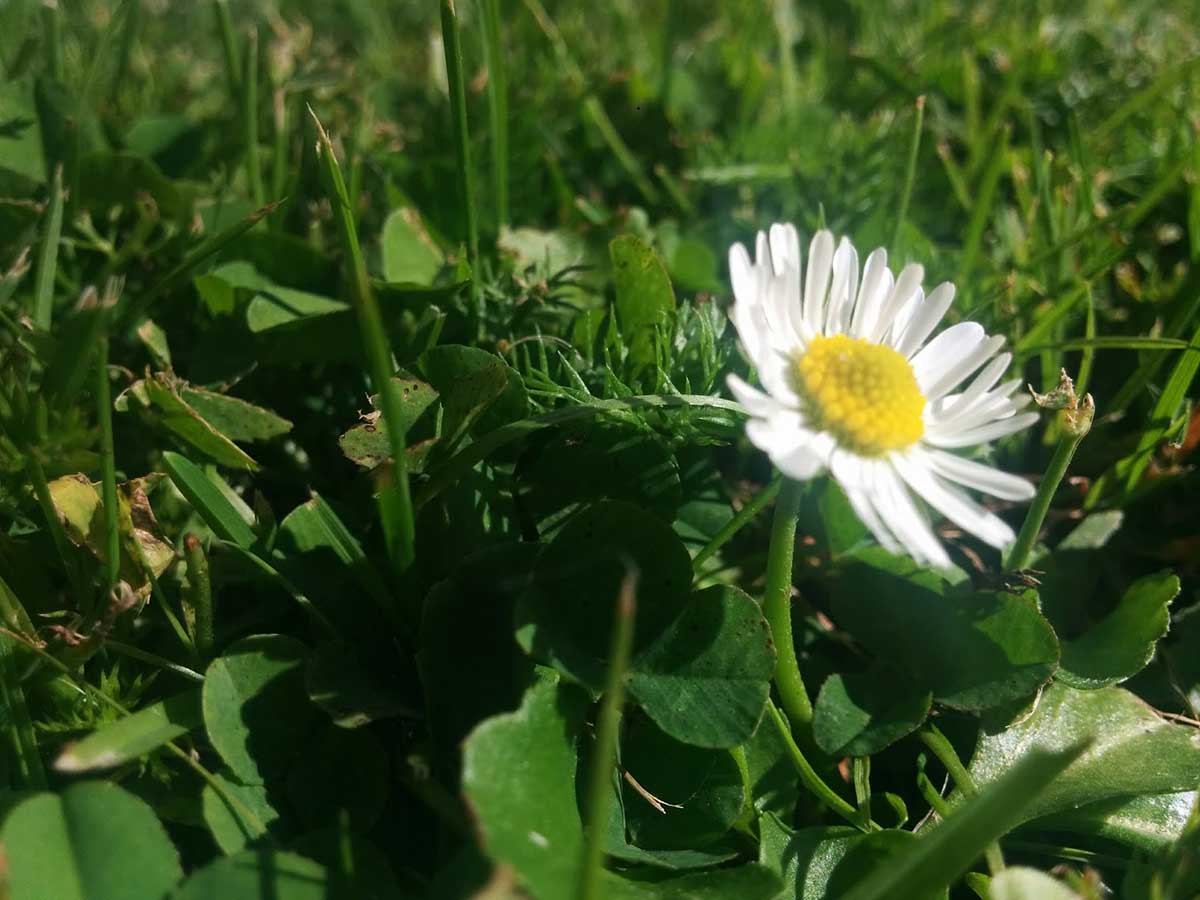
I thought the little white daisy in the lawn must be the “marguerite” in A. W. Anderson’s chapter. But once I started reading through his words, I realised that the flower most of us know from the lawn is usually a lawn daisy, not a marguerite. Now I realised that the everyday lawn flower is the starting point of a bigger story about names, gardens, fashion, migration, and how people once grouped flowers by likeness long before modern classification pulled them apart...

This is the flower most of us will chop with a lawn mower, the common daisy. It is also called the lawn daisy or English daisy. Its scientific name is Bellis perennis. Kew explains that it appears in lawns readily and survives because it grows as a low, compact rosette, close enough to the ground to escape the mower. So if you are picturing a tiny daisy flat in the grass, that is usually not a marguerite in the modern botanical sense. It is Bellis perennis.
Anderson was writing about daisies in an older world of plant names.
A. W. Anderson was a respected Timaru botanist, conservationist and author, and he served as Curator of Reserves for Timaru City Council from 1932 to 1956. His book How We Got Our Flowers, formerly titled The Coming of the Flowers, was published in 1950. He wrote with real knowledge, but he was writing at a time when older plant names still travelled widely through gardening books, nurseries and public memory.
Anderson used “marguerite” in a broader, older way. He was talking about several daisy-like flowers that gardeners once comfortably grouped together.
Since Googling, I have realised that modern botany is a bit stricter. Today, the names are more specific, even if the flowers look similar. Anderson was not careless through, it turns out he was writing before today’s naming was settled. In fact, a 1938 Timaru Herald report shows Anderson speaking about the importance of scientific plant naming and classification. So updating him now is not a rejection of his work. It is, in a way, continuing it.
A marguerite today usually means a bushier garden daisy, not a tiny lawn flower.
In modern gardening, “marguerite” usually means Argyranthemum frutescens, often called marguerite daisy or Paris daisy. The Royal Horticultural Society describes it as a rounded subshrub with coarsely cut green leaves and lots of white daisy-like flowers with yellow centres. That is a very different plant from the little lawn daisy. You are more likely to see these in a border, pot, or cottage garden planting than living rouge in the middle of a lawn.
So if you put a marguerite and a lawn daisy side by side, one hugs the grass. The other rises up and makes a show of itself as a shrub.
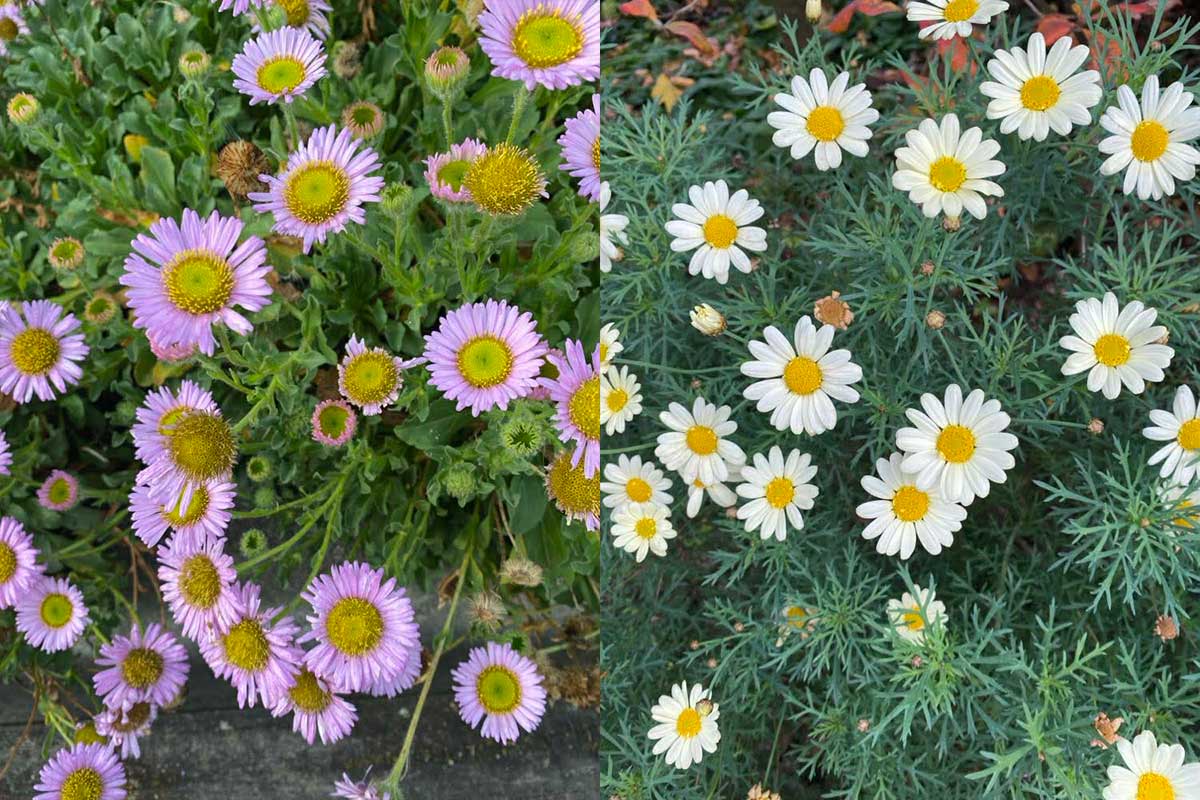
Marguerite Daisies (Argyranthemum frutescens) They are a low maintenance shrub that flowers for months & months. They are Exotic to New Zealand and were naturalised in 1940, originating from Canary Islands (part of Spain). The word frutescens comes rom the Latin frutex ‘shrub’, meaning ‘becoming shrubby’.
Anderson’s chapter also touched older daisy relatives such as oxeye and moon daisies.
Anderson’s chapter belongs to that wider daisy family world. The oxeye daisy, for example, is now Leucanthemum vulgare. The New Zealand Plant Conservation Network lists Chrysanthemum leucanthemum as a synonym, which helps explain why older books can feel botanically slippery. Another flower often pulled into this history is the moon daisy, now Leucanthemum maximum. These are closer to the large white daisies people recognise from rougher grass, roadside verges, or perennial borders. They are not the little flat lawn daisy either.
A daisy looks simple, but it is actually a small crowd pretending to be one flower.
Britannica explains that a daisy flower head is composite. So, what looks like one flower is actually a cluster of many tiny flowers: the white ray flowers around the edge and the yellow disk flowers in the centre.
Some of Anderson’s royal stories are rooted in history, while others belong more to legend.
Anderson loved the way flowers collect human stories around them, and his chapter moves through queens and courts as much as through gardens. Some of those references stand up well. Margaret of Anjou really was queen consort of Henry VI and a leader of the Lancastrians during the Wars of the Roses. Margaret of Valois really did marry Henry of Navarre in 1572 and later became associated with courtly life in Navarre.
But modern checking also shows where romance may have outrun the record.
Hexham Local History Society notes that the famous legend of Queen Margaret of Anjou and the robber after the Battle of Hexham does not hold up, because she was in France at the time. Likewise, while Marguerite de Valois is genuinely linked with Nérac and the enlarged Parc Royal de la Garenne, Shakespeare’s Love’s Labor’s Lost cannot be tied to her garden as a settled fact. Folger notes that the play is one of Shakespeare’s works without a primary source. That does not ruin the story. It actually makes it better. We get to see how old flower writing mixed scholarship, memory and myth in the same bouquet.
The New Zealand angle makes the story sharper, because our familiar daisies have a migration history.
In New Zealand, both Bellis perennis and Leucanthemum vulgare are recorded by the New Zealand Plant Conservation Network as exotic species, and both are included in the 2024 environmental weed framework. That means the flowers many of us treat as harmlessly familiar are also part of the wider colonial movement of plants. They arrived, settled, spread, and became part of the visual language of fields, roadsides and lawns.
That does not mean nobody can love them. It simply means they have a history, just as poppies do, roses do, and almost every garden flower does.
Once you begin to notice that, a lawn can become a small historical landscape.
While I got into a tangle learning from Anderson and then relearning with more modern knowledge, the most honest way to read Anderson is to keep his wonder and update his labels.
So where does that leave us? Well, Anderson’s chapter still has charm and carries cultural memory. It still shows how flowers were woven into stories of queens, fashion and gardens. But if we want to be precise, the little daisy in a lawn is usually Bellis perennis. A modern marguerite is usually Argyranthemum frutescens. Oxeye daisy is Leucanthemum vulgare. Moon daisy is Leucanthemum maximum. And Anderson’s “marguerites” belong to an older naming tradition that folded several of these relationships together.
That may sound like a technical correction, but it is the difference between glancing and noticing. The photo in the grass can still belong in the story, because it shows the very confusion that led to the blog.
And perhaps that is the loveliest ending of all.
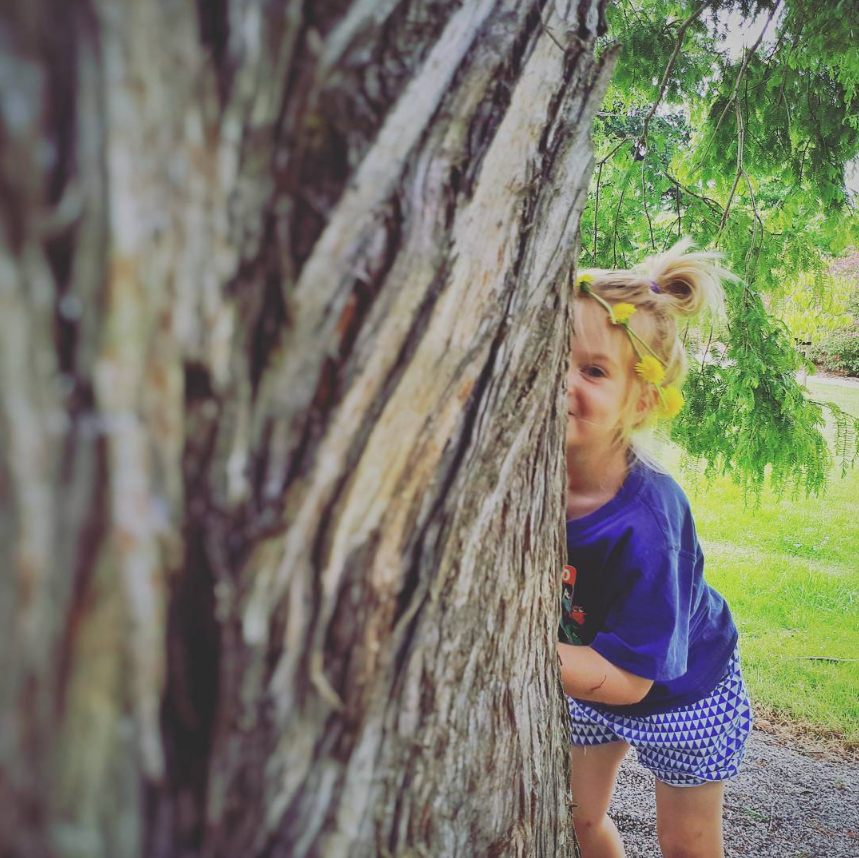
A photograph of a child lying in the lawn among white daisies and yellow dandelions would not be a photograph of a true marguerite in the strict modern sense. But it would still belong beautifully in this story. It would show the moment before the correction. The instinctive naming. The ordinary affection people have for familiar flowers. The exact place where curiosity begins.
Because that is really what this blog has become.
Not a fussy exercise in getting someone wrong, but a small journey from what we thought we knew to what we now understand better. And that, in the end, is one of the most satisfying things history and botany can do together.
Common daisy that you will often see in the lawn is known by its scientific name Bellis perennis, best time to spy them is between January to December, but it can flower almost all year-round. You can use its flowers to make necklaces (daisy chains) which is usually something that children love to do, and adults usually try to rid their lawns of this so-called 'weed'. It has spoon-shaped leaves that form a rosette at the base of the plant, close to the ground and among the short grass it favours. A single stem carries the head of the flower. Some might think this is just one flower, but the head is actually a composite of many tiny flowers which make up the yellow disc in the middle called a 'disc florets. The surrounding white 'ray florets' look just like petals.
Some key phrases
“most commonly seen on Anzac Day”
Source: NZ History, The red poppy
Link: https://nzhistory.govt.nz/war/anzac-day/poppies
“The first New Zealand Poppy Day was held in 1922.”
Source: Veterans’ Affairs New Zealand, 100 Years of Poppy Day
Link: https://www.veteransaffairs.mil.nz/news-events/articles/100-years-of-poppy-day/
“compact, ground-hugging rosettes”
Source: Kew, Bellis perennis general information
Link: https://powo.science.kew.org/taxon/urn:lsid:ipni.org:names:184409-1/general-information
“profuse white daisy-like flower heads”
Source: RHS, Argyranthemum frutescens
Link: https://www.rhs.org.uk/plants/1531/argyranthemum-frutescens/details
“developed by Luther Burbank … in the 1890s”
Source: Missouri Botanical Garden, Leucanthemum × superbum
Link: https://www.missouribotanicalgarden.org/PlantFinder/PlantFinderDetails.aspx?taxonid=244689
“without a primary source”
Source: Folger Shakespeare Library, Love’s Labor’s Lost
Link: https://www.folger.edu/works/loves-labors-lost/
“Queen Margaret was in France at the time of the battle!”
Source: Hexham Local History Society, Myths & Legends
Link: https://www.hexhamhistorian.org/historic-hexham/i-didnt-know-that/myths-legends/
“generic and specific names”
Source: Timaru Herald, Papers Past, 10 May 1938, Plant Names
Link: https://paperspast.natlib.govt.nz/newspapers/THD19380510.2.19
Timeline
1430: Margaret of Anjou is born.
1445: Margaret of Anjou marries Henry VI of England.
1455: The Wars of the Roses begin, and Margaret becomes a leading Lancastrian figure.
1464: Battle of Hexham. Later legend links Margaret to a robber there, but local historical authorities say she was in France at the time.
1553: Marguerite de Valois is born.
1572: Marguerite de Valois marries Henry of Navarre; the St Bartholomew’s Day massacre begins five days later.
1577 to 1582: Nérac serves as the principal residence of Henry of Navarre and Marguerite de Valois.
Sixteenth century: The Parc Royal de la Garenne at Nérac is enlarged by Queen Margot, including the allée des 3000 pas.
1609: Marguerite de Valois buys the residence at Issy and has a nymphaeum built there before her death in 1615.
1753: Bellis perennis is first published by Linnaeus and remains the accepted name for the common daisy.
1779: Leucanthemum vulgare is first published and is the accepted name for oxeye daisy.
1838: Leucanthemum maximum is first published and is the accepted name for the moon daisy.
1867: NZPCN records both Bellis perennis and Leucanthemum vulgare as naturalised in New Zealand by this year.
1890s: Luther Burbank develops the Shasta daisy, Leucanthemum × superbum, near Mt Shasta.
1922: The first New Zealand Poppy Day is held.
1932 to 1956: A. W. Anderson serves as Curator of Reserves for the Timaru City Council.
1938: Anderson publicly discusses plant naming and classification in Timaru.
1950: How We Got Our Flowers is published; the National Library notes it was formerly titled The Coming of the Flowers.
2024: NZPCN records both Bellis perennis and Leucanthemum vulgare in the current environmental weed framework.
Full source list with full links
National Library of New Zealand, How we got our flowers / by A. W. Anderson
https://natlib.govt.nz/records/21816012
Aoraki Heritage Collection, Walter Anderson
https://aorakiheritage.recollect.co.nz/nodes/view/3960
Papers Past, Timaru Herald, 10 May 1938, Plant Names
https://paperspast.natlib.govt.nz/newspapers/THD19380510.2.19
NZ History, The red poppy
https://nzhistory.govt.nz/war/anzac-day/poppies
Veterans’ Affairs New Zealand, 100 Years of Poppy Day
https://www.veteransaffairs.mil.nz/news-events/articles/100-years-of-poppy-day/
Kew, Plants of the World Online, Bellis perennis
https://powo.science.kew.org/taxon/urn:lsid:ipni.org:names:184409-1
Kew, Plants of the World Online, Bellis perennis general information
https://powo.science.kew.org/taxon/urn:lsid:ipni.org:names:184409-1/general-information
Kew, Plants of the World Online, Leucanthemum vulgare
https://powo.science.kew.org/taxon/urn:lsid:ipni.org:names:30296198-2
Kew, Plants of the World Online, Leucanthemum maximum
https://powo.science.kew.org/taxon/230047-1
Royal Horticultural Society, Argyranthemum frutescens
https://www.rhs.org.uk/plants/1531/argyranthemum-frutescens/details
Missouri Botanical Garden, Leucanthemum × superbum
https://www.missouribotanicalgarden.org/PlantFinder/PlantFinderDetails.aspx?taxonid=244689
Encyclopaedia Britannica, Daisy
https://www.britannica.com/plant/daisy
New Zealand Plant Conservation Network, Bellis perennis
https://www.nzpcn.org.nz/flora/species/bellis-perennis/
New Zealand Plant Conservation Network, Leucanthemum vulgare
https://www.nzpcn.org.nz/flora/species/leucanthemum-vulgare/
Massey University, Oxeye daisy
https://www.massey.ac.nz/about/colleges-schools-and-institutes/college-of-sciences/our-research/themes-and-research-strengths/plant-science-research/new-zealand-weeds-database/oxeye-daisy/
Encyclopaedia Britannica, Margaret of Anjou
https://www.britannica.com/biography/Margaret-of-Anjou-queen-of-England
Hexham Local History Society, Myths & Legends
https://www.hexhamhistorian.org/historic-hexham/i-didnt-know-that/myths-legends/
Encyclopaedia Britannica, Margaret of Valois
https://www.britannica.com/biography/Margaret-of-Valois
Folger Shakespeare Library, Love’s Labor’s Lost
https://www.folger.edu/works/loves-labors-lost/
Tourisme Lot-et-Garonne, Château-musée Henri IV
https://www.tourisme-lotetgaronne.com/culture-patrimoine/chateau-musee-henri-iv/
Tourisme Lot-et-Garonne, Le Parc Royal de la Garenne
https://www.tourisme-lotetgaronne.com/culture-patrimoine/le-parc-royal-de-la-garenne/
French Ministry of Culture POP, Demeure de Marguerite de Valois, séminaire Saint-Sulpice
https://pop.culture.gouv.fr/notice/merimee/IA00108496