
By Roselyn Fauth

Kerr grave at the Timaru Cemetery - Photo Roselyn Fauth
Recently I have started sharing some of the stories I have discovered while guiding tours through the Timaru Cemetery. As we walk through the older sections, people often pause beside the headstones and ask about the names carved into the stone. One grave that always catches my attention belongs to the Kerr family. When we stop there, I usually tell people that there is a much bigger story connected to this family that I am still uncovering.
Three generations of the Kerrs were involved in running the Timaru Herald. For decades they helped produce the newspaper that recorded the life of this district. In many ways they were the champions of Timaru’s stories. And for someone like me who spends a lot of time researching the lives of women whose stories were often overlooked, those newspapers are invaluable. Without them, many of these lives would have vanished from the record entirely.
Standing beside the Kerr graves made me curious. If the Kerr family were printing the stories, who started the newspaper in the first place? And where did those stories begin?
So I went back to the newspaper itself to find out...

In the General Section of Timaru Cemetery, Row 26, several nearby headstones mark the graves of members of the Kerr family, each buried in their own individual plot. One headstone marks the grave of Elizabeth Kerr, aged 55, who was interred on 30 May 1903 in Plot 161. She rests alone in this plot. Nearby is the grave of Edward George Kerr, aged 61, interred on 18 October 1906 in Plot 162. His burial is located on the seaward side of the headstone, facing toward the sea, and he is the only person in this plot. Further along the same row are two additional Kerr graves. Henry Stanley Kerr, aged 9, was interred on 14 November 1887 in Plot 171, and Laura Elizabeth Kerr, aged 21, was interred on 14 February 1890 in Plot 172. Both are buried alone in their respective plots. - Timaru Cemetery March 2026 - Photo Roselyn Fauth
The Graves That Started the Story
The Kerr graves sit close together in Row 26 of the General Section of the Timaru Cemetery.
According to Timaru District Council cemetery records, four members of the Kerr family are buried in neighbouring plots.
• Edward George Kerr – buried 18 October 1906, aged 61
• Elizabeth Kerr – buried 30 May 1903, aged 55
• Henry Stanley Kerr – buried 14 November 1887, aged 9
• Laura Elizabeth Kerr – buried 14 February 1890, aged 21
Standing there you begin to see a family story... Edward George Kerr and his wife Elizabeth lost two of their children while they were still young. Behind every newspaper that recorded the lives of others were families experiencing the same joys and sorrows themselves.
But if you look a little further toward the sea, another Kerr grave appears nearby. In Row 28, Plot 160A, lies Louisa Kerr, buried on 30 July 1954, aged 65. The clustering of these graves suggests that members of the wider Kerr family continued to be buried in the same part of the cemetery across several generations. And that small observation led me further down the history trail.

A row closer to the sea stands another Kerr headstone in the Timaru Cemetery. This stone marks the grave of Louisa Kerr, aged 65, who was interred on 30 July 1954. She is buried alone in Section General, Row 28, Plot 160A. Nearby, in Section General, Row 26, Plot 161, is the grave of Elizabeth Kerr, aged 55, who was interred on 30 May 1903. She is also buried alone in her plot. - Timaru Cemetery March 2026 - Photo Roselyn Fauth
A Kitchen at the Foot of George Street
One of the most fascinating details I discovered is that the first editions of the Timaru Herald were printed on a small hand press in a detached kitchen behind a cottage on George Street. That cottage had originally been built in 1851 for George Rhodes, part of the shore station used to service the Rhodes family’s sheep run at The Levels.
By 1856 the Williams family were living there. That year Ann Williams gave birth to William Williams, recorded in early histories as the first European child born in Timaru. Ann therefore stands as one of the earliest European mothers in our town.

1868 Photograph of the foot of George Street, Timaru, circa 1868. It was built in 1851 by George Rhodes and his employees. It was the only habitation between Lake Ellesmere and the Waitaki River at the time. The cottage was a simple structure with battened sides, a clay-plastered exterior, and a thatched tussock roof, located near present-day George Street. In 1857, Archdeacon Harper visited Timaru during his journey from Christchurch to Moeraki and was warmly received by Samuel Williams, his wife, and son. A commemorative plaque was placed on the site in 1955. Harper's letters from September 1857 mention encountering an old whaler (Williams) living in a hut with his family near the sea coast. Williams shared whaling stories with Harper during this visit; his wife provided directions for Harper's journey to Waimate. The building is pictured in the centre is a landing service building (either the Timaru Landing and Shipping Company or the George Street Landing Service), while Rhodes' original cottage is to the left. South Canterbury Museum 2000/210.095
But Ann’s life in Timaru was short. She died in 1860, only a few years after arriving.
And here is the moment that always gives me goosebumps. Four years after Ann died, in 1864, the kitchen behind that same cottage became the birthplace of the Timaru Herald! The place where one of Timaru’s earliest mothers raised her family quietly became the place where the town’s stories would begin to be written down.


Here you can see the boat launch at the foot of George Street, the Landings Service Building and beside, in the center the Rhodes cottage. Section from Hocken Snapshop hocken.recollect.co.nz/24023
The first edition was printed in the Williams Kitchen! "First edition of the Timaru Herald. It was printed in a small room, a detached kitchen in the George Street cottage on a hand press. You can see early editions here: https://paperspast.natlib.govt.nz/newspapers/timaru-herald

First edition of the Timaru Herald 11 June 1864. The Timaru Herald is the daily newspaper in Timaru. It has been published continuously since 1864. In the 1870s it was one of New Zealand’s most important newspapers. The Herald was founded by Alfred George Horton and Ingram Shrimpton. The first issue was printed on 11 June 1864. Originally publication was weekly.

At the unveiling of Ann Williams’ memorial at the Timaru cemetery on Tuesday evening, also the 165th anniversary of her death, back from left, Les Jones of Aorangi and Harding Memorials, Lynne Kerr of the Timaru Civic Trust, Chris Fauth, Roselyn Fauth, Geoff Cloake, South Canterbury Museum curator of documentary history Tony Rippin, South Canterbury Museum director Philip Howe, and South Canterbury Museum educator Keely Kroening. Front from left, Medinella Fauth and Annabelle Fauth. AIMAN AMERUL MUNER / THE TIMARU HERALD https://www.thepress.co.nz/nz-news/360890111/honouring-ann-williams-memorial-unveiled-timaru-cemetery
The Young Printer Who Started It All
According to the Dictionary of New Zealand Biography on Te Ara, the newspaper was founded by Alfred George Horton, a young English printer and journalist.
Horton arrived in Canterbury in 1861. In 1864, at only about 21 years of age, he purchased a small hand-printing plant and brought it to Timaru, where he established the weekly Timaru Herald.
At the time Timaru was still a small coastal settlement clustered around the surf landing place below George Street. From these modest beginnings Horton began printing the newspaper that would eventually become the voice of the district.
Horton’s career did not end in Timaru. According to the Dictionary of New Zealand Biography, he later moved to Auckland where he became one of the country’s most influential newspaper proprietors through Wilson and Horton, publishers of the New Zealand Herald.
The small newspaper he began in Timaru was therefore the starting point of a career that would help shape journalism across New Zealand.
The Herald was set up to promote the interests of Timaru and Gladstone districts against those of the Canterbury province to which they belonged. People in the Timaru area thought they were not getting a fair share of the revenues collected by the provincial government. Horton’s involvement in this issue is very clear; he helped promote a bill in parliament setting up the Timaru and Gladstone Board of Works. This gave Timaru more control of expenditure on public works in the area and seems to have satisfied the local desire for independence from Canterbury.
In 1866 the Herald became a bi-weekly, and in 1871 Horton sold to Herbert Belfield. Horton went on to become one of the most important newspaper publishers in New Zealand when, in 1876 he joined the Wilson family to create Wilson and Horton, the publishers of the New Zealand Herald for so many years.
In the 1870s the Timaru Herald developed into a significant newspaper with a national reputation. This was largely due to the editor Edward Wakefield. Wakefield, the nephew of Edward Gibbon Wakefield, was an able and hard-hitting writer who was active in both local and national affairs. He was a Member of the House of Representatives in the 1870s and 1880s. As editor of the Herald he led campaigns that gained Timaru a port and waterworks. In parliament he had a reputation as a fierce debater but also for fickleness, which probably prevented him from achieving high office. In 1876 he was summoned to appear before the House of Representatives on a charge of breach of privilege after he wrote an article in the Herald that impugned the integrity of the current Members. The charges were dropped after Wakefield apologised to the House. During Wakefield’s term the paper began daily publication. He left the Herald in 1885 when he moved to Wellington.
During the 1880s the Herald ran into financial difficulties. The Timaru Herald Company was formed to take over ownership with Herbert Belfield retained as the manager of the newspaper. In 1886 the paper was leased by its mortgagees to Joseph Ivess, an indefatigable founder and owner of newspapers in New Zealand in the 19th century. Ivess is reckoned to have started twenty-six newspapers; characteristically he did not stay with the Herald for long.
In 1887 the paper was sold to Edward George Kerr. Kerr already owned another Timaru newspaper, the South Canterbury Times. Kerr ran the Times and the Herald from the same building, with the Herald published in the morning and the Times in the evening. The Times was closed in 1901 as part of a deal Kerr made with the other morning paper, the Timaru Post. Kerr persuaded the Post to switch to evening publication, becoming in effect the evening edition of the Herald. In 1923 the Herald began to subsidise the Post to keep it going. The Post ceased in 1939.
The Kerr family owned and managed the Herald until the 1980s when it was sold to Independent Newspapers Limited (INL). In 2003 ownership passed to the Fairfax Group. The name of the company was changed to Stuff Ltd in 2018, and in 2020 Sinead Boucher bought the company from Fairfax’s Australian owners for $1, bringing the Timaru Herald and other newspapers back into local ownership.
Side Quest: The Forgotten Co-Founder
While Alfred Horton provided the energy and journalism behind the new newspaper, he did not do it alone. Early histories record that Horton was supported financially by Ingram Shrimpton, an early settler who helped fund the establishment of the Timaru Herald in 1864. Shrimpton’s role is often overlooked in later histories of the newspaper, yet without his financial backing the paper may never have been established. Members of the Shrimpton family are also buried in Timaru, creating another quiet connection between the newspaper and the town’s cemetery.

The Great Fire of 1868
The young newspaper nearly disappeared just four years after it began. In December 1868, a devastating fire swept through Timaru. Reports preserved through the Papers Past archive describe how the blaze destroyed more than thirty buildings and caused losses estimated at around £70,000.
Among the buildings destroyed was the office of the Timaru Herald.
A report from the time described how staff worked desperately to save the newspaper type, throwing materials out of windows before the flames reached the building.
The presses were lost. Even the editor’s dog reportedly died in the blaze. Yet remarkably, despite the destruction, the newspaper did not remain silent for long. Within days a limited edition of the paper was printed again. Even when much of the town had burned, the newspaper carried on.
Enter the Kerr Family
Years later the newspaper came into the hands of Edward George Kerr, who purchased the Timaru Herald and the South Canterbury Times in 1887. From that point on the Kerr family would run the newspaper for generations.
They continued on from the newspapers roots to printed reports of the stories of the district, nation and the world. Births. Deaths. Shipwrecks. Political debates. Court cases. Celebrations. Disasters... War, Pandemics, Depressions... The very records historians and community researchers like me rely on today, were produced under their stewardship.

Glimpse of the past: The Timaru Herald Building (20 Aug 1977). Aoraki Heritage Collection, accessed 04/06/2025, https://aorakiheritage.recollect.co.nz/nodes/view/580
Page from the "Official Guide: Timaru and surrounding districts". Aoraki Heritage Collection, https://aorakiheritage.recollect.co.nz/nodes/view/8923
Harlau House
The Kerr family home was known as Harlau House, located in Beaconsfield. The name carries very sad story.
“Harlau” was created by combining the names of two of the Kerr children — Harry and Laura. Both of them died young. Their names were joined together in the name of the family home, a lasting reminder of the children the family had lost.
According to historical information connected with the Kerr family and the history of the Timaru Herald, Harry drowned in the Washdyke Lagoon in 1887. Laura died just three years later 14 February 1890 at the age of twenty one. This was a devastating loss for the family. Later, when Edward George Kerr named the family home Harlau House, the name was created by combining the names Harry and Laura, two children the family had lost.
The Kerr's printed the stories of other people’s tragedies and triumphs in the newspaper, yet also experienced their own private grief and reported on it.
Today the historic printing press used by the Timaru Herald is preserved at the South Canterbury Museum, where it stands as a reminder of the newspaper that helped record the district’s history.

Harlau House Café, situated just outside Timaru on Beaconsfield Road, was constructed in 1890 by Edward George Kerr, an early owner of the Timaru Herald. Designed by French architect Maurice de H’Arven Duval, the building features distinctive “quoin” blockwork—alternating long and short concrete blocks—a hallmark of Duval's architectural style. Duval also designed notable structures like the Convent of Mercy in Timaru and St Mary’s Church in Geraldine. The name "Harlau" is a combination of the names of Kerr's children, Harry and Laura. Harry drowned as a child in the Washdyke Lagoon, and Laura died as a young woman. In 1945, Kerr's grandson, R.H. Kerr, acquired the property and undertook significant renovations two years later. In 1945, Kerr's grandson, R.H. Kerr, acquired the property and initiated extensive renovations two years later. Today, the former brick stables have been transformed into Harlau House Café.
The Kerr family significantly influenced Timaru's media landscape and community development from the late 19th century through the 20th century.

Edward George Kerr Sr. (1844–1906)
Side Quest: How News Travelled to Timaru
One of the fascinating things about early newspapers is how quickly information could travel, even in the nineteenth century.
An obituary for Edward George Kerr records that he served as a director of the United Press Association, the organisation that allowed newspapers across New Zealand to share news through telegraph networks.
Through this system, international news could reach the country quickly, while local stories could travel outward.
A descendant of the Kerr family later shared with me that the family had early connections with Reuters, the London-based international news service. While documentary evidence confirming that the Kerr family personally owned shares in Reuters has not yet been located, the story reflects how newspapers of the time were increasingly linked into global communication networks.
Through telegraph wires and press networks, a newspaper printed in Timaru was not as isolated as it might seem.
Sometimes the stories reported here travelled far beyond South Canterbury.
Side Quests in the Pages of the Herald
Once you begin searching through the pages of the Timaru Herald, the stories seem endless.
Each article becomes a doorway into another life.
Many of those stories connect directly to the women whose lives I talk about on cemetery tours.
The newspaper reported on the funeral of Richard Turnbull, Member of Parliament for Timaru, leaving behind his wife Mary Hepzibah Turnbull, who had endured financial hardship both as a child and later while raising her own family.
It recorded the legal battle of Lavinia Morrison, who fought in court to secure her inheritance after a will went missing.
It reported on the death of early settler Samuel “Yankie Sam” Williams, while his wife Ann Williams, who died young, appears only briefly in the historical record.
The newspaper also covered the Benvenue disaster, one of the most dramatic maritime tragedies in Timaru’s history.
It reported on temperance meetings, the campaign for women’s suffrage, and the establishment of schools for girls.
And it documented women entering professions such as nursing, including Laura Woollcombe, who was associated with the Nightingale system of training.
Slowly, through the pages of the newspaper, we see women moving from the margins of society into public life.
Who Chooses the Stories We Tell?
All of these stories appeared in the pages of the same newspaper that began with a small hand press in a kitchen behind a cottage on George Street.
For historians today, the Timaru Herald is one of the richest windows we have into the past. Births. Deaths. Shipwrecks. Political debates. Court cases. Celebrations. Disasters. But as I followed this trail from the Kerr graves to the pages of the newspaper, another question kept surfacing.
Who chooses the stories that we tell?
In the nineteenth century it was often the newspaper editors and proprietors who decided what was recorded. The Kerr family printed the stories of the district for generations. In doing so they became custodians of Timaru’s public memory. Yet even as those pages recorded the lives of many settlers, some voices were barely heard.
Ann Williams, one of the earliest European mothers in Timaru, appears only briefly in the historical record. She lived in the cottage where the Timaru Herald would later be born, yet her story survives only in fragments. Like many women of that time, her life was largely lived outside the columns of the newspaper.
And that is why these old newspapers are so powerful. They do not just preserve the stories that were told. They also reveal the stories that were not fully told.
Today, through archives like Papers Past, we can read the pages that the Kerr family printed more than a century ago. And we can begin to look again — between the lines — to rediscover the lives that were once overlooked.
Standing beside the Kerr graves now, I see them differently.
They were not simply newspaper owners. They were custodians of the stories that shaped how Timaru remembered itself. And now, as we revisit those pages, we have the opportunity to ask new questions... To follow forgotten red threads like those detective boards you see in the movies.
And perhaps to tell a few more of those stories ourselves.


I am sure the reports of the past helped to form history books like these.

Reports have helped me piece together the cemetry's story and timeline. The 87-year-old chapel at the Timaru Cemetery was demolished in just seven hours after falling into disuse and disrepair. It was believed to have been designed by a French architect named Maurice de Harven Duval. The chapel had not been used for burial services for over 50 years, with the last conducted by Archdeacon H. W. Harper who retired in 1911. In recent years it had been used to store the cemetery's small tractor and other equipment. Structural damage, borer infestation, and weak mortar made most of the building unsalvageable, aside from the iron roof. A proposal after the First World War to renovate the chapel failed due to lack of interest, and a 1935 plan to convert it into a crematorium was rejected. There are no plans to build a new chapel at the site. - Timaru Herald, 20 Apr 1968.
Edward George Kerr Sr. (1844–1906)
Born in Glasgow, Scotland, in 1844. Edward George Kerr Sr. immigrated to New Zealand in 1861. He initially settled in Kaiapoi, where he served as mayor, before moving to Timaru. In 1881, he acquired the South Canterbury Times, and in 1887, he purchased the Timaru Herald, consolidating both newspapers under his ownership. The Herald was published in the morning, while the Times served as the evening edition until its closure in 1901. Kerr Sr. also constructed a dedicated building for the South Canterbury Times in 1884, which later housed the Levels County Council offices. Kerr was also active in politics, contesting the 1890 Timaru by-election as an independent candidate. Although he was not elected, his candidacy reflected his engagement in public affairs. Edward George Kerr Sr. passed away in 1906 and is buried in Timaru, Canterbury, New Zealand. His contributions to journalism and public service left a lasting impact on the Timaru community. aorakiheritage.recollect.co.nz
Edward George Kerr Sr. (1844–1906) was married to Elizabeth Goldthorpe. They wed on 25 September 1867 at St John the Baptist Church in Christchurch, Canterbury, New Zealand. Elizabeth was originally from Cheshire, England, and she predeceased Edward by a few years. Together, they had a large family. The family relocated to Timaru when Kerr Sr. acquired the Timaru Herald in 1887. Their children, including Edward George Kerr Jr. (born circa 1876), Laura Elizabeth Kerr, Mary Ann Kerr, Maria Margaret Kerr, Maude Margaret Kerr, Edith Agnes Kerr, Henry Stanley Kerr, Charles Eustace Kerr, Albert Ernest Kerr, Evelyn Kerr, Francis James Kerr, May Kerr, and Ethel Harlan Kerr.
Edward George Kerr Jr. (1876–1942)
Born in Kaiapoi, Edward George Kerr Jr. was the son of Edward George Kerr Sr. He began his career at the Timaru Herald as an office boy and rose to become its manager in 1900. In 1906, the newspaper was reorganized into a limited liability company, with Kerr Jr. serving as managing director. He maintained this role until his death in 1942 .wikitree.comnatlib.govt.nz

Staff of the "Timaru Herald", June, 1934
Those pictured are identified on the mount, below the print, as (presumably from left to right):
BACK ROW: J Parfitt, J Milne, J R Wham, A S Harvey, J M Hay, J Sherwin, M C I Maclaren, A K Provan, N R Johnston, P Collins;
FOURTH ROW: G C Darroch, J D Meechin, G S Griffiths, L Abraham, C J Newman, M Baker, A E Hall, J C Hayhurst, F Morgan, P L D Hornbrook;
THIRD ROW: J C Davey, J J Mason, R C Skipper, A Irvine, W Morgan, P C Harding, W J McPherson, C J Dewar, A E Gunn, E T McLaughlan, C F Gunderson;
SECOND ROW: R H Davey, F J Mulvihill, W V J Smith, J S Whitehead, G J Gaffaney, S Scales, Miss T Ziesler, Mrs S Black, Miss G McIntosh, Miss L Wills, A D Mangos, J M Kerr, E G Kerr (Jnr), A A Wakefield;
SITTING: R Campbell, H W McKay, S H Harrow, J R Gilford, A J Allport, A E Lawrence, A M Parker, W Vance, G M Arthur;
Absent: C E Hassall, R N Downes
Richard Harlau Kerr (1916–1995)
The son of Edward George Kerr Jr., Richard Harlau Kerr continued the family's legacy in media and public service. He served as chairman of the Timaru Herald Company and was recognized for his contributions to the community. In 1984, he was appointed a Commander of the Order of the British Empire (CBE) for his services to the New Zealand Hospital Boards Association and the community .en.wikipedia.org The Kerr family's stewardship of the Timaru Herald spanned nearly a century, concluding in the 1980s when the newspaper was sold to Independent Newspapers Limited (INL). This long-standing association underscores the family's integral role in shaping Timaru's journalistic and civic landscape .paperspast.natlib.govt.nz

Timaru Herald, Volume CXXV, Issue 18008, 13 July 1928, Page 1 (Supplement) https://paperspast.natlib.govt.nz/newspapers/timaru-herald/1928/07/13/17

An image, identified on the verso, as "Telegraph of news 17th May 'The Relief of Mafeking' c[irca] 1900 (Baden Powell), being received at a Post Office by C W. Keinan" Depicts two men at a bench transcribing the message while three others stand in the background. South Canterbury Museum 2681

Timaru township. The Press (Newspaper) :Negatives. Ref: 1/1-008713-G. Alexander Turnbull Library, Wellington, New Zealand. /records/29947494

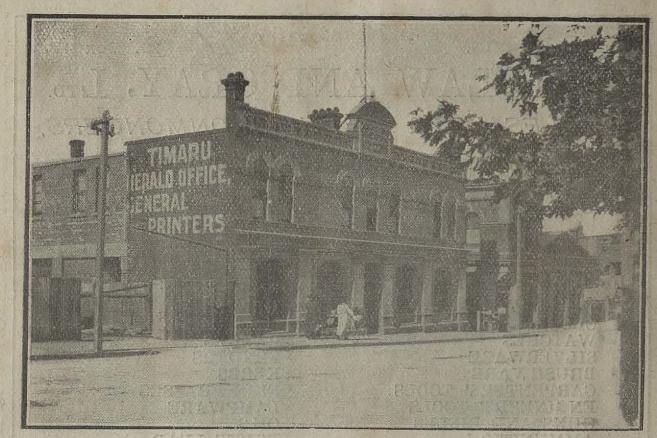
The Sophia Street Timaru Herald Office before the extension ground line, and built of solid bluestone masonry and concrete. Illustration Roselyn Fauth
23 Sophia St
1886
Architect Meason & Marchant
Builder Palliser & Jones
It is a Victorian with classical element's built of brick and plaster. It was the first building by Meason & Marchant. In 1928 and identical addition was built. The ground floor was used as a garage for the seven Model T Ford cards which formed the fleet for the Timaru Herald's mail run contract with the Post Office.
Significant elements include pilasters, capitals, cornice, string cource, timpany, window detailing and parapet.
This building is the The Timaru Herald's first Sophia St premises, which was occupied by the newspaper from 1886 to 1984. But the papers history goes back much further.
in July 1864 The Herald is established by Alfred George Horton, helped in first year, by Fred Edmond Younghusband and Ingram Shrimpton; first weekly issue printed on Saturday, June 11, in small detached kitchen run by former whaler and town character Sam Williams; paper eventually moves further west on George St. In 1866: Herald becomes bi-weekly, printing on Wednesdays and Saturdays (with the arrival of telegraph). In 1868 the Herald office, next to the Excelsior Hotel), burns down along with 38 other wooden buildings on, or neighboring, Great Southern Rd, now Stafford St. Staff tried to save what was possible from the burning building. While some were tasked with carrying out cases of type and taking down presses, others threw paper from the windows onto the street. Before much was done in this way the men had the fire falling upon them through the roof, and were compelled to desist. The principal portion of the newspaper type was saved, but the whole of the jobbing type, frames, and other materials were destroyed. Herbert Belfield, joint proprietor who later bought the paper in 1871, lost his dog to the blaze. "It refused to leave the office as long as its owner remained, and not seeing its owner leave, in the end was buried in the flames." Learn more here
Herald is offered temporary premises and prints single sheet for "a week or two" afterwards. Main South Road site is rebuilt.
1871: Horton sells to Herbert Belfield, who became joint proprietor in 1866. In the same year, The Herald's two-storey premises on corner of Sophia St and Royal (Ross) Arcade is opened; becomes Herald's home for nearly 100 years. 1887: Edward George Kerr, owner of South Canterbury Times, buys Herald; both papers operate from Sophia St building - Herald as a morning publication, Times as an evening publication. 1905: The Timaru Herald Co Ltd is formed, owned principally by members of Kerr family who lived at Harlau House. Learn more here
The Sophia Street building, erected in 1885 and extended in 1928. In 1939 the Timaru Post, the company's evening newspaper since the mid-1930s, ceased publication after 40 years. In 1954 a new press room and a paper store were built at the rear of the Sophia Street premises and the company's Crabtree rotary press was commissioned on October 2. Three years later the printing press was extended to take a maximum of 48 pages and the Herald became the first newspaper in New Zealand to offer two-colour printing. During 1960-61 the interior of the second storey of the Sophia Street building was reconstructed and a new factory built. In 1964 the Herald celebrated its centenary. In 1977 the newspaper changed to front-page news, the first issue in that format being published on February 8. Learn more here
The material to be published the next day came in from several sources and in several ways. I imagine it was assembled in suitable order and passed on to the linotype operators to type for printing. This was not a simple procedure. The linotype machines were monstrous machines and if seen today would seem like something out of this world. They had an extremely hot area in which lead was placed to melt. The operator would type his article on a keyboard which was then transferred to "lead slugs" and assembled in order as columns for the paper. One interesting point to note is that the letters on the "lead slugs" were back-to-front so that when the pages were assembled for printing the words were of course around the correct way. The proof readers were the next to see the assembled columns before the pages were passed on to the printing machines. Learn more
Did you know? In 1984 Herald moves to Banks St; building is officially opened by then-Prime Minister Robert Muldoon.
Can you find? The historic photo on the wall? Can you see the ear sculpture on the former telecomunications building across the road?
Get a selfie with the paper boy


Postcard - Timaru April 1876 Herald Office on Great South Rd and other buildings. (Stafford street just down from Theatre Royal). The obscured building on left is the Criterion Hotel, later renamed the Excelsior. - Curtosy of Jason Westaway
The Timaru Heralds newly built office were located on this site. Following the destruction of the building the by 1868 fire. The Timaru Herald temporarily relocated to "Captain Cains" New Stone Bond" until its new premises were re-built on this site within 6 months of the fire. A dog belonging to Mr Belfield who was one of the Herald owners, was burnt to death as it refused to leave the office as long a its owner remained, and not seeing its owner leave, in the end was burned in the flames.

A colour slide showing the old Timaru Herald building on Sophia Street, Timaru, circa 1985. The slide mount bears the processing date "Oct 85NZ". South Canterbury Museum 2016/053.015
Sources and Further Reading
Much of the information in this story was discovered by following the historical trail through newspapers, archives, and cemetery records. The following sources are publicly accessible and allow readers to explore the stories further.
Papers Past – National Library of New Zealand
Digitised historic newspapers including the Timaru Herald, allowing researchers to search births, deaths, legal cases, disasters, and community events recorded at the time.
https://paperspast.natlib.govt.nz
Aoraki Heritage Collection – Timaru District Libraries
Information about the history and holdings of the Timaru Herald, including its publication from 1864 and its preservation in library collections.
https://aorakiheritage.recollect.co.nz/nodes/view/998
Dictionary of New Zealand Biography – Alfred George Horton
Biography of Alfred George Horton, the young printer who founded the Timaru Herald in 1864 before later becoming a major newspaper proprietor in Auckland.
https://teara.govt.nz/en/biographies/2h37/horton-alfred-george
Te Ara – The Encyclopedia of New Zealand: Newspapers and Journalism
Background information about the development of newspapers and journalism in New Zealand.
https://teara.govt.nz/en/newspapers-and-journalism
Timaru District Council Cemetery Records
Burial records for members of the Kerr family in the Timaru Cemetery.
https://timaru.dataled.co.nz/cemeteries
South Canterbury Museum
Home to historic printing equipment associated with the Timaru Herald and other artefacts relating to Timaru’s early history.
https://www.scmuseum.org.nz
National Library of New Zealand – United Press Association
Information about the early press networks that allowed newspapers across New Zealand to exchange news via telegraph.
https://natlib.govt.nz