
By Roselyn Fauth
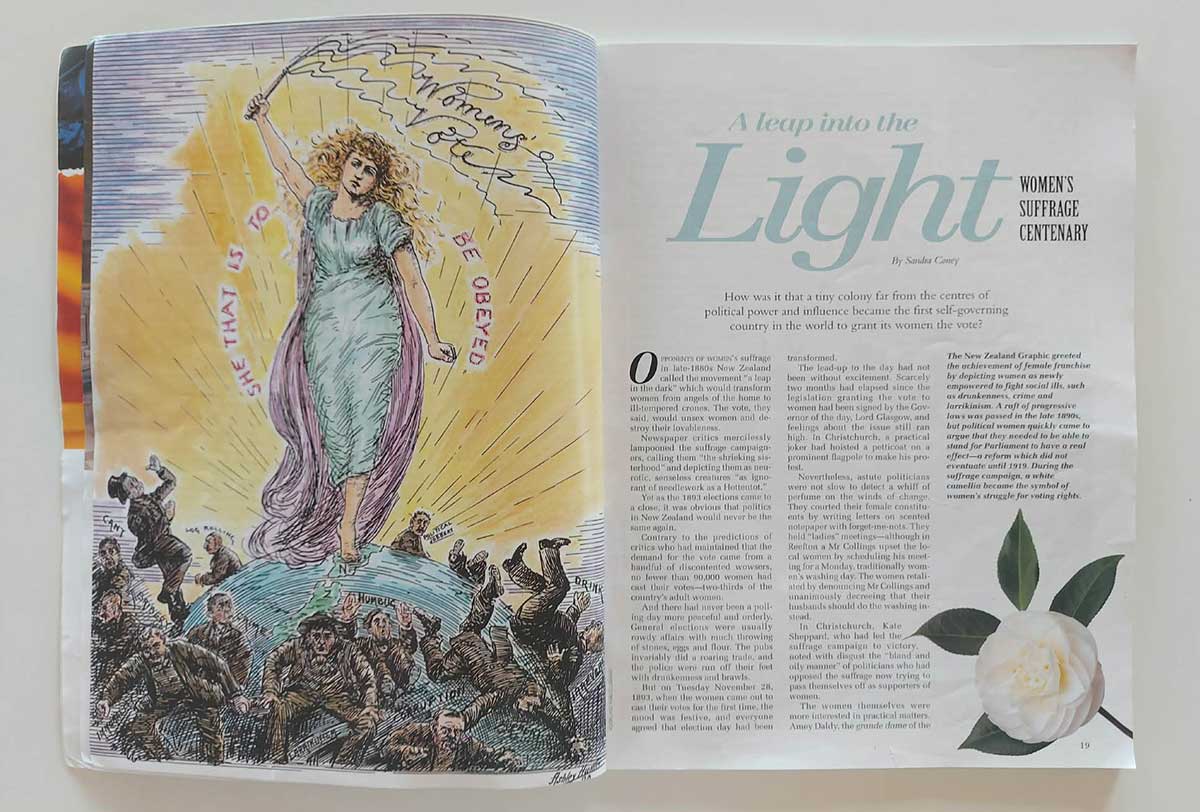
New Zealand Geographic - Women's Suffrage Centenary
I was looking for a bit of wet weather entertainment and thought the kids might enjoy making a collage. I spotted a banana-box stack of New Zealand Geographic magazines on Facebook for a song. Twenty dollars. What a score. So off we popped to collect them.
But once they were home and I started flicking through them, I realised they were far too good to chop up. Instead of cutting them into pieces, I’ve found myself swapping screen time for the pages of a vintage collection. Not a bad trade, really.
I’ve read two so far. One featured a Timaru Girls’ High lass, which was enough to catch my attention straight away. The other was a celebration of women’s suffrage, and honestly, it was one of the clearest and most enjoyable articles I’ve read on the subject. It set out the events in a way that made the whole story feel alive rather than distant, so naturally I did what I always do when something sparks my interest. I made a timeline.
I love timelines. They help give context to a person’s story. They help me see what else was happening around them. They help me edge a little closer to understanding what life might actually have felt like back in the day.
So here you go. First, the timeline. Then, because I can never quite leave things there, a bit of Google hunting to see how Timaru and South Canterbury fit into that wider line of milestones. And that was where it got even more interesting...
The national story is pretty amazing enough. The main 1893 women’s suffrage petition, presented to Parliament on 28 July 1893, survives as a huge rolled petition made up of more than 500 sheets and around 24,000 named women in the NZ History database, with the full surviving petition recorded as 25,519 signatures by Archives and NZ History.
But the local story is what really pulled me in... Timaru is in it! South Canterbury is in it. Not vaguely, but properly. Street names, schools, churches, families, workplaces, all starting to appear once you go looking. The suffrage petition database includes women signing from Timaru, Waimate and Temuka, which means this was not just something happening somewhere else in Wellington or Christchurch. It was here too.
What especially caught my eye was the link with education. Timaru High School opened in 1880 as a co-educational school and later split into boys’ and girls’ schools in the late 1890s, giving us the foundation of Timaru Girls’ High School right in the middle of the suffrage era.
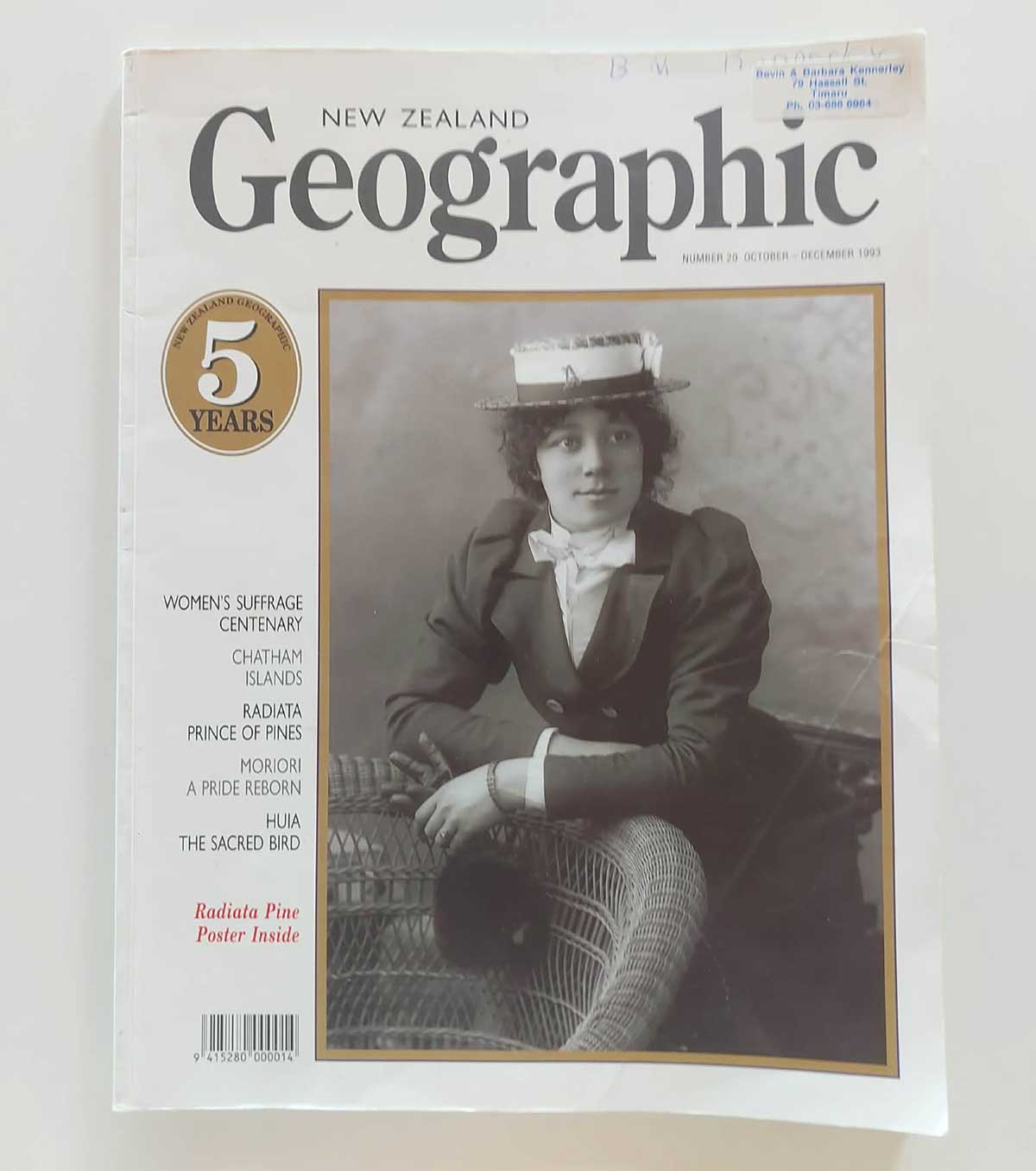
New Zealand Geographic - Women's Suffrage Centenary
And then there are the women themselves.
One 1893 suffrage signatory, Emma Pearson, gave her address simply as High School Timaru. NZ History notes that Timaru Girls’ High School history records her as teaching there from 1882 to 1900 and serving as Lady Superintendent from 1882 to 1898. Another signer, Agnes A. Pearson of Beach Road, Timaru, is identified as a teacher from Timaru. Agnes M. Donn, who signed from Bank Street, had trained as a teacher and was appointed assistant mistress at Waimataitai School in 1886. Suddenly the local suffrage story is not just about signatures on paper. It is about women teaching, leading, organising and helping shape young lives here in Timaru.
There are other local threads too. Margaret Norrie of Timaru was active in Trinity Church, the WCTU and the Presbyterian Women’s Missionary Union, and her biography records that she and her mother attended the earliest meetings of the Timaru WCTU. In Waimate, Sarah Elizabeth Murray signed while connected to the Waimate Wesleyan Church through her husband, Rev. Daniel James Murray. These are exactly the kinds of local church and temperance networks that helped power the movement nationally.
Even the newspapers show the debate was alive down here. The Timaru Herald was discussing women’s suffrage as a serious political question in June 1891, noting that Sir John Hall’s proposal was already the subject of “keen discussion”.
So what began as a cheap rainy-day magazine haul has turned into something rather lovely. A reminder that good stories are often sitting quietly in a box, waiting for the right afternoon. A reminder too that national milestones do not float above local life. They are lived in places. On streets. In schools. In churches. In family homes. In towns like Timaru.
That is probably why I keep making timelines. They do not just pin down dates. They help us see people. They help us notice connections. And every now and then, they help us realise that our own patch was part of something much bigger.
So here you go. The timeline first. Then some of my local digging to see where Timaru and South Canterbury sit in the story too.
Combined timeline of women’s suffrage and wider women’s reform in New Zealand
- Traditionally, before major colonial legal change: Māori women could inherit land rights and exercise authority over inherited land.
- 1862: The Native Land Court was established. Māori women are recorded arguing cases there over land rights.
- 1866: The British suffrage campaign began, many years before women in Britain gained even partial voting rights.
- Early 1870s: Auckland schoolteacher Mary Colclough, also known as Polly Plum, gave public lectures on women’s rights, including talks such as The Subjection of Women.
- Early 1870s: Colclough’s views provoked strong criticism. Editors, letter writers, satirists and cartoonists warned that women’s emancipation would destroy womanliness and domestic order.
- 1870s: In Hawke’s Bay, some Māori women reportedly chose not to marry under European law because marriage could transfer control of their land to their husbands.
- 1872: A published attack on women’s rights argued that women should remain in the domestic sphere and that home life would be damaged if women escaped it.
- 1877: Local brewers produced nearly 26 million litres of beer, highlighting the scale of alcohol consumption in colonial New Zealand.
- 1877: Kate Edger graduated with a Bachelor of Arts, becoming the first woman in the British Empire to earn a degree.
- 1877: After Edger’s success, the New Zealand Herald argued that claims about women’s intellectual inferiority could no longer be sustained.
- 1877: When Edger originally applied to study for a degree, she did not mention her sex, stating only that she met the entrance requirements. The University Senate accepted her enrolment.
- 1880: There were nearly 2,000 public houses in New Zealand.
- 1880: With just over 300,000 adults over 15, this worked out at about one pub for every 150 adults.
- 1880s: Heavy drinking remained deeply embedded in colonial society, especially in frontier culture shaped by a predominantly male settler world.
- 1880s: Women were often directly affected by men’s alcohol use, which drained family income and was frequently linked to violence against women and children.
- 1880s: Mary Lee, mother of John A. Lee, later recalled that when she confronted her husband over drinking away money in the pub, both she and her daughter were assaulted.
- 1880s: By this period, New Zealand’s early pioneering stage was drawing to a close, and towns were becoming more established and substantial.
- 1880s: Libraries, theatres, factories, department stores, churches, telegraph offices and early telephone exchanges reflected a more developed society.
- 1880s: Some towns had gas street lighting, lit at dusk by men using long poles.
- 1880s: Urbanisation and industrialisation were opening up new roles for women outside the home, even though domestic work still dominated many women’s lives.
- 1880s: Many girls still left school to help their mothers, but increasing numbers of women entered paid work.
- 1881: Nearly 12,000 women worked as domestic servants in New Zealand.
- 1881: Another 4,594 women worked in the clothing industry.
- 1881: Only a very small number of women worked as shop assistants or in offices.
- 1880s: Women in domestic service and clothing manufacture often worked long hours for low pay in exhausting conditions.
- 1880s: Clothing workers were often paid by the piece rather than by the hour, and generally earned much less than men.
- 1880s: Girls as young as 12 and 13 could still be found in factories as apprentices, often for little or no pay.
- 1880s: Domestic servants commonly worked 16-hour days and were lucky to receive even a Sunday afternoon off.
- 1880s: Domestic service was so harsh that some women compared it to slavery.
- 1882: An Auckland Star survey found that nearly half the population attended church on a Sunday, and that women outnumbered men.
- 1880s: Church life played a major part in respectable middle-class women’s social world and community work.
- 1880s: Women did much of the charitable work in society, caring for the poor, sick, widowed and deserted, often through church networks.
- 1885: The government passed the Hospitals and Charitable Institutions Act, establishing a national hospital and welfare system under local boards.
- 1885: The first sod was turned for the North Island Main Trunk railway.
- 1885: The organised women’s suffrage campaign in New Zealand effectively began.
- 1885: The Women’s Christian Temperance Union (WCTU) was established in New Zealand and quickly became central to the suffrage movement.
- 1885: Mary Clement Leavitt, an American representative of the Woman’s Christian Temperance Union, travelled through New Zealand encouraging women to form local unions.
- 1885: Leavitt argued that women should not be excluded from any sphere of life and should have access to professions, universities, juries and political rights, including the vote.
- 1885: She criticised the political system for grouping women among those denied voting rights.
- 1885: Her message found ready support. By the time she left New Zealand, ten unions had been formed and around 600 women had joined.
- 1885 onwards: The WCTU campaigned against alcohol, seeing drink as a major cause of poverty, violence and suffering for women and children.
- 1880s: The WCTU encouraged women and children to pledge not to drink alcohol, set up temperance tea rooms and booths, and pressed for wider moral and legal reform.
- 1880s: The union also sought temperance teaching in schools, though unsuccessfully.
- 1880s: Māori women were asked by WCTU reformers to give up tobacco and facial tattooing as part of its moral programme.
- 1880s: Reformers also campaigned against the routine use of alcohol as medicine in hospitals.
- 1880s: The suffrage movement in New Zealand was closely tied to temperance in a way that distinguished it from Britain.
- 1880s: Most suffragists were drawn from Protestant church circles, especially Methodist, Presbyterian and Anglican communities.
- 1880s: Many church women believed they had a moral duty to cleanse society and fight drink.
- 1880s: Churches and temperance groups gave women opportunities for public work, but usually kept them in subordinate roles rather than positions of authority.
- 1880s: Women in these groups raised money, ran Sunday schools, cared for parishioners and cleaned churches, but were often barred from holding office, chairing meetings or speaking publicly.
- 1880s: The Good Templars were a notable exception among reform groups in allowing women more formal standing.
- 1880s: The belief that a wife was her husband’s helper rather than an independent leader remained deeply embedded.
- 1880s: Many women increasingly chafed against these restrictions and began demanding a fuller place in public life.
- 1880s: Opponents of suffrage argued that women voting would “unsex” them, ruin their charm, and turn them from domestic “angels” into aggressive political creatures.
- Late 1880s: Newspapers and commentators mocked suffragists as shrill, irrational, unfeminine, and unsuited to political life.
- Late 1880s: Women who rejected the passive, decorative ideal were condemned as mannish, over-assertive, or unnatural.
- Late 1880s: The emancipated woman was satirised in cartoons as stepping into men’s shoes and seeking dominance over men.
- Late 1880s: The term “The Girl of the Period”, used critically by Mrs Lynn Linton, became associated with fears of modern, self-assertive women.
- Late 1800s: The campaign for the vote became part of a much wider rethinking of women’s place in society.
- Late 1800s: Women increasingly sought paid work, higher education, public leadership, healthier bodies, more freedom of movement, and greater legal rights.
- Late 1800s: Reformers argued that women’s domestic role should not be the sole purpose of their lives.
- Late 1800s: Margaret Sievwright celebrated the idea of the “New Woman”, even in imperfect form, as preferable to a woman with no life beyond domestic boundaries.
- Late 1800s: Educationally, New Zealand women began challenging older assumptions earlier than many women elsewhere in the British world.
- Late 1800s: Although only a minority of girls attended secondary school, increasing numbers of women went on to university.
- From the beginning of university education in New Zealand: Universities were open to women.
- 1884: Core Mary Tracey enrolled as a medical student, becoming the first New Zealand woman to do so, although she later withdrew.
- Late 1800s: Women increasingly entered fields beyond the arts.
- 1896: Emily Siedeberg graduated in medicine despite hostility, exclusion from some lectures, and harassment by male students.
- 1897: Ethel Benjamin qualified as a lawyer, becoming the first woman in the British Empire to do so.
- 1897: Benjamin still faced exclusion, including denial of access to the Supreme Court Library and exclusion from Law Society dinners.
- Late 1800s: Learmonth Dalrymple campaigned for Otago Girls’ High School and for women’s admission to Otago University.
- 1884: Before the Married Women’s Property Act, some Māori women were outraged to learn that marriage under European law could place their land under their husbands’ control.
- 1884: The comparatively stronger customary position of Māori women was cited in Parliament as an argument for improving Pākehā women’s property rights.
- 1880s and 1890s: Reformers also challenged conventional ideas about women’s health and dress.
- 1880s and 1890s: Alternative health practices such as hydropathy, vapour baths, vinegar washing, vegetarianism and food reform were promoted among suffrage circles.
- 1880s and 1890s: Reformers advocated a view of women’s bodies based on health, strength and vigour rather than weakness.
- 1880s and 1890s: Cycling became a powerful symbol of women’s independence, mobility and improved health.
- 1880s and 1890s: The “New Woman” became strongly associated with the bicycle.
- 1890s: Bicycle riding gave women freedom to move about without chaperonage.
- 1890s: Women adapted bicycles with practical accessories. Hannah Hippolite, an early Nelson nurse, was pictured with a lamp, sprung seat and skirt guard on her machine.
- 1880s and 1890s: Women also took up new physical activities such as gymnastics, golf, swimming and bowling.
- 1886: Women first played cricket at Motueka.
- 1890s: Women’s hockey appeared in New Zealand.
- 1891: A women’s rugby team was formed in New Zealand.
- 1891: Nita Webbe announced plans for a women’s rugby tour, which drew fierce press hostility and may never have proceeded.
- 1894: At Canterbury College, Alice Burn shocked authorities by appearing in knickerbockers. The university then banned such clothing.
- Late 1800s: Dress reformers criticised tight corseting, heavy skirts and restrictive clothing as unhealthy and limiting.
- Late 1800s: Some even argued that tight lacing damaged women’s internal organs.
- Late 1800s: Reformers promoted looser undergarments and divided garments such as knickerbockers and split skirts.
- Late 1800s: In Christchurch, Alice Burn and others formed a Rational Dress Association.
- 1884: A reform dress wedding, in which the full bridal party wore trousers, caused public scandal.
- Late 1800s: Christchurch became a major centre for feminist and experimental social ideas.
- 1892: The Canterbury Women’s Institute was formed in Christchurch and was probably the first specifically feminist society in New Zealand.
- 1892: The Institute taught women practical new skills, including photography and darkroom work.
- Late 1800s: Ada Wells emerged as a leading member of the Institute and supported alternative approaches to health.
- 1894: The English theosophist Annie Besant visited New Zealand and drew large crowds with lectures on spiritual masters, karma and rebirth.
- Late 1800s: Educated middle-class Victorians in New Zealand were often more intellectually curious and open to new ideas than the stereotype of strict puritanism suggests.
- Late 1800s: Darwinian thought, spiritualism and other alternative ideas helped unsettle older certainties and open discussion about social change.
- Late 1800s: Enlightenment and French Revolutionary ideals of equality, democracy, reason and freedom influenced thinking about women’s rights.
- Late 1800s: Women’s rights were increasingly seen as part of a broader movement for justice affecting other marginalised groups, including workers.
- 1889: Public concern over poor factory conditions led to the formation of the Tailoresses’ Union in Dunedin.
- 1889: Dunedin, then New Zealand’s most industrialised city, had about 27 per cent of its workforce in clothing manufacture, and 80 per cent of those workers were women.
- Late 1880s: Harriet Morison became a key figure in organising tailoresses and also tried to organise domestic servants.
- 1890: A Sweating Commission was established to investigate workplace abuses.
- Early 1890s: Its findings helped bring reforms to factory legislation.
- 1893: A photograph from Ringland Bros. in Napier captured female tailoresses working in crowded, poorly ventilated factory conditions.
- 1896: A Domestic Servants Half Holiday Bill was introduced to Parliament proposing one afternoon off a week for servants.
- 1896: The proposal was laughed out of Parliament, showing how little regard domestic workers still received.
- Late1800s: Some officials still claimed a servant was not really a “worker”.
- Late1800s: Women in the workforce, especially self-supporting women, increasingly challenged the old assumption that daughters remained economically dependent until marriage.
- Late 1800s: Suffragists used the principle of “no taxation without representation” to argue that women who worked and paid their way deserved political rights.
- Late1800s: Women lacked many basic civil rights and were restricted by discriminatory laws.
- Late1800s: Suffragists objected that girls as young as twelve could legally be subjected to sexual intercourse and marriage.
- Late1800s: The Contagious Diseases Act was attacked as a sexual double standard because women merely suspected of prostitution could be detained and forcibly examined.
- Late1800s: Campaigners condemned the power this gave police over women’s bodies and reputations.
- Late1800s: One case cited was that of a girl taken into Auckland Lock Hospital at only ten years old.
- Late1800s: Divorce law was unequal. A woman had to prove more than adultery, often including violence, and judges sometimes told battered women to reconcile with abusive husbands.
- Late1800s: A widow did not automatically gain guardianship of her children if her husband had appointed someone else.
- Late1800s: Equal pay did not exist, even in professions such as teaching.
- Late1800s: Women could not vote for local bodies unless they were ratepayers.
- Late1800s: Local authorities did not appoint women to hospital boards.
- Late1800s: Suffragists wrote pamphlets, held meetings and wrote to newspapers to push for change.
- Late1800s: Some women worked quietly or anonymously because of opposition from husbands or family members.
- Late1800s: Mary Müller wrote secretly under the pen name Femina.
- 1885 onwards: Petitioning became the main practical strategy of the suffrage movement.
- 1891: The first major women’s suffrage petition was presented.
- 1892: A second major petition followed.
- 1893: A third and final petition was organised.
- 1893: Suffragists went door to door and into factories across New Zealand gathering signatures.
- 1893: The final petition stretched for about 300 yards and was signed by just under one quarter of the adult women in the colony.
- 1893: When Sir John Hall brought the long petition into Parliament and unrolled it through the debating chamber, the scene reportedly fell silent.
- 1893: As the general election approached, it became obvious that New Zealand politics was being transformed.
- Less than two months before polling day in 1893: The law granting women the vote was signed by Governor Lord Glasgow.
- Lead-up to the 1893 election: Public feeling remained intense. In Christchurch, one joker protested by hoisting a petticoat up a flagpole.
- Lead-up to the 1893 election: Politicians quickly tried to court women voters, sending letters on scented paper and organising women’s meetings.
- Lead-up to the 1893 election: In Reefton, Mr Collings upset local women by scheduling a meeting on a Monday, traditionally washing day. Women responded by saying husbands should do the washing instead.
- 1893: In Auckland, Amey Daldy led meetings showing women how to complete ballot papers correctly.
- 1893: Daldy urged women not to let babies, washing or dinner keep them from going to the polls.
- 1893: Reports described women turning out enthusiastically in large numbers, well dressed and visibly confident in their new civic role.
- 1893: Around 78 per cent of adult women enrolled to vote within roughly six weeks of the Electoral Bill’s passage.
- 28 November 1893: Women voted in a general election for the first time in New Zealand.
- 28 November 1893: About 85 per cent of enrolled women voted.
- 28 November 1893: Around 90,000 women, about two-thirds of the country’s adult women, cast votes.
- 28 November 1893: Polling day was widely described as festive, peaceful and orderly.
- Before 1893: General elections were often rough affairs marked by drunkenness, brawling, and even the throwing of stones, eggs and flour.
- 1893: The first election in which women voted was noted for being much calmer than earlier elections.
- 1893: A photograph from New Plymouth polling day is described as probably the earliest photograph anywhere in the world showing women voting.
- 1893: Some supporters hoped women voters would help clean up politics and back principled candidates.
- 1893 election: Although women’s votes were symbolically powerful, it is difficult to prove they alone determined the election result.
- 1893 election: The Liberals won, but the swing toward them was broader across the electorate, among both men and women.
- 1893: Kate Sheppard, who had led the movement, scorned politicians who had opposed suffrage and then tried to present themselves as supporters of women.
- 20 December 1893: Māori women voted on Māori polling day.
- 20 December 1893: About 4,000 Māori women cast votes.
- 1893: Māori women had already formed committees to support candidates and held large meetings to discuss policies.
- 1893: Newspapers noted the enthusiasm with which Māori women exercised the franchise.
- 1893: New Zealand became the first self-governing country in the world to legislate for universal female suffrage.
- 1893: It was also the first country where a sustained women’s suffrage campaign had succeeded in changing national law.
- Late 1890s: Publications such as the New Zealand Graphic celebrated women’s franchise as a force for tackling drunkenness, crime and larrikinism.
- Late 1890s: The white camellia became a recognised symbol of the struggle for women’s voting rights.
- After 1893: The WCTU continued campaigning on wider moral and legal issues, including raising the age of consent and prohibition.
- 1896: A photograph showed Kate Sheppard with members of the National Council of Women, including Amey Daldy.
- Late 1890s: A raft of progressive laws followed the granting of women’s suffrage.
- After suffrage was won: Women argued that the vote alone was not enough and that women should also be able to stand for Parliament.
- 1919: Women in New Zealand finally gained the right to stand for Parliament.
- 1934: Kate Sheppard died after continuing to support women’s causes for decades after the suffrage victory.
- 1956: Only 55 per cent of Pākehā households and 20 per cent of Māori dwellings had electric washing machines.
- 1956: Many homes still relied on wringers, tubs and coppers for washing.
- Until the Second World War: Domestic service remained the largest single employment category for women in New Zealand.
- 1901: A maid serving afternoon tea at Mansion House on Kawau Island would already have completed around nine hours of work by that point in the day.
Not bad for twenty dollars and a wet afternoon.
Here's is my google hunt for more local milestones
South Canterbury and Timaru women’s suffrage timeline
1866: Mary Jane McLean was born in Timaru, the daughter of Dr Duncan McLean and Ann le Ber McLean. She later attended Timaru Main School and Timaru High School, becoming one of the strongest examples of how girls’ education in Timaru was advancing in the same generation that women were beginning to claim wider public rights.
Full link: https://teara.govt.nz/en/biographies/3m26/mclean-mary-jane
1874: Charlotte Colbeck emigrated from Lincolnshire to New Zealand with her husband John and their two young children, arriving in Canterbury in December and settling in Waimate, South Canterbury. Her story matters because she later became a South Canterbury suffrage signer and also signed the earlier 1892 suffrage petition roll, showing sustained commitment rather than one-off participation.
Full link: https://nzhistory.govt.nz/suffragist/charlotte-colbeck
1880: Timaru High School opened as a co-educational institution. This is a key local milestone because it places girls’ secondary education in Timaru firmly before the 1893 suffrage victory. Timaru Girls’ High School later grew out of this foundation when the school split into separate boys’ and girls’ schools in 1897.
Full link: https://teara.govt.nz/en/south-canterbury-region/page-12
1882: Emma Pearson was teaching at the Timaru school later tied to Timaru Girls’ High School history. NZ History notes that the school history Lively Retrospect records her as teaching there from 1882 to 1900 and serving as Lady Superintendent from 1882 to 1898. That makes her one of the most important named local bridges between women’s education and suffrage.
Full link: https://nzhistory.govt.nz/suffragist/pearson
1884: In Waimate, Catherine Richardson, later known in the petition as Mrs C. Meyers, had already established herself in local life. Her biography records that she married Charles Henry Bagley at Thomas Frampton’s residence, Cameron Street, Waimate, and that she was a dressmaker. This is a valuable local clue because it ties a suffrage signer not only to a place but also to women’s paid work.
Full link: https://nzhistory.govt.nz/suffragist/mrs-c-meyers
1886: Agnes MacFarlane Donn, later a suffrage signer from Bank Street, Timaru, was appointed assistant mistress at Waimataitai School. By 1890 she had secured a teaching position at Adair School. She shows that the Timaru suffrage world included women teachers working right across the local education system, not only at the high school.
Full link: https://nzhistory.govt.nz/suffragist/agnes-m-donn
1886 onward: Mary Jane McLean attended lectures at Canterbury College while teaching part time at Timaru High School, building a remarkable education career from a Timaru base. Her later prominence helps show that South Canterbury was producing women who moved confidently into professional leadership during the same reform era as the suffrage movement.
Full link: https://teara.govt.nz/en/biographies/3m26/mclean-mary-jane
1889: Mary Jane Russell, born in Temuka in 1866, married William Coltman in Temuka. She later signed the 1893 petition from Waimate. Her life is especially useful for local history because it links Temuka and Waimate through marriage and movement, showing that South Canterbury suffrage history was regional rather than confined to one town.
Full link: https://nzhistory.govt.nz/suffragist/m-j-coltman
1890: Mary Jane McLean became first assistant teacher at Timaru High School after several years of part-time teaching. This is not direct suffrage evidence, but it is strong evidence of women’s growing authority in Timaru’s educational life just before women gained the vote.
Full link: https://teara.govt.nz/en/biographies/3m26/mclean-mary-jane
20 June 1891: The Timaru Herald shows that women’s suffrage was already part of local public debate. The article notes that the women’s suffrage section associated with Sir John Hall was then the subject of “keen discussion”. This is a useful marker because it places Timaru readers in the middle of the debate before the 1893 breakthrough.
Full link: https://paperspast.natlib.govt.nz/newspapers/THD18910620.2.5
1892: Charlotte Colbeck of Waimate signed the 1892 Women’s Suffrage Petition Roll as well as the 1893 petition. That makes her one of the clearest South Canterbury examples of a woman involved before the final campaign year.
Full link: https://nzhistory.govt.nz/suffragist/charlotte-colbeck
28 July 1893: The main women’s suffrage petition was presented to Parliament. NZ History says its online database is a digitised version of the main 1893 petition and records names and addresses from the surviving sheets. This matters locally because it is the source that lets us place real South Canterbury women on real streets.
Full links:
https://nzhistory.govt.nz/politics/womens-suffrage/petition
https://nzhistory.govt.nz/page/about-suffrage-petition
1893: In Timaru, a clear petition cluster appears around Bank Street. Named signers there include Mary McRae, Susan Donn, Rosina North, Maude M. Greig, and Agnes M. Donn, all on or associated with sheet 274. This strongly suggests a neighbourhood or family-based collecting network in central Timaru.
Full links:
https://nzhistory.govt.nz/suffragist/mrs-mary-mcrae
https://nzhistory.govt.nz/suffragist/susan-donn
https://nzhistory.govt.nz/suffragist/miss-rosina-north
https://nzhistory.govt.nz/suffragist/agnes-m-donn
1893: The Donn family offers a particularly rich Timaru example. Jessie Donn appears as Mrs R. Donn, having married at St Mary’s Church, Timaru in 1863 and later signing in Timaru after years in the district; her daughter Susan Donn also signed from Bank Street, Timaru and later married at Trinity Presbyterian Church, Timaru in 1897. This gives you a local family story tied to church, street, and petition.
Full links:
https://nzhistory.govt.nz/suffragist/mrs-r-donn
https://nzhistory.govt.nz/suffragist/susan-donn
1893: In Timaru, Emma Pearson signed the petition with the address “High School Timaru.” This is one of the strongest local entries in the entire South Canterbury record because it places the suffrage movement directly inside the world of the school that later became Timaru Girls’ High School.
Full link: https://nzhistory.govt.nz/suffragist/pearson
1893: Agnes A. Pearson signed from Beach Road, Timaru, and NZ History identifies her as Miss Agnes Aitken Pearson, a teacher from Timaru listed in the 1893 New Zealand Gazette. Taken together with Emma Pearson, this suggests that women teachers in Timaru were not bystanders to reform but participants in it.
Full link: https://nzhistory.govt.nz/suffragist/agnes-pearson-0
1893: Lydia Smith signed from North Street, Timaru. Along with the Bank Street and Beach Road signers, her entry helps map the movement across the town rather than tying it to a single institution.
Full link: https://nzhistory.govt.nz/suffragist/lydia-smith
1893: Jessie Allan Walker signed in Timaru after her family moved there when her husband entered a partnership in the South Canterbury Woollen Mills. Her biography also links her to other women signing “at the same time” on Bank Street and Heaton Street. This is a very strong clue that Timaru suffrage was not just a church story or a school story, but also linked to industrial and family networks.
Full link: https://nzhistory.govt.nz/suffragist/mrs-jessie-allan-walker
1893: In Timaru, Margaret Norrie and her mother Sarah attended the earliest meetings of the Timaru WCTU. Margaret later became deeply involved in Trinity Church, Timaru, the WCTU, and the Presbyterian Women’s Missionary Union, and served as president of the Timaru WCTU branch from 1918 to 1933. Her biography is one of the strongest local proofs that the Timaru suffrage story ran through church and temperance networks.
Full link: https://nzhistory.govt.nz/suffragist/mrs-margaret-norrie
1893: In Waimate, Sarah Elizabeth Murray signed the petition while her husband, Rev. Daniel James Murray, was stationed at the Waimate Wesleyan Church. This gives South Canterbury a named Methodist-linked suffrage example that fits the wider New Zealand pattern of church women’s reform networks.
Full link: https://nzhistory.govt.nz/suffragist/s-e-murray
1893: In Waimate, Mary Jane Coltman signed from the town after her Temuka marriage and move. Her later family prominence, including her husband’s civic career, makes her useful for showing how women’s political engagement in South Canterbury sat within ordinary household and community life, not just in formal activism.
Full link: https://nzhistory.govt.nz/suffragist/m-j-coltman
11 July 1893: The Temuka Leader carried a piece titled “Women’s Franchise.” The search result itself is clear evidence that the issue was live in local print culture in Temuka during the campaign. I would still want the full article opened before quoting its exact tone at length, but even the accessible result is enough to show the subject was being directly addressed in the district.
Full link: https://paperspast.natlib.govt.nz/newspapers/TEML18930711.2.12.3
19 September 1893: The Electoral Act received the Governor’s assent. The local significance is visible in the way South Canterbury newspapers then discussed the change as a major colonial turning point.
Full links:
https://nzhistory.govt.nz/politics/womens-suffrage/petition
https://paperspast.natlib.govt.nz/newspapers/THD18930928.2.19
28 September 1893: The Timaru Herald explicitly reflected on the passage of the bill and noted that it had received the Governor’s assent on 19 September. This gives you a local newspaper date for when Timaru readers were digesting the fact that women had legally won the vote.
Full link: https://paperspast.natlib.govt.nz/newspapers/THD18930928.2.19
10 October 1893: The Temuka Leader described the recently closed Parliament as one that had “enfranchised women,” calling it an epoch in the history of the colony and perhaps of the civilised world. That is powerful local evidence of South Canterbury recognising the reform as historic in real time.
Full link: https://paperspast.natlib.govt.nz/newspapers/TEML18931010.2.11
28 October 1893: A Temuka Leader report on a political meeting noted that remarks were directed towards “the education of women in regard to the new duties which the franchise had imposed upon them.” This is a particularly valuable local line because it links the vote not just to politics but to civic preparation and expectations about women’s new public role.
Full link: https://paperspast.natlib.govt.nz/newspapers/TEML18931028.2.21
21 November 1893: The Temuka Leader reported a speaker in Temuka saying he was glad that women had the franchise and that it was “only a right.” This gives you another local example of pro-suffrage sentiment being publicly voiced in South Canterbury just before the first election at which women voted.
Full link: https://paperspast.natlib.govt.nz/newspapers/TEML18931121.2.19
28 November 1893: Women voted in the general election for the first time. In Temuka, the local paper later reported that election day was a busy throng, with both parties trying to poll their women early, and that voting proceeded slowly because of the numbers. That is one of the clearest South Canterbury glimpses of women actually arriving at the polls and changing the feel of election day.
Full link: https://paperspast.natlib.govt.nz/newspapers/TEML18931130.2.15
30 November 1893: The Temuka Leader’s report on the election atmosphere confirmed the district-wide importance of women’s first vote and the practical pressures it placed on local polling arrangements. Even without naming individual women, it gives you a vivid local scene.
Full link: https://paperspast.natlib.govt.nz/newspapers/TEML18931130.2.15
1897: Timaru High School split into boys’ and girls’ schools, according to Te Ara. This is a major local milestone because it places the formal birth of Timaru Girls’ High School only four years after women won the vote, in a climate already shaped by women’s claims to education, leadership, and citizenship.
Full link: https://teara.govt.nz/en/south-canterbury-region/page-12
25 August 1897: The Timaru Herald reported the destruction of the Timaru High School building by fire. This matters for your local education timeline because the school’s transition years were also years of disruption and rebuilding, not just quiet institutional change.
Full link: https://paperspast.natlib.govt.nz/newspapers/THD18970825.2.10
21 September 1897: The Timaru Herald reported the reassembly of classes under temporary arrangements after the fire. This gives a strong sense of continuity and determination around education in Timaru during a period of major change.
Full link: https://paperspast.natlib.govt.nz/newspapers/THD18970921.2.26
6 October 1897: The Timaru Herald carried another item headed “Timaru High School,” showing the school remained a matter of public local interest during the post-fire and post-split period. I would still want a full article read before making any stronger claim from that item, but it reinforces how visible the school was in local civic life.
Full link: https://paperspast.natlib.govt.nz/newspapers/THD18971006.2.17
1898: Mary Jane McLean became principal of Timaru Girls’ High School after the school’s division. She is a superb local example of the kind of woman whose career became imaginable and respectable in the same decades that women were entering public life more boldly.
Full link: https://teara.govt.nz/en/biographies/3m26/mclean-mary-jane
1918 to 1933: Margaret Norrie served as president of the Timaru WCTU branch. This sits beyond the 1893 breakthrough but is worth including because it shows the suffrage-and-temperance generation in Timaru did not vanish after the vote was won. It matured into long-term organisational leadership.
Full link: https://nzhistory.govt.nz/suffragist/mrs-margaret-norrie