By Roselyn Fauth
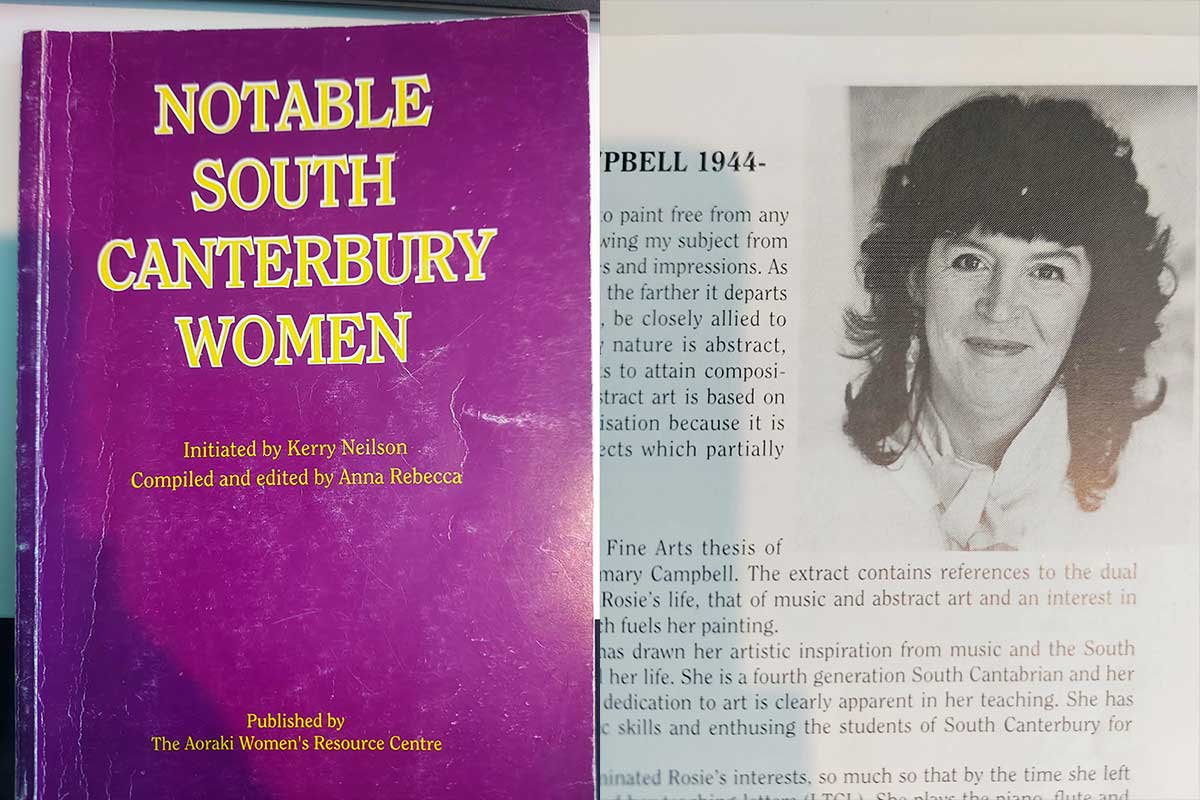
Last year, I was being shown through Timaru Girls’ High School after putting my hand up to volunteer and offer support to the school archivist. The tour was led by the school’s Community Builder, Amanda Davies, who have me a tour around my old stomping ground. There is so much that is the same, and different. And one of the things that was the same was the artworks on the schools walls. Among them were several pieces by local artist Rosemary Campbell.
I have admired Rosemary’s work for a long time. One of her portraits hangs in my aunty and uncle’s home. Rosemary is also my aunty Margaret Cloake’s cousin.. that's Timaru hey, we are all connected. Seeing her work displayed proudly within the school setting was really special. The art in a school can be more than decoration.
After that visit, I gave Amanda a few ideas, offered support where I could, and stayed in touch. Driving home, I remember thinking how lucky she was to have such a role. A job built around people, place, stories, and connection. At the time, it was just a passing thought.
At the end of 2025, Amanda prepared to move to Christchurch. When the role was advertised, I couldn't believe my eyes and pulled an application together to be Amanda's replacement. Making it through to the interview stage felt like a gift. And I took time to prepare which also involved revisiting my own time at Timaru Girls’ High, not just as an academic student but what school meant to me emotionally and socially too. I realised how deeply the school had shaped the woman I am today. My confidence, my curiosity, my sense of service, and my love of community all trace back there. Just like the school crest says, Knowledge is Power.
I am incredibly excited to say that I was offered the role, and I start next week. It is part time, and I will continue working at Cloake Creative as I have for the past 20 years with my father, providing graphic and web design services alongside it. It feels like a balance that fits this season of my life perfectly, totally aligns with my personal views of public education, and I am genuinely really passionate about supporting the school past students, staff and volunteers, present and future.
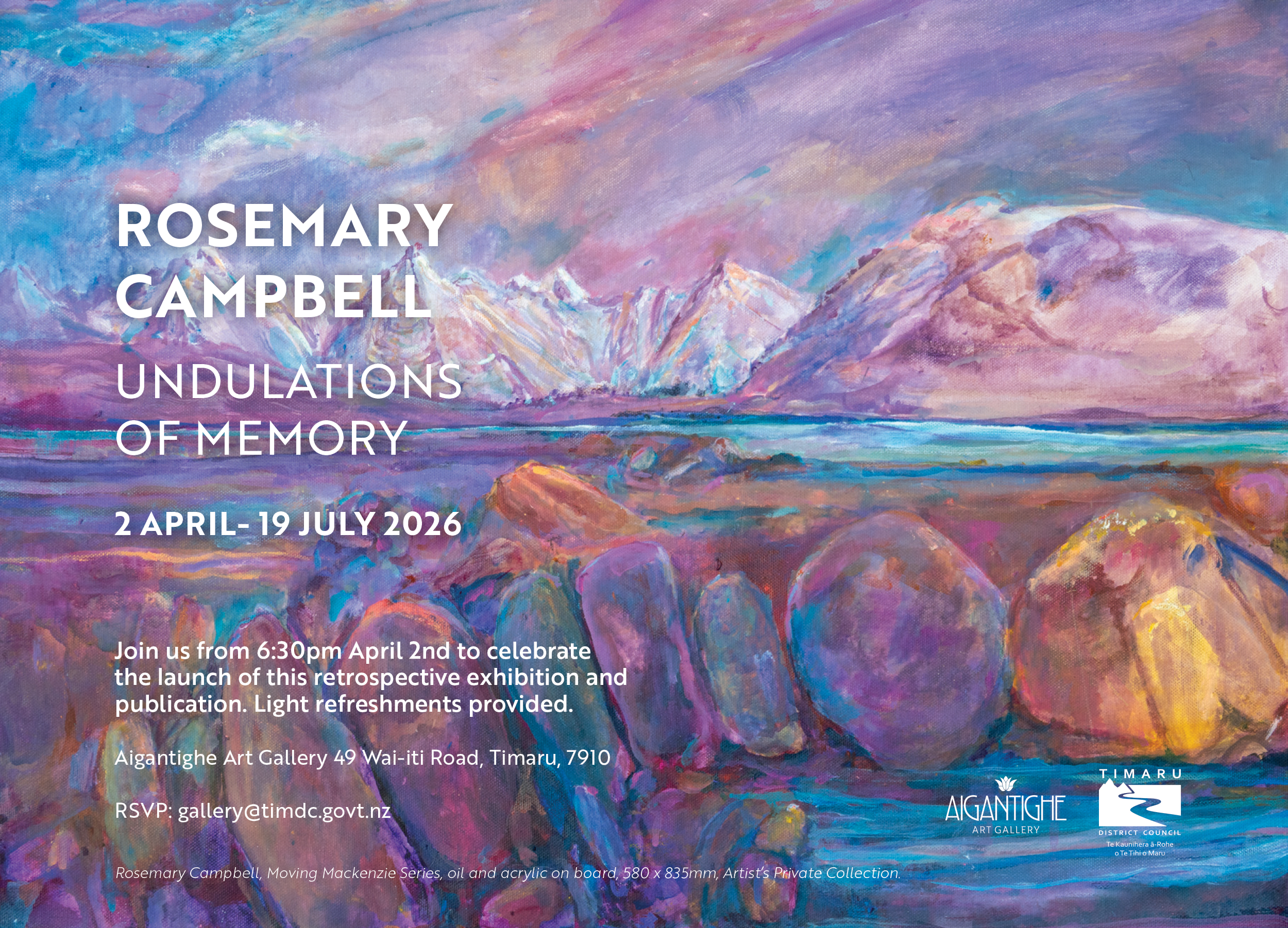
Adding to this sense of alignment is the wonderful news that an exhibition is being planned at the Aigantighe Art Gallery to celebrate Rosemary Campbell’s career and her contribution to our community. The exhibition is coming up in April so supporting the archivist Pamela Gibson and the Aigantighe team is a top priority. so here is my blog about my learning about Rosemary so far... who has strong links to Timaru Girls’ High School as she taught art there for many years, shaping generations of young women through her teaching, discipline, and creativity. As I mentioned before, her work hangs within the school walls, as well as public galleries like in Timaru and Christchurch. She is nationally regarded as one of the countries artist treasures. I am looking forwardto learning more about her time at Timaru Girls' and her life after she left the classroom.
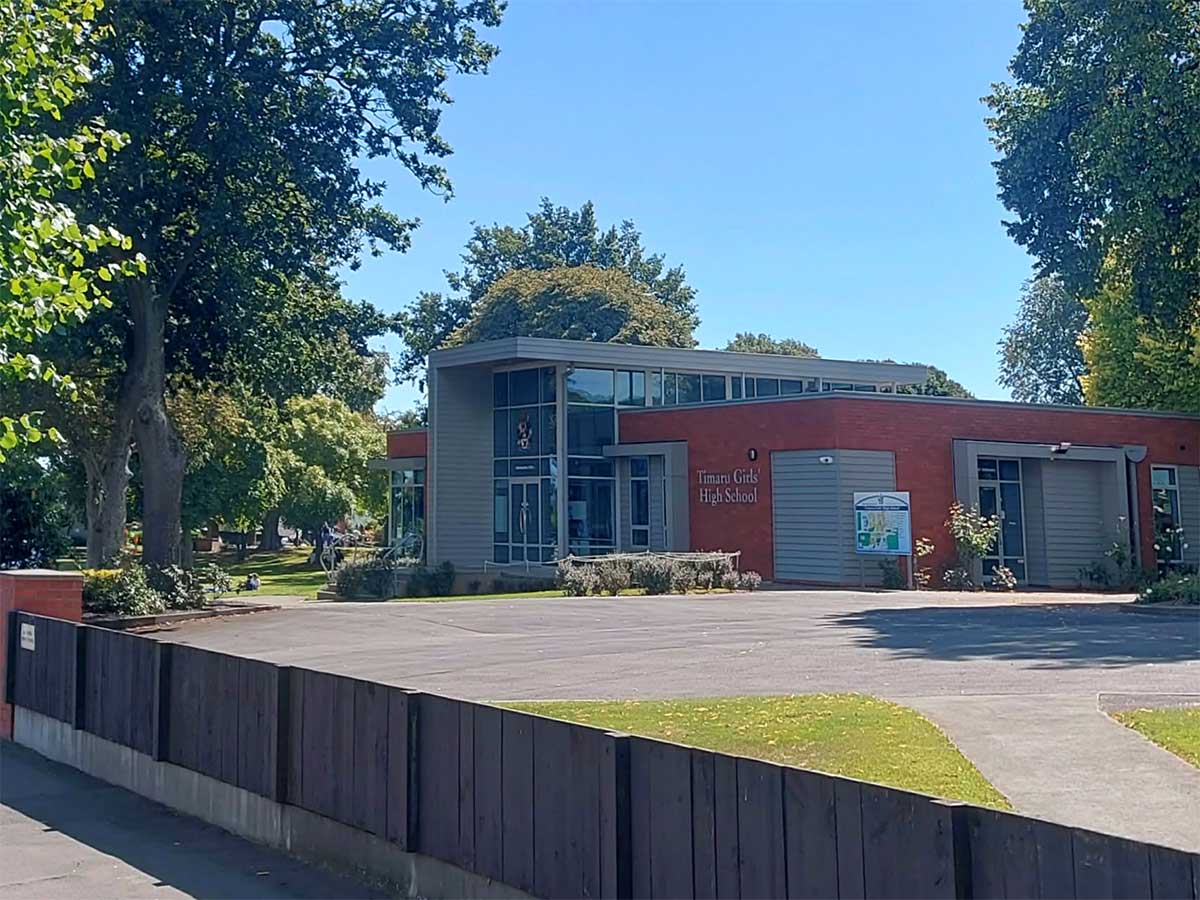
To kick off my history hunting, I am lucky to have a copy of Notable South Canterbury Women at home.
The book was initiated by Dr Kerry E Neilson, compiled and edited by Anna Rebecca, and published by the Aoraki Women’s Resource Centre as part of the Women’s Suffrage Whakatū Wāhine centenary, marking 1893 to 1993. Its purpose was to record the stories of women whose lives had shaped South Canterbury, many of whom had never been formally written about before.
Rosemary’s profile flows over two full pages. Notable South Canterbury Women lists her as having been born in Timaru in 1944, and that is the date I am using here. The entry opens with her own words, taken from her Fine Arts thesis, where she describes her desire to paint free from naturalistic reference. She speaks of drawing on subconscious images and impressions, and of the close relationship between abstract painting and music. Music, she notes, is abstract by nature, relying on formal elements to create order. Painting, for her, works in much the same way.
"Abstract
I have felt the desire to paint free from any naturalistic reference, drawing my subjects from stored subconscious images and impressions. As painting becomes abstract the farther it departs from nature it can, I feel, be closely allied to music. Music by it's very nature is abstract relying on formal elements to attain compositional order. Similarly, abstract art is based on formal elements of organisation because it is not depicting known objects which would partially suggest a composition.
I have endeavoured to explore how closely the two arts are allied in other respects.
Because both are elusive and untrammelled by objectivity they can be considered superior to other arts which seem to lose impact by transcription into words. Music is essentially an art of time while painting is an art of space."
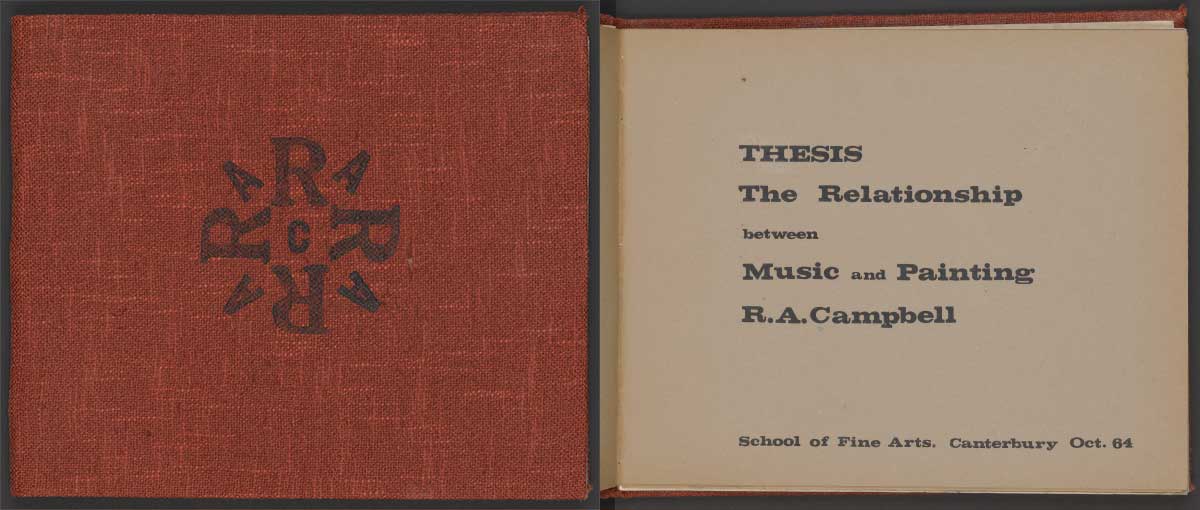
Rosemary Ann Campbell 1964 - relashionship The relationship between music and painting. https://ir.canterbury.ac.nz/items/04dbd60f-d0ec-46b8-9e4f-b41d517f078a
She studied at the Ilam School of Fine Arts at the University of Canterbury, where painting became her major focus, though music remained central to her thinking. After completing her Fine Arts degree, Rosemary returned to South Canterbury and taught at Timaru Girls’ High School and Craighead Diocesan School, later becoming Head of the Art Department at Aoraki Polytechnic.
In 1974, she received a Queen Elizabeth II Arts Council Scholarship to study at the École des Beaux-Arts in France, where she focused on lithography and etching. The experience of studying overseas, combined with her deep connection to her local environment on returning home, continued to shape her work.
Landscape and music are the major themes in Rosemary’s painting. She works predominantly in watercolour, a medium she values for its sensitivity to light and atmosphere, and produces a significant number of commissioned portraits in oils. She often spoke about wanting her paintings to capture a mood rather than depict a place, and about her hope that the passion she felt while painting might reach the heart of the viewer.
If you’ve read my last few blogs, you’ll know we took a trip out to Woodbury over the long weekend. So it was a delight to discover, while reading the book, that Rosemary made her home there. After returning from France, she and her husband settled in Woodbury, creating a life surrounded by gardens, animals, and wide South Canterbury skies. The book describes peacocks roaming freely across the property, and a home that reflected her colourful personality.
Having just been there myself, the connection felt really interesting. The light, the openness, the sense of space and movement suddenly made perfect sense when viewed through her work. Woodbury was not just where she lived. It was part of how she saw. And as I am learning more about the people who live in the small rual township, I can imagine why Rosemary would have loved it out there.
As I step into my new role as Community Builder at Timaru Girls’ High School, I feel incredibly grateful that one of the first stories I get to learn more deeply is hers. Her influence stretches far beyond galleries and books. It lives in classrooms, corridors, and in the confidence of students she encouraged to look closely, think deeply, and trust their creative instincts.
I cannot wait to walk back through the school again, pause in front of her paintings once more, and see them not just as artworks, but as part of a much bigger story of women, education, and place.
Her thesis is published online, and I encourage you to have a read.
I opened Rosemary’s thesis knowing full well I didn’t have time to read it properly... but you know me. I love a side quest, and I had a lunch break to spare, so in I went. Like a few theses I’ve dipped into recently, I already know this is one I’ll need to come back to a few times to really get my head around it.
The good news is, that this is so well written, that didn’t need to read this cover to cover to understand what she’s getting at. From the outset, she comes across as someone working out what she believes about painting, and why. She’s interested in abstraction, but not in a loose, anything-goes way. She keeps coming back to order and to structure.
Her comparison between music and painting is simple on the surface, but it stays with you. Music exists in time. Painting exists in space. They differ mainly in how we experience them. A painting isn’t “always on”. It only really exists when someone is standing in front of it, just as music only exists while it’s being heard.
As a musician and an artist myself, that made total sense. I’ve found myself looking at paintings differently since, noticing how my eye moves, where it slows down, where it jumps. Almost like listening for a rhythm. A beat. I also know that I need to choose the music carefully when I create because it can impact the end result. Listening to music and creating for me go hand in hand.
Rosemary talks about rhythm as something visual as well as musical. Colour on its own can’t carry a painting she explains. There has to be balance, tension, repetition. I trust her on this. She’s clearly someone who spent a lot of time actually making work, not just talking about it. And going by the art I have seen, she was very good at it too.
A good painting, she suggests, works for the same reason good music works. Just as music doesn’t need words to make sense or carry feeling, a painting doesn’t need a recognisable subject either. Both rely on pattern, balance, contrast, repetition, and timing. Some may think abstract art is random. She’s saying the opposite and that once you remove obvious subject matter, the artist actually has to work harder to make the piece hold together. Colour alone isn’t enough. Shape alone isn’t enough. There has to be an underlying order guiding how your eye moves.
That’s what I think she means by structure. Not rules. Not stiffness. Just enough order so the viewer doesn’t get lost.
And this is where I think her thesis thinking opens up beyond art.
Feeling matters, but it isn’t enough on its own. I think many of us recognise that in other creative parts of our lives too. Writing. Cooking. Gardening. Music. Anything creative, really. Instinct and emotion matter, but so do judgement, decisions, editing, and control. To me, Rosemary isn’t only talking about painting. She’s explaining why some things feel satisfying and others don’t. She’s putting words around an experience many of us already have.
I think she wrote this thesis because she wanted to explain what she was doing, and why it mattered.
In 1964, abstract painting was often misunderstood. If a work didn’t show a recognisable place or person, people may have assumed it was random or careless. Rosemary knew her work wasn’t, and this feels like her way of quietly setting that straight.
She turns to music because music already had permission to be abstract. We accept that music can move us without representing anything specific, much like a film soundtrack helps us feel a story. She uses that idea to say painting can work in the same way. But she’s also making it clear that good paintings don’t happen by accident. Even abstract ones rely on careful choices. Colour. Shape. Balance. Rhythm. All of it considered, all of it working together.
I don’t read this as a dry academic exercise. It feels more like someone setting out the principles they wanted to work by. A way of saying, this is how I think about making art.
I don’t feel like I’ve really “read” Rosemary’s thesis yet. Not properly. But I do feel like I’ve met her through it. And so far, what she’s teaching me isn’t just about music or painting. It’s about paying attention. About not rushing the thinking. About trusting intuition, but not letting it run the show.
That feels like a lesson worth taking slowly. I suspect I’ll be tapping a few artist-teacher friends on the shoulder soon to talk it through a bit more.
Rosemary wrote her thesis in 1964.
I would love to chat with her and learn about what is the same and what has changed since then. If she has learned more since her thesis was handed in and published and if so what would she share. I wonder about all the students that Rosemary taught at Timaru Girl's High School. I wonder how her influence impacted their lives.
So many more questions... I will need to go back to the Timaru Girls archives.
In the meantime, the date for Rosemary's exhibition at the Aigantighe Art Gallery has been set. Lock into your diaries the exhibition details:
Undulations of Memory Runs from 2 April to 19 July 2026, with the opening event taking place at 6.30pm on Thursday 2 April at the Aigantighe Art Gallery. Light refreshments will be provided.