
By Roselyn Fauth
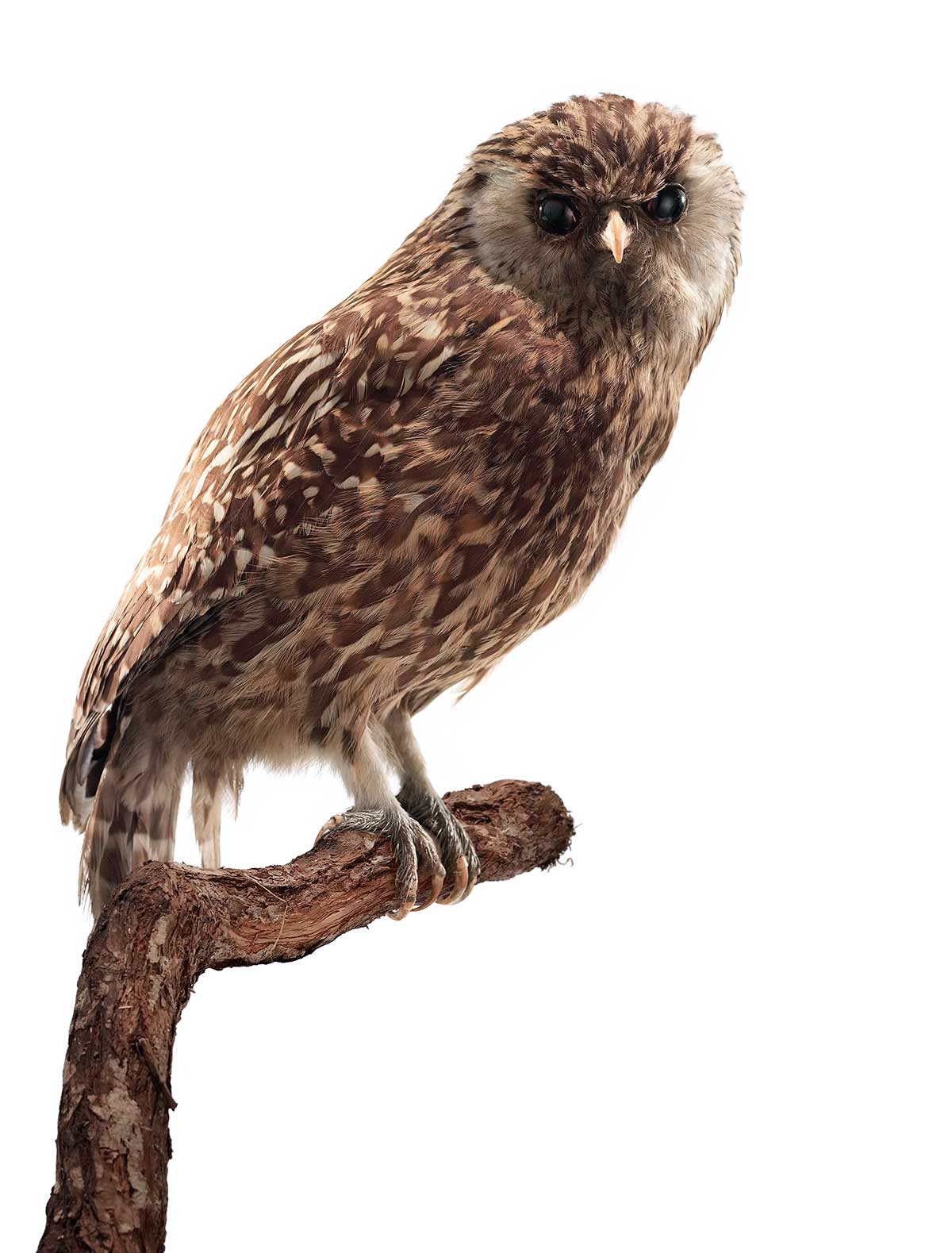
Ninox albifacies cf. albifacies, collected 1881, possibly Stewart Island, New Zealand. Exchanged from University of Amsterdam, 1963. CC BY 4.0. Te Papa (OR.010143). The laughing owl, Sceloglaux albifacies, was a native New Zealand owl, also known as whekau in the South Island and hakoke or korohengi in parts of the North Island.
The laughing owl, or whēkau, is said to have had a haunting call in the dark. People described it as shrieking.. almost crazed.
It lived on all three main islands of New Zealand and was larger than a morepork. It hunted in the dark and ate a wide range of prey, from beetles and worms to birds, bats, lizards, frogs, fish, rats and mice.
Then, sometime in the early twentieth century, the laughter stopped.
By 1903 the laughing owl was “almost extinct in Canterbury” and the last known laughing owl was found dead on a road at Blue Cliffs Station, near Timaru, in 1914. There were later reports of possible sightings and sounds, but no living laughing owl has been confirmed since. The owl’s extinction shows how quickly a native species could disappear when slow breeding, habitat loss and introduced mammalian predators combined.
That is the fact that brings this story so close... this was not just a lost bird from somewhere else. Its last confirmed record belongs here, to South Canterbury.
The whēkau did not disappear because of one neat cause. Nature rarely works in tidy lines. It disappeared through a chain of changes. Land was cleared. Habitats were altered. Farms spread. Cats, stoats, ferrets and weasels entered a world of birds that had evolved without those mammalian predators. People collected laughing owls too, for museums, curios and zoos.
That is the uncomfortable part. The bird was noticed and studied, it was event collected.. and yet somehow we lost it. Maybe people at the time didn't realise that admiration was the same as protection.
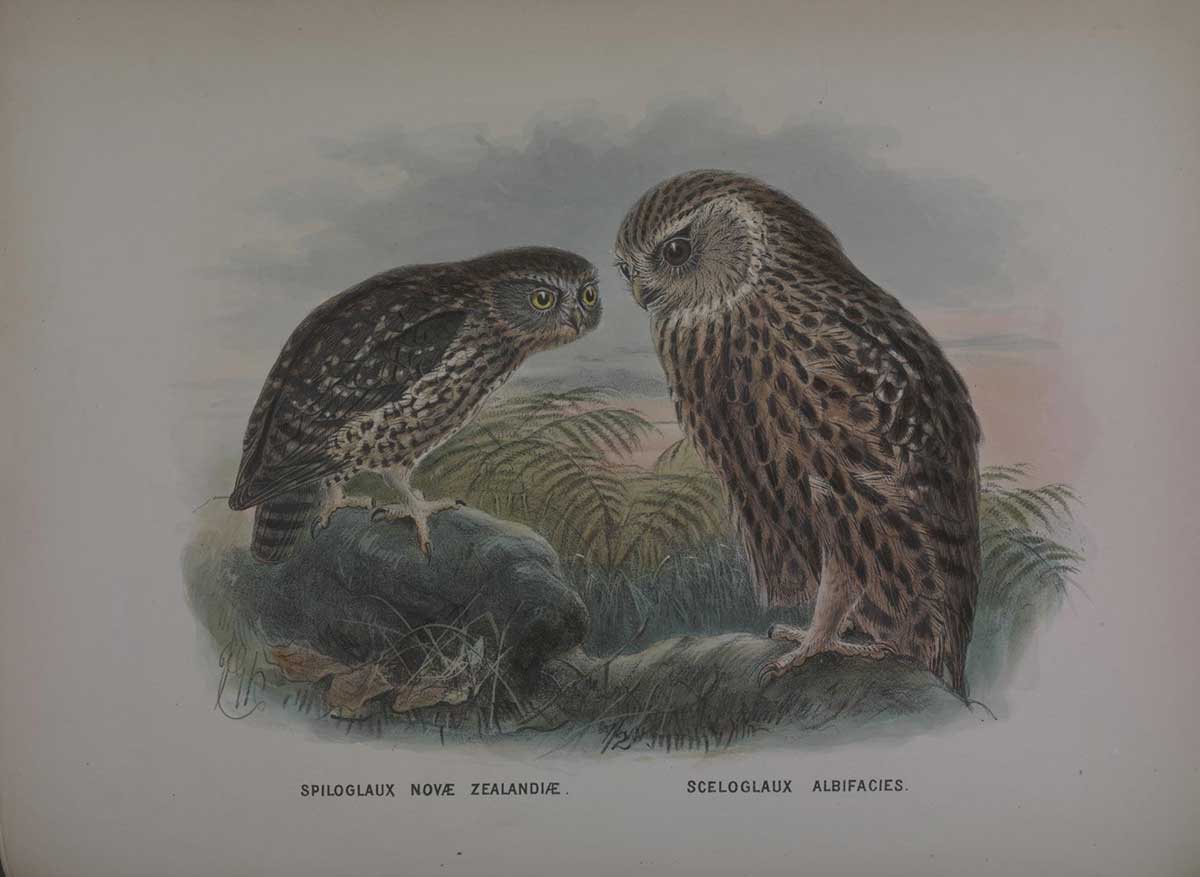
The laughing owl’s story is also a story about systems. A rabbit is introduced. Predators are introduced to control the rabbit. Those predators do not politely stick to the plan. They move through the wider landscape, finding eggs, chicks and birds that had no long history of defending themselves against such hunters.
One change leads to another, and as we all know, that is how living systems work.. they are linked together.
Strangely, the laughing owl also left us one of the richest records of that older world.
Like other owls, it swallowed prey and later cast out pellets of the parts it could not digest: bones, fur, feathers, beetle cases and other hard remains. Over time, these pellets gathered around roosts and nest sites. In dry, sheltered limestone crevices and caves, they were preserved.
Some sites were used for generations. A cave site at Takaka Hill is thought to have been used by laughing owls for around ten thousand years. Imagine that: one place, returned to again and again, while the world outside changed around it.
Those layers of owl debris have become a kind of natural archive... you would expect maybe notes or photos... but it was bones.
From these middens, scientists have identified remains of native birds, bats, lizards, frogs, fish, beetles, weevils and even tuatara. Te Papa notes that forty-three species of native bird have been found in laughing owl deposits, along with three species of bat, seven species of lizard, two indigenous frog species, fish, insects and tuatara.
After the arrival of settlers from Eastern Polynesia, kiore, or Pacific rats, began to appear in laughing owl roost deposits. The owls ate them, and their pellets show how the food web changed as new species arrived. It is important to be careful here. Kiore changed the ecosystem, but they were probably not the main cause of the laughing owl’s final decline. New Zealand Birds Online notes that kiore and laughing owls coexisted for hundreds of years in the South Island. The rapid final collapse is more strongly linked to later habitat clearance, collecting, and introduced predators such as stoats, ferrets, weasels and cats.
Later still, after European settlement, the bones of European rats and introduced birds also appear in the layers around owl roosts. The deposits become a timeline. They show what the owl ate, what species were present, and how the living world changed as people, animals and land use changed.
That is what makes the laughing owl so haunting. It is gone, but not silent. We can only find them today as stuffed museum specimens, in old photographs, scientific papers, and the small bones of prey digested in the dark.
And here in South Canterbury, it asks us to listen differently. Not only for what has vanished, but for what is still here.
The laughing owl cannot return because we finally noticed it, but its story can still change how we notice everything else.
Timeline: Laughing Owl / Whēkau
Before human arrival in Aotearoa New Zealand
The laughing owl, or whēkau, lived across Aotearoa New Zealand and was part of a bird-rich ecosystem that had evolved without land mammals such as stoats, ferrets, weasels and cats. It hunted beetles, birds, lizards, frogs, bats and other small animals. Its roosting and nesting places later preserved extraordinary evidence of what lived in earlier New Zealand landscapes.
Thousands of years before extinction
Some laughing owl roost and nest sites were used for many generations. Te Papa notes that a cave site at Takaka Hill is thought to have been used by laughing owls for around ten thousand years. These long-used sites built up layers of pellets, bones and other remains, creating natural archives of past ecosystems.
After the arrival of settlers from Eastern Polynesia
Kiore, or Pacific rats, began to appear in laughing owl roost deposits. The owls ate kiore, and the pellets show how the food web changed as new species arrived. It is safest not to present kiore as the main cause of the owl’s extinction, because New Zealand Birds Online notes that kiore and laughing owls coexisted for hundreds of years in the South Island and that kiore were unlikely to have caused the final decline.
Early 1800s
The laughing owl was still quite common in parts of the South Island. Te Ara describes it as twice the height of a morepork, about 38 centimetres from head to tail, with very long legs, nesting in bluffs and rock outcrops.
Mid-1800s
New Zealand Birds Online says laughing owls were still common in the South Island in the mid-1800s, but declined rapidly afterwards. Their call was described by one contemporary observer as a loud cry made up of repeated dismal shrieks.
1844 to 1845
The laughing owl was formally described scientifically in the nineteenth century. Older sources often use the name Sceloglaux albifacies, while recent genetic work supports placing it in Ninox as Ninox albifacies.
1867 to 1868
One of the few known North Island specimens was shot in the Wairarapa and sent to the Colonial Museum in Wellington, now Te Papa, though that specimen was later lost. This shows how rare and patchy North Island evidence had already become by the late nineteenth century.
1870s
The bird was known to naturalists and collectors. Some living laughing owls were kept or displayed, and the species became part of the nineteenth-century world of collecting, illustration and scientific description. This matters because the owl was not lost because nobody noticed it. It was noticed, studied, collected and still disappeared.
By 1880
The species was becoming rare. Te Ara says the decline was rapid from the 1880s, and New Zealand Birds Online links the final decline especially to the introduction of stoats, ferrets and weasels.
1881
William Walter Smith, gardener at Albury Park in South Canterbury, found laughing owls in crevices in the limestone cliffs. One was sitting on an egg with a well-grown chick inside. This is a key South Canterbury detail because it shows the birds were not just passing through this region, but breeding here.
Late nineteenth century
Habitat clearance, farming, introduced predators and collecting all placed pressure on the species. Te Papa names habitat clearance, stoats, ferrets, cats and human hunting for museum specimens, curio collections and zoos as major pressures.
1903
W. W. Smith wrote that the laughing owl was almost extinct in Canterbury. New Zealand Geographic records his search around Albury on the Tengawai River, where he found old castings but no fresh sign, while local residents rarely heard the owl’s call by then.
1909
A young laughing owl was photographed at its nest beneath a limestone boulder at Raincliff Station, near the Opihi River in South Canterbury, by Cuthbert and Oliver Parr. This image is one of the most important surviving glimpses of the species in life.
1914
The last known bird was found dead on a road at Blue Cliffs Station, near Timaru. New Zealand Birds Online calls this the last confirmed record, and Te Papa describes it as the last known bird.
After 1914
People continued to report possible sightings and sounds. New Zealand Birds Online says sight and sound records continued from both islands into the 1930s, but no living laughing owl has been confirmed since the 1914 South Canterbury record.
By the early to mid twentieth century
The laughing owl was accepted as extinct. National Library describes whēkau as one of many native birds that became extinct through habitat loss, introduced predators such as stoats, and overseas trade by bird collectors.
1996
Richard Holdaway and Trevor Worthy published work on laughing owl diet and biology using fossil deposits from Takaka Hill. Their research helped show how owl pellet deposits can reveal earlier small-vertebrate communities in New Zealand.
2016
Ancient DNA research gave strong support for the old genus Sceloglaux being nested within Ninox. This means the laughing owl is now often referred to as Ninox albifacies, although many historical and museum sources still use Sceloglaux albifacies.
Today
The laughing owl is extinct, but it is not silent in the historical and scientific record. Its specimens, photographs, roost sites, pellets and bones continue to teach us about lost ecosystems, extinction, introduced predators, collecting, and the importance of noticing what is still here before it disappears.
Source list with links
Te Papa: The laughing owl’s extinction
Used for: last known bird at Blue Cliffs Station near Timaru in 1914; extinction causes; habitat clearance; stoats, ferrets and cats; human collecting; pellet deposits; Takaka Hill; middens and prehistoric fauna.
https://collections.tepapa.govt.nz/topic/1450
New Zealand Birds Online: Laughing owl / Whēkau
Used for: species description; size; colour; call descriptions; habitat; diet; breeding; decline; last confirmed South Canterbury record; post-1914 reports; kiore caution; taxonomy references.
https://www.nzbirdsonline.org.nz/species/laughing-owl
New Zealand Geographic: Laughter in the night
Used for: South Canterbury detail; Raincliff; Albury; W. W. Smith; Opihi River; Blue Cliffs Station; later rumours; the importance of South Canterbury in the final records of the species.
https://www.nzgeo.com/stories/laughter-in-the-night/
Te Ara: Laughing owl
Used for: public-facing summary; size, long legs, bluffs and rock outcrops, calls, prey, early South Island abundance and later informal reports.
https://teara.govt.nz/en/photograph/9956/laughing-owl
Wingspan: Extinct Birds of Prey, New Zealand Laughing Owl
Used for: 1909 Raincliff Station photograph of a young laughing owl at its nest beneath a limestone boulder; conservation reflection.
https://www.wingspan.co.nz/extinct_birds_of_prey_new_zealand_laughing_owl.html
Te Papa Blog: Laughing owl, long gone but not forgotten
Used for: public-domain/no-known-copyright-restrictions photograph reference; young bird with rodent at Raincliff Station, Opihi River, South Canterbury, 1909.
https://blog.tepapa.govt.nz/2015/11/28/laughing-owl-long-gone-but-not-forgotten/
National Library of New Zealand: Last of the laughing owls
Used for: educational framing; extinction through habitat loss, introduced predators such as stoats, and overseas trade by bird collectors.
https://natlib.govt.nz/teaching-and-learning-resources/te-kupenga-stories-of-aotearoa-nz/last-of-the-laughing-owls
Holdaway and Worthy, 1996: Diet and biology of the laughing owl Sceloglaux albifacies on Takaka Hill, Nelson, New Zealand
Used for: scientific basis for diet, fossil deposits, pellet evidence and laughing owl prey accumulation.
https://researchnow.flinders.edu.au/en/publications/diet-and-biology-of-the-laughing-owl-sceloglaux-albifacies-aves-s/
Worthy and Holdaway, 1996: Taphonomy of two Holocene microvertebrate deposits, Takaka Hill, Nelson, New Zealand, and identification of the avian predator responsible
Used for: microvertebrate deposits formed from owl pellets; identification of laughing owl as the likely predator responsible for the deposits.
https://researchnow.flinders.edu.au/en/publications/taphonomy-of-two-holocene-microvertebrate-deposits-takaka-hill-ne/
Wood et al., 2016: Phylogenetic relationships and terrestrial adaptations of the extinct laughing owl, Sceloglaux albifacies
Used for: modern taxonomy; ancient DNA; strong support for Sceloglaux being nested within Ninox; relationship to morepork and other boobook owls.
https://www.researchgate.net/publication/306071727_Phylogenetic_relationships_and_terrestrial_adaptations_of_the_extinct_laughing_owl_Sceloglaux_albifacies_Aves_Strigidae