
By Roselyn Fauth
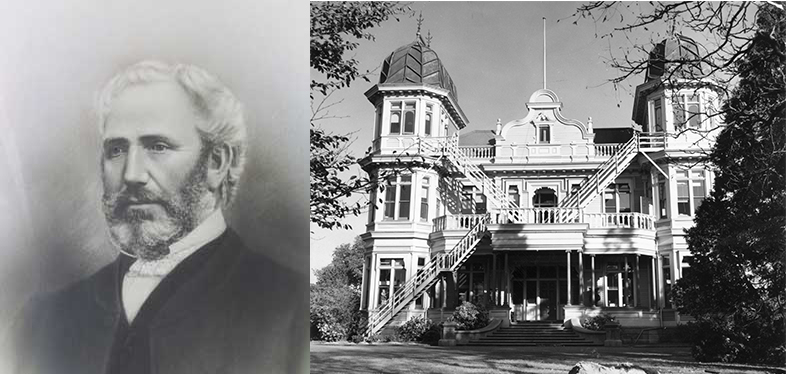
Allan McLean born 24 May 1822 Coll Island, Argyll and Bute, Scotland and later lived at Waikakahi, near Waimate, never married and had is said to not have children. He left his fortune to establish the McLean Institute for women. Christchurch locals know this as McLean’s Mansion. - Wikepedia. Allan gifted some of his wealth to his housekeeper Emily Phillips and she built Te Kiteroa Lodge in Waimate. Sadly this property burnt down in May 2021. At the time of writing this blog, a new Te KIteroa Ecolodge was emerging on the site. Alan died 12 Nov 1907 (aged 85) and rests in the Addington, Christchurch cemetery.
I was on a history hunt and stumbled across a fascinating newspaper article in the Aoraki Recollect collection. I gave myself a little leeway to read it properly — and I am so pleased I did... What a remarkable man Allan McLean was! This blog is inspired by the reporter William Vance, writing in The Timaru Herald on 6 April 1954. His storytelling opened a door, and once I stepped through it, I found myself travelling from the Hebrides to Waimate, from fencing wire to Jacobean towers.
From the Hebrides to South Canterbury
Allan McLean was born in 1820 on the Isle of Coll in the Scottish Hebrides. The MacLeans were an old Highland clan, remembered in tradition for fierce loyalty — including the cry “Another for Hector” at the Battle of Inverkeithing in 1651. But by Allan’s childhood, the clan world had been reshaped.
After the failed Jacobite rising of 1745, Highland authority weakened. Then came the Highland Clearances. Tenant families were forced from their land to make way for large-scale sheep farming. Homes were burned. Communities were scattered. Even their traditional tartan was banned by the English, and the highlanders for decades. When the English royals wanted to pull the Kingdowm together, they used the tartan cloth to unite. This helped bring a rebirth of identity and the tartan, once simply practical cloth, became a powerful expression of belonging after territory had gone. The tartan was a revival of older traditions.
Allan grew up in a culture shaped by dispossession, where land no longer meant tradition. For allan it could have meant security — or the lack of it.
Allan was one of nine children, his father was a fisherman and they also made their living on a farm. His father Alexander drowned and his mother emmigrated with her five children to Victoria in Australia.
As a young man, Allan and his brothers John and Robertson went to the Australia with their monther and siblings.
With his two brothers, Allan went to work as shepherds and managed to grow their wealth to be able to buy two sheep runs together around 1848. They then moved to Bendago making a living as merchants and gold buyers.
They saw wealth appear quickly, they witnessed it disappear just as quick. A Chinese man named Tan Suey once warned them of danger at the diggings. Allan later cared for him in New Zealand, a loyalty remembered long after the gold rush faded.
Land was seen as a way to hold onto financial security and so by the early 1850s, the McLeans arrived in Lyttleton in Canterbury, where they turned back to farming and built large pastoral holdings including Lagmhor near Ashburton and Morven Hills in North Otago. The rest of the family joined them and they later moved to Ashburton in 1854. Robertson returned to Scotland and lived there. He died in 1871.
The brothers moved to Otago and held the largest run in the country at the time. It was 500,000 hectares.
In 1880 the brothers formally divided their partnership and Allan retained Waikakahi, 47,836 acres between the Waihao and Waitaki Rivers.
He had paid £1 per acre for freehold land. Freehold mattered deeply to someone shaped by eviction. He built around 400 miles of fencing. Each fence used nine strands of heavy wire. Permanent fencing gangs worked year round. Boundary keepers lived in distant parts before fencing was complete.
I dont think this would have been romantic farming. It sounds like hard graft! At its height:
- 50,000 sheep were shorn annually
- 24 shearers worked the board — 12 Māori and 12 Pākehā
- Swaggers were fed and housed
- Long-serving shepherds were later offered farms
Wool from Waikakahi like many of this huge runs, flowed through North Otago and South Canterbury’s economy. Timaru grew as the port that shipped inland produce exchange to the world.
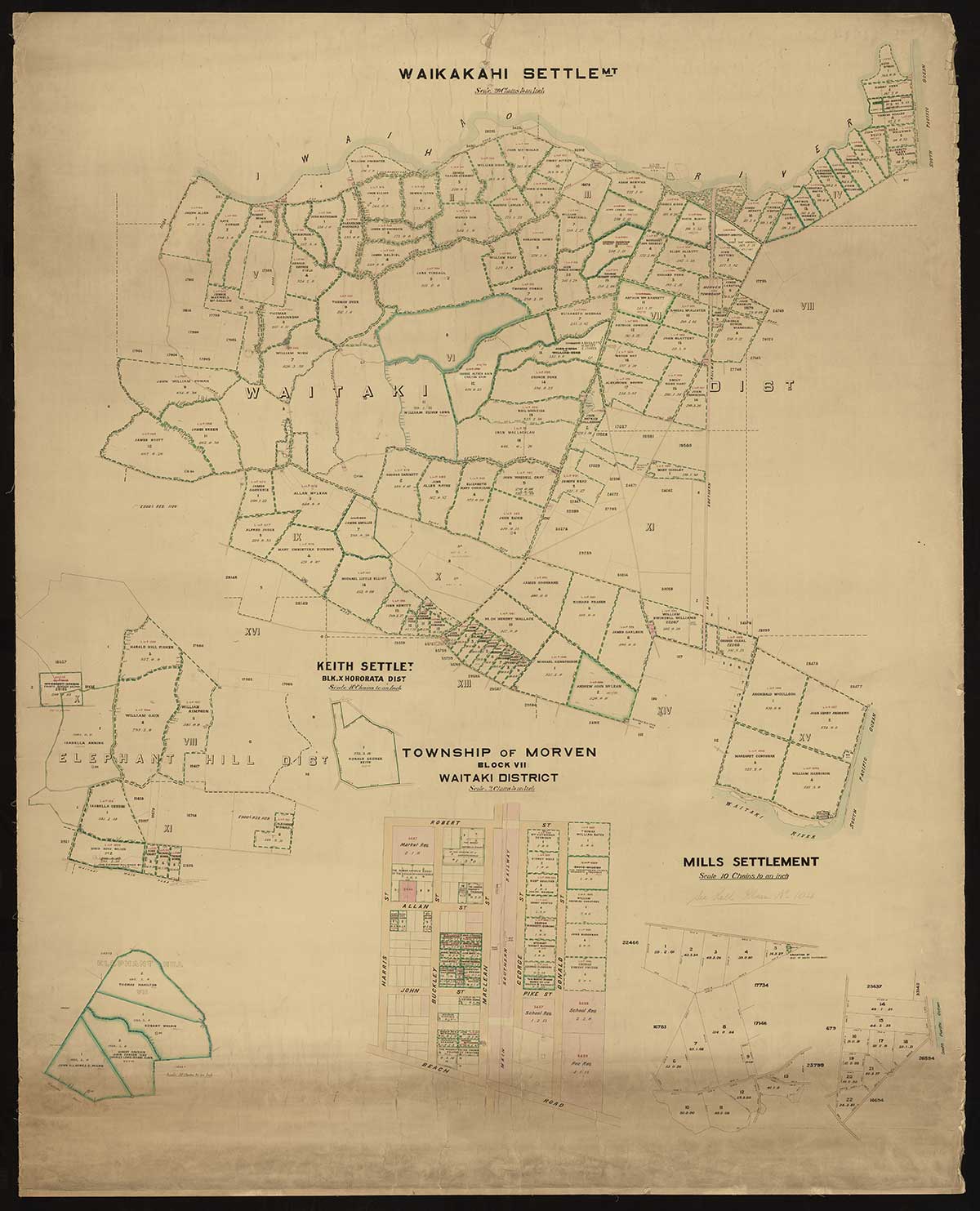
Crown Grant Plan showing acquired land at Waikakahi, Keith, Mills Settlements, Elephant Hill and the Township of Morven, c.1880. The plan includes detailed scale notations for each block, including Waikakahi Settlement at 20 chains to an inch and the Township of Morven, Block VII, Waitaki District at 2 chains to an inch. Map 108. Original approximately 1.77 x 1.42 metres.
Archives New Zealand Te Rua Mahara o te Kāwanatanga, Christchurch Regional Office. Archway Record Code R22668464. Crown Grant Plan Acquired Land – Waikakahi, Keith, Mills Settlements, Elephant Hill, Town of Morven, c.1880. NZMS Batch, October 2019.
The paddocks and the harbour were connected.
At Waikakahi Allan built The Valley homestead. Twenty acres of gardens. Nine gardeners. Imported trees. A willow-edged lake. Orchards heavy with apples, apricots, plums, pears and peaches. A conservatory filled with oranges, lemons and grapes. A bathhouse. Peacocks roaming the lawns. Five servants ran the household under Mrs Phillips, his long-serving housekeeper, who also sewed garments for poorer families.
It was gracious and carefully managed. But Allan never married. From what I can find, there was no heir waiting to inherit the estate he had worked so hard to secure.
By the 1870s there were growing calls to break up large estates. this must have been a tough blow when the Government forced the large run holders to break their properties into smaller lots. By 1882, 32 percent of runs over 10,000 acres were held by less than one percent of owners. In 1891 the Liberal Government came to power promising closer settlement. John McKenzie, Minister of Lands, pressed large holders to sell. Waikakahi became the first property sold to the Crown under the Public Lands Act.
In 1899:
• The Government paid £326,616
• With stock sales Allan received about £400,000
• The estate was divided into 164 farms, 14 grazing runs and 126 lease-in-perpetuity sections
The stock sale lasted three days.
The fences remained. The ownership changed. Allan left Waimate before the final dispersal and never returned.
From Fencing Wire to Jacobean Towers
With the proceeds of Waikakahi, Allan built Holly Lea at 387 Manchester Street, Christchurch. Designed by architect Robert William England in the Jacobean-Victorian style, the mansion:
• Was constructed of kauri timber
• Contained 53 rooms
• Was the largest timber house in Christchurch, some say in New Zealand.
• Took inspiration from Mentmore Towers in England
Two three-storey towers flank the entrance. Inside, a vast central hall rises beneath a massive skylight, surrounded by an arcaded gallery. It is dramatic and confident.
Timaru has its own Jacobean echoes — Taiganfale and Elloughton Grange — buildings that similarly expressed permanence and aspiration in colonial Canterbury. For a man whose childhood had been shaped by land insecurity, this architectural language of solidity feels deeply symbolic.
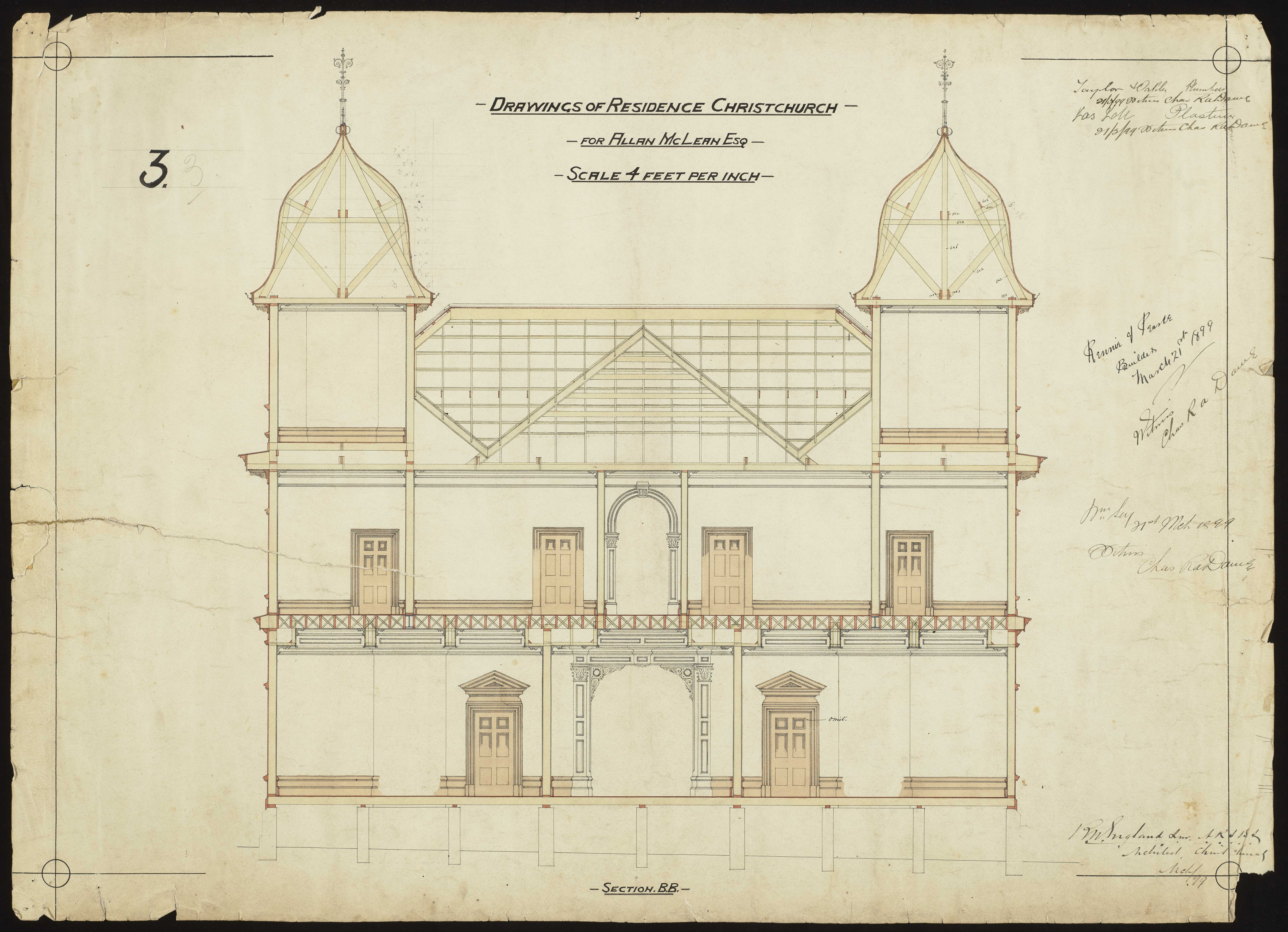
HOLLY LEA MCLEANS MANSION - Original drawings of residence for Allan McLean 2 sets - 1 original water-colour, 1 drafting paper -Section B:B - New Zealand Archives
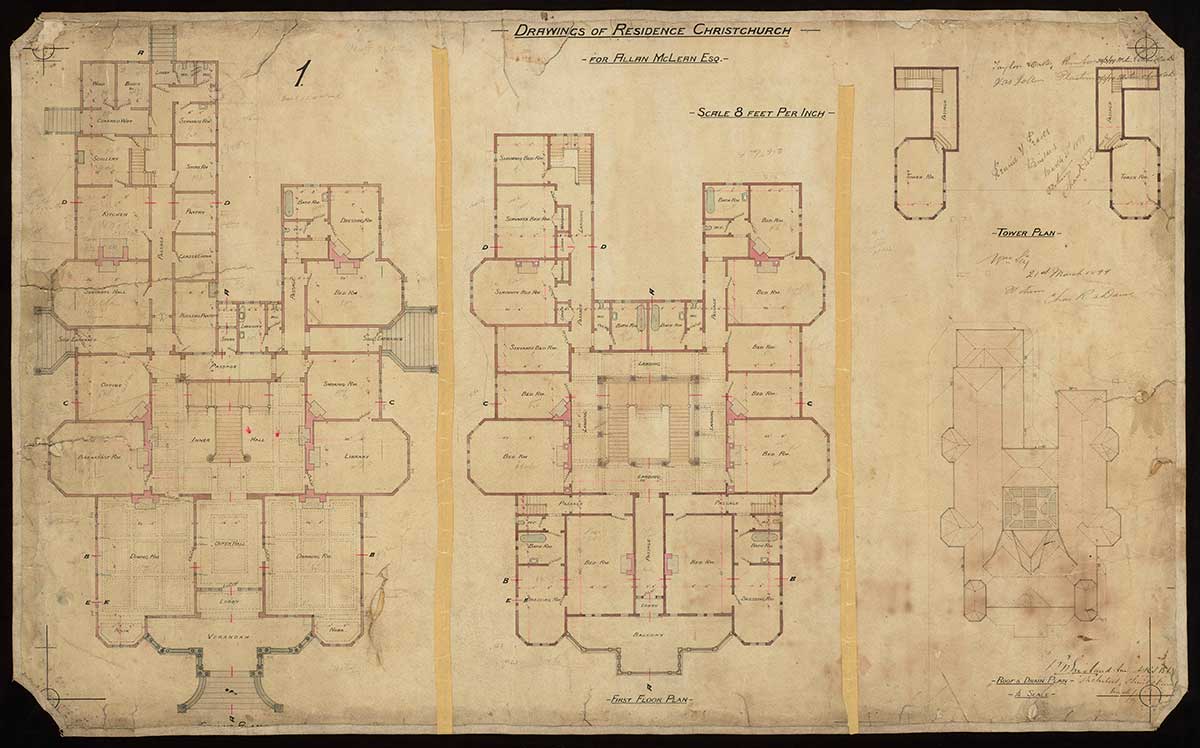
HOLLY LEA MCLEANS MANSION - Original drawings of residence for Allan McLean 2 sets - 1 original water-colour, 1 drafting paper -Ground floor, first floor, roof and drain plans New Zealand Archives https://ndhadeliver.natlib.govt.nz/delivery/DeliveryManagerServlet?dps_pid=IE50052289
The Gift No One Probably Expected
When Allan McLean died at Holly Lea in 1907, he was buried in the family plot in Addington Christchurch. His will revealed something remarkable... He established a trust to provide a “home for women of education and refinement in reduced or straitened circumstances.” He endowed it with £300,000.
In the 19th century, land meant power and protection. Most women did not own land. Married women’s property was often controlled by husbands. Unmarried daughters relied on male relatives. Widows depended on prior settlements. During the depression of the 1880s, when estates shrank and fortunes faltered, women’s security could disappear quickly.
Allan had seen land taken in Scotland. He had seen wealth contract in South Canterbury. Instead of rebuilding another estate, he converted private land wealth into shared security. Not another fence. But protection.
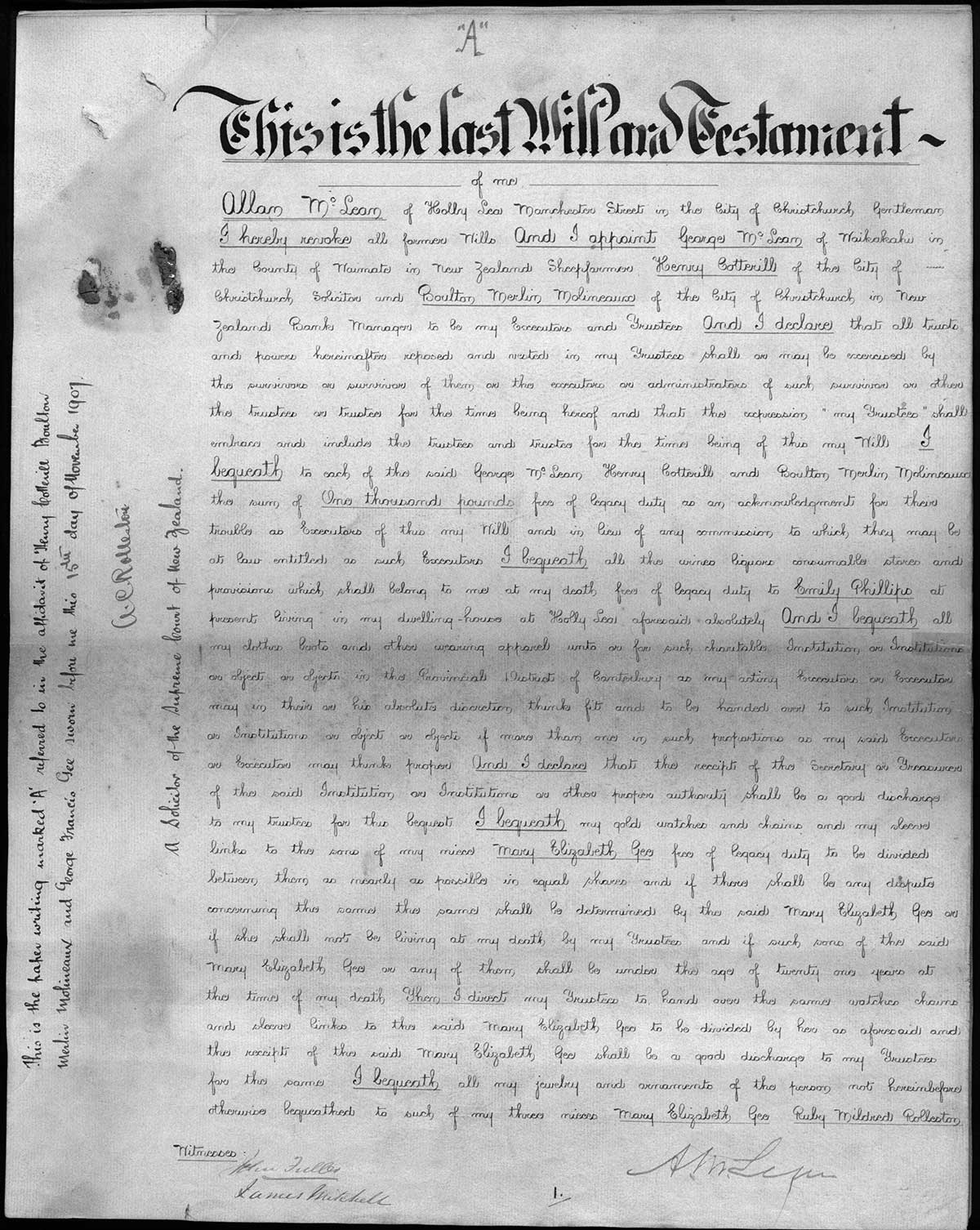
One of the 248 pages of William McLeans' Last Wills and testament documents. McLEAN Allan - Christchurch - Esquire. New Zealand Archives R22390558 https://ndhadeliver.natlib.govt.nz/delivery/DeliveryManagerServlet?dps_pid=IE70697082 George McLean of Waikakahu, County of Waimate, Sheepfarmer was one of his executors. The will establishes detailed multi-generational trusts, providing income for life beneficiaries and capital distribution to children upon reaching adulthood, with reversion to the residue if no qualifying heirs survive.
The estate is very substantial (over £200,000 specifically mentioned, which would have been an enormous fortune at the time). The primary beneficiaries included his nieces. Such as all wines, liquors, consumable stores and provisions at his dwelling house at Holly Lea are left to: Emily Phillips. To His Nieces: Mary Elizabeth Gee, £100,000 Plus watches and chains and sleeve links (to be divided among her and others as described). Ruby Mildred Rolleston £50,000 held in trust Income payable to her for life After her death, income from £50,000 to her husband: Cecil Rolleston. Capital and income to benefit her children (details governed by trustees) Fannie Hay £50,000. William Frederick McLean Buckley and Georgina Rose Buckley. were also named as recipients.
Allan McLean directs payments to his female domestic servants at Holly Lea at the time of his death, scaled according to length of service, and leaves £100 to Frederick Collins if he is in his service at death. He establishes a trust of £5,000 (income to Mary Alexandra Henderson, wife of Thomas Morrow of Christchurch, for her separate use for life, then to her children subject to age conditions). He also creates a £1,000 trust for the daughters of Edward Richardson the Younger of Christchurch by his late wife Charlotte Elizabeth Morrow Richardson, payable when they reach 21 or marry. There are detailed provisions for the daughters of Edward Richardson the Elder of Wellington and his wife Frances Mary Elizabeth Richardson, including appointment powers and age conditions.
Allan gifted some of his wealth to his housekeeper Emily Phillips and she built Te Kiteroa Lodge in Waimate. whe she was 76 in 1913. Sadly this property burnt down in May 2021. At the time of writing this blog, a new Te KIteroa Ecolodge was emerging on the site. Emily was born in London and married James Philips, for what ever reason, Emikly became Allan's housekeeper. The Te Kiteroa website says that at the time of Alan's death, he was one of the world's wealthiest men. The website says from 1945-1978, Te Kiteroa was owned by the Women's Division of Federated Farmers, providing a place fo refuge for farmers wives and operating as a 'relief housekeeper' scheme. I had visited the lodge before it burned down, it was really lovely, and had a wonderful feeling.
A Mansion That Nearly Disappeared
McLean’s Mansion later served as a dental nurse training hostel and vocational training centre. After damage in the 2011 Canterbury earthquakes, it was once marked for demolition.
A public campaign saved it. In 2018 the McLean’s Mansion Charitable Trust acquired the building and undertook major seismic strengthening and restoration.
Today it stands restored, ready for its next chapter, it had been on the market for a time, but an article in the Press in February 2026 exlained the plans for the next chapter of McLean’s Mansion.
The new owner is Auckland developer Citadel Capital who purchased the landmark for $6.25 million. Their plans are to see the grand 53-room Jacobean timber house to build onto the eight years of rescue work by the McLean’s Mansion Charitable Trust., which spent millions on seismic strengthening and structural restoration. They could not complete the project. So, the mansion now moves into a phase of “sensitive adaptive re-use”. The new owners have signalled intentions to integrate arts, culture and hospitality, while respecting the building’s architectural and historical significance. Once built in 1899–1900 for Allan McLean and later used as a residence, school and training centre, the earthquake-damaged mansion has already been saved from demolition. Its future now hinges on how this next vision balances heritage protection with sustainable public use, as Christchurch watches to see how one of the country’s most extraordinary timber buildings will be reimagined.
From Coll to Waimate to Christchurch
Allan McLean’s life traces a long arc:
Highland clan
Dispossession
Emigration
Colonial accumulation
Government redistribution
Philanthropic endowment
South Canterbury built his wealth. Waimate holds his grave. Christchurch holds his 53-room mansion.
He began life shaped by land being taken.
He spent decades securing land.
And he ended by securing people.
A local Waimate lad did that.
And I am very glad I paused long enough in the archives to discover it.
Side Quest: What Did His Legacy Actually Do for Women?
When Allan McLean left Holly Lea and £300,000 to create a home for women “in reduced or straitened circumstances,” he was not simply making a charitable gesture. He was building infrastructure. In 1907, most women’s long-term security depended on marriage, family inheritance, or modest paid work. If a woman remained unmarried, or was widowed without adequate income, her options could be limited and precarious. The McLean Institute offered something rare for its time — safe, respectable housing that did not depend on a husband.
The wording of his will is telling. He intended the home for women “of education and refinement” whose finances had declined. These were not women without capability. They were women without capital. Without support, many might have been forced into boarding houses, reluctant dependence on relatives, or quiet social isolation. The Institute allowed them to retain dignity and stability at a time when economic security flowed largely through male land ownership.
The £300,000 endowment was crucial. It meant the Institute had income from invested funds and did not rely solely on donations. McLean understood capital. He had built his fortune through land. In the end, he converted that private pastoral wealth into long-term institutional protection. Before the modern welfare state emerged, this kind of structured philanthropy filled real gaps. It reduced vulnerability for older women who had few avenues for rebuilding income later in life.
In a society where land equalled power — and power was overwhelmingly male — Allan McLean created security for women outside that structure. He began life shaped by land being taken. He ended it ensuring that some women would never be displaced again.
Side Quest: What About His Brothers?
Allan McLean did not build his pastoral wealth alone. He worked in partnership with his brothers, John and Robertson McLean. Together they established large sheep stations across Canterbury and North Otago, including Lagmhor near Ashburton, Morven Hills in North Otago, and Waikakahi in South Canterbury.
Robertson who died in Edinburgh as the young age of 45 also in 1871.
Robertson left the partnership earlier, and in 1880 John and Allan formally divided their holdings. Allan retained Waikakahi. John took Lagmhor and Waitaki. The McLean footprint across the South Island was significant, and their combined influence shaped pastoral settlement in the region.
But their legacies diverged.
John married and had children. (although some say he did have a daughter but I can't find any records to cite. I was told that The Trust looked after his daughter and her mother at Holly Lea). His wealth passed down through family lines in the traditional way. Allan did not marry. He had no children and no direct heirs. Instead of creating a dynasty, he created a trust.
All three brothers were shaped by Highland dispossession. All three rebuilt wealth through land. But only Allan converted that wealth into structured protection for women outside his family.
The McLeans’ grave at Addington Cemetery is where many of the family rest, including Allan's mother Mary, who died at ‘Waimakariri’ in 1871. The daughters, Mary and Alexandrina both died in Christchurch in 1875 and 1902.
John died at Redcastle in Oamuru in 1902.
One brother called Robertson went back home and died young.
One brother secured land for descendants.
The other secured dignity for women without land.
And that difference is what makes Allan’s story stand out.
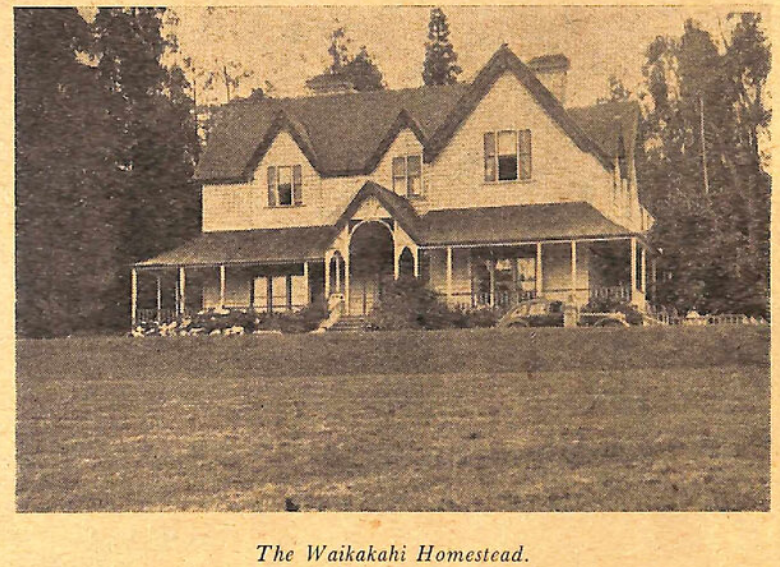
Waikākahi homestead
Side Quest: The Valley — His Garden of Eden
Waikakahi was not just fences and sheep, it was Allan's home. At its heart stood The Valley, McLean’s homestead, described by visitors as “the Garden of Eden.” Set among trees and surrounded by acres of garden, it was considered one of the show places of its day. McLean employed upwards of seven gardeners and about the same number of domestic staff. Even by the 1950s, writers noted that although the house still stood, it had been “shorn of much of the glory of other years.”
Life moved constantly across the estate. Along its roads were shepherds’ cottages and outstations such as Merino Downs. You might pass gangs of men fencing, dogs chained along the boundaries, or wagons travelling the five miles to and from Glenavy — two men aboard, one simply to open gates.
The story about the swaggers I think is the most interesting thing about the home. The station cookhouse became their home. Dining and sleeping quarters were specially designed for them, and the cook, “Skinny” Andrews, was instructed to give them the best. As many as 52 swaggers were known to stay at once, remaining as long as they liked.
The Valley was not merely ornamental. It was hospitable — a working estate and a place of shelter. That instinct would reappear later, in a very different form.
Sources
William Vance, The Golden Days of Waikakahi: Before The Estate Was Subdivided (06 Apr 1954). Aoraki Heritage Collection, https://aorakiheritage.recollect.co.nz/nodes/view/3823
Martin Leonard, Colourful Days at Waikakahi. Aoraki Heritage Collection, https://aorakiheritage.recollect.co.nz/nodes/view/3840