
By Roselyn Fauth
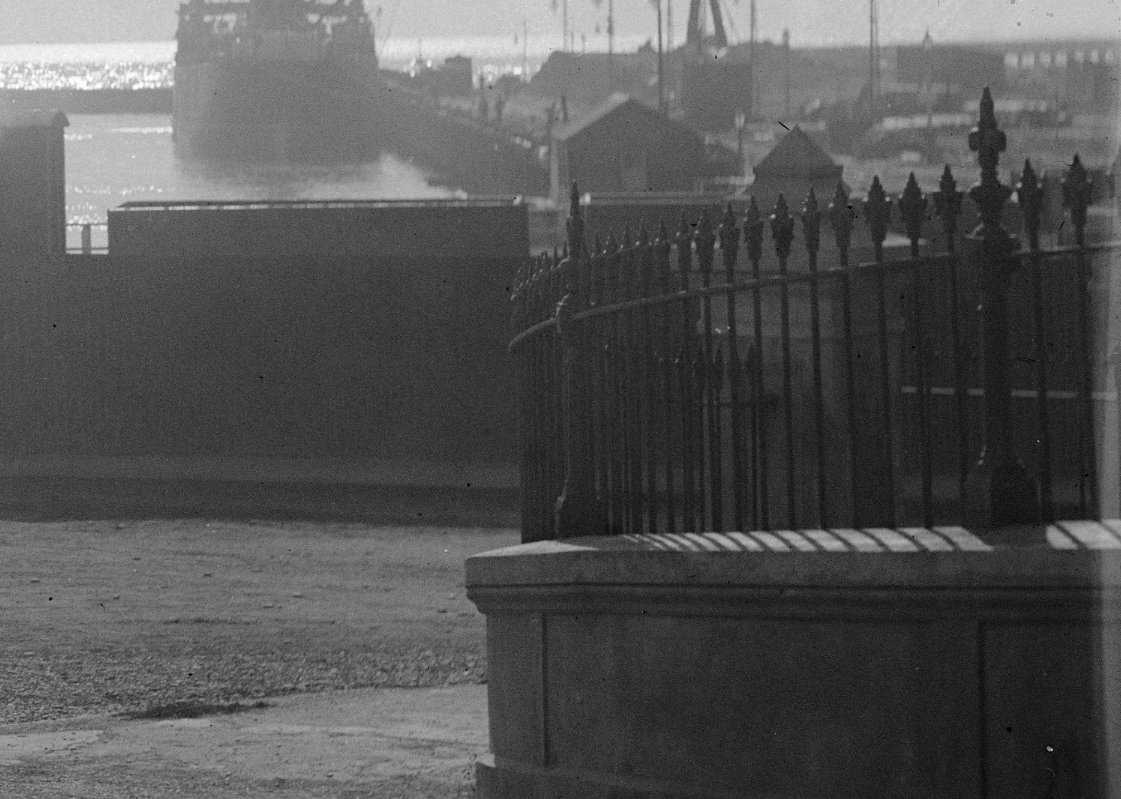
[Timaru], New Zealand, by Muir & Moodie. Te Papa (C.014801) Customshouse
The maker’s mark on the Timaru Customhouse fence turns a grand government building into a local workmanship story, linking the polished world of customs and commerce with the foundrymen of King and Edward Streets.
Look closely at the iron fence around Timaru’s old Customhouse and there is a small clue to a local founry. It's not the massive fluted columns. Not the lettering above the entrance, “HM Customs 1902”. Or even the elegant sweep of the rounded corner at Strathallan Street. The clue is a little humbler than that... It is a maker’s mark in the metal of the fence, a practical stamp that says, “we made this”.
That mark leads us to J. Storrier and Co., one of Timaru’s great working firms. The Customhouse itself was built in 1901 to 1902, designed by local carpenter turned architect Daniel West and built by Thomas Pringle, with plasterwork by Emil Hall. It was a confident little government building, placed where it could keep watch between the port, the railway station and the town. Customs mattered. Goods, duties, shipping and paperwork all passed through this part of Timaru.
The fence reminds us that important buildings are not only the work of architects and officials. They are also the work of local hands. Storriers began as blacksmiths, engineers, brass founders and iron founders. In 1887, when the firm was still known as Sturrock and Storrier’s Foundry, a Timaru Herald reporter watched molten iron run from the furnace “as freely as if it were water”. The job that day was no trinket. They were casting heavy sections of an intake pipe for the Timaru waterworks dam.
That is the world the maker’s mark opens up. Sand and loam floors. Pig iron and coke. Forges, lathes, moulders, pattern makers, wheelwrights, blacksmiths and engineers. A later notice placed J. Storrier and Co. at the corner of King and Edward Streets, with a new smithy, coach building and wheelwright department. By the twentieth century the firm was making farm implements, Hustler cultivators, Hedgehog gorse cutters, rollers, pipes, fittings and structural steel.
The Customhouse fence belongs beautifully in that story. It is not just a boundary. It is a meeting point between civic authority and local industry. On one side was the polished face of government, dressed in Neoclassical style to suggest order, trust and permanence. Around it was ironwork from a town that knew how to make, mend and adapt.
There is still more to check. Was this fence made for the original 1902 building, or was part of it added or repaired later? The mark itself deserves a careful photograph, measurement and comparison with other known Storrier work. Good heritage stories should leave room for evidence.
Even so, that small mark is enough to change the way we look. The Customhouse is not only a fine old building beside the former shoreline. It is also a record of Timaru’s makers. Next time you pass, pause at the fence. The grand columns speak of empire and customs, but the iron whispers something local: this town was built by people who could cast, forge, fit and finish.
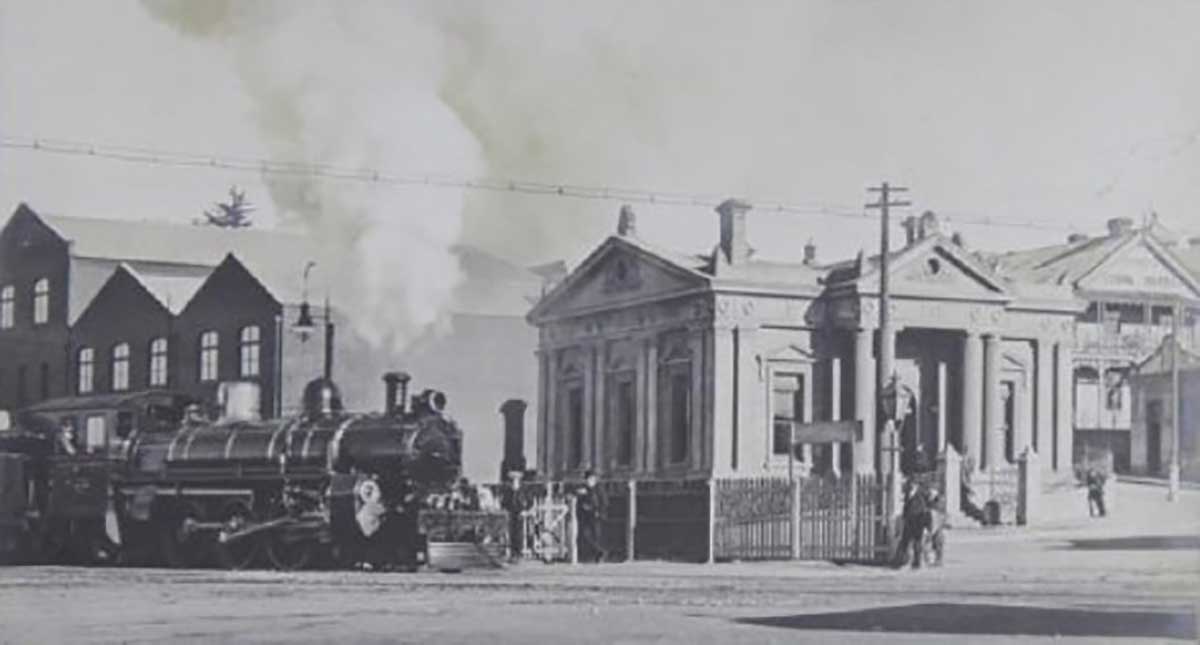
Railway locomotive next to the Customhouse at Timaru p13 1910-1920 South Canterbury Museum 3873
Detailed timeline
Customhouse and customs context
1861
Timaru was operating as a legal port of entry, with customs work tied to shipping and trade. Later Customhouse summaries note that before the purpose-built Customhouse, customs staff used temporary premises around the town, including the Post Office, a hut near the breakwater, and an office in Beswick Street.
1880
The Collector of Customs was accommodated in Timaru’s Post Office from 1880, before the later purpose-built Customhouse replaced these temporary arrangements.
1901 to 1902
The former Customhouse at 2 Strathallan Street was built. The Timaru District Council heritage record gives the date of construction as 1901-2, with Daniel West as architect and Thomas Pringle as builder.
August 1902
The new Customhouse opened. It occupied a rounded corner site at the intersection of Strathallan Street, Station Street and Cains Terrace, close to both the port and the railway station.
1902 physical form
The building was designed in Neoclassical style, with a square footprint, gabled roof hidden behind a parapet, fluted Doric columns, an arched entrance, pediments, paired pilasters, sash windows, decorative frieze work and the lettering “HM Customs 1902” above the entrance. It was constructed in brick, cement plaster and corrugated iron roofing.
1902 craftsmanship
The Timaru District Council heritage record notes the building’s high technological and craftsmanship significance, particularly its brick construction and classical detailing. It also records that Emil Hall undertook the concrete foundations and plasterwork.
1976
The government relinquished the Customhouse and it was converted to commercial use.
1985 onwards
Post-1985 hard landscaping and planting altered the northern boundary area. The Timaru District Council record also notes that the chimneys were removed and a flagpole added, date unknown.
2018
The Timaru Civic Trust purchased the Customhouse. It continues to function as a restaurant.
Present observation
A maker’s mark on the Customhouse fence appears to connect the ironwork to J. Storrier and Co. This is a strong local-history lead, but the exact date of the fence or marked component should be checked against early photographs, physical inspection and any property records.

Timaru circa 1904 Dunedin by Muir and Moodie Te Papa C014423 - section of photo
J. Storrier and Co., Sturrock and Storrier, and the foundry story
1875, later recollection and heritage summary
Several later sources state that the firm was established in 1875 by John Storrier. The Aoraki Heritage Collection summarises J. Storrier and Co. Ltd as an engineering firm established by John Storrier in 1875, operating on the same King Street site until it closed in 1971.
About 1886, later recollection
The 1977 Glimpse of the past clipping gives a different version, saying the actual beginning was “somewhat clouded” but believed to be about 1886, by John Storrier, whose family had emigrated from Scotland and lived at Otipua for a time. This conflicts with the 1875 date and should be treated as a recollection rather than a firm establishment date.
7 July 1887
A Timaru Herald advertisement for D. Sturrock, Wallace Implement Works, at the corner of Edward Street and Main South Road, described him as an engineer, millwright, blacksmith and wheelwright, making and repairing agricultural and milling machinery, supplying iron and brass castings, and making ornamental gates and railings to order.
13 October 1887
The Timaru Herald published “Local Industries: Sturrock and Storrier’s Foundry”. The article described the foundry as “recently established”, located at the junction of Main South Road and Edward Street, near the Garrison drill-shed. It described the blacksmith’s, engineer’s and millwright’s shops, the foundry, the cupola, the use of Saltwater Creek sand and loam, and a major casting job for the Timaru waterworks dam.
1887, waterworks casting
The same article recorded that Sturrock and Storrier cast sections of a huge intake pipe to replace one washed away at the Timaru waterworks dam. Each section was described as 11 cwt, 4 feet long, 2 feet wide and 18 inches deep. This is an early example of the firm’s civic infrastructure work.
19 December 1887
A Timaru Herald advertisement listed Timaru Foundry, late Wallace Implement Works, Sturrock and Storrier, as agricultural engineers, blacksmiths, iron and brass founders, making and repairing agricultural and milling machinery, supplying iron and brass castings, and specialising in ornamental iron work.
1897, June
J. Storrier and Co. announced that they had acquired the South End Implement Works, formerly carried on by J. W. Blackwood, and would combine it with their own business under J. Storrier and Co., XL Foundry and Implement Works. The same notice brought W. J. Palmer, blacksmith, and Mark Higgin, wheelwright, into the partnership.
1897, July and August
Later advertisements promoted the XL Foundry and Implement Works, including XL cooking ranges, XL field rollers and the XL patent plough wheel. These ads show the firm’s branding and its mix of foundry, household, farming and implement work.
Late nineteenth century to early twentieth century
Later accounts say James Storrier, John’s brother, took over or continued the business. One source says he bought a half share near the end of the nineteenth century or shortly after the turn of the century, then took full control after John’s death. Another says John moved to Ashburton and James continued the business. These are recollections and need careful reconciliation.
2 November 1910
A Timaru Herald notice announced that J. Storrier and Co.’s blacksmith’s business had moved to the foundry at the corner of King and Edward Streets, where a new smithy had been built. A coach building and wheelwright department was added under Mr J. Miller, while Mr A. Irvine remained in charge of the blacksmith’s department.
About 1910 or 1918, H. J. Brewer joins
The sources conflict on Harry Brewer’s entry into the firm. The 1977 clipping says about 1910 he sold his Ashburton grocery business and moved to Timaru to become a working partner. The 1971 article, drawing on Brewer’s own recollection, says he started as an apprentice in 1918 and became manager from 1940 to 1961. The 1918 date is probably stronger because it is linked to Brewer’s own memory, but both should be noted.
1929
J. Storrier and Co. advertised the Hustler General Purpose Cultivator, with H. S. McCully named as patentee. The advertisement emphasised that the cultivator was not a new product, but one that had already won public goodwill, and included a testimonial from Glenavy.
1930s
According to the 1977 Glimpse of the past, James Storrier and Co. manufactured a range of agricultural implements. The best known were the Hustler cultivator, originally designed by Hugh McCully of Temuka, and the Hedgehog gorse-cutter, designed by Alf Shipley.
1930s, Sacred Heart Church fence
The 1977 clipping states that the firm produced the ironwork for the fence of Sacred Heart Church. This is useful comparative evidence for the firm’s local ornamental and functional ironwork.
1939
The 1977 clipping says J. Storrier and Co. produced cast iron pipes used in the piping of the Timaru water supply in 1939. This echoes the 1887 article’s emphasis on waterworks castings.
1940, James Storrier death and Brewer management
The 1971 closure article says James Storrier ran the business until his death in 1940, after which management came under H. J. Brewer. This aligns with the 1971 account but conflicts with the 1952 article, which says James Storrier died “nine years ago”, implying about 1943.
1952
The article “Engineering Firm Celebrates Eighty Years Of Growth” described J. Storrier and Co. as a modern engineering and implement manufacturing business controlled by Mr H. J. Brewer, who had been with Storriers for 34 years. The article recorded the 2000th Hustler Cultivator, more than 500 Hedgehog gorse cutters, heavy rollers, steel bodies, bulldozer work, coulter attachments for 3½ inch seed sowing, and a workforce of 16 skilled men.
Mid-1950s
The 1971 closure article says Storrier’s closed their foundry because of a lack of skilled staff, with casting work taken over by Excella Foundry.
1960, 1961 or 1962, sale and transition
The sources again differ. Brewer’s 1976 obituary says the business was sold in 1960. The 1971 closure article says H. J. Christian bought the shareholding in 1961. The 1977 Glimpse says Brewer operated the foundry until 1962, when he retired and sold to Christian. The 1961 date appears strong for Christian’s purchase, but all three should be kept in the notes.
1961 onwards
H. J. Christian retained the crafts developed by the Storrier family, but expanded the firm into structural steel and other forms of steel production. The 1971 article records his estimate that more than 50 major buildings in Timaru, including churches, contained structural steel components made by the company.
1967
The Aoraki Heritage Collection lists a clipping titled “Engineering Firm’s Implements Have Travelled As Far As US”, suggesting continued recognition of the firm’s agricultural equipment beyond New Zealand.
August or September 1971, closure
The 1971 closure article contains an internal date conflict. Its opening says Storrier and Company ceased trading on September 18, but later says the firm ceased business on August 18. Because the article itself is dated 4 September 1971, the August date makes better chronological sense, but the contradiction should be preserved.
4 September 1971
The Timaru Herald article “J. Storrier and Company: Timaru Firm Closes After 97 Years” reported that remaining stocks were to be auctioned and that South Canterbury’s oldest engineering manufacturers had come to an end.
16 March 1976
The Timaru Herald obituary for Henry J. Brewer recorded his long association with Jas. Storrier and Co., his earlier life as a grocer in Ashburton, his partnership with his father-in-law James Storrier, and his later life in Taupo.
10 September 1977
The Timaru Herald published “Glimpse of the past: John Storrier and Co foundry”, illustrated with the old foundry. It located the foundry at the corner of King, Edward and William Streets, summarised the family and business story, and recorded its output of agricultural implements, church fence ironwork and water supply pipes. DigitalNZ records the item as part of the Aoraki Heritage Collection.
Detailed source list
Supplied newspaper clippings and transcriptions
“Local Industries: Sturrock and Storrier’s Foundry.”
Timaru Herald, Volume XLV, Issue 4060, 13 October 1887, Page 3.
User-supplied clipping. Important for: early foundry location, Sturrock and Storrier partnership, casting process, Timaru waterworks intake pipe, workmanship description.
“XL Foundry and Implement Works.”
Timaru Herald, Volume LX, Issue 2420, 14 June 1897, Page 1 Advertisements Column 2.
User-supplied clipping. Important for: J. Storrier and Co. acquiring South End Implement Works, link to J. W. Blackwood, partnership with W. J. Palmer and Mark Higgin, XL Foundry and Implement Works name.
“Notice of Removal: J. Storrier & Co., Blacksmiths, Engineers, and Brass Founders.”
Timaru Herald, Volume XIIIC, Issue 14338, 2 November 1910, Page 2.
User-supplied clipping. Important for: move to the foundry at corner King and Edward Streets, new smithy, coach building and wheelwright department, J. Miller and A. Irvine.
“Hustler General Purpose Cultivator.”
Waimate Daily Advertiser, Volume XXIV, 23 November 1929, Page 3 Advertisements Column 2.
User-supplied clipping and Papers Past search result. Important for: J. Storrier and Co. as manufacturers, H. S. McCully as patentee, cultivator testimonial and distribution.
“Engineering Firm Celebrates Eighty Years Of Growth.”
The Timaru Herald, likely 1952.
Earlier user-supplied clipping transcribed in this conversation. Important for: later company narrative, 1875 establishment claim, H. J. Brewer, machinery, staff, Hustler Cultivator, Hedgehog gorse cutters and equipment.
“J. Storrier and Company: Timaru Firm Closes After 97 Years.”
The Timaru Herald, Saturday, 4 September 1971, Page 28.
Earlier user-supplied clipping transcribed in this conversation. Important for: closure, H. J. Christian, H. J. Brewer’s recollections, James Storrier, foundry work, farm implements, Blackmore dividers and key staff.
“Obituary: Mr H. J. Brewer.”
The Timaru Herald, 16 March 1976.
User-supplied clipping. Important for: Henry J. Brewer biography, Ashburton grocery background, partnership with James Storrier, sale date given as 1960, family details.
“Glimpse of the past: John Storrier and Co foundry.”
The Timaru Herald, 10 September 1977.
User-supplied clipping and DigitalNZ/Aoraki Heritage record. Important for: foundry site at King, Edward and William Streets, family recollections, Zealandia range claim, Sacred Heart Church fence, Timaru water supply pipes, Hustler cultivator, Hedgehog gorse-cutter and export reach.
Online supporting sources
Aoraki Heritage Collection: “J Storrier and Co Ltd.”
Summary business description states that J. Storrier and Co. Ltd was established by John Storrier in 1875 and operated on the same King Street site until closure in 1971. Also lists the related clippings used above.
Papers Past: “Timaru Foundry, late Wallace Implement Works, Sturrock & Storrier.”
Timaru Herald, 19 December 1887, Page 1 Advertisements Column 4.
Important for: confirming Sturrock and Storrier’s advertising as agricultural engineers, blacksmiths, iron and brass founders, and ornamental ironworkers.
Papers Past: D. Sturrock, Wallace Implement Works advertisement.
Timaru Herald, 7 July 1887, Page 1 Advertisements Column 4.
Important for: locating D. Sturrock at the corner of Edward Street and Main South Road immediately before the Sturrock and Storrier foundry article.
Papers Past: later XL Foundry advertisements.
Timaru Herald, 15 July 1897 and 21 August 1897.
Important for: showing the XL Foundry and Implement Works trading name and range of products including cooking ranges, field rollers and patent plough wheels.
Timaru District Council Historic Heritage Item Record Form: Former Customhouse, HHI38, Category A.
Important for: Customhouse address, construction date, architect Daniel West, builder Thomas Pringle, Neoclassical style, materials, architectural description, historical use, 1976 government relinquishment, 2018 Civic Trust purchase, and significance statements.
Historic Places Aotearoa Blue Plaques: Customhouse, Timaru.
Important for: concise Customhouse history, location at 2 Strathallan Street, relationship to port and railway station, Daniel West, August 1902 opening, later commercial use and Timaru Civic Trust ownership.
WuHoo Timaru: Timaru Custom House History and Architecture.
Useful as a local interpretive source, especially for architectural language, public-facing explanation and the note that the building is enclosed by a concrete wall and metal fence.