
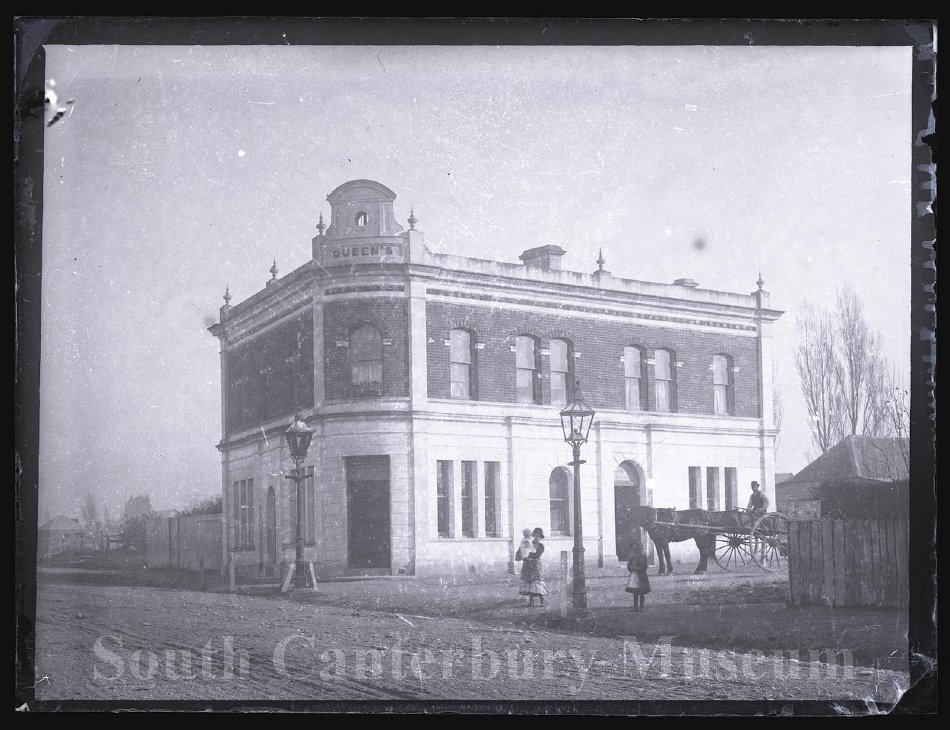
A man in a horse drawn cart and a woman holds an infant with a child nearby outside the Queens Hotel on the corner of North and Barnard Streets c 1885. A previous record had H Taylor in the subjects. The Kura Marumaru South Canterbury Museum 4693. The Queen’s Hotel opened on 1 October 1878, opposite the Timaru Courthouse, with Thomas Bell Jones as its first publican. Queens Hotel 1885 South Canterbury Museum 4693
Stand on the corner of Barnard and North Streets and you'll find the Queen’s Hotel. Its rounded corner turns towards the road wrapping the corner, its upper windows look out across the justice precinct, and above the parapet is a segmental pediment with a curious circular opening.
The Queen’s Hotel opened on 1 October 1878, opposite the Timaru Courthouse, with Thomas Bell Jones as its first publican. Jones had been a blacksmith and, like many people in early Timaru, his life was not a neat success story. He had been declared bankrupt in 1875, yet within a few years he was part of the town’s hospitality trade, opening a hotel in a highly strategic location. In a busy colonial town, a hotel near the courthouse and police station was not just a place for beds and beer. It was part of the social machinery of town life.
Designed by local builder turned architect Thomas Machin and built by J. Simpson, the Queen’s Hotel is a two storey brick building in a simplified commercial classical style. Its hipped roof, solid parapet, arched sash windows, rusticated ground floor and plastered detailing gave the corner a sense of confidence without excessive flourish. The building was practical, public facing and sturdy, qualities that mattered in a town still learning how to build for permanence.
Machin is an important name in Timaru’s built heritage. Before architectural registration, skilled builders could also practise as architects. To claim you are an architect these days you need to be qualified and registered. Machin’s work appears across a few significant local buildings in Timaru's central business district. He was associated with the Timaru and Gladstone Board of Works building, the former Union Bank of Australia, and Bruce’s Royal Flouring Mills.
While obviously he was thinking about what a building should look like, he also designed with safety in mind. In 1879 he wrote publicly about hotel design and fire safety, warning against dangerous architectural excess. The Queen’s Hotel’s restrained detailing may reflect that attitude: a building that presents itself well, but does not forget the lives inside it. Remember that the punters were in here before we could flick an electric heat pump on, there would have been plenty of flames and hazards at the time.
The site is on North Street. If you have every felt frustrated crossing a North St intersection, there is a reason why they don't line up. Because Timaru was once two towns. North of North Street was private enterprise known as Rhodes Town and the Southern side was established by the Government, known as Government Town. So North St marked the boundary between the two in Timaru’s early colonial layout history chapter.
Over the years, the Queen’s Hotel changed hands many times. By 1893, A. F. Anderson was in possession, and many other publicans and patrons followed. In 2014 it was announced that the hotel was closing, but new owners were found and the building continued to operate. Timaru has lost many early hotels, and for what ever reason the hotel closed and its doors haven't been seen open for a while. It's a shame to see if sit idle, as the built heritage helps us read the town’s nineteenth century street pattern and social life over its almost 150 years.
Today, the Queen’s Hotel is not just an old and idle pub and accommodation on a corner. It is a reminder of a time when buildings had to earn their place through use, visibility and endurance. Look up at that empty circular opening and imagine if this was decorative or unfinished. If the hole was once intended for a clock, then the building itself marks more than 140 years of Timaru life from one well chosen corner.
Thomas Machin was a capable masonry contractor who worked on important Timaru bluestone buildings. The two strongest examples are the former Timaru and Gladstone Board of Works Building and the former Union Bank of Australia, both in Stafford Street.
95 Stafford St
1874
William Williamson
Thomas Roberts, architect; Thomas Machin, contractor Italianate
The Gladstone Board of Works moved into their bluestone and plaster office in 1874, where they developed major public works for the region.
This board was a precursor of the Timaru Borough Council, one of the political divisions that led to the disintegration of the Provincial system in 1876. Gladstone was one of the two electoral districts which returned members to the House of Representatives 1866-1881. This is one of the few remaining bluestone buildings in Timaru, it is two-storey and rectangular in plan with a shallow hipped roof. Recent unobtrusive additions have been made to the rear of the building.
Significant elements include quoins, dressed window facings, window and door details, string course and cave detail.
The Timaru and Gladstone Board of Works were also responsible for the formation of a section of railway from Timaru to Temuka, not originally with the idea of completing a section of the South Island Main Trunk line, but rather for the purpose of providing a needed feeder line to link with the main railway. This section was opened on 26 October 1875. Timaru was proclaimed a borough on 13 July 1868 and became a city on 11 November 1948. Learn more here
Fun fact: Timaru started as two towns Government Town and Rhodes Town, which is why the roads are out of line at intersections along North Street. In 1856 Timaru was gazetted as a proposed town site by Canterbury Provincial Government. Land was reserved for town south of the present day North Street. Government town was laid out by Samuel Hewlings, he was our first Mayor 1868-1870. The centre of town was to be Alexander Square. Here you can see Hewlings laid the streets in Government town to run parrallel with the beach. The others are at right angles.
The Rhodes brothers had their free hold area surveyed by Edwin Henry Lough incorporating the well worn bullock wagon tracks which followed the easier route through the hil-and-gully area. - Streets of Timaru.
As you can see in the map below it dosn't look like either surveyor collaborated.
Here you can also see Alexander Square named in honor of the Alexandra of Denmark the wide of King Edward II.

1909 Photograph taken by an unidentified photographer employed or contracted by 'The Press' newspaper of Christchurch.Stafford Street, Timaru, with carts, horses and people in the street. The Press (Newspaper) :Negatives. Ref: 1/1-008815-G. Alexander Turnbull Library, Wellington, New Zealand. /records/29944621