
By Roselyn Fauth
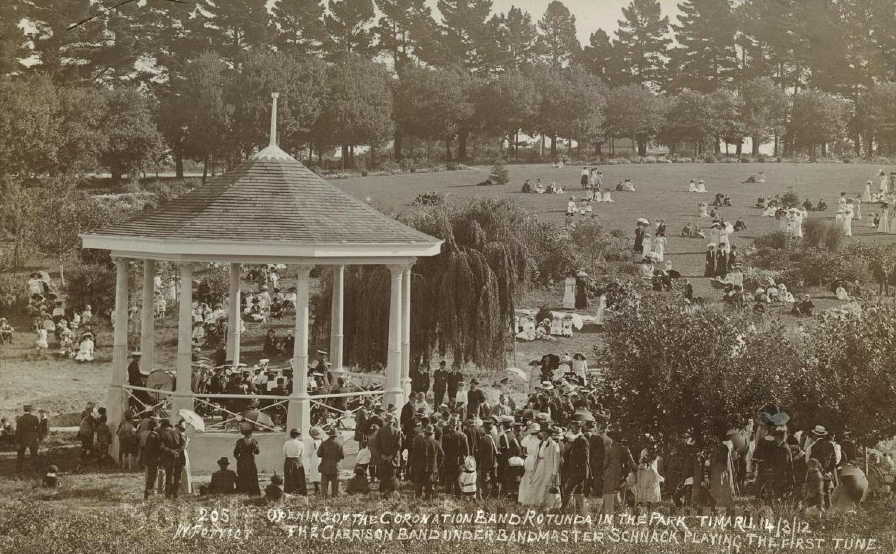
The opening of the Coronation Band rotunda in the Timaru Botanical Gardens in 14 March 1912. Crowds surrounding the rotunda watch as the Timaru Garrison Band, under Bandmaster Schnook, play the first tune. Bears a standard divided verso, postally unused, but with a brief message of good wishes.
I have walked past the band rotunda in Timaru Botanic Gardens more times than I could count. I remember it as a child, and now my own children run rings around it too. It has always felt as though it belongs there.
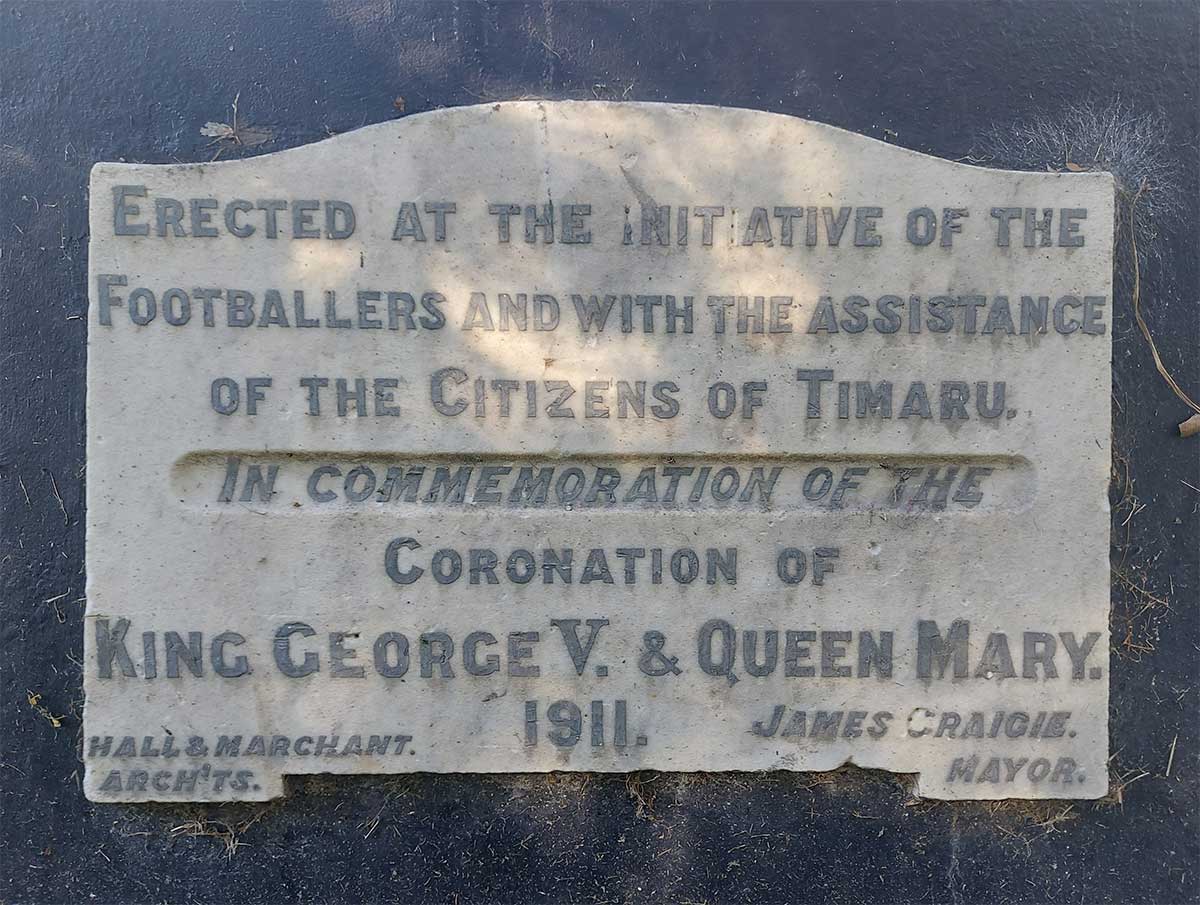
But if you stop by the steps and read the plaque, the rotunda starts to look different.
It says it was erected at the initiative of the footballers, with the assistance of the citizens of Timaru, in commemoration of the coronation of King George V and Queen Mary in 1911. So this is not just a pleasant shelter beside the pond. It is a memorial, a public gift, and a reminder of what Timaru wanted to make visible about itself at that moment.
The coronation was in 1911. The rotunda opened on 14 March 1912. Both dates matter. One is the reason for it. The other is the moment it entered public life.
At that time, brass and military bands were woven into civic occasions and public recreation. Parks, domains, and seaside reserves needed no speakers, just instruments built to carry in the open air and somewhere suitable for the players to stand. That is why rotundas and bandstands appeared in towns across New Zealand. They gave music a setting and gave people somewhere to gather around it.
Timaru already knew the form. There had been one at Alexandra Square, opened in 1904 and gifted by Charles Bowker, and another at Caroline Bay, built around 1905 by private subscription before the later soundshell replaced it. The Botanic Gardens rotunda belongs to that wider local tradition of outdoor public music and, as far as the evidence currently suggests, it appears to be the only survivor of that earlier generation of Timaru bandstands.
To understand why it was built here, it helps to remember what the gardens were before they were the gardens.
For years this was simply The Park. In 1864, local residents asked the Canterbury Provincial Council to reserve land at the southern end of Timaru for public use. The land was set aside as Reserve 314, with part for hospital purposes and the rest becoming what locals called The Park. It was public land held for the future, not a finished garden.
The place grew slowly. Planting began in the late 1860s. Trees, shrubs, bulbs, roots, and seeds were donated. A ranger was appointed. Budgets were slowly allocated. Much of the land was still leased for grazing. Prisoners from the nearby gaol helped with some of the early planting. Shelter belts were established. None of it sounds glamorous, but that practical work sits behind the beauty people enjoy now.
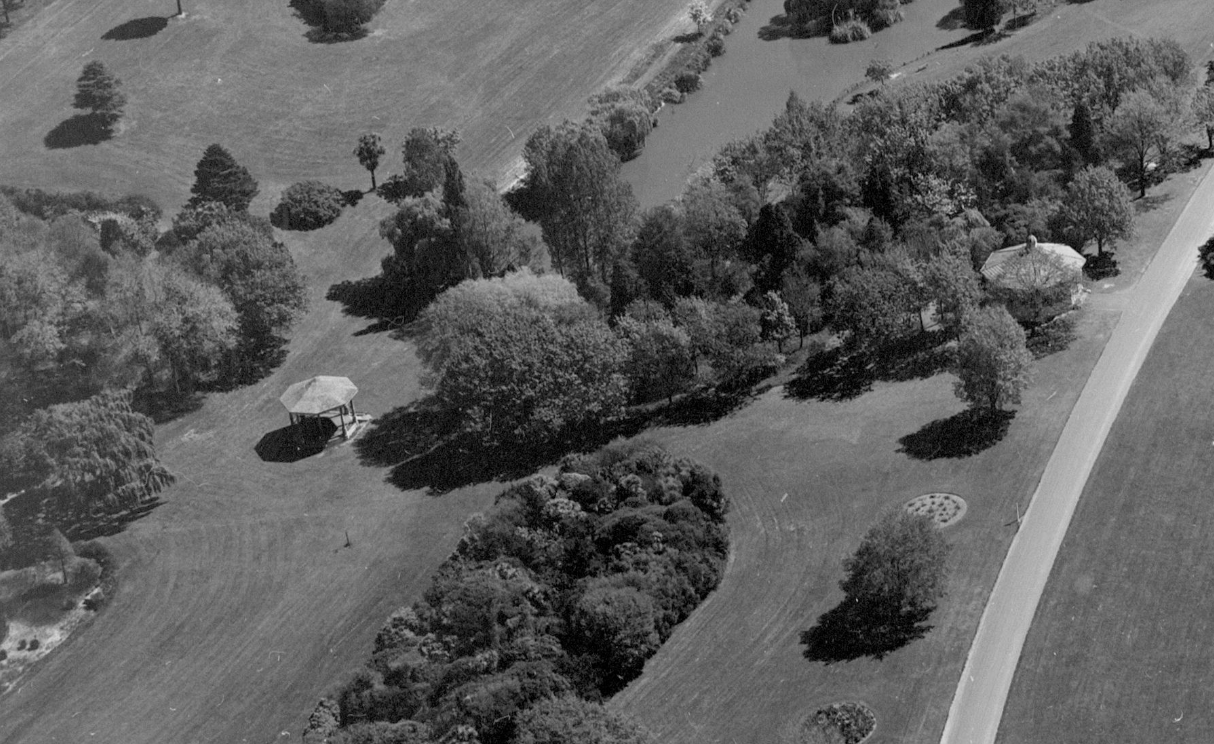
Timaru Botanic Gardens Oct 1956 Whites Aviation Collection Alexander Turnbull Library PA-Group-00080
By the early twentieth century, though, the reserve was becoming something more ambitious. A glasshouse was built in 1905. The bowling green was excavated in 1908. Football and cricket grounds were levelled. In 1909, a climatological station was established. The Park was not only ornamental. It was recreational, civic, and useful.
By 1912, that shift was obvious enough for the Timaru Herald to say so. Reporting on the rotunda opening, the paper described the grounds as the “Botanical Gardens”, “formerly the Park, but no longer so”, and said the south end of town had at last “come into its own”.
In 1911, the Rugby Union, led by its president Arthur Shirtcliffe, discussed creating a permanent coronation memorial for Timaru. At first they considered supporting something at the hospital, but that idea was dropped because it was not considered lasting enough. Shirtcliffe said they wanted to do something that would show loyalty and also benefit the district. James Craigie, then mayor, urged them to think bigger and suggested a rotunda in the Park.
That decision tells you plenty about the town. The footballers were not after something merely decorative. They wanted a memorial that people would actually use.
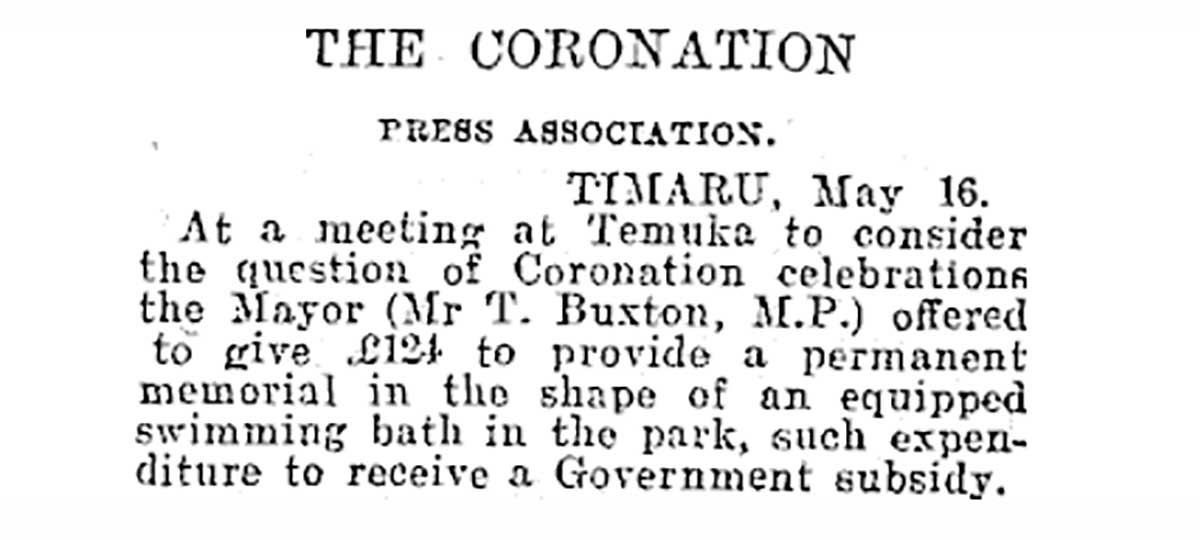
New Zealand Times, Volume XXXIII, Issue 7442, 17 May 1911, Page 6
A football match raised £60. James Craigie gave £30. The Borough Council added £50. The balance came from public subscriptions and other local support, bringing Timaru’s total to £157. Because the rotunda was accepted as the town’s coronation memorial, the Government matched that amount, making the final total £314.
That wider government support was part of a coronation subsidy scheme. Timaru was not the only place to benefit. Other South Canterbury projects included halls at Woodbury and Orari, while Temuka marked the occasion with Coronation Baths, a memorial fountain, and a boundary fence. The memorials expressed loyalty to the Crown and Empire, certainly, but they were also meant to leave communities with something practical.
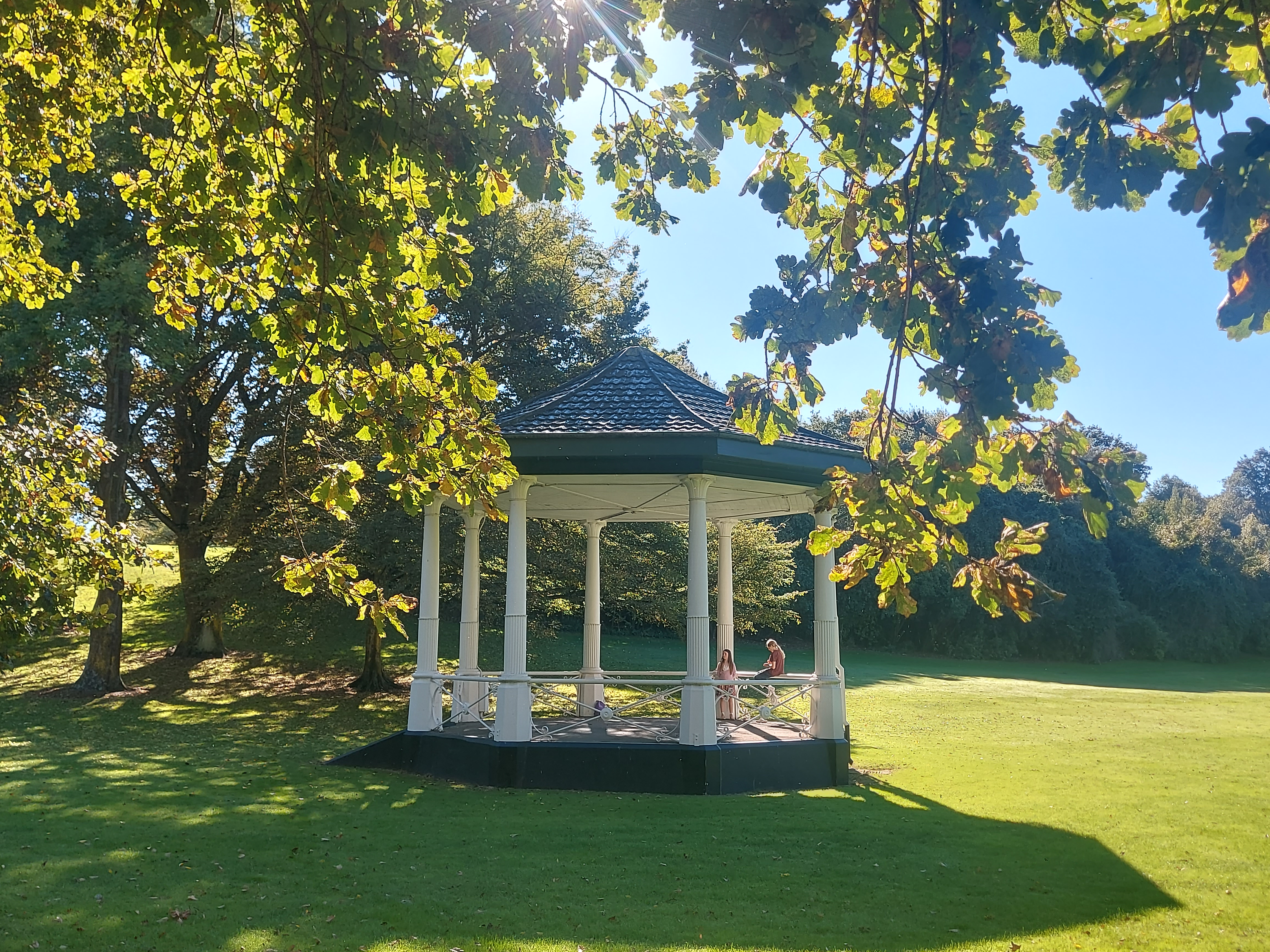
The rotunda itself was more carefully designed than many people would guess at first glance. It was octagonal, about 23 feet in diameter, with a wide flight of concrete steps and eight fluted reinforced concrete columns. There were hand-moulded caps, grey cement work, and brown-stained shingled eaves beneath a russet brown roof. Herbert Hall and Frederick William Marchant, trading as Hall and Marchant, designed it, and Messrs Baird and Sons built it.
The timber ceiling curved downward to help spread the sound, and the rotunda stood east of the pond in a hollow where the surrounding slopes formed what the newspaper called a natural amphitheatre. Early photographs show how well that setting worked, with the band inside and people gathered above and around it on the grass.
The opening ceremony sounds like a day Timaru was rather pleased with itself. Crowds gathered on both sides of the slope. The Timaru Garrison Band, under Bandmaster Schnook, played the first tune, and the Marine Band was there as well. Arthur Shirtcliffe handed the rotunda over on behalf of the footballers. Catherine Craigie cut the ribbon. The National Anthem was sung. Cheers were given.
The rotunda was not a stand-alone gesture. A year later, in 1913, James Craigie presented the Robert Burns statue to the people of Timaru in the gardens. In 1914, a Floral Fete committee formed to raise funds for further improvements. The first playground arrived in 1919. The tea kiosk opened in 1922. Later came the Gloucester Gates, the Queen Victoria Garden Fountain, bridges, plant houses, memorials, and all the other built layers that helped turn The Park into Timaru Botanic Gardens.
That is what I keep noticing now when I walk there. The gardens are not only about plants. Their built heritage is threaded right through them. The band rotunda, the Burns statue, the tea kiosk, the gates, the fountain, the caretaker’s cottage, the conservatory, all of them mark stages in the long making of a public place.
And the rotunda still does what it was built to do, even in silence. It draws the eye. It gathers people. It gives shape to the slope around it.
More than a century later, the plaque is still there, the pond is still there, and the ground still holds the suggestion of an audience. That seems worth stopping for.
Because it tells us something simple and rather hopeful. Timaru once believed public life should have room for beauty, ceremony, and music. Not just utility. Not just function.
That is still a good ambition for a town.
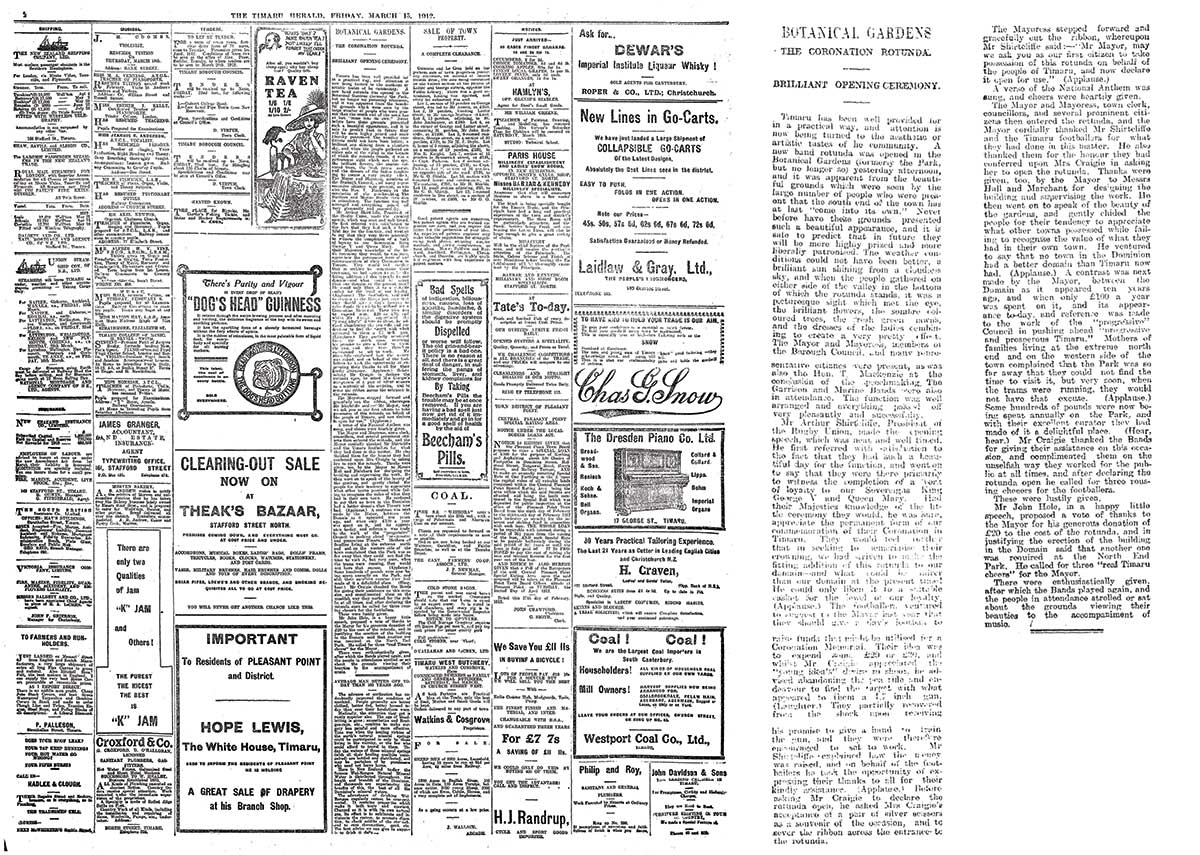
https://paperspast.natlib.govt.nz/newspapers/THD19120315.2.3
BOTANICAL GARDENS.
Timaru Herald, Volume XCV, Issue 14697, 15 March 1912, Page 2
BOTANICAL GARDENS
THE CORONATION ROTUNDA.
BRILLIANT OPENING CEREMONY.
Timaru has been well provided for in a practical way, and attention is now being turned to the aesthetic or artistic tastes of the community. A new band rotunda was opened in the Botanical Gardens, formerly the Park, but no longer so, yesterday afternoon, and it was apparent from the beautiful grounds which were seen by the large number of people who were present that the south end of the town has at last “come into its own.” Never before have these grounds presented such a beautiful appearance, and it is safe to predict that in future they will be more highly prized and more liberally patronised. The weather conditions could not have been better, a brilliant sun shining from a cloudless sky, and when the people gathered on either side of the valley in the bottom of which the rotunda stands, it was a picturesque sight which met the eye, the brilliant flowers, the sombre coloured trees, the fresh green lawns and the dresses of the ladies combining to create a very pretty effect. The Mayor and Mayoress, members of the Borough Council, and many representative citizens were present, as was also the Hon. T. Mackenzie at the conclusion of the speechmaking. The Garrison and Marine Bands were also in attendance. The function was well arranged and everything passed off very pleasantly and successfully.
Mr Arthur Shirtcliffe, President of the Rugby Union, made the opening speech, which was neat and well timed. He first referred with satisfaction to the fact that they had such a beautiful day for the function, and went on to say that they were there primarily to witness the completion of a work of loyalty to our Sovereigns King George V and Queen Mary. Had their Majesties knowledge of the little ceremony they would, he was sure, appreciate the permanent form of our commemoration of their Coronation in Timaru. They would feel gratified that in seeking to memorise their crowning, we had striven to make the fitting addition of this rotunda to our domain, and what could be fairer than our domain at the present time? He could only liken it to a suitable casket for the jewel of our loyalty. (Applause.) The footballers ventured to suggest to the Mayor last year that they should give a day’s football to raise funds that might be utilised for a Coronation Memorial. Their idea was to expend some £20 or £30, and while Mr Craigie appreciated the “young idea’s” desire to shoot, he advised abandoning the pea rifle and endeavour to find the target with what appeared to them a 4.7 inch gun. (Laughter.) They partially recovered from the shock upon receiving his promise to give a hand to train the gun, and they were encouraged to set to work. Mr Shirtcliffe explained how the money was raised, and on behalf of the footballers he took the opportunity of expressing their thanks to all for their kindly assistance. (Applause.) Before asking Mr Craigie to declare the rotunda open, he asked Mrs Craigie’s acceptance of a pair of silver scissors as a souvenir of the occasion, and to sever the ribbon across the entrance to the rotunda.
The Mayoress stepped forward and gracefully cut the ribbon, whereupon Mr Shirtcliffe said: “Mr Mayor, may we ask you as our first citizen to take possession of this rotunda on behalf of the people of Timaru, and now declare it open for use.” (Applause.)
A verse of the National Anthem was sung, and cheers were heartily given.
The Mayor and Mayoress, town clerk, councillors, and several prominent citizens then entered the rotunda, and the Mayor cordially thanked Mr Shirtcliffe and the Timaru footballers for what they had done in this matter. He also thanked them for the honour they had conferred upon Mrs Craigie in asking her to open the rotunda. Thanks were given, too, by the Mayor to Messrs Hall and Marchant for designing the building and supervising the work. He then went on to speak of the beauty of the gardens, and gently chided the people for their tendency to appreciate what other towns possessed while failing to recognise the value of what they had in their own town. He ventured to say that no town in the Dominion had a better domain than Timaru now had. (Applause.) A contrast was next made by the Mayor, between the Domain as it appeared ten years ago, and when only £100 a year was spent on it, and its appearance to-day, and reference was made to the work of the “progressive” Council in pushing ahead “progressive and prosperous Timaru.” Mothers of families living at the extreme north end and on the western side of the town complained that the Park was so far away that they could not find the time to visit it, but very soon, when the trams were running, they would not have that excuse. (Applause.) Some hundreds of pounds were now being spent annually on the Park, and with their excellent curator they had made of it a delightful place. (Hear, hear.) Mr Craigie thanked the Bands for giving their assistance on this occasion, and complimented them on the unselfish way they worked for the public at all times, and after declaring the rotunda open he called for three rousing cheers for the footballers.
These were lustily given.
Mr John Hole, in a happy little speech, proposed a vote of thanks to the Mayor for his generous donation of £20 to the cost of the rotunda, and in justifying the erection of the building in the Domain said that another one was required at the North End Park. He called for three “real Timaru cheers” for the Mayor.
These were enthusiastically given, after which the Bands played again, and the people in attendance strolled or sat about the grounds viewing their beauties to the accompaniment of music.
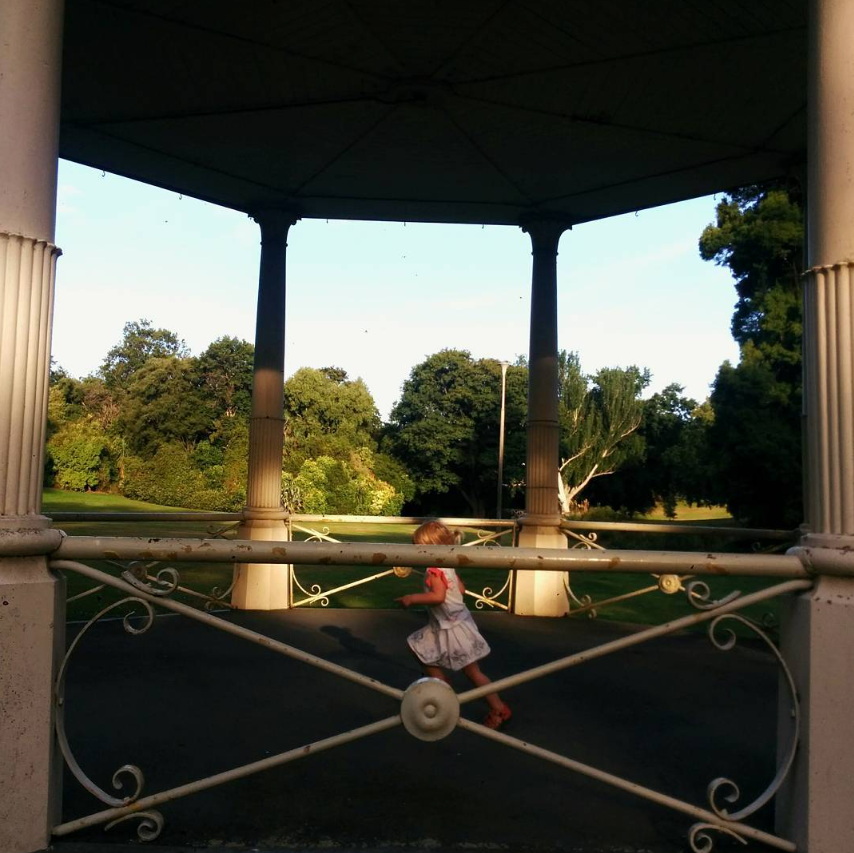
Medinella Fauth runs rings inside the band rotunda. Photo Roselyn Fauth
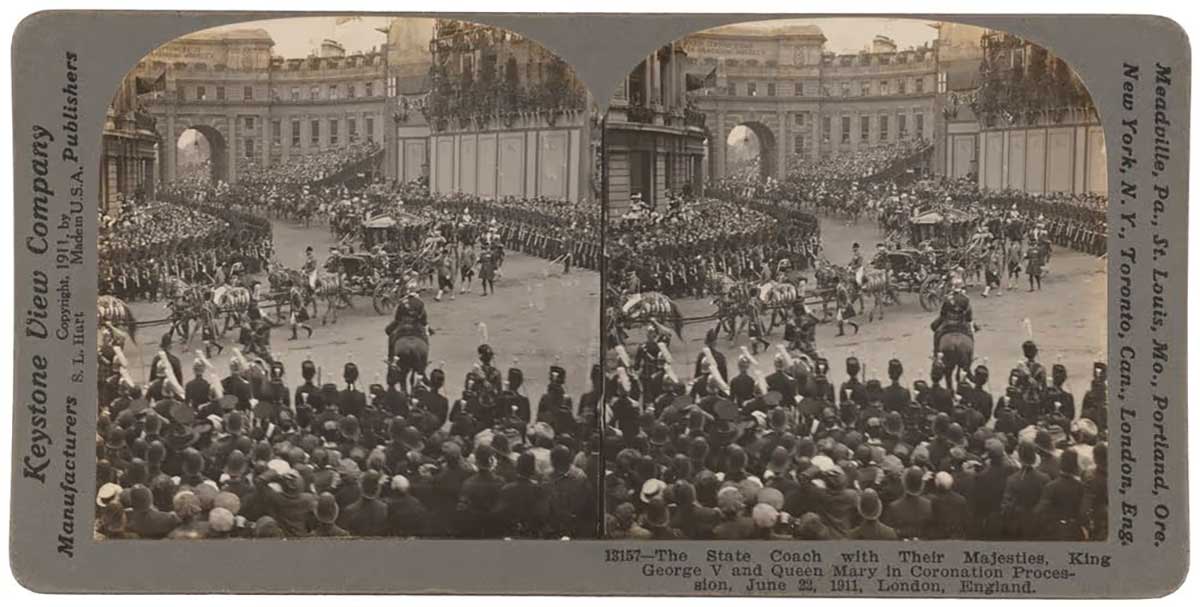
The State Coach with Their Majesties, King George V and Queen Mary in Coronation Procession, June 23, 1911 London, England, 23 June 1911, London, by Keystone View Company. Te Papa (O.005127)
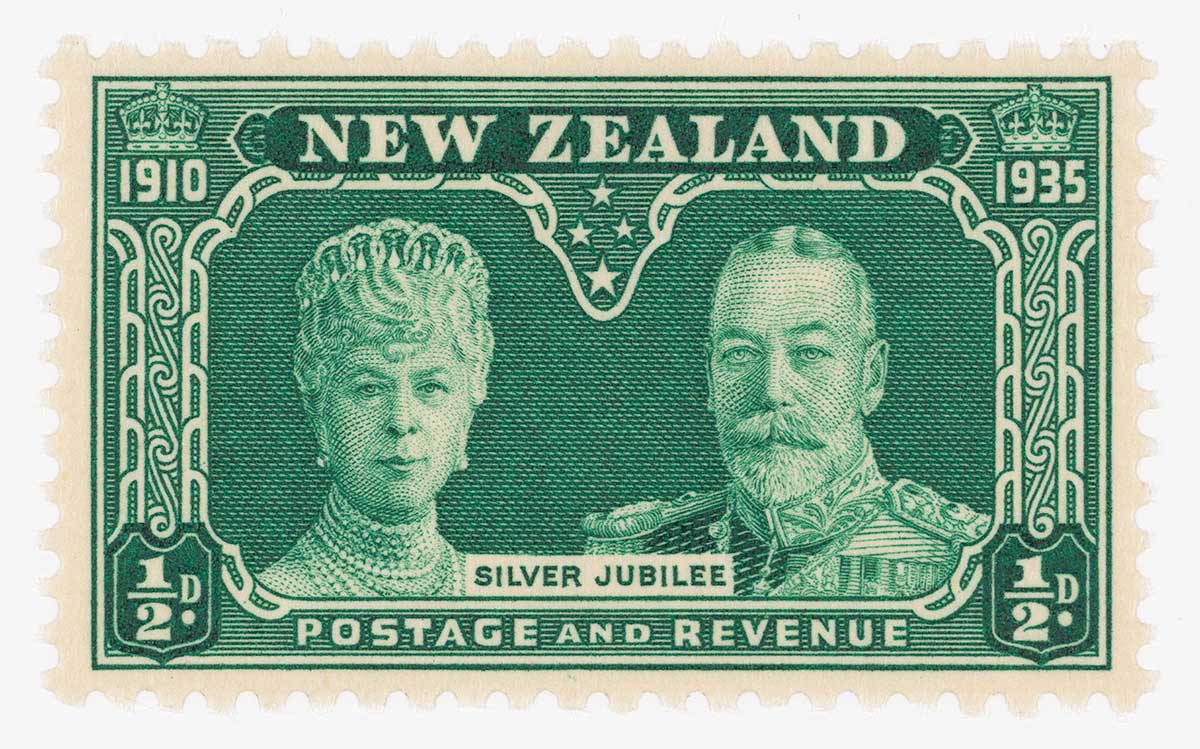
Issued half penny 'King George V and Queen Mary' Silver Jubilee stamp, 1935, London, by Bradbury, Wilkinson & Co. Ltd., James Berry. The New Zealand Post Museum Collection, Gift of New Zealand Post Ltd. 1992. Te Papa (PH000321)
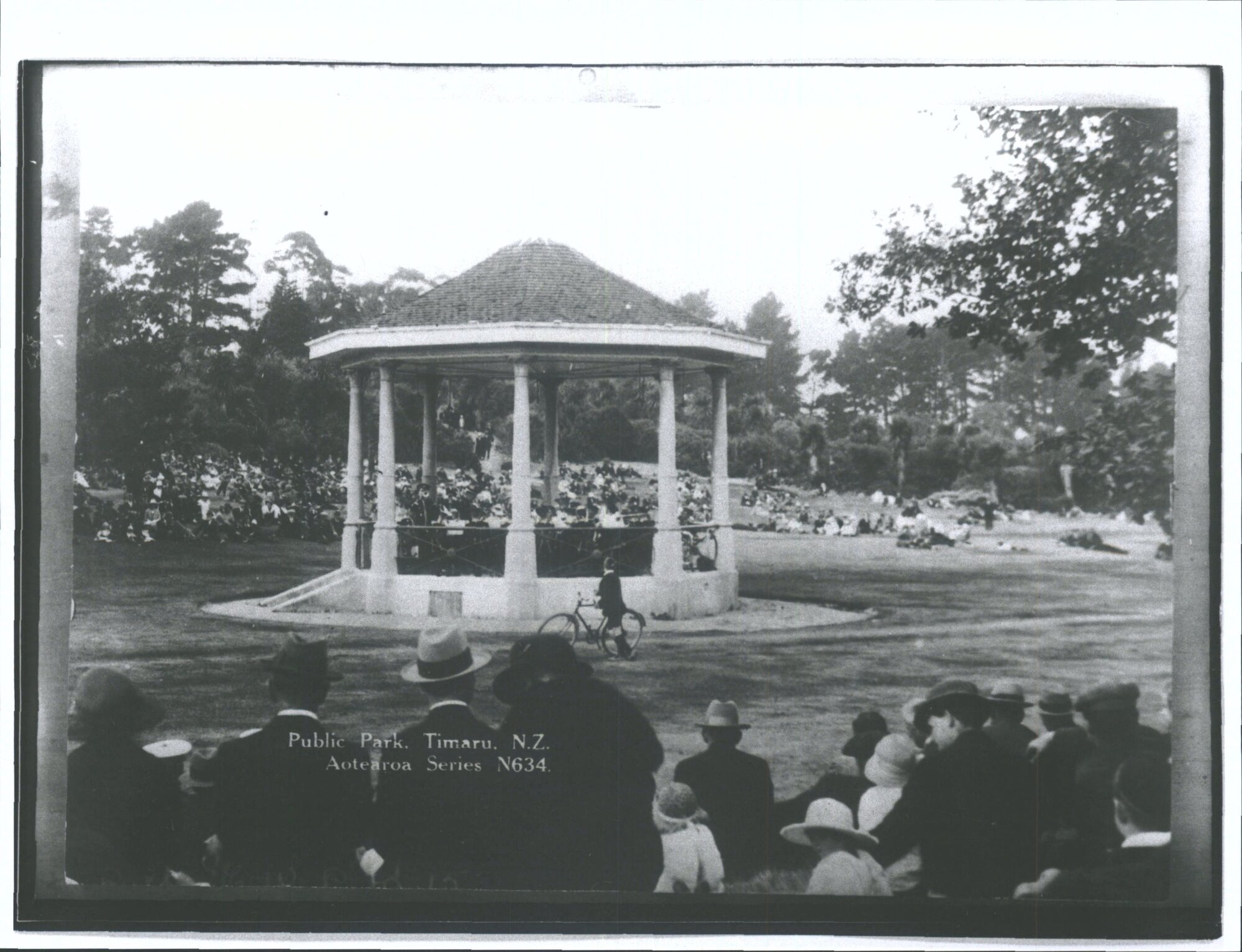
Public Park, Timaru, N.Z.. Hocken Digital Collections, https://hocken.recollect.co.nz/nodes/view/24162
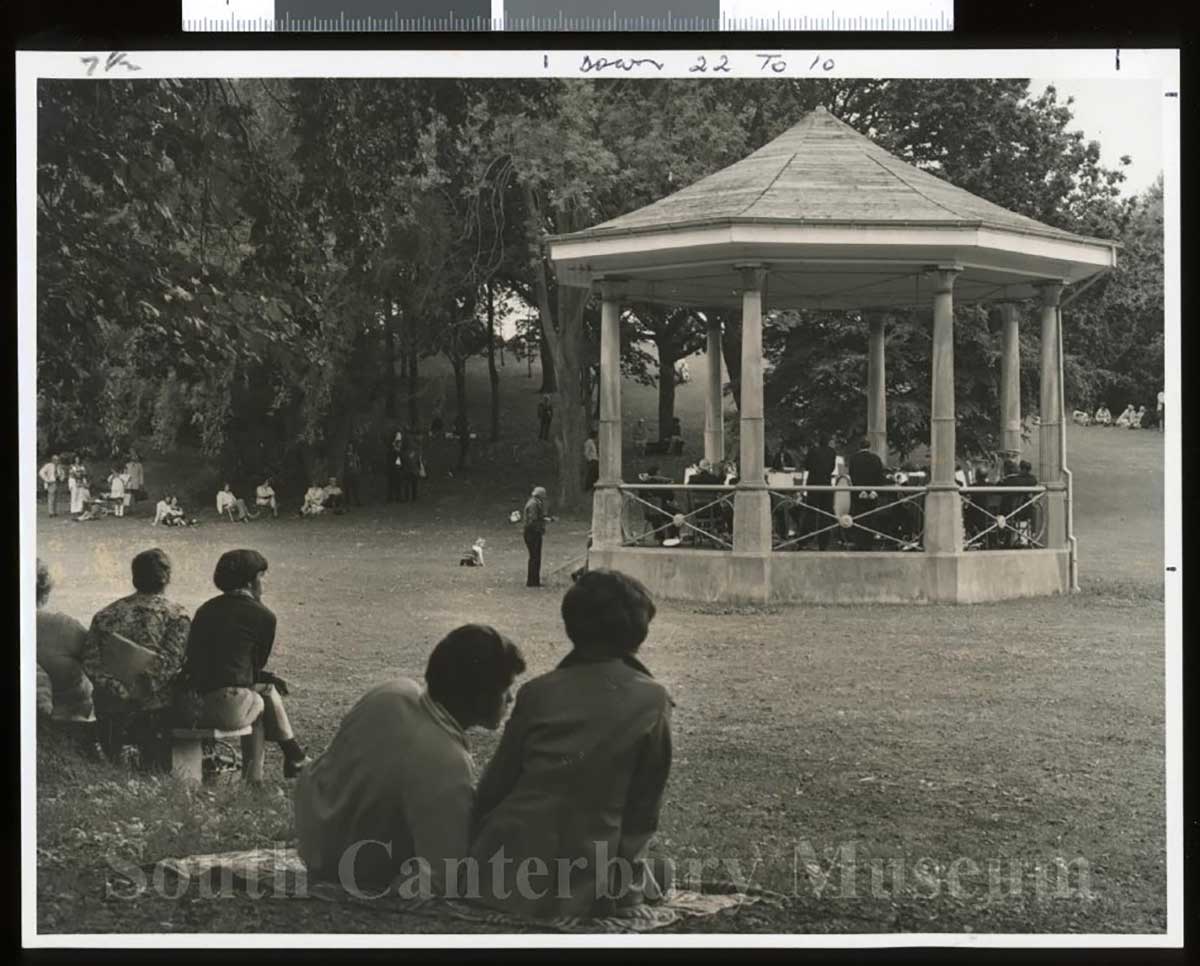
Timaru Municipal Band performing at the Coronation Rotunda in the Timaru Botanic Gardens 1960s https://timdc.pastperfectonline.com/Photo/B94A8E1D-0557-45D0-B302-793165666143
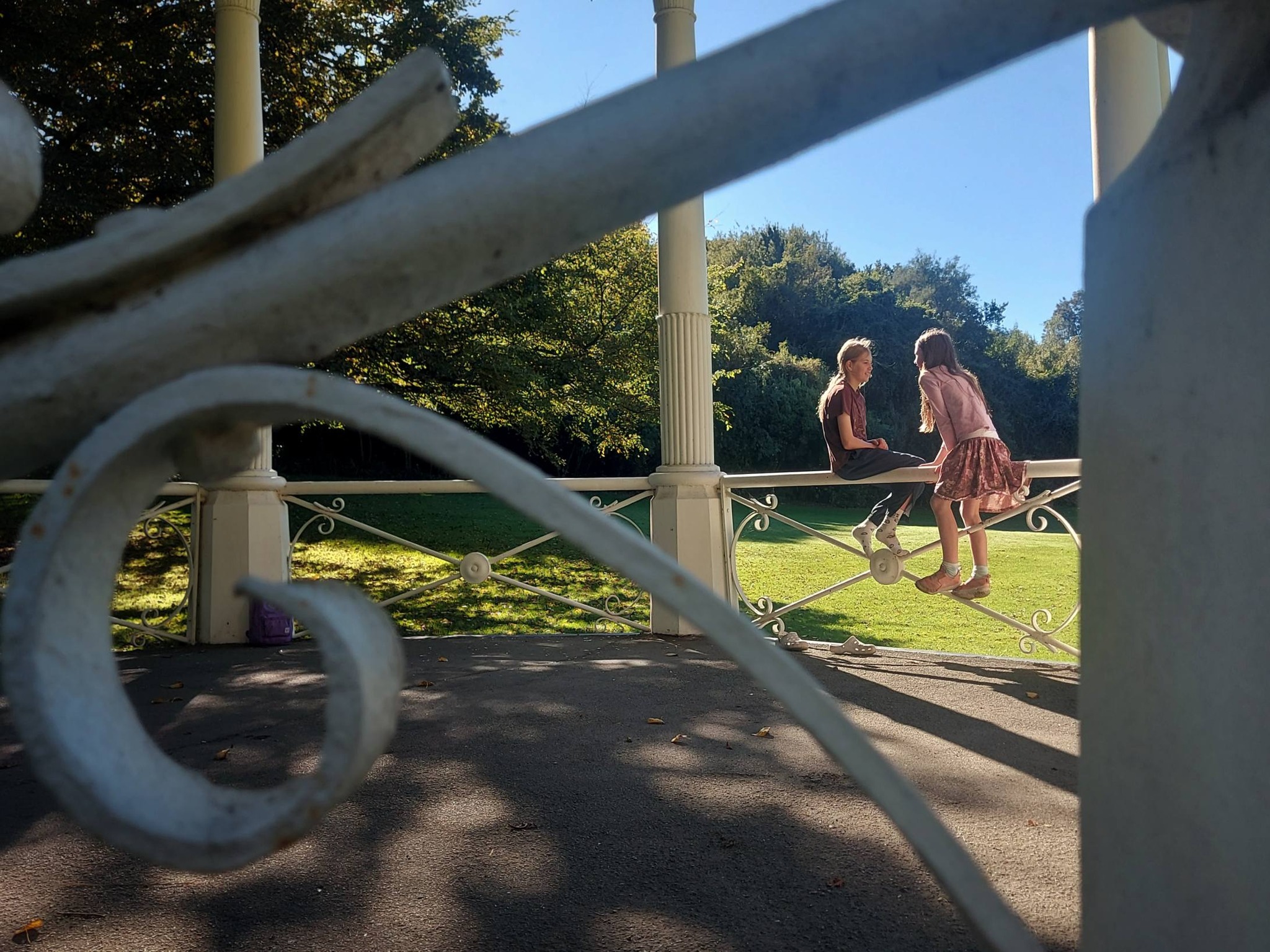
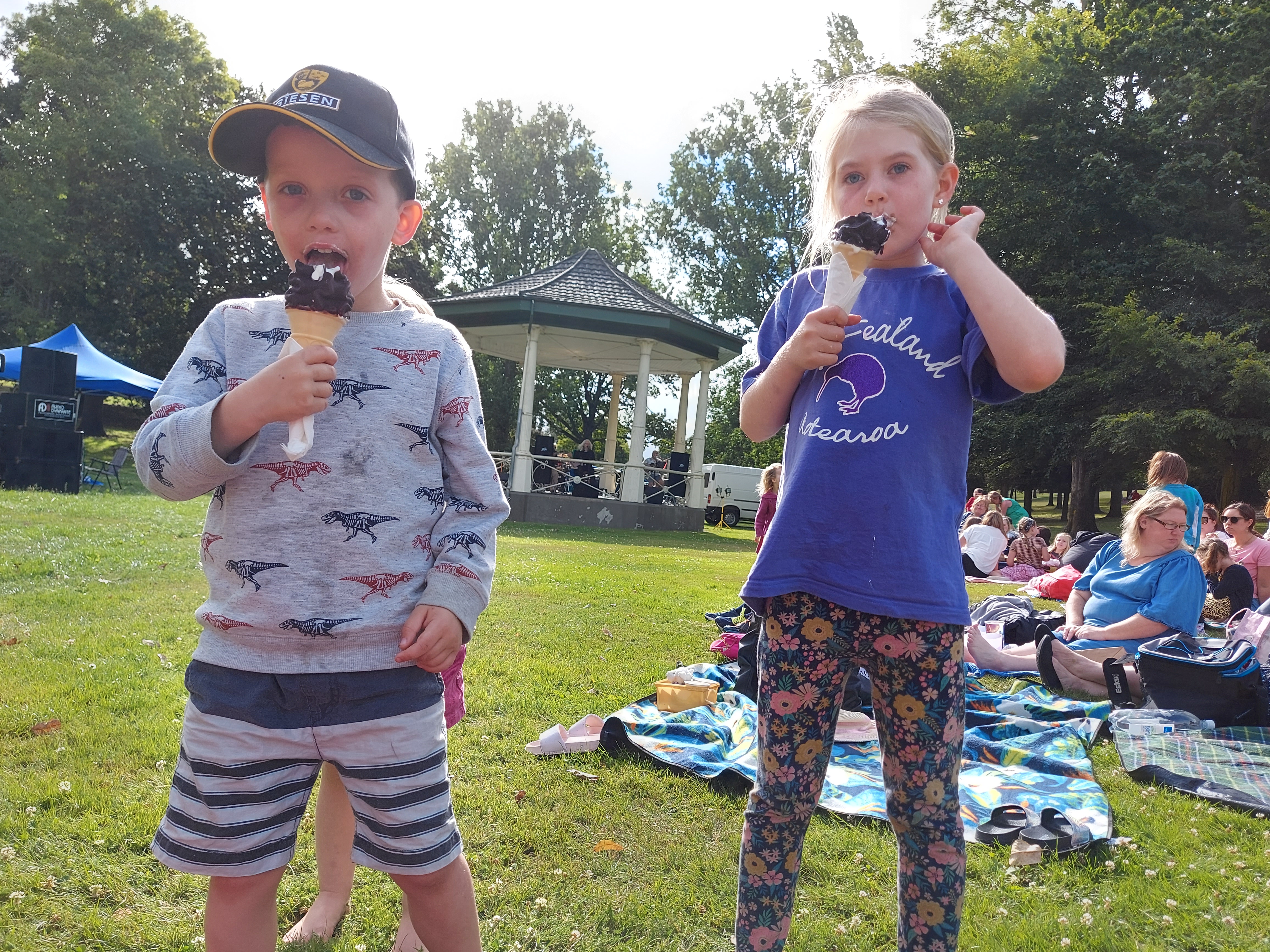
Medinella and Annabelle Fauth 2026. at the Timaru Botanic Gardens band rotunda. Photo Roselyn Fauth
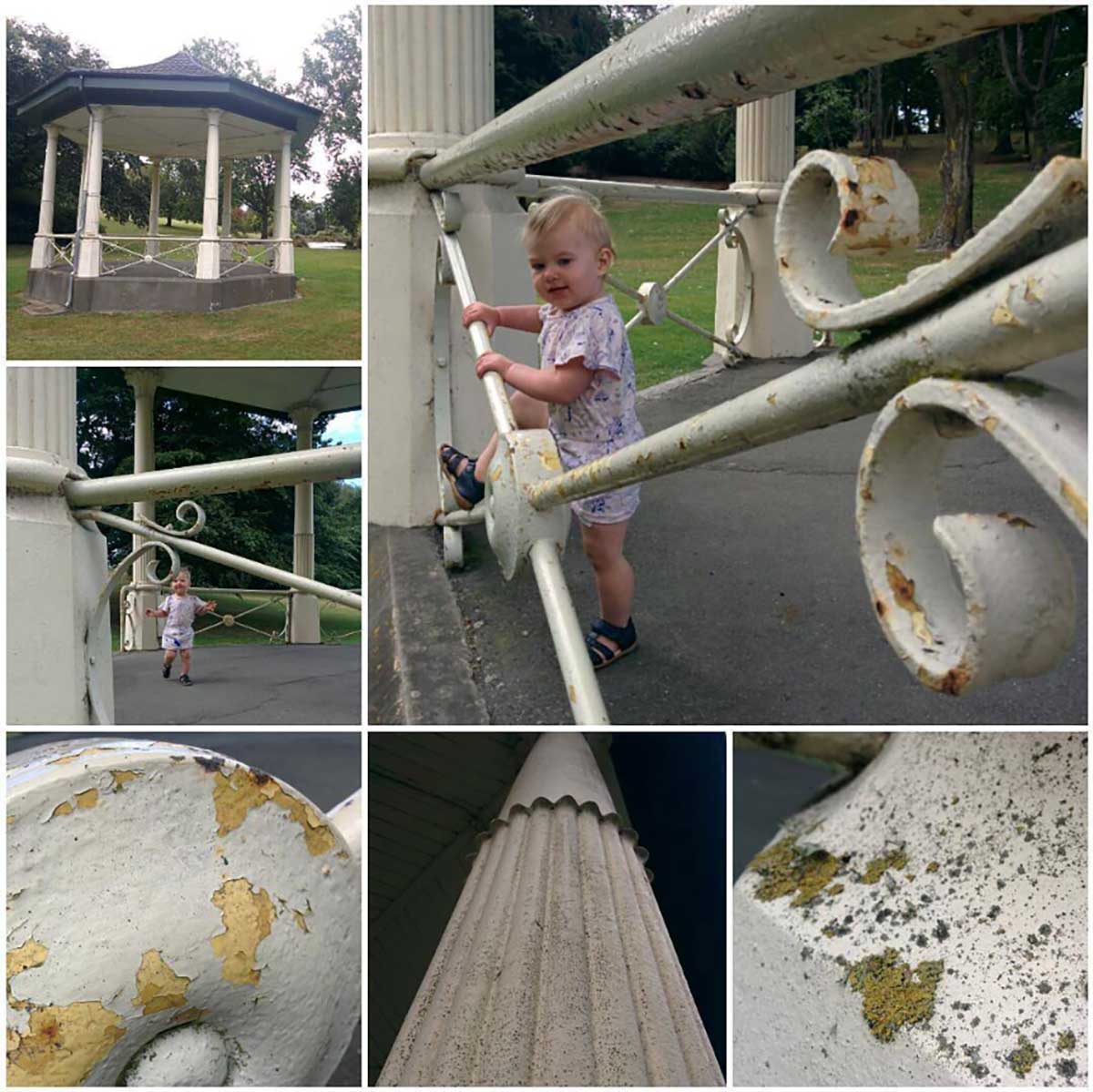
Medinella Fauth 2016 at the Timaru Botanic Gardens band rotunda. Photo Roselyn Fauth
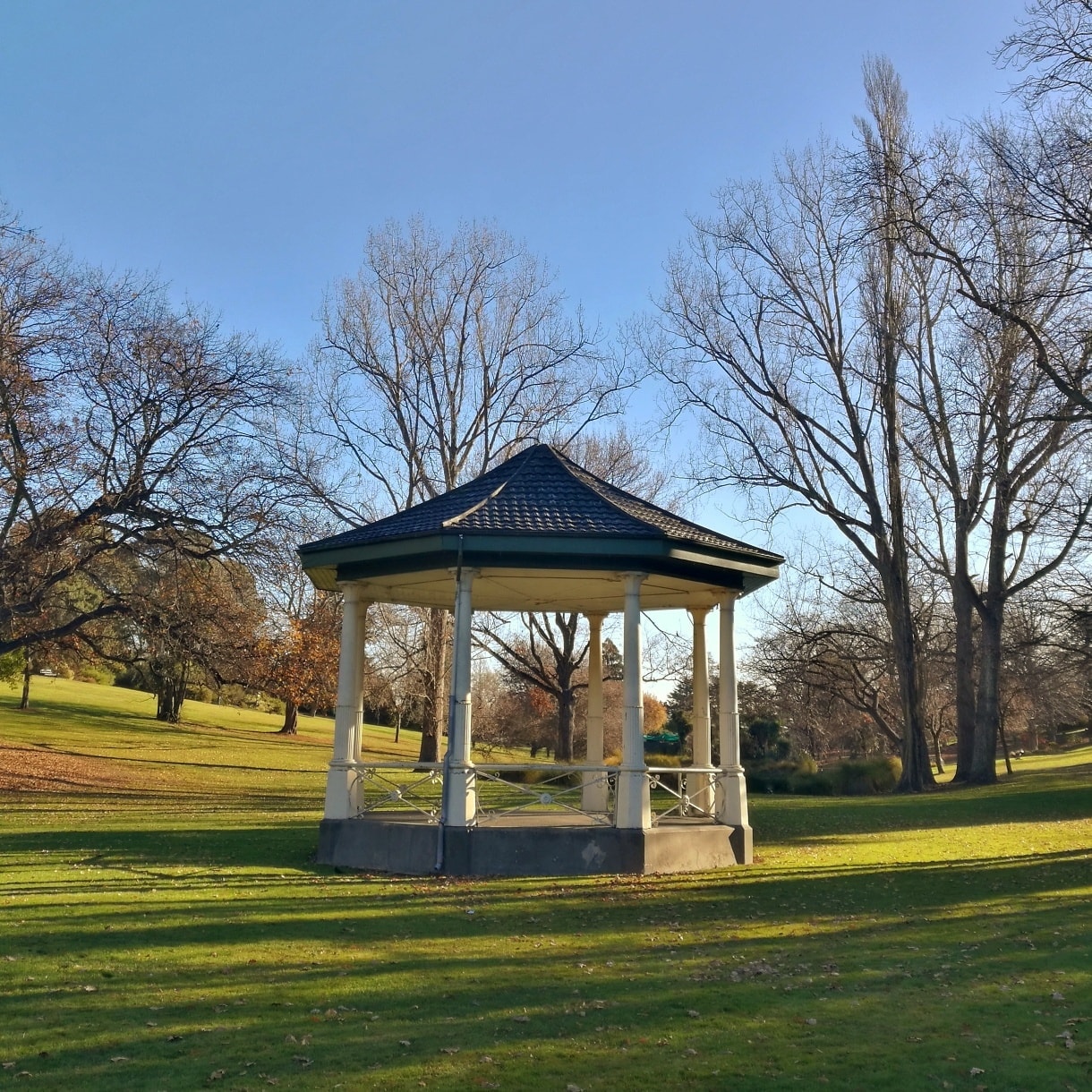
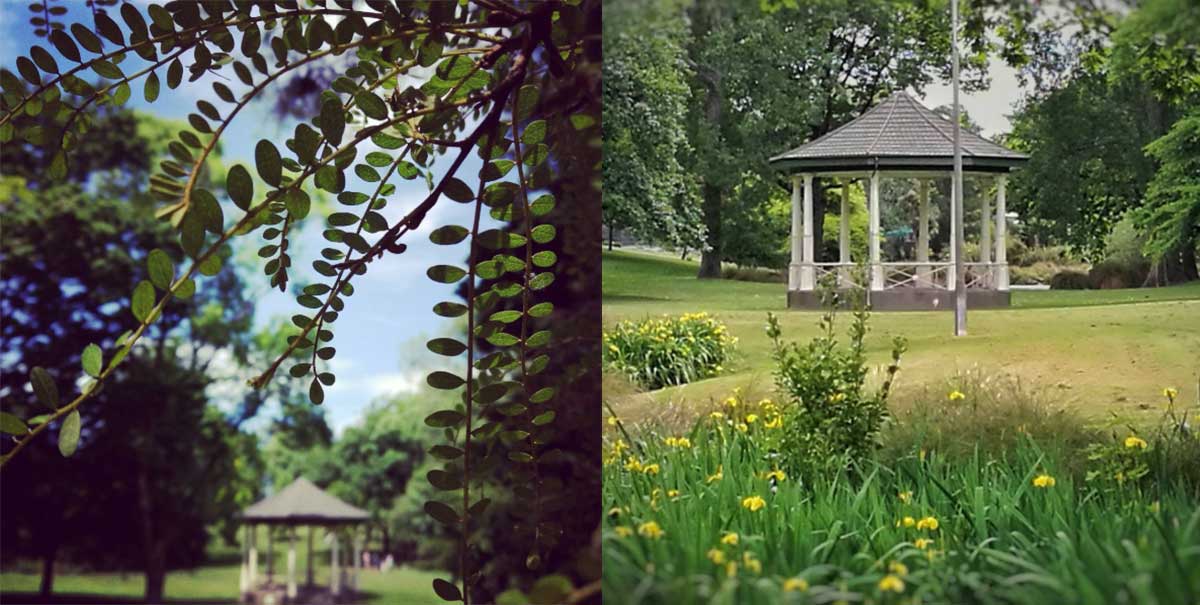
Timaru Botanic Gardens Band Rotunda - RFauth 2020

Timaru Botanic Gardens Band Rotunda - RFauth 2020 view from native bush
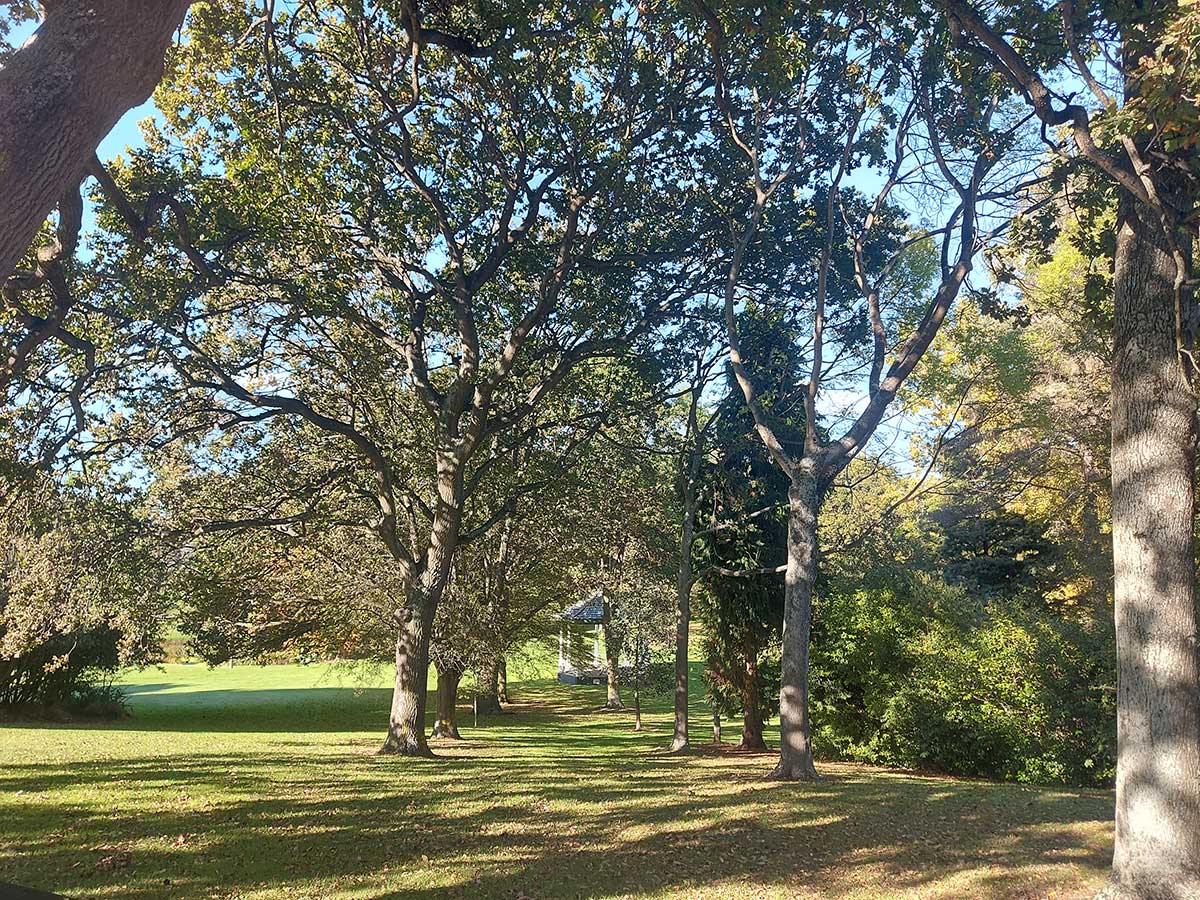
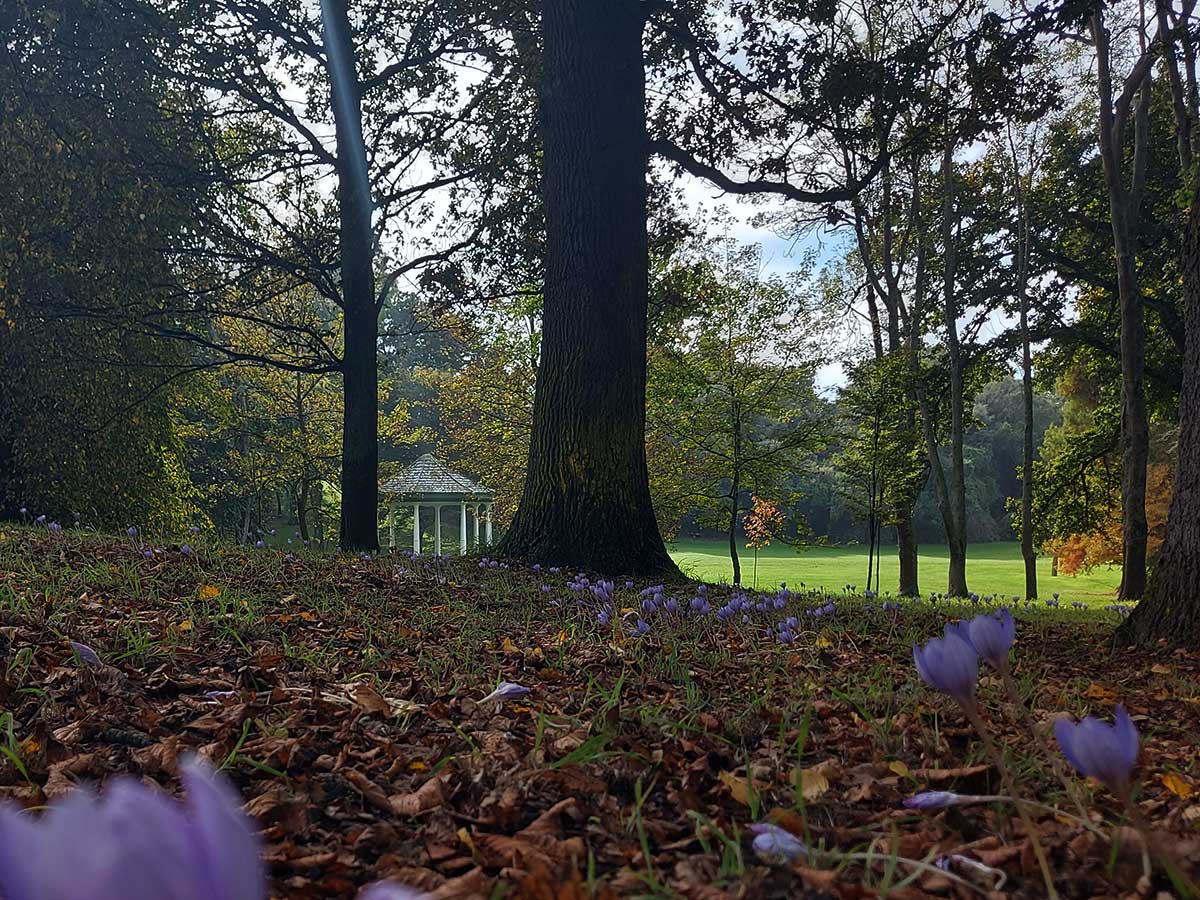

Photo Roselyn Fauth 2026
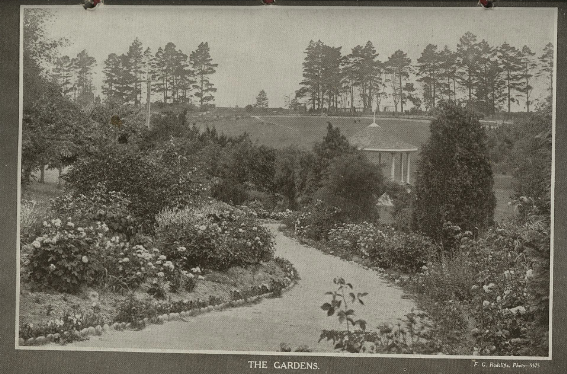
Frank Duncan & Co Ltd, In the Gardens Timaru NZ (1920). Aoraki Heritage Collection, accessed 09/04/2026, https://aorakiheritage.recollect.co.nz/nodes/view/29

In The Park, Timaru, N.Z.. Hocken Digital Collections, https://hocken.recollect.co.nz/nodes/view/24223
The opening of the Coronation Band rotunda in the Timaru Botanical Gardens in 14 March 1912. Crowds surrounding the rotunda watch as the Timaru Garrison Band, under Bandmaster Schnook, play the first tune. Bears a standard divided verso, postally unused, but with a brief message of good wishes.
Frank Duncan & Co Ltd, In the Gardens Timaru NZ (1920). Aoraki Heritage Collection, accessed 09/04/2026, https://aorakiheritage.recollect.co.nz/nodes/view/29
Before it was known as the Timaru Botanic Gardens, it was simply called The Park. In 1864, local residents asked the Canterbury Provincial Council to reserve land at the southern end of Timaru for public use. The land was set aside as Reserve 314, around 23 hectares in all. Part of it was marked off for hospital purposes, and the rest became what locals called The Park. Not a finished garden. Not a grand botanical showpiece. Just public land held aside for the future. That early beginning meant that the Timaru Botanic Gardens are among the older botanic gardens in New Zealand.
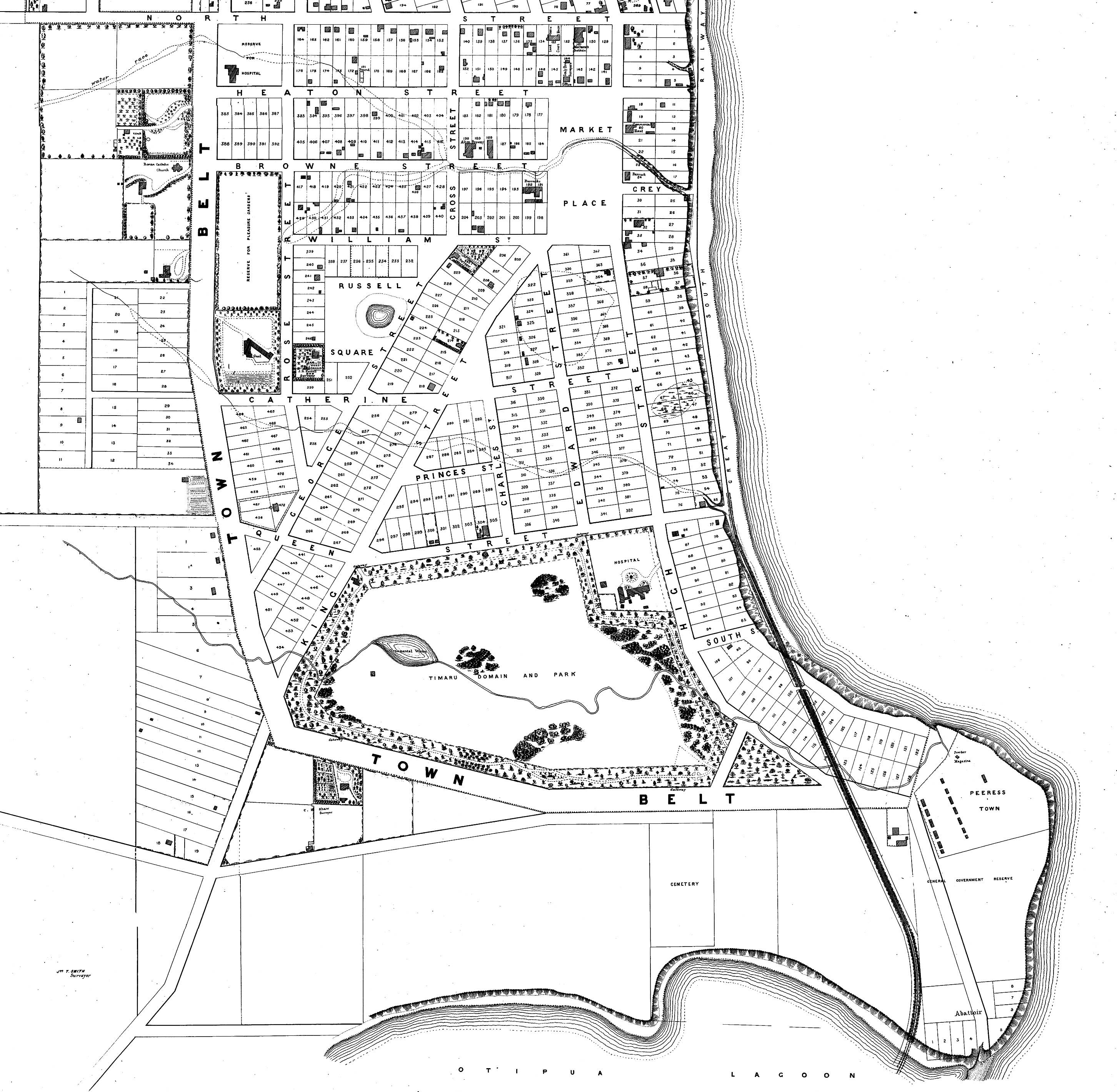
1875- Plan of Timaru Townships Canterbury, Courtesy of the Timaru District Council. Key features today include: Graeme Paterson Conservatory and Fernery, Ornamental ponds, Interpretive centre, Aviary, Cenotaph and War Memorial Wall, Anderson Rose Garden, Band rotunda, Children's playground, Species Rose Garden, Native plant collections, Threatened plant collections, Ornamental plantings, Pinetum, Queen Victoria Garden, Many plant collections. The Timaru Botanic Gardens provides some very attractive vistas as well as a year round interest for plant lovers. It is a photographer's delight. A highlight for children is feeding the ducks on a Saturday as by Sunday they are usually too well fed to be interested.
This was not a ready-made landscape of curving paths and mature trees. A ranger was appointed. Budgets were slowly allocated, and trees were planted mainly around the perimeter, while much of the remaining land was still leased for grazing stock. The stock caused a few problems back in the day, and there are a few reports in the Timaru Herald where they got out and grazed in the cemetery over the road. The fencing of the cemetery was prioritised to keep the animals out.

Some of the earlies trees were planted by prisoners, known at the prisoner pines. Two remain in the gardens today. You can see in the survey map above that the town "gaol" was close by on the town belt, no named Craigie Ave. The Jail is long gone, but the prison staff's homes over the road are still there. The border of the gardens used to have a macrocarpa hedge that was planted to give shelter to the grounds to help the new plants establish and thrive.
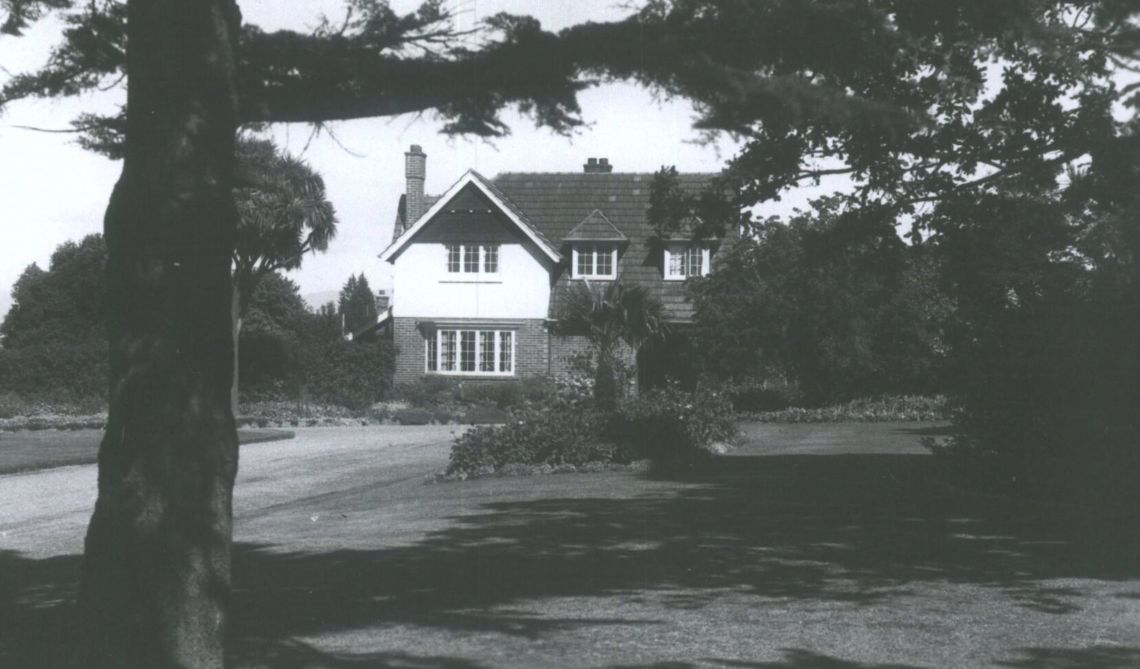
Gardens, Timaru, N.Z.. Hocken Digital Collections, https://hocken.recollect.co.nz/nodes/view/24243. I wonder if this is the original rangers cottage that $200 pounds was set aside for in 1872, or a more recent one. I am thinking this could be a more recent one, maybe from the early 1900s. I found a social media post on South Canterbury Museums Facebook page with a roof tile from the Curator's House in Timaru's Botanic Gardens. It was made by Guichard Carvin and Company, in Marseille, and dates from around 1914.
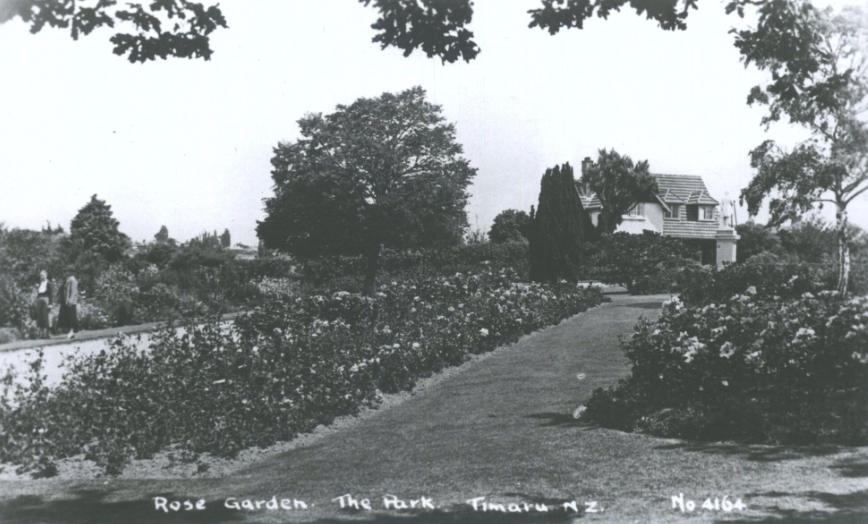
Rose Garden, The Park, Timaru, N.Z.. Hocken Digital Collections, accessed 08/04/2026, https://hocken.recollect.co.nz/nodes/view/24154
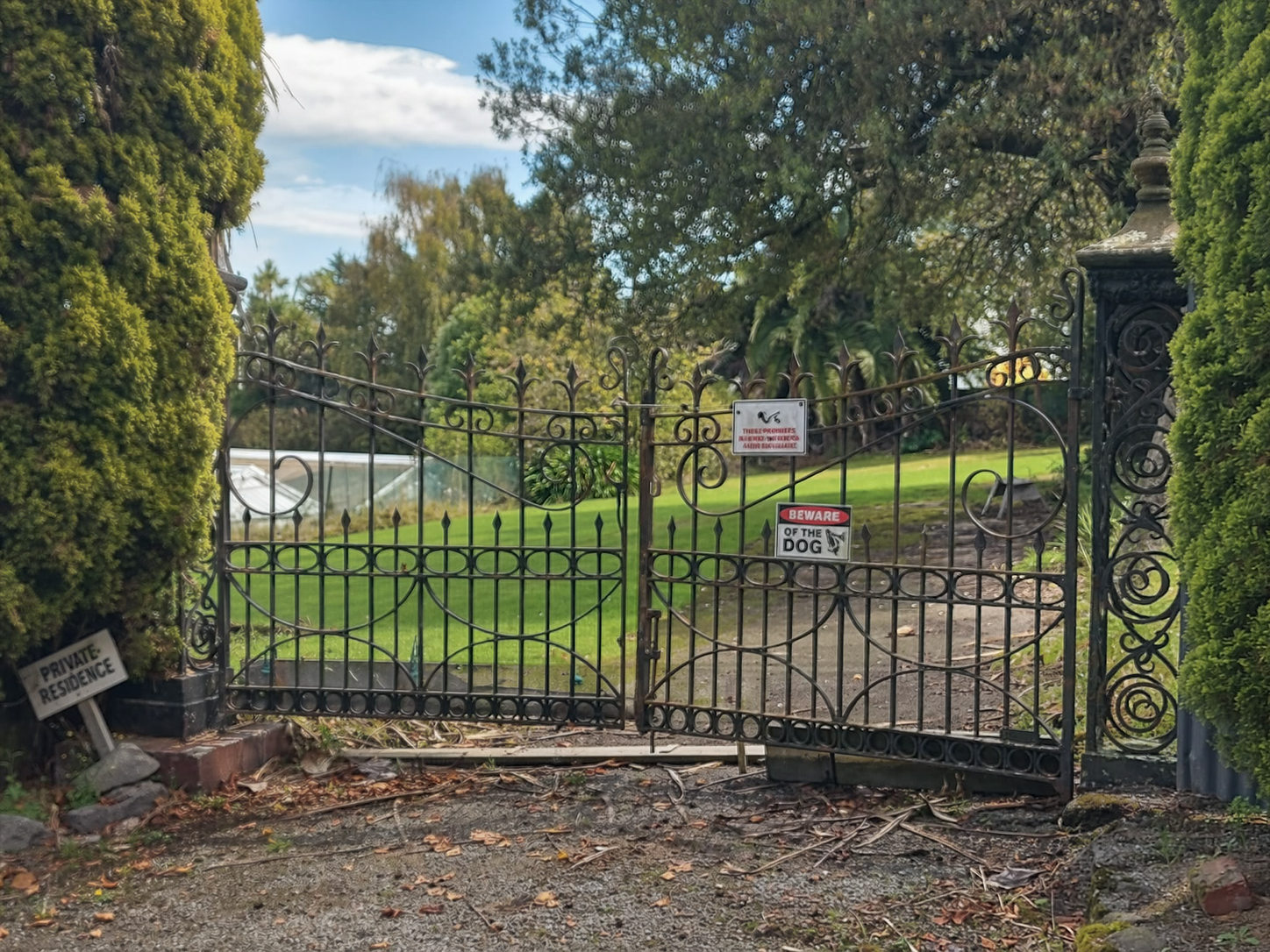
Gates at the Timaru Botanic Gardens. I assume they were once the key entry to the Caretakers Cottage. Photography By Roselyn Fauth 2026.
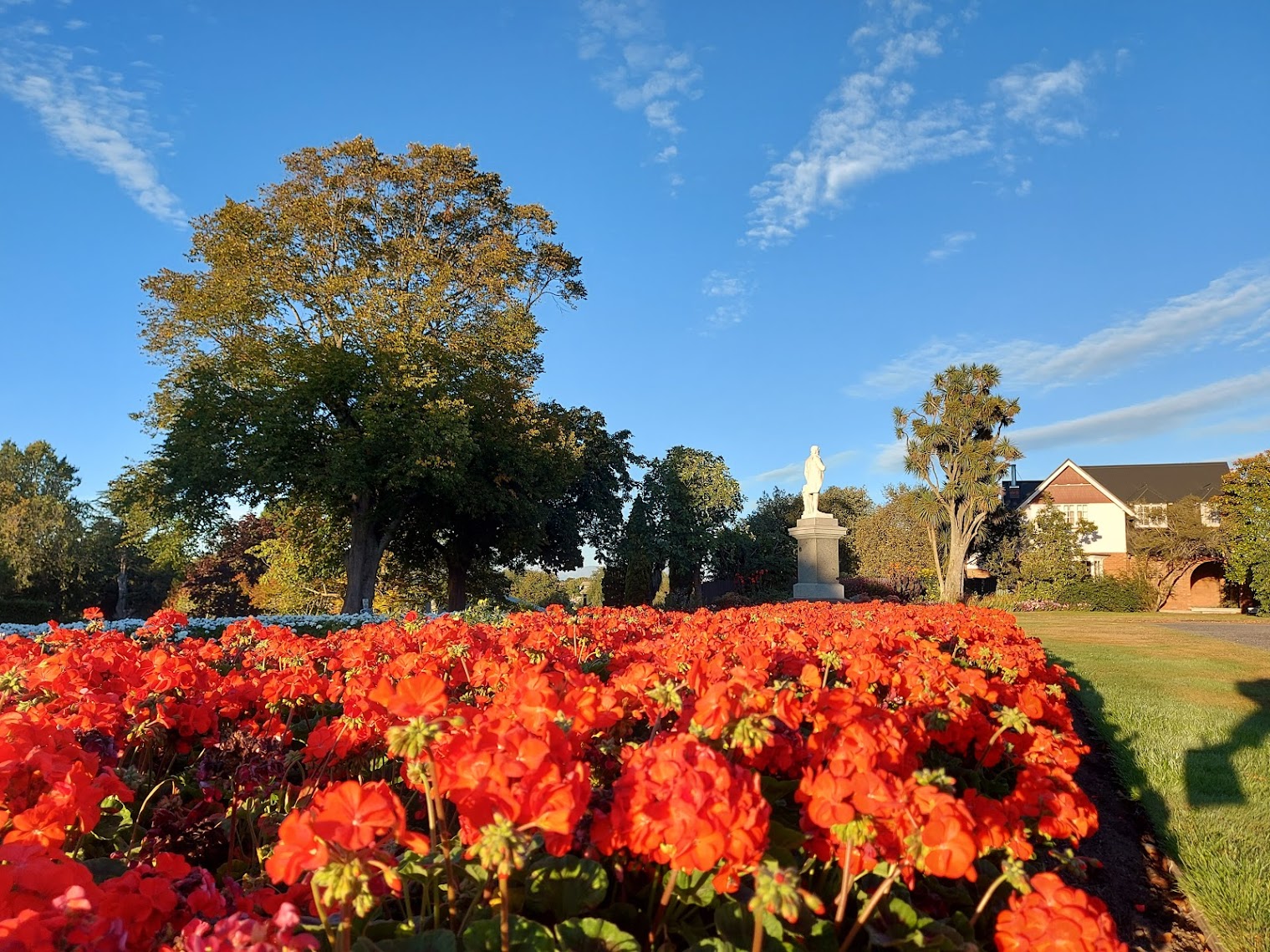
The Park starts to grow up By the early twentieth century, the reserve was becoming something more ambitious. The first glasshouse was built in 1905. The bowling green was excavated in 1908. Football and cricket grounds were levelled. In 1909, a climatological station was established. That mix of uses tells us a lot. The Park was never only about ornamental gardening. It was also about recreation, observation, sport and public life.
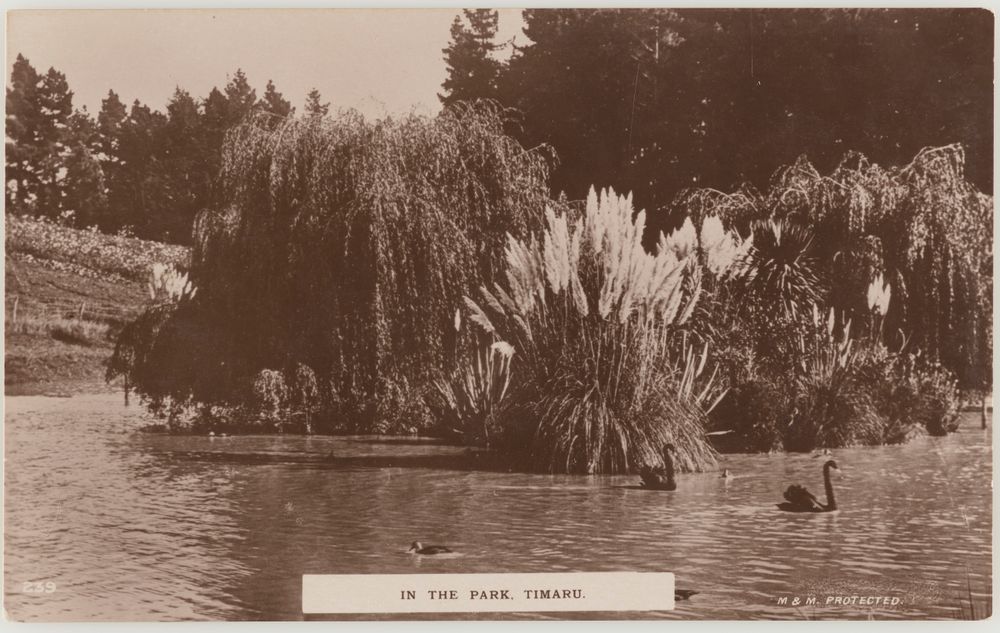
Timaru Botanic Gardens: In the Park, Timaru, 1912, Timaru, by Muir & Moodie. Purchased 1998 with New Zealand Lottery Grants Board funds. Te Papa (PS.002231) No known copyright restrictions.
Public Park, Timaru, N.Z.. Hocken Digital Collections, https://hocken.recollect.co.nz/nodes/view/24162
In 1912, the Coronation Rotunda was opened. The Timaru Herald referred to the grounds as the “Botanical Gardens”, “formerly the Park, but no longer so”.
People were encouraged to bring musical instruments with them to New Zealand when they emigrated. Music was seen as recreation, played in homes, churches, pubs, hotels and outdoor venues such as this band rotunda. Teamed with attractions such as tearooms and gardens, cricket grounds, bowling and croquet greens, tennis courts and band rotundas... Timaru's Botanic Gardens were a wonderful asset for the town.
In The Park, Timaru, N.Z.. Hocken Digital Collections, https://hocken.recollect.co.nz/nodes/view/24223
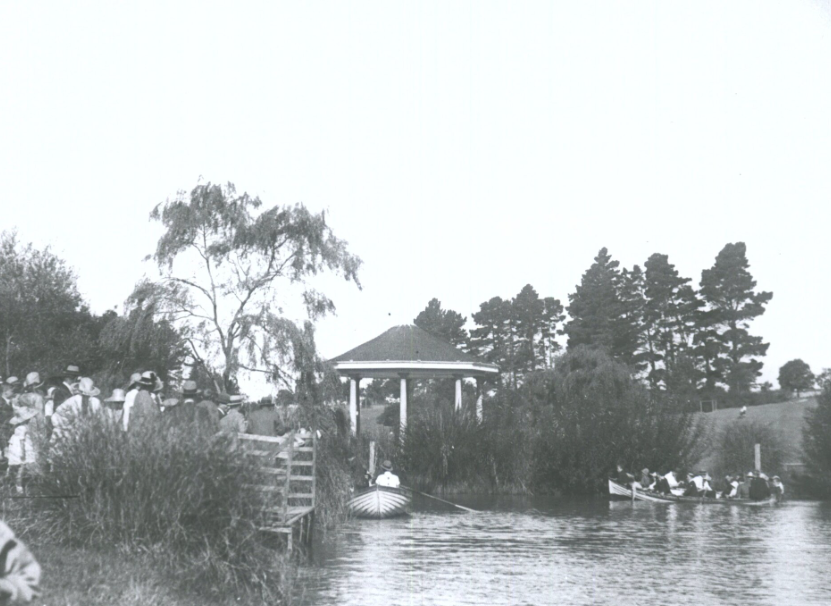
Timaru Park (Mid-late 1920s). Hocken Digital Collections, accessed 08/04/2026, https://hocken.recollect.co.nz/nodes/view/24204
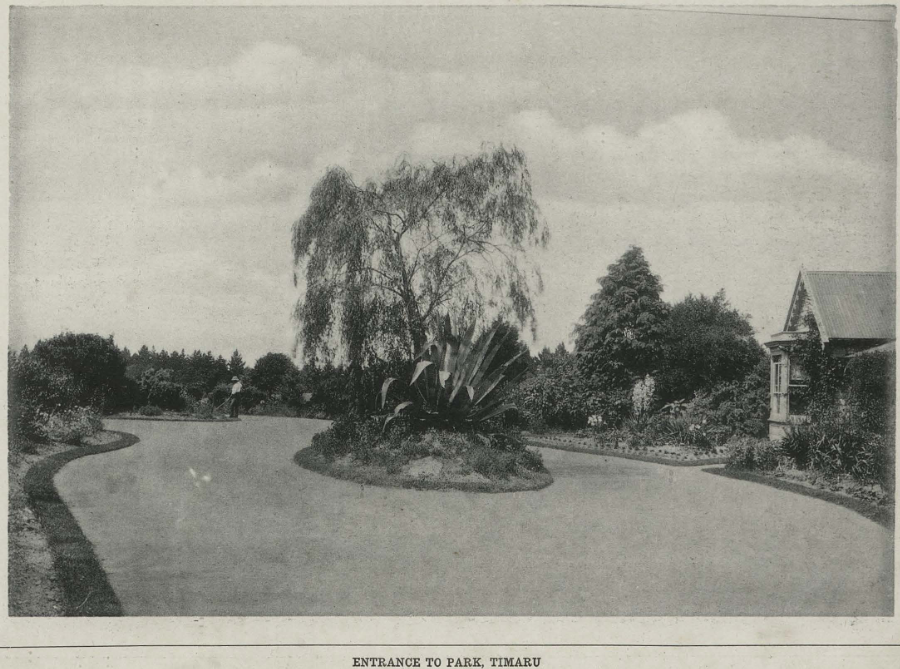
William Ferrier, Album of Views Timaru & District Descriptive & Illustrated. Aoraki Heritage Collection, accessed 04/05/2026, https://aorakiheritage.recollect.co.nz/nodes/view/168 Book of photographs of Timaru and surrounding districts, published by William Ferrier, a well known local photographer, and Thomas Wagstaff, a local bookseller and stationer. Date of Publication 1904. Publisher W Ferrier & T Wagstaff
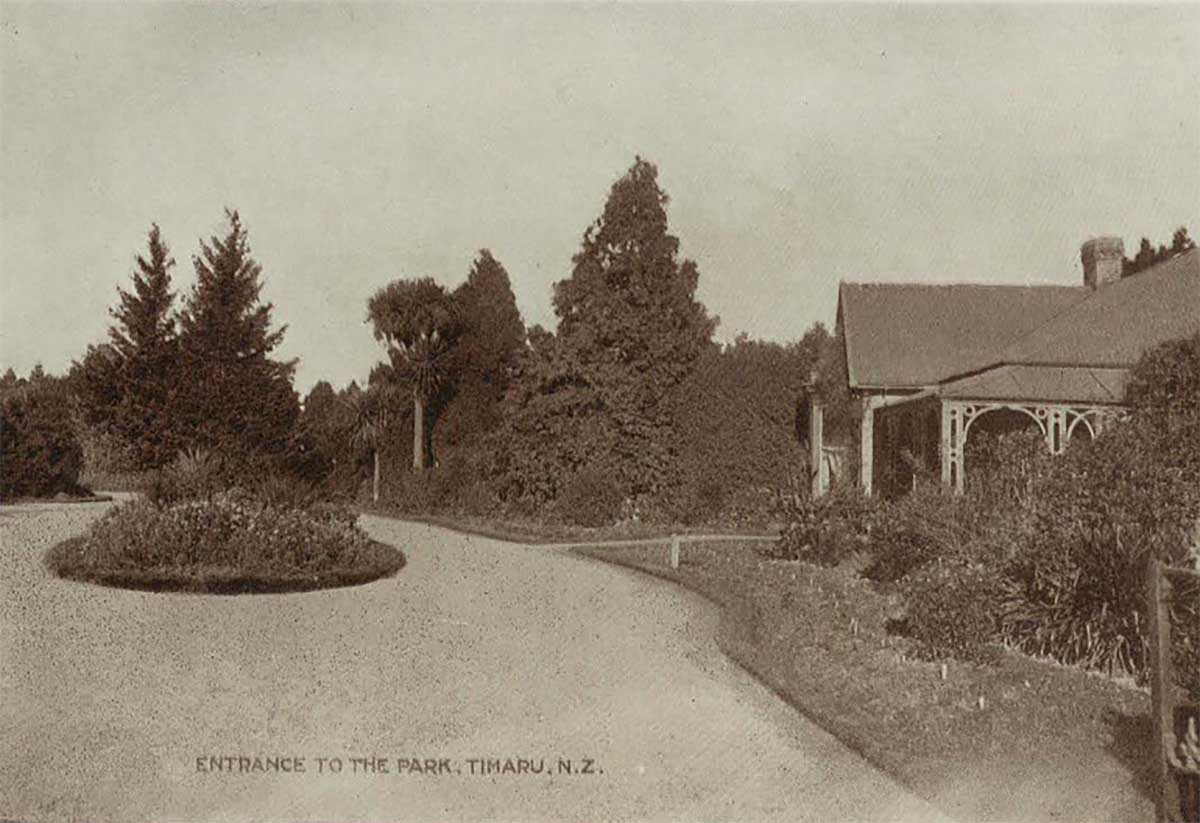
Timaru and surrounding districts Entrance to the Park Aoraki Heritage Collection
You can almost hear the shift in civic confidence. This was no longer just a reserve on the edge of town. It had become a place of gathering, music, ceremony and identity.

James Cragie championed this Statue of Burns; The Unveiling Ceremony at the Timaru Botanic Gardens in May 1913. Aoraki Heritage Collection, https://aorakiheritage.recollect.co.nz/nodes/view/44
Did you know that Timaru had other rotundas too
There had been one in Alexandra Square, and another at Caroline Bay. they were ornate and a similar vintage as this one. A ‘sound shell’ (for concerts) replaced the rotunda in 1937. (There is a band rotunda at Caroline Bay, but this is a more modern one.) Timaru clearly had a stronger culture of outdoor public music than many people would guess now. Bands were a regular part of civic and recreational life, and rotundas gave them a place to play.
As far as the evidence currently suggests, the Botanic Gardens rotunda appears to be the only surviving example from that earlier generation of Timaru bandstands. There is another lovely one in the Temuka Domain and at Waimate's Seddon Square.
Waimates rotunda also opened in 1911 as a memorial to the King Edward VII. It cost 5001 pounds to build with public subscription providing $259 pounds. It was opened by Sir William Steward MP on 8 June 1911 in a Southerly wind and rain. But despite the weather 100 people braved the elements to attend the ceremony. the Mayor of Waimate at the time Mr Norton Francis said the roof and the pillars might require some renewal but the limestone base filled with boulders should always remain.
The Municipal Band Rotunda at the Temuka Domain was built in 1940. Designed in classical style by T Devine,. The Octagonal bandstand was opened by Mayor AW Buzan on 8 December 1940 and erected by the Temuka Municipal Band. The Mayor Buzan had a long association with the Municipal Band. The town’s brass band had been formed in 1880 and often performed in the Domain (aka Victoria Park). the Waimate Silver Band and the Waimate Highland Pipe Band performed at the opening ceremony. - Band rotunda built in 1911 to be restored (28 Feb 1985). Aoraki Heritage Collection https://aorakiheritage.recollect.co.nz/nodes/view/3399
"Construction of the rotunda commenced in September 1940 and, although side panels of ‘coloured wood’ were intended, as built the rotunda was an uncovered concrete structure that might, more accurately, be described as a bandstand. The Municipal Band appears to have finally disbanded in 1957; by which time the Temuka Pipe Band was in existence (est. 1953)." - https://www.timaru.govt.nz/__data/assets/pdf_file/0009/674028/Historic-Heritage-Assessment-Report-HHI207-Municipal-Band-rotunda,-Temuka-Domain-Category-B.pdf
Timaru Park (Mid-late 1920s). Hocken Digital Collections, accessed 08/04/2026, https://hocken.recollect.co.nz/nodes/view/24204
Why band rotundas mattered
It is easy to forget how important brass bands once were. Before recorded music became part of everyday life, bands were one of the main ways music entered public space. They played at civic receptions, sports events, regattas, picnics, parades, openings, and all sorts of local gatherings. Parks and domains were often described as the lungs of the town, places where people could breathe, stroll, meet one another, and be out in the fresh air. Add a band, and the place changed again. It became social in a different way.
The Mayoress cut the ribbon with silver scissors presented as a souvenir. The National Anthem was sung. The Garrison and Marine Bands were there. Crowds stayed afterwards, strolling and sitting about the grounds while the music continued. Someone even said another rotunda was needed at North End Park.
That is such a good local detail. It tells you that this was not seen as a novelty. It was seen as part of the kind of town Timaru wanted to be.
What stays with me most is not the imperial side of the story, though that matters. It is not even the architecture, though I love those details... It is the fact that people here wanted to make something lasting and public and beautiful, and they did it together.
The footballers began it. Citizens helped fund it. The council backed it. The Government added money because of the coronation. Architects designed it properly. Bands animated it. Crowds turned up. And the newspaper, in its slightly grand way, recognised that something had shifted. The south end of town had “come into its own”.
More than a century later, the rotunda is still there. The plaque is still there. The slope around it still hints at the old audience. I think that is why it is worth stopping for and taking notice of this built history.
It tells us that Timaru once believed public life should sound like something. It should look like something too.
And maybe that is still a good ambition for a town.
1875- Plan of Timaru Townships Canterbury, Courtesy of the Timaru District Council. Key features today include: Graeme Paterson Conservatory and Fernery, Ornamental ponds, Interpretive centre, Aviary, Cenotaph and War Memorial Wall, Anderson Rose Garden, Band rotunda, Children's playground, Species Rose Garden, Native plant collections, Threatened plant collections, Ornamental plantings, Pinetum, Queen Victoria Garden, Many plant collections. The Timaru Botanic Gardens provides some very attractive vistas as well as a year round interest for plant lovers. It is a photographer's delight. A highlight for children is feeding the ducks on a Saturday as by Sunday they are usually too well fed to be interested.
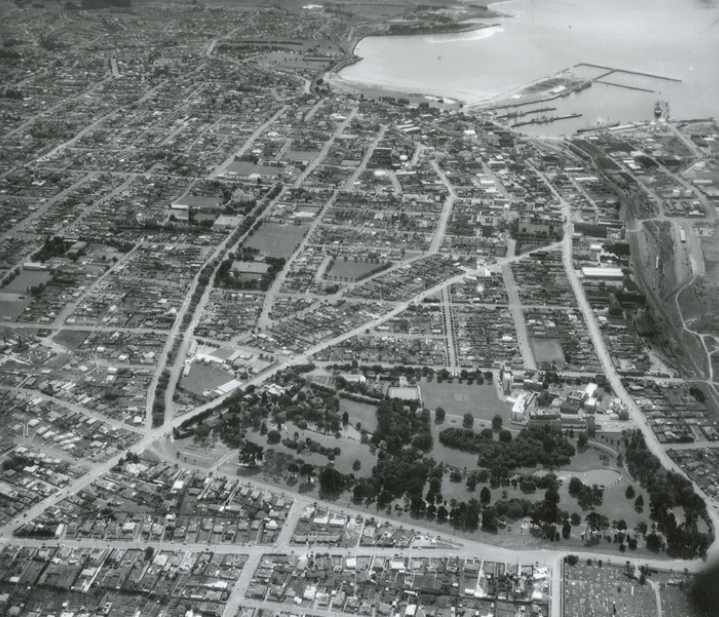
Timaru Publicity Caption Aerial view of Timaru. Photographer V.C. Browne.
Primary newspaper sources
Timaru Herald, 14 March 1912, “Music in the Park”
https://paperspast.natlib.govt.nz/newspapers/THD19120314.2.43
Timaru Herald, 15 March 1912, “Botanical Gardens. The Coronation Rotunda. Brilliant Opening Ceremony.”
https://paperspast.natlib.govt.nz/newspapers/THD19120315.2.3
Timaru Herald, 25 May 1911, “Coronation Memorial”
https://paperspast.natlib.govt.nz/newspapers/THD19110525.2.3
Timaru Herald, 21 February 1911, “Timaru’s Commerce”
https://paperspast.natlib.govt.nz/newspapers/THD19110221.2.5
Timaru Herald, 18 January 1904, Alexandra Square rotunda construction reference
https://paperspast.natlib.govt.nz/newspapers/THD19040118.2.8
Timaru Herald, 28 April 1904, Alexandra Square rotunda opening notice
https://paperspast.natlib.govt.nz/newspapers/THD19040428.2.5
Timaru Herald, 28 April 1904, Alexandra Square with band rotunda reference
https://paperspast.natlib.govt.nz/newspapers/THD19040428.2.28
Timaru Herald, 24 November 1905, Caroline Bay rotunda reference
https://paperspast.natlib.govt.nz/newspapers/THD19051124.2.5
Sun, 7 March 1917, obituary of Frederick William Marchant
https://paperspast.natlib.govt.nz/newspapers/SUNCH19170307.2.10
Official and heritage sources
Timaru District Council, Timaru Botanic Gardens
https://www.timaru.govt.nz/community/recreation/gardens/timaru-botanic-gardens
Timaru District Council, Timaru Botanic Gardens History Book
https://www.timaru.govt.nz/news-and-events/latest-news/timaru-botanic-gardens-history-book
Timaru District Council, James Craigie, Hall of Fame
https://www.timaru.govt.nz/community/our-district/hall-of-fame/category-three/james-craigie
Timaru District Council heritage report, Caroline Bay Soundshell
https://www.timaru.govt.nz/__data/assets/pdf_file/0005/673853/Historic-Heritage-Assessment-Report-HHI30-Caroline-Bay-Soundshell-Category-B.pdf
Timaru District Council heritage report, Orari Buildings / Herbert Hall context
https://www.timaru.govt.nz/__data/assets/pdf_file/0007/673900/Historic-Heritage-Assessment-Report-HHI77-Orari-Buildings-Category-B-NEW.pdf
Collection and image sources
Aoraki Heritage Collection, Timaru Botanic Gardens band rotunda plaque
https://www.aorakiheritage.recollect.co.nz/nodes/view/4900
Aoraki Heritage Collection, Timaru Botanic Gardens band rotunda
https://aorakiheritage.recollect.co.nz/nodes/view/4901
Aoraki Heritage Collection, In the Gardens Timaru NZ
https://aorakiheritage.recollect.co.nz/nodes/view/29
National context sources
Te Ara, City parks and green spaces
https://teara.govt.nz/en/city-parks-and-green-spaces/print
Te Ara, Brass and pipe bands
https://teara.govt.nz/en/brass-and-pipe-bands/print
NZHistory, Dominion status
https://nzhistory.govt.nz/page/dominion-status
NZHistory, New Zealand Coat of Arms warranted
https://nzhistory.govt.nz/page/new-zealand-coat-arms-warranted
International context source
Westminster Abbey, George V
https://www.westminster-abbey.org/abbey-commemorations/royals/george-v
Detailed timeline with local, national, and international context
1840s to 1860s: the bigger background
1840, international and colonial context: The Treaty of Waitangi is signed, and British colonial structures expand across New Zealand. In the same broad era, industrial Britain’s overcrowded cities help shape the idea that public parks are essential urban “lungs”.
1840s to 1860s, national: Military and volunteer bands become part of colonial New Zealand life, laying the foundations for the later brass-band movement.
1864, local: Land at the south end of Timaru is reserved for public use, the beginning of what became The Park and later the Timaru Botanic Gardens.
1868, local: Planting is underway in the reserve. Early development is gradual and practical.
1870s to 1900: a park culture grows
1872, local: £200 is set aside for a ranger’s cottage, and the public are invited to donate trees, shrubs, bulbs, roots, and seeds.
Late nineteenth century, national: Brass bands flourish across New Zealand and become central to outdoor entertainment, public ceremonies, sports events, and parades.
Late nineteenth century, national: Band rotundas become common in parks and domains, reinforcing the role of public green spaces as social and musical gathering places.
1901 to 1907: Timaru’s public spaces become more ambitious
1904, local: Alexandra Square has a band rotunda under construction by January, and an opening notice appears in April.
1904 to 1905, local: Caroline Bay also has a band rotunda, and Craigie later refers to its opening in December 1904.
1905, local: The first glasshouse is built in Timaru’s gardens, showing the reserve becoming more horticulturally ambitious.
1907, national: New Zealand becomes a Dominion within the British Empire on 26 September.
1910 to 1911: the imperial moment arrives
1910, international: George V becomes king after the death of Edward VII.
21 February 1911, local: Timaru’s Chamber of Commerce reports strong shipping and trade figures, reflecting a confident port economy.
22 June 1911, international: King George V and Queen Mary are crowned at Westminster Abbey.
25 May 1911, local: The Rugby Union discusses creating a permanent coronation memorial. Hospital-related ideas are considered, then set aside in favour of a more lasting public project. James Craigie pushes the idea of a rotunda in the Park.
26 August 1911, national and imperial: George V issues the royal warrant for New Zealand’s first coat of arms, another marker of New Zealand’s place within the Empire.
1911, local: The plaque on the Timaru rotunda records the memorial year as 1911, tying it directly to the coronation.
1912 to 1914: Timaru’s south end comes into its own
14 March 1912, local: The citizens’ band rotunda is officially opened. The Timaru Herald records the footballers’ initiative, the public fundraising, Government subsidy, Hall and Marchant’s design, Baird and Sons’ construction, and the natural amphitheatre setting east of the pond.
15 March 1912, local: The paper describes the grounds as the Botanical Gardens, “formerly the Park, but no longer so”, and says the south end of town has “come into its own.” The ceremony includes the Mayor and Mayoress, the Hon. T. Mackenzie, the Garrison and Marine Bands, ribbon-cutting, and cheers.
1912, local: Hall and Marchant are active in Timaru as architects and are associated with other substantial local commissions around this period.
1913, local: James Craigie donates the Robert Burns statue to the Botanic Gardens.
1914, international: The First World War begins, soon reshaping public life, memorial culture, and civic priorities across New Zealand and beyond. This is not directly part of the rotunda story, but it helps show how brief and vivid this pre-war civic optimism was.
Later context
1917, national and local: Frederick William Marchant’s obituary remembers him as a notable civil engineer associated with Timaru’s earlier harbour works.
2014, local and national: Timaru Botanic Gardens are recognised as a Garden of National Significance by the New Zealand Gardens Trust.
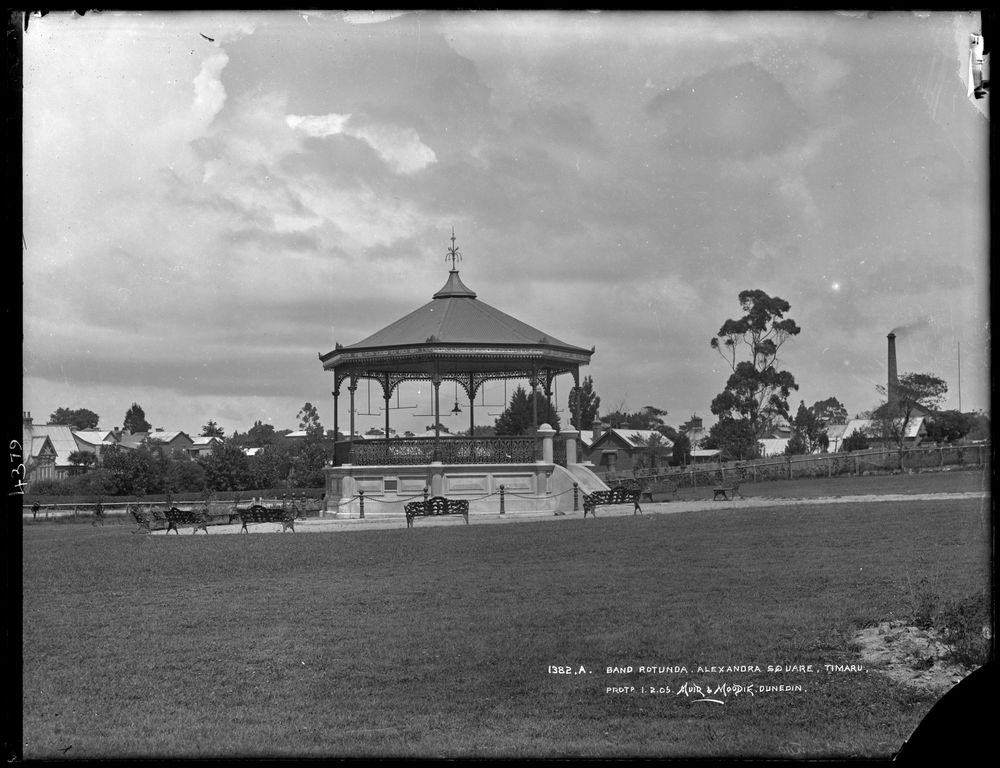
Band Rotunda, Alexandra Square, Timaru, circa 1905, Dunedin, by Muir & Moodie. Te Papa (C.014379)
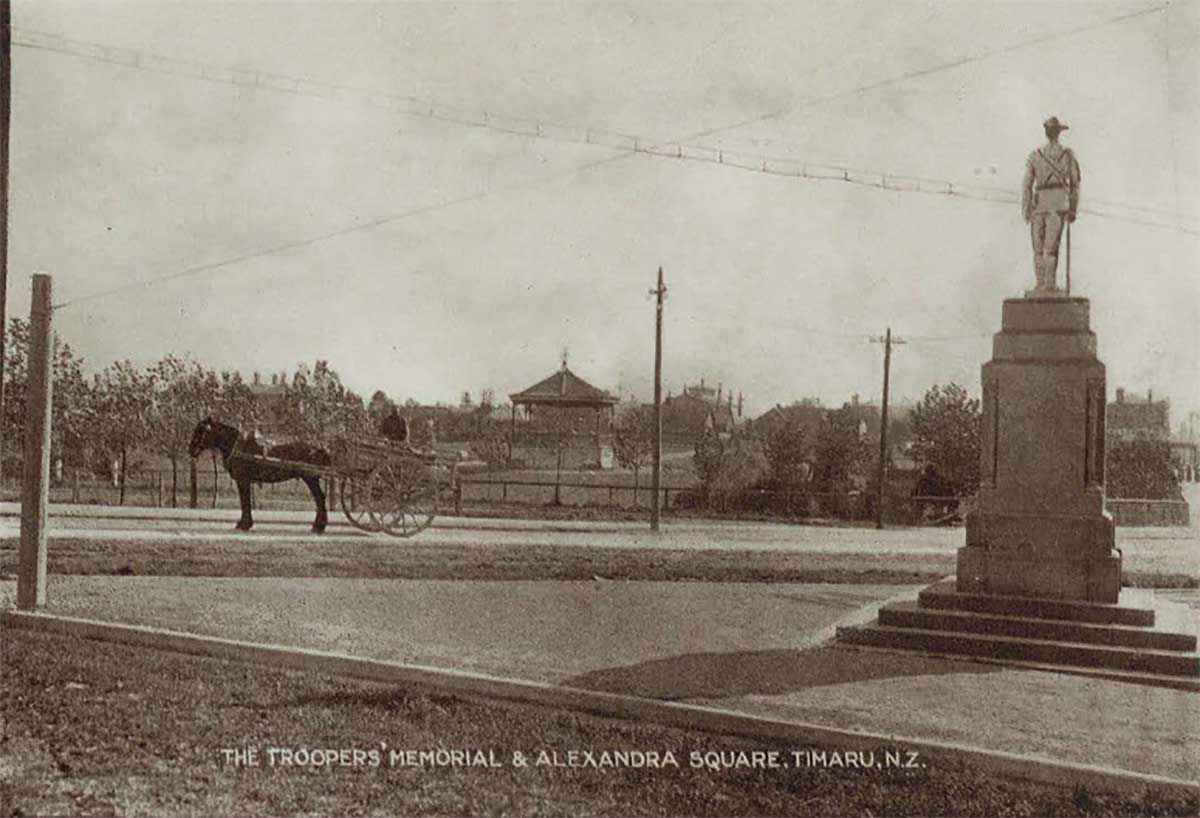
Official Guide: Timaru and surrounding districts. Aoraki Heritage Collection, accessed 10/05/2026, https://aorakiheritage.recollect.co.nz/nodes/view/8923
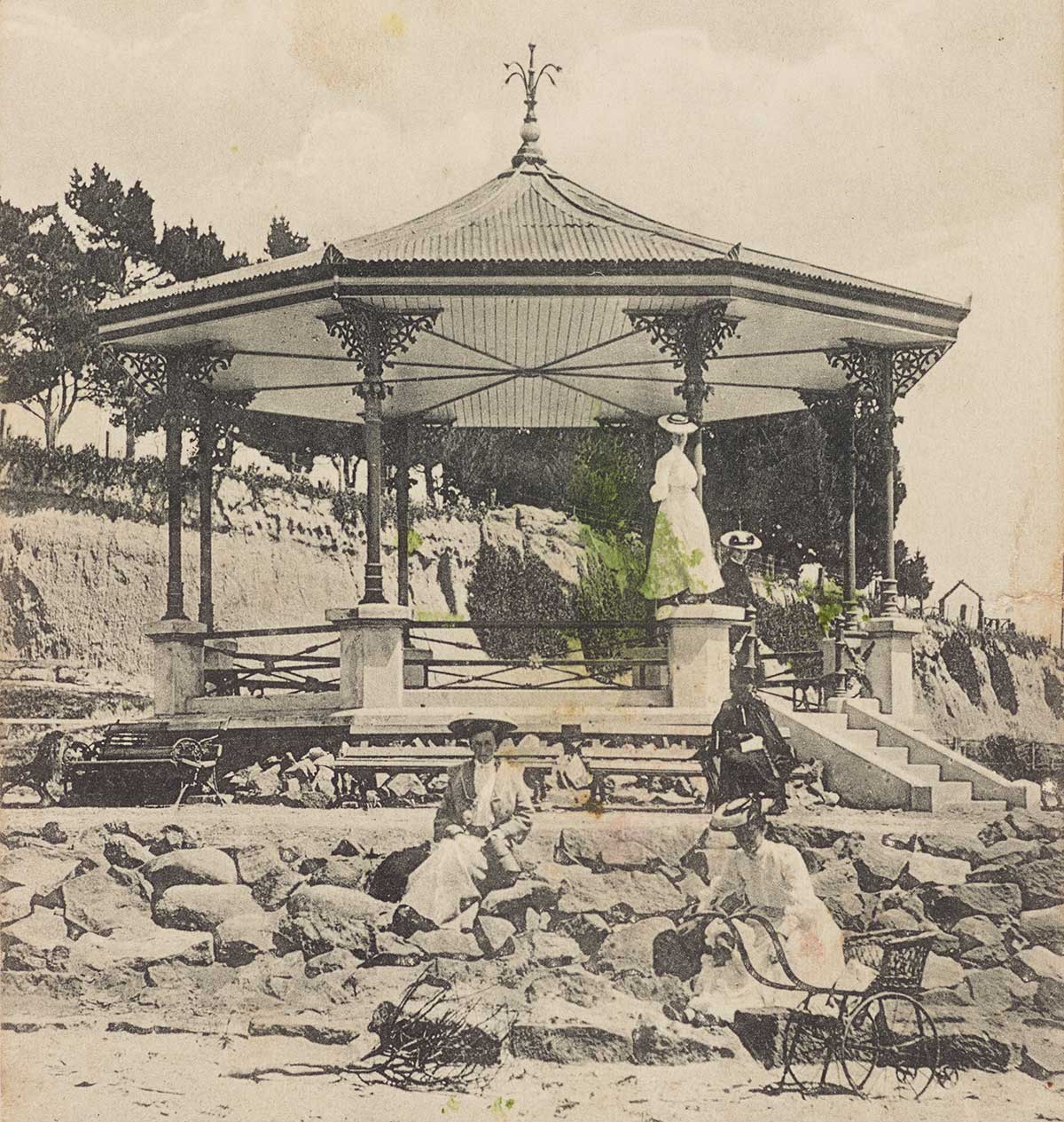
Band Rotunda, Timaru Esplanade, New Zealand, 1904-1915, Timaru, by Muir & Moodie. Purchased 1998 with New Zealand Lottery Grants Board funds. Te Papa (PS.002378)
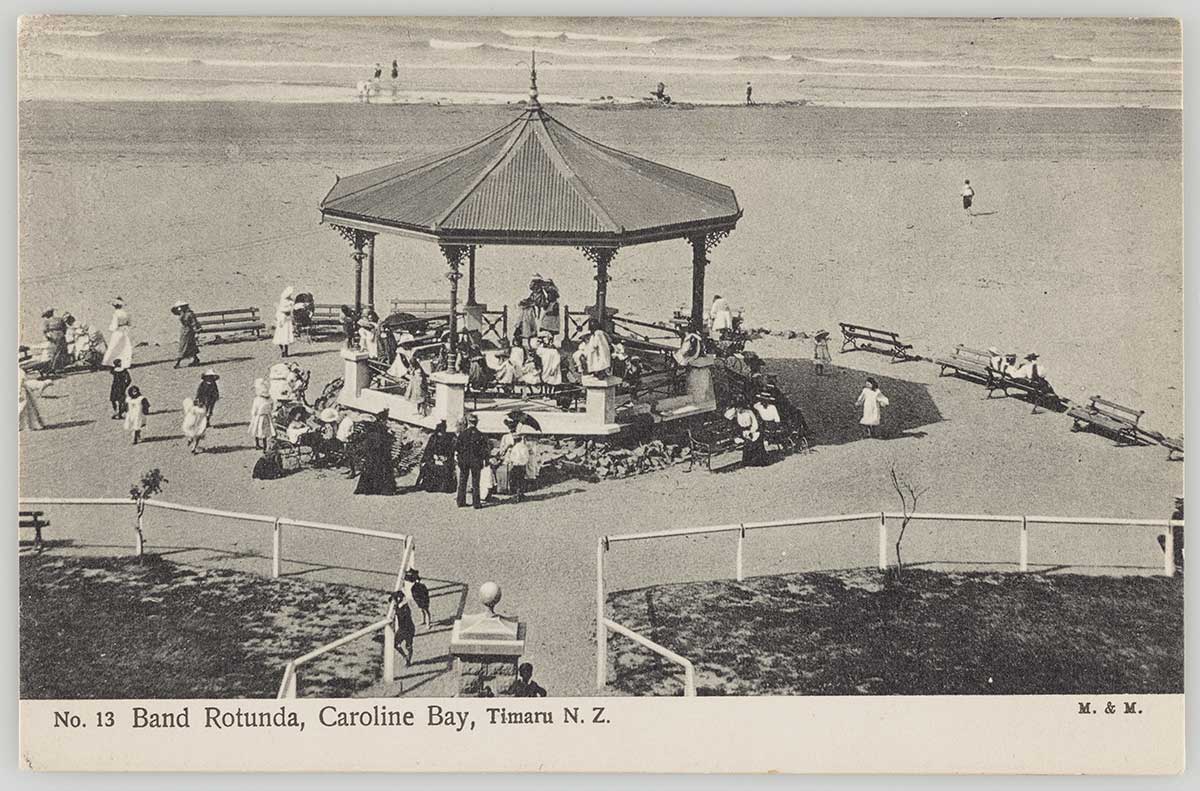
Band Rotunda, Caroline Bay, Timaru, New Zealand, 1904-1915, Timaru, by Muir & Moodie. Purchased 1998 with New Zealand Lottery Grants Board funds. Te Papa (PS.001047)
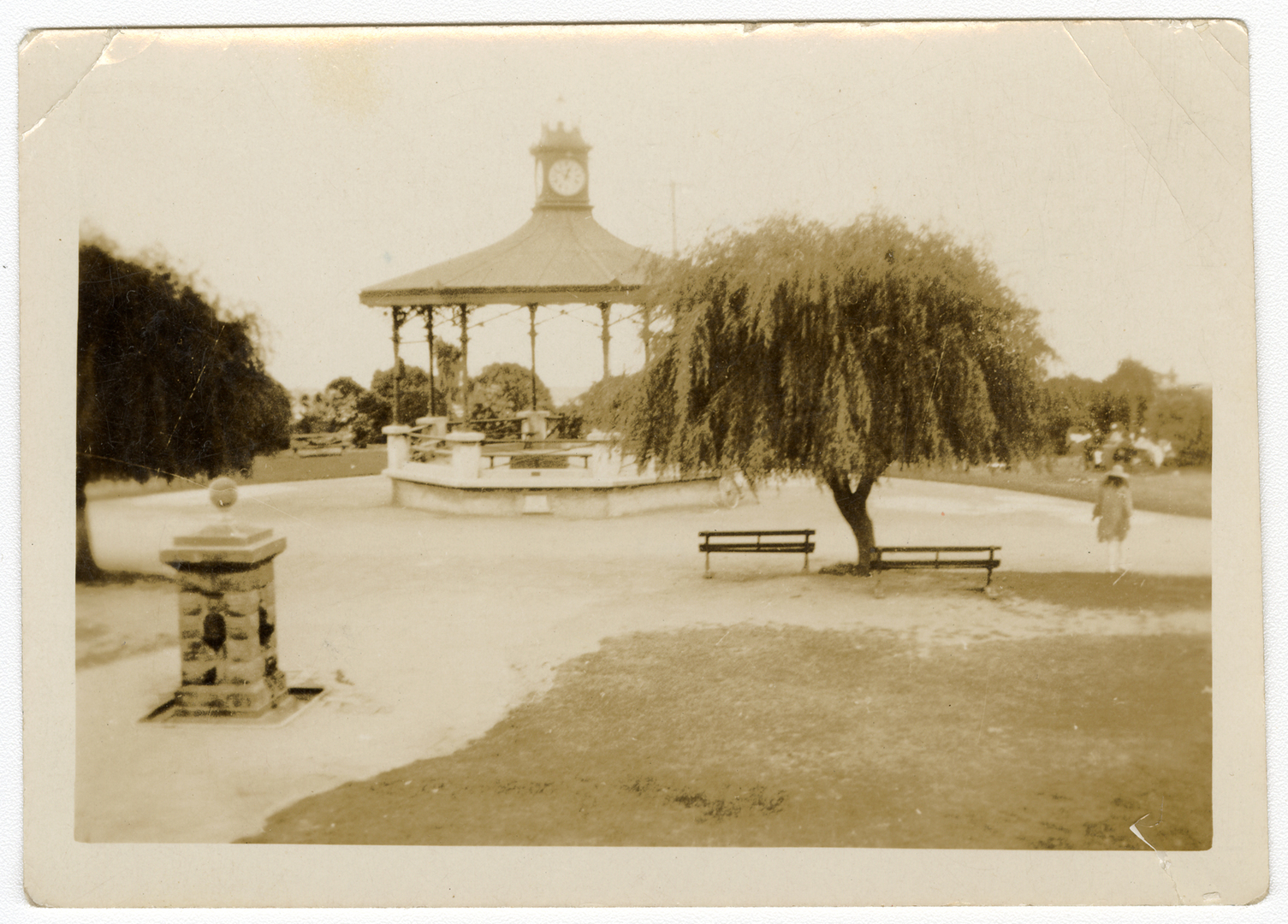
Band Rotunda at Caroline Bay 4264 - Christchurch Star archive. Archive 1072. Copy prints. Arch 1072/1/2/1 https://www.canterburystories.nz/collections/star/prints/1900-1939/ccl-cs-4264
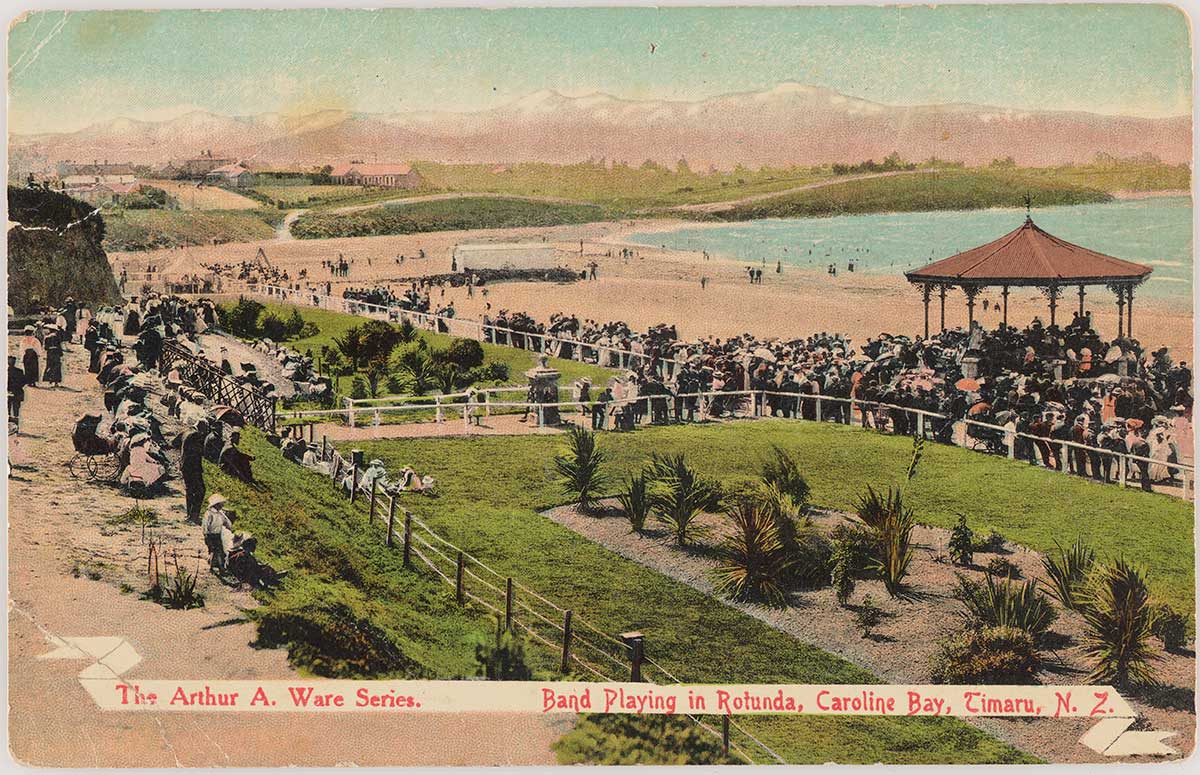
Band playing in rotunda, Caroline Bay, Timaru, New Zealand, 1903-1907, by Arthur A. Ware Company. Purchased 1998 with New Zealand Lottery Grants Board funds. Te Papa (PS.002468)
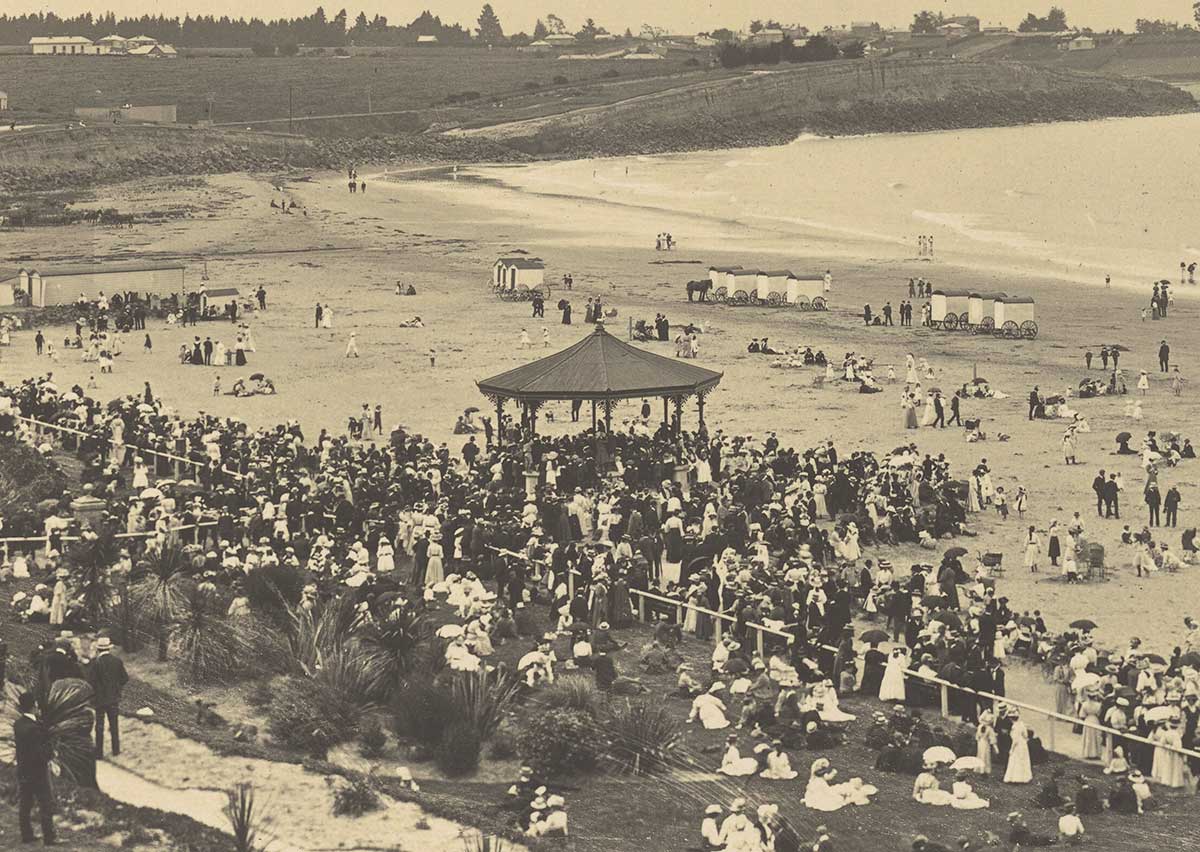
Caroline Bay, Timaru, seaside resort, circa 1910, Timaru, by William Ferrier. Te Papa (O.051440)
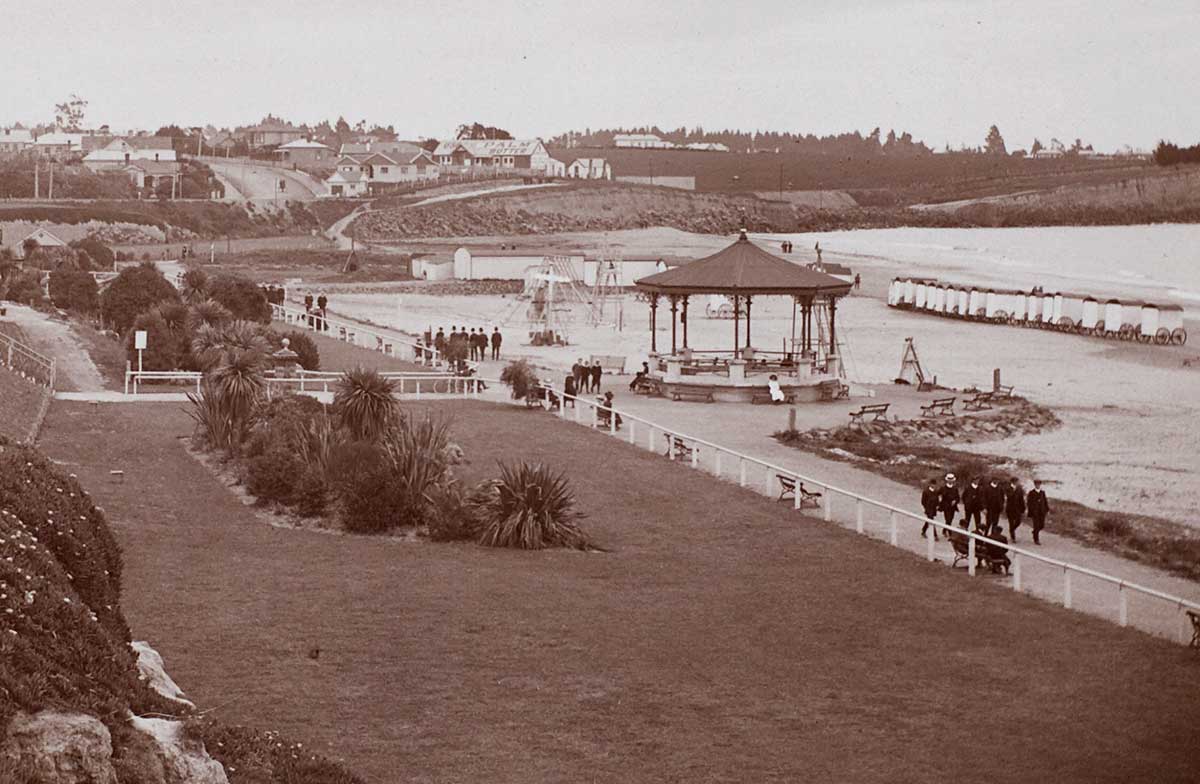
Section of a photo of the beach at Timaru, Timaru, by Burton Brothers. Te Papa (O.019251)
Master timeline: Timaru Botanic Gardens Band Rotunda and the growth of The Park
1864 Local residents asked the Canterbury Provincial Council to reserve land at the southern end of Timaru for public use. The land was set aside as Reserve 314, around 23 hectares in all.
Part was marked off for hospital purposes, and the remainder became what locals called The Park.
Late 1860s Planting began in The Park. The public were encouraged to donate trees, shrubs, bulbs, roots, and seeds. Early development years A ranger was appointed. Budgets were slowly allocated. Trees were planted mainly around the perimeter. Much of the remaining land was still leased for grazing stock. Some early planting work was done by prisoners from Timaru Gaol. A macrocarpa hedge was planted to shelter the grounds while the new plantings established.
1872 £200 was set aside for a ranger’s cottage.
1875 Plans of the Timaru townships show The Park reserve clearly in place.
1904 Timaru already had an earlier band rotunda in Alexandra Square. It was opened in 1904 and later remembered as having been gifted by Charles Bowker. This shows the Botanic Gardens rotunda was not Timaru’s first bandstand.
Around 1905 Caroline Bay also had an early band rotunda, built by private subscription, later replaced by the soundshell. Timaru was already developing a pattern of public music in outdoor spaces.
1905 The first glasshouse was built in The Park.
1908 The bowling green was excavated. Football and cricket grounds were also levelled around this period.
1909 A climatological station was established in The Park.
1911 The coronation of King George V and Queen Mary gave Timaru the reason for the memorial.
The rotunda plaque preserves 1911 as the commemorative year.
May 1911 The Rugby Union, led by its president Arthur Shirtcliffe, discussed creating a permanent coronation memorial for Timaru. A hospital-related idea was considered first, but set aside as not lasting enough. Shirtcliffe said the footballers wanted to do something that would show loyalty and benefit the district. James Craigie, then mayor, encouraged them to think bigger and suggested a rotunda in the Park. (This comes from the 25 May 1911 newspaper report used throughout the research.)
1911 fundraising A football match raised £60. James Craigie donated £30. The Borough Council gave £50. The balance came from public subscriptions and other local support, bringing Timaru’s total to £157. Because the rotunda was accepted as the town’s coronation memorial, the Government matched that amount, bringing the final total to £314. (This funding breakdown is drawn from the 1911–1912 newspaper material used throughout the research.)
1911–1912 design and construction The rotunda was designed by Herbert Hall and Frederick William Marchant, trading as Hall and Marchant. It was built by Messrs Baird and Sons. The rotunda had an octagonal footprint, was about 23 feet in diameter, and had wide concrete steps. It had eight fluted reinforced concrete columns, hand-moulded caps, grey cement work, and brown-stained shingled eaves beneath a russet brown roof. The timber ceiling curved downward to conserve and spread the sound. It stood east of the pond, where the surrounding slopes formed a natural amphitheatre. (These details come from the March 1912 opening reports and associated research used in the blog and column work.)
14 March 1912 The Coronation Band Rotunda was officially opened. The opening postcard image shows crowds surrounding the rotunda while the Timaru Garrison Band, under Bandmaster Schnook, played the first tune.
15 March 1912 — report of the opening ceremony
The Timaru Herald described the event in rich detail:
The paper said the new band rotunda had opened in the “Botanical Gardens, formerly the Park, but no longer so”.
It said the south end of the town had at last “come into its own.”
The weather was described as brilliant, with a cloudless sky.
A large crowd gathered on both sides of the valley where the rotunda stood.
The scene was described as picturesque, with flowers, sombre coloured trees, green lawns, and the dresses of the ladies combining to create a very pretty effect.
Present were the Mayor and Mayoress, members of the Borough Council, many representative citizens, and the Hon. T. Mackenzie.
The Garrison and Marine Bands were both in attendance.
Arthur Shirtcliffe’s speech
Arthur Shirtcliffe, president of the Rugby Union, spoke first.
He described the rotunda as a work of loyalty to King George V and Queen Mary.
He said the footballers had first thought of raising only £20 or £25, but that Craigie urged them to abandon the “pea rifle” and aim with a “4.7 inch gun”, encouraging them to think on a much larger scale.
Shirtcliffe publicly thanked those who had helped raise the money.
Before the opening, he presented Mrs Craigie with a pair of silver scissors as a souvenir and asked her to cut the ribbon.
Opening moment
The Mayoress, Catherine Craigie, stepped forward and cut the ribbon.
Shirtcliffe then asked Mr Craigie, as first citizen, to take possession of the rotunda on behalf of the people of Timaru and declare it open.
A verse of the National Anthem was sung.
Cheers were given.
Mayor Craigie’s remarks
Craigie thanked Shirtcliffe and the footballers.
He also thanked them for the honour shown to Mrs Craigie.
He thanked Messrs Hall and Marchant for designing the building and supervising the work.
He praised the beauty of the gardens and said that no town in the Dominion had a better domain.
He contrasted the Park of ten years earlier, when only £100 a year was being spent on it, with the improved grounds of 1912.
He said some hundreds of pounds were now being spent annually on the Park and praised their excellent curator.
He noted that, once trams were running, families in the far north and west of town would have no excuse not to visit.
He thanked the bands for their assistance and called for three cheers for the footballers.
John Hole’s remarks
John Hole proposed a vote of thanks to Craigie for his generous donation of £20.
He argued that another rotunda was needed at North End Park.
Three “real Timaru cheers” were then given for the Mayor.
After the speeches, the bands played again and people strolled or sat about the grounds enjoying the gardens to the accompaniment of music.
1913 James Craigie presented the Robert Burns statue to the people of Timaru in the gardens.
1914 A Floral Fete committee was formed to raise funds for further improvements. A rustic bridge was built over the lower pond. A native bush area was established.
1919 The first children’s playground arrived in the Park.
1920 The Floral Fete committee raised most of the money for the tea kiosk.
1921 The tea kiosk contract was awarded.
1922 The tea kiosk opened in time for the Floral Fete.
1923 Windows, chairs, and tables were added to the tea kiosk after complaints that the roughcast walls were ruining people’s clothing.
1927 Park patronage was growing strongly. Attractions included possums, kea, swans, deer, emu, and even a monkey called Bridget.
Depression era Unemployed men were engaged for manual work, including digging improvements to the duck ponds by hand.
1935 The Gloucester Gates were opened by the Duke of Gloucester.
1936–1939 The cactus house, tropical house, and fernery were added. Some 20,000 daffodil bulbs were donated between 1936 and 1939. In 1938, the Timaru Herald reported about 2,000 roses in bloom across more than 120 varieties.
1940 Pupils of South School planted 60 trees along the Domain Avenue frontage.
1945 Deer kept in the gardens escaped, caused damage, endangered staff, and were eventually destroyed.
1946 A carob tree was planted beside the Gloucester Gates.
1948 The Park officially became the Timaru Botanic Gardens in 1948. Important caution: this sits alongside the fact that newspapers were already calling the grounds the “Botanical Gardens” in 1912, while “The Park” continued in use for years after. So 1912 shows public use of the name, while 1948 may represent a formal official change. That formal renaming date is worth confirming from council records before treating it as beyond doubt. Also in 1948, a tōtara was planted near the band rotunda to celebrate Timaru becoming a city.
Early 1930s onward A. W. Anderson became a major figure in Timaru’s parks and reserves. He was associated with native plant conservation, wider beautifying work across South Canterbury, and later received the Loder Cup.
1960 The Queen Victoria Garden Fountain was moved into the gardens from in front of the Timaru District Council building. The sunken gardens were established around it.
1964 The bird aviary opened.
1965 The weather station in the gardens became the basis for the temperature reported for Timaru on national news, replacing the colder reading taken at the port.
1973 The tea kiosk closed when the tenant did not renew the lease.
1974 New glasshouses and amenities buildings were constructed.
1975 A major storm damaged many trees in the gardens.
1980 A commemorative tree was planted for John Lennon.
1989 The Species Rose Collection was established.
1991 The tea kiosk reopened as an education centre.
1994 A commemorative planting marked 100 years since the first ascent of Aoraki / Mount Cook.
2005 The Timaru Species Rose Border received the inaugural Heritage Roses Award.
2006 A major snowstorm, the biggest since 1946, caused significant damage throughout the gardens.
2014 The gardens celebrated 150 years since the land was formally gazetted as a public park. A Metrosideros ‘Maungapiko’ was planted to mark the anniversary. The Timaru Botanic Gardens were recognised as a Garden of National Significance by the New Zealand Gardens Trust.
Band Rotunda's around Aotearoa New Zealand
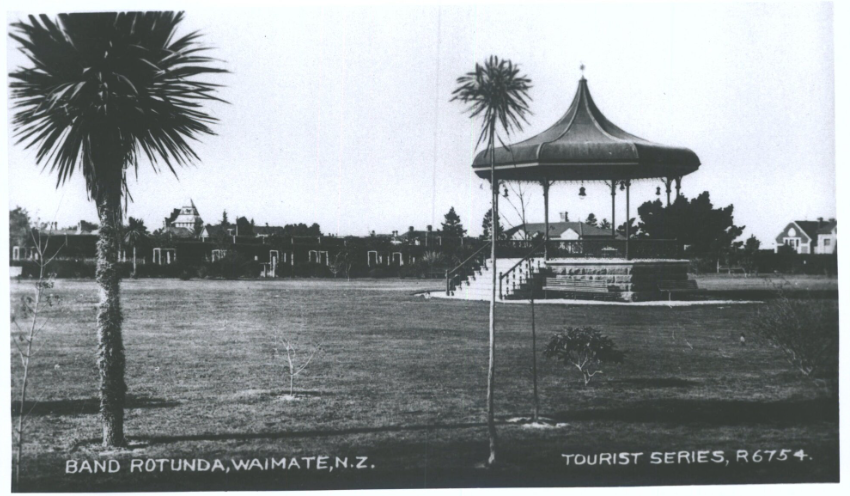
Band Rotunda, Waimate, N.Z.. Hocken Digital Collections, accessed 28/04/2026, https://hocken.recollect.co.nz/nodes/view/26751
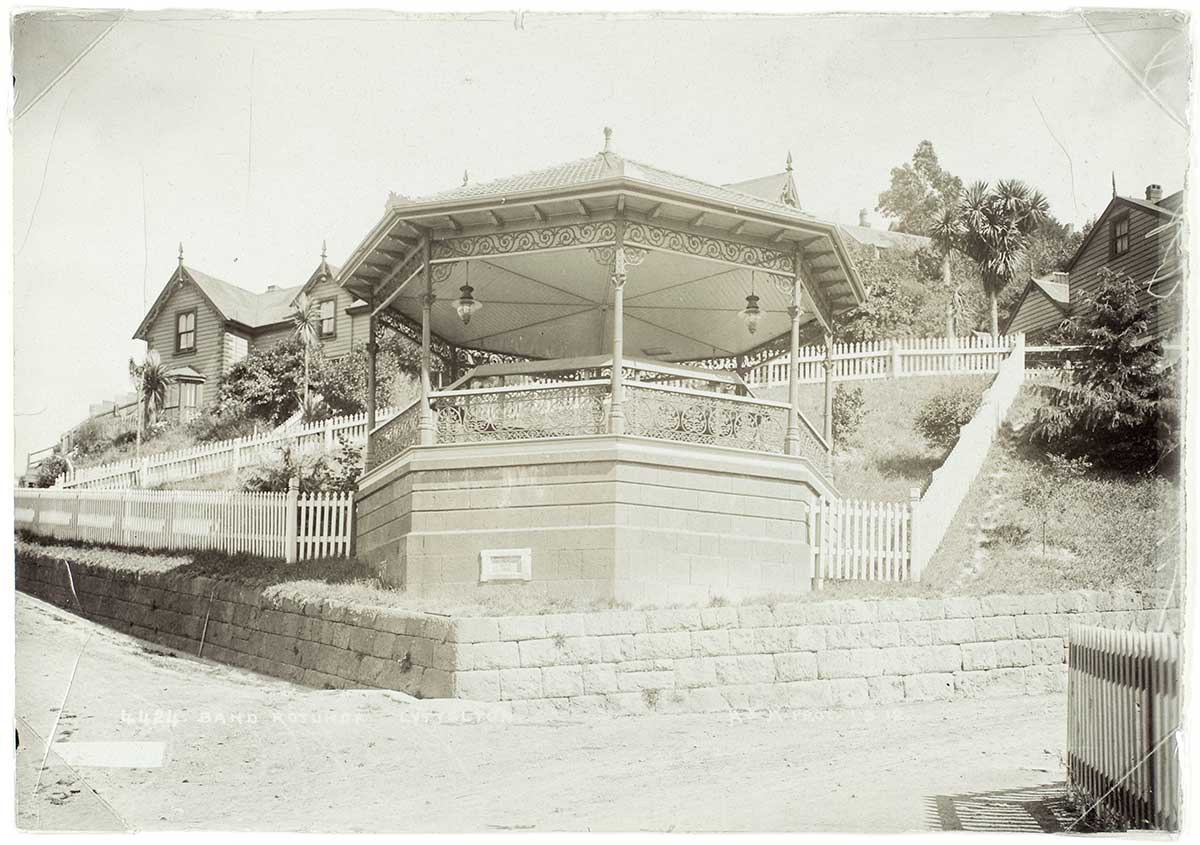
Band Rotunda, Lyttelton, 1912, Lyttelton, by Muir & Moodie. Te Papa (O.000859)
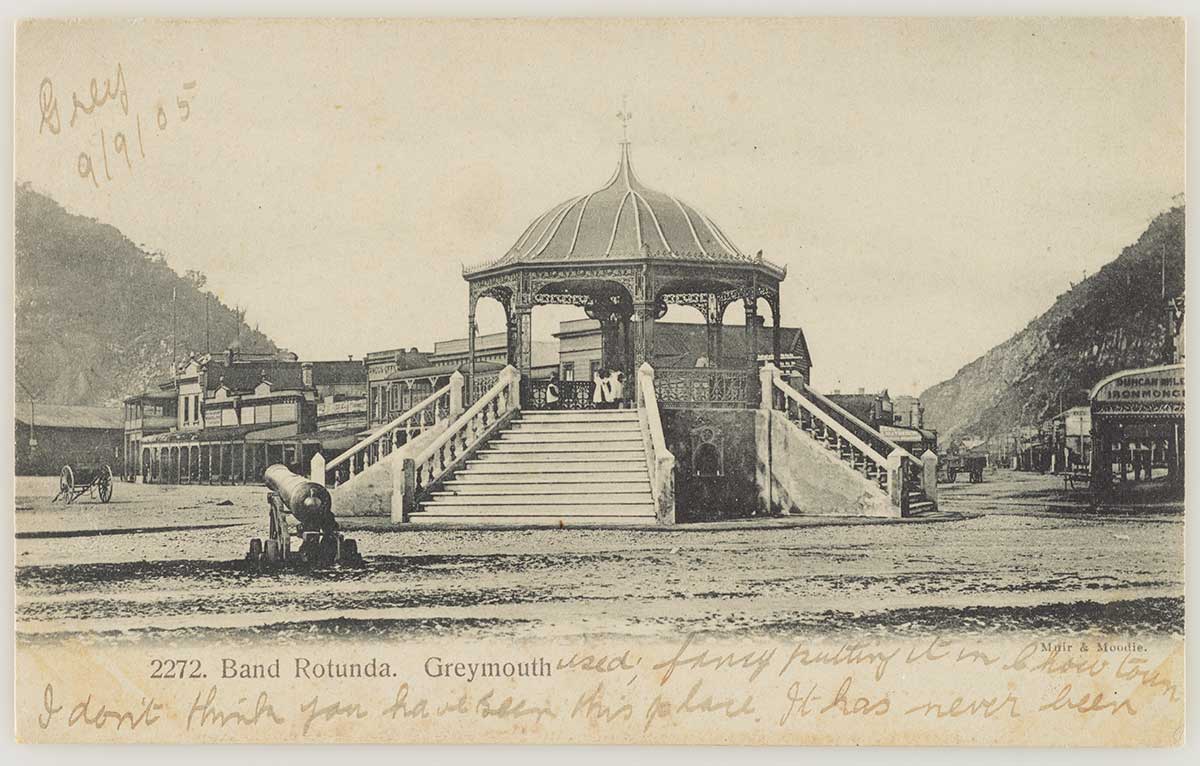
Band Rotunda, Greymouth, 1904, Greymouth, by Muir & Moodie. Purchased 1998 with New Zealand Lottery Grants Board funds. Te Papa (PS.001198)

Postcard: With Love from Greymouth : Band Rotunda, Greymouth, 1905. (Source: Jeremy de Korte Collection)
References: Dixon, B. (1910). With Love from Greymouth : Band Rotunda, Greymouth [Postcard]. B. Dixon, Bookseller, Greymouth, N.Z.
Posted in Band Rotunda, Band Stands & Rotundas. Tagged Band Rotunda, New Zealand, Greymouth, West Coast
Postcard: With Love from Greymouth : Band Rotunda, Greymouth, 1905. (Source: Jeremy de Korte Collection)
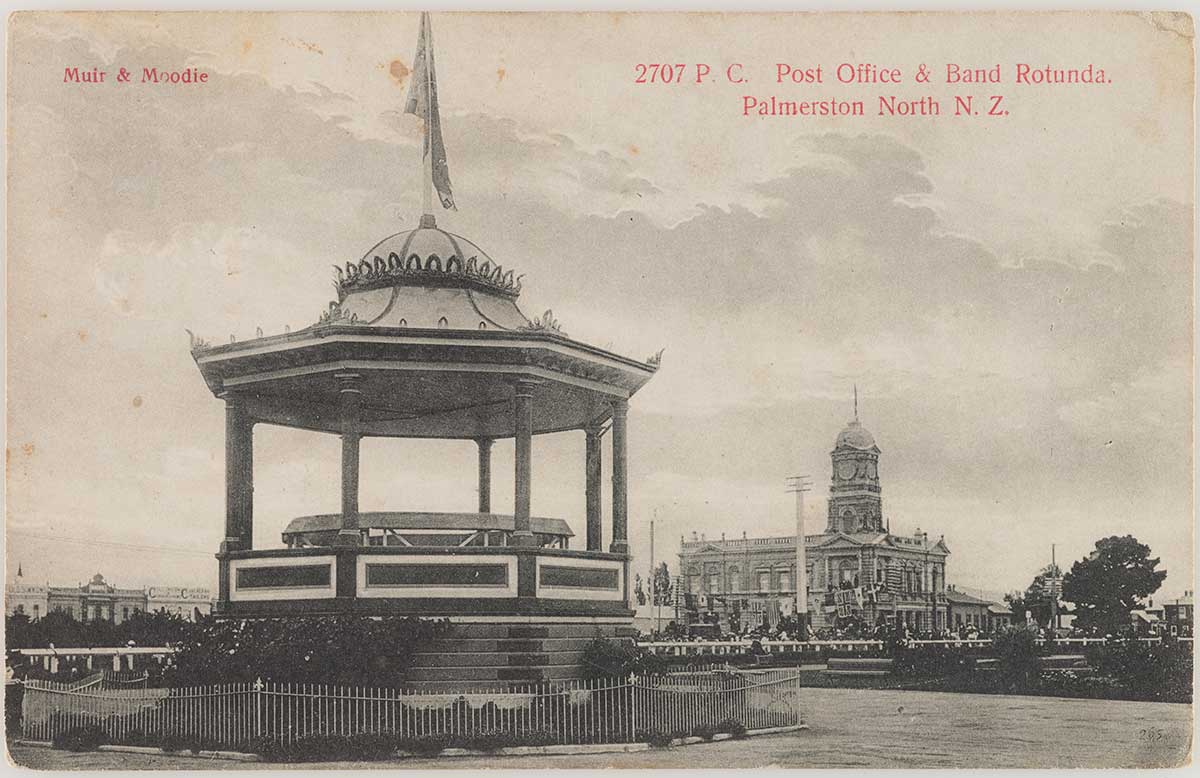
Post Office and Band Rotunda, Palmerston North, New Zealand, 1904-1915, Palmerston North, by Muir & Moodie. Purchased 1998 with New Zealand Lottery Grants Board funds. Te Papa (PS.001813/02)
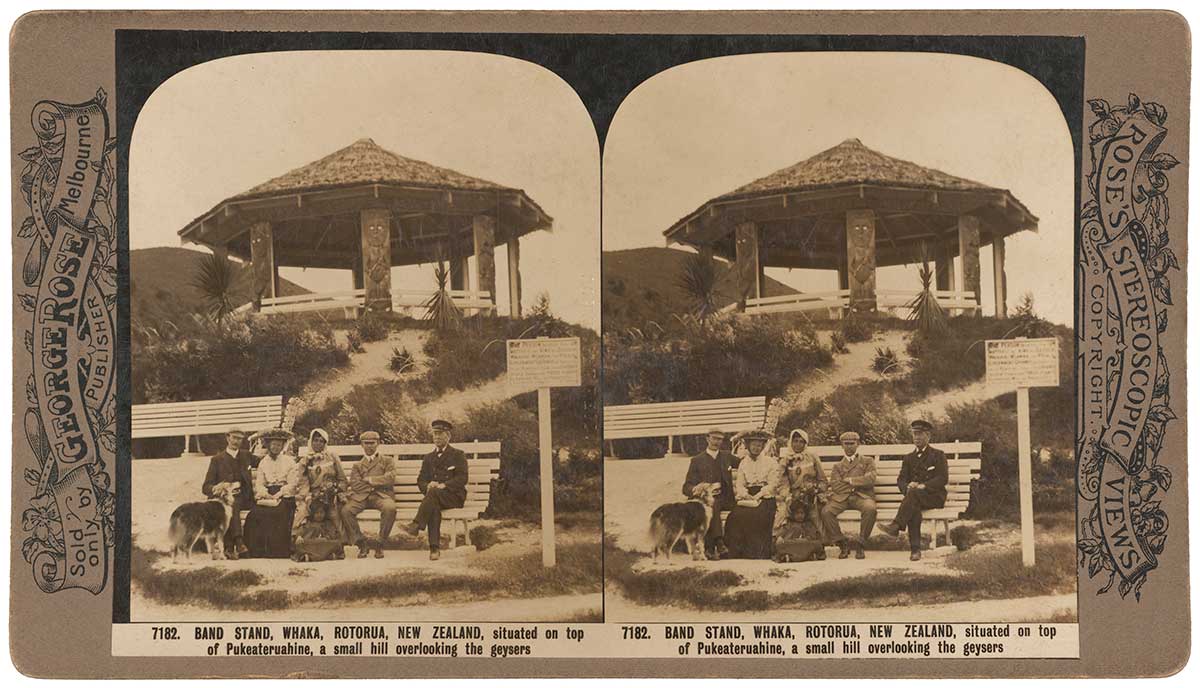
Band Stand, Whaka, Rotorua, New Zealand ..., circa 1900, Melbourne, by George Rose. Purchased 1991. Te Papa (O.004834)
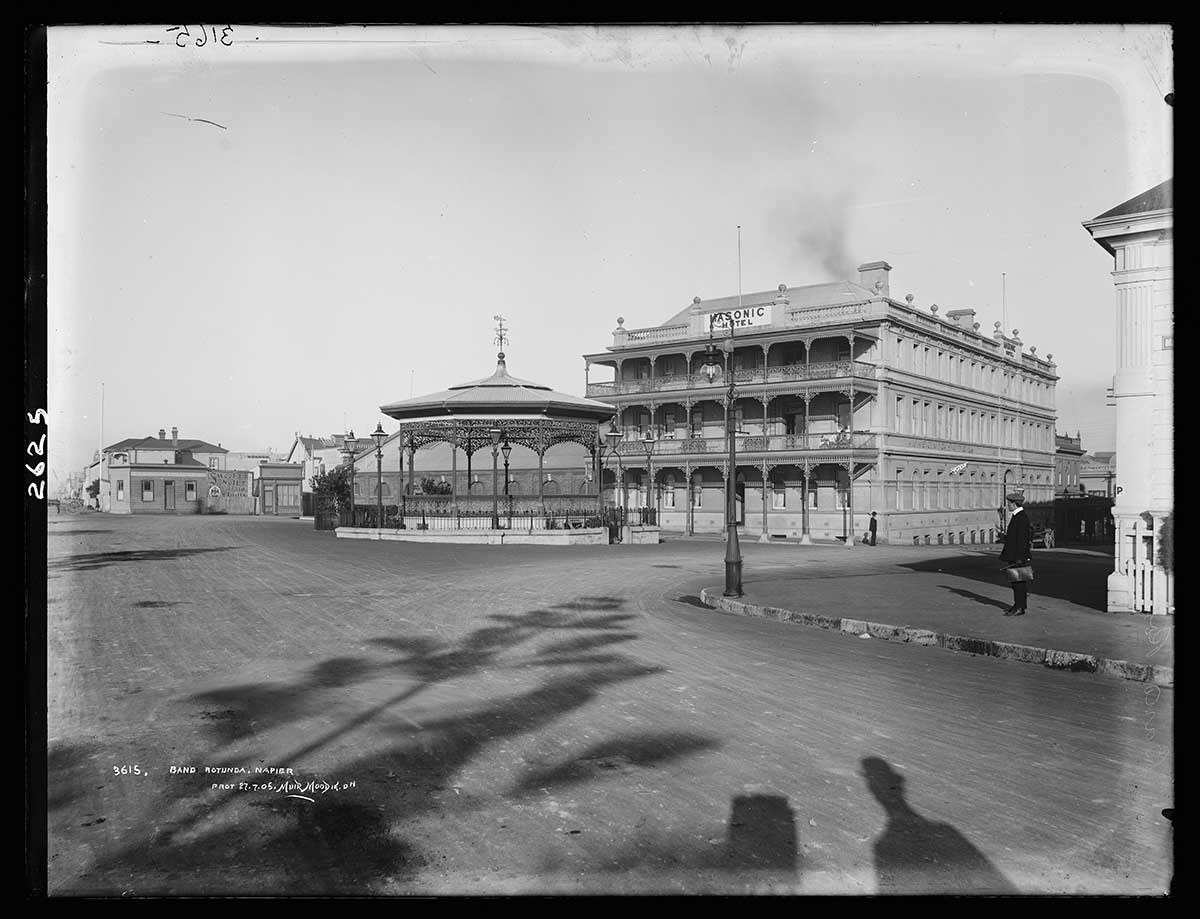
Band rotunda, Napier, circa 1905, Dunedin, by Muir & Moodie. Te Papa (C.012625)
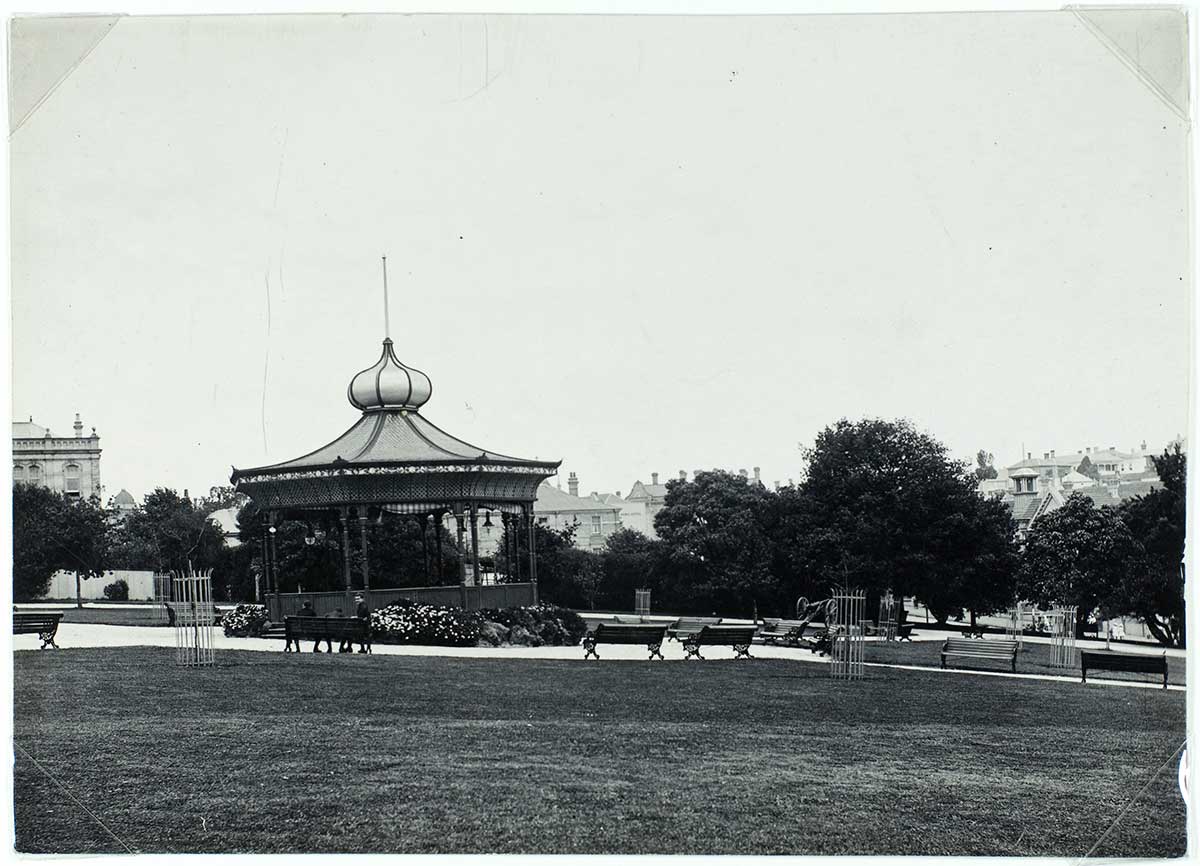
Albert Park, Rotunda on left, Auckland, circa 1912, Auckland, by Muir & Moodie. Te Papa (O.001718)
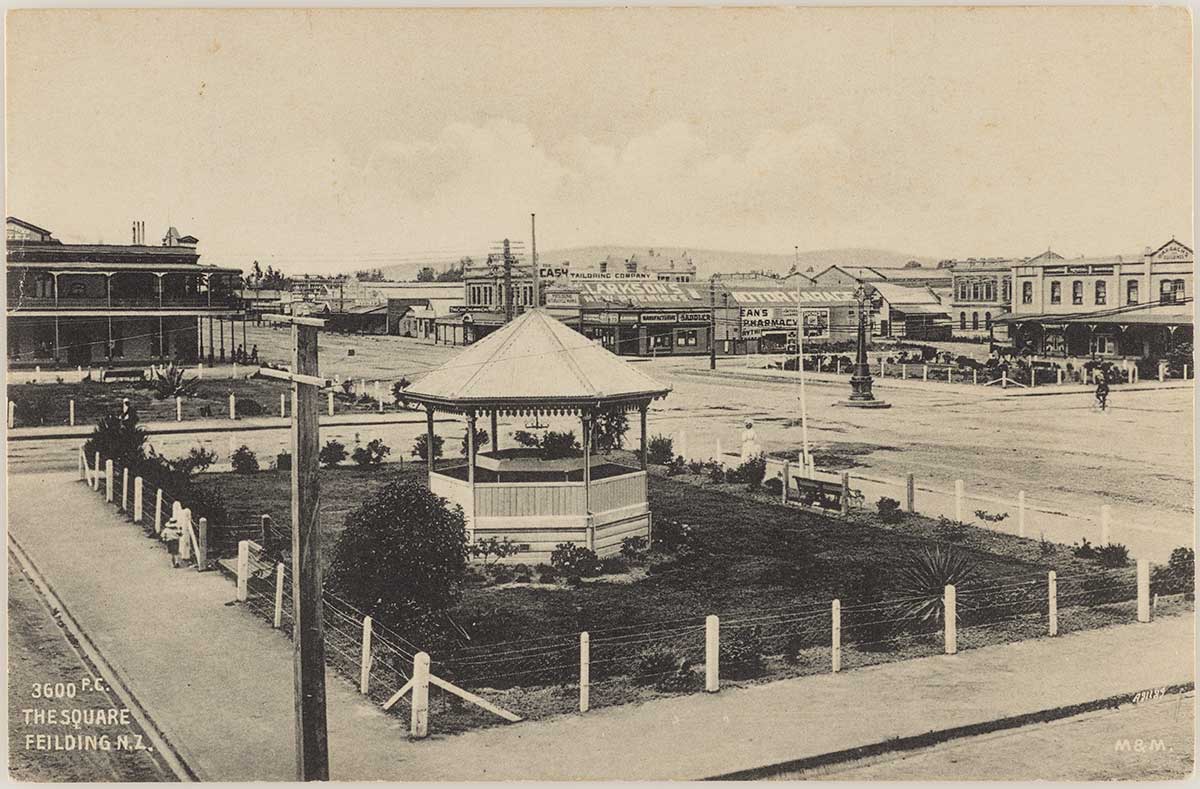
The Square, Feilding, New Zealand, 1909, Feilding, by Muir & Moodie. Purchased 1998 with New Zealand Lottery Grants Board funds. Te Papa (PS.001656)
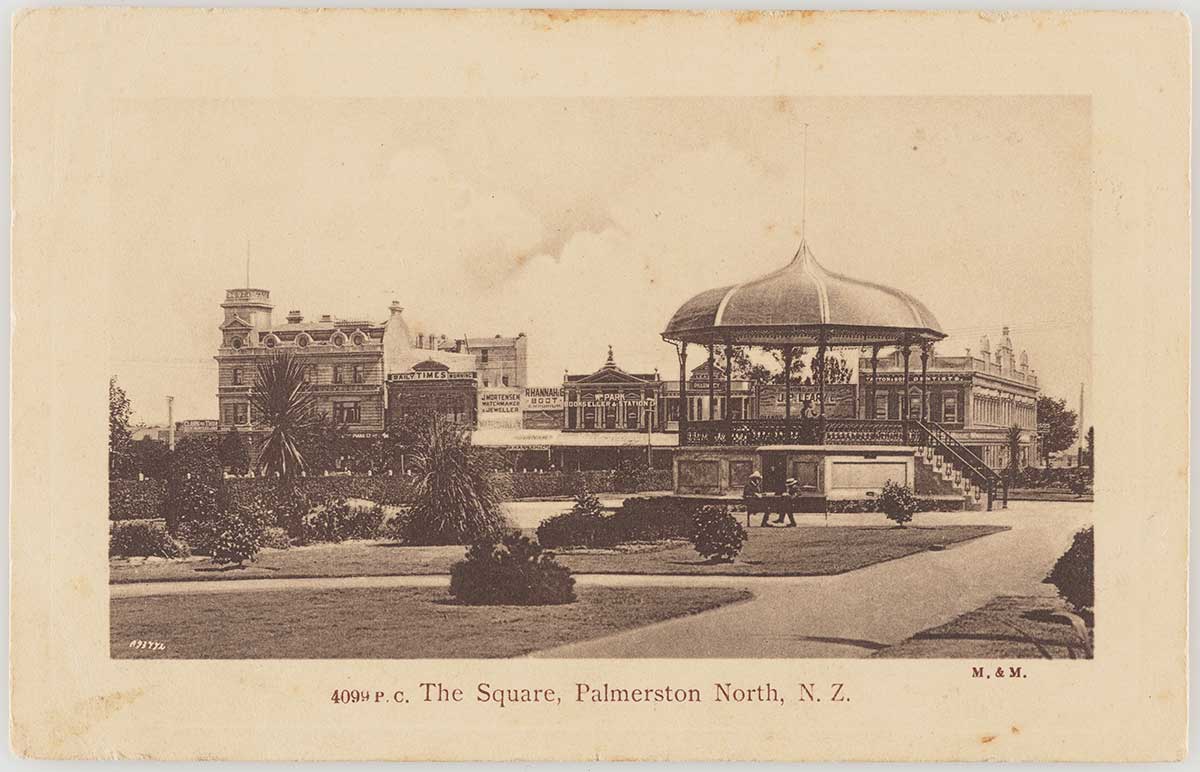
The Square, Palmerston North, New Zealand, 1909, Palmerston North, by Muir & Moodie. Purchased 1998 with New Zealand Lottery Grants Board funds. Te Papa (PS.002158)
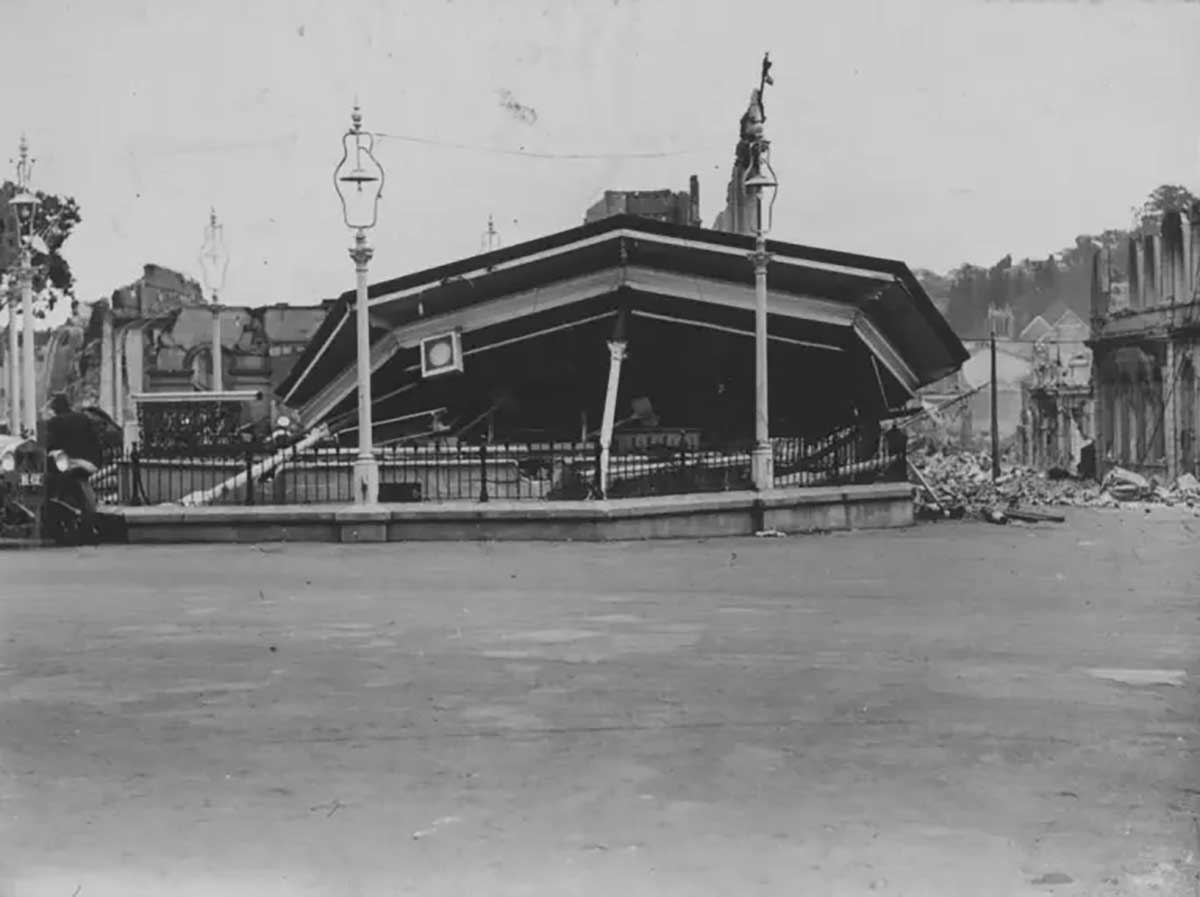
Photograph: A photograph of the band rotunda on Marine Parade in Napier taken after the Hawke’s Bay earthquake on 3 February 1931. The structure collapsed as a result of the quake.
(Source: Collection of Hawke’s Bay Museums Trust, Ruawharo Tā-ū-rangi, 2039 [gifted by Pam Tong]: 84129)
References: Band Rotunda, Napier. (1931). [Black and white photograph glued into an album on black card]. [84129]. Hawke’s Bay Museum, Collection of Hawke’s Bay Museums Trust, Ruawharo Tā-ū-rangi, 2039. https://collection.hawkesbaymuseum.com/objects/84129/band-rotunda-napier
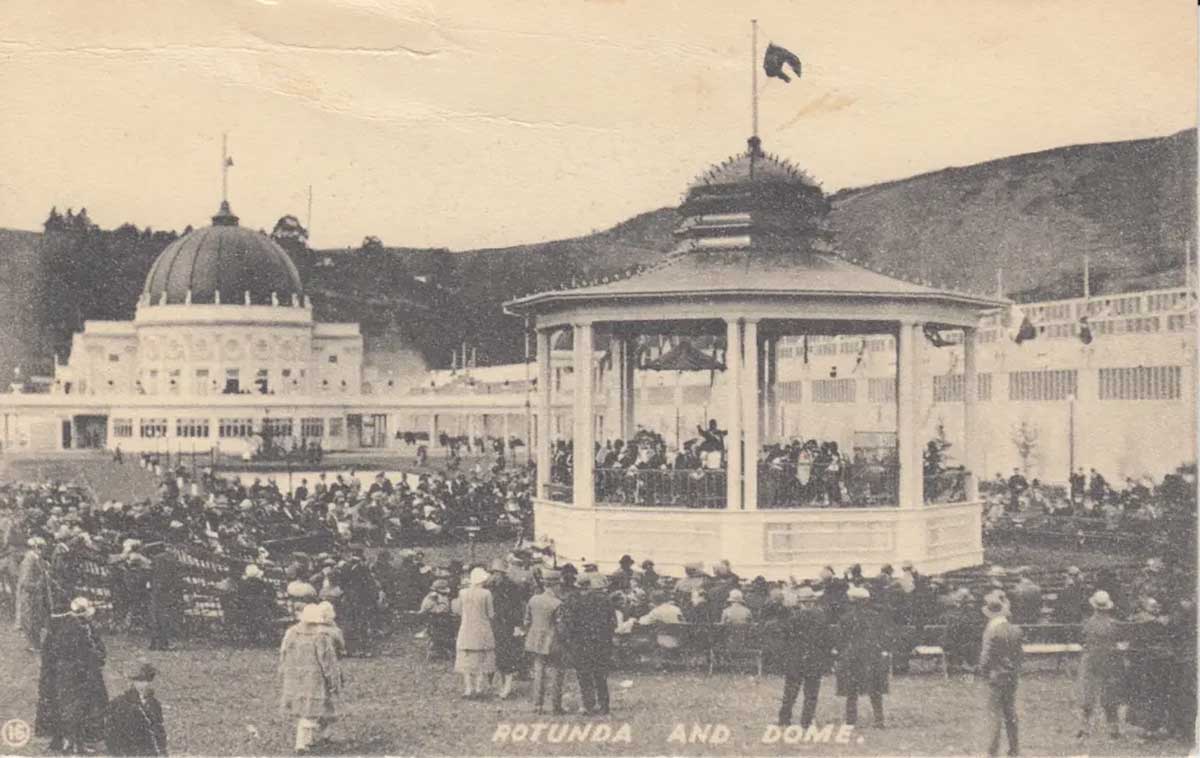
Postcard: Rotunda and Dome, 1925. (Source: Jeremy de Korte Collection)
Reference: Neill, H., & Neill, G. K. (1925). Rotunda and Dome [Postcard]. [New Zealand and South Seas International Exhibition]. Hugh & G. K. Neill, Dunedin, N.Z. Posted in Band Rotunda, Band Stands & Rotundas. Tagged Band Rotunda, Dunedin, New Zealand, New Zealand and South Seas International Exhibition, Otago
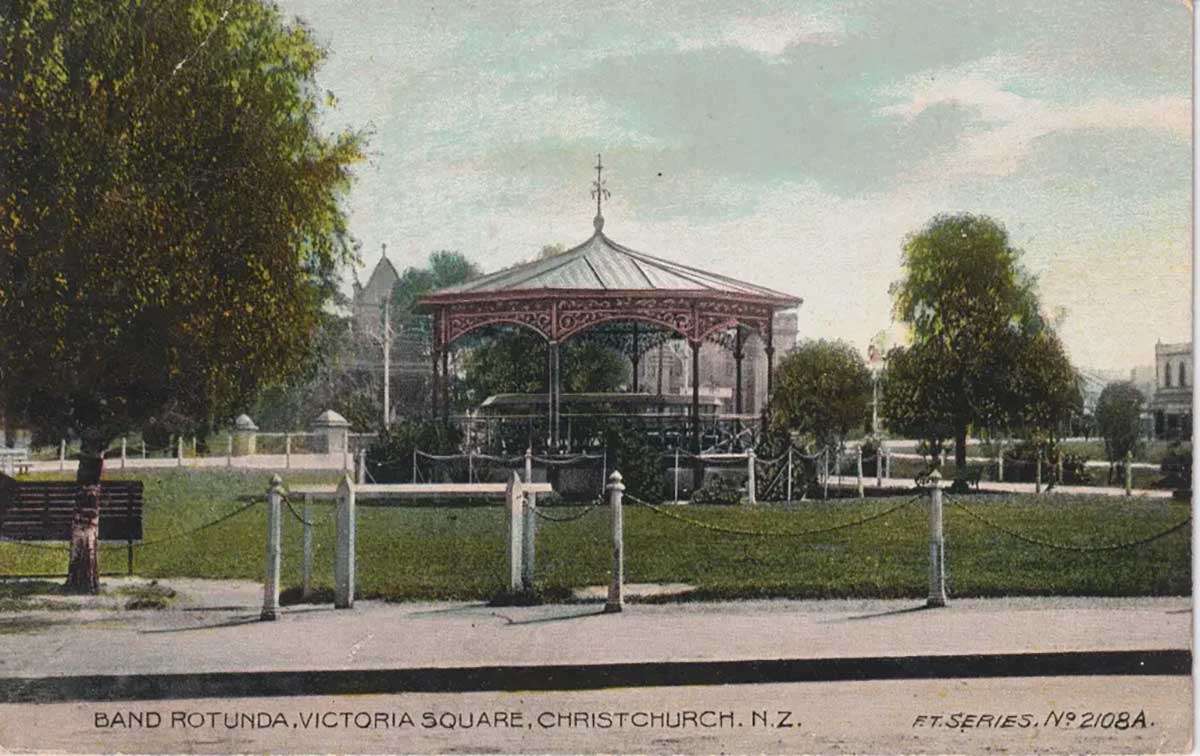
Postcard: Band Rotunda, Victoria Square, Christchurch, N.Z. (date unknown). (Source: Jeremy de Korte Collection)
References: Fergusson, T. (n.d.). Band Rotunda, Victoria Square, Christchurch, N.Z. [Postcard]. [F.T. Series. No. 2108A]. Fergusson Ltd., Christchurch, N.Z. Posted in Band Rotunda, Band Stands & Rotundas. Tagged Band Rotunda, Canterbury, Christchurch, New Zealand, Victoria Square
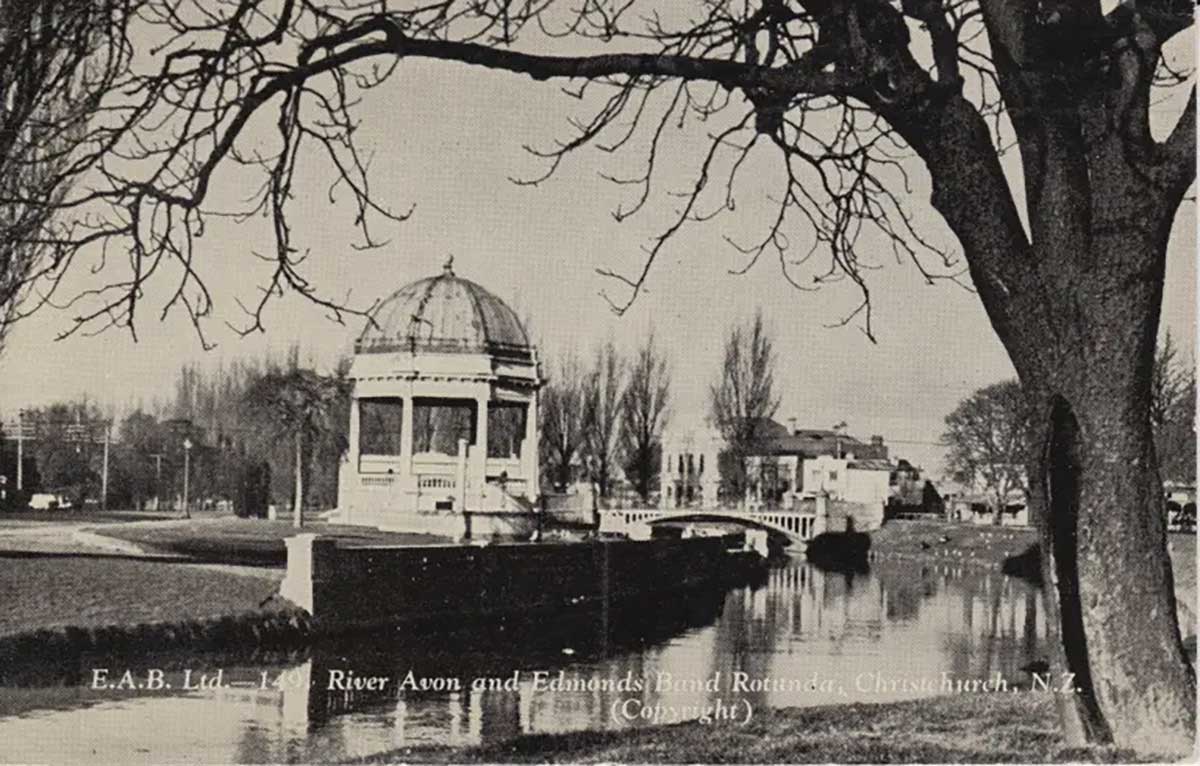
Postcard: River Avon and Edmonds Band Rotunda, Christchurch, N.Z. (date unknown). (Source: Jeremy de Korte Collection)
References: E.A.B. Ltd. (n.d.). River Avon and Edmonds Band Rotunda, Christchurch, N.Z. [Postcard]. [149]. E.A.B. Ltd, Christchurch, N.Z.
Posted in Band Stands & Rotundas, Band Rotunda. Tagged Band Rotunda, Canterbury, Christchurch, New Zealand
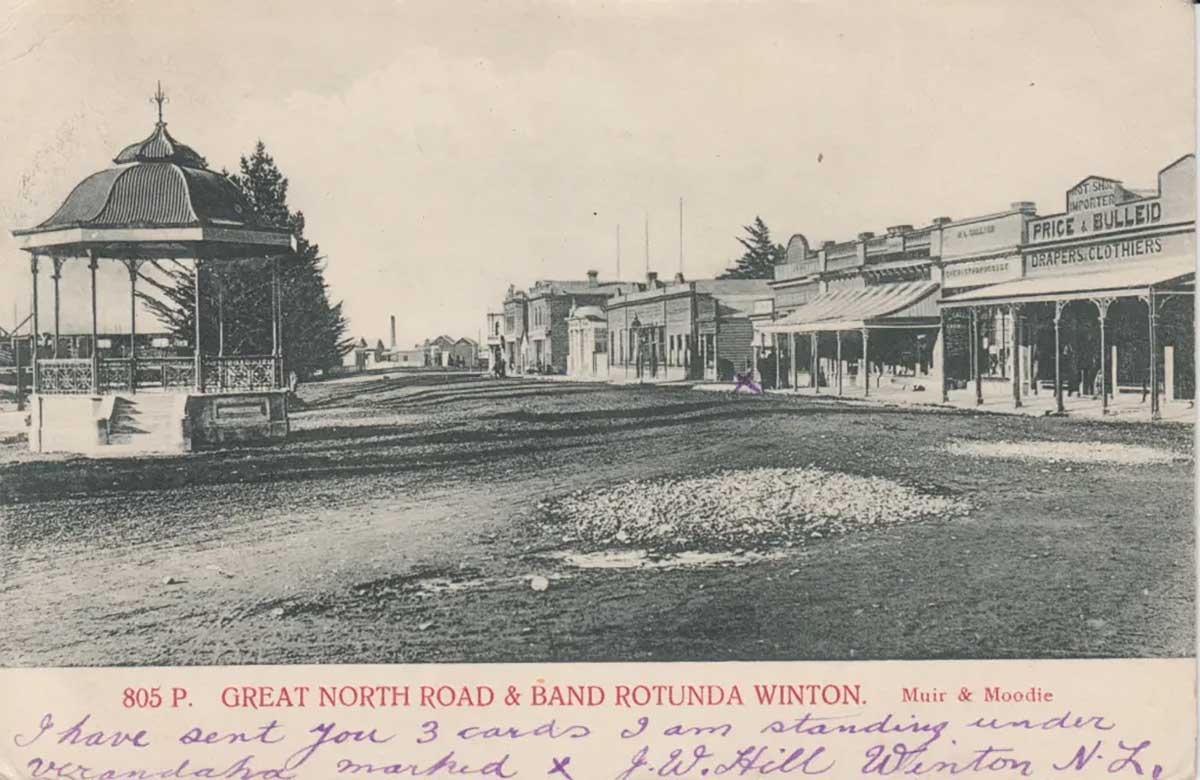
Postcard: Great North Road & Band Rotunda Winton, 1906. (Source: Jeremy de Korte Collection)
References: Muir & Moodie. (1906). Great North Road & Band Rotunda Winton [Postcard]. [805 P.]. Muir & Moodie, Dunedin, N.Z.
Posted in Band Rotunda, Band Stands & Rotundas. Tagged Band Rotunda, New Zealand, Southland, Winton
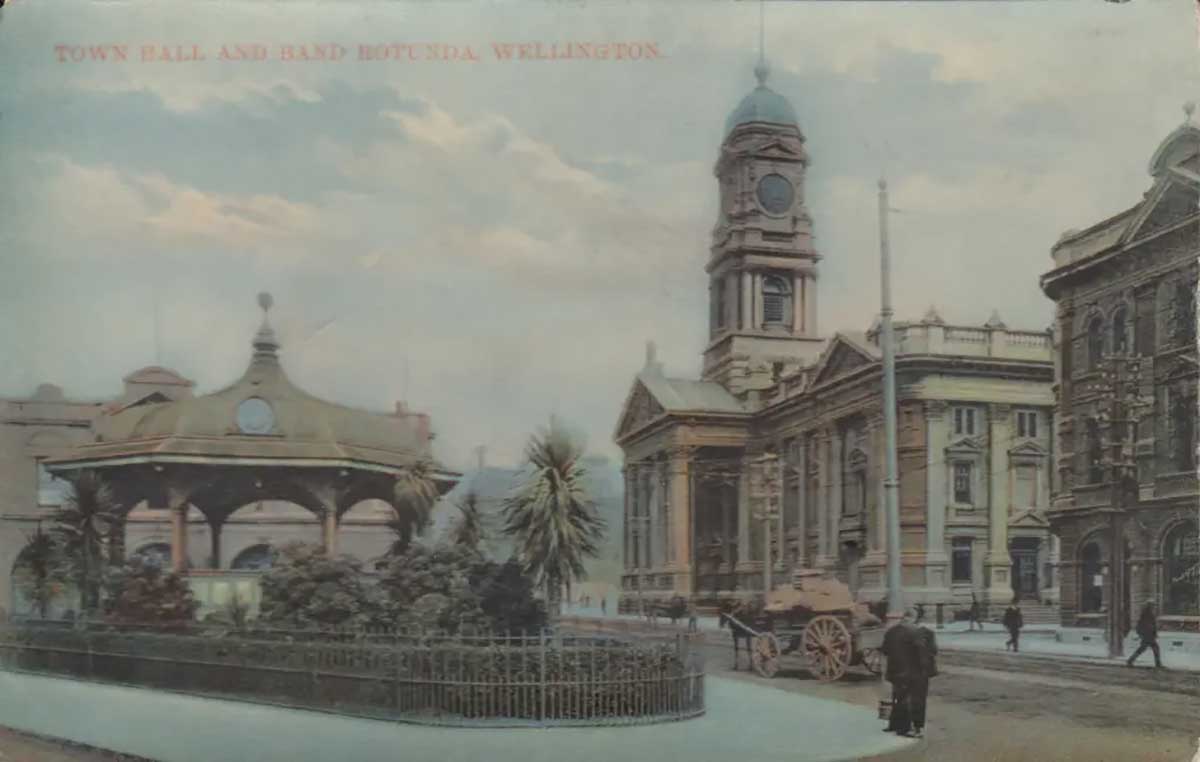
Postcard: Town Hall and Band Rotunda, Wellington, 1912. (Source: Jeremy de Korte Collection)
References: Universal Postcard Co. (1912). Town Hall and Band Rotunda, Wellington [Postcard]. Universal Postcard Co., Dunedin, N.Z.
Posted in Band Rotunda, Band Stands & Rotundas. Tagged Band Rotunda, New Zealand, Wellington