
By Roselyn Fauth inspired by a news story in NZ Herald 18 February 1907
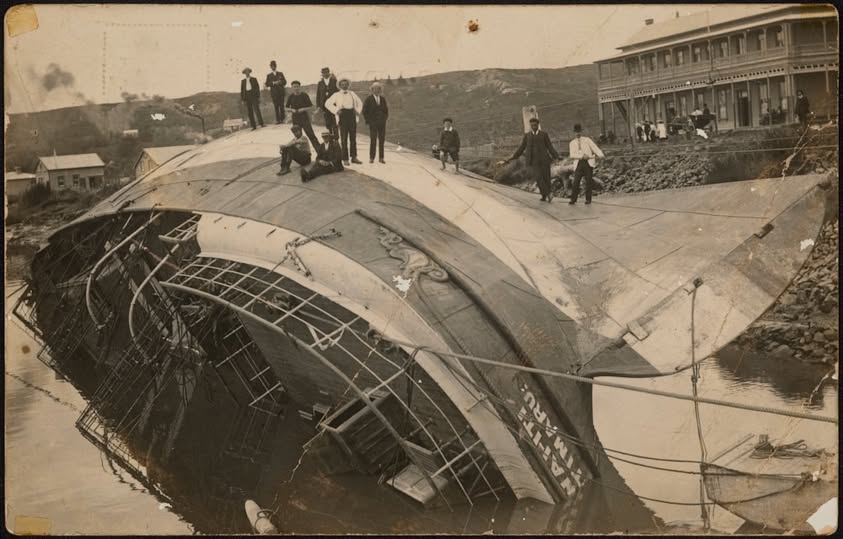
The Wai-iti was refloated, taken to Lyttelton, and sold for use as a coal hulk. When no longer required, she was sunk at Starvation Bay, near Godley Head, in October 1935. Later museum records refer to remains of the hulk and even explosives being detonated there, suggesting that parts of her survived for some time, although she no longer exists as an intact or easily recognisable vessel. Showing the barque Wai-iti capsized at Mangawhare, Kaipara," January-February 1907. Auckland Libraries Heritage Collections 957-537.
Some ships are lost in storms far out at sea. The Turnbull barque Wai-iti was lost almost in sight of the wharf.
In January 1907, the iron barque Wai-iti was lying at Mangawhare, near Dargaville, on the Northern Wairoa River. She had come from Lyttelton to Kaipara, discharged her cargo and ballast, and was preparing to load timber at Hoanga for Melbourne. For the Turnbull shipping interests, this should have been a routine timber voyage. Instead, it became another costly example of the risks faced by their sailing fleet.
The Wai-iti had begun life as the Norwegian barque Signe, built in Norway in 1891. By 1907 she was sailing under British registration from the Port of Timaru. Contemporary reports described her as an iron vessel of about 689 tons register, recently purchased by Mr Turnbull of Timaru. She was part of the wider Turnbull involvement in coastal and trans-Tasman trade, carrying bulk cargoes such as timber and coal between New Zealand and Australia...
On Monday 28 January 1907, Captain William Cormack was taking the Wai-iti from Mangawhare Wharf to Hoanga, where she was to load timber for Melbourne. At about eight o’clock that morning, a strong north-east wind caught the lightly ballasted vessel and carried her onto a bank immediately below the wharf.
Attempts were made to float her on the rising tide, but they failed. As the tide fell, the barque listed outward. At about half past three in the afternoon she turned over. Her masts snapped close to the deck and she lay on her side, half submerged in the river.
The accident quickly became news around the country. The New Zealand Herald reported that the vessel would probably become a total loss. The Star in Christchurch placed the mishap in a wider Turnbull pattern, saying the Wai-iti was the fifth barque connected with Messrs A. H. Turnbull and Co. to “come to grief” in recent years. It listed earlier casualties including the Timaru, lost with all hands in Cook Strait, the West Australian, wrecked north of New Caledonia, the Kinclune, wrecked near Kaipara, and the Lutterworth, dismasted and abandoned in Cook Strait.
The official casualty report later found that the Wai-iti had gone aground and then capsized. It judged that the master had made an error in leaving the wharf when he did, and had been negligent in not doing more to keep the vessel upright after she grounded. However, the court did not consider the negligence serious enough to affect his certificate. No lives were lost.
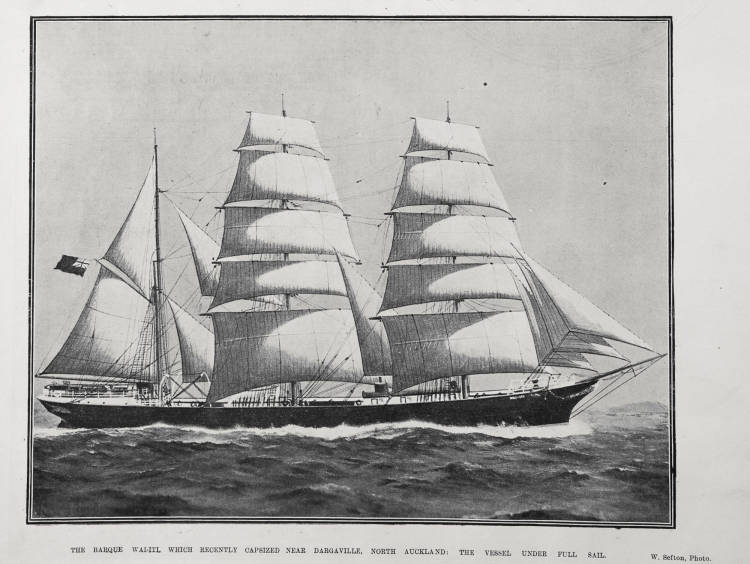
The barque began life in Norway in 1891 as the Signe, owned by A/S Signe of Christiania. In January 1906 she was sold to New Zealand’s Colonial Sailing Ship Company Ltd and renamed Wai-iti. That company was part of the Turnbull shipping story, involving Arthur H. Turnbull, Captain Hugh Monro and David Clarkson Turnbull. At the time of her 1907 capsize, newspapers variously described her as owned by Mr Turnbull of Timaru, by A. H. Turnbull and Co., or by Turnbull & Co. of Christchurch. After she was refloated but judged too costly to restore, she was sold in 1907 to the Blackball Coal Company for use as a coal hulk at Lyttelton.. Auckland Libraries Heritage Collections AWNS-19070207-08-02
Salvage work began soon afterwards. Captain Willis, representing the London Salvage Association, inspected the vessel, and Messrs Brown and Sons of Te Kopuru were contracted to try to refloat her. It was not a simple task. The barque lay close to the riverbank, near the Mangawhare Hotel, with spars and gear tangled in mud and deep water close outside her.
The first salvage efforts dragged on for weeks. In March 1907, Brown and Sons abandoned their contract after gear failed and the work proved more difficult than expected. The owners and underwriters continued the attempt.
By early April 1907, the Wai-iti had finally been refloated and berthed alongside the wharf. But the sight was not encouraging. Reports said she had a “very wrecked appearance”. Only the lower mizzen mast and part of the lower foremast remained standing. The rest of her spars had been cut away, and mud in the hold gave her a heavy list. Refloating alone had cost about £1,000, and refitting her for sea was expected to cost far more.
By June 1907, the decision had effectively been made. The Wai-iti was prepared for towing to Lyttelton. She was to carry a final cargo of timber, but she would not return to the sailing trade in her former role.
In July 1907, newspapers reported that Messrs A. H. Turnbull and Co. had sold the Wai-iti to the Blackball Coal Company for use as a coal hulk. This confirmed that the Turnbulls had decided not to spend the money required to restore her as a sea-going barque.
Her later life was useful but diminished. Instead of crossing the Tasman under sail, the former Signe, later Wai-iti, became part of the coal supply system at Lyttelton. Museum records note that she was eventually sunk at Starvation Bay, near Godley Head, in October 1935.
For the Turnbulls, the Wai-iti was not a total loss in the dramatic sense of disappearing beneath the sea. She was refloated, towed away, and reused. But commercially, her sailing career was over from the moment she turned turtle in the Northern Wairoa River. She is a reminder that ship losses were not always sudden or heroic. Sometimes they happened slowly, in daylight, beside a wharf, as wind, tide, mud and judgement combined to end a vessel’s working life.

The Gables, D.C Turnbull's home, 4 Evans St., Timaru, S.C Museum 4043A &4043B
Side Quest: Why did they call their Barque the Wai-iti?
Wai-iti is the name of a road where the Turnbulls had property.
Sources
New Zealand Herald, 29 January 1907, “A Barque Capsizes.”
Star, Christchurch, 29 January 1907, “The Barque Wai-iti.”
Official shipping casualty report, barque Wai-iti, Shipping and Seamen Act 1903, issued 1907.
Auckland Star, 2 February 1907, “The Capsized Barque. Refloating the Wai-ite.”
New Zealand Herald, 19 March 1907, report on failed salvage contract.
Te Aroha News, 6 April 1907, “The Barque Wai-iti. Successfully Re-floated.”
Marlborough Express, 7 June 1907, report on preparation for tow to Lyttelton.
Greymouth Evening Star, 30 July 1907, report on sale to Blackball Coal Company.
DigitalNZ and Auckland Libraries Heritage Collections, image records of the Wai-iti capsized at Mangawhare.
Te Ūaka The Lyttelton Museum, material on Turnbull shipping interests, the Colonial Sailing Ship Company, and the later use of vessels as coal hulks.
eHive / Lyttelton Museum catalogue record for the former Signe / Wai-iti, noting later use as a coal hulk and sinking at Starvation Bay in 1935.