
By Roselyn Fauth
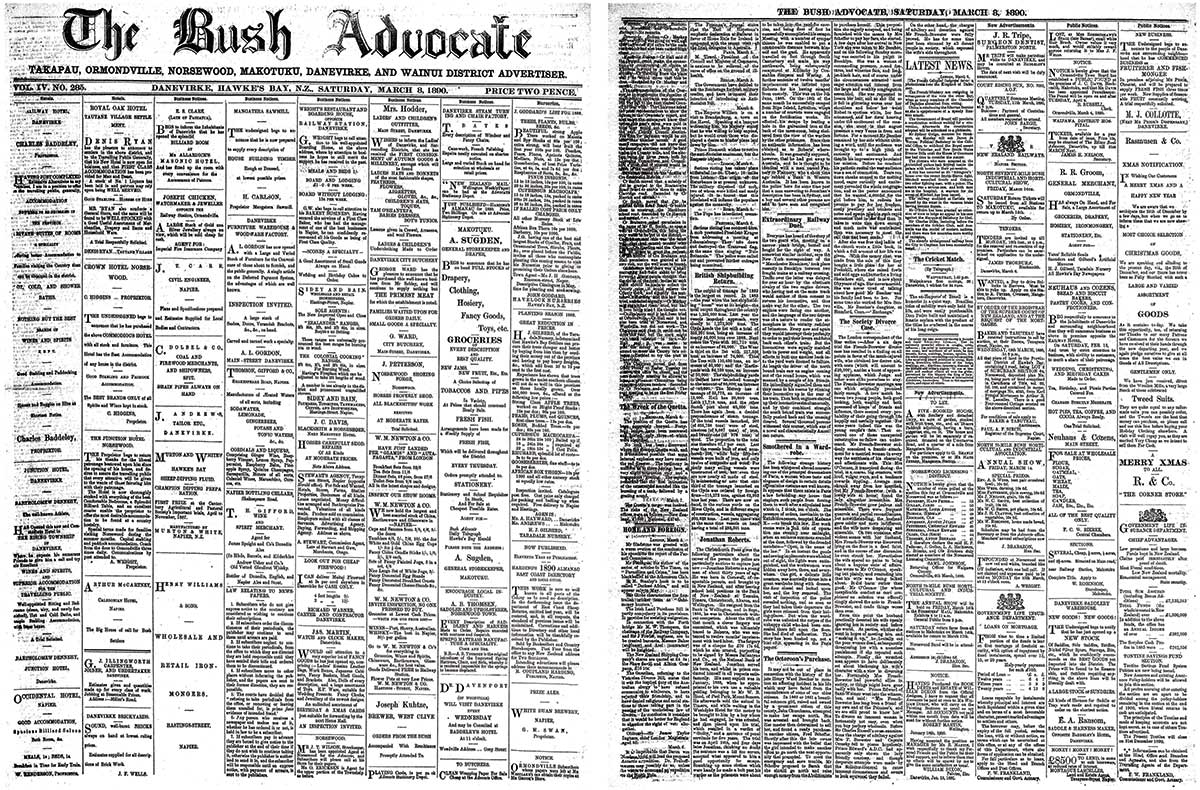
Jonathan Roberts appears in the Bush Advocate, Volume IV, Issue 285, 8 March 1890, Page 3 https://paperspast.natlib.govt.nz/newspapers/BA18900308.2.13
A pine tree led me to Timaru Gaol... I had been learning about one of the great old pines at the Timaru Botanic Gardens, a tree said to have been planted by prisoners doing hard labour from the local gaol. The early gardens were shaped in part by prison labour, so I began following that thread backwards, looking for the men and the institution behind it. That is how I stumbled across Jonathan Roberts, a man who did not begin life as a gaol character at all, but as a bank clerk.
His life began in Cornwall in 1861. This was just a few years before the Timaru Botanic Gardens were set aside as a reserve in 1864. Roberts was brought up in New Zealand, and employed as a bank clerk by the Bank of New Zealand at Temuka, Timaru, Christchurch, Akaroa and Wellington. He was a Bank of New Zealand clerk at Temuka in 1877 and by 1885 it was reported he had left banking "discharged after a quarrel with another official. He had been out of work, and made some choices that change his world of signatures, ledgers, reputation and trust - I wonder if anyone expected him to become a colonial outlaw?
His first clearly documented fall was the forging of a cheque in 1886...

His first documented fall was cheque forgery in Christchurch. 1907 Dunstable House and Ballentines in Timaru - Stafford Street looking North Timaru NZ Industria series Addressed to Miss L Roberts and postmarked. Dunstable House was founded in 1854 named by its founder David Clarkson, his wife Esther, and sister Elizabeth Clarkson. Esther came from Dunstable in Bedfordshire, England and had been trained as a milliner. She imported 2 cases of straw hats which she sold, with sundry and other items of clothing, from the front room. Seeing how well she was doing, David built a small gabled shop for her, which extended out to the street frontage. In 1854, a partnership with David's cousin, Thomas Atkinson, was established and the "New Drapery Establishment" in Cashel Street was first advertised in the Lyttelton Times on 23 September 1854. The business was bought in 1864 by William Pratt. He led the way in improving the conditions of staff, and made additions to the buildings in brick before selling the business in 1872 to John Ballantyne. After 7 years in Dunstable House he retired to go farming in the Rangitata District of South Canterbury, and the business was carried on by a series of partnerships which at times included his three sons, eventually becoming a Company in 1920. The Timaru Branch opened in 1883 near where the Timaru theatre Royal is today. It relocated to its present site in 1913. the building we see there today is not the original one. The Original building was designed by David Clarkson's son. David went into partnership with Richard Turnbull to establish Clarkson and Turnbull Drapery store on the corner of George and Stafford Streets. - https://paperspast.natlib.govt.nz/newspapers/LT19040705.2.7? and https://www.ballantynes.co.nz/our-heritage.html
The first firm newspaper record of Roberts in serious trouble comes in October 1886. The Taranaki Herald reported that he had been arrested for forging a cheque for £76, purporting it to be signed by Ballantyne and Co.
Roberts nutted out a plan to use boys to steal some quick cash.
In early October 1886, a forgery scheme unfolded in Christchurch using boys as messengers. First, a boy went to Ballantyne’s and got a cheque, saying a man wanted to send £2 7s to Wellington. The next day, another boy tried to get blank bank cheques, but the bank refused. Later, another boy obtained a small cheque book using a note signed Ballantyne and Co.
On Thursday morning, a boy took a cheque to the bank for £76 17s 6d, with another note asking for the money in notes, half-sovereigns and silver. The bank paid out the money, but later staff noticed the cheque number did not match the genuine series. They checked with Ballantyne’s and confirmed it was a forgery.
Police were called, and that evening a boy led them to the suspect. Roberts was arrested after handing a letter to a cabman. The letter told someone to hide his clothes and the bank bag in the sandhills. Police recovered the items and found £64 in National Bank notes in his coat.

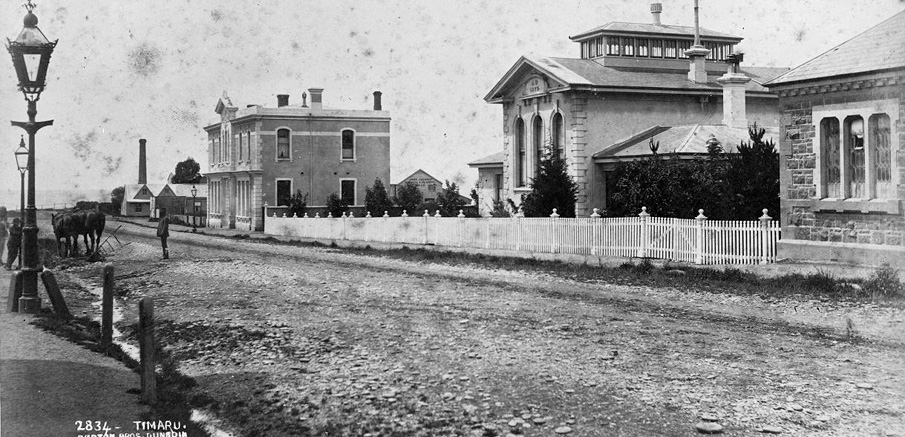
Jonathan Roberts began as a bank clerk, not as a gaol legend. Timaru, 1875, Dunedin, by Burton Brothers, Alfred Burton. Te Papa (C.014371) Bank of New Zealand is on the right. The bluestone building replaced the wooden bank that burned down in the Great Fire of 1868, which started in Daniel Munro's furniture stores rear cabinet makers workshop. William Nicholls was melting glue and the shavings on the floor caught on fire. It was reported that a few strangers passing through town may well have related to an appearance in the magistrates court later in the week when a man was sentenced to three months imprisonment with hard labour for stealing a watch on the night of the fire. Samuel Hewlings was the Mayor at the time, a bi law was created, and new buildings in the central business area had to be constructed of stone instead of timber, resulting in this "bluestone" (local quarried basalt) National Bank building.

His first documented fall was cheque forgery in Christchurch. ABOVE: Photo taken in 1899 shows the Ballantynes branch in Timaru (established here in 1883). A sign reads “J Ballantynes & Co Victoria House” almost next door to the Theatre Royal. Ballantynes moved to its present site in 1913. Section of a photo. Section of a photo by William Ferrier. - Courtesy of the South Canterbury Museum 1415
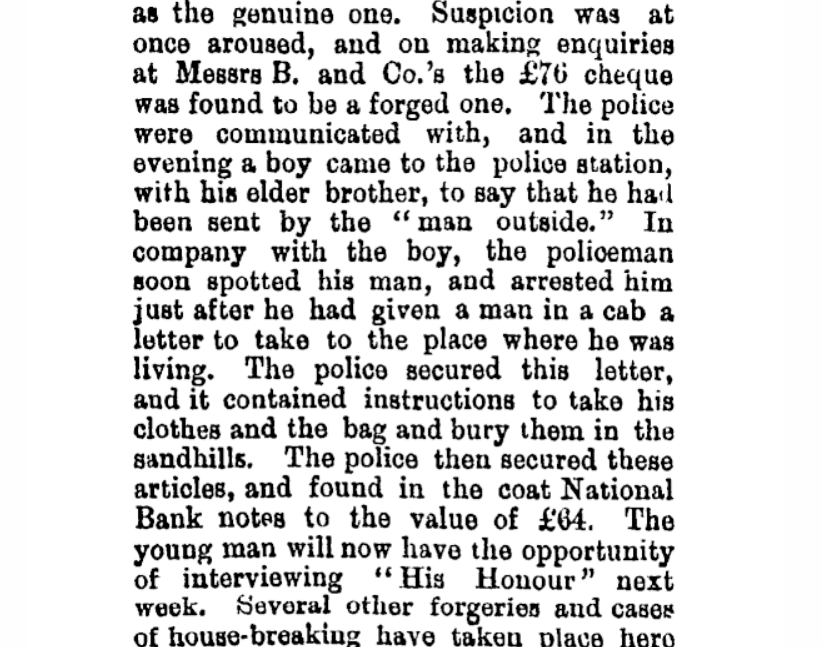
CHRISTCHURCH. Tuapeka Times, Issue 1289, 6 October 1886, Page 3 https://paperspast.natlib.govt.nz/newspapers/TT18861006.2.15
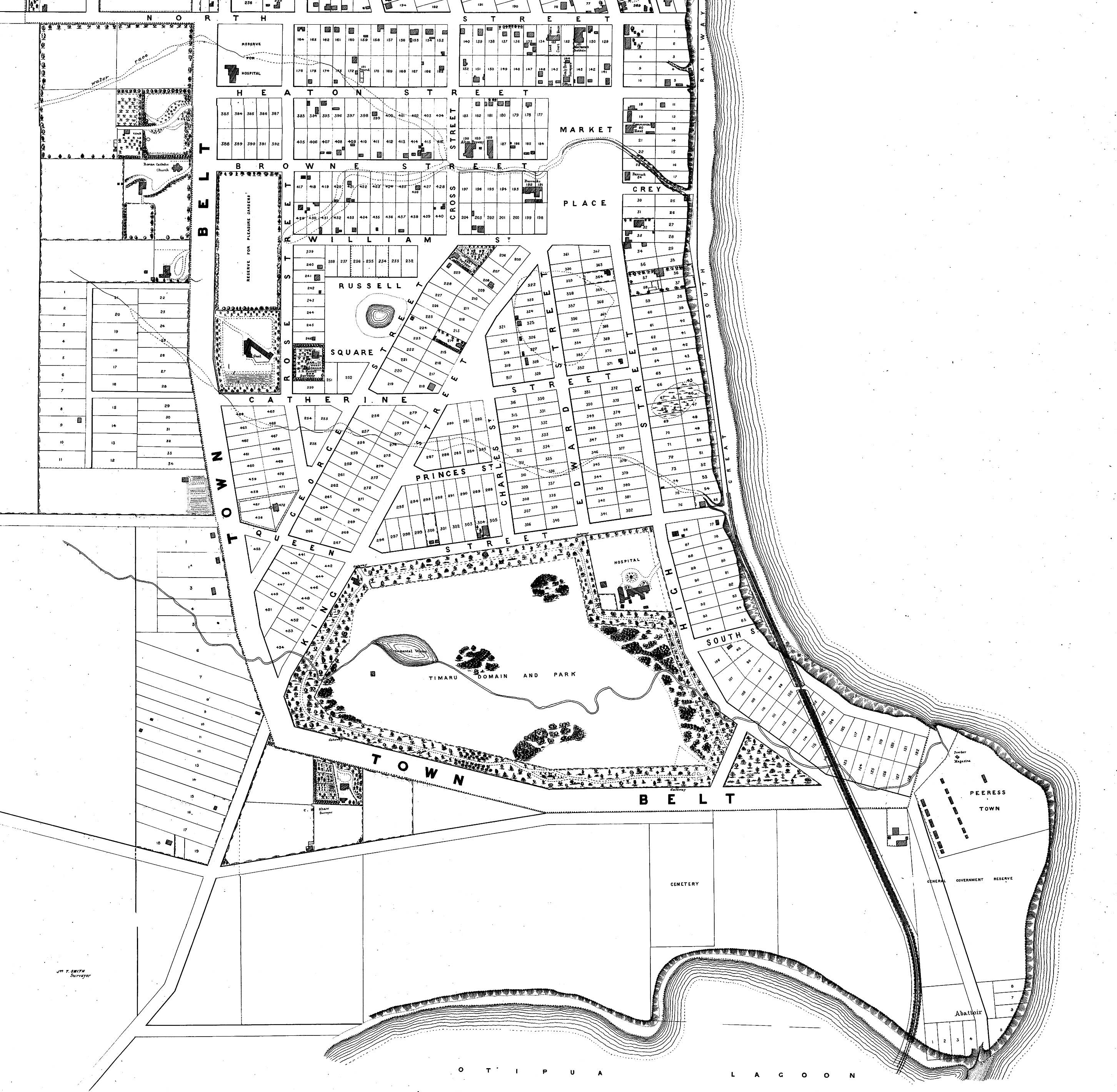
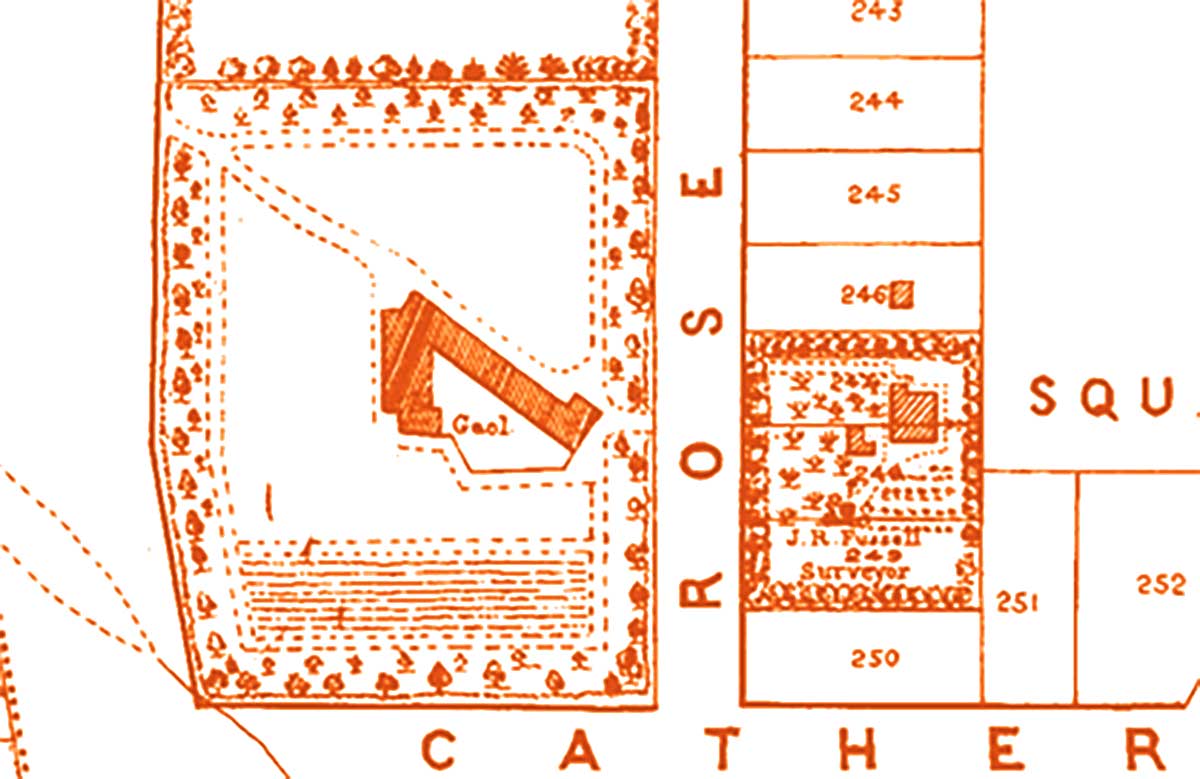
Timaru set aside land for The Park in 1864, and by the late 1860s and early 1870s the planting had begun. Donations of seeds, bulbs, shrubs and trees poured in. Fences were built. By laws were written. The place was precious. But it did not create itself. Prison labour played a major part in the early planting and ground work. In 1887, a newspaper visitor described Timaru Gaol as a yellow corrugated iron building tucked among trees, churches and villas on the West Town Belt. In 1875, while a gang of 18 prisoners was working near the park reserve, one man, James Tucker, slipped away. He ran to nearby Peeress Town, tried to swap out of his prison clothes, and ended up hiding under a bed in Mrs Anderson’s house. He was caught before he could fully change, still wearing the marked prison shirt with its broad arrow of government property. What began as a story about trees suddenly turned into a prison escape side quest. Jonathan Roberts became known as the “Timaru gaol-breaker” after escaping four days after his conviction from Timaru Gaol in April 1888. His escape became part of local folklore. This must have been stressful for the gaoler’s at the time, Mr Swann. Especially when Roberts got extra twelve months’ hard labour.
Contemporary newspaper reporting on Jonathan Roberts, the former bank clerk who escaped from Timaru Gaol in 1888.
Jonathan Roberts fell at a time when New Zealand’s economy was under real strain
That shift from respectability to crime did not happen in easy times. The Reserve Bank’s economic history shows that colonial New Zealand had grown fast on resource extraction like gold, imported capital, and large public spending on roads, railways and settlement. But once the gold boom faded and the civic work slowed, the economy narrowed. From 1879, recession in Britain flowed into the colonies, real GDP was flat through the 1880s, the banking sector was under strain, and for the first time there was a net flow of migrants out of New Zealand. We cannot say those pressures made Roberts commit his crimes, but they do help explain the harder world in which he lost his footing.
Before he became famous as a gaol breaker, he was a former Bank of New Zealand clerk who had worked in Temuka, Timaru, Christchurch, Akaroa and Wellington. After leaving banking, he drifted into debt and in 1886 forged a Ballantyne and Co. cheque for £76 17s 6d. Contemporary reports say he was arrested for that forgery, and in October 1886 he was sentenced to twelve months’ imprisonment with hard labour.
In 1888 he was convicted of horse stealing and sent into the prison system, that was until 28 April 1888, four days after sentence he escaped from Timaru Gaol when he escaped from Timaru Gaol and recaptured near Killinchy in early June. He was caught but on 8 June 1888 he escaped again from Rīpapa Island.
By April 1888 Roberts was before the Supreme Court at Timaru on a charge of stealing a gelding belonging to John Hood. A later newspaper account explained that "One night young Roberts had occasion to go to Timaru, the nearest township, and proceeding to his father's paddock, saddled the first horse he came to and rode off. Arrived at his destination he ran short of cash, and sold the animal, which he fully believed to be his father's. It transpired, however, that the horse which had strayed into the paddock was the property of a neighbour, who, being at enmity with the Roberts' family, refused compensation. Roberts was sentenced to two years' for horse-stealing." - Hawera & Normanby Star, Issue 2965, 31 October 1891, Page 4
The summary based on the Timaru trial at the time however said the charge concerned a horse allegedly stolen from Hood’s Hotel at Peel Forest, then taken to Timaru and put before auctioneers with a forged letter of ownership. Roberts was said to have been convicted because the handwriting matched. He was convicted at Timaru on 24 April and sentenced to five years’ imprisonment.
Perhaps Roberts felt the whole thing was a misunderstanding, and believed the neighbour, who was said to be on bad terms with the Roberts family, refused compensation, putting Roberts in the hot seat for theft. Or maybe that was the yarn Roberts tried to spin to get himself out of the mess. Was he up to no good because of the financial pressure at the time? Or was it a misunderstanding that got out of hand?
I wonder what his stay at the Timaru gaol was like then? Only a year earlier, in March 1887, the South Canterbury Times had described Timaru Gaol as a yellow corrugated iron building on the West Town Belt, standing among trees, churches and villas. Inside were bolts, locks, polished fittings and a vigilant gaoler, Mr Swann. The same report said the gaol could hold twenty male and five female prisoners, that six months was the maximum term there, and that the men worked outside from 7 a.m. In other words, Timaru Gaol was small, visible, and closely tied to the everyday life of the town.
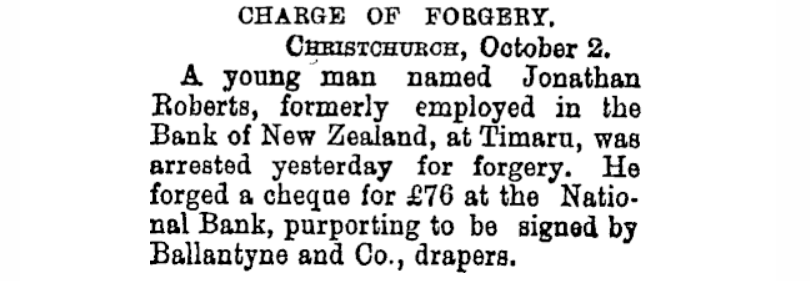
Taranaki Herald, Volume XXXV, Issue 7186, 2 October 1886, Page 2
On 28 April 1888, just four days after his sentence, newspapers reported that Roberts escaped from Timaru Gaol at about 9:00 in the morning while awaiting transport onward. When he later reappeared in court, he admitted escaping from legal custody at Timaru, and another twelve months’ hard labour was added to his punishment. A man who had once worked in a trust based profession had now made a public mockery of a prison that prided itself on order.
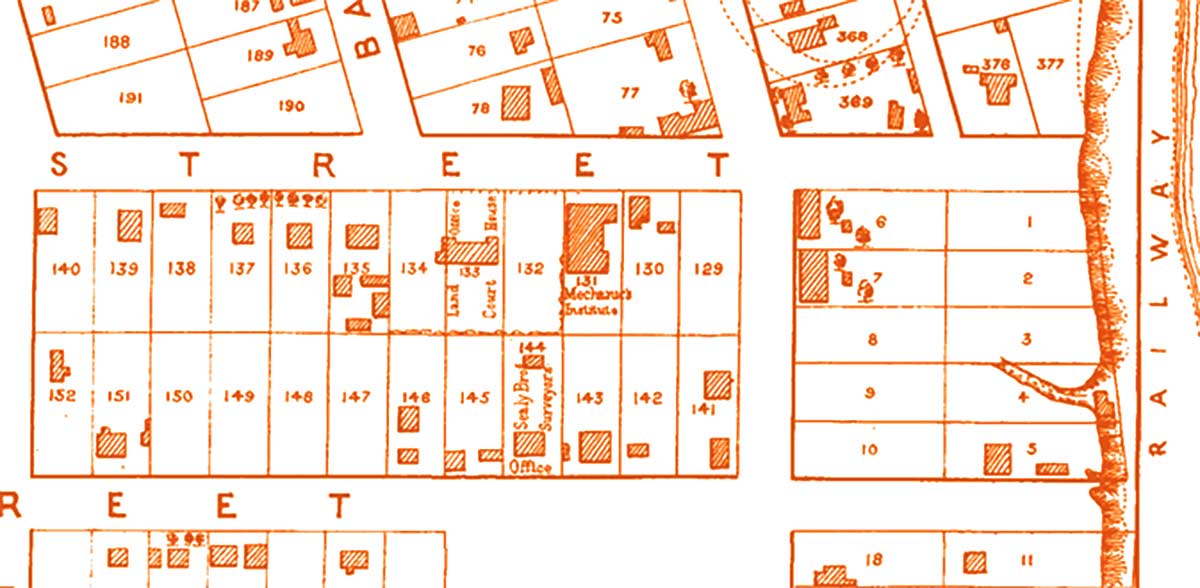
Courthouse, Timaru. Burton Bros. postcard. View of North St. showing from left Mechanics' Institute, Court House and Police Station, taken ca 1880s. Bollinger, Mrs, fl 1958 : Scenic photographs of New Zealand. Ref: PAoll-0808-01. Alexander Turnbull Library, Wellington, New Zealand. /records/3219877 | Alexander Turnbull Library, Wellington
He was recaptured near Killinchy after about a month on the run
The escape did not last forever, but it lasted long enough to turn him into a regional sensation. There were sightings of him, including at a threshing mill in the Waimate district. On 2 June 1888, the Feilding Star reported that Jonathan Roberts, the Timaru escaped convict, had been captured near Killinchy in the Ellesmere district. The paper said he had been seen working near the road there for a farmer. For at least part of his month of freedom, Roberts was not living as a romantic outlaw. He was moving through the ordinary working world of colonial Canterbury.
Roberts was rearrested after being on the run, and was sent to work with a gang of convicts on a little island called Ripapa in Lyttelton harbour
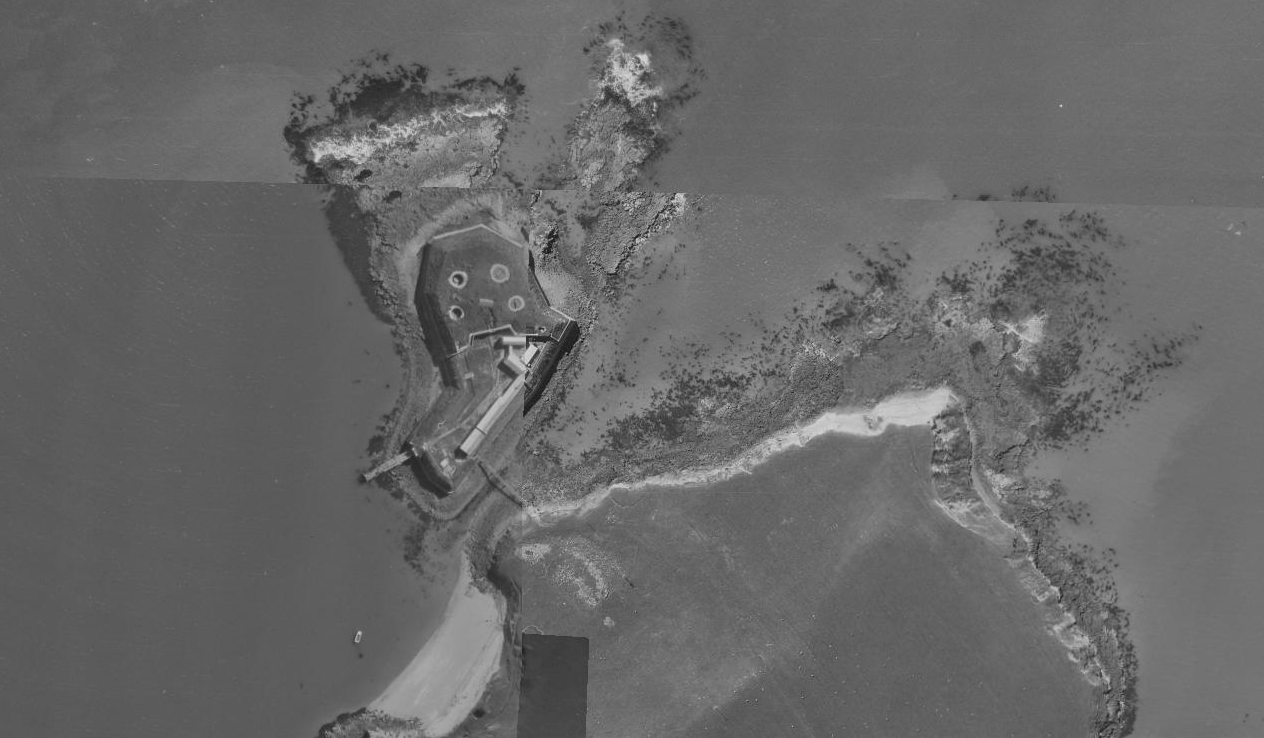
c1970-1974 Canterbury Maps Historical Aerial Imagery. In 1880 the island was used as a temporary prison for about 150 followers of Te Whiti, who were arrested during the Parihaka campaign of peaceful resistance against the confiscation and surveying of Māori land in Taranaki. From 1886, Ripapa became one of the key Lyttelton Harbour defence sites built during the so-called Russian scare. Its walled fort still survives and is regarded as the most complete example of this kind of fort in New Zealand, with two rare disappearing guns still largely intact. The army used the site through the First World War and again during the Second World War. Since 1990, the island has been managed by the Department of Conservation, which has continued repair work, including damage caused by the 2011 earthquakes.
He then escaped again from Rīpapa, by breaking through a tin wall and crossing the channel at high tide... that is when Roberts story slid from record into legend
Even recapture did not end the story. On 9 June 1888, newspapers reported that Roberts, the a convicted horse thief, had escaped again, this time from Rīpapa Island after being sent there with the prison gang to work on harbour defences. He appears to have quickly observed weaknesses in the guarding arrangements there. The article suggests he may also have received help or information from other prisoners.
While the warders and artillerymen were distracted by their meal during the dinner hour, Roberts slipped through this opening where a sheet of corrugated iron at the back of the shed had apparently been prepared or loosened beforehand.
He ran to the strait between the island and mainland and then swam across to the mainland.
The alarm was only raised when someone later saw that the iron sheet had been moved and then officials were then forced to muster and count the prisoners. It was only then was it realised that Roberts had escaped.
A newspaper article reported that Roberts had friends on Banks Peninsula, from when he had once worked at the Bank of New Zealand at Akaroa. So Roberts would have known the the district well.
There was speculation that he might try to reach Port Levy, steal or obtain a boat, and head toward Kaiapoi. Police formed a cordon to prevent his escape either to the plains or elsewhere. No doubt the authorities would have felt embarrassed.
They found Roberts’ coat, wet through, about fifty yards up the hill. This confirmed he had crossed from the island and had made a clear start of perhaps an hour. A "thick layer of mist lay over the land" and the weather conditions probably helped Roberts avoid capture on the first night of the escape.
Within days there were reported sightings near Greenpark, and by late July Christchurch papers were still saying he had “not since been seen by the police,” although clothes thought to be his were found near the harbour. The authorities took the hunt seriously. By 15 August 1888, the New Zealand Police Gazette was circulating a warrant notice for Roberts and offering a £50 reward for information leading to his arrest, made up of £30 from the Government plus £20 under the Prisons Act 1882.
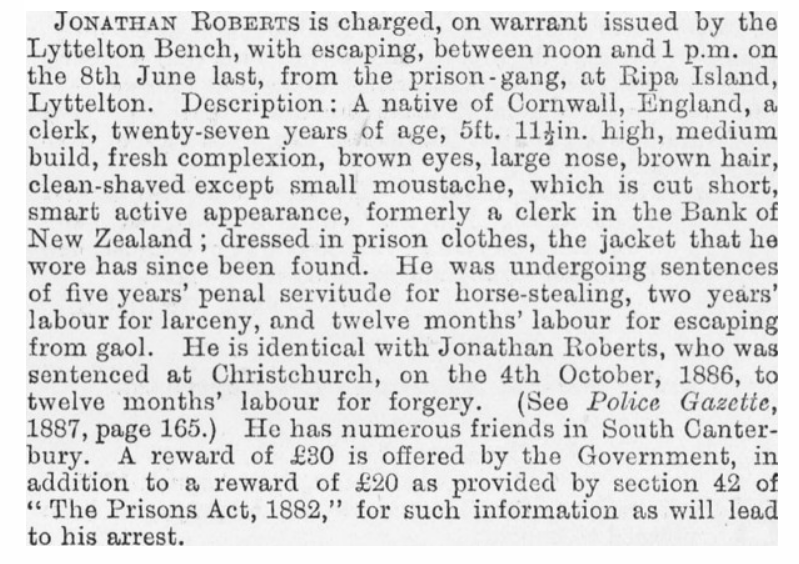
Escaped Prisoners.
New Zealand Police Gazette, Volume XII, Issue 17, 15 August 1888, Page 153
In early 1890, newspapers reported that Roberts had been captured “on the Sydney side,” but in the same breath said the authorities had received no formal advice and only knew he had been in New South Wales for some time.
By 1891 the story had become even more speculative. Papers repeated a sensational claim that one of the insurgent leaders in Chile was none other than Jonathan Roberts under another name. The article says that he went by a lengthy titel the began with "Del and ends with and O" Going by this, it was thought that he succeeded in getting away to South America after his final escape and settle in Chili where he became a prominent politician! - https://paperspast.natlib.govt.nz/newspapers/HNS18911031.2.21
Roberts appears to have evaded capture in New Zealand, attracted a major police hunt and reward, and then vanished into contradictory reports. I tried to figure out what happened to him. The strongest later lead is that the authorities believed he was in New South Wales by 1890, but I have not found a firm, primary-source ending that proves where he finally lived or died.
That second breakout pushed him further into public notoriety. After that, later accounts became more colourful. Some reports and reminiscences sent him into hidden huts, sympathetic households, overseas ships and faraway afterlives. sympathisers, search parties, rewards, public excitement, and rumours that he escaped via Lyttelton to Chile, North America, or Australia.
What makes Jonathan Roberts interesting is not just that he ran, but what he had been before he ran
Jonathan Roberts was not simply a colourful jail breaker. He appears to have been a young man who once moved through the respectable world of colonial banking, then crossed into forgery, then into a more serious horse stealing case, and then into one of the most memorable escape stories linked to Timaru Gaol. His story opens a wider window onto the period. It shows how fragile respectability could be in the long depression, how much colonial life depended on trust and paper, and how quickly a small town prison could become the talk of the region when one determined prisoner slipped through it.
So I began with a prison planted pine, and ended with a man who made Timaru Gaol a link into a bigger story of crime, prison breaks and the economy at the time.
I wonder what it might have been like to be face to face with a Cornish bank clerk who became a forger, a convicted horse thief, a Timaru escapee, and then a figure of legend. The tree led me to the gaol. The gaol led me to Jonathan Roberts. And Jonathan Roberts opened up a much bigger story about work, trust, punishment and hard times in colonial New Zealand.
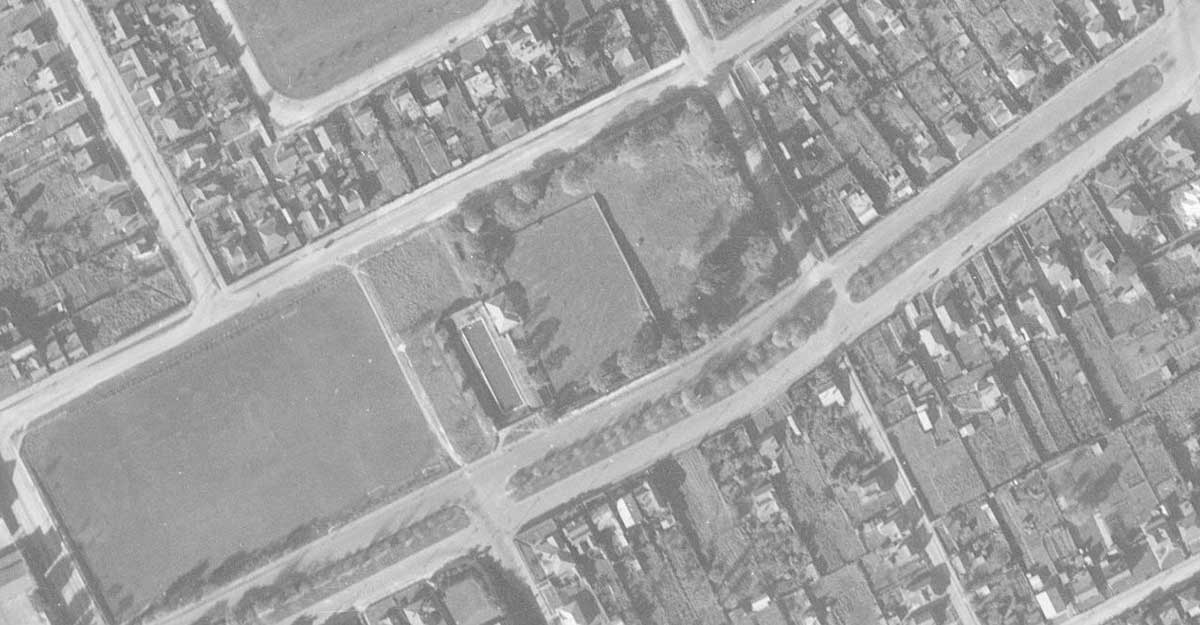
Site of the Timaru Gaol then swimming pool - 1938 Retrolens
JONATHAN ROBBERTS ESCAPED AGAIN.
Lyttelton Times, Volume LXIX, Issue 8504, 9 June 1888, Page 5
JONATHAN ROBERTS
ESCAPED AGAIN.
The celebrated Jonathan Roberts has added one more commentary, during the short time he has been in the hands of gaol warders, on the efficiency of our gaol arrangements for confining what old gaol-birds at Home would call a “game ’un.” Jonathan Roberts received from the Resident Magistrate at Christchurch quite a fatherly admonition last Tuesday on the enormity of the offence he had been guilty of in escaping from the clutches of the prison staff at Timaru, and evading the keen scent of the police for a whole month. To give point to his admonition, the R.M. tagged on a further sentence of twelve months’ hard labour to the term for which Jonathan had already been sentenced for horse-stealing. On Thursday, Roberts was sent for the first time to the labour gang at Ripa Island, and evidently his quick wit took in during that day the weakness of the situation. Doubtless, too, he had no want of an intelligence department among the men he had to work with, among whom, as is usual with the class, there is always a large number ready to regard as a hero any prisoner who has made a plucky and daring escape. On Friday, Roberts startled the whole city, and by this time, of course, the Colony, by again succeeding in making his escape. His modus operandi was simple in the extreme. There can be
NO DOUBT WHATEVER
that he received assistance from some of his fellow-prisoners, but what really enabled him to escape and get clear away was the deficient watch kept by those on the island. Ripa Island stands on the West side of the entrance to Purau Bay, and is separated from the mainland by about fifty or sixty yards of a strait. On all sides, except the water front to this strait, escape from the island by a prisoner would be difficult indeed, the rocky ribs of Ripa rising up almost sheer. Yet it appears that this “scoot hole” into the strait had no sentry or guard at it, and none planted on any of the “cliffs superior,” from which both harbour and strait could have been overlooked. As a matter of fact, only one sentry was on duty yesterday on the island at all, and his post was at the front door of the mess-shed in which both prisoners, warders, and Permanent Artillerymen take their meals. The prisoners are filed into this shed by the warder, who counts the men as they enter, and then themselves follow to partake of their meals, sitting in the same shed with their charges, and having them under their eyes. Yesterday, at dinner time, Roberts so filed in with his fellow prisoners, but at once made for the back wall of the corrugated iron shed, one sheet of which iron had been previously “faked,” evidently for his special benefit. Through this opening Jonathan sped, and making use of his splendid running powers he reached the strait. No better swimmer ever breasted the water than is Jonathan Roberts, and but a few minutes would suffice him to reach the mainland. Meanwhile, the prisoners, conscious of what had happened, were gleefully enjoying their prison rations, knowing well how their guardians along the table had been outwitted. Both warders and artillerymen were also enjoying their mid-day meal, in blissful ignorance of the fact that a man who had only come into their care the day before, after a month’s stolen liberty, was giving them leg bail with all his might over the Peninsula ranges or along the shores of the harbour. The sentry on the door told out his measured beat, but neither heard nor saw the escape. Nor would he, as no man of ordinary eyes has yet been able to see through a corrugated iron house, with a small regiment of hungry men inside of it earnestly intent on the tempting morsels before them. The prisoners ate with knowledge. The warders ate in ignorance, and both ate well. But the dinner had to come to an end, and one artilleryman with less care for his digestion than his neighbours left the festive scene, and went round the shed. The displaced iron met his eye, and he gave the alarm. Hurriedly the men were mustered, and their number told, when — the fugitive was found to be the redoubtable Jonathan Roberts. The rage and chagrin of the luckless officials when they discovered their loss, and how those feelings would give expression to some of those crystals of our Saxon tongue that convey so much in so little, may be imagined, but cannot be described.
SPECULATION IS RIFE
as to the route the fugitive has probably taken, and the point he will make for. As he has friends resident on the Peninsula, and was at one time employed in the Bank of New Zealand at Akaroa, and the whole country is well known to him, he is in a position to cause trouble in finding him again. But then he has no food with him, so far as the authorities know, and such clothing as he has is marked with the tell-tale broad arrow. We have heard it suggested by those who know the man and the country, that last night being calm, and no surf on the beach, if Roberts could make Port Levy and secure a boat, or filch one from the harbour side of the coast, he might be able to strike the beach at Kaiapoi. But a cordon of police has been stretched out to prevent this, and also his escape to the plains, so that unless the strong feeling that appears to have arisen in his favour should tempt settlers to give him surreptitious but illegal aid and hiding, it is quite likely that another forty-eight hours may see him once more in Inspector Pender’s custody.
It cannot be very cheerful to the police, who have twice handed this man over to the keeping of the gaol authorities, to find that he has once more got free, and in so simple a manner.
Shortly after two o’clock yesterday afternoon great excitement was occasioned in Lyttelton by a report that the now well-known convict Jonathan Roberts had effected his escape from the gaol authorities. It is quite unnecessary for us to remind our readers that Roberts escaped from the Timaru Gaol on April 28 last, and for over a month managed to evade the search of the police. Upon being recaptured, he was sentenced to a further term of imprisonment of twelve months, making in all six years. On Wednesday last he was included in the forty convicts sent to Ripa Island to work on the Harbour defences there. He was also sent to the island on Thursday, and again yesterday morning. As far as can be ascertained,
THE ESCAPE
was effected in the following manner:—At twelve o’clock the convicts knocked off for dinner. The meal is served in a temporary structure, one end of which is used by the warders as their mess-room, and the balance by the convicts. With the exception of one warder, who acts as sentry outside the locked door; the whole go to partake of their meal together. When the hurry and scurry of getting to their seats was going on, Roberts must have slipped through a small hole in the shed, made by quietly pushing a piece of the galvanised iron aside, which must have been previously broken away; a fact which goes to show that at least some of the other convicts were in the secret. The dinner hour passed without any of the warders suspecting that anything was wrong, and it was just before turn-to time when one of them happened to go outside the shed and noticed a piece of the iron pushed away. Suspicion was immediately excited, the men were ordered to fall-in, and were numbered, and then it was found that one man was missing. The numbering away gave a big result. The convicts “acted green,” and not one of them knew who the missing man was, until one of the warders had carefully gone down the ranks and discovered that Roberts was non est.
ACTIVE MEASURES.
A sentry was immediately placed over the rest of the prisoners, and a search made of the island. As this proved fruitless, eight men, including some of the members of the Regular Artillery who were on the island at work on the guns, and one or two who had been assisting the warders to keep guard, were immediately put on to the mainland in order to go in search of the fugitive. It was high tide at the time, and at the point where Roberts must have left the island to escape being noticed by the sentry, the width of water was about sixty yards, so that he would have a good swim for it. The steam launch, with Mr Wilson, of the Public Works Department, started for Lyttelton, and arrived about 2 p.m. Sergeant O’Malley, in charge of the Police at Port, was informed of the escape, and he immediately sent Constable McCormack on horseback round to Governor’s Bay, and Constable Bleasel across to Ripa Island in the steam launch to assist the warders in the search. Inspector Pender was also informed, and the 4.25 p.m. train brought him and Constables Kenny, Dillon, and Lane to Lyttelton. The convicts usually return to Port about 4.15 p.m.; but yesterday the boat was delayed, and it was on this account thought possible that the party had managed to capture their man and had him on board. This notion, however, died away as the launch neared the wharf. The joyful expression of the convicts was quite sufficient to tell that Roberts was not there. The Chief Gaoler, Mr B. L. O’Brien, went to the Island during the afternoon, and returned with the prisoners. After a short conversation with Inspector Pender and Sergeant O’Malley, the launch was sent back to the island, with Constable Drake, of Lyttelton, and the three constables brought from Christchurch. It should be mentioned that of the party of eight who went in pursuit in the first instance, all returned with the exception of two members of the Artillery, Richdale and Hastie. As the party were returning to the island after their fruitless search, they
DISCOVERED THE COAT
of the escaped convict, wet through, about fifty yards up the hill. From the foregoing it will be seen that Roberts had almost an hour’s start, and of course the authorities have not the least idea as to the direction he took. A party of gentlemen were out shooting on the hill, but they had not seen him, and it is generally believed that he will again give the police a deal of trouble to get their hands on him. As on the previous occasion, there is undoubtedly a certain amount of public sympathy with the convict, and the hope that he will manage to evade the police is openly and freely expressed. Up to a late hour no tidings of his re-capture were to hand, and as the night was very dark, and there was a thick mist hanging over the land, the probabilities are that Roberts has managed to keep out of the way of his pursuers at least for the first night of his second spell of unlawful freedom.
JONATHAN ROBERTS.
Hawera & Normanby Star, Issue 2965, 31 October 1891, Page 4
According to the Sunday Times, which is well informed on the subject of the Chilian leaders, one of the insurgent leaders is no other than the notorious Jonathan Roberts, whose sensational escapes were the talk of New Zealand a few years back. He does not now go by the name of Roberts, but by a lengthy title that begins with "Del" and ends with "o." Roberts succeeded in getting away to South America after his final escape and settled in Chili, where he became a prominent politician. When recent troubles broke out the Congressional party had plenty of men, but a lack of officers, and the New Zealander having had some sort of military training, was speedily installed in a foremost position. The account given by the Sun of Roberts' delinquencies and escape seems somewhat tame, and not altogether correct. You shall read it for yourself, and see how insurgency can whitewash a man:—One night young Roberts had occasion to go to Timaru, the nearest township, and proceeding to his father's paddock, saddled the first horse he came to and rode off. Arrived at his destination he ran short of cash, and sold the animal, which he fully believed to be his father's. It transpired, however, that the horse which had strayed into the paddock was the property of a neighbour, who, being at enmity with the Roberts' family, refused compensation. Roberts was sentenced to two years' for horse-stealing. He escaped from prison, but was rearrested after being at liberty three months. He was set to work with a gang of convicts on a little island in Lyttelton harbour, some miles from the mainland. A few days subsequently he swam ashore, and succeeded in getting away.' No mention is made of his more serious crime of forgery.—Press correspondent.

Timaru Roll 71 / TR71, with notes on the history of TR 71 and Black Map 306. Aperture card available. Town of Timaru. NZ Heritage Maps Platform, accessed 19/07/2023. Held by: Archives New Zealand/Te Rua Mahara o te Kāwanatanga, Christchurch Regional Office. Archway Record CodeR22668789 https://maps.recollect.co.nz/nodes/view/331
Sources
1. Taranaki Herald, 2 October 1886
Arrest report. Says Jonathan Roberts, formerly employed by the Bank of New Zealand at Timaru, was arrested for forging a cheque for £76, purporting to be signed by Ballantyne and Co.
https://paperspast.natlib.govt.nz/newspapers/TH18861002.2.8
2. Tuapeka Times, 6 October 1886
Detailed forgery account. Explains how boys were used as messengers, how the cheque book was obtained, how the forged cheque for £76 17s 6d was cashed, and how the bank detected the wrong cheque series.
https://paperspast.natlib.govt.nz/newspapers/TT18861006.2.15
3. Press, 12 October 1886
Sentencing report. States that Jonathan Roberts was sentenced to twelve months’ imprisonment with hard labour for forgery.
https://paperspast.natlib.govt.nz/newspapers/CHP18861012.2.28
4. South Canterbury Times, 16 March 1887
Important Timaru Gaol context piece, “In Prison. A Visit to the Timaru Gaol.” Describes the yellow corrugated iron gaol on the West Town Belt, Mr Swann the gaoler, the capacity of the gaol, and the fact that men worked outside from 7 a.m. to 5 p.m.
https://paperspast.natlib.govt.nz/newspapers/SCANT18870316.2.12
5. Inangahua Times, 30 April 1888
Short but useful escape notice. Says Roberts, then serving five years for horse stealing, escaped from Timaru Gaol at about 9 a.m. while awaiting transport.
https://paperspast.natlib.govt.nz/newspapers/IT18880430.2.5
6. Kumara Times, 30 April 1888
Another short report on the Timaru Gaol escape. Says Roberts had been convicted on the Tuesday, was awaiting transport to Mount Cook Gaol, and escaped from custody.
https://paperspast.natlib.govt.nz/newspapers/KUMAT18880430.2.8
7. Feilding Star, 2 June 1888
Recapture report. Says Roberts, the Timaru escaped convict, was captured near Killinchy in the Ellesmere district.
https://paperspast.natlib.govt.nz/newspapers/FS18880602.2.9
8. Star (Christchurch), 5 June 1888
Court report. Says Roberts was charged with escaping from legal custody at Timaru on 28 April, admitted the offence, and had an extra twelve months’ hard labour added. It also states he had been convicted at Timaru on 24 April 1888 of horse stealing and sentenced to five years’ imprisonment.
https://paperspast.natlib.govt.nz/newspapers/TS18880605.2.11
9. Press, 9 June 1888
Major report on the Rīpapa Island escape. Describes Roberts escaping again from Rīpapa after being sent there with the prison gang.
https://paperspast.natlib.govt.nz/newspapers/CHP18880609.2.31
10. Lyttelton Times, 9 June 1888
Longer narrative version of the second escape, including the loosened corrugated iron sheet, the swim to shore, the wet coat found on the hillside, and public excitement.
https://paperspast.natlib.govt.nz/newspapers/LT18880609.2.38
11. New Zealand Herald, 9 June 1888
Another report on the Rīpapa breakout, useful for cross-checking details of the second escape.
https://paperspast.natlib.govt.nz/newspapers/NZH18880609.2.32
12. New Zealand Police Gazette, 15 August 1888
Official police notice. Offers a £50 reward for information leading to Roberts’ arrest: £30 from the Government plus £20 under the Prisons Act 1882.
https://paperspast.natlib.govt.nz/periodicals/NZPG18880815.2.11
2) Later retrospective / rumour sources
13. Bush Advocate, 8 March 1890
Retrospective sketch. Says Roberts was born in Cornwall, brought up in New Zealand, and had worked for the Bank of New Zealand at Temuka, Timaru, Christchurch, Akaroa and Wellington. Also recounts the first Timaru escape and his earlier forgery sentence. Useful, but later than the events.
https://paperspast.natlib.govt.nz/newspapers/BA18900308.2.13
14. Lyttelton Times, 1 March 1890
Another retrospective on Roberts’ career and escapes. Useful for checking how the story was being retold by 1890.
https://paperspast.natlib.govt.nz/newspapers/LT18900301.2.39
15. Hawera & Normanby Star, 31 October 1891
Highly speculative later piece claiming Roberts ended up in Chile under a long name beginning with “Del” and ending with “o.” Useful only as evidence of later legend and rumour.
https://paperspast.natlib.govt.nz/newspapers/HNS18911031.2.21
3) Context source
16. Reserve Bank of New Zealand, “The Reserve Bank and New Zealand’s economic history”
Good background source for the long depression and the tightening colonial economy of the 1880s. This is context, not direct evidence for Roberts’ motives.
https://www.rbnz.govt.nz/museum/history/rbnz-and-new-zealands-economic-history
Timeline of Jonathan Roberts
1861 — Roberts was born in Cornwall. A later retrospective newspaper said Jonathan Roberts was born in Cornwall, brought up in New Zealand, and later worked in several Bank of New Zealand positions.
Before 1886 — He worked in banking. Later reporting said he held Bank of New Zealand positions at Temuka, Timaru, Christchurch, Akaroa and Wellington.
2 October 1886 — Arrest reported for forging a Ballantyne cheque. The Taranaki Herald reported that Roberts, formerly employed by the Bank of New Zealand at Timaru, had been arrested for forging a cheque for £76, purporting to be signed by Ballantyne and Co.
6 October 1886 — The forgery method was reported in detail. The Tuapeka Times described how boys were used as messengers, how a cheque and cheque book were obtained, and how a forged cheque for £76 17s 6d was cashed before the bank detected the fraud.
12 October 1886 — He was sentenced for forgery. The Press reported that Roberts was sentenced to twelve months’ imprisonment with hard labour.
16 March 1887 — Timaru Gaol was publicly described. The South Canterbury Times published “In Prison. A Visit to the Timaru Gaol”, describing the yellow corrugated iron gaol on the West Town Belt, the gaoler Mr Swann, and the prison regime. This is important context for what kind of place Roberts later escaped from.
24 April 1888 — Roberts was convicted of horse stealing. The Star later reported that Roberts had been convicted at Timaru on 24 April 1888 of horse stealing and sentenced to five years’ imprisonment.
28 April 1888 — He escaped from Timaru Gaol. Multiple papers reported that Roberts escaped from Timaru Gaol at about 9 a.m. while awaiting transport onward.
2 June 1888 — He was recaptured near Killinchy. The Feilding Star reported that Roberts had been captured near Killinchy in the Ellesmere district.
5 June 1888 — He admitted the Timaru escape in court. The Star reported that Roberts admitted escaping from legal custody at Timaru and received an extra twelve months’ hard labour.
9 June 1888 — He escaped again, this time from Rīpapa Island. The Press, Lyttelton Times, and other papers reported Roberts’ second escape, from the prison gang at Rīpapa.
15 August 1888 — A £50 reward was offered. The New Zealand Police Gazette offered £50 for information leading to Roberts’ arrest.
March 1890 — Later papers said he was in New South Wales. Retrospective reporting suggested Roberts had been in New South Wales, though the position was already getting murky.
October 1891 — The Chile story appeared. A later paper claimed Roberts had ended up in Chile under another name and become a politician. This is best treated as rumour, not firm fact.