
By Roselyn Fauth

If you’re a regular visitor to the South Canterbury Museum on Perth Street like I am, you may have noticed the beautiful old oak tree between the museum and St Mary’s Church. It’s a peaceful spot, but if you look closely, you’ll see a plaque tucked beneath the tree. It marks the place where Catherine Burnett and her husband Andrew once camped overnight with their bullock wagon, on their way inland to establish what would become Mount Cook Station. It’s hard to imagine now. What is just a few hours by car today was a much bigger undertaking back then. No roads, no bridges, no backup. That simple plaque gives us a window into the world Catherine entered, and the journey that lay ahead.
She went from the relative comfort of the coast into the stark and unforgiving Mackenzie Basin, helping to set up one of the earliest pastoral stations in the region. It was a tough place to exist, especially for a woman. There’s an account from one of her sons that has always stuck with me... describing a snowstorm so severe that sheep began eating each other’s ears just to survive. That image says a lot about how extreme life could be. Maybe it was that experience that turned him off farming altogether. Instead, he went into politics and ended up representing the area in Parliament. He used that platform to champion better infrastructure for rural communities, including the water race at Cave, which still helps farmers navigate dry seasons today.
So next time you’re passing through Perth Street, take a moment. Stop at the rock. Read the plaque. Imagine Catherine Burnett wrapped up warm beneath the stars, the vast unknown ahead of her. Her story is one of resilience... and one of the reasons Timaru and the Mackenzie are what they are today. Put the kettle on, have a read, and raise your mug to the bullock dray days and the amazing women like Catherine Burnett and her family...
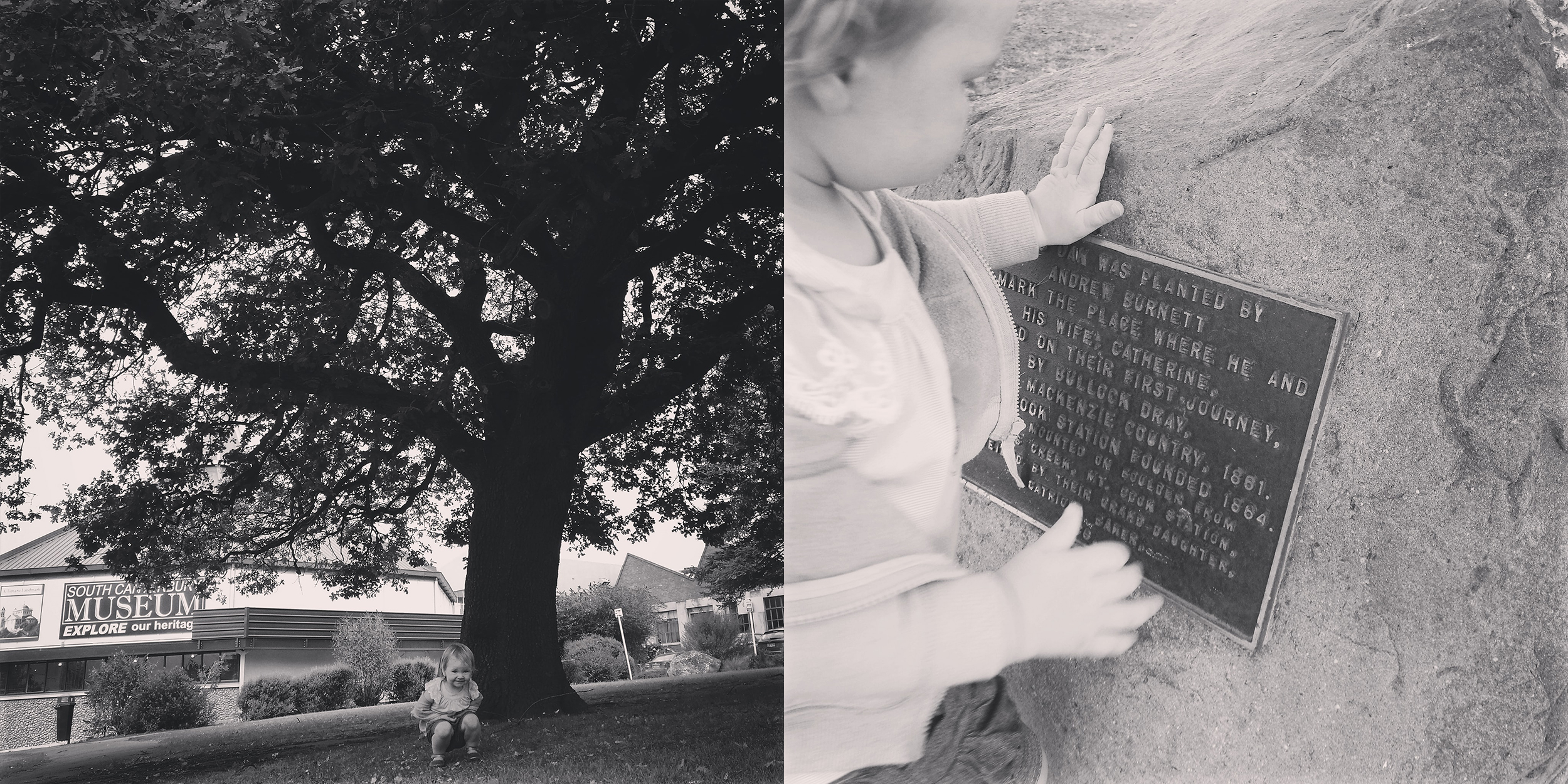
Annabelle Fauth plays under the Museums Oak Tree and investigates the plaque underneath - Roselyn Fauth
In the remote valley of the Mackenzie Country, the story of Mount Cook Station is often shared through the men who held public office, ran sheep, and made memorials from stone. Yet it is the story of the women of the Burnett family who to me, who endured, remembered, and passed it on on their legacy through their children.
Catherine Burnett arrived in New Zealand from Strathnaver in the Scottish Highlands. She and her husband Andrew took up Mount Cook Station in May 1864, one of the earliest and most remote pastoral runs in the country. Their journey inland followed rough route only recently opened by James Mackenzie who in 1855 had shepherds from the Rhodes' Levels Station searching for 1000 missing sheep in the upper reaches of the Waitaki Valley. Catherine travelled by bullock dray, across rivers and through boulders and matagouri scrub to the flats of the Tasman.
Their first home was a one-room hut of black birch logs, plastered with clay and thatched with snowgrass where Catherine raised her eight children. As the family grew, she moved with them to a two-room cob cottage on the hillside, and later a larger homestead. Her workload remained constant: managing food, schooling, visitors, and farm duties in a region where winter could isolate a family for weeks.
Hospitality was said to be a hallmark of Catherine's life. Early explorer William S. Green wrote, "Our good hostess was full to overflowing with the happiness of her life ... cramming our pockets with hot scones just out of the oven, she bids us Godspeed." Julius von Haast referred to the Burnetts as "the good people of the wilderness" and sent them illustrated magazines. William Rolleston sent schoolbooks for the children.
In 1873, to be closer to education, Catherine and Andrew purchased Aorangi at Cave. In 1876, they built a third home on Perth Street in Timaru, where the South Canterbury Museum now stands. Catherine lived to see rail and air travel replace bullocks and drays, and remained deeply connected to the hills she helped settle.
She is remembered at Mount Cook Station by a stone cairn above a quiet cup in the land. Her son Thomas explained, "My mother often came here to read her Bible." The granite slab reads: "To the memory of Catherine Mackay, who helped her husband Andrew Burnett to subdue this mountain country ... a brave woman, a great-hearted pioneer, the best of mothers."
Agnes Ellen Burnett, born Agnes Little of Annadale, Cave, married Catherin's son, Thomas David Burnett in 1912. Like her motner-in-law, she shaped life in the Mackenzie through home and family. Her children were Donald Mount Cook Burnett and Catriona Burnett, and she helped maintain the household while her husband served as MP for Temuka and as the visionary behind the Downlands Water Supply Scheme. Agnes Ellen was helped to sustain Mount Cook Station through decades of political and pastoral challenges.
Jessie Agnes Burnett, youngest daughter of Catherine, never married and became one of the region's early motorwomen. She drove regularly between Mount Cook Station and Cave, helped manage the Aorangi property, and was remembered for her humour, Highland storytelling, and unrelenting connection to the hills. She told stories of blown tyres, swollen rivers, and passengers who said they "felt every bump" in her careful driving. She was involved in the Stratheona Training School and the South Canterbury Countrywomen's Institute, and remained devoted to the land even in old age, asking to be driven into the hills for a glimpse of the mountains she loved.
Catriona Burnett, daughter of Agnes and Thomas, helped manage Mount Cook Station alongside her brother Donald. Together they produced fine Saxon merino wool and maintained the station through the twentieth century. Catriona married late in life, to Richard St Barbe Baker, an internationally recognised environmentalist known as the "Man of the Trees." Though she had no children, she carried forward the environmental and community values of her family. She died in 2014, aged 97.
The clearest architectural tribute to the Burnett family is St David's Memorial Church in Cave, built by Thomas Burnett in 1930. The church is made from local boulders and features stained glass and materials sourced from the land. A mast-lantern from an immigrant ship lights the porch, and the floor is inlaid with totara blocks. The pulpit is made from the hearthstones of the original Mount Cook homestead, topped with polished totara carved with mountain lily and ribbonwood designs.
The font is built from a stone mortar once used by Catherine’s Mackay ancestors, placed on the hub of the bullock dray that carried her to Mount Cook, resting on a greywacke boulder from the Jollie Gorge. A brass tablet beneath the windows reads: "To the glory of God and in honour and in memory of the pioneer women of the Mackenzie Country, who, through arctic winters and in the wilderness, maintained their homes and kept the faith."
Every detail of the church reflects the hands and lives of these women. Boulders were collected from the Tasman Valley. The wood came from totara logs buried in riverbeds. The pews were pegged by hand. The altar cross, Bible rest, and names carved into the walls tell a story not only of hardship, but of grace and strength.
Today, Mount Cook Station is owned by the Miles family and the memory of the Burnett women is still part of every track, wall, and window. Catherine made the place habitable. Agnes Ellen nurtured its heart. Jessie Agnes carried its memory. Catriona steered its values into a new century. Their names live on through the children they raised.
My Reflection from Today
Reading the lives of Catherine, Agnes Ellen, Jessie, and Catriona, I am struck by what they endured, and how little fuss surrounded it. These women built their legacy through care, grit, and practicality. They fed their families while crossing swollen rivers. They created space for others in rough shelters and remote valleys. They made it thinkable to live here.
As a woman today, with very different tools and freedoms, I find myself asking: what would Catherine think of a world where we no longer have to boil laundry or ride bullock drays... where many of us still shoulder the emotional load, hold families together, and seek ways to contribute?
I see echoes of these women everywhere... in the way mothers juggle work and care, in the way communities hold together during crisis, in the women who organise, document, and preserve history because they know the stories matter.
Jessie Agnes said she only needed a view of the hills to feel whole. I understand that. Standing under the sky in the Mackenzie, looking towards Mount Cook, I feel connected to a lineage that survived this place and helped to shaped their family and community with it.
These women lives became the European foundations for building communities, what a legacy to pass down to us and our children, their future generations.
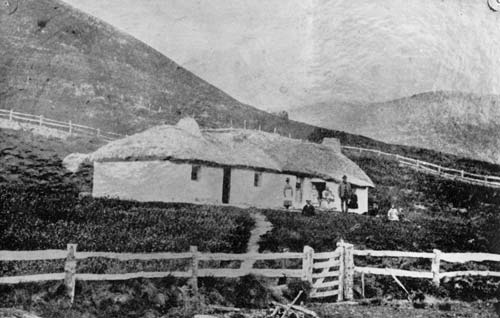
Andrew and Catherine Burnett pose with their children outside their Mt Cook homestead, in the 1870s. The family had to endure extreme isolation. In 1873 Joanna Acland-Troyte was part of a group that visited the Burnetts on their way to Aoraki/Mt Cook. The visit caused quite a stir. Joanna was the first woman other than their mother that the Burnett children had ever seen. South Canterbury Museum Reference: 1946

Section from an oval portrait of Catherine Burnett at age 19, taken before leaving Scotland, from an old daguerreotype; silver gelatin print on paper, circa 1855, copy print from the Burnett Collection, South Canterbury Museum (2015/184.922).

A mob of sheep being driven along Braemar Mount Cook Station Road toward Mount Cook Station, with Donald Burnett’s jeep and dog trailer in the foreground; photographed circa 1960 by Donald M. C. Burnett, colour 35mm slide, Burnett Collection, South Canterbury Museum (2015/184.182).
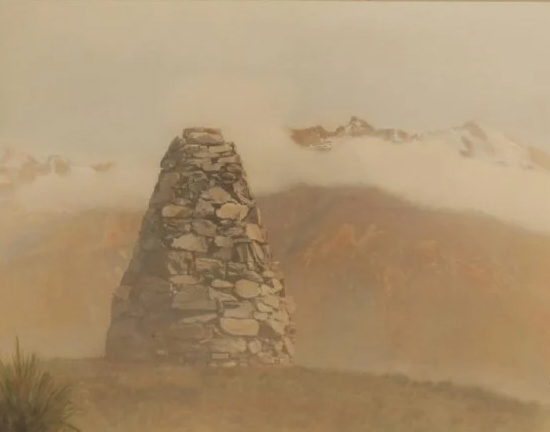
Coloured landscape view of the memorial cairn commemorating Catherine Burnett at Mount Cook Station, photographed circa 1920 by Havelock Williams of Timaru; original glazed and framed photographic print mounted on card, Burnett Collection, South Canterbury Museum (2015/184.094).
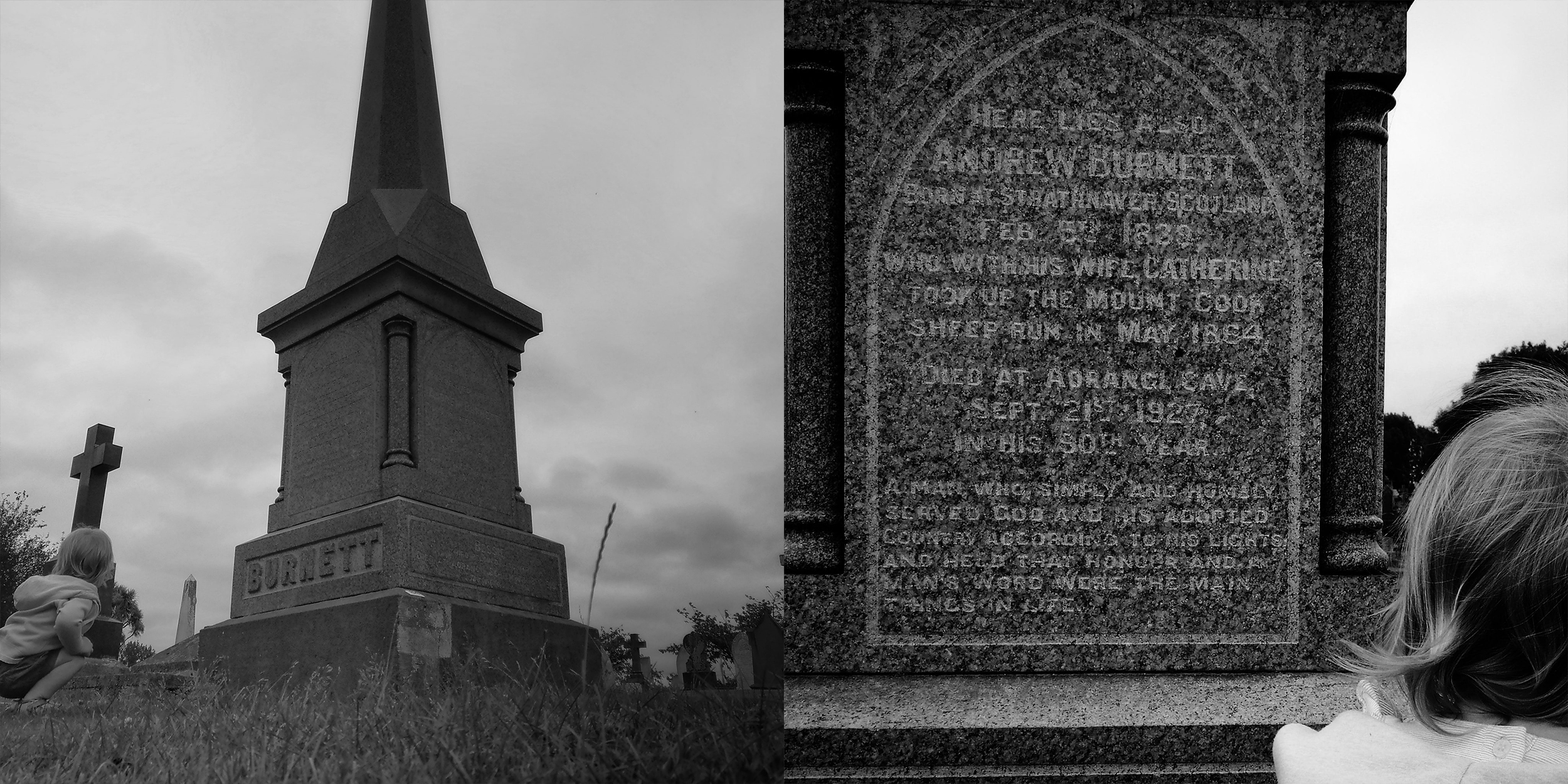
Burnett Family burial plot at the Timaru Cemetery. Photography Roselyn Fauth
Thomas Burnett married Agnes Ellen Little of Annadale, Cave, who married Thomas David Burnett in 1912. She was the daughter of William Little and Agnes (née Graham). museum.timaru.govt.nz William Little managed Cannington Station near Cave and married Agnes Graham on 15 March 1883. They had three children: William Alexander, James, and Agnes Ellen. The family resided at Annadale, a property near Cave, and were active in the local Presbyterian community. William was instrumental in establishing Cannington School in 1891 and served as chairman of the school committee. He passed away on 23 December 1908 at his residence in Cave and was buried at Pleasant Point Cemetery. museum.timaru.govt.nz
Agnes Ellen's brothers, William Alexander and James, were farmers at Annadale. James registered for military service during World War I but was deemed unfit for active duty due to health issues. Both brothers were involved in the Albury Presbyterian parish, with James serving as treasurer. museum.timaru.govt.nz
Agnes Ellen and Thomas Burnett had two children: Donald Mount Cook Burnett, who managed Mount Cook Station, and Catriona Burnett, who married Richard St. Barbe Baker, a renowned environmentalist known as the "Man of the Trees." timaru.govt.nz
Agnes Ellen's life was deeply rooted in the South Canterbury region, contributing to the community through her family's agricultural and civic engagements.
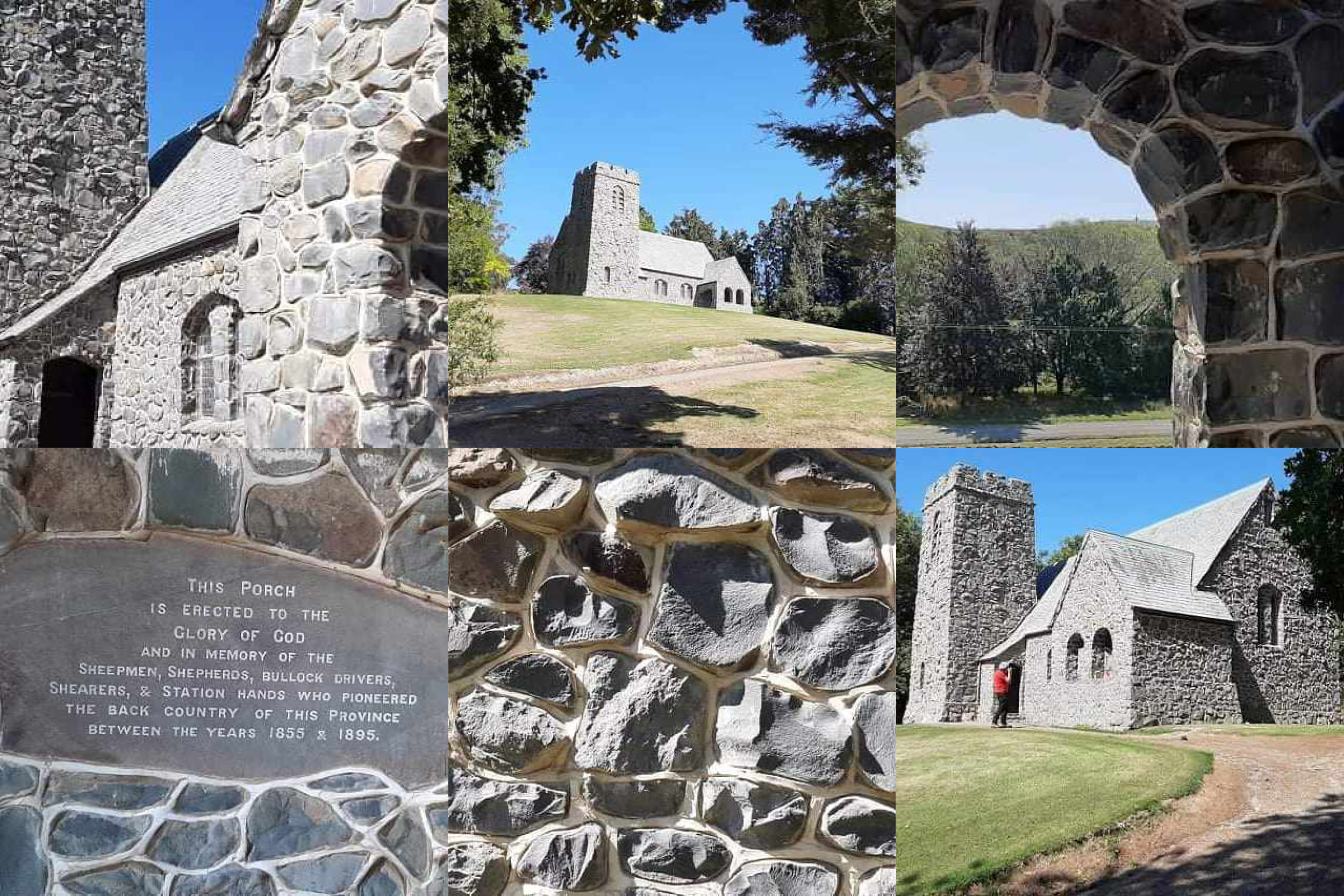
Have you been to St David's Church in Cave? Built from river stone found nearby, and glacial granite from Mt Cook, not a single nail is used inside. It was designed in 1930 by Herbert W. Hall. The building was awarded the New Zealand Institute of Architects gold medal in 1934. It was built for Thomas Burnett in memory of his father Andrew Burnett (1838–1927) and his mother Catherine (1837–1914), as well as to commemorate other pioneering run-holders who took up runs in the Mackenzie country. Andrew and Catherine Burnett arrived in Timaru in 1861. Andrew was a Highland shepherd and he worked for John Hayhurst on Grays Hill, Simons Pass and Blue Cliffs stations before taking up the 30,000 Mount Cook Station with George McRae in 1864 for 63 years. Next time you visit the SC Museum, check out the plaque under the Oak tree.
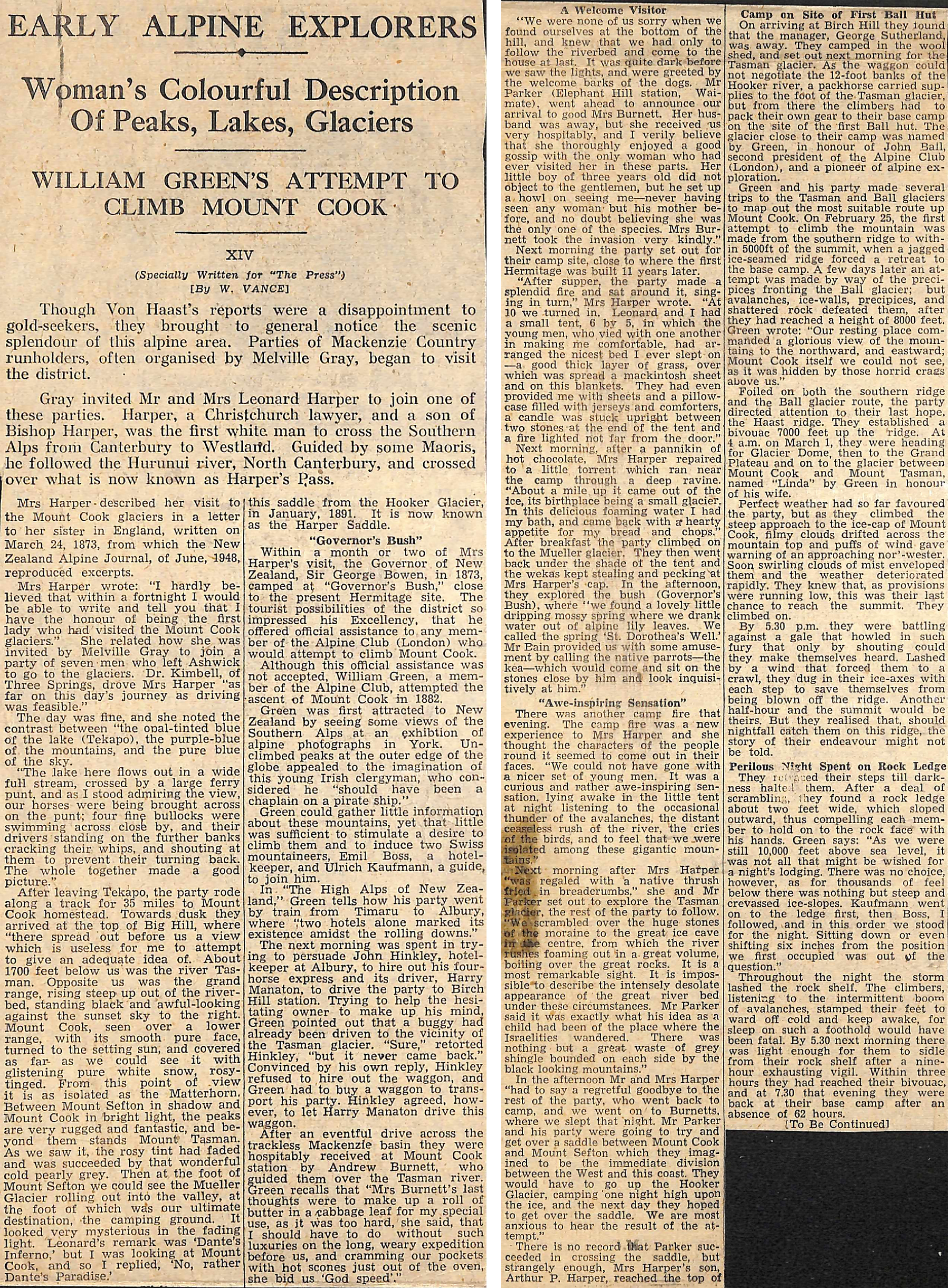
W Vance, Early Alpine Explorers, Woman's Colourful Description Of Peaks, Lakes, Glaciers (c1954). Aoraki Heritage Collection, accessed 16/06/2025, https://aorakiheritage.recollect.co.nz/nodes/view/7190
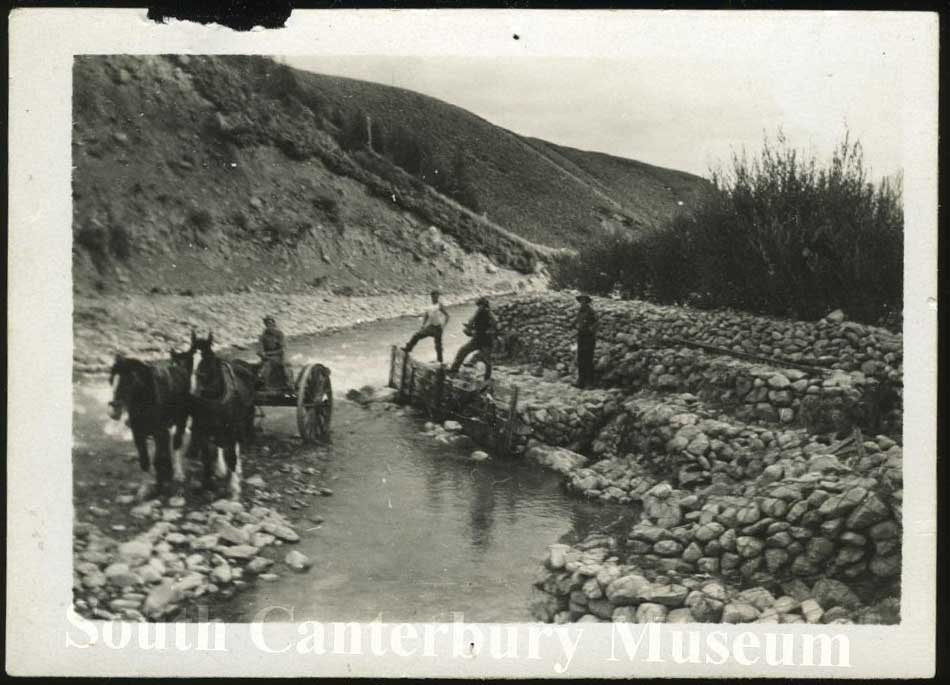
An undated view of four men, with a horse and cart, building a stone groyne/flood wall/flood bank along the edge of a river at Mount Cook Station, Canterbury, circa 1930? Burnett Collection. Te Kura Marumaru South Canterbury Museum 2015/184.844
In 1873, Mrs Emily Harper became the first recorded woman to visit the glaciers near Mount Cook, marking a pioneering moment in New Zealand’s alpine history. Invited by Melville Gray to join an expedition of seven men, she travelled from Ashwick to the remote Mount Cook area, her journey vividly documented in a letter to her sister in England. Her reflections, later published in the New Zealand Alpine Journal (1948), provide a rare and colourful female perspective on an environment dominated by male adventurers and explorers. She described the striking natural contrasts of Tekapo’s blue lake, the towering mountain ranges, and the serene beauty of sunset over Mount Cook—an image she likened to “Dante’s Paradise.”
Camping near the Mueller Glacier, Mrs Harper recounted the novelty and thrill of alpine travel, from bathing in glacier-fed streams to sharing stories around a fire with her male companions. Despite being the only woman in the group—and the first many local children had ever seen besides their mother—she was warmly received and supported. Her reflections convey not only awe at the landscape but also a keen observational eye and poetic sensibility. She named a spring “St. Dorothea’s Well,” described mischievous wekas stealing her cap, and delighted in the sight of alpine parrots responding to calls.
Mrs Harper’s experience was remarkable not just for her presence in a remote, rugged location, but for how she claimed space and voice in a male-dominated narrative. Her story adds essential depth to the early history of New Zealand mountaineering, where women’s contributions were often overlooked. She also served as a symbolic link between exploration and domesticity, comfort and courage—her tent fitted with soft linens and hot chocolate in the morning, even as avalanches roared nearby. Later, her son, Arthur Paul Harper, would honour the family legacy by crossing what became known as Harper Saddle, further embedding her pioneering journey in alpine lore.
In 2024 with my friend Francine Spencer we created two designs for the Aigantighe Art Gallery. My contribution, the window on the right was inspired by our family trip to Aoraki Mt Cook. It is one of many trips into the glacier. I have a memory of a family weekend there when I was around 12. I remember ringing some bells in a womans memory. I wonder if those bells were for the Women of Mt Cook Station?


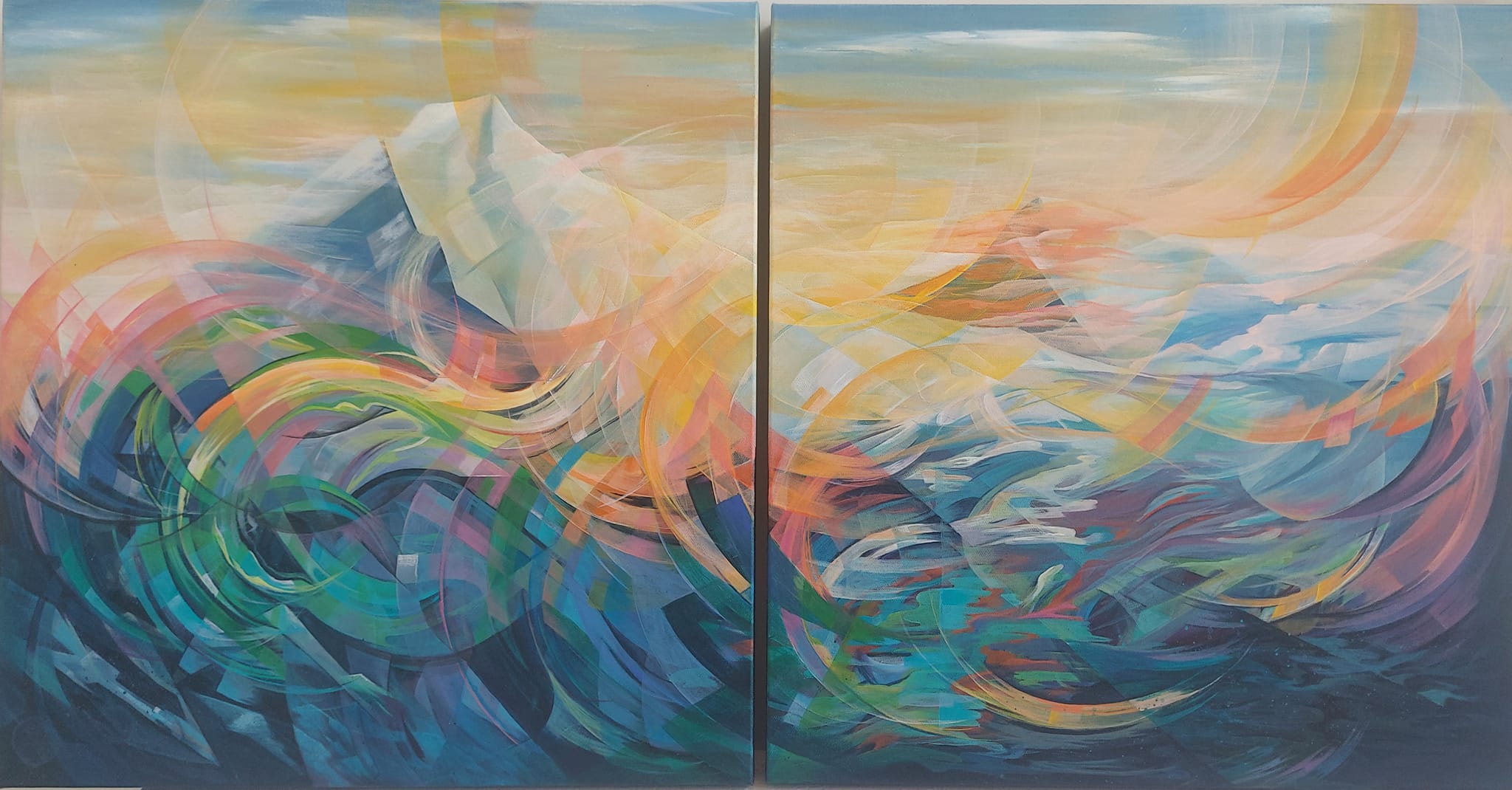
Inspired by Aoraki Mt Cook... lifted, squeezed, worn down by shaking, wind, rain, ice, plants... while it's moved and sculpted by the elements and mammoth tectonic forces... even with everything thrown at it, it still stands tall and the sunrise brings a new day. There's hints of tartan and kete, symbolic of people with place.
-
c. 1841–1842: Catherine Mackay is born in the Scottish Highlands, likely around 1841–1842 based on her official cemetery age of 72 at death.
-
Early 1860s: Catherine emigrates from Scotland to New Zealand and marries Andrew Burnett, a Highland shepherd working in the South Canterbury pastoral world.
-
May 1864: Andrew Burnett selects Mount Cook Station with George McRae in May 1864, establishing one of the earliest and most remote pastoral runs in the Mackenzie Basin.
-
May 1864: The original Mount Cook Station run covers about 6,000 hectares from the Jollie River to the base of the Tasman Glacier, with the Tasman River forming its western boundary.
-
May 1864: Catherine later recalled the three day bullock dray journey inland through gorges, waterfalls, and wild Irishman scrub, saying, “I thought we would never get there… and when we got there, I thought we would never get back.”
-
1864: A man named Hall warned Andrew Burnett not to take the run, telling Catherine that “a bird of the air could not live on it,” showing how forbidding the country was considered.
-
1864–late 1860s: The Burnetts’ first home at Mount Cook was a one room black birch hut plastered with clay and thatched with snowgrass, where Catherine began the work of making life possible in isolation.
-
1860s–1880s: Catherine raised a family of eight children in the Mackenzie wilderness, managing domestic labour, schooling, survival, and station life without nearby community support.
-
1860s–1880s: Despite hardship, the Burnetts became known for hospitality, with Julius von Haast calling them “the good people of the wilderness” and visitors remembering Catherine’s warmth and generosity.
-
1873: To be closer to education and community, Catherine and Andrew purchased Aorangi at Cave, marking a shift from extreme alpine isolation toward inland settlement.
-
1876: The Burnetts established a home on Perth Street, Timaru, on the land now occupied by the South Canterbury Museum, where a plaque beneath the oak commemorates their bullock wagon camping place.
-
3 October 1884: Catherine suffered the great grief of losing a child after coming into Timaru for schooling, with her son Andrew Burnett buried aged 13 in Timaru Cemetery, General Section, Row 84, Plot 170.
-
Early 1900s: By the early 1900s Mount Cook Station had expanded beyond 10,000 hectares with added lands such as Cox’s Downs and Balmoral, reflecting the growth of the Burnett enterprise.
-
Early 1900s: Andrew and Catherine retired to their Aorangi property at Cave, leaving Mount Cook Station under the management of their second son Thomas David Burnett (T. D.).
-
Early 1900s: Johannes Andersen later wrote that Cave became the gathering place of the Burnett clan, showing how firmly Catherine had knit her children to her heart.
-
Late 1800s–early 1900s: The Burnett daughters Catherine, Mary, Bessie, Johanna, and Agnes (Jessie Agnes) were all remembered as skilled horsewomen of the high country.
-
Early 1900s: Jessie Agnes Burnett became one of the first women to drive regularly between Mount Cook Station, Cave, and Timaru, enduring blown tyres, flooded creeks, frosted roads, and even transporting an injured man for medical help.
-
8 July 1914: Catherine MacKay Burnett died aged 72 on 8 July 1914 and was interred on 10 July 1914 in Timaru Cemetery, General Section, Row 84, Plot 209.
-
20 September 1919: Catherine’s daughter Bessie Burnett was buried beside her aged 42 on 20 September 1919 in Timaru Cemetery, General Section, Row 84, Plot 210.
-
24 September 1927: Andrew Burnett, Catherine’s husband and the Mount Cook Station pioneer, was buried aged 89 on 24 September 1927 in Timaru Cemetery, General Section, Row 84, Plot 169.
-
1941: Thomas David Burnett, former Member of Parliament and manager of Mount Cook Station, died in 1941 from complications of hydatids infection.
-
After 1941: Following T. D. Burnett’s death, Jessie Agnes helped her sister Johanna manage the Aorangi property at Cave, continuing the Burnett women’s stewardship of the land.
-
1950s–2010s: T. D.’s children Donald and Catriona Burnett became internationally known for producing extremely fine Saxon merino wool at Mount Cook Station.
-
2010: Donald Burnett died aged 95 in 2010, having never married and devoted his life to the station.
-
2014: Catriona Burnett died aged 97 in 2014, leaving no heirs and bringing the Burnett family line at Mount Cook Station to its close.
-
Early 2000s: In the early 2000s Mount Cook Station underwent tenure review and was reduced to about 2,600 hectares, with much of the former run returning to Crown conservation land.
-
2017: With no descendants remaining, Mount Cook Station was sold in 2017 to new owners, ending the Burnett family’s 150 year connection to the high country they helped make habitable.
-
Cemetery Anchor: Timaru Cemetery, General Section, Row 84 holds the Burnett family cluster, with Andrew senior in Plot 169, the child Andrew in Plot 170, Catherine in Plot 209, and her daughter Bessie in Plot 210.