

I’ve just finished reading my neighbour (and high school friend) Pauline’s thesis — and wow, it’s opened my eyes. She’s was awarded a Master of Indigenous Studies (MIndS) for COVID-19 Talanoa: The Voices of Tongan Kāinga in South Canterbury.
Her research gives voice to Tongan families in Timaru, capturing how they faced the early days of COVID-19 with strength, faith, and family at the centre. Every story she gathered is more than “research” — it’s real life. What stood out most to me is how every decision — moving here, sending money home, getting through a global pandemic — always came back to family.
Resilience, as Pauline shows so beautifully, isn’t just individual. It’s cultural, communal, and deeply rooted in stories. Read it here: otago.ac.nz/COVID-19-Talanoa-The-Voices-of-Tongan and then if you like, read on for my reflection on her thesis and what Pauline has taught me...
When Pauline first told me about her thesis, I have to be honest — I didn’t really know what a thesis was. I understood it was a huge amount of work, and as my husband pointed out, it’s the kind of achievement anyone would be very proud of. But now that I’ve finished reading it, I’m blown away. I can see just how much thought, care, and dedication went into every page... please read her thesis for yourself, and I hope that it leaves you feeling uplifted, and inpired too.
Abstract
Tongan kāinga living in South Canterbury Diaspora Migration experiences New Zealand Tongan values Pacific ethnic-specific COVID-19 responses Pandemic experiences Coronavirus Third Space Theory Cross Cultural collaboration Co-Leadership Praxis of engagement Pacific communities Small Pacific populations in South Island Navigating COVID-19 Negotiating Tongan and Western values Tongan culture Tonga Deficit Theory Paradigm Government Funding Cultural barriers Community led Pacific Leadership
This thesis is an exploratory study on the experiences of Tongan kāinga (distant relations/community) in the rural region of South Canterbury, New Zealand before and during the COVID-19 pandemic. It examines Tongan kāinga’s migration stories and their experiences in response to COVID-19 from March 2020 to May 2020.Migration stories were gathered to provide background and context for Tongan kāinga’s diverse responses during COVID-19 and to acknowledge participants' journey to the diaspora. A further aim was to challenge the deficit theory paradigm often ascribed to Pacific ethnic-specific populations by demonstrating the richness and strength of Tongan cultural values, knowledge, and customs. The Kakala methodology comprised individual talanoa with nine participants based in South Canterbury.
Findings showed that kāinga Tonga in South Canterbury derived strength from their children, family, and faith to persevere and support each other throughout the COVID-19 pandemic. Hardships were navigated through care and concern for others, gathering and processing information, and collective activation and mobility. Findings also revealed that participants negotiated between Tongan and Western values in the predominantly New Zealand European ethnic region. They do this as individuals, and as kāinga through the Tongan Society South Canterbury. Local community-based solutions and cross-cultural provider collaboration, irrespective of ethnicity, was strong and effective in South Canterbury with selective organisations. Participants reflected and demonstrated that Tākanga ‘Emau Fohe (together we can make a difference) contributed to overcoming hardships during COVID-19. This is the first piece of academic research on the experiences of Tongan kāinga in South Canterbury, or any comparatively small Tongan or Pacific ethnic-specific community in New Zealand. Further research is warranted.
My key take-aways:
Faith was a thread that ran through it all. When things got hard, prayer wasn’t just a fallback, it was part of the everyday. That really challenged me to think about what I lean on when life gets uncertain.
I really loved the way family was defined — not just blood, but neighbours, church, rugby clubs. One mum even merged her lockdown bubble with her Pālangi neighbour so the kids wouldn’t feel lonely.
And I have a new appreciation for the Tongan Society here in Timaru. While the big national agencies didn’t always reach people, the local group knew exactly what families needed because they were part of the community themselves.
Pauline shared the Tongan proverb Takanga ’Emau Fohe “together we make a difference.” I could picture the rowing of a canoe in unison. It reminded me that resilience isn’t about pushing through alone, but about moving together.
Her work has given me a new way to see resilience: family, faith, generosity, and doing it side by side.
Pauline’s thesis inspires me because it shows how strength comes from family, faith, and generosity and that resilience is not about standing alone, but moving forward together.
Here are ten facts I learned from Pauline’s thesis:
- Family was central – Every participant placed their children and immediate family (‘api) at the centre of decisions, whether moving to Timaru or navigating COVID-19.
- Three-step decision process – Participants consistently followed the same pattern: first concern for family safety, then gathering and processing information, and finally acting together as a family or community.
- Migration motivations – Tongans moved to Timaru for family connections, education, rugby opportunities, faith, and to create safer futures for their children.
- Smaller Tongan population in Timaru – This was seen as an advantage compared to Auckland, as it allowed families to focus on their own responsibilities without being overwhelmed by wider fatongia (extended obligations).
- Remittances and reciprocity – Families sent money and goods back to Tonga and Auckland, and received goods and support in return, showing a continual two-way exchange.
- Faith was a foundation – Prayer, belief in God, and church involvement consistently helped participants through hardships, migration challenges, and the uncertainty of COVID-19.
- Language barriers created fakamā (shame) – At first many participants felt shy or ashamed about their English, but through work, school, and encouragement, they grew in confidence and often attended English classes.
- Tongan Society South Canterbury (TSSC) – Established in 2016, this incorporated society became a vital support network during COVID-19, providing food, hygiene packs, competitions for children, and advocacy with government.
- “Takanga ’Emau Fohe” (Together we make a difference) – This Tongan proverb was lived out in how families and communities persevered, emphasising collective resilience over individual struggle.
- A “third space” emerged – The thesis showed that in South Canterbury, Tongan families and TSSC created a hybrid space between Tongan values and Western systems, where new ways of working and supporting each other could grow.
Five inspirational women that I learned about from Paulines thesis
1. T01 – The Eldest Grandchild and Family Anchor. They carried the role of fahu, responsible for sending goods, food and clothing back to Tonga. Even when facing the stress of visa insecurity and the heartbreak of being stranded in Tonga during her grandmother’s funeral in the 2020 lockdown, she remained steadfast. Her courage to hold her family together across oceans shows how women often carry invisible but vital responsibilities for continuity and care. When I was in the Netherlands it took a long time for my working visa to be approved, at age 18, I had to get a marriage certificate to prove I was not married! It felt very frustrating as I had met criteria, followed the rules, had a dutch mother, but he bureaucracy had let me down. One evening when I was working at a restaurant, I had to wear all of my colleagues coats and hide in the chiller because immigration officer had arrived. So reading about T01 really resonated with me, I could feel her stress when she also had to hide when immigration officers came to her workplace.
2. T02 – The Community Leader and Mother of Six. Balancing six children, study, work, and leadership within the Tongan Society South Canterbury, T02 became a powerhouse of service. During COVID-19 she took on extra roles as an essential worker and community interpreter, ensuring health information was understood in plain language. She embodies the proverb Takanga ’Emau Fohe (rowing together in unison) by pulling her family and community forward at the same time. I really admire how she juggled being a mother of six children, juggling parenting with study, work, and community leadership.
3. T04 – The Faith Pioneer. Arriving in Timaru in 1972, T04 came through the Catholic Church and worked alongside the Sisters of Compassion. Homesickness pressed heavily on her, yet she stayed, holding fast to her faith as her compass. She was one of the earliest Tongan women to build a life in South Canterbury, planting seeds for the generations who followed. I can see that her faith helped to give her strength to keep going when her heart was deeply longing for home.
4. T05 – The Mother Who Carried Her Family Through COVID. Pregnant during the first lockdown, T05 faced the fear of hospitalisation, separation from her children, and the stress of isolation without extended family support. Despite this, she remained a source of comfort for her children and adapted to the uncertainty with determination. Her story is one of quiet strength in the face of overwhelming pressure. I could relate to the visa troubles - I had issues when I lived in the Netherlands, and it was really stressful. I think she is really inspiring.
5. T06 – The Church Builder and Survivor. T06 migrated with her husband to pioneer a church in Timaru, but after his sudden passing and her mother’s death, she was left to raise her children alone. Guided by deep faith, she persevered, continuing the work they had begun. Her resilience is a reminder that leadership is often born in moments of profound loss, and that endurance can be an act of love. I found her story really heartbreaking, arriving here for a fresh start and to find opportunity, she has endured so much. It made me quite emotional actually. And grateful for my life and those I love.
My Reflection
I can relate to Pauline’s thesis because even though my story is different, there were many things that these women experienced that I had felt too. I could relate to the strong sense of responsibility for family, migration and belonging. I am a sixth-generation Kiwi, but my mother came here from the Netherlands, carrying her own hopes for her children and building a life far from home. After high school, I went to live on Texel with family to learn more about my mothers culture and myself. I realised that I would never be fully 100% kiwi, or 100% dutch, and that I was a blend of both worlds. Reading about the Tongan families in Timaru reminded me that whether we have been here for generations or have just arrived, we are all shaped by the pull of family, the courage of migration, and the way we learn to stand strong together in a new place.
When I was helping to volunteer with the design of the Caroline Bay playground upgrade, we asked the Pasifika community for their ideas. That was when Pauline first shared some of the history of her community with me. We were looking at ways to tell the story of the eels, their long migration from Aotearoa to the seas near Tonga, and Pauline suggested using a frangipani or Hibiscus flower to link the tuna to the Pacific. That symbol became a bridge — tying together the migration of people, the journey of eels, and all the other meanings of the frangipani flower: love, beauty, resilience, and connection.
In my 20s I made a painting inspired by a quad on Lake Ruataniwha. One of the best feelings was when we moved the oars, blades and seats in perfect unison. I remember the rhythm of the blades cutting the water, the flick of spray, the sound as we rolled forward together and stretched the oars out to drive us further. It was only when we were all in sync, in full control, that the boat would lift and you could hear the bubbles rushing under the hull. Success was when we moved together — and it felt incredible when we made that happen as a team.
Reading Pauline’s thesis reminded me of that feeling. The strength of her work comes from the same place... people moving together, families and communities pulling in time with each other. That’s where I think resilience is found, and that’s what carries us forward.
The thesis shows that family is at the heart of decision-making and resilience for Tongans in South Canterbury, with care and concern for others as the first priority.
As the eldest of four, I relate strongly to this. I often felt like “mum number two,” stepping into a caring role beyond my years. Psychology describes this as parentification, where children assume adult responsibilities. While it can be demanding, it also builds empathy, resilience, and a deep sense of responsibility — qualities I recognise as central to who I am today.
The research also highlights how ‘ofa (love and kindness) extends family beyond blood ties, bringing neighbours and community members into the circle of care. I see myself in this too. Growing up, my caregiving extended naturally to cousins, friends, and others around me. Psychology calls this prosocial behaviour — actions driven by empathy and the wellbeing of others. These experiences shaped me to view family not just as who you are related to, but also those you choose to support and include.
The thesis positions TSSC as a modern expression of kāinga, filling the gaps where Western systems can be transactional and impersonal. This resonates with me because social psychology suggests caregiving often becomes part of identity, influencing how people continue to act as adults. For me, that early identity as a caregiver continues to shape my passion for creating spaces of belonging, support, and collective resilience — just as TSSC does for the community.
Something else that really resonated with me from Pauline’s thesis was how it made me reflect on my own family. Over time, many of my relatives have passed away, and I realise that one day when I am finally able to go back to the Netherlands, my mother’s home will not be the same. The people I knew are gone, the houses sold, and those familiar places will feel different. It reminds me of the eels — when they return home after their long journey, the world can shift quickly and no longer feel familiar. In Timaru, eels once thrived in Ashbury Park, which used to be a huge lagoon and eel weir, until it was drained in the 1930s to ease flooding and reclaim land for sport.
I wonder if this feeling is something the Tongan community that Pauline writes about knows well. Some of her participants spoke about going back or keeping strong ties with home, only to find things had changed. T04 shared how homesick she was and thought about returning to Tonga, but she knew it would never quite be the same as when she left. T01 experienced this even more directly when she went back for her grandmother’s funeral in 2020, only to become stranded there during lockdown — caught between two worlds, with neither place feeling steady. Others described the daily calls, sending goods, or receiving parcels as ways to hold on to what was shifting in Tonga.
Reading her research reminded me that belonging is never fixed, it’s something we carry, nurture, and pass on. Migration is about opportunity, loss and adaptation. Pauline’s thesis helped me see that more clearly. In a way, it’s not unlike the eels... returning to find the world altered, yet still holding on to the deep pull of belonging.
Whether we have been here for generations or have just arrived, we are all shaped by the pull of family, the courage of migration, and the way we learn to stand strong in a new place.
The way they view themselves in context with their community was interesting.
Hopefully I have understood this right... but I think going by Paulines' thesis, The Tongan Kinship Circle (Nofo ‘a Kāinga), puts family, hierarchy, and responsibility right at the centre of life. Everyone knows their place and their duty through bloodlines, and values like respect, humility, loyalty, and love (‘ofa) hold everything together. When I think about this alongside Maslow’s Hierarchy of Needs, I can see how different the two are. Maslow’s idea is about an individual journey, where you move step by step through needs until you finally reach self-actualisation. The Kinship Circle, though, is about the collective... it’s not about one person’s growth but about the strength that comes when everyone fulfils their responsibilities to each other.
That really makes me think about what I see around me in my own community. I worry that people are losing their sense of duty, becoming more focused on individual goals and independence. Maybe this is because we’ve been shaped by Maslow’s way of thinking, where fulfilment is something you achieve for yourself. The Tongan way shows something different, that wellbeing and resilience come from serving others and living out obligations to family and community. I can’t help wondering if some of the disconnection we see today comes from drifting too far away from that collective sense of care.
I also find it fascinating to compare this with what I’ve learned about Native American perspectives, where people are believed to be born with self-actualisation already inside them. The task isn’t to climb toward it but to hold onto it as we grow. That really struck me because it’s such a contrast to Maslow’s idea of working upward, or the Tongan view of finding fulfilment through collective duty.
When I think back to my experiences in the Netherlands, I felt that some of the Dutch society can be described as egalitarian, individualistic, and consensus-driven. Hofstede’s cultural dimensions demonstrate the Netherlands as high in individualism (valuing personal autonomy and independence), but also strong in low power distance (everyone is considered equal regardless of status). This is reflected in their “polder model” of decision-making — long, inclusive discussions aimed at consensus, where every voice counts. Dutch culture also values directness, practicality, and personal responsibility. Unlike whta I think the Tongan hierarchical kinship structure is, where roles and duties are inherited and collective wellbeing is prioritised, the Dutch tend to see responsibility as personal choice, with the community outcome shaped by everyone’s equal contribution.
Putting all these side by side has taught me that wellbeing isn’t one-size-fits-all. Some see it as a ladder to climb, others as something innate we must protect, and others as the responsibilities we carry together. For me, it raises a question I keep coming back to: are some of the struggles we face today because we’ve lost that balance between what we carry within us and what we believe owe to each other?
“The true meaning of life is to plant trees, under whose shade you do not expect to sit.” - Canadian farmer Nelson Henderson
“He that plants Trees, loves others besides himself.” - Thomas Fuller (1732)
The other thing that resonated with me in her thesis was around her comments on local and culturally led services work best.
The thesis findings showed that service delivery in small regions like South Canterbury is most effective when it is locally and culturally led. National providers often lack genuine relationships with the community, which means their solutions can be disconnected from real needs. Participants in the research had little awareness of large social service providers or government agencies, showing that local advocacy and solutions are born directly from within the community. This is very true to my experience with CPlay - a volunteer and community led re development of a 1960s playground.
I actually debated this with some friends recently, and I struggled to articulate why thoughts. I wish I had read Paulines thesis sooner, as I would have had more confidence in my perspective.
This section in her thesis reinforced to me how valuable our local knowledge and networks are. We live and work here... we understand the context in a way that outsiders cannot. It makes me proud of the role we play in shaping solutions that truly meet our community’s needs.
The thesis highlights the importance of tauhi vā-māfana... warm, trusting relationships, as central to effective service delivery. Without these culturally grounded relationships, services risk being sub-optimal and contribute to a deficit paradigm. For Tongan and Pacific kāinga, positive relationships built on Anga faka-Tonga are essential for receiving the high-quality services they deserve.
This challenges me to think about how I foster and protect those warm, culturally respectful relationships in my own work. It’s not just about delivering a programme, it’s about building trust, showing respect, and making sure people feel seen and valued. I think this is why sometimes we see negativity in local government led projects, the community hasn't been on the journey from the outset, they dont feel included, seen or considered, and the approach that the thesis recommends reinforces the value of relationships.
The thesis also warns that when national bodies don’t include regional input, they risk throwing funding at problems without offering relevant or sustainable solutions. Money alone does not solve issues if it isn’t grounded in the lived reality of the community.
This makes me more determined to keep speaking up for local voices. I can see how easily national services could overlook or undervalue what matters most here. For me, this is a reminder that advocacy is essential—we need to keep insisting that solutions are co-designed with the people they affect.
Please, make yourself a hot drink and take in Pauline’s incredible work. It’s a truly inspiring read. https://ourarchive.otago.ac.nz/esploro/outputs/graduate/COVID-19-Talanoa-The-Voices-of-Tongan/9926479986901891
I want to congratulate Pauline on this incredible achievement. Her thesis is a really important piece of academic work, and I can imagine will feel to many as a gift from her to her community and to South Canterbury. She has taken the time to listen deeply, to hold people’s stories with care, and to share them in a way that honours both Tongan values and the challenges of living in Aotearoa. I have so much respect for the dedication, courage and heart it took to bring this research to life. Pauline has created something that will continue to inspire and teach, and I feel grateful to have learned from her lived experiences, dedication and hard work. What a phenomenal woman.
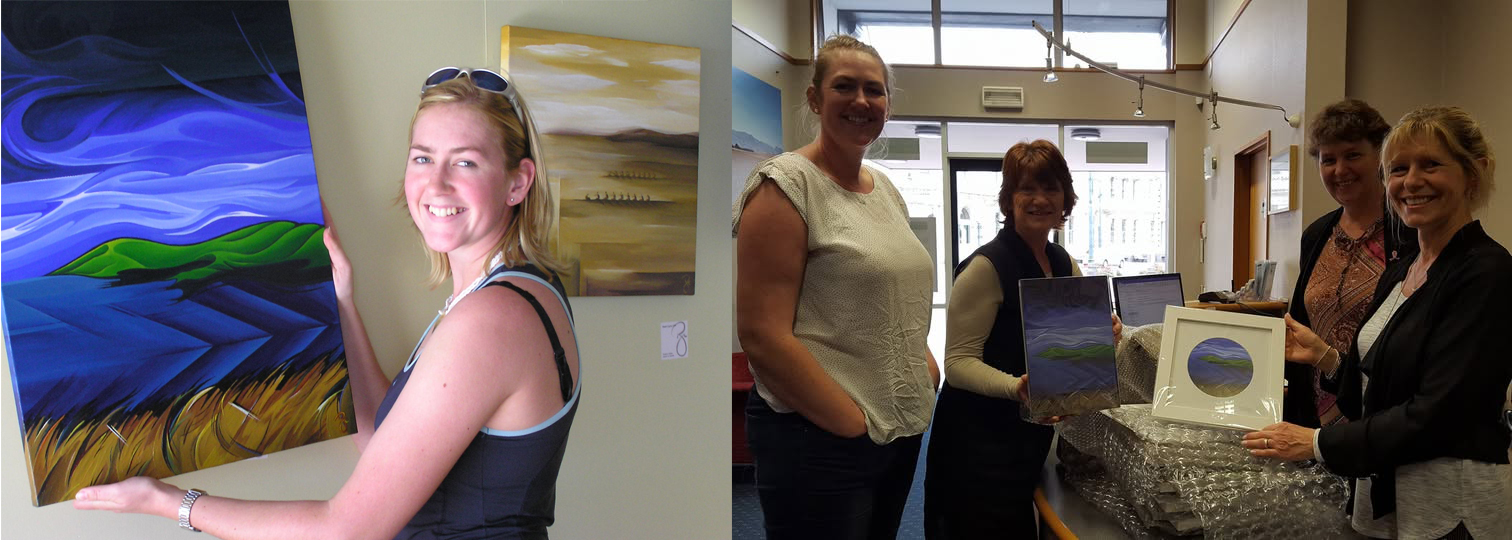
Roselyn Fauth in her 20s with her painting Maadi. Right, gifted the image to the South Canterbury Chamber of Commerce to use for their branding and gifts.

Roncalli College girls out training on Sunday 13 Oct 2014 Geoff Cloake
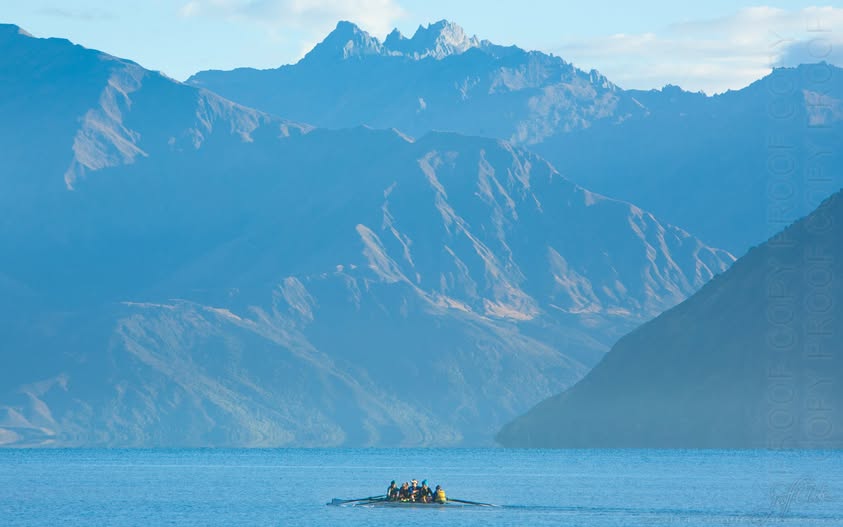
Lake Wanaka 2009 Geoff Cloake
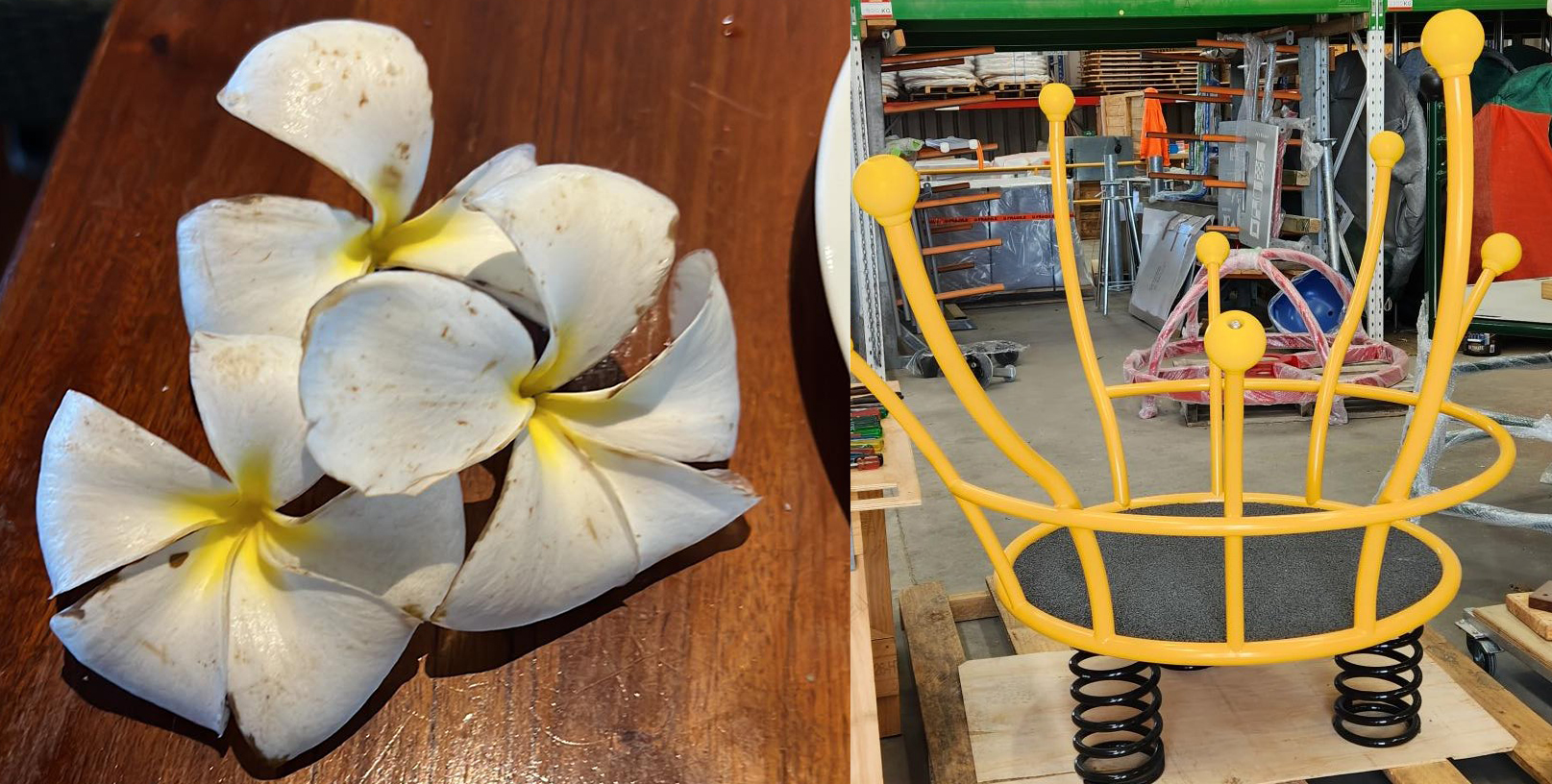
Photo of Hibiscus that Pauline sent me that inspired the design for the playground surfacing. I sent through the design to the playground surfacing contractors to make for us and position under the rocker to look like a pacifica flower.
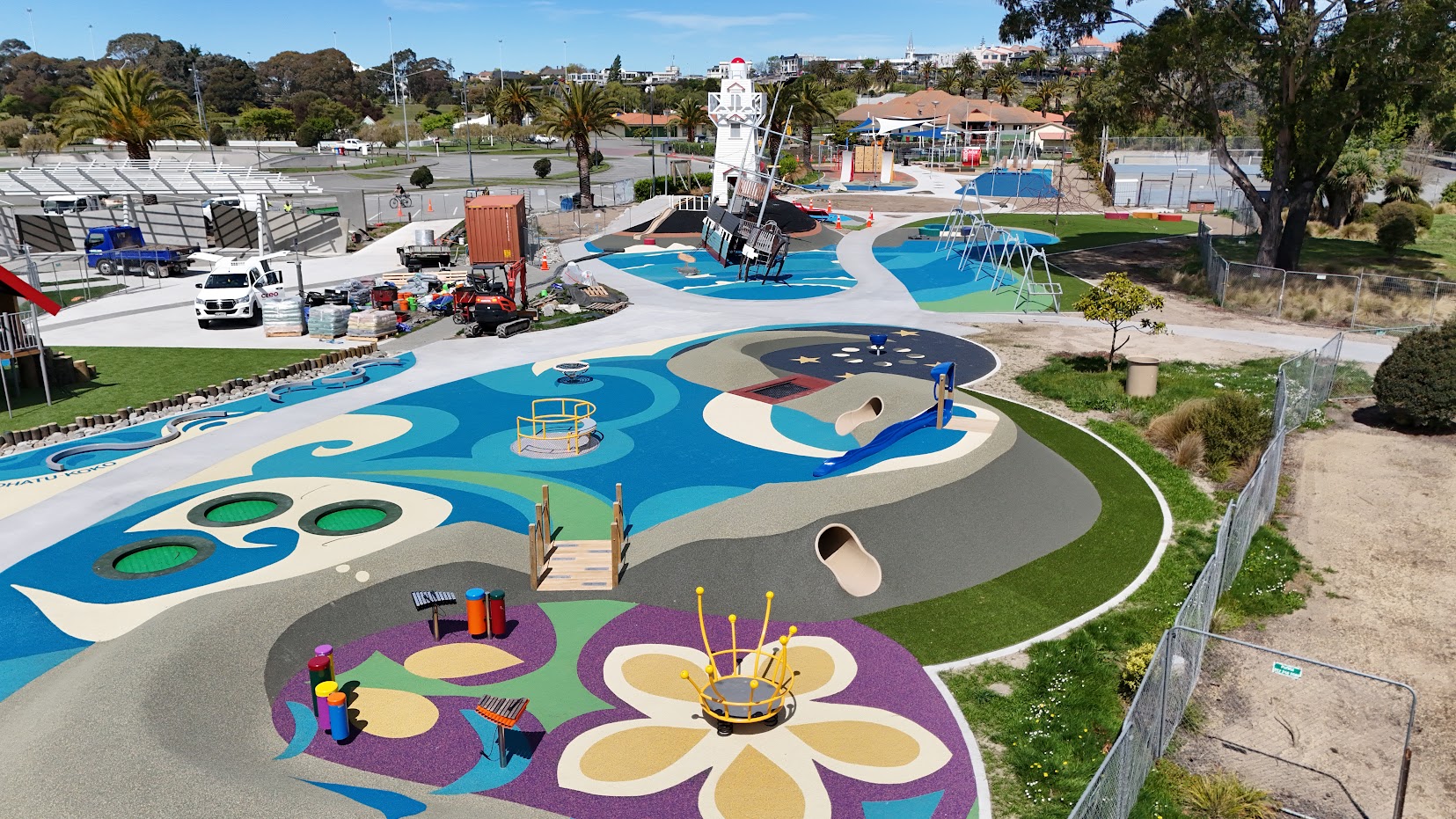
Pop of colour, the Pacifica flower in position with the Caroline Bay Playground, that opened December 2023. The playground has won multiple awards. For me one of the most satisfying results was the inclusion of place based story telling with design elements that reflected the people of our area. this was the first time that Maori and Pacifica cultures have been recognised in a public council space in South Canterbury. I am really proud to have been a part of that achievement, to help the community connect and reflect on the stories of our past people and place.
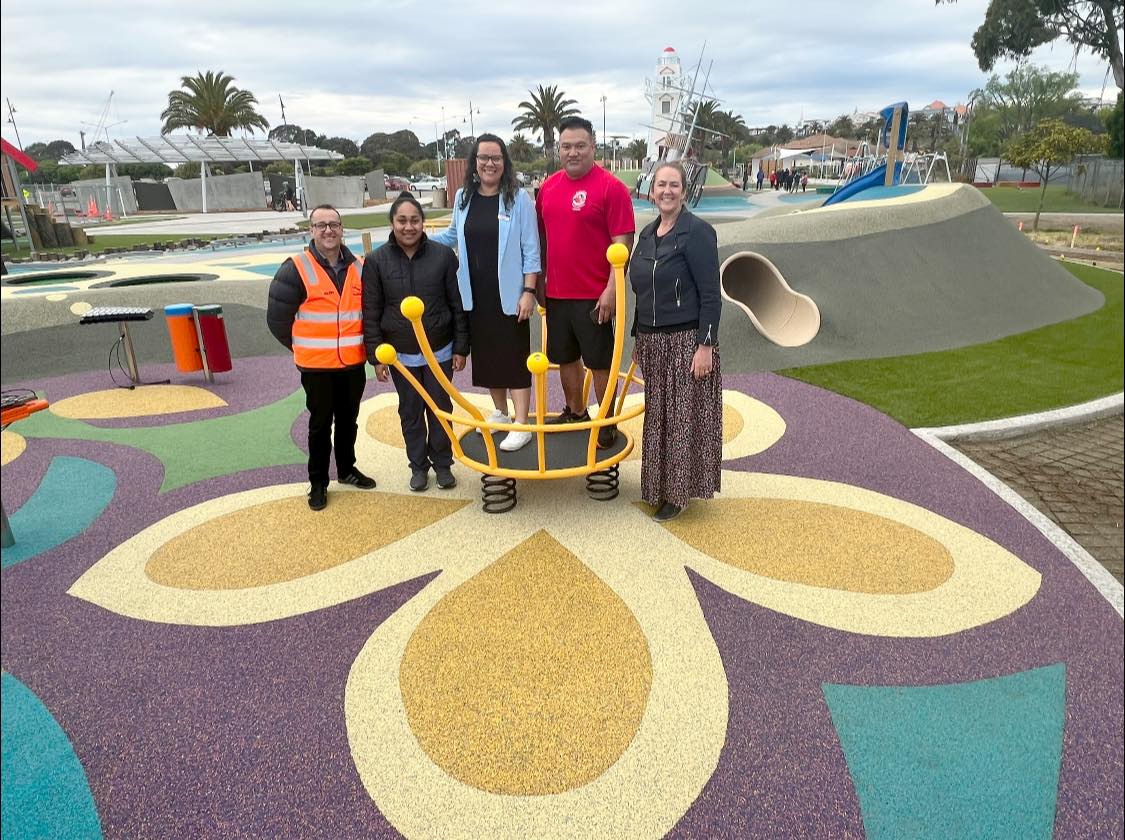
The Frangipani flower is symbolic and used in lei, kahoa, salusalu (flower garland) known as the kakala (lei making) process. The lei is gifted to show welcome, love and kindness to a person receiving the gift. CPlay’s flower symbolizes Pasifika hospitality and the deep connection across the ocean, as reflected in the migration of tuna eels from the Pacific to Aotearoa NZ. I love watching the kids play with their family and frirends and pretending they are on a journey to the Pacific islands.
When we were designing the playground, Pauline shared ideas that helped us bring Pasifika stories into the space. One of her suggestions was the frangipani flower, which became a symbol linking the migration of eels from Aotearoa to the seas near Tonga with the journeys of Pacific peoples. The flower also carries so many other layers of meaning (love, welcome, resilience, and connection) which felt like the perfect fit for a place where children and families gather.
Reading Pauline’s thesis made me see just how deeply those values run in the lives of Tongan families in South Canterbury. The way she described ofa (love and kindness), faka‘apa‘apa (respect), and tauhi vā (nurturing relationships) reminded me that resilience doesn’t come from standing alone, but from the ways people move together, like oars in a rowing crew. That same spirit is present in the frangipani at the playground, quietly carrying those values into our shared community space.
For me, the playground design and Pauline’s thesis are both about connection across oceans. The eels return on their long journey, just as families migrate, adapt, and hold on to belonging. Symbols like the frangipani help us remember those stories, and invite everyone in Timaru (whether here for generations or newly arrived) to step into that third space of welcome, learning, and moving forward together.
Pauline, your work is a gift... to your community, to Timaru, and to anyone willing to listen, and I feel proud to walk alongside you in this place we both call home.