
By Roselyn Fauth

At the top of the Timaru Cemetery, with a view to the pacific ocean lies the grave of Captain Alexander Mills (1833-1882). While he witnessed is story is bound to the lifeboat Alexandra and to one of Timaru’s darkest days — the wrecks of the Benvenue and the City of Perth in May 1882.
Mills was the Harbour Master at the time. He’d stepped into the role after Captain Woollcombe, who before him had been beach master. Woollcombe had seen enough wrecks to read the sea like a sentence. That morning, looking out over the bay, he turned to his daughter and said something was wrong. “If the ships don’t get moving, they’re going to be in real trouble.” He wasn't wrong...
It was a political tug-of-war. The Harbour Board wanted ships in close. Ships used to drop their anchor in the sea by the coast and smaller boats moved between ships and the shore to transport cargo and passengers. That meant efficient mooring, faster offloading, and a boost for viable trade. But sailors and their families understood the danger. If a big sea whipped up, especially with little wind, a ship too close to shore might never escape. There wouldn’t be enough time or room to raise sails and tack for the safety of deeper water. Many of Timaru’s wrecks happened when the anchors failed. They snapped or dragged. The sea took the fate of the ship over.
One blue sky Sunday in 1882, the sea turned mean. Captain Woollcombe who had been the towns beach master for many years earlier, said to his young daughter Laura... if the ships didn't get to open water they would be in real trouble. Captain Mills the harbour master at the time had been keeping a close watch, and summoned the sea rescuers with the blast of the signal gun. As men rushed to the rescue, the town rushed to the cliffs to see what all the comotion was about. People later recalled how loud the ocean roared. The Benvenue went first, dragging its anchor and running aground below the cliff now named after it. Soon the The City of Perth lost its anchor too and followed, helpless against the swell. Mills reputation was at stake. He had beem heavily critised over the 16 years as Harbour Master for the reputation Timaru was gaining as a ships graveyard. He launched a salvage attempt with a few small row boats in tow, but it ended in disaster and dozens of men were thrown into the surf. At one point forty men were stuggling inthe boiling sea, battling the waves for their lives while the town watched helpless from the cliff tops above.

Since its retirement in 1882 the lifeboat has been a memorial to those who manned it and those it rescued. Named after the wife of King Edward VII, Alexandra of Denmark, the Timaru lifeboat is one of the oldest vessels of its type in the world.
The Alexandra lifeboat was called into action. She’d been built in 1862 in London and designed to right herself if overturned and on the mission capsized multiple times. Somehow brave men worked together to save 43 lives.
While Captain Mills made it back to shore, he was not so lucky, exhausted and frozen to the bone he died of exposure. His grave marks the end of a life at the cost of a hard decision. He had fought to serve both safety and trade, and in the end, he gave everything to try to save others. But the politics didn't let him rest in peace. Astonishingly the harbour board decided to save face that they would fire Mills a few days after his death. This must have hurt his greiving family, crews and friends deeply. A low blow act to a brave and now defensless man.
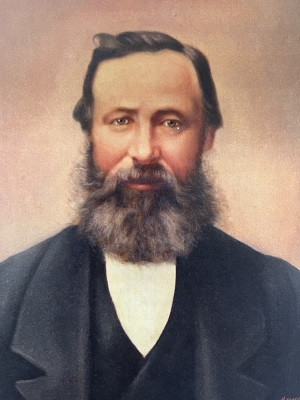
Oil painting of Captain Mills c.1880s. Image courtesy of the South Canterbury Museum, item P0071. Please contact the museum for more information.
For years people of Timaru would recount where they were that day. Watching from the cliffs was a young David Clarkson Turnbull, son of merchant and politican David only a few years away from leaving school to join the family trade. His father had been a large advocate for the construction of a harbour, minting a penny token to sell the dream, and hosting a town meeting that saw the formation of the first harbourboard. They group worked tirelessly to raise funds, ultimately became an asset of the local rate payer and in 1878 work began on one of only two independant ports in the country. This forsight for efficiency and safey was still in its infancy, and with so many ships queing for a turn at the breakwater, Turnbull saw the ships Benvenue and City of Perth met their demise. He salvaged the ship’s bell and years later, donated it to the South Canterbury Museum. Turnbull went on to build a life in shipping and logistics, making a significant impact to the opportunity of the town and wider region. The weight of what he witnessed never left him.
The Alexandra lifeboat went on to become a memorial. At monument stands at PerthStreet, and Caroline Bay Playground drew its themes from the story of sea rescue. The lifeboat returning to the bay for people to connect to the stories of the past, remember the early coastal connection challenges and those who bravely rushed to the rescue.
So next time you are at the cemetery, take a moment up on the hill at the grave of Captain Mills and his family. Now a silent watchman over a harbour that once asked him to choose between safety or speed on which he paid the ultimate the price for trying to hold the line between.

Here is the grave of Captain Alexander Mills, the Timaru Harbour-Master for 16 years, who witnessed most of Timarus shipwrecks. He died from exposure from the Ben Venue disaster. He rests in peace here, with his wife Margaret, three infant children and two teenage children. Mills, Alexander James, 1833-1882. Row 9, plot 9, Timaru Cemetery. Photo Roselyn Fauth

The large painting (about four feet in length) of the wreck of 'City of Perth' and 'Ben Venue' at Timaru hung for many years in the Farmers tearooms and now the painting is at the Port Company Offices, Timaru located along Marine Parade which is located near the distal end of the Port Loop Road a route to Caroline Bay and the harbour. The plate below the painting reads "Wreck of the Ben Venue and City of Perth on 14 May 1882, Presented to: The Port of Timaru Ltd. by Arthur Bradley. Last surviving son of Issac Bradley, A member of the rescue craft's crew." Photo by Roselyn Fauth with permission of PrimePort Timaru.

The wrecks at Timaru, New Zealand: Lifeboats rescuing sailors in heavy surf, one life boat named City of Perth. . Wood engraving by Ashton, Julian Rossi, 1851-1942 slv.vic.gov.au/permalink/f/1cl35st/SLV_ROSETTAIE670476

Timaru, "Ben Venue" stranded, stern c1882 https://collections.tepapa.govt.nz/object/1346853

ALEXANDRA LIFEBOAT, 1865.TIMARU HERALD, VOLUME CXXV, ISSUE 18008, 13 JULY 1928, PAGE 9 (SUPPLEMENT)
Using This Item: Stuff Ltd is the copyright owner for the Timaru Herald. You can reproduce in-copyright material from this newspaper for non-commercial use under a Creative Commons BY-NC-SA 3.0 New Zealand licence. This newspaper is not available for commercial use without the consent of Stuff Ltd. For advice on reproduction of out-of-copyright material from this newspaper, please refer to the Copyright guide.
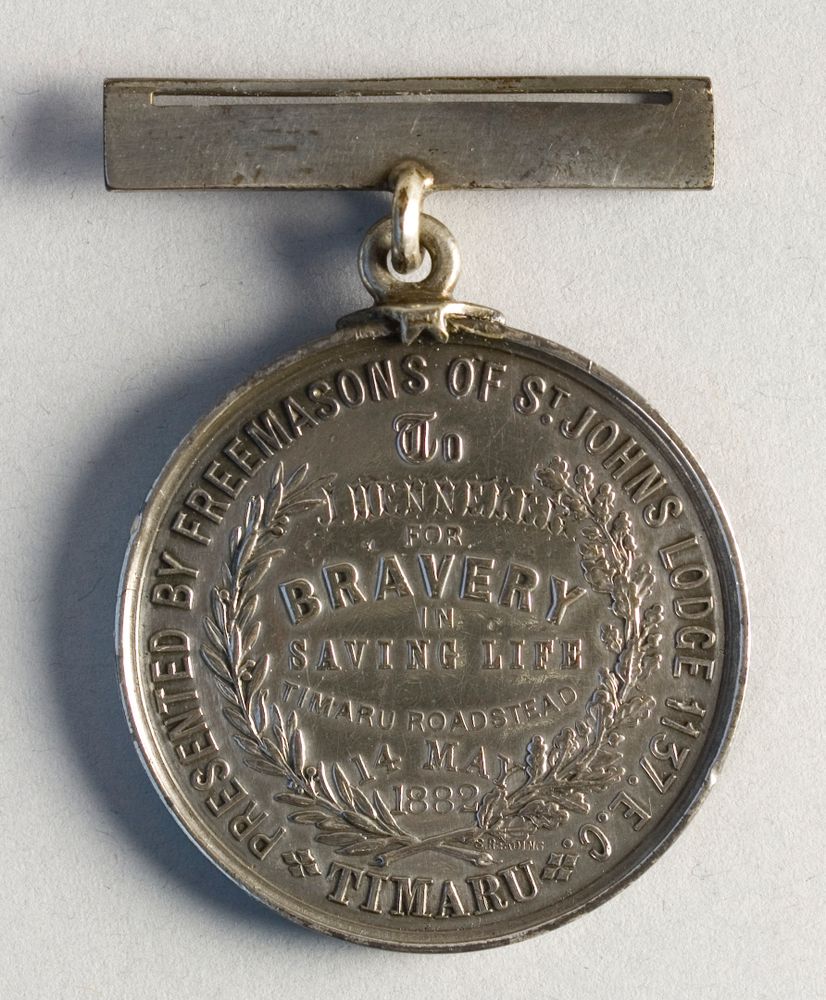
Bravery medal, silver Gift of Mrs Olive Baker, 1969 https://collections.tepapa.govt.nz/object/113138
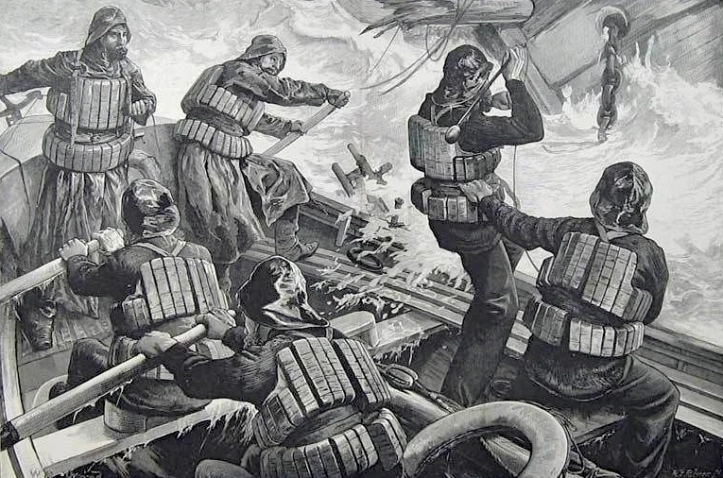
How the Illustrated London News saw rowing lifeboats in action. heartheboatsing.com/for-those-in-peril-on-the-sea/

Images are from the collections at Te Papa and Illustrated Australian News - Melbourne Vic -1876-1889 Saturday 10 June 1882

A lifeboat crew rowing to rescue shipwrecked sailors. published 1893-02-11 The New Zealand Graphic and Ladies Journal, 11 February 1893, p.121 - New Zealand Graphic; Wright, Henry Charles Seppings, 1849-1937 - Auckland Libraries Heritage Collections NZG-18930211-0121-01

The lifeboat Alexandra, manned by Waterside Workers for an unidentified parade, pictured on Sarah Street in Timaru, circa 1912. The lifeboat is shown harnessed to a team of Clydesdale horses and appears to be heading for or leaving a parade. Amongsat the flags flown are the American and Australian flags and the British ensign (among others), as well as a banner for "Timaru Waterside Workers". South Canterbury Museum 1543

Messrs Forrest of Limehouse life-boat building yard where Alexandra Timaru Lifeboat was built - The Illustrated London News Google Books - Page 478

Crowds assembled at the Benvenue Wreck Memorial, Timaru, for the 50th jubilee of the event in May 1932. The crowd appears to be being addressed by dignitaries from on the lifeboat 'Alexandra'.
Handwritten on verso "14th May Jubilee 1932" - South Canterbury Museum

Captain Alexander James Mills (1833-1882) - Catalogue Number 2011/169.01 https://timdc.pastperfectonline.com/library/80C95C38-D80F-4A62-80C4-581962264094

https://paperspast.natlib.govt.nz/.../timar.../1928/07/13/25
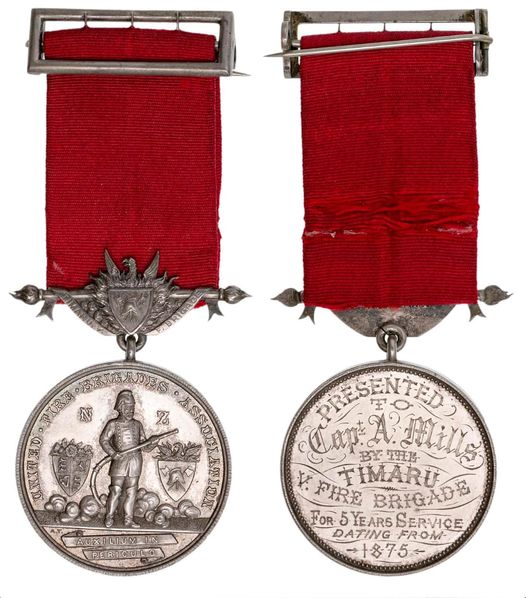
Medals won at auction for a private collection in 2024. Copyright has been granted to reproduce this image. "Front: Capt A Mills, by the Timaru V. Fire Brigade For 5 Years Service dating from 1875. REVERSE: New Zealand Fire Brigade Long Service Medal. NZ United Fire Brigade's Association - engraved around the edge. Fireman with hose, "Auxilium in Periculo" engraved on the bottom." The brigade was an all-volunteer force. "Brigade discipline was much aided by the contemporary popularity of military style disciplinary codes. It was the age of the emergence of police forces, the Salvation Army, uniformed brass bands, Boys' Brigades and Boy Scouts. Esprit de corps was promoted by uniforms and parades. Military patterns of rank and drill were well suited to brigade purposes. But the brigades also valued their voluntary nature, their right to manage their own affairs and to elect their own officers. They were not conscripts or bought men, but free agents inspired by an altruistic concern for their communities. So while a successful brigade might look to the military for models of style, polish and precision, its real aim was to be an honoured fraternal association. Lacking the funds to give proper material support, councils and communities looked for other means of encouraging the spirit of altruism and fraternity that held their brigades together. Honour could be frugally shown through annual dinners, parades, speeches and medals. Proper equipment, quarters and salaries came much less cheaply." - https://nzetc.victoria.ac.nz/tm/scholarly/tei-ArnNewZ-c16-4.html Learn more here: https://view.taurangaheritagecollection.co.nz/objects/4971/new-zealand-fire-brigade-medal