
By Roselyn Fauth
Lorna Grant, born Marion Lorna Guthrie in 1885, was the only daughter of Dr John Guthrie (b.1859, d.1930) and Marion Hay Guthrie of Christchurch. She died 30 January 1972.
Dr. John Guthrie (1848–1922) was a Scottish-born physician who played a notable role in early New Zealand medical practice, particularly in Christchurch and Akaroa. Born in Kendal, England, he was the eldest son of Rev. Dr. John Guthrie, D.D., who had seceded from his church over the doctrine of predestination. Initially working in commerce with Patrick Henderson & Co., John Guthrie later pursued medicine at the University of Glasgow, where he earned his M.D. in 1872, writing a thesis on yellow fever based on personal experience aboard an emigrant ship to South America—an event that included future writer Cunningham Graham among the passengers.
After serving as a resident house surgeon and physician at the Royal Glasgow Infirmary, he emigrated to New Zealand in 1874 with his sister Hannah aboard the leaking Crusader. Once in Christchurch, Hannah married Tom Hay, and John soon married her sister Marion Taylor Hay in 1876.
Guthrie initially served as Resident Surgeon at Christchurch Hospital before entering private practice. He lived in Armagh Street and later moved to Akaroa, where he worked for five strenuous years in an isolated and demanding district, eventually contracting rheumatic fever. Following his recovery, he returned to Christchurch and entered medical partnerships—first with Dr. W. F. Moore, then with Dr. Walter Thomas, and later Dr. A. H. Devenish-Meares—practicing from homes on Colombo and Cashel Streets.
Health concerns forced another break in 1894, prompting travel to England and, by 1897, permanent relocation with his family, though he briefly returned to New Zealand. A skilled caricaturist, Guthrie was also active in sports, serving as a founding member and president of the Christchurch Golf Club. His children included John, who also studied medicine, and Robert Neil. His brother, James Guthrie, became President of the Royal Scottish Academy. Dr. John Guthrie died on 7 August 1922, aged 74, leaving a legacy of medical service and cultural contribution in both New Zealand and the United Kingdom.
So, as you can see, Lorna grew up in a family rooted in both medicine and the arts. Her father had emigrated from Glasgow in 1874, and her uncle was the celebrated portrait artist Sir James Guthrie, known internationally for his paintings of prominent figures including Winston Churchill. Lorna’s upbringing, with two older brothers and strong family ties to Scotland and the arts, helped shape a life devoted to care, beauty, and the value of public good.

Sir James Guthrie. Portrait Sir Winston Churchill (Oil on Canvas). Marion Lorna Guthrie 1895. christchurchartgallery.org.nz/sir-james-guthrie/marion-lorna-guthrie. "James Guthrie made his mark in the early 1880s as a member of the ground-breaking Glasgow Boys, who were influenced by French painters, particularly Jules Bastien-Lepage. This later work, with its restricted range of colour and tones, also shows the influence of Guthrie’s friend and mentor, American-born, London-based artist, James McNeill Whistler."
In 1916, Lorna married James William Grant (known as Hamish) at St Andrew’s Church in Christchurch. Shortly afterwards, Hamish left to serve with the New Zealand Field Artillery in France during the First World War. When he returned, the couple settled at Gray’s Hills Station in the Mackenzie, where Hamish farmed merino sheep. In the 1930s, they began spending more time in Timaru with Hamish’s mother Helen Grant, and in 1947 they formally retired to The Croft, a gracious homestead on the edge of town surrounded by roses, rhododendrons and mature specimen trees.
Lorna shared the Grant family’s love of gardens and her mother-in-law’s commitment to community. Where Hamish found joy in horticulture and rhododendrons, Lorna cherished art, conversation and cultural life. Their home was a retreat, and a place of generosity. Lorna believed deeply in the idea that beauty should be shared. She was not a collector for the sake of ownership, she was a custodian for others to enjoy.
When Lorna died in 1972, she gifted their private art collection to the Aigantighe Art Gallery in Timaru. 23 Works in total, including two paintings by Charles Goldie and a portrait of herself painted by her uncle, Sir James Guthrie. She also bequeathed another portrait to the Christchurch Art Gallery in memory of her brothers. Lorna had known Charles Goldie personally, a connection that links her legacy to one of Aotearoa’s most recognised portrait artists.
Her bequest added to the legacy at the Aigantighe. When I see these artworks at the gallery, I reflect on the Grant women and inlaws belief in access, public value, and importance of art. Lorna’s legacy continues on today in gallery walls and in the gardens of The Croft, where the terms of her and Hamish’s bequest included a simple but meaningful request: that the character of the gardens be preserved as best as possible.
Today, the art is still admired, the trees still bloom, and Lorna’s quiet legacy still shapes the cultural and social fabric of Timaru. She did not seek attention or titles—but what she gave has lasted generations.
The Croft Homestead 1972. Hamish and Lorna Grant purchased the Croft in 1947 and bequethed it to the PSSA in 1968. - PSSA Given The Croft For Home (22 Feb 1972). Aoraki Heritage Collection, accessed 15/06/2025, https://aorakiheritage.recollect.co.nz/nodes/view/7315
"The Aigantighe Art Gallery and The Croft Estate which Mr Grant gifted to the community and PSSC in 1955 and 1968 respectively, have a combined estimated capital value of $14million and land values of nearly $2.5million. Extensive strengthening and future proofing of both homes is underway and will see Mr Grant’s legacies continue to contribute to a thriving community." - https://pssc.org.nz/homestead-heritage-project-history/
Lorna Grant (née Guthrie) was a large part of the establishment and enrichment of the Aigantighe Art Gallery in Timaru, particularly through her generous contributions of artworks by renowned artist Charles Frederick Goldie, who is believed to have studied portraiture under Lorna’s uncle, Sir James Guthrie, in London.
In 1955, following the inheritance of the family residence, Aigantighe House, her husband James William Grant, together with his sister Jessie Wigley, gifted the house and its gardens to the City of Timaru to be used as a public art gallery. Officially opened in 1956, the Aigantighe’s initial collection included 82 works from the South Canterbury Arts Society as well as key pieces from the Grant family’s private holdings. According to the Curator’s Talk Legacies Behind the Aigantighe, Lorna and James Grant made further significant contributions in the 1960s and 1970s, donating 27 artworks to the gallery. Among these were two smaller Goldie paintings, helping to establish the gallery’s now-celebrated Goldie collection. Their donations also featured works by artists such as William Greene, Esther Hope, John Gully and Sir James Guthrie.
These gifts were part of a broader legacy from the Grant and Wigley families, who together donated a total of 59 artworks and period furnishings. In 1972, gallery director Ainsley Manson described these family contributions as forming a collection of “undoubted distinction and historic depth”, cementing Lorna’s role as a key figure in shaping the cultural legacy of the Aigantighe and its importance to South Canterbury.
"Memories: The Last of Her Tribe" (1913) (See the painting here: ehive.com/memories-the-last-of-her-tribe )
James Craigie, a notable benefactor and former Mayor of Timaru, was deeply involved with the South Canterbury Art Society. In 1914, he donated Thomas Kennington’s painting The Mother to the society. After his death, his family donated Goldie’s Memories: The Last of Her Tribe to the people of Timaru. This poignant portrait of a Ngāti Awa widow was donated in 1956 by the South Canterbury Arts Society, who were custodians of this artwork and many more until the Aigantighe Art Gallery opened.
"Tumai Tawhiti" (1913) (See the painting here: ehive.com/tumai-tawhiti )
Depicting a Ngāti Raukawa and Te Arawa elder, this painting was also gifted by the South Canterbury Arts Society in 1956 to the Aigantighe.
Two Smaller Works by Goldie
These were personally donated by Marion Lorna Grant (née Guthrie).

By Rupert Farnall Studios - Webb's, Public Domain, https://commons.wikimedia.org/w/index.php?curid=114793148
Charles Frederick Goldie (1870-1947) was born in Auckland, the son of a timber merchant who also became the Mayor of Auckland. Goldie travelled to Paris in 1892 where he trained at the Académie Julian. He attended the École des Beaux Arts in Paris and is said to have studied portraiture under Sir James Guthrie in London. Guthrie was the uncle of Lorna Guthrie who married James Grant and in 1955 Grant gave the Aigantighe home to Timaru so that it could become an art gallery. Lorna Grant knew Goldie and two smaller paintings by him which she owned are also part of the gallery's collection.
Goldie returned to New Zealand in 1898 and painted prolifically from a studio in Auckland. Memories is a portrait of Pani a Ngatiawa widow. It is among the last of Goldie's large works and was painted as a companion piece to Tumai Tawhiti which the Aigantighe also owns. The close attention to detail and realistic treatment of the lined face and moko continue to fascinate viewers but this work is constructed. The clothes are the same studio 'props' which are depicted in many of Goldie's other Maori portraits. The pose is staged and Goldie tended to portray his sitters as melancholy with an averted gaze painted in isolation.
Goldie dedicated his life to painting the Māori chiefs, Māori leaders and their communities who also became his friends. He lived with them on their various marae and spoke fluent Te Reo Māori. He wanted to preserve the heritage of the Māori people, whom he admired. Some critics saw the fine detail in his paintings as evidence that he painted from photographs, which he did not.
On 31 October 1920 Goldie travelled to Sydney, where on 18 November at the age of 50 he married 35-year-old Olive Ethelwyn Cooper, an Australian by birth but a resident of Auckland. They did not have any children.
Goldie's health eventually deteriorated through lead poisoning (from the lead white used to prepare his canvases). In order to create the finest of detail in his paintings, he would lick the end of his paint brush to ensure an even finer tip. This was a relatively common practice at that time. He produced little work in the 1920s. Encouraged by the Governor-General, Lord Bledisloe, Goldie resumed painting around 1930; in 1934 and 1935 he exhibited at the Royal Academy of Arts in London, and in 1935, 1938 and 1939; the Salon of the Société des artistes français.
He stopped painting in 1941 and died on 11 July 1947 aged 76. He was buried at Purewa Cemetery in the Auckland suburb of Meadowbank.

Obituary: Mr J W Grant (Jun 1969). Aoraki Heritage Collection, accessed 15/06/2025, https://aorakiheritage.recollect.co.nz/nodes/view/902
Lorna's sister in law was Jessie Wigley, the daughter of Alexander and Helen Grant who comissioned James Turnbull to design their town home the Aigantighe. On June 15th 1910 at Chalmers Church, Rodolph Lysaght Wigley, second son of the late Thos. H. Wigley, of Opuha married Jessie Christie (born 1880 21st Dec) daughter of Alexander and Helen Grant, Gray's Hills. Jessie has been described as the Lady behind the Aigantighe. She had a big involvement in the arts community of South Canterbury. At the age of 21 she took on the responsibility of decorating the interior of the Grand's new Queen Anne Revival Edwardian house, which would later become the Aigantighe Art Gallery. Jessie was creative and practical, and channeled her energies into carving wooden furniture (to add to what had been ordered from Glasgow), selecting wall paper, and sewing bedspreads and curtains for the family over a period of several months. The family moved into the completed and prepared home in 1905. Jessie had six children with Rodolph and died 1968 1st Dec. Learn more here: Learn more about Jessie here: aigantighe.co.nz/jessie-wigley
The Aigantighe connection to the street art on Strathallan Street. Rodolph's Mt. Cook Motor Car Service provided the first car transportation from Fairlie to the Hermitage in February 1906. In 1913 Jessie designed the company's lily motif after the giant mountain buttercup (incorrectly called the Mt Cook 'lily'.) Flowers November to January. Today the symbol still represents the goodwill of the company, a permanent memorial to the Wigley's and the dramatic Mackenzie Country. You can see street art on Strathallan Street celebrating the design. sites.rootsweb.com/wigley
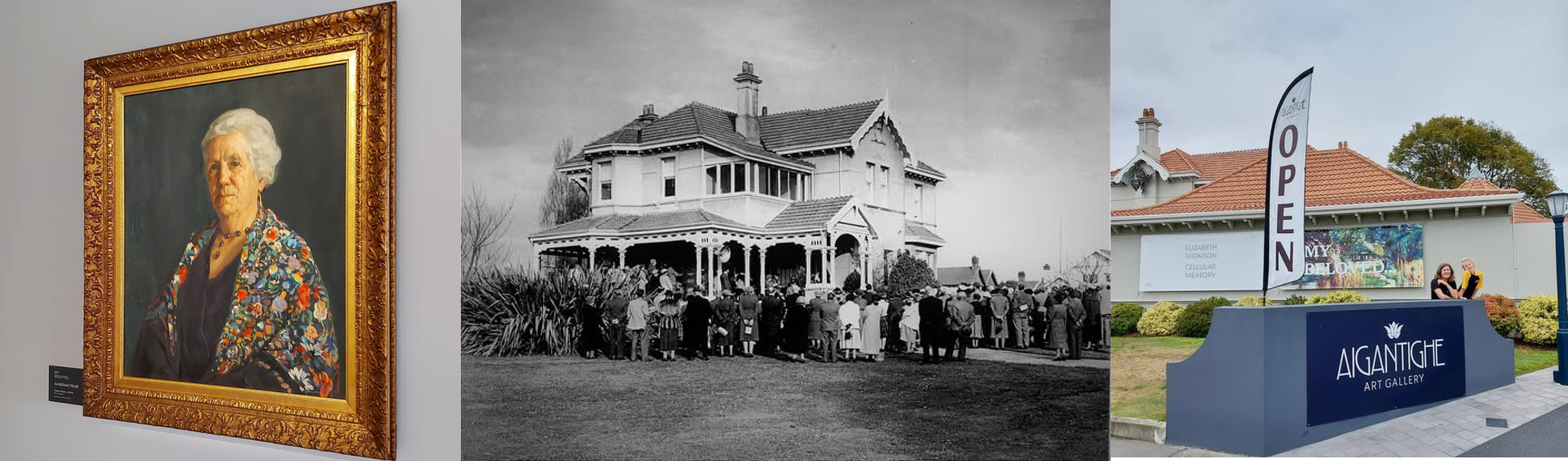
Alexander Grant (1832-1921) was the son of James Grant and Helen Grant
Helen Lindsay Grant (Banks) (1854-1955) was the daughter of Robert Lindsay Banks and Jessie Banks
James Grant (1879–1969) Son of Alexander and Helen. Married Lorna Guthrie.
Jessie Christie Wigley (1881-1968) Daughter of Alexander and Helen. Wife of Rodolph Lysaght Wigley
The Street at by Aroha Novak. Wall Flowers. 2018 was inspired by the Mt Cook Lilly illustration that Jessie Wigley created for her husbands Mt Cook Transport business.
As Launa Grant’s sister-in-law, Jessie Christie Wigley, born Jessie Grant in 1883, was a driving force behind the creation and enrichment of the Aigantighe Art Gallery in Timaru. A gifted and versatile artist, she trained under William Greene and Cecil and Elizabeth Kelly, and expressed her creativity through painting, wood carving, playwriting, and design, including the Mount Cook lily emblem for her husband Rodolph Wigley’s tourism company. As the daughter of Helen and Alexander Grant, Jessie personally oversaw the interior decoration of Aigantighe House in 1905 and later became a key advocate for the arts in South Canterbury. In 1951, she helped revive the South Canterbury Arts Society by co-founding the South Canterbury Arts Club, and by 1954 she was serving as patron of the re-established Society.
Her commitment culminated in 1955 when she and her brother James Grant, who was Launa’s husband, gifted the Aigantighe House and gardens to the people of Timaru to become the region’s first public art gallery. Jessie also contributed significant artworks from her private collection, including admired pieces by British and Italian artists such as Lucy Kemp-Welch, Henry John Yeend King, Marcella Smith, William Wyllie, Giuseppe Gambarini, and Delapoer Downing. Her own artistic legacy lives on in the gallery’s permanent collection, which holds seven of her paintings, five of which were donated by her daughters Hester Wigley and Margaret Parker. Among these is Edinburgh from Calton Hill, a luminous watercolour honouring her mother’s Scottish roots. Jessie Wigley’s vision and generosity helped realise the long-held dream of a civic art gallery for South Canterbury and established her as a central figure in the region’s cultural history.

Aroha Novak. Wall Flowers. 2018. LOCATION: Community House, Strathallan Street
After much googling and research at the library about the history of Timaru, Aroha decided to keep this particular composition simple but nostalgic “as a little girl, I loved the Mount Cook lily logo, and always wanted to travel on one of their planes”. It references the former Mount Cook Airlines logo of the Mount Cook lily, creating a wallpaper pattern on the side of the building." - Aroha Novak, Dunedin based artist. "The Community Trust of Mid and South Canterbury is very pleased to be associated with the Timaru Civic Trust’s street art project. Aroha Novak’s work will contribute to the vibrancy of the Timaru CBD and we were only too pleased to offer our blank Community House wall as the canvas. The end result will be a visually impressive counterpoint to Community House’s heritage frontage and a colourful celebration of the unique Mt Cook buttercup and its fragile and vulnerable ecosystem." - Community House, Timaru Aroha Novak's Mt Cook Lily Dunedin artist Aroha Novak’s mural – on the side of Community House in Strathallan St – also has a nature theme in the form of Mt Cook lilies painted to resemble wallpaper. Novak said it was a nostalgic reference to the Mt Cook Airlines logo, which featured the Mt Cook lily. A few doors down you'll find the crew at the Ship Hop Brewery. They are open on Fridays from lunchtime until around 7pm. And if you're in need of a decent steak, check out Customs Steak House.
The mural was brought to the community by: Timaru Civic Trust & Alive Vibrant Timaru

Photograph By Geoff Cloake of a Mount Cook Line truck at Kyle Park, Timaru.

Grays Hills Home where the Grants farmed. Photo supplied by Sherie Whelan who raised her family there. The Urquhart family acquired Grays Hills Station from the Grant family in 1948. Grays Hills Station, located in the Mackenzie Basin near Lake Tekapo, was originally established by William Gray in 1858. It was purchased by Alexander Grant in 1881 and remained under Grant family ownership until 1948. As of 2025 Mark Alexander Urquhart and Sherie Ann Whelan as shareholders and directors of about 10,801 hectares, including Grays Hills Station. The Urquhart family's association with Grays Hills Station has been longstanding. A photograph from the Timaru Herald, dated circa 1990, features Duncan Urquhart at Grays Hills Station, highlighting the family's active involvement in the property's operations.
Early Life (1859–1878)
- Sir James Guthrie was born in Greenock, Scotland, in 1859.
- He was the youngest child of Rev John Guthrie (1814–1878), a Scottish minister.
- His childhood involved many moves due to his father’s vocation, but it was described as a happy upbringing.
- His father intended him to study law for the English Bar.
- At age 15, Guthrie attended Glasgow University to study law but spent his free time drawing.
- His father recognised his talent but feared art was a precarious profession.
- After consultations with family, friends, and artists, his father allowed him to leave university to pursue art.
- His father died unexpectedly in 1878, and Guthrie returned to Glasgow to live with his mother.
- His mother’s allowance freed him from the need to earn a living, enabling him to focus fully on art.
- This period marked his “artistic apprenticeship,” during which he did not need to sell his works.
- In 1881, he joined a group of young artists in Glasgow, later dubbed the “Glasgow School”.
- In 1884, Guthrie and his cousin James Cay rented a studio in Cockburnspath and worked closely with artist Edward Arthur Walton.
- In 1885, Guthrie faced a crisis when his cousin married and left; he began painting portraits despite his fear of failure.
- His cousin introduced him to his father, Rev Andrew Gardiner, whose portrait became Guthrie’s breakthrough work.
- Guthrie increasingly focused on portraiture.
- In 1888, he was elected an Associate of the Royal Scottish Academy, becoming the first representative of the Glasgow School to achieve this.
- In 1890, he exhibited in Paris and began visiting and exhibiting there regularly.
- That year, the Grosvenor Gallery (London) held an exhibition of Glasgow School artists, increasing their reputation.
- In 1892, Guthrie was promoted to academician rank within the Royal Scottish Academy.
- His mother died in 1895.
- In 1897, he married Helen Newton Whitelaw, and they had one son.
- Guthrie’s reputation as a portrait painter grew, and he frequently travelled to London for commissions.
- In 1902, he was recognised as having reached artistic maturity.
- In 1902, Sir George Reid resigned as president of the Royal Scottish Academy, and Guthrie was elected as his successor.
- In 1903, he became a director of the Edinburgh Life Assurance Company.
- In 1905, he joined the board of the National Bank of Scotland.
- He served as president of the Royal Scottish Academy for 16 years (1903–1919), implementing reforms.
- He retired from the presidency in 1919.
- Major Commission – “Some Statesmen of the Great War” (1919–1930)
- In 1919, Guthrie received his most famous commission: “Some Statesmen of the Great War”.
- Initially reluctant, he accepted after consulting colleagues.
- By 1921, he had completed 17 studies for the painting (including those for India and Italy).
- He began the actual canvas in 1924, but encountered problems with paint adhering to it and had to abandon it.
- In 1925, he obtained a new canvas from Paris and restarted the work.
- He spent 5½ years on the painting, reducing its width by two feet for balance.
- The painting was completed and placed on view at the Edinburgh Gallery on 30 April 1930.
- Just before it went on display, he scraped back and repainted the portrait of Lord Balfour over a weekend.
- The retouched portrait of Lord Balfour was presented to the Aigantighe Art Gallery in Timaru by Mr and Mrs J. W. Grant.
- Mrs Grant (née Guthrie) was Sir James’s niece, the daughter of his sister Hannah, who emigrated to New Zealand in the 1870s.
- Focus on Aigantighe: Sir James Guthrie." Timaru Herald, 14 January 1984, p. 14.