
By Roselyn Fauth
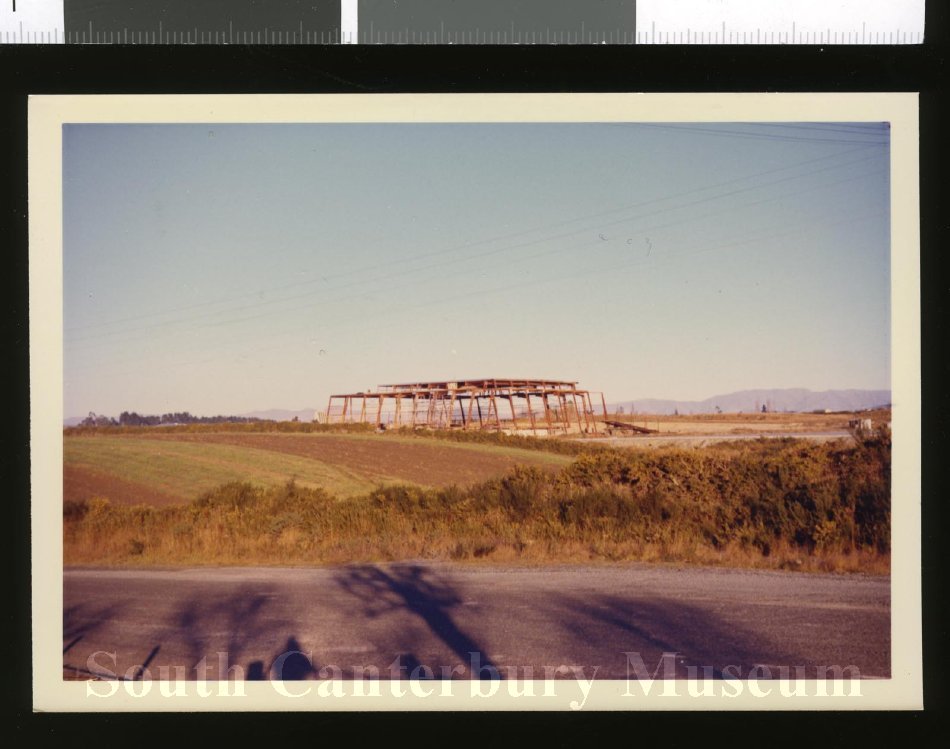
Aorangi Park stadium in Timaru during the early stages of construction, circa 1974. This photograph records the development of one of South Canterbury’s key sports and recreation facilities. Source: South Canterbury Museum 2014/004.54.
I was up at netball, waiting for the game to start, when I took a quick video of a view many South Cantabrians know well... the hockey turf, the car park, kids warming up... I thought to kill some time I could do a quick video and take some photo's for a Wuhoo Timaru facebook post... I hit record over the turf and panned the camera West to show the Aorangi Stadium redevelopment taking shape.
That was the obvious story... we are witnessing the build of the new stadium. She's a big project for a small city, and there is a big story here, but once I started researching I learned there was a bigger story underneath it.
According to Timaru District Council, the first land for what became Aorangi Park was acquired in 1953, fronting Mountain View Road. The following year, the largest block, fronting Morgans Road, was added. Today the park sits in Gleniti and covers about 13 hectares, but in the 1950s this was still on the western edge of Timaru, between the North and South Branches of Otipua Creek.
I have not yet found the full story of who owned or farmed the land before it became part of the park. That is a side quest still waiting... but what I did find out was the land was not developed straight away. Major development began in 1970, Aorangi Park was officially named in 1972, the stadium and netball courts followed in 1974, and the first sports field arrived in 1975.
The stadium that was built here first was not a rush job, and it took a while to get the construction underway.
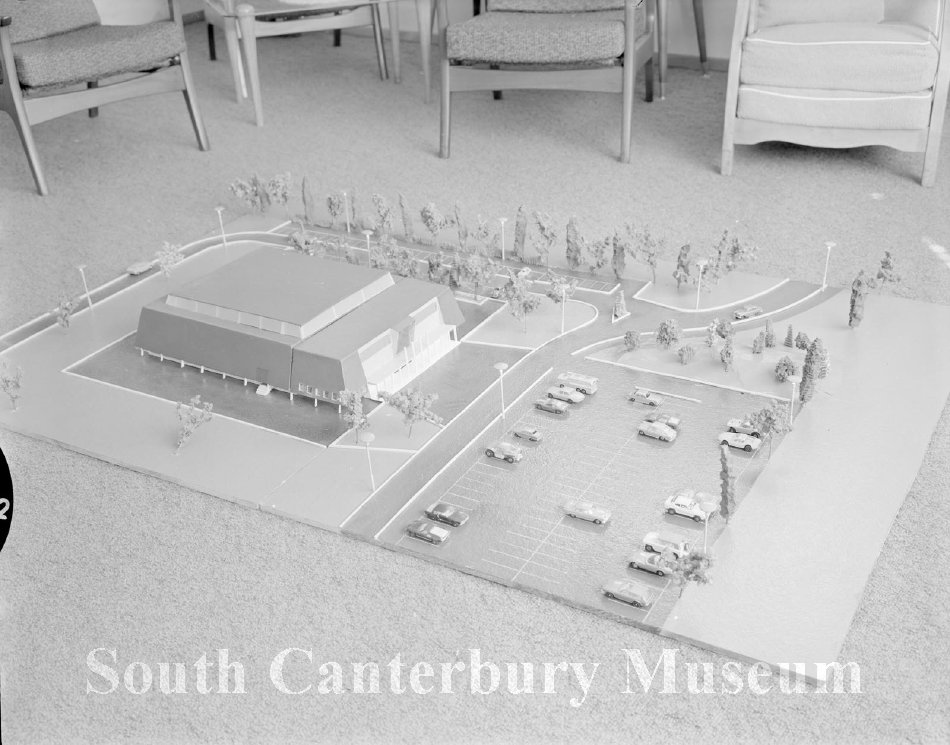
A model of a sports stadium at Aorangi Park, Timaru, photographed by Bremford Studios for the Timaru Herald, 14 September 1972. Source: South Canterbury Museum T6439, Anderson & Bremford Photographic Collection.
People looked at land on the edge of Timaru and imagined what South Canterbury might need later. At this point in time, as you can see in the photo this was still pretty rural. They thought about how this space could be not just for one team or one season, but for future players, clubs, schools, families and volunteers.
Since then, Aorangi Park has become one of South Canterbury’s key sporting places, connecting netball, hockey, basketball, volleyball, cricket, football, tennis, bowls, athletics.
Then I found a newspaper clipping in Aoraki Recollect website from the official opening of the Aorangi Park sports stadium in 1974. The article, headed “Sports Stadium Officially Opened”, described a large crowd, a colourful dais, a mural of Aoraki/Mt Cook and the Southern Alps, and Mrs T. W. M. Tirikatene-Sullivan, Minister of Tourism and MP for Southern Māori, giving the opening address.
Suzanne Kennedy, a Timaru swimmer who represented New Zealand at the Commonwealth Games, raised a flag that had flown at Queen Elizabeth II Park during the Games. A new South Canterbury stadium opened with a Commonwealth Games connection, under the gaze of Aoraki.
The clipping is full of names and clues... Des Crowe, chairman of the Stadium Association, appears to have been one of the key drivers. Sir Basil Arthur, MP for Timaru, said many doubts and questions had been raised in the early days, but Des “never flinched”. Mayor C. R. Hervey described the project as a major community achievement. R. L. G. Talbot, MP for South Canterbury, spoke about the enthusiasm and community spirit it had created. The Minister of Sport and Recreation, J. A. Walding, sent a letter announcing a $6000 grant and described the stadium as growing from “one man’s idea” into a major public amenity.
Was that one man Des Crowe? Was it someone else? Was the idea first raised in a clubroom, a committee meeting, or after someone had simply had enough of South Canterbury not having the indoor facilities it needed?
The clipping also mentions Stadium Stakes, praised at the opening as an important fundraising idea. I still have not found out exactly what it was. If anyone remembers, I would love to know.
What I do know is that the 1974 article makes one thing clear: Aorangi Stadium was not built by concrete, steel and council decisions alone. It was built by public support, service clubs, fundraising, volunteers and persistence. Rotary, Lions, Jaycees and Round Table are all mentioned as part of the effort.
Timaru District Council is funding most of the current Aorangi Stadium redevelopment in 2026.
The project includes strengthening and upgrading the existing stadium, building a new eight-court indoor sports facility, and creating a link building between the old and new spaces. Alongside that, a dedicated team of local volunteers is working to raise the additional funds needed to help bring the full vision to life.
Fundraising is not glamorous. Most of us will have been in the thick of it at some point and will know all too well it is meetings, phone calls, grant applications, sponsorship conversations, planning, asking, thanking, and keeping things moving... at times it can feel like a slog, but its incredible when the projects get over the line and the vision works.
The names of the Stadium development may have changed, but the work has not.
I once saw a sign in Greymouth that said, “Kids in sport stay out of court.” It stayed with me... Sport is not only about creating elite athletes. Most children who haved played at Aorangi like me have not become champions, and that is fine. the player may still learn how to turn up, listen, lose, win, try again, support others and belong to a team. Later they may become coaches, parents, teachers, nurses, tradies, business owners, volunteers and community leaders.
The best thing Aorangi produces probably will not be a trophy. It will be people.
Looking at a 1970s photograph of the stadium being built, I keep thinking about vision and the people behind it. They could not know every game that would be played, every friendship that would form, every child who would find confidence, or every volunteer who would give years of service. But they understood the need to make a space for those things to happen.
The people who bought land in the 1950s were building possibilities. The people who fundraised and opened the stadium in the 1970s were building possibilities. The people supporting the redevelopment today are doing the same.
Because they could not see the future.
So here is the WuHoo history hunt.
Who remembers Des Crowe? Who remembers Stadium Stakes? Who was at the 1974 opening? Who has photos of the stadium being built, the early netball courts, the first teams, opening day programmes, fundraising tickets, club records or family stories? Were your parents or grandparents involved through Rotary, Lions, Jaycees, Round Table, a sports club, school, business or family connection?
The official history gives us dates and buildings. The human history tells us why it mattered.
And I have a feeling some of the best parts of this story are still sitting in photo albums, garages, clubrooms, memory boxes and kitchen-table conversations around South Canterbury.
Timeline so far
1953: First land acquired for what would become Aorangi Park, fronting Mountain View Road.
1954: Largest block of land added, fronting Morgans Road.
1970: Major development of the park began.
1972: Aorangi Park was officially named.
1974: The stadium and netball courts were developed. The official opening of the Aorangi Park sports stadium was held, with Whetū Tirikatene-Sullivan giving the opening address and Suzanne Kennedy raising a Commonwealth Games flag.
1975: The first sports field was developed.
1980/81: Aorangi Oval hosted List A cricket, with Canterbury playing Wellington.
1998: First-class cricket was played at Aorangi Oval.
2000: Aorangi Oval hosted women’s international cricket, with New Zealand Women playing England Women.
2004: South Canterbury’s all-weather athletics track at Aorangi Park was opened.
Today: Aorangi Park covers about 13 hectares and remains one of South Canterbury’s key sporting spaces.
Current redevelopment: The project includes strengthening the existing stadium, a new eight-court indoor sports facility, and a link building. Community fundraising is helping support the wider vision.
People and side quests
Des Crowe: Chairman of the Stadium Association and likely a major driver of the original stadium project. Aoraki Heritage records Desmond Terence Crowe as a police officer, Timaru City Councillor, Lions Club member, rugby referee, JP and MBE recipient.
Whetū Tirikatene-Sullivan: Minister of Tourism and MP for Southern Māori, who gave the opening address. She was the first Māori woman to become a Cabinet minister.
Suzanne Kennedy: Timaru swimmer and New Zealand Commonwealth Games representative, who raised the Commonwealth Games flag at the opening.
Sir Basil Arthur: MP for Timaru, who praised the project and Des Crowe’s persistence.
R. L. G. Talbot: MP for South Canterbury, who spoke about the enthusiasm and community spirit generated by the stadium.
Mayor C. R. Hervey: Mayor of Timaru during the opening period, who read the Minister of Sport and Recreation’s grant letter.
J. A. Walding: Minister of Sport and Recreation, whose letter announced a $6000 grant and described the stadium as growing from “one man’s idea”.
Service clubs: Rotary, Lions, Jaycees and Round Table were mentioned in the opening article as part of the community effort.
Stadium Stakes: A fundraising side quest still to be solved.
Sources and clues so far
Timaru District Council, Aorangi Park history and park information:
https://www.timaru.govt.nz/community/recreation/parks-and-sports-facilities/popular-sportsgrounds/aorangi-park
Timaru District Council, Aorangi Stadium redevelopment:
https://www.timaru.govt.nz/council/projects/aorangi-stadium-upgrade
Aorangi Stadium fundraising website:
https://www.aorangistadium.co.nz/
Aoraki Foundation, Aorangi Sports Stadium:
https://www.aorakifoundation.org.nz/aorangistadium
National Library of New Zealand, Aorangi Stadium record:
https://natlib.govt.nz/records/43375495
National Library of New Zealand, Gleniti record:
https://natlib.govt.nz/records/22611456
“Sports Stadium Officially Opened”, newspaper article covering the 1974 Aorangi Park sports stadium opening.
Aoraki Heritage, Desmond Terence Crowe:
https://aorakiheritage.recollect.co.nz/nodes/view/1628
New Zealand Olympic Committee, Suzanne Kennedy athlete profile:
https://olympic.org.nz/athletes/suzanne--kennedy
Te Ara, Whetū Tirikatene-Sullivan:
https://teara.govt.nz/en/biographies/6t6/tirikatene-sullivan-tini-whetu-marama
Te Ara, Sir Basil Arthur:
https://teara.govt.nz/en/biographies/5a19/arthur-basil-malcolm
Aoraki Heritage, Robert Leslie Gapper Talbot:
https://aorakiheritage.recollect.co.nz/nodes/view/2380
Athletics New Zealand, South Canterbury Amateur Athletics Club:
https://athletics.org.nz/celebrating-150-years-of-south-canterbury-amateur-athletics-club/