
By Roselyn Fauth
I only stopped because of the cemetery... we had pulled over on Huffey Street in Geraldine so I could have a quick look to see if there was a historic entrance to the graves. Cemeteries are often where local history starts for me. You go in looking for one name and come out with five more questions... well this time rather than a headstone hunt, I found myself looking across the road.
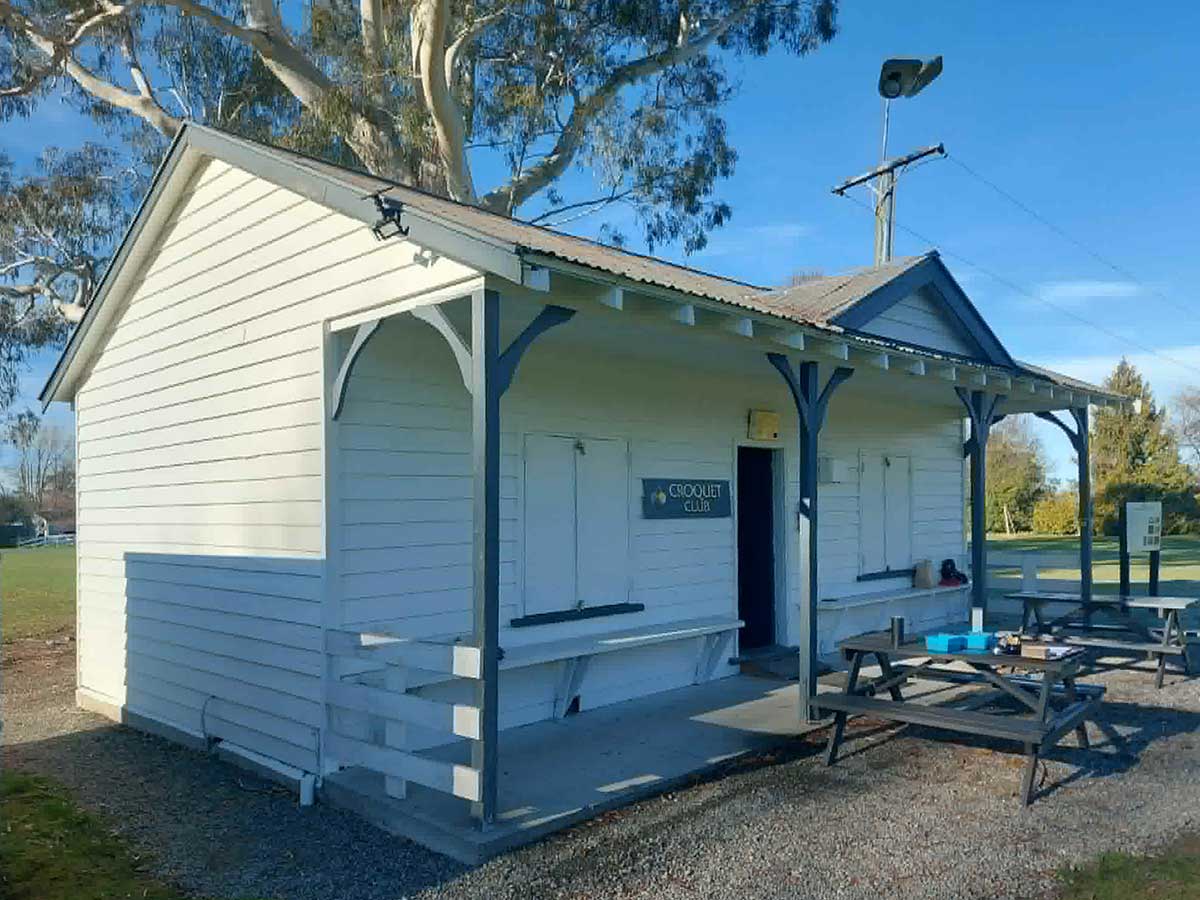
Through a gap in the macrocarpa hedge I could see a small timber building in the Geraldine Domain. The small country sports pavilion shone in the early morning light the dew on the grass flicked up little speckles of light as a few keen croquet players played together on the field. They looked at me, I didn't want to interrupt their game, or stand on their manicured lawn, so I gave a little wave and then quickly investigated the little building. It stodd clad in weatherboards, a verandah, shuttered windows, a simple roofline.
Above the door was a plaque that explained this building was the Geraldine Hockey Memorial Pavilion. It was opened by Mr T. D. Burnett MP on 22 October 1923, and erected by members of the Geraldine Hockey Club in memory of clubmates who died in the First World War. Today it is home to the Geraldine Croquet Club.
So the little building was not just a spot for sports, it was also a war memorial.
Generations of players would walk beneath the names to change for games, shelter from rain, store gear, hold meetings, make tea and watch from the verandah. Remembrance was not separate from club life. It was built into it.
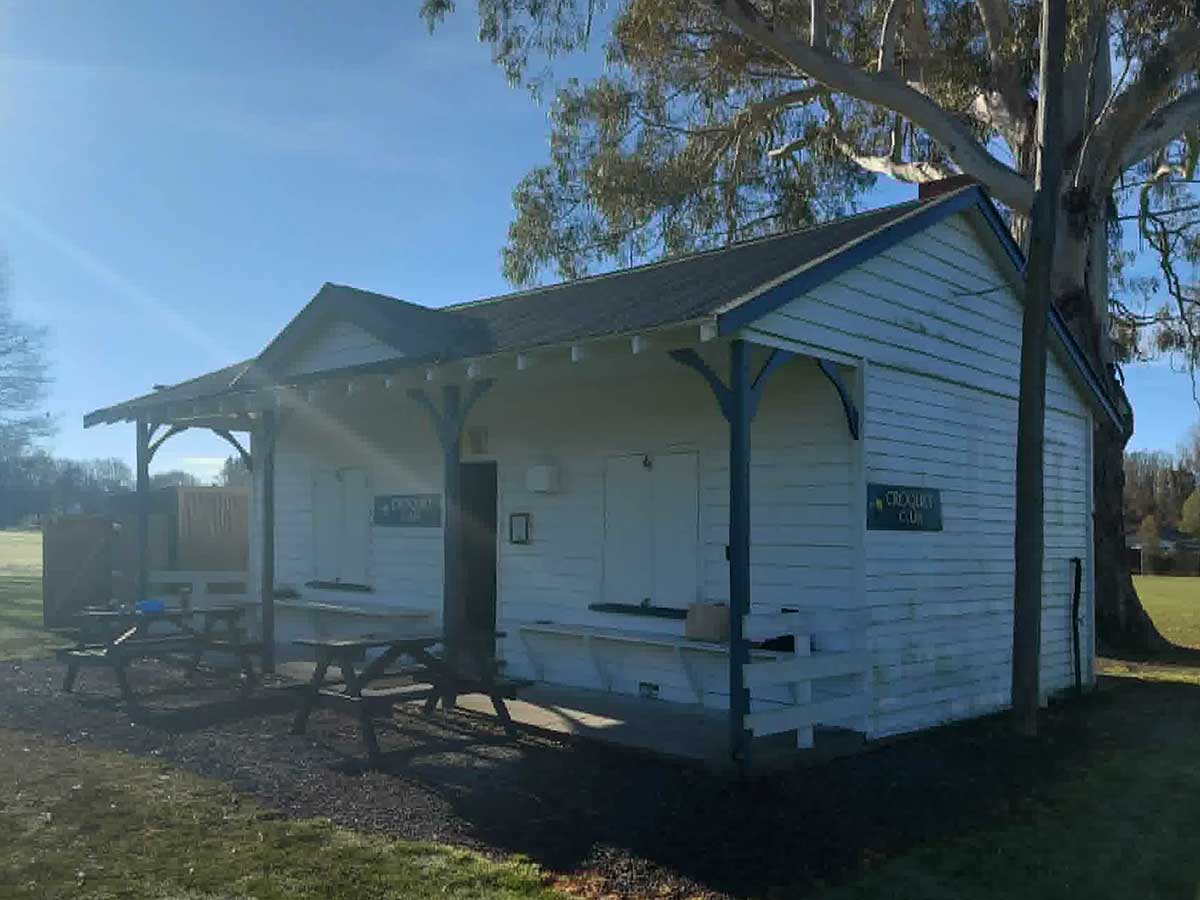
The architecture is pretty straight forward using what was handy and what I assume low cost to help the funds go far: timber weatherboards, corrugated metal roofing, a gabled roof, a central doorway, shuttered windows, plain verandah posts, shaped timber brackets and long bench seats facing the grounds.
The sport was field hockey, played on grass long before artificial turf changed the game. Weather mattered. Grounds had to be marked, drained, maintained and fought for. Teams needed somewhere to change, store sticks and gear, shelter, meet, fundraise and boil the kettle. A pavilion was not decoration. It was the backbone of club life.
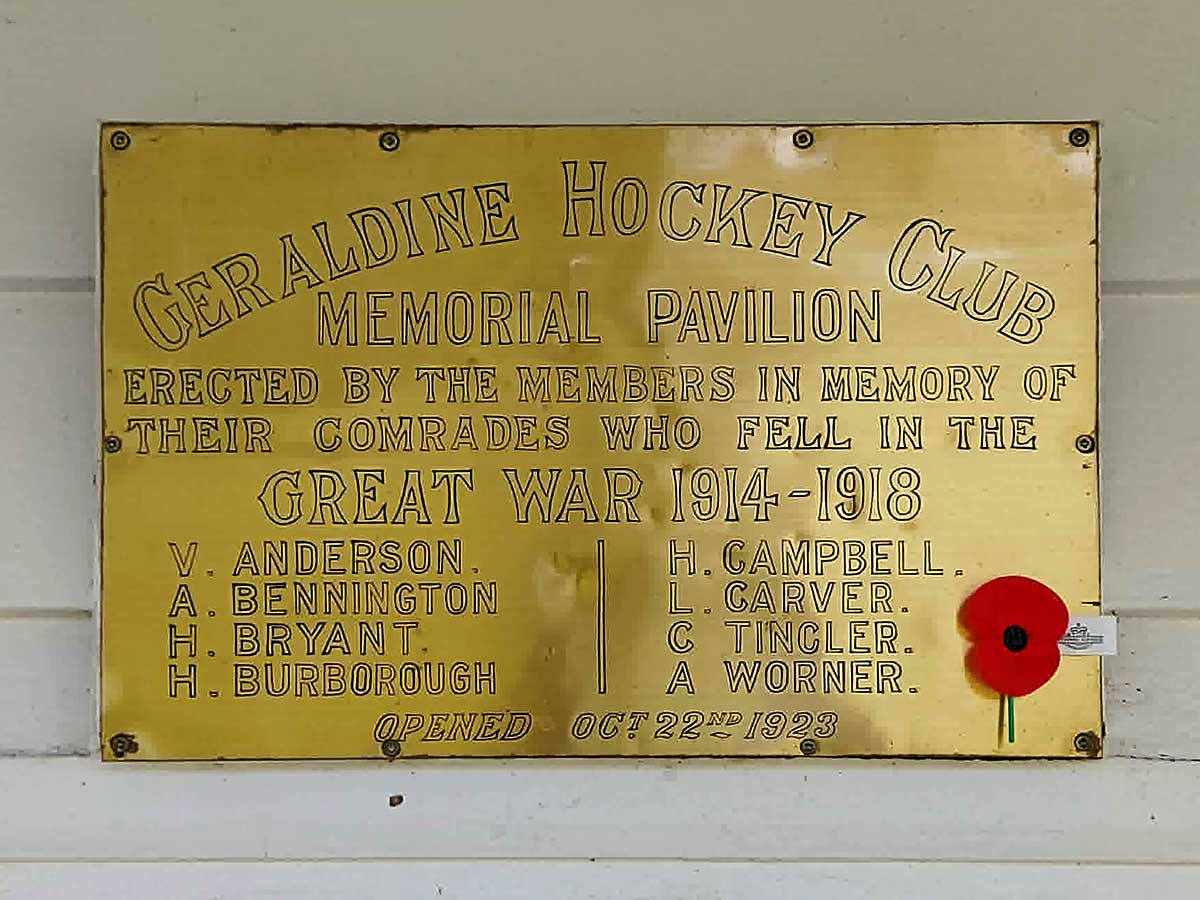
The plaque records eight men: Alexis Harry Victor Anderson, Alexander John Bennington, John William Herbert Bryant, Herbert Robert Burborough, Herbert Malcolm Campbell, Leonard Thomas Carver, Charles Knox Kirkwood Tincler and Alexander Worner.
They were local men with jobs, families, streets, skills and club ties.
Anderson was a married farmer who died of disease in France. Bennington was a Geraldine ironmonger, hockey player, brass band member, swimmer and territorial who died of wounds at Gallipoli. Bryant was a Geraldine-born baker from Talbot Street who died of disease in England. Burborough was a Geraldine-born grocer’s assistant from Talbot Street, killed in action in France. Campbell worked in his father’s Geraldine orchard and was known through hockey, football, bowling, cycling and shooting. Carver was a painter from Peel Street. Tincler was a shepherd working at Beautiful Valley who died of wounds after Messines. Worner was a Geraldine-born butcher who served as Warner, was mentioned in despatches, and was one of three Worner brothers killed in the war. His brothers Alfred and George also served and died, although they are not named on this pavilion plaque.
For anyone who has not had to think much about the First World War, the scale of loss can be hard to picture. It ran from 1914 to 1918, and for New Zealand it reached right into small towns, farms, shops, schools, churches, sports clubs and families. Men from places like Geraldine enlisted and were sent overseas to Gallipoli, the Middle East and the Western Front. Many did not come back. Some were buried overseas. Some had no known grave.
Their families were left with letters, medals, photographs, telegrams and empty places at the table.
That is why memorials mattered. They gave communities somewhere to put the names. They made absence visible. They said these men belonged here, even if they had died far from home.
Geraldine Hockey Club’s answer was practical. They built a place the living could keep using.
The idea appears to have started while the war was still underway. In late April 1918, the Geraldine Hockey Club held its annual meeting. Two returned servicemen, Corporal D. Turner and Trooper F. Tiplady, were welcomed home. At that same meeting, the club decided to invest £16 in war certificates and, after five years, use the capital to build a pavilion in memory of members who had given their lives in the war.
A war certificate was not a donation. It was a loan to the government. During the war, New Zealand raised money locally through war loans, and war-loan certificates let ordinary people, clubs and small investors take part. They could be bought through the Post Office for less than their final value, then repaid later at full value.
In 1917, a five-year £1 certificate could be bought for 16 shillings. A £10 certificate cost £8. A £100 certificate cost £80. So if the Geraldine Hockey Club invested £16 in five-year certificates in 1918, the money may have matured to about £20 by 1923.
That was nowhere near enough to build the pavilion. The tender recorded on the interpretive sign was £125. But the war certificates appear to have been the seed. Money first lent to help pay for the war came back five years later to help remember the men the war had taken.
By August 1923, the idea was moving again. A Timaru Herald hockey notice reported that Geraldine club members were to meet to consider “the erection of a memorial pavilion”. Two months later, the building opened on Labour Day. A Temuka Leader notice shows the opening sat within the wider public life of the Geraldine Domain, with the Sports Association granted use of the park for a Labour Day fete.
The funding was very small town New Zealand: a bit of money, a lot of goodwill, and people giving what they could. The plaque says the pavilion was erected by the members. The interpretive sign records that Mr B. Payne’s tender of £125 was accepted. It also records a council donation, a Domain Board loan, member labour, and gifts of materials and practical help, including cutlery and crockery.
I love the crockery, and that someone thought, quite rightly, that a club pavilion would need cups and plates.
The building was made from relationships as much as materials.
The pavilion opens a door onto women’s sport in Geraldine.
The sign beside the building says women’s hockey in Geraldine began in 1906. I have not yet found the primary source for that date, so I would treat it carefully. But the newspaper trail shows Geraldine women were playing, organising and fundraising through hockey by the early 1920s.
In 1921, the Geraldine Ladies Hockey Club advertised its first annual ball at the Oddfellows’ Hall. In 1926, the club advertised a dance, again at the Oddfellows’ Hall, with music, supper, ticket prices and an honorary secretary. By the 1930s, Geraldine women were part of regular hockey competition. In 1933, Geraldine Ladies beat Winchester 4 to 1 and were reported as leading the Geraldine Hockey Sub-Association competition. The scorers were Miss K. Aker, Miss M. Aker and Miss M. McShane.
I find that women’s sport can be harder to trace because newspapers often tucked it into small columns, used initials instead of full names, or treated social events as more reportable than the sport itself. The men are named above the door. The women are found in balls, dances, team lists and euchre notices.
A 1941 Geraldine Ladies’ Hockey Club euchre notice refers to the Hockey Pavilion. That almost certainly points back to the club’s pavilion life, but the building’s exact location history still deserves checking, so I would keep that wording careful.
The wider hockey timeline is also not as neat as the sign makes it look. The sign records the men’s club as beginning in 1909, but newspaper evidence shows Geraldine men were already playing organised matches by 1907, when a Geraldine team travelled to Timaru to play the Town Club at the Athletic Grounds. A 1936 report described the previous season as the thirty-second year of the Geraldine Men’s Hockey Club, which points back to about 1904 or 1905, depending how the seasons were counted.
That does not necessarily make the sign wrong. Club histories often depend on what is being counted: first informal matches, formal club organisation, reorganisation, or combined administration. It does mean there is probably more to dig out.
By 1936, the club had added lighting, water, seating, shrubs, verandah boarding and a rear gear shed, showing the pavilion was used, adapted and cared for. These are small details, but they are excellent heritage evidence. A building survives not because people admire it once, but because people keep noticing what it needs.
This building reminds me that care is how heritage survives.
In 1927, the pavilion also became part of a small location mystery. The Geraldine Hockey Club asked for a reserve at the foot of Waihi Terrace to be set aside as a sports ground because the Domain ground was wet. The club wanted two playing areas, more secure tenure, and permission to remove its pavilion there. The Domain Board later granted a seven-year lease and authority to move the pavilion from the Domain to the reserve.
I do not yet know whether it was actually moved, later moved back, or never shifted. That needs checking against Domain Board or club minutes. Either way, the episode says a lot. The pavilion was not just a sentimental object. It was tied to mud, drainage, leases, playing surfaces and the practical geography of sport.
Then comes the international twist... In June 1926, Geraldine played the touring Indian Army hockey team! It sounds almost too good to be true, but there it is in the newspapers.
The Geraldine Hockey Club was granted exclusive use of the park for the Indian Army v Geraldine match on 17 June 1926, with permission to charge admission. The visitors won 15 to nil. The report described the Indian Army team as skilful, fast and tactically strong, with clever passing and excellent support play. Geraldine was well beaten, but two local players, Voss and Mackay, were singled out for their efforts.
The wider context gives the match real weight. The Indian Army side was part of a major New Zealand tour and connected to the early rise of India as an international hockey power. The tour came just before India’s famous Olympic hockey successes in 1928, 1932 and 1936.
For one afternoon, Geraldine’s local ground sat beside one of the great arcs in world hockey.
Over time, hockey changed. Artificial turf centralised the sport and altered where games were played. Small grass-ground pavilions were no longer as central to hockey life. Many buildings in that position become redundant, neglected or lost.
Fortunately rather than retiring, this building one found another use.
The pavilion became associated with the Geraldine Croquet Club, and in 2022 the croquet club purchased the premises.
In 2023, the pavilion reached its centenary. Descendants of seven of the soldiers were reconnected with the building and its story. Some had not known their family member was remembered there.
A name above a door had waited for one hundred years, then found its way back to family.
I am glad I crossed the road. I stopped for the cemetery, but the building across the road had its own way of keeping the dead close. Not in rows of stone, but in weatherboards, a verandah, a plaque, a clubroom, a cup of tea, and a memorial that kept playing... The pavilion matters because it turns remembrance into use.
It kept the dead close by making room for the living.
Side Quest: Geraldine Domain, the Park Across the Road
I thought the Geraldine Hockey Memorial Pavilion was the side quest...
I had stopped on Huffey Street because of the cemetery, then noticed the small timber pavilion through the hedge on the other side of the road. That building became a whole story: hockey, war certificates, eight clubmates named above a door, women’s sport, the Indian Army hockey team visit in 1926, and a pavilion that eventually found new life with the Geraldine Croquet Club.
But the pavilion is not sitting in a random patch of grass. It belongs to a much older public landscape.
Dr Ann McEwan’s heritage evidence for Timaru District Council describes Geraldine Domain as a recommended Historic Character Area. She uses a phrase from the 1903 Cyclopedia of New Zealand, which called it “a beautiful little park-like reserve”. That is a neat description, but it almost sounds too gentle for what the place actually holds.
The Domain’s formal story goes back to the Domain Board established in 1874. Like Timaru Botanic Gardens and Temuka Domain, Geraldine Domain became one of those public green spaces where a town did far more than play sport. It gathered, planted, remembered, fundraised, watched games, marked civic milestones, and made public life visible.
Hislop Street divides the Domain into two parts. That matters, because the heritage story is not only one building or one oval. It is a whole landscape of entrances, sports grounds, trees, walls, memorial planting and club use.
The Domain has three historic gateways. The stone gateway into the eastern part was presented by Edward Speechly and opened on 16 July 1920. The iron gates into the western part were funded by government subsidy and F. R. Flatman, who had served on the Domain Board and was mayor of Geraldine for two years. Those gates were made by Cooper and Duncan of Christchurch. Further down Hislop Street, another set of gates was erected by the borough in 1955 to mark the district centennial.
That gives the Domain three different public entry points into its story: 1920, an undated but early civic gateway linked to Flatman, and 1955.
The trees add another layer. Ann’s evidence records a tree planted when Frederick Flatman was mayor to commemorate the formation of the Geraldine Town Board in 1884. Oaks were planted for the coronation of Edward VII on 9 August 1902 and for the coronation of George VI in 1937. Another tree was planted on 19 July 1919 to commemorate the signing of the treaty that ended the First World War on 28 June 1919. A later tree, planted in 1994, marked the Plunket Society’s 75th year in Geraldine.
That changed how I saw the Hockey Memorial Pavilion.
The pavilion was opened in 1923 as a practical sports building and a First World War memorial. But it sat within a Domain that was already used to holding public memory. Around it were trees for civic beginnings, royal occasions, peace after war, children’s welfare and local service. Geraldine did not only remember through stone monuments. It remembered through use.
There are also two useful research clues in Ann’s evidence that should not be rushed.
The first is an attractive brick wall of uncertain date, just inside the Domain gates, defining part of the edge of the cricket oval. That is exactly the sort of small built feature that can vanish from local memory because it seems too ordinary. But ordinary fabric is often where public history survives. Someone planned that wall, paid for it, built it and maintained it. It may help tell the story of how the oval was shaped, used and valued.
The second clue is a sports pavilion, noted as “1898?”, which was nominated as a historic heritage item in 2018. This should not be confused with the Geraldine Hockey Memorial Pavilion, which was opened in 1923. The 1898 question mark is important. It suggests either an earlier pavilion, a different sports building, or a date that still needs checking against Domain Board minutes, council records, newspapers or photographs.
That is the next breadcrumb.
The hockey pavilion gives us one clear story: a club turned grief into a building the living could keep using. The wider Domain gives us the larger setting: a town park where sport, memory, planting and civic identity were layered over time.
It also sharpens the question of place. In 1927, the Geraldine Hockey Club asked for a reserve at the foot of Waihi Terrace because the Domain ground was wet. The club wanted two playing areas, more secure tenure, and permission to remove its pavilion there. The Domain Board granted a seven-year lease and authority to move the pavilion. I still do not know whether the move happened, whether the pavilion later returned, or whether permission was granted but never acted on.
Ann’s Domain evidence makes that question more important, not less. If the building moved, it has a more complicated landscape history. If it did not move, that tells us something about the club, the ground, the cost of shifting a building, or the practical limits of small-town sport.
So the next walk probably starts at the gates, not the pavilion.
I would want to look at the Speechly gateway, the Flatman gates, the 1955 centennial gates, the cricket oval wall, the commemorative trees, and the position of the Hockey Memorial Pavilion in relation to the older sports ground. I would also want to check whether any early photographs show the 1898 pavilion or the layout of the Domain before the hockey pavilion was built.
The first story was about a memorial that kept playing.
The side quest is about the Domain that held it.
Source notes and leads
Dr Ann McEwan, evidence for Timaru District Council Proposed District Plan, Appendix 3, Historic Heritage and Trees evidence, Geraldine Domain section.
Cyclopedia of New Zealand, 1903, description of Geraldine Domain as “a beautiful little park-like reserve”, as cited in McEwan’s evidence.
Timaru District Historical Overview, quoted in McEwan’s Geraldine Domain section.
Timaru District Built Heritage Inventory, Opus Consultants, 2004, reference GER7, “Hislop Street Gateways, Geraldine”.
Further checks needed: Geraldine Domain Board minutes, Geraldine Borough Council records, early photographs of the Domain, newspaper references to the 1898 sports pavilion, and records relating to the 1927 Waihi Terrace reserve and proposed pavilion move.
Sources and further reading
Geraldine Hockey Memorial Pavilion, NZHistory, Manatū Taonga Ministry for Culture and Heritage
https://nzhistory.govt.nz/memorial/geraldine-hockey-memorial-pavilion
William Fred Tiplady profile, South Canterbury Museum
https://museum.timaru.govt.nz/explore/scroll/profile?id=3595
War Purposes Loan Act 1917, New Zealand Legislation
https://www.legislation.govt.nz/act/public/1917/4/en/latest/
Timaru Herald, 15 August 1917, “The War Loan”
https://paperspast.natlib.govt.nz/newspapers/THD19170815.2.4
First World War loans, NZHistory
https://nzhistory.govt.nz/media/photo/first-world-war-loans
Liberty loans, 1917, Te Ara Encyclopedia of New Zealand
https://teara.govt.nz/en/zoomify/34930/liberty-loans-1917
Timaru Herald, 25 May 1907, Empire Day hockey match
https://paperspast.natlib.govt.nz/newspapers/THD19070525.2.24
Timaru Herald, 3 August 1923, memorial pavilion meeting notice
https://paperspast.natlib.govt.nz/newspapers/THD19230803.2.64
Temuka Leader, 20 October 1923, Geraldine Memorial Pavilion opening notice
https://paperspast.natlib.govt.nz/newspapers/TEML19231020.2.5
Temuka Leader, 24 September 1921, Geraldine Ladies Hockey Club first annual ball
https://paperspast.natlib.govt.nz/newspapers/TEML19210924.2.5
Timaru Herald, 23 June 1926, Geraldine Ladies Hockey Club dance notice
https://paperspast.natlib.govt.nz/newspapers/THD19260623.2.2.4
Timaru Herald, 22 July 1931, Geraldine Ladies Hockey Club team notice
https://paperspast.natlib.govt.nz/newspapers/THD19310722.2.89
Timaru Herald, 29 July 1933, Geraldine Ladies defeat Winchester
https://paperspast.natlib.govt.nz/newspapers/THD19330729.2.15
Timaru Herald, 19 November 1941, Geraldine Ladies Hockey Club euchre party notice
https://paperspast.natlib.govt.nz/newspapers/THD19411119.2.3.7
Women Together: Sport and recreation, NZHistory
https://nzhistory.govt.nz/women-together/theme/sport-and-recreation
Timaru Herald, 16 September 1927, Waihi Terrace reserve and pavilion removal authority
https://paperspast.natlib.govt.nz/newspapers/THD19270916.2.82
Geraldine, Timaru Herald, 21 April 1936
https://paperspast.natlib.govt.nz/newspapers/THD19360421.2.10
Timaru Herald, 21 September 1936, Geraldine Sports Association and pavilion radio detail
https://paperspast.natlib.govt.nz/newspapers/THD19360921.2.11
Temuka Leader, 12 June 1926, notice for Indian Army v Geraldine match
https://paperspast.natlib.govt.nz/newspapers/TEML19260612.2.7
Indian Army Team at Geraldine, Star, 18 June 1926
https://paperspast.natlib.govt.nz/newspapers/TS19260618.2.152
India’s First International Match: Indian Army Team Tour to New Zealand, 1926, The Hockey Museum
https://hockeymuseum.org/india-army-tour-nz-1926/
The Indian Army hockey tour of New Zealand 1926, Stick2Hockey
https://stick2hockey.com/the-indian-army-hockey-tour-of-new-zealand-1926/
Hunt to find relatives of soldiers, Timaru Courier, 12 October 2023
https://www.timarucourier.co.nz/news/hunt-to-find-relatives-of-soldiers/
Centenary chance for reconnection, Timaru Courier, 23 November 2023
https://www.timarucourier.co.nz/spotlight/centenary-chance-for-reconnection/
Alexander John Bennington profile, South Canterbury Museum
https://museum.timaru.govt.nz/explore/scroll/profile?id=1083
Herbert Malcolm Campbell profile, South Canterbury Museum
https://museum.timaru.govt.nz/explore/scroll/profile?id=1174
Leonard Thomas Carver profile, South Canterbury Museum
https://museum.timaru.govt.nz/explore/whats-on/ww100/scroll/profile?id=1189
Alexander Worner profile, South Canterbury Museum
https://museum.timaru.govt.nz/explore/scroll/profile?id=2481
Contemporary newspaper items
Timaru Herald, 3 August 1923, “Hockey”
Useful because it records Geraldine club members were to meet to consider erecting a memorial pavilion.
https://paperspast.natlib.govt.nz/newspapers/THD19230803.2.64
Temuka Leader, 20 October 1923, Geraldine Memorial Pavilion opening notice
Useful because it appears to give the Labour Day / opening context, but I would re-check the page image before quoting from it.
https://paperspast.natlib.govt.nz/newspapers/TEML19231020.2.5
Temuka Leader, 27 March 1928, “Hockey”
Useful because it records the Geraldine Hockey Club annual meeting being held “in the pavilion”, showing active club use.
https://paperspast.natlib.govt.nz/newspapers/TEML19280327.2.2
Timaru Herald, 21 April 1936, “Geraldine”
Very useful because it records improvements to the Hockey Memorial Pavilion, including lighting, water tap, shrubs, verandah boarding, permanent seating and rear storage.
https://paperspast.natlib.govt.nz/newspapers/THD19360421.2.10
Timaru Herald, 1 April 1935, “Geraldine”
Useful because it refers to the Geraldine Men’s Hockey Club annual meeting being held in the Memorial Pavilion.
https://paperspast.natlib.govt.nz/newspapers/THD19350401.2.13
Timaru Herald, 21 September 1936, “Geraldine”
Useful for wider Geraldine Domain sporting context, including the Oval, Hockey Club grounds and pavilion/radio detail.
https://paperspast.natlib.govt.nz/newspapers/THD19360921.2.11
Indian Army hockey side story
Temuka Leader, 8 June 1926, “Geraldine: The Indians’ Visit”
Useful planning/background article for the Indian Army hockey team visit.
https://paperspast.natlib.govt.nz/newspapers/TEML19260608.2.2
Temuka Leader, 12 June 1926, notice for Indian Army v Geraldine match
Useful because it confirms the Geraldine Hockey Club was granted exclusive use of the park for the match.
https://paperspast.natlib.govt.nz/newspapers/TEML19260612.2.7
Star, 18 June 1926, “Indian Army Team at Geraldine”
Useful because it reports the match result: Indian Army defeated Geraldine 15 to nil.
https://paperspast.natlib.govt.nz/newspapers/TS19260618.2.152
Women’s hockey links
Temuka Leader, 24 September 1921, Geraldine Ladies Hockey Club first annual ball
https://paperspast.natlib.govt.nz/newspapers/TEML19210924.2.5
Timaru Herald, 23 June 1926, Geraldine Ladies Hockey Club dance notice
https://paperspast.natlib.govt.nz/newspapers/THD19260623.2.2.4
Timaru Herald, 22 July 1931, Geraldine Ladies Hockey Club team notice
https://paperspast.natlib.govt.nz/newspapers/THD19310722.2.89
Timaru Herald, 11 May 1933, Geraldine Ladies Hockey Club team to play Fairlie
https://paperspast.natlib.govt.nz/newspapers/THD19330511.2.100
Timaru Herald, 29 July 1933, Geraldine Ladies defeat Winchester
https://paperspast.natlib.govt.nz/newspapers/THD19330729.2.15
Timaru Herald, 19 November 1941, Geraldine Ladies Hockey Club euchre notice
https://paperspast.natlib.govt.nz/newspapers/THD19411119.2.3.7
Modern article
Timaru Courier, 23 November 2023, “Centenary chance for reconnection”
Useful because it confirms the centenary, current croquet use, the eight hockey players, and descendants being reconnected.
https://www.timarucourier.co.nz/spotlight/centenary-chance-for-reconnection/
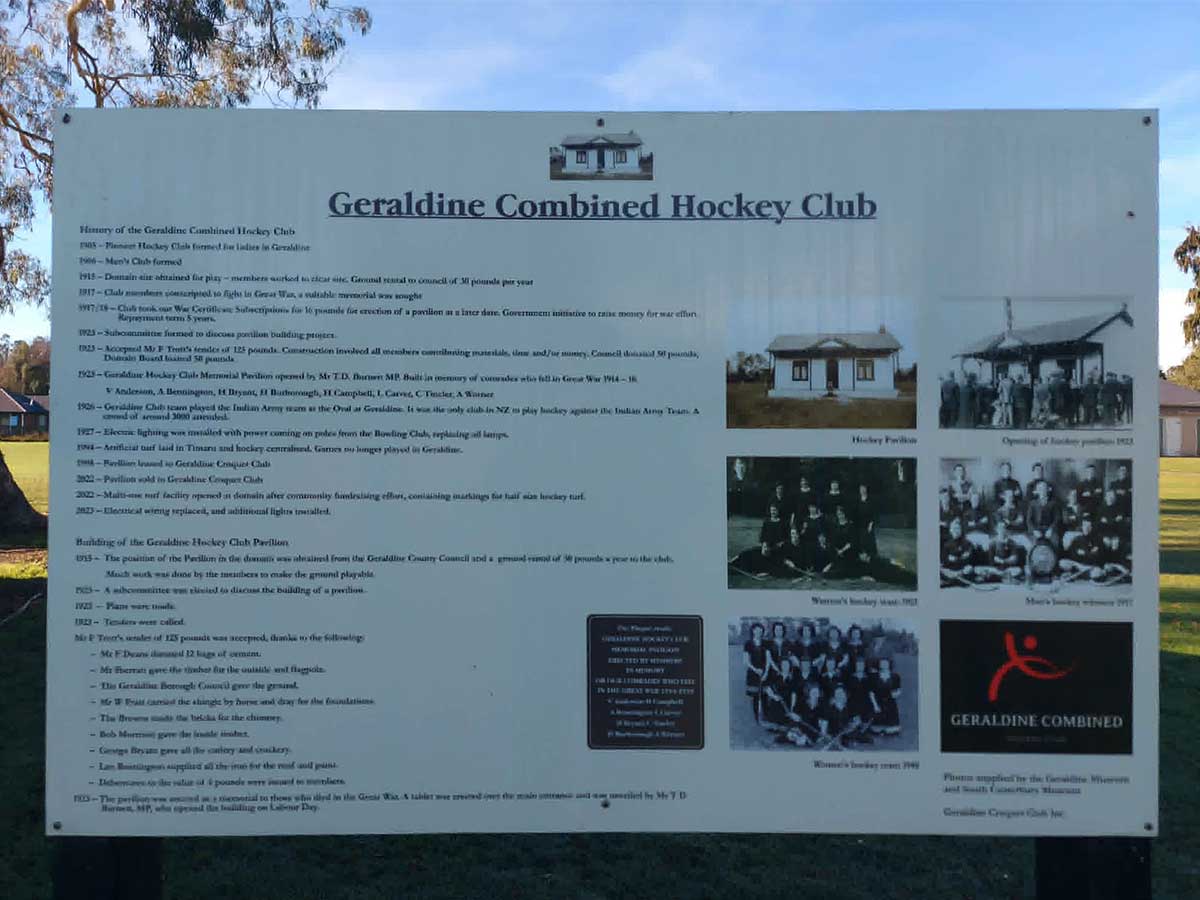
Geraldine Combined Hockey Club
History of the Geraldine Combined Hockey Club
1905 – Pioneer Hockey Club formed for ladies in Geraldine
1906 – Men's Club formed
1915 – Domain site obtained for play. Members worked to clear site. Ground rental to council of 30 pounds per year.
1917 – Club members conscripted to fight in Great War, a suitable memorial was sought.
1917/18 – Club took out War Certificate Subscriptions for 16 pounds for erection of a pavilion at a later date. Government initiative to raise money for war effort. Repayment term 5 years.
1923 – Subcommittee formed to discuss pavilion building project.
1923 – Accepted Mr F Trott's tender of 125 pounds. Construction involved all members contributing materials, time and/or money. Council donated 50 pounds; Domain Board loaned 50 pounds.
1923 – Geraldine Hockey Club Memorial Pavilion opened by Mr T. D. Burnett MP. Built in memory of comrades who fell in Great War 1914–18.
V Anderson, A Bennington, H Bryant, H Burborough, H Campbell, L Carver, C Tinkler, A Worner
1926 – Geraldine Club team played the Indian Army team at the Oval at Geraldine. It was the only club in NZ to play hockey against the Indian Army Team. A crowd of around 3000 attended.
1927 – Electric lighting was installed with power coming on poles from the Bowling Club, replacing oil lamps.
1994 – Artificial turf laid in Timaru and hockey centralised. Games no longer played in Geraldine.
1998 – Pavilion leased to Geraldine Croquet Club.
2022 – Pavilion sold to Geraldine Croquet Club.
2022 – Multi-use turf facility opened at domain after community fundraising effort, containing markings for half size hockey turf.
2023 – Electrical wiring replaced, and additional lights installed.
Building of the Geraldine Hockey Club Pavilion
1915 – The position of the Pavilion in the domain was obtained from the Geraldine County Council and a ground rental of 30 pounds a year to the club.
Much work was done by the members to make the ground playable.
1923 – A subcommittee was elected to discuss the building of a pavilion.
1923 – Plans were made.
1923 – Tenders were called.
Mr F Trott's tender of 125 pounds was accepted, thanks to the following:
Mr F Deans donated 12 bags of cement.
Mr Sherratt gave the timber for the outside and flagpole.
The Geraldine Borough Council gave the ground.
Mr W Pratt carried the shingle by horse and dray for the foundations.
The Browns made the bricks for the chimney.
Bob Morrison gave the inside timber.
George Bryant gave all the cutlery and crockery.
Len Bennington supplied all the iron for the roof and paint.
Debentures to the value of 2 pounds were issued to members.
1923 – The pavilion was erected as a memorial to those who died in the Great War. A tablet was erected over the main entrance and was unveiled by Mr T. D. Burnett MP, who opened the building on Labour Day.
Photo captions
Hockey Pavilion
Opening of hockey pavilion 1923
Women's hockey team 1921
Men's hockey winners 1917
Women's hockey team 1948
Memorial plaque text
The Plaque reads:
GERALDINE HOCKEY CLUB
MEMORIAL PAVILION
ERECTED BY MEMBERS
IN MEMORY OF
OUR COMRADES WHO FELL
IN THE GREAT WAR 1914–1918
V Anderson
H Campbell
A Bennington
L Carver
H Bryant
C Tinkler
H Burborough
A Worner
Photos supplied by the Geraldine Museum and South Canterbury Museum.
Geraldine Croquet Club Inc.