
I had been learning about Bidwill Hospital’s history to help prepare an archive display space and timeline when two women kept appearing near the beginning of the story. Sister Susan McArthur was one of them, and Sister Elizabeth Shanks was the other.
At first, I assumed they had been matrons working in hospitals established and owned by doctors. That seemed the obvious arrangement for the early twentieth century... it was not what I found. The surprising part is not that women did the nursing. It is that, for a time, at that time, they owned the hospitals too.
Elizabeth Shanks ran a trusted private hospital in Timaru for more than twenty years. Doctors treated patients there. Nurses and domestic staff worked for her. Families knew her name... then medicine changed. Hospitals needed increasingly expensive operating theatres, X-ray equipment, heating systems, lifts and sterilising plants. It became difficult for one nurse to finance the machinery expected of a modern hospital.
A company bought the goodwill of Elizabeth’s business, purchased some of her equipment and carried her work into the new institution that became Bidwill.
Here is my history hunt into her life into the lead up of her closing her hospital, and what she did next...
Her hospital closed, and the service continued. But for a while, I wonder if her name nearly disappeared?
This was not a case of good modern doctors replacing poor old-fashioned nursing. At the opening of the new Timaru Private Hospital in 1936, Dr Leonard Talbot said that better nursing than that provided by Sisters Shanks and McArthur would have been difficult to find.
What changed was not the quality of their care, but who could afford to own the hospital. The transition was recorded in three figures: £250 for goodwill, £15 for equipment and £3 15s for two sterilisers.
That left me with a question... what did £250 worth of goodwill actually look like?
First side quest: Why did Timaru need private hospitals?
Timaru already had a public hospital, so why did we need private ones?
Timaru' first organised hospital service seems to have begun in 1862, when the settlement was still young and sick or injured people had few places to receive sustained care. Belfield Woollcombe, who was one of the early European families to move to Timaru in laste 1850s, pressed the Canterbury Provincial Government to establish a hospital. A small cob house was rented, Mrs Simpson was employed as nurse and Dr Edward Butler was appointed Provincial Surgeon and medical superintendent. It began with only a few beds and basic equipment. A wooden hospital followed, then a more substantial building opened beside the Botanic Gardens in 1870.
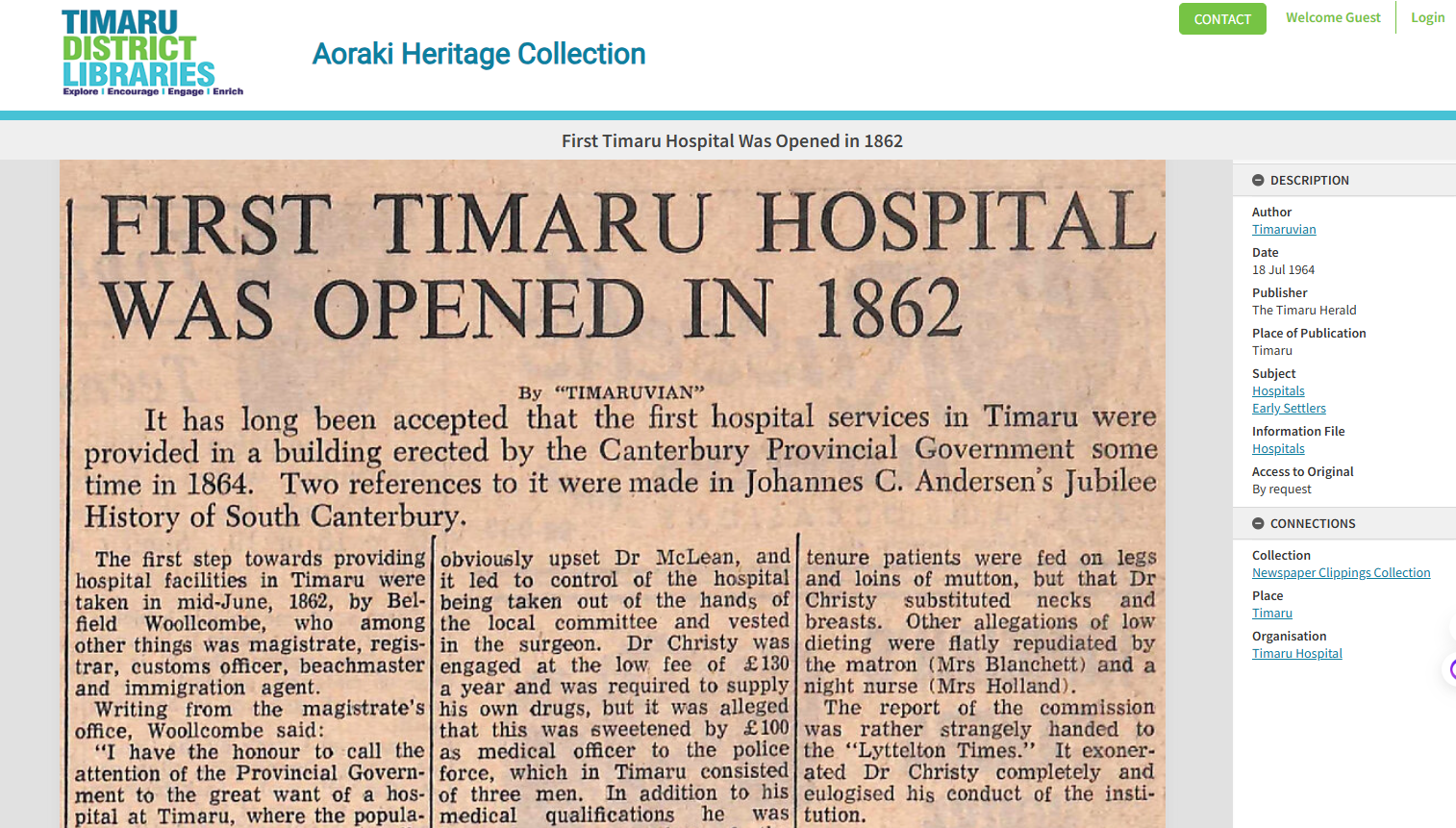
Timaruvian, First Timaru Hospital Was Opened in 1862 (18 Jul 1964). Aoraki Heritage Collection, accessed 16/07/2026, https://aorakiheritage.recollect.co.nz/nodes/view/7685
So why, several decades later, were nurses opening hospitals of their own?
Well, the answer is that the public hospital of Elizabeth Shanks’s time was not the universal, largely taxpayer-funded service we recognise today.
Public and private hospitals worked alongside one another. Government policy operated through a sliding system of payment. People who could not afford treatment might receive public hospital care without paying the full cost, while those able to pay were encouraged to use private hospitals. The government regulated the private system but generally expected its owners to fund their own buildings, staff and improvements.
Private hospitals offered another attraction. A patient could often continue under the care of their own doctor. The hospital proprietor provided the room, nursing staff, meals, laundry, equipment and round-the-clock care. The doctor visited, diagnosed, treated or operated on the patient and charged for professional services.
A nurse-owned hospital was therefore part clinic, part ward, part household and part accommodation business. Its proprietor had to keep all of those parts working at the same time. Public hospitals and private hospitals were not simply rivals. They filled different needs and together formed the healthcare system of the period.
Second side quest: Who owned these private hospitals?
I found an awesome thesis. It was written by Ann-Marie Quinn’s 2023 Massey University thesis, Public Virtue, Private Ambition: The Quiet Rise of Entrepreneurial Women in New Zealand’s Private Hospitals 1890–1935. Her study examined the world in which Elizabeth was working.
Quinn found that, by the early twentieth century, New Zealand had developed a public hospital system supported by a large network of private hospitals. Those private institutions were predominantly owned and managed by nurses and midwives. They were not all tiny maternity homes. Women also owned some of the country’s substantial medical and surgical hospitals.
A 1909 government report examined 58 general medical and surgical private hospitals. Only two or three had been established by medical men. The rest were owned and conducted by qualified nurses.
Doctors had status, income and considerable professional authority... yet women owned most of these hospitals. Why?
Third side quest: Why did the doctors not own them?
Some doctors did establish hospitals, particularly during the earlier years of settlement. Dr Herbert Barclay, for example, owned the Shearman Street private hospital in Waimate that Elizabeth later managed. But doctors did not always need to own the hospitals in which their private patients were treated.
A doctor could run consulting rooms, visit patients at home and treat or operate on patients inside a nurse’s hospital. He did not necessarily need to invest in a building, kitchen, laundry, bathrooms, heating, beds, nursing staff and twenty-four-hour supervision.
The nurse-owner carried much of that overhead.
She had to:
- provide and maintain the premises
- employ nursing and domestic staff
- feed patients
- manage linen and laundry
- keep wards and operating rooms clean
- purchase and sterilise equipment
- comply with inspections and licensing rules
- collect fees and pay suppliers
- carry the financial loss when beds were empty.
The doctor brought the medical work. The nurse provided the institution that made the work possible.
This was not always a comfortable or equal partnership, but it was a mutually dependent one. Quinn describes the private hospital as a more symbiotic environment than the public hospital, because the doctor and nurse-owner each needed the other. There was also an interesting shift in authority. Inside a public hospital, nurses worked within a hierarchy led by doctors, administrators and hospital boards.
Inside her own private hospital, a nurse was still expected to follow a doctor’s clinical instructions regarding his patient. But she controlled the premises. She employed the staff. She held the licence. She was responsible to the health authorities for the operation of the hospital.
The doctor might direct the operation, but the nurse owned the operating room.
For women living at a time when access to independent careers, property and public authority was still limited, that was significant. Nursing was considered respectable, feminine work. It could be presented as service, duty and care rather than ambition. Yet it also offered trained women a pathway into management, income, property and business ownership.
They may not have used the word entrepreneur... but reading between the lines I think this was what many of them were.
Back to Elizabeth
Elizabeth Shanks trained at Riverton Hospital and passed the State nursing examination in 1904. Her later entry in the national register traced work at Riverton and Palmerston North hospitals before she became matron of Waimate Hospital.
In January 1909, the nursing journal Kai Tiaki reported that the Riverton staff nurse had been appointed matron at Waimate. Her former patients presented her with an inscribed Queen Anne tea set when she left.
A matron supervised staff, maintained discipline, managed supplies and organised the daily life of the hospital. She needed clinical judgement, authority and practical skill.
Elizabeth was gaining the experience required to run an institution.
In 1910 she left the public hospital to become matron of Dr Barclay’s private hospital in Shearman Street. On her departure, the Waimate medical, nursing and domestic staff presented her with a picture, a silver inkstand and a fountain pen. That move took her from a publicly governed institution into private hospital management. She still nursed, but now the work sat closer to business.
Elizabeth comes to Timaru
By early 1915, Elizabeth had left the Waimate hospital and taken over the Timaru hospital previously managed by Miss Morris. Dr Cruickshanks took over the Waimate business, with Nurse Marion Brown placed in charge.
A 1918 advertisement Otago Daily Times 18 September 1918 Page 1, sought a registered nurse experienced in medical and surgical work for Sister Shanks’s private hospital in Theodosia Street, later Bidwill histories place her hospital in Elizabeth Street.
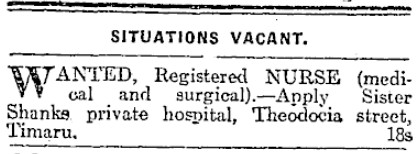
Otago Daily Times 18 September 1918 Page 1

New Zealand Tablet, 23 May 1918, Page 25
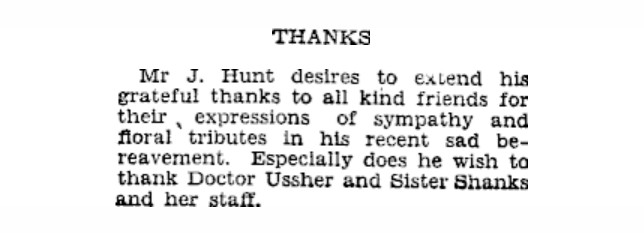
Timaru Herald, Volume CXXV, Issue 18618, 14 July 1930, Page 8
Sister Shanks and her staff
Elizabeth has not left us a memoir that I have found. No authenticated portrait has yet emerged so far... so instead, her working life appears in little newspaper notices.
In 1918 she needed a registered medical and surgical nurse. That tells us about the patients she was equipped to receive and the professional standard she expected.
In 1921 she advertised for a good cook for the private hospital.
It is easy to skim past an advertisement for a cook, but hospitals could not operate on surgical skill alone.
Patients needed meals. Linen had to be washed. Rooms had to be heated. Night shifts had to be covered. Floors needed scrubbing. Dressings and instruments had to be prepared. Someone had to answer the door while someone else remained with the patient.
In 1930, after a family bereavement, Mr J. Hunt publicly thanked Dr G. H. Ussher and “Sister Shanks and her staff”.
Those words help correct the image of one woman taking a few patients into a spare room.
Elizabeth led a healthcare team.
Dr Ussher’s presence also reveals the arrangement in practice. A doctor treated the patient. Elizabeth and her staff provided the hospital and nursing care around that treatment. It was her name attached to the institution. She was not alone, Elizabeth belonged to a longer local history of nurse-led enterprise.
In 1899, Nurses Morrison and Christian, both former staff nurses at Timaru Hospital, took over Ettrick Bank in High Street and converted the large house into a private hospital. Contemporary reporting noted the money spent improving its sanitation, decoration and suitability for patients. It also described the women’s training and endorsements from local doctors.
In 1909, Nurses Jessie King and Lucy White were advertising Whare Nana, a maternity hospital in Wai-iti Road. Both had trained at St Helens Hospital.
Their service proved successful enough for them to commission a purpose-designed maternity hospital in Chester Street, near Elizabeth Street. When it opened in 1911, the Timaru Herald praised the women’s enterprise and described it as one of the country’s most modern maternity hospitals.
In 1912, Sister Susan McArthur opened a new medical and surgical hospital farther along Chester Street, later renamed Bidwill Street. Contemporary reporting described its sunny position, purpose-built design and facilities for medical and surgical cases.
Then there was Nurse Morris, whose Timaru hospital Elizabeth took over. There were almost certainly more... These women were helping to build Timaru’s medical life and care for the community with different forms of care. Whare Nana specialised in maternity work. McArthur and Shanks received medical and surgical cases. Other nurses undertook private nursing in patients’ homes or operated smaller maternity and convalescent homes.
Together, they created a web of healthcare around the public hospital.
When medicine became expensive
By the early 1930s, a smaller nurse-owned hospital faced a growing problem... modern healthcare required capital. A hospital now needed more specialised operating facilities, sterilising equipment, heating systems, plumbing, lifts, trained staff and access to X-rays. Quinn’s research shows that a lack of money was a persistent difficulty for nurse proprietors, particularly when adapting houses to meet increasingly demanding hospital regulations.
Timaru doctors and businesspeople began planning a larger private hospital. The emerging company included Dr Leonard Talbot, Dr Charles Fraser and business figures such as Bertrand Blodorn, Frederick Ward, L. M. Inglis and J. Leggott. Dr William Sowerby was connected with the proposed X-ray department, while other local doctors advised on the project.
But they were not beginning from nothing, Timaru already had patients accustomed to private hospital care. It already had doctors accustomed to treating and operating on private patients. Most importantly, it had two established nursing groups led by Sisters McArthur and Shanks.
The company purchased McArthur’s Bidwill Street property for £3,000, made up of £2,000 in cash and £1,000 in fully paid shares.
Elizabeth’s arrangement was different. Her building was not bought. Instead, the company agreed to pay £250 for the goodwill of her Elizabeth Street hospital when she closed it.
The two figures should not be compared as though one nurse’s contribution was valued at £3,000 and the other’s at £250. McArthur’s payment included property. Elizabeth’s was for the intangible value of her business.
Then came the smaller purchases: £15 worth of equipment and two sterilisers for £3 15s.
What is goodwill? Goodwill is one of those tidy business words that conceals a great deal of human effort, It cannot be loaded onto a cart, it is the confidence that makes a doctor refer a patient. It is the family that returns because someone was treated kindly the first time, the staff who know how the hospital works, and the name people trust when they are frightened.
The £250 recognised that Elizabeth had created something valuable beyond the second-hand price of her beds and instruments. The company wanted that value transferred into the new hospital rather than left behind as a competing service. In October 1936, Elizabeth was given one month’s notice that the company intended to complete the goodwill arrangement.
The minutes tell us the business decision, but they do not tell us how she felt. I wonder if she was she ready to retire? Relieved to surrender the financial burden? Proud to see a more advanced hospital opening? Disappointed that her own institution would disappear? I do not know... and it is tempting to supply the emotion that the records leave out, but that would be storytelling rather than history.
Better facilities, not better nurses
The new Timaru Private Hospital officially opened in October 1936 and began admitting patients in early November.
Sister Helen Stevenson became its first matron. M. R. Allen was appointed theatre sister, with J. E. Johnstone and H. Hill among the early ward sisters. Once again, women would organise much of the hospital’s daily clinical life, but now they would do so as employees of a company-owned institution.
At the opening, Dr Talbot publicly acknowledged the care already provided by Sisters McArthur and Shanks. The need for a new hospital did not arise because their nursing had failed. He considered the standard of their nursing extremely high. The difficulty was that individual nurses could no longer be expected to supply the expensive equipment modern medicine demanded from their own resources.
A company could raise money, sell shares and spread the cost among investors. An individual nurse proprietor could not readily do that. So progress arrived, but it did not arrive empty-handed. It carried forward the patients, experience, equipment, relationships and goodwill built by women who had already been doing the work.
What changed when the new hospital opened?
Patients gained better facilities, Doctors gained access to modern equipment, Timaru gained a larger and more sustainable private hospital, and the ownership moved.
Women such as Elizabeth Shanks had been nurses, matrons, employers and proprietors. They held responsibility for the premises and the business. In the company model, nurses remained essential, but the building, capital and equipment belonged to directors, shareholders and, later, a trust.
The work stayed with women.
Much of the ownership and institutional authority moved elsewhere. This was happening across New Zealand. The number of private hospitals grew to 327 by 1929, before the Depression forced many to close. As medicine became more technical and costly, smaller nurse-owned hospitals found it increasingly difficult to compete with larger institutions. That makes Elizabeth’s story more than a footnote to Bidwill. It is a local example of a national change.
What learning about what I could find about Sister Shanks’s life has taught me
Elizabeth’s hospital did not disappear because it had failed, it disappeared because the financial structure of medicine changed around it. Her career shows how women found room to exercise authority inside a society that offered them relatively few pathways to independent professional life.
Nursing was publicly understood as care and service. Behind that respectable language, some women were also negotiating leases, managing staff, purchasing equipment, meeting regulations and building valuable businesses. Their ambition was made acceptable because it helped other people.
That is the clever tension captured in Quinn’s title, Public Virtue, Private Ambition. Elizabeth also reminds us to be careful about how institutions tell their histories. Buildings are easy to remember. They have foundation stones, architects, opening ceremonies and photographs. Companies leave minutes and Doctors appear in professional records.
A nurse-owned business might survive only in advertisements for a cook, a message of thanks or a line recording the purchase of two sterilisers. Yet without those nurses, there may have been no established private healthcare service for the new company to consolidate. Progress did not replace poor nursing. It replaced a woman-owned model of healthcare with a company-owned one.
The questions that remain
Elizabeth’s professional career is well supported, but parts of her personal life remain uncertain. Genealogical records point towards an Elizabeth Shanks born in Otago in the early 1870s who died in Timaru in 1945. I have not yet found the death certificate, obituary or probate evidence needed to connect that woman conclusively with the registered nurse. For that reason, her dates (incase you are citing this) should remain c.1872–1945, provisional.
The location of her Timaru hospital also needs more work. Theodosia Street and Elizabeth Street are both supported by historical records, but the exact sequence and property have not yet been settled. Perhaps the answer is sitting in a family album, an old receipt, a nurse’s letter or the back of an unnamed photograph.
That is the pleasure and the frustration of a history hunt... one question leads to another. Then a side quest opens a much larger story.
I began by looking for two nurses near the beginning of Bidwill’s timeline... I found women who had owned hospitals.
Bonus side quest for those who read all the way to the bottom of this blog... A woman doctor in Elizabeth’s circle
That move placed Elizabeth in the same small medical world as Dr Margaret Cruickshank, one of New Zealand’s most important medical pioneers. Cruickshank joined Dr Herbert Barclay’s Waimate practice in 1897 and became the first woman registered as a doctor in New Zealand, as well as the first to establish herself in general medical practice. Because Elizabeth managed Barclay’s private hospital, the two women almost certainly knew one another professionally, although I have not yet found a record describing their personal relationship or naming a patient they treated together. The connection became even clearer when Elizabeth left Waimate for Timaru: Kai Tiaki reported that Dr Cruickshank took over the Waimate private hospital, with Nurse Marion Brown placed in charge.
Cruickshank served Waimate from 1897 until 1918, travelling into the surrounding countryside by horse and gig, bicycle and on foot to reach her patients. During the 1918 influenza epidemic she continued working until she contracted the illness herself and died on 28 November. Waimate remembered her with a public statue unveiled in Seddon Square in 1923, one of New Zealand’s rare early civic memorials to a woman. Her legacy is not only that she broke a professional barrier, but that she earned lasting trust through more than twenty years of practical service to one community. For Elizabeth, she was not a distant national figure. She was a pioneering woman doctor working beside her in the same local network of doctors, nurses and private hospitals.
Timeline: Sister Elizabeth Shanks and Timaru’s nurse-owned hospitals
1862 Timaru’s first organised public hospital opened in a rented cob house. Mrs Simpson was employed as nurse and Dr Edward Butler became Provincial Surgeon and medical superintendent. The service began with only a few beds and basic equipment.
1897 Dr Margaret Cruickshank joined Dr Herbert Barclay’s medical practice in Waimate. She became the first woman registered as a doctor in New Zealand and remained in Waimate for the rest of her career.
1899 Former Timaru Hospital staff nurses Morrison and Christian opened Ettrick Bank Private Hospital in High Street. Their venture shows that nurse-owned hospitals were already part of Timaru’s healthcare network before Elizabeth arrived.
1901–1902 The Nurses Registration Act 1901 introduced national training, examination and registration. New Zealand became the first country to establish state registration for nurses. This gave trained women such as Elizabeth a recognised professional qualification that could be carried from one hospital to another.
1903 A purpose-designed private hospital opened in Shearman Street, Waimate. It contained six patient rooms, an operating room, laboratory and drug room. Drs Herbert Barclay and Margaret Cruickshank lived nearby and were expected to attend its patients. This appears to be the hospital Elizabeth later managed.
1904 Elizabeth Shanks completed her training at Riverton Hospital, passed the State nursing examination and was registered in December. Her later register entry records her as registration number 428.
January 1909 Elizabeth, then a staff nurse at Riverton Hospital, was appointed matron of Waimate Hospital. Patients presented her with an inscribed Queen Anne tea set when she left Riverton.
1910 Elizabeth left Waimate Public Hospital to take charge of Dr Barclay’s private hospital in Shearman Street. This placed her within the same small medical network as Dr Margaret Cruickshank, Barclay’s medical partner. Elizabeth was moving from a salaried public position into private hospital management.
January 1911 Nurses Jessie King and Lucy White opened their purpose-built Whare Nana maternity hospital in Chester Street, Timaru. Their enterprise was part of the wider local network of hospitals established and managed by trained women.
1912 Sister Susan McArthur opened her medical and surgical private hospital in Chester Street, later renamed Bidwill Street. McArthur and Shanks would become the two nurse proprietors most directly connected with the creation of the later Timaru Private Hospital.
Late 1914 to January 1915 Elizabeth gave up the Waimate private hospital and took over a Timaru hospital previously managed by Miss Morris. Kai Tiaki reported that Dr Cruickshank took over the Waimate hospital, with Nurse Marion Brown placed in charge. This provides strong evidence of a professional connection and probable handover between Cruickshank and Shanks, although their personal relationship remains unknown.
23 May 1917 Twenty-year-old Mary Breen of Levels died at Nurse Shanks’s Private Hospital in Timaru. The memorial notice confirms that Elizabeth’s hospital was receiving seriously ill patients by this date.
September 1918 Elizabeth advertised for a registered nurse experienced in medical and surgical nursing. The advertisement placed her hospital in “Theodocia Street”, almost certainly Theodosia Street. It is the clearest contemporary evidence of the hospital’s clinical work and location at this stage.
November 1918 Dr Margaret Cruickshank died after contracting influenza while caring for Waimate residents during the pandemic. She had served the district for more than twenty years. A public memorial was later erected in Seddon Square. There is not yet enough evidence to state that Elizabeth’s Timaru hospital treated influenza patients during the epidemic.
August 1921 Elizabeth advertised for a good cook and a lady help for her private hospital. These notices reveal the domestic workforce needed to support medical care. Elizabeth was responsible for food, staff and the daily operation of the institution as well as nursing.
1920s Later Bidwill histories associate Elizabeth’s hospital with Elizabeth Street. It remains unclear whether she moved from Theodosia Street, whether the hospital occupied a corner site described from different streets, or whether one of the records is incorrect. No street number should yet be published as proven.
July 1930 Following a bereavement, J. Hunt publicly thanked Dr G. H. Ussher and “Sister Shanks and her staff”. This confirms that Elizabeth led an established healthcare team and worked alongside visiting doctors.
Early 1930s Doctors and businesspeople began planning a larger private hospital with modern operating, X-ray, heating, lifting and sterilising facilities. Their project was not starting from nothing. Timaru already had two long-established nursing groups led by Sisters McArthur and Shanks.
7 November 1935 The Timaru Private Hospital Company purchased Susan McArthur’s Bidwill Street property for £3,000, comprising £2,000 in cash and £1,000 in fully paid shares. An arrangement was also made to pay Elizabeth £250 for the goodwill of her hospital when she closed it.
October 1936 Elizabeth was given one month’s notice that the company intended to complete the goodwill purchase. The company also bought £15 worth of her equipment and two sterilisers for £3 15s. Her building itself was not acquired.
30 October 1936 The new Timaru Private Hospital was officially opened. Dr Leonard Talbot publicly praised the nursing previously provided by Sisters McArthur and Shanks. He explained that the problem had not been poor nursing, but the rising cost of the equipment required by modern medicine.
2 November 1936 The new hospital began receiving patients. Sister Helen Stevenson became its first matron, supported by theatre and ward sisters. Nurses continued to organise much of the daily clinical work, but they now did so inside a company-owned institution.
1945, provisional Genealogical records suggest Elizabeth died in Timaru in April 1945 and was buried at Mataura. This identity has not yet been conclusively connected to the registered nurse through a death certificate, obituary or probate file, so her life dates should remain c.1872–1945, provisional.
2023 Historian Ann-Marie Quinn completed her Massey University thesis on entrepreneurial women in New Zealand’s private hospitals. Her work helps explain that Elizabeth was not an isolated local curiosity. She belonged to a substantial national group of nurses and midwives who became hospital owners, employers and regulated businesswomen.
Sources and full links
Sister Elizabeth Shanks
New Zealand nursing register information
The supplied Bidwill Story research includes Elizabeth’s registration number, Riverton training, State examination and career summary.
New Zealand Gazette index, 1930:
https://gazette.howison.co.nz/nzg/1930
Appointment as matron of Waimate Hospital, January 1909
Kai Tiaki, 1 January 1909:
https://paperspast.natlib.govt.nz/periodicals/KT19090101.2.42
Move to Dr Barclay’s Waimate private hospital, 1910
Kai Tiaki, 1 October 1910:
https://paperspast.natlib.govt.nz/periodicals/KT19101001.2.42.4
Move from Waimate to Miss Morris’s Timaru hospital
Kai Tiaki, 1 January 1915:
https://paperspast.natlib.govt.nz/periodicals/KT19150101.2.52.2
Mary Breen’s death at Nurse Shanks’s Private Hospital, 1917
New Zealand Tablet, 23 May 1918:
https://paperspast.natlib.govt.nz/periodicals/NZT19180523.2.46
Advertisement for a registered medical and surgical nurse, 1918
Otago Daily Times, 18 September 1918:
https://paperspast.natlib.govt.nz/newspapers/ODT19180918.2.2.3
Advertisements for a cook and lady help, 1921
Otago Daily Times, 2 August 1921:
https://paperspast.natlib.govt.nz/newspapers/ODT19210802.2.2.3
Thanks to Dr Ussher and “Sister Shanks and her staff”, 1930
Timaru Herald, 14 July 1930:
https://paperspast.natlib.govt.nz/newspapers/THD19300714.2.40
Provisional genealogical lead for Elizabeth’s death
FamilySearch, not yet independently confirmed:
https://ancestors.familysearch.org/en/9FSZ-ZM5/elizabeth-shanks-1872-1945
Waimate and Dr Margaret Cruickshank
The Waimate private hospital in Shearman Street, 1903
Oamaru Mail, 27 July 1903:
https://paperspast.natlib.govt.nz/newspapers/OAM19030727.2.3
Margaret Cruickshank biography
NZ History:
https://nzhistory.govt.nz/people/margaret-cruickshank
Cruickshank’s registration as New Zealand’s first woman doctor
NZ History:
https://nzhistory.govt.nz/nzs-first-registered-woman-doctor-margaret-cruickshank
Dictionary of New Zealand Biography entry
Te Ara:
https://teara.govt.nz/en/biographies/3c41/cruickshank-margaret-barnet
Cruickshank’s graduation portrait
NZ History:
https://nzhistory.govt.nz/media/photo/margaret-cruickshank
Cruickshank memorial in Waimate
NZ History:
https://nzhistory.govt.nz/media/photo/margaret-cruickshank-memorial
Statue of Margaret Cruickshank
Te Ara:
https://teara.govt.nz/en/photograph/32564/statue-of-margaret-cruickshank-waimate
Waimate Hospital history
Aoraki Heritage Collection:
https://aorakiheritage.recollect.co.nz/nodes/view/6775
Timaru’s public and private hospitals
Timaru’s first public hospital, opened in 1862
Aoraki Heritage Collection:
https://aorakiheritage.recollect.co.nz/nodes/view/7685
Ettrick Bank Private Hospital, opened by Nurses Morrison and Christian
South Canterbury Times, 18 August 1899:
https://paperspast.natlib.govt.nz/newspapers/SCANT18990818.2.19
Whare Nana purpose-built maternity hospital
Timaru Herald, 20 January 1911:
https://paperspast.natlib.govt.nz/newspapers/THD19110120.2.5
Sister Susan McArthur’s private hospital, 1912
Timaru Herald, 13 July 1912:
https://paperspast.natlib.govt.nz/newspapers/THD19120713.2.5
Original nurse-owned hospital in Bidwill Street
Aoraki Heritage Collection:
https://aorakiheritage.recollect.co.nz/nodes/view/7485
Later history of Bidwill Hospital
Aoraki Heritage Collection: https://aorakiheritage.recollect.co.nz/nodes/view/7614
Bidwill Trust Hospital’s official website https://www.bidwillhospital.co.nz/
Your existing WuHoo profile of Sister Susan McArthur https://wuhootimaru.co.nz/blog/1042-sister-susan-mcarthur-a-history-hunt-into-timaru-s-first-private-hospital
Nursing registration and private-hospital regulation
Nurses Registration Act 1901
New Zealand Legislation: https://www.legislation.govt.nz/act/public/1901/12/en/latest/
Official scan of the Nurses Registration Act 1901 https://www.legislation.govt.nz/act/public/1901/12/en/1901-09-12/official_scan.pdf
World’s first state-registered nurses
NZ History: https://nzhistory.govt.nz/page/worlds-first-state-registered-nurses
Hospital-based nurse training and State examination
Te Ara: https://teara.govt.nz/en/hospitals/page-2
The law applying to private hospitals in 1914
Kai Tiaki: https://paperspast.natlib.govt.nz/periodicals/KT19140101.2.34
Ann-Marie Quinn’s research
Thesis catalogue page
Ann-Marie Quinn, Public Virtue, Private Ambition: The Quiet Rise of Entrepreneurial Women in New Zealand’s Private Hospitals 1890–1935, Massey University, 2023:
https://mro.massey.ac.nz/items/5c42814a-54fd-4f85-bbff-18d6d1f8c989
Full thesis PDF
https://mro.massey.ac.nz/server/api/core/bitstreams/0e621ab0-bba3-4fe6-a685-0f71ed972eb8/content
The Bidwill institutional history D. E. Drake, The Bidwill Story: Sixty-five Years of a Private Hospital in Timaru, published by the Bidwill Trust Hospital Board, c.2001.
South Canterbury Museum catalogue record: https://timdc.pastperfectonline.com/library/97F20075-B3EE-40C1-8295-730280153784
University of Canterbury library record: https://libcat.canterbury.ac.nz/Record/805339
The expanded centenary edition is catalogued as: D. E. Drake, The Bidwill Story: A Private Hospital in Timaru for 100 Years, Bidwill Trust Hospital Board, 2012.
National Library of Medicine catalogue record: https://www.ncbi.nlm.nih.gov/nlmcatalog/101624309