
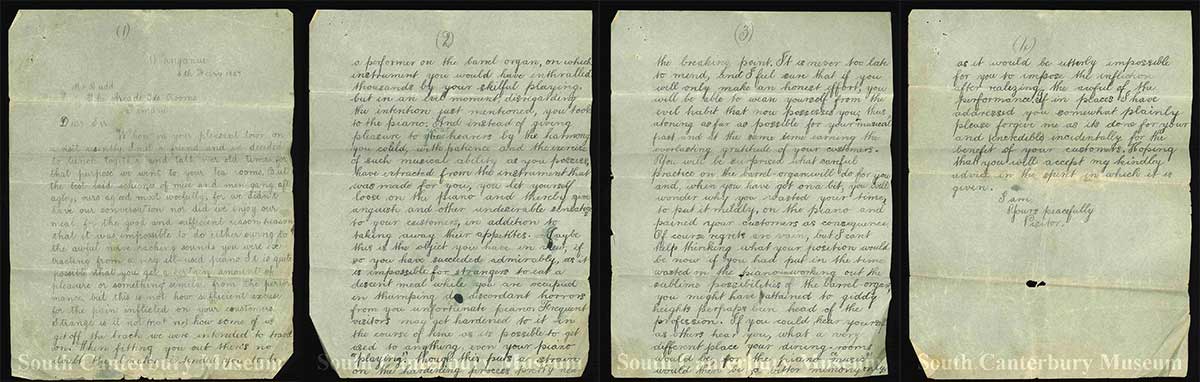
South Canterbury Museum record: Anonymous to Mr Budd of the Arcade Tea Rooms, 5 February 1907 RE piano playing. The record notes that the letter complains about the “pain inflicted” on customers by the “awful nerve racking sounds” from a “very ill-used piano.” https://timdc.pastperfectonline.com/archive/498BCA69-011A-42C1-948F-013080419510
Imagine writing a business complaint letter so dramatic that, more than a century later, it ends up in a museum archive... well that is exactly what happened to one anonymous visitor from Wanganui!
I have been learning about early tea rooms in Timaru, especially the way they became important public spaces where women could meet, eat, wait, talk, organise, rest, and be part of town life. Among the menus, buildings, names and dates, I came across a wonderful little gem in the South Canterbury Museum online archive. In 1907, someone wrote to Mr Alfred Budd of The Arcade Tea Rooms, Timaru.
You might assume the concern could be over cold tea, stale cake, a disappointing sandwich or poor service... but no, this persons four page letter was about the piano!
The writer complained about the “awful nerve racking sounds” Mr Budd was extracting from “a very ill-used piano”. They described the experience as so painful that it spoiled both their meal and their conversation. In fact, they suggested Mr Budd might have been better suited to a barrel-organ than a piano.
It is, essentially, the 1907 version of a one-star Google review — only written with pen, paper, beautiful handwriting, and a wonderfully sharp turn of phrase. The visitor had come to Timaru, met a friend, and gone to the Arcade Tea Rooms hoping to enjoy lunch and “talk o’er old times”. Instead, the piano seems to have ruined everything!
You never know what you might find wiht a keyword in an archive, and coming across this drama was a great side quest departure from my tea room history hunt.
This letter puts our modern grumbles into perspective.
Today we complain about slow Wi-Fi, parking, coffee temperature, online forms, or a typo on a menu. In 1907 visitor felt personally attacked by piano playing in a Timaru tea room. A little document like this helps bring The Arcade Tea Rooms back to life. It reminds us that these places were not just businesses. They were social spaces where people went there to meet, and from this also complain. From their concerns we gain a tiny glimpse into that world.
Poor Mr Budd... poor piano. and lucky us that the complaint survived.
Side quests from a 1907 piano complaint
Reading the complaint letter made me curious... who was Mr Budd? Where were the Arcade Tea Rooms? And was there a bigger Timaru story hiding behind it? So I went looking...
Side quest one: Mr Budd was not just “the man with the piano”
The Mr Budd in the South Canterbury Museum record appears to be Alfred Budd senior, a Timaru pastrycook, confectioner, caterer and tea-room proprietor.
South Canterbury Museum’s profile for his son Herbert George Budd says Alfred Budd senior ran tea rooms at the south end of Stafford Street, the Arcade Cafe, Budd’s Tea Kiosk at Caroline Bay, and catering services. It also records that Alfred and Elizabeth Budd came to New Zealand from Britain with three children on the Oamaru, arriving at Lyttelton in January 1884.
So this was not just a cafe owner being roasted by an annoyed customer... Budd was part of Timaru’s growing hospitality world of public dining rooms.
Alfred was married to Elizabeth Budd, née Reid. Her middle name appears with slightly different spellings in the sources — Corthwaite and Cornthwaite. South Canterbury Museum names her as Elizabeth Corthwaite Budd in Herbert George Budd’s profile, while another Museum profile for Alfred Ernest Budd gives “Elizabeth Cornthwaite (née Reid).”
An Elizabeth C. Budd of Stafford Street, Timaru signed the 1893 Women’s Suffrage Petition. Given the name, initial and Stafford Street connection, I think this is very likely Alfred’s wife.
While Alfred’s name is on the businesses, the tea-room story sits inside a wider women’s history story. These places gave women somewhere respectable to meet, and move through town life with more independence.
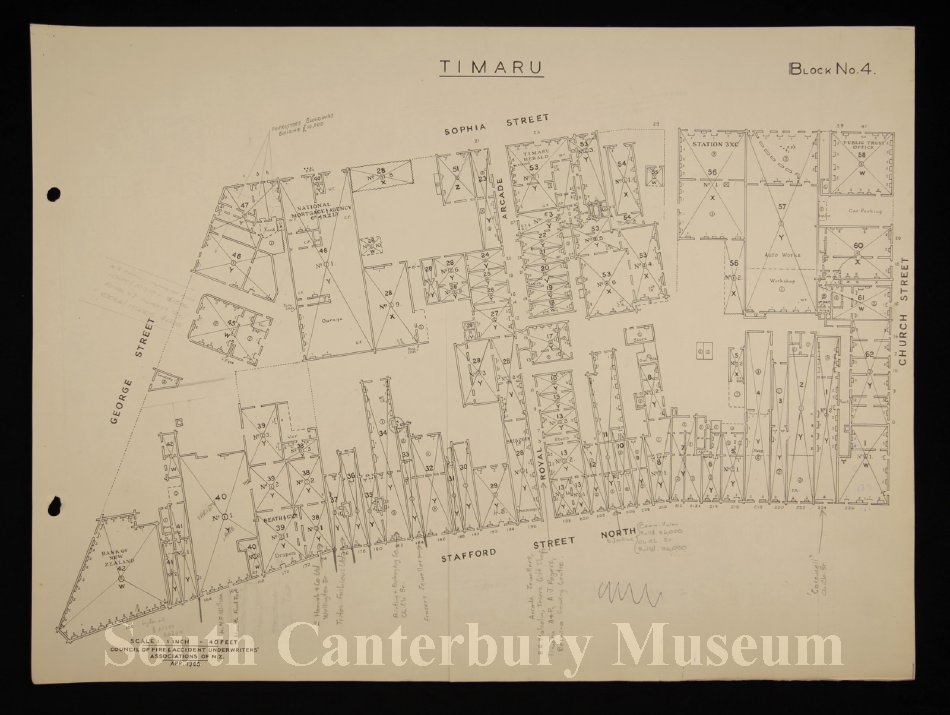
Royal Arcade - Fire and Accident Underwriters Association block plans Timaru township 1959 - South Canterbury Museum 200200506b-10
Side quest three: The Arcade Cafe was bigger than I imagined
When I first read “tea rooms”, I pictured something fairly small... but the Arcade Cafe sounds much more ambitious.
The Timaru Civic Trust says Budd’s Arcade Cafe was upstairs in the 1906 Priest and Holdgate extension, designed by J. S. Turnbull. Customers passed glass display cabinets for the confectionery and cake shop below, then went upstairs to a large dining room seating about 120 people. It also had an orchestra alcove, a ladies’ dressing room, a men’s smoking and coffee room, and lavatory conveniences.
That changes how I picture the complaint... I now realise that this was not someone grumbling in a tiny corner shop. This was a modern social space in central Timaru. Food, music, display, comfort, gendered spaces, and public life all under one roof.
No wonder the piano mattered.
Side quest four: Did Budd turn the complaint into advertising?
This is the delicious part... the complaint letter is dated 5 February 1907. The anonymous visitor, writing from Wanganui, complained about the “pain inflicted” on customers by the “awful nerve racking sounds” coming from a “very ill-used piano.” Eleven days later, an advertisement appeared in the Timaru Herald for the Arcade Cafe. It jokingly announced the “Arcade Conservatorium”, with Budd as “Principal”, and advertised “famous interpretations daily” on Budd’s “almost human Pianoforte Player.”
Was that a direct reply to the complaint? Well I cannot prove it... but the timing is fun. It may have been coincidence or it may have been Budd leaning into the joke.
Side quest five: A family story opens up
Alfred and Elizabeth had a large family. South Canterbury Museum lists three children who came with them from Britain — Katie, Bessie and Frederick — and six more born after arrival: William Henry, Edward, Margaret Lilian, Alfred Ernest, Herbert George and Nellie.
Some of those children open more doors.
Herbert George Budd was born in Timaru in 1895, enlisted from Craigie Avenue, and was killed at Gallipoli on 7 August 1915, aged 20.
Alfred Ernest Budd was also a son of Alfred and Elizabeth. His Museum profile records that he was educated at Timaru Main School and later died in 1960, with his memorial at Eastern Cemetery, Invercargill.
Side quest six: Where did Alfred Budd die?
This part still needs checking... at this stage, I would not say Alfred Budd senior is buried in Timaru Cemetery unless we find a cemetery record. We know from South Canterbury Museum that Mrs Budd advertised the sale of their Craigie Avenue home in July 1915 and that the couple relocated to Auckland.
So Alfred’s death and burial stay in the “still hunting” basket for now.

While I was hunted, I found a blog on the Timaru Civic Trust, and I clicked that the tea rooms, was where I used to do jazz ballet, The floor is now used as an event space for hire, and I created the logo for the Arcade. The Arcade Cafe was on the top floor of the 1906 Priest and Holdgate extension, and designed by the architect J. S. Turnbull. The Arcade Cafe was opened almost 120 years ago on the 9th October 1906, with 400 people dining during the day and a large banquet that evening for the Builders’ Association Dinner. I remember the stunning art nouveau stained glass window that I stepped past up the stair well on the way to dance class.
Building work on Timaru’s first arcade began in 1885, but the arcade known at first as Ross’ Arcade – after the Mayor of Timaru who backed it – opened its doors in 1886, and went through a series of major changes over the next two decades. This was partly because Mr Ross got declared bankrupt, and partly because others invested in new sections and new frontages being built, including the Arcade Chambers in 1907.
When a smell was investigated they found rotting stumps of an old orchard below the arcade. In an old map you can see a stream running through Sophia Street across Stafford Street to the sea.
During the Spanish Flu pandemic after World War 1, Timaru Arcade had an ‘inhalation chamber,’ through which at its peak over 300 people a day would pass to check their breathing and to receive an antiseptic spray considered at the time as a preventative measure. The chamber was in the arcade for about a month through November – December 1918.
That letter survived and has led us to Stafford Street, the Arcade Cafe, Caroline Bay, country visitors, women’s public spaces, family history, Gallipoli, and the way a town learns to gather. Whlie I thought the complaint was funny, it has opened up some history hunting and side quests.
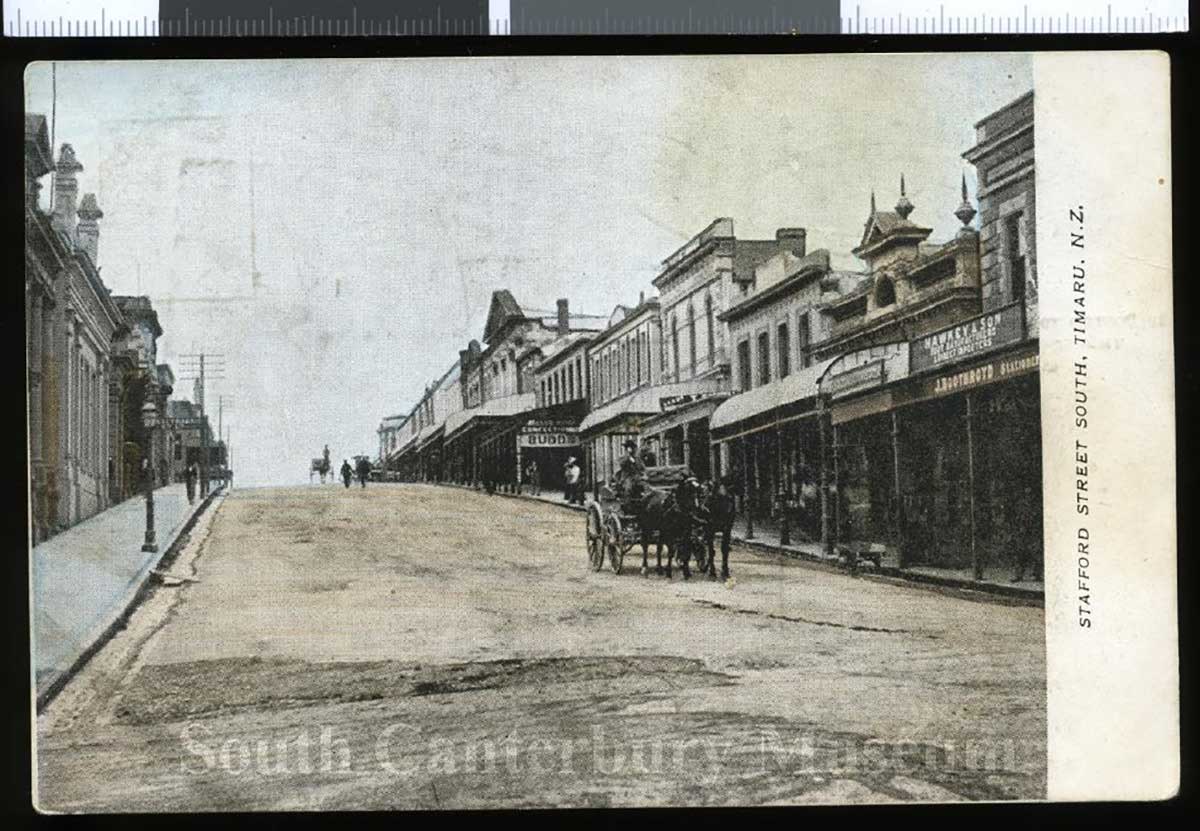
View from the George Street intersection looking south, circa 1905, several businesses can be identified along the road including confectioner Alfred Budd. South Canterbury Museum - 2011/037.37. Alfred Budd senior was a pastrycook and confectioner. He ran tearooms at the south end of Stafford Street, the Arcade Cafe, and Budd’s Tea Kiosk at Caroline Bay, as well as providing catering services. However, in July 1915, Mrs Budd advertised the sale of their Craigie Avenue home in the Timaru Herald and the couple relocated to Auckland.
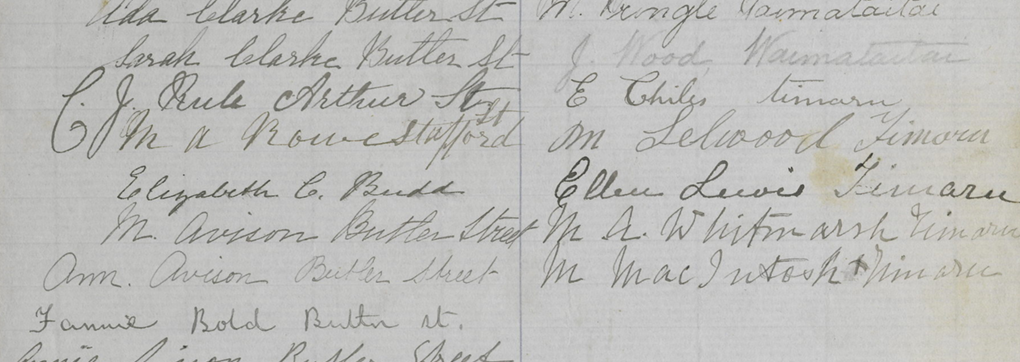
https://nzhistory.govt.nz/sites/default/files/documents/suffrage-pdfs/275.pdf
Elizabeth C. Budd, Stafford St signed the 1893 petition. Her name appears on sheet number 275
Digital copies of the sheets supplied by Archives New Zealand.
Their son Herbert George elisted 1 June 1915. The Scroll record shows Alfred Budd (father) was living at 10 Craigie Ave, Timaru at the time. Herbert George Budd was born on 25 January 1895. He attended Timaru South School as a child and later studied plumbing at Timaru Technical School (which went on to become Aoraki Polytechnic and Mountainview High School) from 1910 to 1914. Prior to enlistment, he was employed by Timaru Member of Parliament and Mayor (1902-1913), James Craigie. Herbert was killed in action on 7 August 1915. He is remembered on the Memorial wall, Timaru; Timaru South School WW1 Memorial plaque and Chunuk Bair (NZ) Memorial, Chunuk Bair Cemetery, Gallipoli, Turkey. - https://museum.timaru.govt.nz/explore/scroll/profile?id=1149
One anonymous visitor from Wanganui sat down in Timaru in 1907, tried to have lunch with a friend, and was so irritated by the piano that they wrote a full complaint letter.
Letter Transcription (to the best of my ability)
Wanganui
5th February 1907
Mr Budd
The Arcade Tea Rooms
Timaru
Dear Sir,
When in your pleasant town on a visit recently, I met a friend and we decided to lunch together and talk o’er old times. For that purpose we went to your tea rooms. But the best laid schemes of mice and men gang aft agley; ours agleyed most woefully, for we didn’t have our conversation nor did we enjoy our meal, for the good and sufficient reason that it was impossible to do either owing to the awful nerve racking sounds you were extracting from a very ill-used piano.
It is quite possible that you get a certain amount of pleasure or something similar from the performance, but this is not how sufficient excuse for the pain inflicted on your customers. Strange is it not how some of us get off the track we were intended to travel on. When fitting you out there’s no doubt the Creator intended you to be a performer on the barrel-organ, on which instrument you would have enthralled thousands by your skilful playing, but in an evil moment, disregarding the intention just mentioned, you took to the piano.
And instead of giving pleasure to your hearers by the harmony you could, with patience and the exercise of such musical ability as you possess, have extracted from the instrument that was made for you, you let yourself loose on the piano and thereby give anguish and other undesirable sensations to your customers, in addition to taking away their appetites. Maybe this is the object you have in view; if so you have succeeded admirably, as it is impossible for strangers to eat a decent meal while you are occupied in thumping discordant horrors from your unfortunate piano.
Frequent visitors may get hardened to it — in the course of time as it’s possible to get used to anything, even your piano “playing,” though this puts a strain on the hardening process pretty near the breaking point. It is never too late to mend, and I feel sure that if you will only make an honest effort, you will be able to wean yourself from the evil habit that now possesses you; thus atoning as far as possible for your “musical” past and at the same time earning the everlasting gratitude of your customers.
You will be surprised what careful practice on the barrel-organ will do for you and, when you have got on a bit, you will wonder why you wasted your time, to put it mildly, on the piano and pained your customers as consequence. Of course regrets are vain, but I can’t help thinking what your position would be now if you had put in the time wasted on the piano in working out the sublime possibilities of the barrel-organ; you might have attained to giddy heights, perhaps been head of the profession.
If you could hear yourself as others hear you, what a very different place your dining-rooms would be, for the piano “music” would then be a bitter memory only, as it would be utterly impossible for you to impose the infliction after realizing the awful[ness] of the performance.
If in places I have addressed you somewhat plainly please forgive me as it’s done for your [good] and incidentally for the benefit of your customers. Hoping that you will accept my kindly advice in the spirit in which it is given.
I am,
Yours peacefully,
Visitor.
I decided to look further into the Timaru Herald, and paperspast and found some really interesting information...
The more I looked at Alfred Budd, the more I realised the advertisements are not just little scraps of business promotion. They are clues, as they show us how a Timaru caterer and confectioner built something much bigger than a cake shop.
Budd was selling food, yes — but he was also selling comfort, novelty, convenience, public respectability, and places to gather. By 1900, his Stafford Street business was clearly growing. A newspaper report described him as “the well-known caterer and confectioner” and explained that he had enlarged his premises to cope with his “large and always increasing” number of customers.
There was a new dining room, a better kitchen, improved fittings, glass, gas lighting, cake decorations, cooking equipment, and even egg-preserving tanks holding thousands of dozens of eggs.
But the line that really matters for this story is this: “The three tea-rooms upstairs, chiefly used by ladies, are retained…” That one sentence tells us that Budd’s rooms were not just about eating. They were part of how women moved through town. Somewhere to meet. Somewhere to wait. Somewhere to rest. Somewhere respectable to sit, talk, shop, plan, and be in public without needing to be in a hotel bar or someone’s private home.
Budd promised freshly made tea in separate teapots. He advertised “every accommodation for country visitors”. He promoted afternoon tea delicacies, imported chocolates, wedding cakes, picnics, luncheons, ices, fruit salads and summer refreshments.
The Arcade Cafe gave him a modern social space — upstairs, central, stylish, with room for crowds.
Caroline Bay gave him the summer visitors, the picnickers, the beachgoers, the families, the people coming to Timaru for a day out.
The newspaper trail shows us something richer: Budd was helping create the places where Timaru met, rested, ate, talked, celebrated, waited, complained, and became social.
Poor piano.
Good advertising.
Excellent archive rabbit hole.
Mr Budd’s Improvements.
South Canterbury Times, Issue 2955, 29 November 1900, Page 4
Mr A. Budd, the well-known caterer and confectioner, Stafford street, has just had completed considerable alterations to his premises, which enlarge their capacity for accommodating his large and always increasing numbers of customers. Habitues on entering the shop will at once observe that it has been considerably lengthened by throwing into it another room, and the fittings have been extended in proportion. These have not only been lengthened, but remodelled, and the shelving behind the counter, with a large diamond-shaped pier glass fitted in the centre, now presents a handsome appearance.
The most important alteration, however, consists in the addition, next to and rearward of the shop, of a dining-room, 24ft by 14ft, 13ft high, neatly finished, walls in plaster, woodwork painted pea-green. The room is entered from the shop through a handsome glass-panelled door, and it is well lighted by day by means of large windows filled with cathedral glass, and by night with a four-light gasalier in the centre. This room contains seven tables, seating in all twenty-eight, half on chairs, half on upholstered benches along the walls. A fireplace with college grate will afford warmth in winter. A small lavatory is screened off in one corner. The room presents a nice and cosy appearance.
The kitchen, which adjoins the dining-room, but is cut off from view by a small pantry, is fitted up with a variety of cooking apparatus—an ordinary range with high-pressure boiler, a large “grill” with coke fire, a gas cooker, gas hot plate or griddle, and a large gas-heated water boiler, the latter having a tap for filling it fitted to it. The coal and coke ranges of course have chimneys; the gas heaters have a combined Cowl’s ventilating shaft, so that the culinary department will be kept fairly cool.
The arrangements for changing dishes, washing up, etc, have been well devised for quick work and saving labour. The three tea-rooms upstairs, chiefly used by ladies, are retained, and have been made more convenient by adding a pantry, which will reduce the labour of carriage to and fro.
The new kitchen contains somewhat of a curiosity in the shape of two large egg-preserving tanks, built of concrete, which at present contain no less than 3000 dozen eggs. It will probably be found necessary to remove these to a cooler place.
Improvements are also in hand at the rear, where the back yard passage is being concreted, and drains relaid, and these will be flushed by the water escaping from the motor which drives the cake-mixer and other confectionery machines.
Mr Budd’s business has grown steadily until his turn-over exceeds £3000 a year, and his enlarged premises will be none too large for his requirements. We observe that his front shop is lighted at night by a new form of incandescent lamp, with pierced chimneys, that appears to be a good idea, and we may mention also that a large stock of cake decorations in glass cases, imported for the trade, make an effective decoration for the shop.
https://paperspast.natlib.govt.nz/newspapers/SCANT19001129.2.44
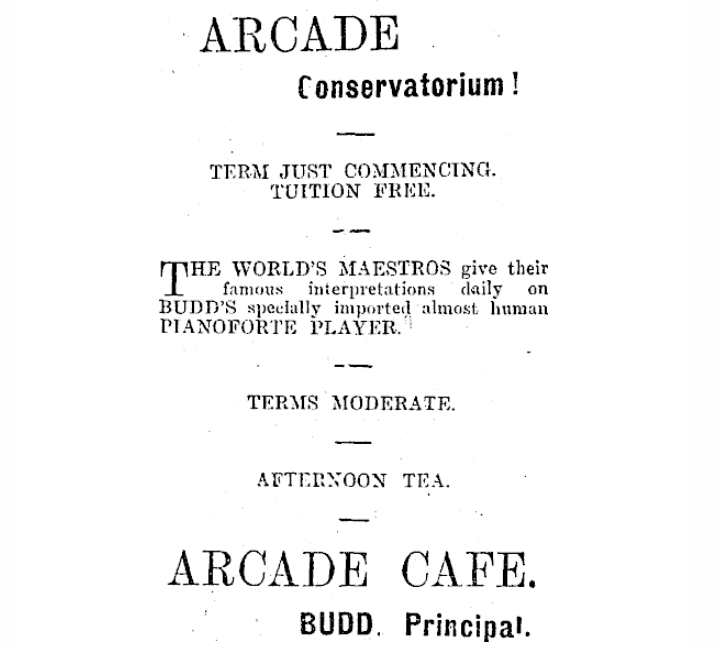
Timaru Herald 16 February 1907
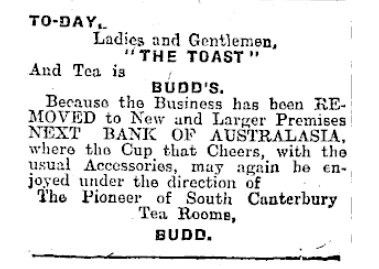
Timaru Herald, Volume XCIV, Issue 14383, 3 March 1911, Page 1
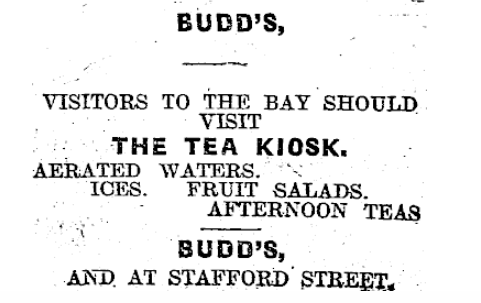
Timaru Herald 30 December 1912 Budd
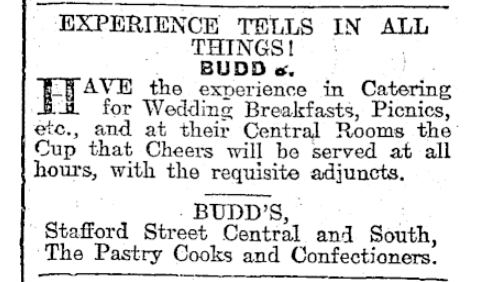
Timaru Herald 9 October 1913
Working timeline: Alfred Budd, Budd’s tea rooms, the Arcade Cafe, and Caroline Bay hospitality
1883–1884 — The Budd family arrives in New Zealand
South Canterbury Museum records that Alfred Budd and Elizabeth Budd emigrated from the United Kingdom with three children — Katie, Bessie and Frederick — on the Oamaru, which left London on 12 October 1883 and arrived at Lyttelton on 12 January 1884. The Museum also records that Alfred and Elizabeth later had six more children: William Henry, Edward, Margaret Lilian, Alfred Ernest, Herbert George and Nellie.
Why it matters: Budd’s later Timaru hospitality story begins as a migration-and-family story. He was not just a shop name; he was a husband and father building a livelihood in a new country.
1887 — Edward Budd is born in Ashburton
Edward Budd, later recorded as the third son of Alfred and Elizabeth Cornthwaite Budd, was born at Ashburton on 5 April 1887. He was educated at Timaru Main and Timaru South schools, later worked in drapery, and is recorded as buried in Timaru Cemetery.
Why it matters: This helps track the family’s movement before Timaru becomes the centre of the story. It also shows that at least one of Alfred and Elizabeth’s children later returned strongly into the Timaru record.
1893 — Elizabeth C. Budd signs the Women’s Suffrage Petition
NZ History records an Elizabeth C. Budd of Stafford Street, Timaru, as a signatory to the 1893 Women’s Suffrage Petition. This is very likely Alfred Budd’s wife, Elizabeth Corthwaite/Cornthwaite Budd, because the name, middle initial, and Stafford Street address fit the Budd family and business trail — but I would still mark it as likely, not fully proven, until confirmed by an electoral roll or BDM record.
Why it matters: This is a beautiful women’s history thread. If this is Alfred’s wife, the Budd tea-room story connects not only with women as customers, but possibly with a woman in the family who signed for political rights.
1895 — Budd is already selling the experience of afternoon tea
A Timaru Herald advertisement from 25 April 1895 used an “extract from letter” style testimonial. The writer described being taken to Budd’s in Timaru, being given tea in a “pretty Japanese teapot”, pouring it themselves, and finding the place “homelike and cosy”. The same advert praised cakes, fancy biscuits, chocolates, wedding cakes, and a christening cake, ending by calling Budd “the confectioner”.
Why it matters: This is one of the earliest clues that Budd was not only selling food. He was selling atmosphere: comfort, fashion, novelty, domestic respectability, and afternoon-tea culture.
1897 — Budd’s “rooms” are popular
By July 1897, Budd was thanking his “numerous patrons” for their appreciation of his rooms and advertising “Latest London Novelties” and “Ranfurly Afternoon Tea Delicacies” such as Victorias, almond, greengage, raspberry and orange creams, slices, sandwiches, éclairs and petit choux.
Why it matters: The word rooms is important. Budd’s business was already more than a bakery counter. He was building a place where customers sat down, ate, talked, and took tea.
1900 — Budd markets separate teapots and comfort for country visitors
In 1900, Budd advertised that a visit to Budd’s was “always satisfactory”, with tea served freshly made in separate teapots and “every accommodation for country visitors”.
Why it matters: This is gold. It suggests Budd was aiming at people coming into Timaru from the district — shoppers, families, women, travellers, farmers’ wives, people waiting between errands or transport. Tea rooms were practical social infrastructure.
29 November 1900 — Budd’s Stafford Street premises are expanded
A long South Canterbury Times article titled “Mr Budd’s Improvements” described Alfred Budd as a “well-known caterer and confectioner” in Stafford Street. It says his shop had been lengthened, a new dining room added behind the shop, the kitchen improved, and the three upstairs tea rooms, “chiefly used by ladies,” retained and made more convenient with a pantry. It also mentions egg-preserving tanks holding 3000 dozen eggs, a motor driving the cake-mixer and confectionery machines, and turnover exceeding £3000 a year.
Why it matters: This is one of the strongest pieces of evidence. It shows the business layout: front shop + rear dining room + kitchen + upstairs tea rooms. It also puts women directly in the story through the phrase “chiefly used by ladies”.
1902 — Budd appears in the organised baking trade
The National Library identifies Alf Budd as a delegate to the second conference of the United Master Bakers’ Association of New Zealand in Christchurch on 13 October 1902.
Why it matters: Budd was not just a local café man. He was visible in the wider baking trade.
1903–1905 — Caroline Bay is being shaped as a civic leisure destination
Heritage New Zealand records that a new improvement plan for Caroline Bay was adopted by Timaru Borough Council in 1903, including tea rooms with a ladies’ cloak room, as part of a plan to turn Caroline Bay and Timaru into an attractive seaside resort. Timaru District Council’s heritage assessment says the Borough Council and Beautifying Association erected a band rotunda in 1904, then a caretaker’s cottage and tea rooms in 1905 to enhance the Bay’s amenities.
Why it matters: Budd’s later Caroline Bay Tea Kiosk was not operating in a vacuum. It fitted into Timaru’s larger civic dream of making Caroline Bay a place for visitors, leisure, promenading, refreshments, families and respectable public recreation.
November 1905 — Caroline Bay Tea Rooms open as a municipal amenity
Timaru District Council’s heritage assessment says that when the first stage of the Caroline Bay Tea Rooms opened in November 1905, Mayor Craigie described them as the “first municipal tea rooms in the colony.” The same assessment says the building was designed by Frank Marchant and later extended in 1913.
Why it matters: This gives the Caroline Bay side of the story real weight. Tea rooms were civic infrastructure — part of making the Bay usable, attractive and respectable.
9 October 1906 — The Arcade Cafe opens
Timaru Civic Trust records that the Arcade Cafe was on the top floor of the 1906 Priest and Holdgate extension, designed by J. S. Turnbull. It says the cafe was run by Mr Budd, who was expanding from smaller premises next door. Customers passed glass display cabinets for a large ground-floor confectionery and cake shop, then went upstairs to a dining room seating about 120 people, with an orchestra alcove, ladies’ dressing room, men’s smoking and coffee room, and lavatory conveniences. The cafe opened on 9 October 1906, with 400 people dining during the day and a Builders’ Association banquet that evening.
Why it matters: This is the big built-heritage pivot. Budd’s operation moved from Stafford Street rooms into a more ambitious modern social space: display downstairs, dining upstairs, music, gendered rooms, comfort, and a crowd-capable venue.
5 February 1907 — The anonymous piano complaint
South Canterbury Museum’s archive record, mirrored through DigitalNZ, identifies a letter from an anonymous visitor from Wanganui to Mr Budd of the Arcade Tea Rooms, dated 5 February 1907. The record says the visitor complained about the “pain inflicted” by the “awful nerve racking sounds” Mr Budd was extracting from a “very ill-used piano.”
Why it matters: This is the hook — the funny complaint that opens the whole story. But it also tells us the Arcade Cafe had atmosphere, music, customers lingering, and enough public presence for someone to write a full complaint letter.
16 February 1907 — The “Arcade Conservatorium” advertisement appears
Only eleven days after the complaint letter, Budd advertised the “Arcade Conservatorium”, with “tuition free”, “famous interpretations daily” on Budd’s “specially imported almost human Pianoforte Player”, and the sign-off: “AFTERNOON TEA. ARCADE CAFE. BUDD. Principal.”
Careful interpretation: It is tempting to say this was a cheeky reply to the complaint, but we cannot prove that yet. What we can say is that the timing is wonderful, and the advert shows Budd using humour, novelty and music to sell the Arcade Cafe experience.
19–23 February 1907 — Master Bakers’ conference in Timaru
The National Library records that the sixth annual conference of the United Master Bakers’ Association was held in Timaru from 19 to 23 February 1907, and lists Alf Budd of South Canterbury among the delegates in the conference photograph.
Why it matters: In the same month as the piano complaint and the “Arcade Conservatorium” advert, Budd is also visible as part of the national baking trade. February 1907 becomes a surprisingly rich Budd month.
1907 — Caroline Bay Tea Rooms are already changing for leaseholders
Heritage New Zealand records that the first additions to the Caroline Bay Tea Rooms were made in 1907, when two rooms for tenants were added at the rear of the building. It notes that in 1908 the Council set new lease conditions, possibly suggesting problems with the previous leaseholder, who has not been identified.
Why it matters: This is important for the Budd-at-the-Bay question. We know Budd later advertised at the Caroline Bay Tea Kiosk, but we still need lease or tender records to say exactly when he became the operator and under what arrangement.
1911 — Budd is operating at Caroline Bay by at least February
The Oamaru Mail reported on 1 February 1911 that Mr Budd had placed a notice of interest to “picnickers to Timaru”, offering a special luncheon from 11 a.m. to 2 p.m. at his tea kiosk, Caroline Bay.
Why it matters: This pushes Budd’s Caroline Bay presence back to at least early 1911. It also shows he was targeting excursion visitors and picnickers — not just regular Timaru customers.
3 March 1911 — Budd moves to larger premises near the Bank of Australasia
A Timaru Herald advertisement on 3 March 1911 says Budd’s business had been removed to “new and larger premises next Bank of Australasia”, where “the Cup that Cheers” could again be enjoyed under the direction of “The Pioneer of South Canterbury Tea Rooms, Budd.”
Careful interpretation: “Pioneer of South Canterbury Tea Rooms” is Budd’s own advertising claim. It is valuable because it shows how he wanted to be seen, but we should not treat it as independent proof that he was literally the first.
1912 — Budd markets Stafford Street and Caroline Bay together
On 30 December 1912, right in the summer holiday season, Budd advertised: “Visitors to the Bay should visit the Tea Kiosk”, offering aerated waters, ices, fruit salads and afternoon teas. The advert ends with “Budd’s, and at Stafford Street.”
Why it matters: This is the clearest evidence that Budd was operating a multi-site hospitality brand: Stafford Street for town, Caroline Bay for seaside visitors.
January 1913 — The Caroline Bay Tea Kiosk advert repeats
A similar advert appeared in the Timaru Herald on 7 January 1913, again telling “visitors to the Bay” to visit the Tea Kiosk for aerated waters, ices, fruit salads and afternoon teas, and again linking it to Budd’s at Stafford Street.
Why it matters: This shows the 30 December 1912 notice was not a one-off. Budd was running a summer campaign for Bay visitors.
1913 — Caroline Bay Tea Rooms extended
Timaru District Council’s heritage assessment records that the Caroline Bay Tea Rooms were extended in 1913, after the establishment of the Caroline Bay Association, which subsequently spearheaded improvements at the Bay.
Why it matters: Budd’s Bay advertising sits right inside a period of improvement and expansion at Caroline Bay. The Bay was becoming more organised, more civic, and more visitor-focused.
October 1913 — Budd promotes catering, central rooms, and Stafford Street Central and South
In October 1913, Budd advertisements promoted experience in catering for wedding breakfasts and picnics, and said tea would be served at the Central Rooms “at all hours”. The advert gives the business as Budd’s, Stafford Street Central and South, “The Pastry Cooks and Confectioners.”
Why it matters: This shows the business was not just tea rooms. It had become a broad hospitality operation: catering, weddings, picnics, central rooms, and multiple Stafford Street identifiers.
1915 — The Budd family leaves Timaru for Auckland
South Canterbury Museum records that in July 1915, Mrs Budd advertised the sale of the family’s Craigie Avenue home in the Timaru Herald, and that Alfred and Elizabeth relocated to Auckland.
Why it matters: This likely marks the end of Alfred Budd’s active Timaru chapter. It also helps explain why I would not assume Alfred is buried in Timaru without a cemetery record.
7 August 1915 — Herbert George Budd is killed at Gallipoli
Herbert George Budd, son of Alfred and Elizabeth Budd, was killed in action at Gallipoli on 7 August 1915, aged 20. His South Canterbury Museum profile records that he enlisted while living with his parents at 10 Craigie Avenue, Timaru, and an external memorial record identifies him as the son of Alfred and Elizabeth C. Budd of 238 Karangahape, Auckland.
Why it matters: This changes the tone. The Budd story is funny because of the piano complaint, but it is also a family story touched by war and loss.
1927 — Possible death lead for Alfred Budd senior
The National Library’s Alfred Budd authority/topic page says Alf Budd was possibly the Alfred Budd who died in 1927, aged 70, based on online historical BDM.
Careful interpretation: This is not yet proof. Before publishing Alfred Budd senior’s death date or burial place as fact, I would want a BDM printout, death notice, probate file, cemetery record, or funeral notice.
1948 — Edward Budd dies and is buried in Timaru
Edward Budd, the third son of Alfred and Elizabeth Cornthwaite Budd, died in May 1948, aged 61, and is recorded at Timaru Cemetery, General Section, Row 130, Plot 362.
Why it matters: This confirms one immediate Budd family member is buried at Timaru Cemetery, but it does not prove Alfred senior is there.
1960 — Alfred Ernest Budd dies and is buried in Invercargill
Alfred Ernest Budd, recorded as the fourth son of Alfred and Elizabeth Cornthwaite Budd, died on 15 December 1960, aged 67, and is recorded at Eastern Cemetery, Invercargill, General Section, Block 36, Plot 469.
Why it matters: The children’s records show the family spreading beyond Timaru: Timaru, Auckland, Gallipoli, Invercargill.
What the timeline tells us
The Budd story is not a straight line from “tea rooms” to “complaint letter”. It is a network.
First, Alfred Budd appears as a confectioner selling cakes, chocolates and afternoon tea. Then he grows into a Stafford Street caterer with a shop, dining room, kitchen and upstairs tea rooms “chiefly used by ladies”. Then he expands into the ambitious upstairs Arcade Cafe, with display cabinets below, a 120-seat dining room above, music, gendered rooms and modern conveniences. Then he appears at Caroline Bay, serving picnickers, visitors and seaside crowds.
That is why the complaint letter is so useful. The anonymous visitor complained about the piano, but the paper trail shows something much bigger: Budd was helping shape the places where Timaru people — especially women, country visitors, families, picnickers and shoppers — could meet, rest, eat, talk, wait, complain and be part of public life.
Source list with full links
South Canterbury Museum / Timaru District Council PastPerfect Online Archive
Anonymous to Mr Budd of the Arcade Tea Rooms, 5 February 1907 RE: Complaint, Catalogue No. 2011/101.02.
https://timdc.pastperfectonline.com/archive/498BCA69-011A-42C1-948F-013080419510
DigitalNZ mirror record
Anonymous to Mr Budd of the Arcade Tea Rooms, 5 February 1907 RE: Complaint.
https://digitalnz.org/records/49583530
Budd family / biographical sources
South Canterbury Museum profile — Herbert George Budd
Includes Alfred and Elizabeth Budd, the children, Alfred’s businesses, Craigie Avenue, and relocation to Auckland.
https://museum.timaru.govt.nz/explore/scroll_kiosk/scroll/profile?id=1149
South Canterbury Museum profile — Alfred Ernest Budd
Includes Alfred Ernest as fourth son of Alfred and Elizabeth Cornthwaite Budd, born Timaru, died 1960, Eastern Cemetery Invercargill.
https://museum.timaru.govt.nz/explore/whats-on/ww100/scroll/profile?id=5042
South Canterbury Museum profile — Edward Budd
Includes Edward as third son of Alfred and Elizabeth Cornthwaite Budd, buried Timaru Cemetery.
https://museum.timaru.govt.nz/explore/whats-on/ww100/scroll/profile?id=5043
NZ History — Elizabeth C. Budd, Women’s Suffrage Petition
Useful but still needs identity confirmation linking her definitely to Alfred’s wife.
https://nzhistory.govt.nz/suffragist/elizabeth-c-budd
Arcade Cafe / building source
Timaru Civic Trust — “My Favourite Building: Arcade Cafe”
Key source for the Arcade Cafe location, opening, seating, layout and J. S. Turnbull connection.
https://www.timarucivictrust.co.nz/blog/my-favourite-building-arcade-cafe
Trade / Master Bakers source
National Library of New Zealand — Budd, Alfred, active 1902–1907
Includes United Master Bakers’ Association delegate information and the cautious “possibly Alfred Budd who died in 1927 aged 70” note.
https://natlib.govt.nz/records/22589386
Papers Past sources
Timaru Herald, 10 May 1892 — Budd’s Digestive Bread / Oswego Cakes / wedding cakes
https://paperspast.natlib.govt.nz/newspapers/THD18920510.2.2.3
Timaru Herald, 21 July 1897 — Budd’s rooms and afternoon-tea delicacies
https://paperspast.natlib.govt.nz/newspapers/THD18970721.2.2.4
Timaru Herald, 22 August 1900 — separate teapots and country visitors
https://paperspast.natlib.govt.nz/newspapers/THD19000822.2.2.4
South Canterbury Times, 29 November 1900 — “Mr Budd’s Improvements”
https://paperspast.natlib.govt.nz/newspapers/SCANT19001129.2.44
Timaru Herald, 16 February 1907 — “Arcade Conservatorium” / Pianoforte Player advertisement
https://paperspast.natlib.govt.nz/newspapers/THD19070216.2.33.3
Timaru Herald, 11 March 1908 — Timaru Association Football Club meeting at Arcade Cafe
https://paperspast.natlib.govt.nz/newspapers/THD19080311.2.44
Timaru Herald, 3 March 1911 — Budd moves near Bank of Australasia / “Pioneer of South Canterbury Tea Rooms”
https://paperspast.natlib.govt.nz/newspapers/THD19110303.2.2.5
Timaru Herald, 30 December 1912 — Budd’s Tea Kiosk at Caroline Bay
https://paperspast.natlib.govt.nz/newspapers/THD19121230.2.2.7
Timaru Herald, 9 October 1913 — catering, wedding breakfasts, picnics, Stafford Street Central and South
https://paperspast.natlib.govt.nz/newspapers/THD19131009.2.5.4
Timaru Herald, 2 December 1913 — similar Budd catering advertisement
https://paperspast.natlib.govt.nz/newspapers/THD19131202.2.8.4