
By Roselyn Fauth
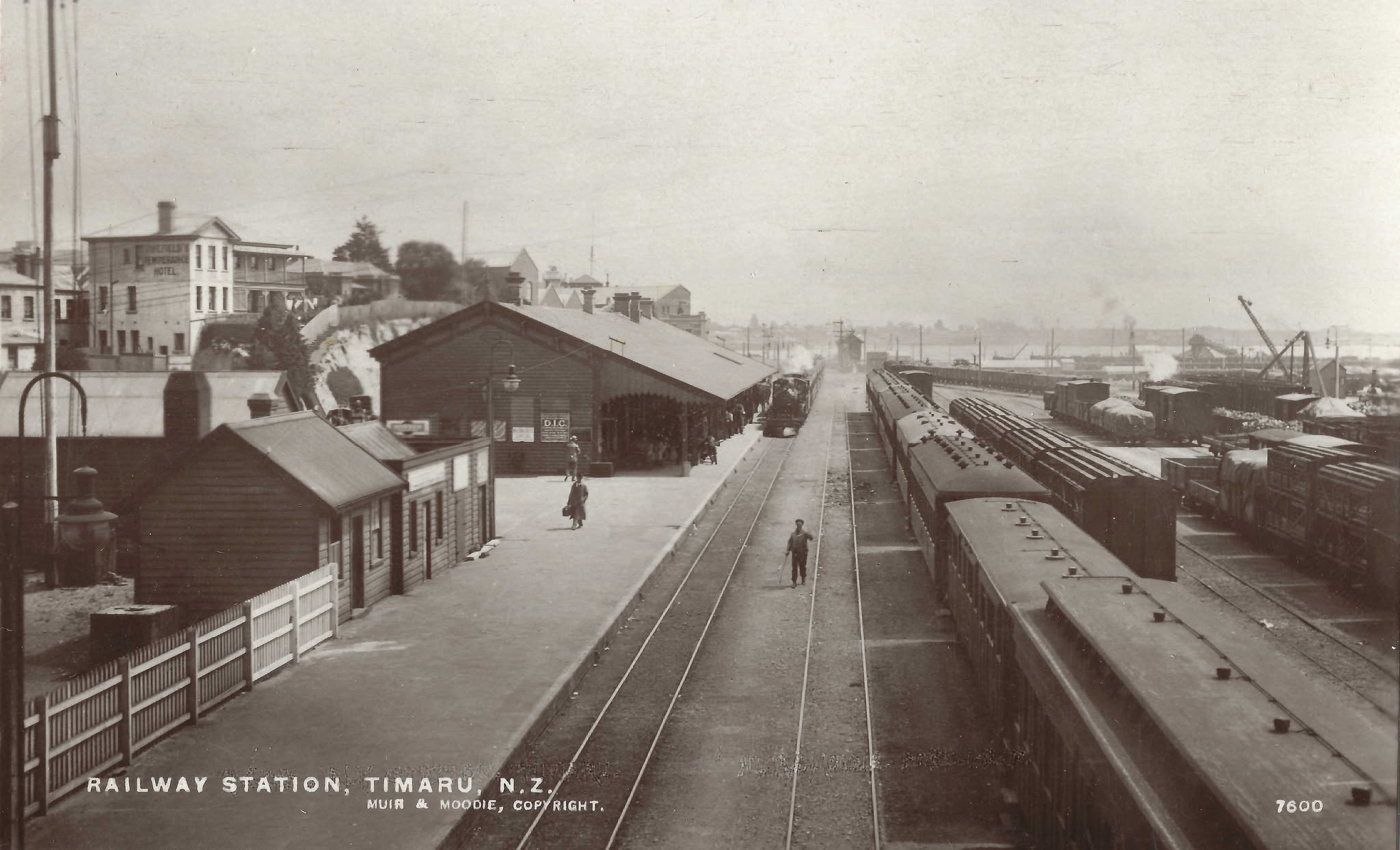
Railway Station Timaru early 1912 (or perhaps late 1911).
Stand near Station Street today and it is easy to see the railway precinct as the awkward edge of Timaru. Tracks, port traffic, old stores, warehouses, trucks and the sea all sit close together. It is not the postcard view of town, but it might be one of the most honest.
This was once one of Timaru’s great doorways...
The railway story began publicly on 4 October 1871, when Mrs Cain, the Mayoress of Timaru, turned the first sod for the Temuka to Timaru section of the planned South Island main trunk railway. Captain Henry Cain, the mayor, stood nearby. It is a lovely local detail. At the beginning of Timaru’s railway future, there was a woman holding the spade.
When rail communication opened between Christchurch and Timaru in 1876, South Canterbury was drawn much closer to the wider colony. By 1878, the Christchurch to Dunedin main trunk railway was complete. By 1879, Christchurch and Invercargill were connected by rail. Timaru now sat on a long transport spine running down the eastern South Island.
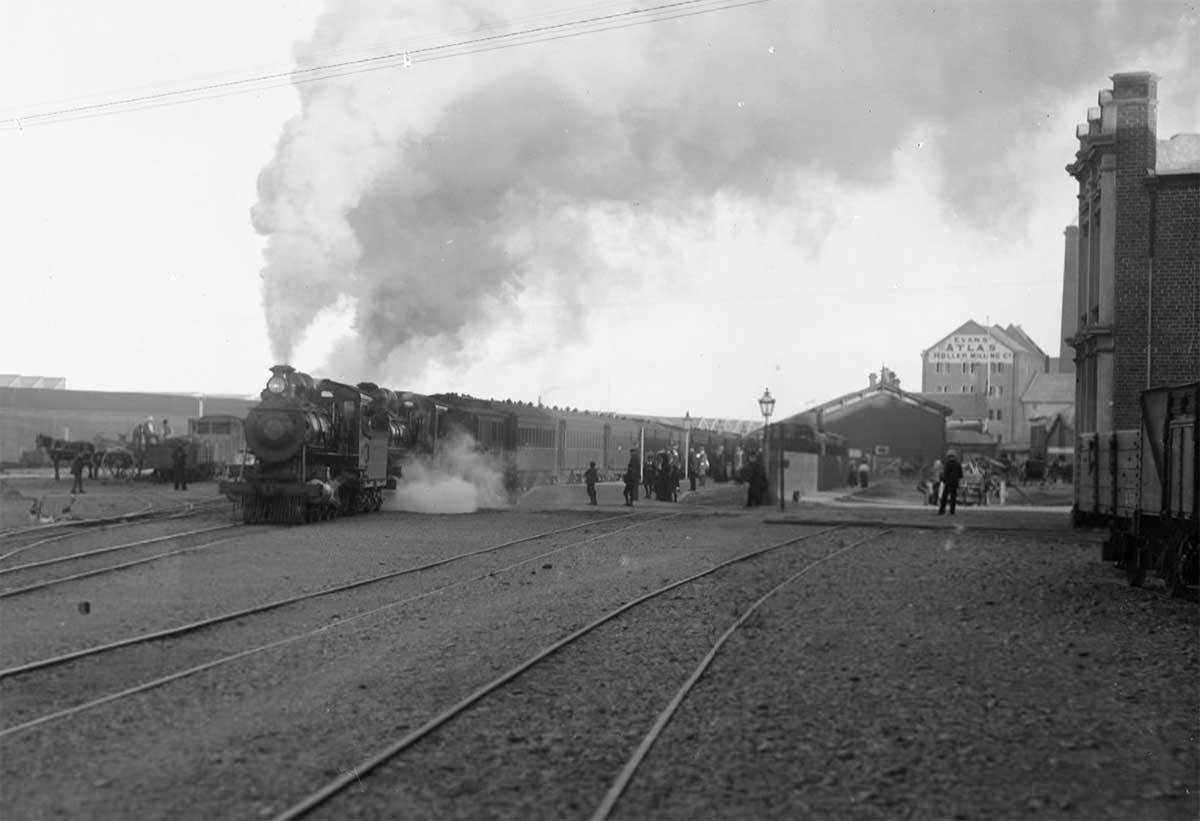
Timaru, departure Christchurch Express, Dunedin, by Muir & Moodie. Te Papa (C.014854) Section
The railway station was never just a place to catch a train. It was part of a larger working system that linked farms, mills, stores, harbour yards and ships. Wool, grain, coal, flour, livestock, machinery, mail and passengers all moved through this landscape.
Old photographs make that clear. An 1882 view of Timaru’s railway yards shows the second station being built, with sheds, a shunting locomotive and the early breakwater nearby. The station was not sitting apart from industry. It was embedded in it.
That helps explain the buildings gathered around it. The Customs House was placed near the port and railway station. Flour mills, grain stores, wool stores and merchant premises clustered where goods could be shifted efficiently. In places such as the former McRae’s Stone Store and the D. C. Turnbull and Miles Archer complex, the heritage value is not only in the stone, brick or frontage. It is in the whole working machine: tracks, sidings, tunnels, stores, labour, harbour and trade.
Timaru’s station also carried public emotion. Soldiers left from this precinct. Families waved, waited and worried. Passengers arrived for business, school trips, holidays and homecomings. In 1954, Queen Elizabeth II appeared at Timaru Railway Station on the observation platform of her royal car, with local officials nearby. For a moment, the same working station that handled everyday freight and travel became a ceremonial stage.
Yet Timaru was not always satisfied with its railway facilities. In 1913, James Craigie MP raised concerns about the station, and the local newspaper reported that its imperfections were at last being officially recognised. That complaint is useful. It reminds us that heritage places were not always admired in their own time. They were argued over, patched up, expanded, criticised and expected to serve a growing town.
Passenger rail has faded from Timaru’s daily life. The Southerner made its final journey in 2002. But rail did not disappear. It changed jobs. Freight still links Timaru’s port, industries and region to the wider network.
That is why this precinct matters. Timaru’s identity is not only found in its grand buildings, churches, bay views or decorative shopfronts. It is also found beside the tracks, near the sidings, behind the stores and on the working edge of the coast.
The railway station was Timaru’s practical doorway to the world. It helped build the town we inherited, and it still asks us to look harder at the parts of Timaru we often drive past without really seeing.
Timaru Railway Station and Railway Precinct Timeline
1863
New Zealand’s first steam-powered public railway opens between Christchurch and Ferrymead. This gives national context for Canterbury’s early role in railway development.
1870
Julius Vogel announces the public works and immigration programme. New Zealand has about 74 kilometres of railway at this point, expanding rapidly during the decade.
4 October 1871
Mrs Cain, Mayoress of Timaru, turns the first sod for the Temuka to Timaru section of the planned South Island Main Trunk Railway. Captain Henry Cain, Mayor of Timaru, stands nearby. This is a major civic moment and gives the column a brilliant human hook: a woman holding the spade at the beginning of Timaru’s railway future.
1875
The Fairlie branch reaches Pleasant Point from Washdyke. This begins the inland branch-line story that later feeds into Timaru’s role as the port and rail hub for South Canterbury.
4 February 1876
Through railway communication opens between Christchurch and Timaru. The journey that had taken far longer by road becomes a rail journey of hours, changing the relationship between Timaru, Christchurch and the wider colony.
1876
The addition to what is now known as the former McRae’s Stone Store is built to accommodate rails through the centre of the building. This is a key built-heritage example showing how buildings near the station and port were physically shaped by rail access.
1877
The Waimate branch from Studholme Junction to Waimate opens, extending the reach of the rail network into South Canterbury’s rural districts.
1878
The Christchurch to Dunedin main trunk railway is completed, placing Timaru on a major transport spine through the eastern South Island.
1879
Christchurch and Invercargill are connected by rail. Timaru is now part of a longer South Island railway system.
1880
Rail freight is already central to Timaru’s economy. A later “Sixty Years Ago” column in the Timaru Herald recalled that 1,919 sacks of grain arrived at Timaru railway station on one day in May 1880. This is a useful detail for showing the scale of grain movement through the station precinct.
1880
Colonial Marine Engineer John Blackett reports on damage to the railway line north of Timaru harbour works and the effect of the breakwater on coastal movement. This links railway, harbour engineering and coastal change.
1882
A South Canterbury Museum image shows Timaru’s railway yards on the southern side of the harbour. It includes a shunting locomotive, sheds, an early section of the breakwater, and the second Timaru Railway Station being built. This is one of the most important visual sources for the Civic Trust column.
May 1883
The station building shown in the Frederick George Radcliffe photograph is noted as having opened in May 1883. This is a key date, but we should be careful not to claim that all present-day fabric is definitely 1883 until checked against property files or railway plans.
1884
The Fairlie branch opens to Eversley, beyond Fairlie. This strengthens Timaru’s role as the rail-linked port and service centre for inland South Canterbury.
circa 1890
Cycle Club members are photographed in front of Timaru Railway Station. This is a nice reminder that the station was not only a transport site, but also a civic backdrop and gathering place.
1897
Timaru businesses are advertising private railway sidings as a commercial advantage. This supports the argument that rail access shaped land use, commercial value and industrial building design near the station and port.
1901 to 1902
The new Timaru Customhouse is built near Strathallan Street, Station Street and Cains Terrace. Heritage material notes that earlier customs premises near the breakwater had been removed to make way for the railway. This is useful for showing how rail physically rearranged the town.
May 1908
The overbridge visible in the background of the Radcliffe railway station photograph is noted as completed in May 1908.
1913
James Craigie MP raises concerns about Timaru Railway Station. The Minister of Railways replies that improvements are contemplated, including additions to goods sheds, the goods office, luggage room and sidings. The Timaru Herald reports that the imperfections of Timaru station are at last being officially recognised.
1914
The railway station precinct becomes part of South Canterbury’s First World War departure story. Soldiers leaving Timaru by train, and later returning, make the station a place of public emotion as well as transport.
1915 to 1916
Frederick George Radcliffe photographs Timaru Railway Station with trains alongside. Evans’ “Atlas” roller milling sign appears in the background, making the photograph especially useful for linking station, rail, milling and industry.
1929
A Timaru Herald letter complains about the need for modern railway facilities, showing that dissatisfaction with Timaru’s railway station and associated facilities persisted.
1930
A Timaru Herald supplement, while discussing Auckland’s new railway station, remarks that Timaru people had to be satisfied with their own “unprepossessing and inconvenient railway station”. This is a sharp quote for the Civic Trust column if used carefully.
1940
Major improvements to Timaru railway yards and locomotive depot are underway, with expenditure reported at £26,000. The existing yard is described as too cramped and inconvenient for newer locomotive types.
25 January 1954
Queen Elizabeth II appears on the observation platform of her royal car at Timaru Railway Station during the royal visit. This gives the station a ceremonial and national-memory layer.
1968
The Fairlie branch closes. This marks the end of an everyday branch-line world for many South Canterbury communities.
December 1970
The inaugural Southerner train is photographed at Timaru. The service becomes part of Timaru’s later passenger rail memory.
1 December 1970 to 10 February 2002
The Southerner passenger express runs between Christchurch and Invercargill. It makes its final journey on 10 February 2002, marking the end of regular long-distance passenger rail through Timaru.
2013
Port of Tauranga and PrimePort Timaru enter a strategic alliance connected with the Timaru Container Terminal. This belongs in the wider “rail did not disappear, it changed jobs” section.
2020
Timaru coastal hazard assessment work identifies the port, industrial areas, road and rail networks, and shoreline protection works as part of the district’s coastal hazard landscape.
2022
High seas threaten parts of the main rail line south of Timaru, especially around Patiti Point to Jacks Point. This gives a modern echo of the older railway, harbour and coast relationship.
Today
Timaru remains part of New Zealand’s freight rail network. KiwiRail lists Timaru as a container transfer site, while PrimePort states that Timaru rail depot and shunting yards are located beside the port and Port Loop Road, with sidings extending into the North Mole Container Terminal and PrimePort Log Yard.
It is interesting to zoom out and think about the Timaru Station as a wider network, it is had to fathom the effort and cost it took to establish the countries rail networks.
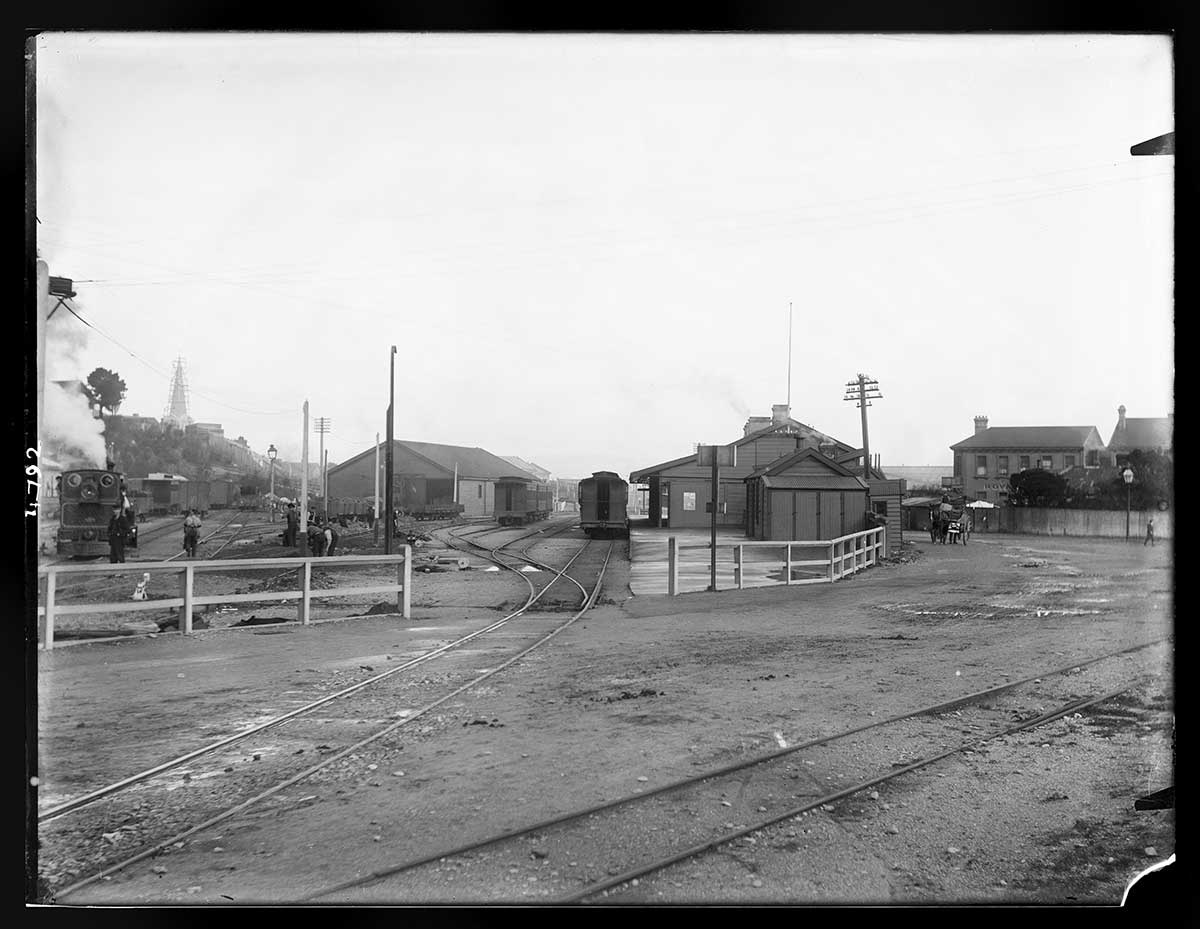
Railway Station, Greymouth, 1900s, Greymouth, by Muir & Moodie. Te Papa (C.014792). Timaru had frequent train visits from the West Coast transporting coal to power East Coast industry.
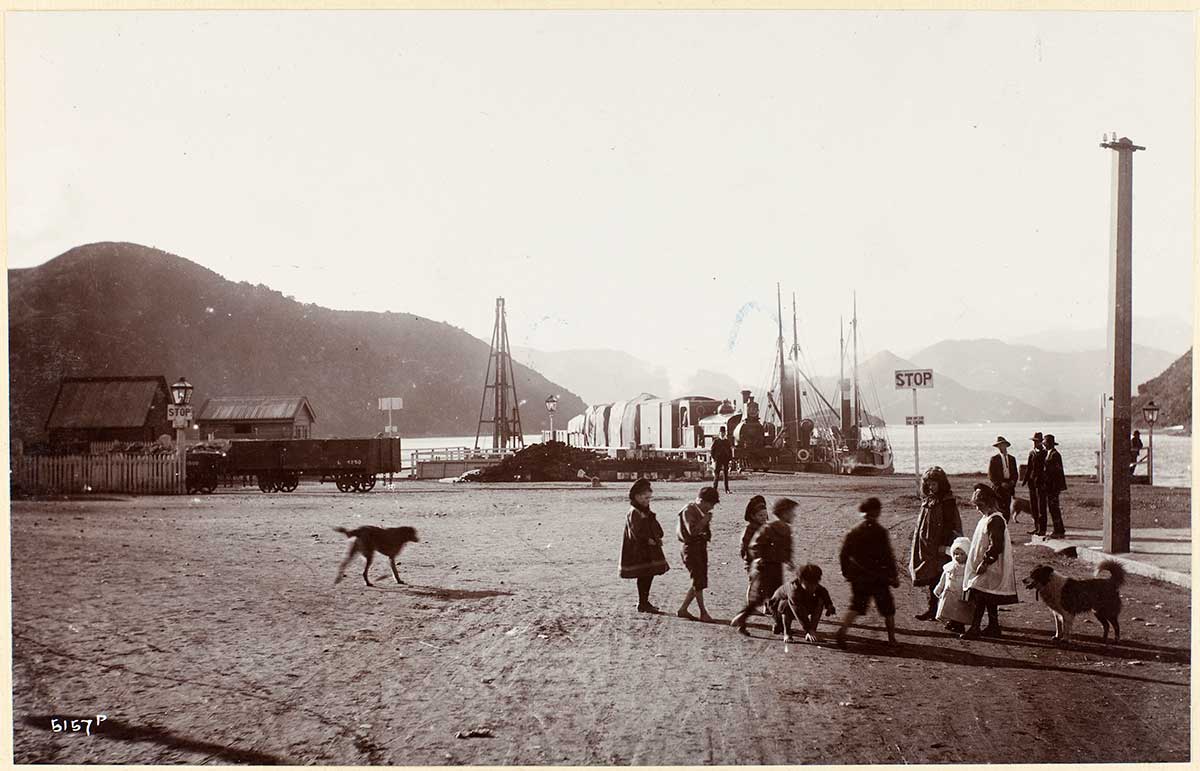
Picton, circa 1900, Dunedin, by Muir & Moodie. Te Papa (O.036758)
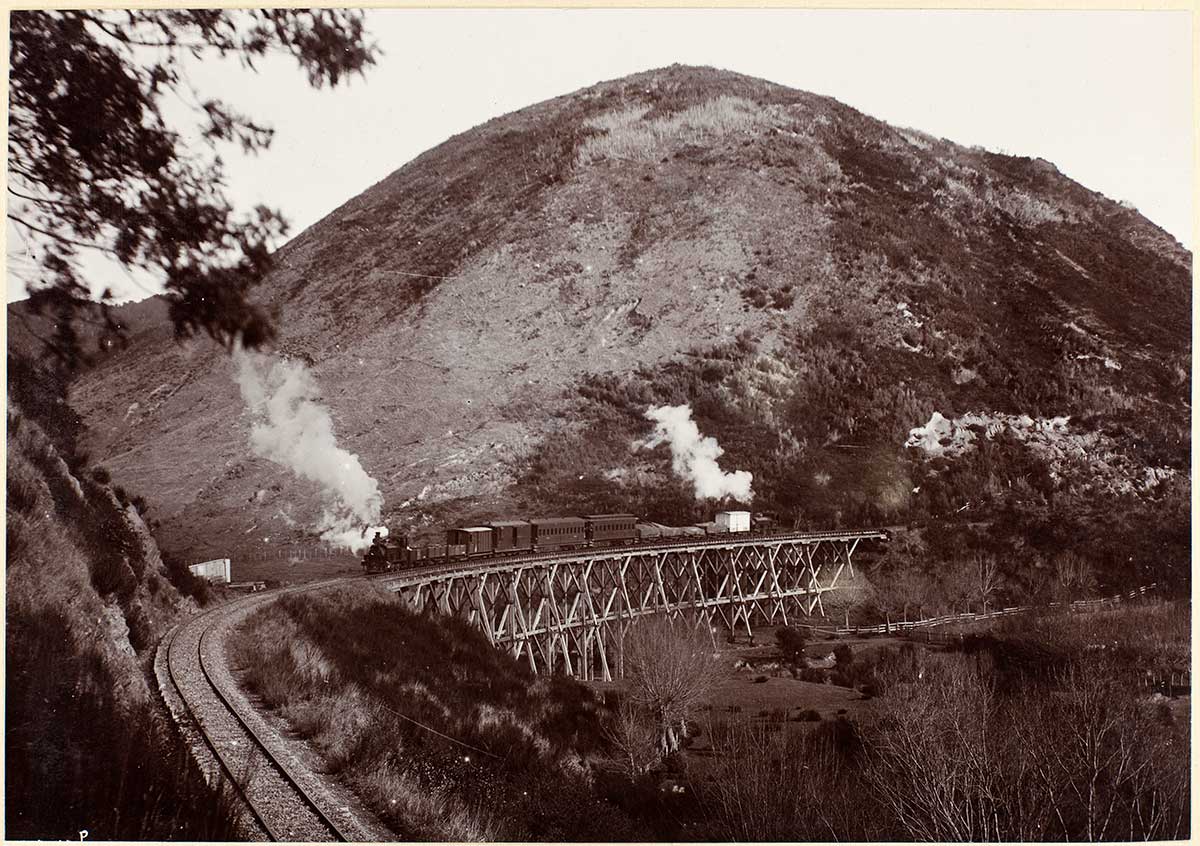
Rail bridge, South of Picton, circa 1900, Dunedin, by Muir & Moodie. Te Papa (O.036757)
Sources Timaru Railway Station sources
NZHistory: Turning the first sod of the Temuka-Timaru railway, 1871
https://nzhistory.govt.nz/media/photo/first-sod-temuka-timaru-railway-1871
National Library: Turning the first sod for the Main Trunk Railway, Timaru-Temuka section
https://natlib.govt.nz/records/22390922
DigitalNZ: Timaru Railway and Harbour, 1882, South Canterbury Museum
https://digitalnz.org/records/42256014
National Library: Timaru Railway Station, Frederick George Radcliffe photograph, 1915 to 1916
https://natlib.govt.nz/records/23012525
National Library: Timaru Railway Station, note that station building opened May 1883
https://natlib.govt.nz/records/22440292
DigitalNZ: Timaru Railway Station, Radcliffe image record
https://digitalnz.org/records/23012525
National Library: Railway station, Timaru, 1882
https://natlib.govt.nz/records/22844590
DigitalNZ: Timaru Railway Station, South Canterbury Museum, 1908 to 1918
https://digitalnz.org/records/42281506
South Canterbury Museum: Cycle Club members, Timaru Railway Station, circa 1890
https://timdc.pastperfectonline.com/Photo/32F62DC9-A943-436D-BBC1-437395398727
NZHistory: Queen Elizabeth at Timaru Railway Station, 1954
https://nzhistory.govt.nz/media/photo/queen-elizabeth-timaru-1954
DigitalNZ: Timaru Railway Station with Queen Elizabeth II, 25 January 1954
https://digitalnz.org/records/32377113
South Canterbury Museum: Queen Elizabeth II at Timaru Railway Station
https://timdc.pastperfectonline.com/Photo/D9EFC454-C067-4BFB-A527-469601331640
Archives New Zealand Flickr: Timaru Railway Station with Queen Elizabeth II, 25 January 1954
https://www.flickr.com/photos/archivesnz/10468643956/in/album-72177720301951306
South Canterbury Museum: The inaugural Southerner train at Timaru, December 1970
https://timdc.pastperfectonline.com/photo/8EC995B5-EE19-471A-A4BC-649582627730
DigitalNZ: The Southerner passenger express, 1970 to 2002
https://digitalnz.org/records/32377042
Great Journeys New Zealand: The Southerner mailing list / historical service dates
https://www.greatjourneysnz.com/short-breaks-and-packages/register-the-southerner/
Papers Past newspaper sources
Papers Past: Evening Star, 7 February 1876, Opening of the Christchurch-Timaru Railway
https://paperspast.natlib.govt.nz/newspapers/ESD18760207.2.11
Papers Past: Lyttelton Times, 5 February 1876, Railway Communication with Timaru
https://paperspast.natlib.govt.nz/newspapers/LT18760205.2.15
Papers Past: Timaru Herald, 11 September 1913, Timaru Railway Station improvements and James Craigie comments
https://paperspast.natlib.govt.nz/newspapers/THD19130911.2.36
Papers Past: Lyttelton Times, 25 January 1913, Timaru Railway Station improvements
https://paperspast.natlib.govt.nz/newspapers/LT19130125.2.10
Papers Past: Timaru Herald, 20 August 1929, Timaru Railway letter
https://paperspast.natlib.govt.nz/newspapers/THD19290820.2.98.1
Papers Past: Timaru Herald, 10 May 1930, reference to Timaru’s “unprepossessing and inconvenient railway station”
https://paperspast.natlib.govt.nz/newspapers/THD19300510.2.74.7.1
Papers Past: Timaru Herald, 19 November 1940, Timaru Railway Yards improvements
https://paperspast.natlib.govt.nz/newspapers/THD19401119.2.30
Papers Past: Timaru Herald, 17 May 1940, “Sixty Years Ago” column referring to grain at Timaru railway station in 1880
https://paperspast.natlib.govt.nz/newspapers/THD19400517.2.49
Papers Past: Timaru Herald, 11 March 1897, John Mee advertisement, “Consign Grain and Wool to my Siding Timaru”
https://paperspast.natlib.govt.nz/newspapers/THD18970311.2.33.3
Papers Past: Timaru Herald, 8 April 1897, advertisement comparing charges via siding and railway shed
https://paperspast.natlib.govt.nz/newspapers/THD18970408.2.34.2
Papers Past: AJHR 1880, Timaru Harbour Works report
https://paperspast.natlib.govt.nz/parliamentary/AJHR1880-I.2.1.6.2
Papers Past: AJHR 1880, Timaru Harbour Works correspondence
https://paperspast.natlib.govt.nz/parliamentary/AJHR1880-I.2.1.6.3
Built heritage and railway precinct sources
Heritage New Zealand: Brick Tunnel and Railway Siding, Timaru
https://www.heritage.org.nz/list-details/7307/Brick%20Tunnel%20and%20Railway%20Siding
Heritage New Zealand: D. C. Turnbull and Co. Limited Buildings
https://www.heritage.org.nz/list-details/2055/Listing
Timaru District Council: Historic Heritage Assessment, former Miles Archer and Co. stores, tramway tunnel and siding, D. C. Turnbull and Co. stores, tramway tunnel and siding and offices
https://www.timaru.govt.nz/__data/assets/pdf_file/0009/673866/Historic-Heritage-Assessment-Report-HHI43-former-Miles-Archer-and-Co.-stores%2C-tramway-tunnel-and-siding-DC-Turnbull-and-Co.-stores%2C-tramway-tunnel-and-siding-and-offices-Category-A.pdf
Timaru District Council: Former Customhouse Historic Heritage Assessment
https://www.timaru.govt.nz/__data/assets/pdf_file/0004/673861/Historic-Heritage-Assessment-Report-HHI38-former-Customhouse-Category-A.pdf
Timaru District Council: Former Canterbury Farmers’ Co-operative Association Wool and Grain Stores
https://www.timaru.govt.nz/__data/assets/pdf_file/0009/673911/Historic-Heritage-Assessment-Report-HHI89-Former-Canterbury-Farmers-Co-operative-Association-Wool-and-Grain-Stores-Category-A-NEW.pdf
Timaru District Council: Former Evans Atlas Flour Milling Company Grain Stores and Mill
https://www.timaru.govt.nz/__data/assets/pdf_file/0004/673879/Historic-Heritage-Assessment-Report-HHI56-Former-Evans-Atlas-Flour-Milling-Company-Grain-Stores-and-Mill-Category-A.pdf
Timaru District Council: Former Belford Flour Mills
https://www.timaru.govt.nz/__data/assets/pdf_file/0011/673877/Historic-Heritage-Assessment-Report-HHI54-Former-Belford-Flour-MIlls-Category-B.pdf
Timaru District Council: Former J. R. Bruce’s Dominion Roller Flour Mills and Biscuit Factory
https://www.timaru.govt.nz/__data/assets/pdf_file/0004/673915/Historic-Heritage-Assessment-Report-HHI93-Former-JR-Buces-Dominion-Roller-Mills-and-Biscuit-Factory-Category-B-NEW.pdf
Timaru District Council: Former McRae’s Stone Store / former NZ Loan and Mercantile Agency Co. / Dalgety and Co. stores
https://www.timaru.govt.nz/__data/assets/pdf_file/0006/673881/Historic-Heritage-Assessment-Report-HHI58-Former-McRaes-Stone-Store-former-NZ-Loan-and-Mercantile-Agency-Co.-Dalgety-and-Co.-stores-known-as-the-former-Landing-~-Category-A.pdf
Pleasant Point and Fairlie branch railway sources
Pleasant Point: A History, Transport
https://www.pointhistory.org.nz/chapters/transport
Heritage New Zealand: Pleasant Point Railway Station
https://www.heritage.org.nz/list-details/1991/Pleasant%20Point%20Railway%20Station
Heritage New Zealand: Signal Box, Pleasant Point Railway Museum
https://www.heritage.org.nz/list-details/1997/Signal%20Box%20%28part%20of%20railway%20museum%29
Timaru District Council: Historic Heritage Assessment, Pleasant Point Railway Station
https://www.timaru.govt.nz/__data/assets/pdf_file/0010/673948/Historic-Heritage-Assessment-Report-HHI126-Pleasant-Point-Railway-Station-Category-A.pdf
Timaru District Council: Historic Heritage Assessment, former Washdyke Railway Signal Box
https://www.timaru.govt.nz/__data/assets/pdf_file/0011/673949/Historic-Heritage-Assessment-Report-HHI127-Former-Washdyke-Railway-Signal-Box-Category-B.pdf
Aoraki Heritage Collection: Pleasant Point Museum and Railway
https://aorakiheritage.recollect.co.nz/nodes/view/2099
Aoraki Heritage Collection: Farewell to the Fairlie Flyer
https://aorakiheritage.recollect.co.nz/nodes/view/8758
Archive.org: Farewell to the Fairlie Flyer, 1968
https://archive.org/details/farewell-to-the-fairlie-flyer-1968/page/n37/mode/2up?view=theater
Heritage New Zealand Blue Plaque: Pleasant Point Railway Station
https://www.blueplaques.nz/pleasant-point-railway-station
Port, rail freight and current network sources
KiwiRail: Timaru Container Transfer Site
https://www.kiwirailfreight.co.nz/rail-freight/ct-site-locations/timaru
KiwiRail Freight: Container Transfer Site Locations
https://www.kiwirailfreight.co.nz/rail-freight/ct-site-locations
KiwiRail: Our Network
https://www.kiwirail.co.nz/our-network/
PrimePort Timaru: Facilities and Services
https://www.primeport.co.nz/facilities-and-services
Timaru Container Terminal
https://www.timarucontainerterminal.co.nz/
Port of Tauranga: Timaru Container Terminal
https://www.port-tauranga.co.nz/facilities/our-national-network/timaru-container-terminal/
Port of Tauranga: Tauranga and Timaru Ports Agree Strategic Alliance
https://www.port-tauranga.co.nz/news/tauranga-and-timaru-ports-agree-strategic-alliance/
Coastal change, harbour and planning sources
Aoraki Heritage Collection: Timaru Harbour Works report
https://aorakiheritage.recollect.co.nz/nodes/view/8602
Te Ara: Coastal erosion, Timaru breakwater
https://teara.govt.nz/en/photograph/6353/timaru-breakwater
Te Ara: Coastal erosion, underwater railway
https://teara.govt.nz/en/coastal-erosion/page-3
Timaru District Council: Timaru Coastal Erosion Assessment, Jacobs 2020
https://www.timaru.govt.nz/__data/assets/pdf_file/0006/669858/Jacobs-2020-Timaru-Coastal-Erosion-Assessment-Final.pdf
Timaru District Council: Timaru District Coastal Hazard Assessment, NIWA 2020
https://www.timaru.govt.nz/__data/assets/pdf_file/0007/669859/NIWA-2020-Timaru-District-Coastal-Hazard-Assessment-Coastal-Inundation.pdf
Timaru District Council: Patiti Point Slip public notice
https://www.timaru.govt.nz/news/public-notices/patiti-point-slip
Public Transport Forum NZ: High seas threaten rail line near Timaru
https://www.publictransportforum.nz/articles/article/high-seas-threaten-rail-line-near-timaru-06-08-2022/
Timaru District Council: Port Zone, Proposed District Plan material
https://www.timaru.govt.nz/__data/assets/pdf_file/0004/897925/9ea69390f1fc64112f9d67eb4c2602d0aa2ecf25.pdf
Timaru District Council: Port Zone technical review
https://www.timaru.govt.nz/__data/assets/pdf_file/0010/1107883/Decision-Appendix-3-61.-PORTZ-TechRvw-Feb26.pdf
General railway and South Canterbury context sources
Te Ara: Railways
https://teara.govt.nz/en/railways/page-1
Te Ara: Railways, print version
https://teara.govt.nz/en/railways/print
Te Ara: New Zealand’s first public railway
https://teara.govt.nz/en/artwork/21373/new-zealands-first-public-railway
NZHistory: The Vogel era
https://nzhistory.govt.nz/politics/the-vogel-era
NZHistory: Building Vogel’s railways
https://nzhistory.govt.nz/politics/the-vogel-era/building-vogels-railways
Te Ara: South Canterbury region, Transport and towns
https://teara.govt.nz/en/south-canterbury-region/page-7
Te Ara: South Canterbury region, Timaru and its port
https://teara.govt.nz/en/south-canterbury-region/page-6
NZHistory: Caroline Bay
https://nzhistory.govt.nz/keyword/caroline-bay
NZHistory: Timaru Landing Service Building
https://nzhistory.govt.nz/media/photo/timaru-landing-service-building
Biographical context sources
Te Ara: Julius Vogel biography
https://teara.govt.nz/en/biographies/1v4/vogel-julius
Te Ara: John Carruthers biography
https://teara.govt.nz/en/biographies/2c11/carruthers-john/print
Te Ara: Edward Richardson biography
https://teara.govt.nz/en/biographies/2r18/richardson-edward
Te Ara: Charles Yelverton O’Connor biography
https://teara.govt.nz/en/biographies/2o1/oconnor-charles-yelverton/print