
By Roselyn Fauth
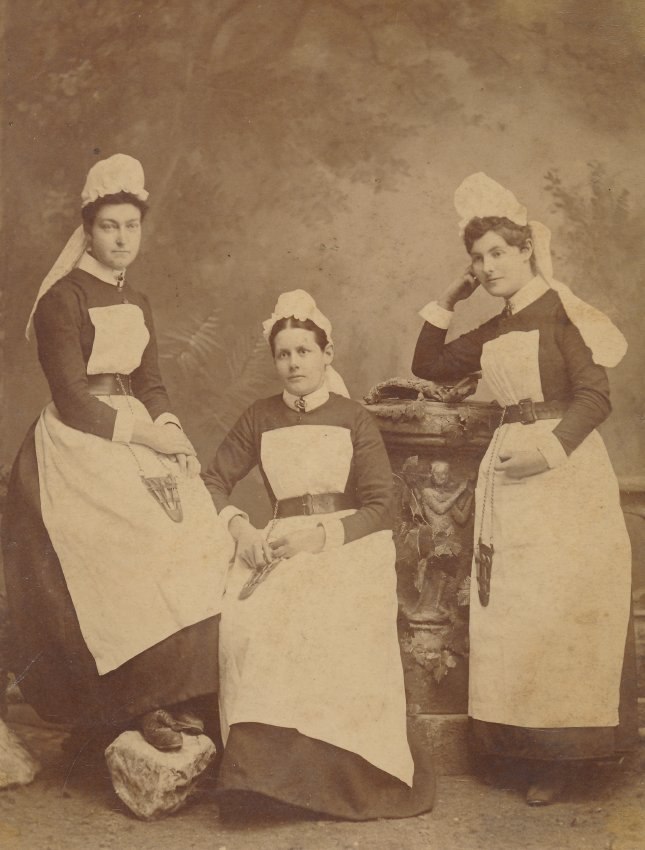
Bella Kellahan, left, with two fellow nurses in uniform. Her nursing career took her to Timaru, where she met Watson Hitch, and she later became a life member of the Nursing Association. Image credit: Ashburton Museum & Historical Society Inc. Catalogue number: 04.2005.0142L
I was not looking for Bella Kellahan... I was actually being nosy poking around the Ashburton Musuem online collection searching for “Timaru”... then their archive opened a side door, and I had a name to follow... her name was Bella Kellahan. The photo It stopped me, partly because of the uniform, partly because of the familiar South Canterbury pull, but mostly because of the name. Bella.
A small name in a caption can feel like a whisper from the edge of the record. But it can also be a trap. Names repeat. Families move. Women marry and disappear into new surnames. Captions can be right, wrong, partial or waiting for someone to ask better questions... So I started with the question. Who was Bella?
The best working identification is Isabella Nicholas Kellahan, born on 11 December 1919. Later records appear to place her as Isabella Nicholas Kellahan Prebble, who died on 5 October 1983 and was buried at Memorial Park Cemetery, Bromley, Christchurch.
That gives us the outside edges of a life. Birth. Death. Burial. A married name.
But the real story sits in the middle I think.
Bella appears to have been the daughter of David Kellahan and Mary Jane McMurchie. Their 1908 intention to marry is wonderfully ordinary and wonderfully useful. David was a farmer, living in Timaru. Mary Jane was living at Washdyke, where she had been for twenty years. They intended to marry at Chalmers Presbyterian Church in Timaru.
That one record pulls Bella’s story straight into the local landscape. Timaru. Washdyke. Chalmers. Farming life. Presbyterian networks. The practical, everyday world of South Canterbury families.
It also gives the story weight. Bella was not just a name passing briefly through Timaru. Her family was rooted in the district before she was born.
The Kellahan name itself asks for care. There was more than one Isabella Nicholas Kellahan in the wider family story. That is exactly the kind of trap that can make a researcher feel very clever just before they become very wrong. A repeated name can be a clue, but it can also be a warning.
So I made sure I wrote this at the top of my notes: do not merge the women.
Our Bella was born in 1919. The earliest public glimpse I found of her was not in a hospital. It was in the social world of Timaru childhood. In December 1929, “Bella Kellahan” appears among a long list of girls at a dance connected with Miss Ford’s pupils and friends at the Stafford. A few days later, in January 1930, she appears again in a Highland dancing result, placed second in the Highland Fling for girls under twelve.
Before she becomes a possible nurse, before she becomes a married woman, before she becomes a grave record, Bella is a child on a stage.
She is ten years old, or close to it. She is part of Timaru’s social world. She is moving to music, probably watched by family and friends, one child among many in the formal lists of a local newspaper.
I love records like that. They remind us that people do not begin as genealogy. They begin as children with shoes, nerves, friends, teachers, family expectations, hobbies and someone probably telling them to stand up straight.
This is where the next question matters... Where did Bella go to school?
I would love to answer that. I would love to place her confidently at Timaru Girls’ High School, or another local school, and find her in a roll, a prize list, a Chronicle, an exam result or a class photograph.
But I cannot do that yet. What I can say is this: Bella was in Timaru’s social world at school age. She was the right age to be part of the changing world of girls’ education in the 1920s and 1930s. But I have not yet found the school record that names her.
That is not a failure. It is a clue with a “next step” sign on it.
The next places to look are school admission registers, Timaru Girls’ High School Chronicles, local primary school rolls, exam results and the biographical files held by South Canterbury researchers. Bella may not be in the easiest records. She may be sitting quietly in a ledger.
Then there is the photograph. The Ashburton Museum nursing image is the reason this hunt began. If the caption correctly identifies Bella Kellahan as one of the nurses, it may place her in one of the most important forms of women’s work in twentieth-century New Zealand. But a careful history hunt has to keep its feet on the ground. I have not yet found the matching nursing register entry, hospital staff list, state examination result, obituary or newspaper item that proves her training or career.
So the honest wording is this: the photograph points strongly towards a nursing connection, but the public confirmation still needs to be found.
That matters, because nursing was not just “caring work”. It was skilled, trained, disciplined and physically demanding work. New Zealand was early in regulating nursing. The Nurses Registration Act 1901 required training, examination and registration. Nursing became a recognised profession at a time when many women’s work was still expected to be quiet, domestic or temporary.
Timaru Hospital was part of that wider story.
In 1928, when Bella was still a child, reports to the South Canterbury Hospital Board said Timaru Hospital nurses were overworked. Some had been ill, some had left, and regular days off had become impossible. The Board discussed increasing staff and even boarding additional nurses near the hospital if necessary.
That one report gives us a glimpse behind the polished photographs and starched uniforms. Nursing could be exhausting. It could be short-staffed. It could demand long hours, discipline, composure and resilience.
If Bella did train or work in that hospital world, she was stepping into something far bigger than a pretty photograph.
She was stepping into a system.
There were wards, uniforms, rules, exams, bells, beds, night duty, matron, doctors, training, friendship and fatigue. There was also pride. Timaru Hospital’s nurses were part of the town’s public life, even when their individual names did not always make it into the main story.
That is often the problem with women’s history. The archive does not always hide women. Sometimes it files them under someone else’s name. Sometimes it gives them a first name only. Sometimes it gives us a photograph but not the biography. Sometimes it records the institution beautifully and leaves the women who kept it running as faces in rows.
That is why Bella matters.
Not because we have every answer, but because we do not.
Her story sits in the space between a caption and a confirmed life. A Timaru childhood can be traced. A family can be placed. A dance result can be found. A likely later identity can be followed to Christchurch. But the school record and nursing proof are still waiting.
And that makes the story more honest, not less.
Local history is not only about producing neat biographies. It is also about showing the method. We start with a clue. We test it. We look for the same person under formal names, nicknames and married names. We watch for family naming traps. We check whether the dates make sense. We separate what is known from what is likely, and what is likely from what is simply tempting.
Bella’s name asks us to do all of that.
She also asks us to look again at Timaru’s women.
The girls in social columns. The daughters of farming families. The young women who trained, worked, married, moved, cared, volunteered and disappeared into other surnames. The nurses who lived in homes near hospitals, studied for exams, worked through shortages, and helped hold community health together.
I keep coming back to the Highland Fling.
There is something almost cinematic about it. A child named Bella in a dancing result in 1930. Then, years later, possibly the same Bella in a nursing photograph. Movement, then stillness. Stage, then ward. Childhood, then service.
But history is not cinema. It does not let us make the leap without evidence.
So this blog is not the final word on Bella Kellahan. It is an invitation.
If you remember Bella Kellahan, Isabella Kellahan, or Isabella Prebble, I would love to hear from you. If your family has a Timaru Hospital nursing photograph, a badge, a reunion booklet, a school Chronicle, a class list, a newspaper clipping, or a memory of the Kellahan family, it may help complete the picture.
For now, Bella remains what so many women in local history are at first: not forgotten exactly, but waiting in the archive for someone to notice her name.
And sometimes, that is where the real history begins.
Working Timeline: Bella Kellahan
1901
New Zealand passed the Nurses Registration Act. This created a formal register for nurses and made training, examination and registration part of the professional nursing system. This matters because, if Bella trained as a nurse, a nursing register or examination record may exist.
26 February 1908
David Kellahan and Mary Jane McMurchie gave notice of intention to marry. David was listed as a farmer living in Timaru. Mary Jane was listed at Washdyke, where she had lived for twenty years. Their intended place of marriage was Chalmers Presbyterian Church, Timaru.
Evidence status: Confirmed in the transcribed Intention to Marry record, but should be checked against the page image.
11 December 1919
Isabella Nicholas Kellahan was born, according to her later burial memorial. She is the strongest working identification for “Bella Kellahan”.
Evidence status: Probable. Needs confirmation through NZ BDM.
1928
Reports to the South Canterbury Hospital Board said Timaru Hospital nurses were overworked. Some had been ill, some had left, and days off were difficult to provide. The Board discussed increasing staff and possibly boarding additional nurses near the hospital.
Evidence status: Confirmed newspaper context. This is not about Bella directly, but it helps explain the local hospital world she may later have entered.
23 December 1929
“Bella Kellahan” appears in a Timaru Herald social note connected with Miss Ford’s break-up dance at the Stafford.
Evidence status: Confirmed newspaper mention.
3 January 1930
Bella Kellahan placed second in the Highland Fling for girls under twelve at the Timaru Caledonian sports.
Evidence status: Confirmed newspaper mention.
1930s
Bella was school age during this decade. She was clearly connected to Timaru’s social world as a child, but her school has not yet been confirmed.
Evidence status: Likely, based on age and Timaru newspaper references. School roll checking still needed.
Late 1930s to 1940s
This is the possible window for Bella’s nursing training or early nursing work, depending on the date and caption of the Ashburton Museum nursing photograph.
Evidence status: Unconfirmed. Needs a nursing register entry, hospital staff record, examination result, obituary, full museum catalogue record or family evidence.
1959
A photograph of the Timaru Hospital Nurses’ Home was recorded by South Canterbury Museum.
Evidence status: Confirmed context. This is later than Bella’s likely training years, but useful for visual and institutional background.
Circa 1960
South Canterbury Museum holds a photograph of a Timaru Hospital nursing class for the Junior State Exam.
Evidence status: Confirmed context. This is later than Bella’s likely period, but useful for showing Timaru Hospital’s nursing training culture.
5 October 1983
Isabella Nicholas Kellahan Prebble died, aged 63, and was buried at Memorial Park Cemetery, Bromley, Christchurch.
Evidence status: Probable, based on Find a Grave. Needs confirmation through NZ BDM or Christchurch cemetery records.
Still to Confirm
Bella’s birth record through NZ BDM.
Bella’s parents through official birth or family records.
Bella’s school.
Whether she attended Timaru Girls’ High School or another local school.
The full Ashburton Museum catalogue record for the nursing photograph.
The date of the nursing photograph.
Whether the photograph identifies Bella as a nurse, probationer nurse, pupil nurse, friend, relative or another role.
Whether Bella appears in New Zealand nursing registers.
Whether Bella appears in Timaru Hospital staff lists, probationer lists, Junior or State Examination results, nurses’ reunion records, or an obituary.
Whether Isabella Nicholas Kellahan and Isabella Nicholas Kellahan Prebble are definitely the same person.
Source list with full links
NZ Intentions to Marry Project, 1908 Canterbury, Otago, Chatham Islands, page 268
Used for David Kellahan and Mary Jane McMurchie’s notice of intention to marry, including residence, occupation and Chalmers Presbyterian Church, Timaru.
https://itm.howison.co.nz/year/1908c/page/42518
Papers Past, Timaru Herald, 23 December 1929, “Social Notes”
Used for Bella Kellahan appearing at Miss Ford’s break-up dance at the Stafford.
https://paperspast.natlib.govt.nz/newspapers/THD19291223.2.18
Papers Past, Star, 3 January 1930, Timaru Caledonian sports results
Used for Bella Kellahan placing second in the Highland Fling for girls under twelve.
https://paperspast.natlib.govt.nz/newspapers/TS19300103.2.44
Find a Grave, Isabella Nicholas Kellahan Prebble memorial
Used for the working identification, birth date, death date, married name and burial place. Treat as secondary until checked against NZ BDM or cemetery records.
https://www.findagrave.com/memorial/146634918/isabella_nicholas-prebble
FamilySearch, David Kellahan, 1878 to 1955
Used as a secondary family-tree source for David Kellahan, Mary Jane McMurchie and their children. Useful, but should be confirmed against official BDM records where possible.
https://ancestors.familysearch.org/en/LH5Z-BLH/david-kellahan-1878-1955
New Zealand BDM Historical Records
Best next step for confirming Bella’s birth, marriage and death records.
https://www.bdmhistoricalrecords.dia.govt.nz/home/
Nurses Registration Act 1901, New Zealand Legislation
Used for nursing registration context, including the nurses’ register, training requirements, examination and badge.
https://www.legislation.govt.nz/act/public/1901/12/en/latest/
NZHistory, “World’s first state-registered nurses”
Used for national context on Grace Neill, Ellen Dougherty and state registration of nurses.
https://nzhistory.govt.nz/page/worlds-first-state-registered-nurses
Te Ara, Health practitioners: nurses and midwives
Used for wider nursing history, hospital apprenticeship training and nurses’ homes.
https://teara.govt.nz/en/health-practitioners/page-3
Papers Past, Star, 22 August 1928, “Increase Needed in Nursing Staff of Timaru Hospital”
Used for local evidence that Timaru Hospital nurses were overworked and that more staff were needed.
https://paperspast.natlib.govt.nz/newspapers/TS19280822.2.36
DigitalNZ, “Nurses Home: Timaru 1959”, South Canterbury Museum
Used for visual and institutional context around Timaru Hospital nurses.
https://digitalnz.org/records/45967805
Christchurch City Libraries ArchivesSpace, Timaru Public Hospital photographs
Useful next-step source for hospital photographs, including doctors, nurses, staff and buildings.
https://archives.canterburystories.nz/repositories/3/archival_objects/1491
Aoraki Heritage Collection, School Roll Indexes
Useful next step for possible school evidence. The site notes that original admission rolls may contain admission date, birth date, parent or guardian, address, previous school, leaving date and destination.
https://aorakiheritage.recollect.co.nz/nodes/view/8143
Aoraki Heritage Collection, Timaru Main School index to school records
Useful next step because it lists Timaru Main School admissions from 1873 to 1935 and points to original admission rolls.
https://aorakiheritage.recollect.co.nz/nodes/view/8275
South Canterbury Genealogy Society, School Rolls
Useful next step because full school roll entries may include register number, admission date, birth date, parent or guardian, address, previous school, last day and destination.
https://scgenealogy.nz/resources/r-two/
South Canterbury Museum Research Reading Room
Useful next step for archives, photographs, newspapers, maps, plans, local history publications and genealogical research.
https://museum.timaru.govt.nz/research