
By Roselyn Fauth
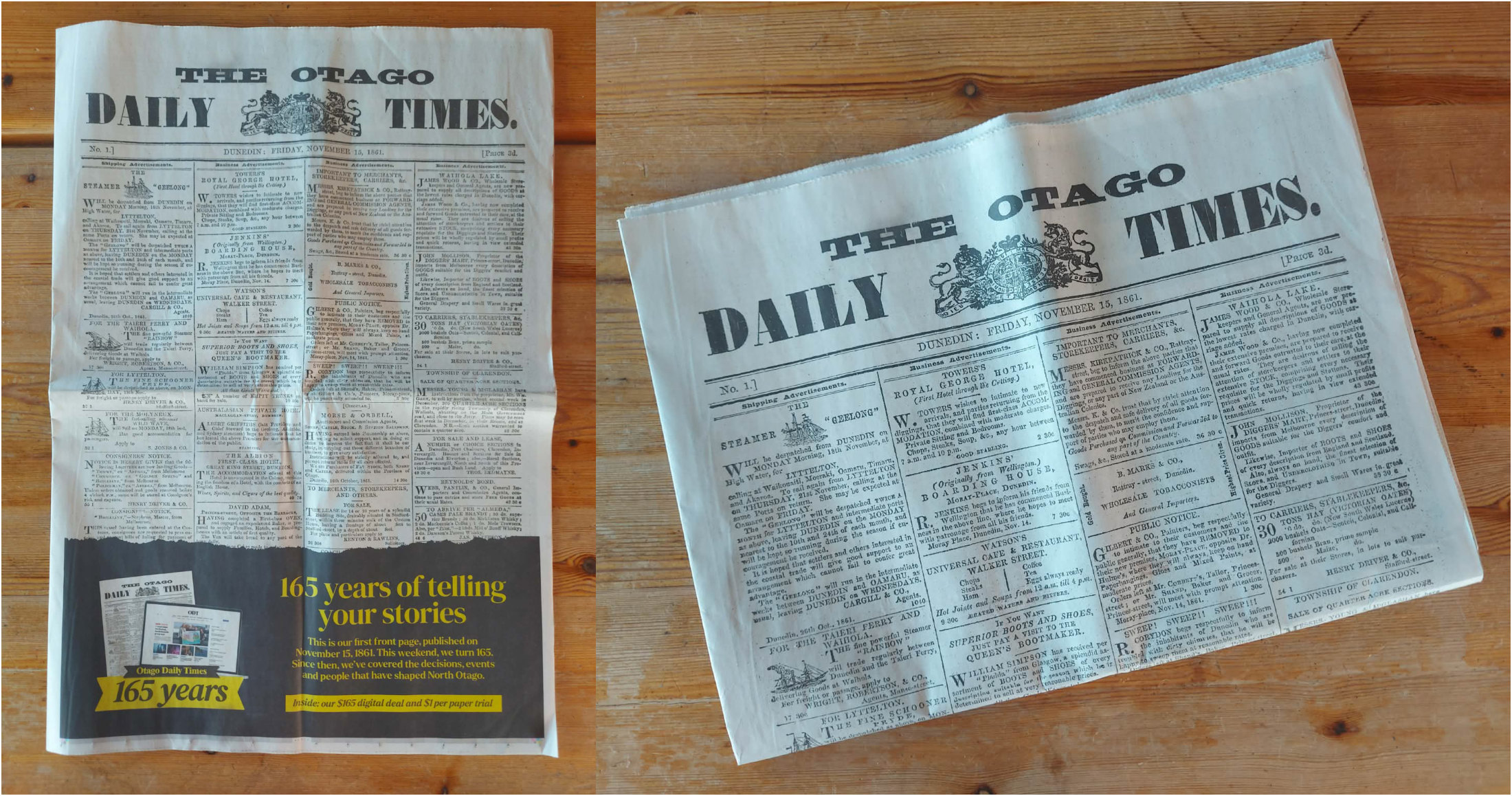
Gold fever, a town celebrating by candlelight, a 65-mile journey and a message from 1861. All thanks to a free handout at the Ōamaru Heritage Parade.
I was watching the heritage parade in Ōamaru over the weekend when somebody handed me a free newspaper...
WuHoo! A freebie!
It was a commemorative reproduction of the very first Otago Daily Times, published on Friday 15 November 1861. New Zealand's first daily newspaper, celebrating its 165th anniversary on the very same weekend.
What a clever thing to give away at a heritage event. Something you could take home, unfold and explore at your leisure. I could have admired it, appreciated the gesture and popped it away with the other souvenirs from our Ōamaru adventure. Instead, I started looking closer.
Who was mentioned? What was making the headlines? What were people buying and selling? Where were they travelling? What did they consider newsworthy?
And, because I'm always curious about our own patch, what was happening up the coast in Timaru?
The more I looked, the more questions I had. But the biggest surprise was an article published on page two, titled The Past and the Present. It was an account of Otago's development, written in 1861, reflecting on the previous thirteen years and considering how future generations might remember them. And here I was, 165 years later, doing precisely that.
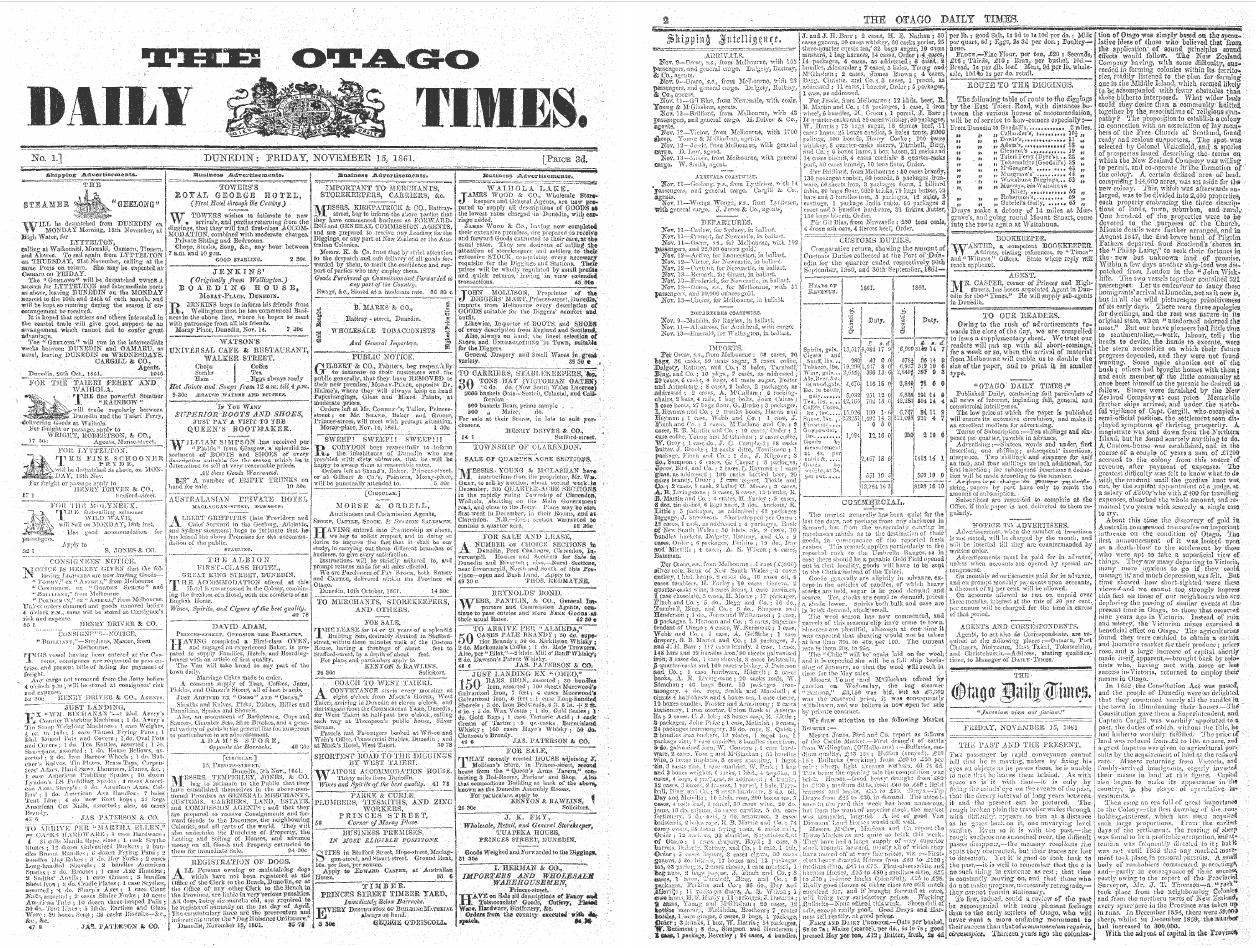
Otago Daily Times 15 November 1861 Pages 1 and 2
Why was New Zealand's first daily newspaper published in Dunedin?
According to NZ History, the Otago Daily Times was established by Julius Vogel and William Henry Cutten. Vogel was a 26-year-old journalist who arrived from Australia in October 1861. Cutten was already involved in publishing the weekly Otago Witness.
Earlier that year, Gabriel Read's discovery of payable gold at Gabriel's Gully had triggered a rush into Otago. Prospectors arrived, businesses expanded, accommodation was in demand and merchants competed to supply everything from food and clothing to mining equipment. There were fortunes to chase, investments to make and plenty of speculation about where the next rich deposits might be found.
Vogel and Cutten recognised that a rapidly growing province might support a daily newspaper.
The first issue appeared on 15 November 1861, costing threepence.
A quarterly subscription was ten shillings and sixpence, while an advertisement of up to sixteen words cost one shilling for its first insertion. So, while the newspaper reported on Otago's commercial expansion, it was also a business venture hoping to benefit from it. Its Latin motto was Inveniam viam aut faciam. "I shall find a way or make one."
Vogel certainly had ambition. He would later become New Zealand's premier and pursue major public works and immigration programmes. But I was interested in what an ordinary reader might have discovered on that first Friday in November.

https://paperspast.natlib.govt.nz/newspapers/otago-daily-times/1861/11/15
What was actually in the newspaper?
The National Library has digitised the original issue, so we can explore it through Papers Past. Four main pages and a supplement, crammed with advertisements, shipping information, provincial politics, government notices, reports from the goldfields and practical advice. One headline announced the arrival of a gold escort carrying 35,100 ounces. According to contemporary reporting, 30,500 ounces came from Tuapeka and another 4,600 from Waitahuna.
Gold was certainly attracting attention... but what caught mine were the smaller notices. The first edition recorded businesses advertising their services, ships arriving with passengers and merchandise, land being offered for sale and roads being developed. There were people organising journeys, buying property, looking for work and trying to make a living.
The newspaper not only announcing major events, it was providing information people could use, and now those ordinary details are clues to understanding their lives.
The Past and the Present: what did the writers want us to remember?
I spent some time reading the editorial The Past and the Present, published on 15 November 1861. It's an account of Otago's European settlement, beginning with the organised Scottish immigration of 1848 and tracing the changes leading up to the gold rush. What interested me first was the writers' observation about memory.
They compared looking back on the past with a traveller surveying country they had already crossed. During the journey, every obstacle and rough patch demands attention. But when viewed from a distance, the landscape appears much smoother. The writers suggested that hindsight can make difficult experiences seem less troublesome than they were.
I thought about the old photographs I often research for WuHoo. We might admire a streetscape, a building or a group of people dressed for an occasion. We can see what they looked like, but we don't necessarily understand what they were experiencing. What did they worry about? What were they trying to achieve? What were the difficulties that a photograph could never reveal?
The editorial attempted to answer some of those questions about Otago's early European settlers. It described the arrival of the John Wickliffe and Philip Laing in 1848, the development of accommodation, businesses, farming and local institutions, and the challenges of establishing a settlement.
The writers celebrated the determination and enterprise of the newcomers. And among the broader history were some rather curious details. (Full transcription is below).
Did Dunedin really use nearly every candle in town?
According to the 1861 editorial, the arrival of news about the 1852 Constitution Act prompted celebrations in Dunedin. The Act introduced a system of representative government, including provincial councils.
The newspaper recalled that residents illuminated their houses, reportedly using almost every candle in town. I rather enjoyed that detail. But I also wondered whether it was literally true. Had somebody counted the available candles? Was this an enthusiastic recollection, perhaps embellished over time? Or did the little settlement genuinely exhaust its supplies? It provides a glimpse of community celebration, but it also raises questions about memory and accuracy. Which, interestingly enough, was exactly what the editorial was discussing!
What changed between 1848 and 1861?
The editorial describes Otago's growing agricultural and pastoral industries. It recalls the initial anxiety caused by people leaving for the Victorian goldfields in Australia. Losing workers and prospective settlers wasn't particularly encouraging for a developing settlement. Yet the writers argued that the Australian gold rush eventually benefited Otago by creating markets for local produce, while returning miners brought money and experience.
Then came the discoveries at Gabriel's Gully... the newspaper reported that Otago's population had risen from 2,557 in 1854 to 8,706 in 1859, before estimating that it had reached about 30,000 during the gold rush. These were contemporary figures, and the 1861 estimate wasn't a modern census count. Nevertheless, they show the scale of change the writers believed they were witnessing. It wasn't simply gold that was transforming the province. Roads, accommodation, businesses, agriculture, transport, government and communication were all developing alongside it. And the newspaper itself was part of that transformation.
A 65-mile journey without Google Maps
On page two, I found a notice titled Route to the Diggings. It provided directions from Dunedin to Gabriel's Gully, listing accommodation houses and distances along the East Taieri Road. The journey was approximately 65 miles. Travellers passed places including Taieri Ferry, Tokomairiro and Waitahuna.
Anyone taking a dray faced an additional complication. They were advised to make a detour of around fourteen miles near Mount Stuart. I enjoy a good South Island road trip, especially when there's an opportunity to explore the quieter routes. But imagine setting off with horses, a dray, rough roads, unpredictable weather and the hope of finding gold. You needed to know where you could stay, how far you could travel and whether your chosen route was suitable. A short notice could make quite a difference.
Read the original Route to the Diggings on Papers Past.
And it made me curious about the roads themselves. Which sections survive? How have the routes changed? What happened to those accommodation houses? An entire historical investigation could begin with that one notice.
Gabriel Read's own account challenged what I thought I knew
Another discovery was tucked into the supplement... a report from Gabriel Read, dated 6 November 1861. Read was the prospector whose discovery at Gabriel's Gully helped trigger the Otago gold rush. But his report wasn't another spectacular success story. He had been searching other areas for the government, including country towards the Pomahaka and Mataura. He reported finding some gold, but nothing comparable to the rich deposits at Gabriel's Gully or Waitahuna. He also explained that he lacked the necessary equipment for deeper prospecting.
Then he requested release from his government duties, acknowledging that he didn't consider himself sufficiently qualified to continue the search. That wasn't the account I expected from someone remembered for a famous discovery. It made me reconsider how easily we reduce historical people to their best-known achievement. Gabriel Read wasn't just the man who discovered gold. He was a prospector working with incomplete information, limited equipment and uncertainty about where another payable field might be found. His own words provide a more complicated, and ultimately more human, picture.
Read Gabriel Read's original report on Papers Past.
A township for sale, and roads being constructed
The supplement also advertised sections in the township of Waihola for public auction on 3 January 1862. Plans could be inspected at the local schoolhouse or the Commissioner's tent at Tuapeka. Copies were available for purchase from a Dunedin bookseller for one shilling. The notice was signed by William Henry Cutten, Chief Commissioner of Crown Lands. Yes, the same Cutten involved in establishing the newspaper.
Nearby were government tenders for roadworks, including improvements between Dunedin and Taieri Ferry. There was quite a lot happening in those advertisements. Land was being offered for purchase, transport connections were being improved and officials were administering the development.
Explore the original Waihola land sale and roadworks notices.
And suddenly I had another question... What did all this progress mean for the people who were already connected to the land?
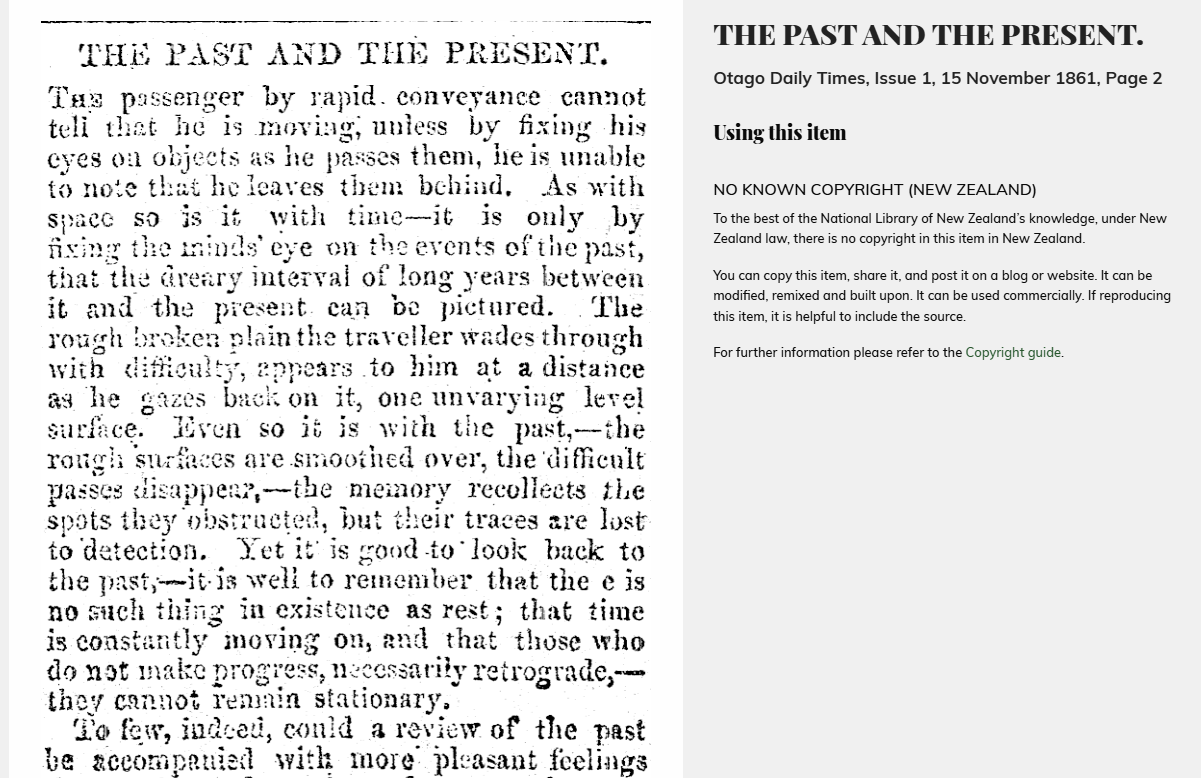
https://paperspast.natlib.govt.nz/newspapers/ODT18611115.2.8.1
Whose past, and whose present?
This was where I started questioning the newspaper's account a little more closely. The Past and the Present is an enthusiastic description of Otago's European settlement. Its writers celebrate the determination of the settlers, the establishment of businesses and the prosperity that followed. But their story effectively begins in 1848.
Of course, the history of Otago didn't begin with the arrival of European settlers... and we know that Kāi Tahu had longstanding connections to the land, waterways and coast, with established communities, travel routes, food-gathering places and traditions.
I wanted to learn more about the mana whenua of the places connected with my newspaper adventure. In Ōamaru, where I was given the free handout, the area is within the takiwā of Te Rūnanga o Moeraki, whose customary interests extend from the Waitaki River to the Waihemo (Shag River), and inland towards the Main Divide.
In Ōtepoti Dunedin, where the newspaper was published, mana whenua are represented by Te Rūnanga o Ōtākou and Kāti Huirapa Rūnaka ki Puketeraki.
And here in Timaru, mana whenua are Kāti Huirapa, represented by Te Rūnanga o Arowhenua.
So there was already a rich history of settlement, movement, food gathering, trade and relationships with the land long before the period celebrated in the newspaper's editorial. I also learnt more about the 1844 Ōtākou land purchase.
According to Te Rūnanga o Ngāi Tahu's account of the Otago Deed, Kāi Tahu understood that additional reserves amounting to one-tenth of the land sold would be set aside. That promise was not fulfilled.
It puts the newspaper's enthusiastic advertisements for land sales and colonial development into a rather different perspective. The settlers' achievements were one part of the history. The consequences of that settlement for mana whenua were another. I also noticed how prominently politicians, merchants, landowners and government officials featured in the publication.
Where were the women, the labourers, the families and the people whose work wasn't considered important enough to record? Some may be found in the advertisements, smaller notices and other historical records. Others will take considerably more investigation.
And that made me reconsider what I was reading. An old newspaper can provide valuable evidence of the past, but it also reflects the interests, attitudes and priorities of the people producing it.
Sometimes the most revealing part of a historical document isn't just what it tells us. It's what we discover when we question whose stories are missing.
That's another reason to look closer.
What was happening up the coast in Timaru?
Naturally, I also wanted to find a South Canterbury connection. In November 1861, Timaru didn't yet have its own newspaper as the Timaru Herald first appeared on 11 June 1864, established by Alfred George Horton.
The newspaper became a means for local residents to advocate for greater influence over decisions affecting the Timaru and Gladstone districts. And its origins were rather modest. According to an account published in the Timaru Herald in 1886, its first printing office was a small cottage with a lean-to, previously used as the kitchen of Sam Williams's Club Hotel in George Street. A newspaper that became such an important part of South Canterbury's history began in a former hotel kitchen. I've previously researched its beginnings and the connections with the Williams family. You can follow that WuHoo story here.
This also made me reconsider the purpose of newspapers. They didn't simply record what communities were doing. They could campaign for change, influence public debate and help determine which issues received attention. The Otago Daily Times and Timaru Herald were products of their particular circumstances, but both became participants in the history they recorded.
The publishers were already thinking about future historians
Returning to The Past and the Present, I found a passage that gave this whole investigation another dimension.
The writers declared: "From this day we aspire to be the historical mirror of all that occurs in Otago"
They understood that a daily newspaper could become a continuing record of their province. They imagined people looking back as Dunedin developed, comparing the settlement they remembered with the city it might become. In 1861, they were recording their present while reflecting on their past.
In 2026, I was studying their present, trying to understand the people, places and circumstances they described. But I was also asking questions they may not have anticipated. Whose accounts had been preserved? Which experiences were missing? How reliable were their claims? What could the advertisements and smaller notices reveal that the editorial overlooked?
Their newspaper had certainly become a historical record. But being able to read it didn't mean I had to accept every interpretation its writers offered. The value was in having evidence I could examine, question and compare with other sources.
What that free newspaper taught me
Which brings me back to the Ōamaru Heritage Parade. Someone thought it would be worthwhile to reproduce an old newspaper and give copies away. Such a simple idea. And yet it achieved something quite valuable. I was handed an object that encouraged me to ask questions. Those questions led me to Papers Past, where I could investigate the original publication. The sources challenged some of my assumptions, particularly about Gabriel Read and the way the editorial described colonial progress. I discovered stories I hadn't expected.
And by considering what was recorded, what was omitted and how the newspaper's perspective influenced its account, I came away with a better understanding of the period.
Not a complete understanding, of course. There are plenty more side quests to follow! But that's the point... a good historical discovery doesn't necessarily provide all the answers. Sometimes it improves the questions we're asking. It also makes me think about how we share heritage today.
We're surrounded by information, but that doesn't automatically make us curious about it. The free newspaper worked because it gave me something tangible to explore, without telling me what I should think.
I could look at the evidence, investigate the stories and work things out for myself. And now I can share what I've learnt, alongside links to the original material, so you can have a look too.
Perhaps you'll notice something I've missed. Perhaps you'll recognise a family name, a place or a business. Or perhaps you'll challenge one of my interpretations and send me off investigating again. That would be useful!
What will people learn about us in another 165 years?
I've been wondering what someone might discover if they looked back at Timaru in 2026. What would our newspapers, websites, photographs and social media posts tell them? Who would be mentioned? Whose contributions would be recorded? What would they misunderstand if they relied on only one source? And how could we improve the records we're creating now, so future generations have a more complete picture of our communities?
Those questions feel particularly relevant when we're researching and sharing local history. We can check dates, identify people, preserve photographs, acknowledge sources, invite corrections and make space for stories that haven't received much attention. We won't get everything right. But we can keep improving.
So next time you come across an old newspaper, photograph or document, have a closer look. Ask a question. Follow a lead. Check the evidence. Challenge what you think you know. And don't be afraid to reconsider your conclusions when you discover something new. All this because somebody handed me a free newspaper while I was watching a heritage parade.
Take on the writers advice from 165 years ago... Look back, appreciate progress, understand the struggles, learn from the past, and help shape the future.
Not a bad return on a freebie! WuHoo!
SIDE QUEST: Taking the newspaper's advice. What can we learn from looking back?
The Otago Daily Times gave advice to their readers in 1861... they encouraged people to look back at the past, remember the difficulties they had overcome, appreciate their progress and think carefully about the future. I thought that was an interesting invitation... so I followed it.
The newspaper took its readers back to 1847, when plans were being made for a Scottish settlement in Otago. The following year, the Philip Laing and John Wickliffe arrived with 321 passengers. According to the article, Dunedin had just three basic dwellings. The newcomers had to establish homes, farms and businesses, with very little infrastructure to support them.
What interested me was how unpredictable progress could be. When gold was discovered in Australia, settlers left Otago and people feared the settlement might fail. Instead, the gold rush created new markets for Otago farmers, and some miners returned with money to invest. Sheep numbers grew from 59,000 in 1854 to 300,000 in 1859. Then came Otago's own gold discoveries, bringing thousands of new arrivals and extraordinary economic change. By 1861, the population had reportedly reached 30,000, and Dunedin was large enough to support New Zealand's first daily newspaper.
In just over a decade, the settlement had changed enormously. No wonder the editors were excited about what might come next.
But following their advice also made me question their version of progress... The newspaper tells us a great deal about the ambitions, difficulties and achievements of European settlers. Yet it tells us very little about mana whenua, whose ancestors had lived in and travelled through this region long before 1848. It doesn't explore how European settlement, land acquisition and expanding pastoral farming affected Māori communities.
That absence I think is worth noticing. The editors were writing from their own perspective, celebrating the kind of progress they valued. They were also deciding which stories deserved a place in the historical record, and perhaps that is the most useful lesson I found in this side quest.
Looking back isn't simply about celebrating how far we have come. It can also be about understanding the struggles, recognising whose experiences have been recorded, questioning what has been left out, and using what we discover to make better decisions for the future.
The newspaper encouraged its readers to become part of Otago's next chapter. More than 165 years later, I think we can take that invitation a little further.
Whose stories are we recording today, and what will future generations wish we had taken the time to notice?
Look closer: follow the original sources
The first edition of the Otago Daily Times was published on Friday 15 November 1861. All five digitised pages, including the supplement, can be explored through Papers Past.
- Complete first edition, 15 November 1861
- The Past and the Present, original editorial
- Route to the Diggings
- Gabriel Read's prospecting report
- Waihola township land sale and roadworks notices
- NZ History: First issue of the Otago Daily Times
- Ngāi Tahu: Rūnanga boundaries
- Te Rūnanga o Ngāi Tahu: The Otago Deed, 1844
- WuHoo Timaru: First edition of the Timaru Herald
Photograph: A commemorative reproduction of New Zealand's first daily newspaper, handed out at the Ōamaru Heritage Celebrations in November 2026.
Thanks to the people who shared the newspapers at the parade. Your handout certainly encouraged me to look closer!
The Past and the Present
Transcription of the newspaper extract
I have arranged your nine screenshots in their correct reading order, beginning with the heading “THE PAST AND THE PRESENT.” and continuing through to the concluding paragraph.
I have retained the original wording, spelling, punctuation, capitalisation and historical terminology wherever legible. Words divided by newspaper column line breaks have been joined together for easier reading. I have not modernised the language or corrected the writer's historical claims.
Full transcription
THE PAST AND THE PRESENT.
The passenger by rapid conveyance cannot tell that he is moving, unless by fixing his eyes on objects as he passes them, he is unable to note that he leaves them behind. As with space so is it with time—it is only by fixing the mind's eye on the events of the past, that the dreary interval of long years between it and the present can be pictured. The rough broken plain the traveller wades through with difficulty, appears to him at a distance as he gazes back on it, one unvarying level surface. Even so it is with the past,—the rough surfaces are smoothed over, the difficult passes disappear,—the memory recollects the spots they obstructed, but their traces are lost to detection. Yet it is good to look back to the past,—it is well to remember that the earth is no such thing in existence as rest; that time is constantly moving on, and that those who do not make progress, necessarily retrograde,—they cannot remain stationary.
To few, indeed, could a review of the past be accompanied with more pleasant feelings than to the early settlers of Otago, who will never want a more enduring monument to their success than that of si monumentum requiris, circumspice. Thirteen years ago the colonization of Otago was simply based on the speculative ideas of those who believed that from the application of sound principles sound effects would follow. The New Zealand Company having, with some difficulty, succeeded in forming colonies within its territories, readily listened to the plan for forming one in the Middle Island, which seemed likely to be accompanied with fewer obstacles than those hitherto interposed. What wider basis could they desire than a community knitted together by the associations of religious sympathy? The proposition to establish a colony in connection with an association of lay members of the Free Church of Scotland, found ready and zealous supporters. The spot was selected by Colonel Wakefield, and a species of prospectus issued describing the terms on which the New Zealand Company was willing to permit, and co-operate in the formation of the colony. A certain defined area of land, comprising 144,600 acres, was set aside for the new colony. This, which was afterwards enlarged, was to be divided into 2,400 properties, each property embracing the three descriptions of lands, town, suburban, and rural. One hundred of the properties were to be devoted to the purposes of the Church. Minute details were further arranged, and in August 1847, the first brave band of Pilgrim Fathers departed from Scotland's shores in the “Philip Laing,” to seek their fortunes in a new but unknown land of promise. Within a few days another ship-load was dispatched from London in the “John Wickliffe.” The two vessels together contained 321 passengers. Let us endeavour to fancy these immigrants' arrival at Dunedin, not as it now is, but in all the wild picturesque primitiveness of its early days. There were three apologies for dwellings, and the rest was nature in its original state, when “unadorned adorned the most.” But our brave pioneers had little time to sentimentalise,—work, labour, toil; the heads to devise, the hands to execute, were the stern necessities on which their future progress depended, and they were not found wanting. Some made shanties out of the bush; others had brought houses with them; and each member of the little community at once best himself to the pursuit he desired to follow. Stores were furnished by the New Zealand Company at cost price. Meanwhile further ships arrived, and under the watchful vigilance of Capt. Cargill, who occupied a semi-official position, the settlement soon displayed symptoms of thriving prosperity. A magistrate was sent down from the Northern Island, but he found scarcely anything to do. A Custom-house was established, and in the course of a couple of years a sum of £1200 accrued to the colony from this source of revenue, after payment of expenses. The greatest difficulty was felt to know what to do with the amount: until the gordian knot was cut, by the sapient appointment of a judge, at a salary of £800; who with £400 for travelling expenses, absorbed the whole amount, and remained two years with scarcely a single case to try.
About this time the discovery of gold in Australia commenced to exercise an important influence on the condition of Otago. The first announcement of it was looked upon as a death-blow to the settlement by those who were apt to take a superficial view of things. They saw many departing to Victoria, many more anxious to go if they could manage it, and much depression was felt. But time showed how short-sighted were these views—and we cannot too strongly impress this fact on those of our neighbours who are deploring the passing of similar events at the present time in Otago, to those that occurred nine years ago in Victoria. Instead of ruin and misery, the Victorian mines exercised a beneficial effect on Otago. The agriculturists found they were enabled to obtain a certain and lucrative market for their produce; prices rose, and a large increase of capital shortly made itself apparent,—brought back by colonists who, having met with more or less success in Victoria, returned to employ their means in Otago.
In 1852 the Constitution Act was passed, and the people of Dunedin were so delighted that they consumed nearly all the candles in the town in illuminating their houses.—The Constitution gave them a Superintendent, and Captain Cargill was worthily appointed to a post, the duties of which, without the title, he had hitherto worthily fulfilled. The price of land was reduced from £2 to 10s. an acre, and a great impetus was given to agricultural pursuits by the acquirement of land at the reduced rate. Miners returning from Victoria, and freshly-arrived immigrants, eagerly invested their means in land at this figure. Capital also began to make its appearance in the country, in the shape of speculative investments.
Then came an era full of great importance to the Colony—the first dawning of the run-holding interest, which has since acquired such large proportions. From the earliest days of the settlement, the rearing of sheep was found to be a profitable occupation, and attention was frequently directed to it; but it was not until 1855 that any marked movement took place in pastoral pursuits. A small body of runholders commenced proceedings, and—partly in consequence of their success, partly owing to the report of the Provincial Surveyor, Mr. J. T. Thomson—a “rush” took place from the neighbouring Colonies and from the northern parts of New Zealand, every spare acre in the Province was taken up in runs. In December 1854, there were 59,000 sheep, whilst in December 1859, the number had increased to 300,000.
With the advent of capital in the Province, the demand for land became so largely increased, that the price was raised to 20s. an acre. The principle of hundreds was adopted with the avowed purpose of allowing persons of small means to become possessors of land. The run-holding and agricultural interests continued to gather in importance, till nothing seemed likely to rival much or even check them. No one dreamed of the vast effects to arise from a discovery similar to that which has produced such startling results in Victoria. For years vague rumours had floated about, that gold existed in small quantities about the Province. Few thought it worth looking after, no one in his most sanguine expectations ever dreamed of anything beyond an ordinarily payable field. We have come down to the present time, and what we now write of, hundreds of our readers can bear us out in. The unfolding of the golden wealth of the Province has been like the divulging of a fairy tale to the major portion of the inhabitants. As week after week has brought to light fresh instances of success, as escort after escort has presented the tangible evidence of undreamt of wealth; the feelings of wondering doubt have given way successively to startled joyful amazement and to unquestioning confidence. No more are heard the fears of difficulties concerning the unemployed, the streets are emptied of those who half supplied half demanded employment. Business in every branch is prospering in town; the inland navigation is being opened up, and a large and enterprising population is permanently locating itself on the gold fields. With this number we are enabled to be the first medium of announcing the arrival of the largest escort that has yet come down; one that would even have been larger, if the carts could have brought down more. Since June the gold produce of Otago has reached the extraordinary amount of 109,045 oz. brought down by escort, besides at least 20,000 more brought down by private hands. The population, which in 1854 amounted to 2557, and in 1859 to 8706, has been increased in four months, by fresh arrivals, to 30,000; and if reports are to be credited, larger numbers are likely to arrive than have even yet come down.
Do our readers ask why we have been so minute in travelling through the details of the past, we will say that all histories at whatever period they commence, have a retrospective introductory chapter. From this day we aspire to be the historical mirror of all that occurs in Otago,—of all that in anyway affects its history. We have gone through the introductory chapter—we have run through the history of the past till we come to the epoch when the fortnightly production of gold has reached 35,000 ounces. In ourselves we are the symbol of the progress of Otago. No one, a few months' back, would have thought of establishing a daily paper in Dunedin—the first daily paper in New Zealand! The past and the present our readers have before them—the future rests with themselves. If they will wisely avail themselves of the resources which a bounteous Providence has placed at their command; if they avoid alike the dangers of excessive doubtfulness and of reckless confidence; if they will add to discriminating judgment the auxiliaries of energy, perseverance, and industry, there is no limit to the success which may crown their career.
If they complain that in our remarks we have mentioned facts with which they were previously cognizant, we may plead that, besides their appropriateness to an opening number, they may serve the purpose of a record, when the present Dunedin may not be recognizable in the large city it will become. The early pioneers of Otago may years hence turn to these pages and recall, with mingled feelings of thankfulness and triumph, the humble times and the hard efforts of their earliest associations with the great colony, and they may dwell with laudable pride on the success of the place whose first settlement they assisted. Some of them may perhaps pass again through a similar ordeal—may again aid in rescuing from wild primitiveness a new country. This history to them will speak volumes; it will remind them of the rewards that wait on energetic perseverance, and teach them not to be discouraged by trifling reverses.