
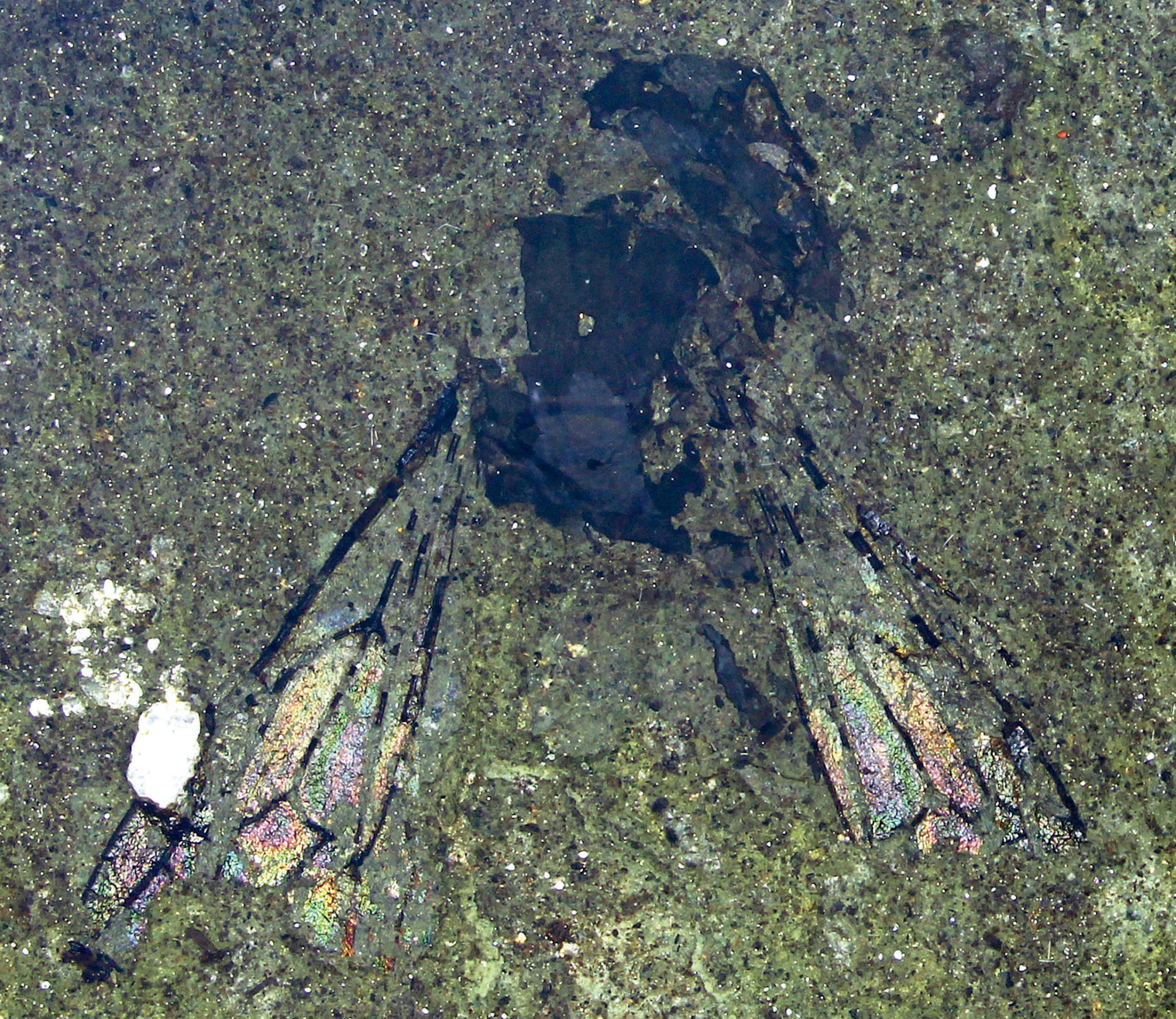
A tiny fossil bee, an ancient volcanic lake, a mystery written in her wings, and a surprising connection to the Mackenzie Country... Leioproctus barrydonovani, habitus of part. Scale bar – 1 mm. Image credit: M.S. Engel & U. Kaulfuss, doi: 10.5252/zoosystema2025v47a3.
I've been doing a bit of research into bees lately, particularly the insects that visit our flowers and the different roles they play in pollination. Between that and helping my daughter research for her palentology science badge, it has thrown my Facebook algorithm and now I am seeing heaps of bee posts. One post this morning caught my eye on something I hadn't considered. How long have bees actually been living in New Zealand?
It turns out that scientists have identified a fossil bee from Otago dating back approximately 14.6 million years! She measured just 6.4 millimetres, and some of the most valuable clues to her identity were preserved in the delicate veins of her wings. Fourteen point six million years! I had no idea we had fossil bees in New Zealand, let alone one this old. Naturally, I wanted to know more. What was Otago like when she was alive? How did she end up preserved in rock? Which flowers might she have visited? And could any of her relatives still be buzzing around our gardens today? I went investigating...
A bee with a story written in her wings
On 29 January 2025, researchers Michael S. Engel and Uwe Kaulfuss published a scientific paper in the journal Zoosystema, describing the first fossil bee known from Zealandia. They named her Leioproctus (Otagocolletes) barrydonovani.
The fossil came from Hindon Maar, near Outram in Otago. Unlike insects preserved in amber, this bee was found as an impression in ancient sedimentary rock. Her body had been compressed, but remarkably, much of her structure was still recognisable. Scientists could examine features of her anatomy, including the intricate arrangement of veins in her wings.
I hadn't appreciated just how useful wing veins can be to entomologists. Their patterns help scientists distinguish one group of insects from another, even when other anatomical features haven't survived.
The researchers concluded that the specimen belonged to the genus Leioproctus, a group that includes native bees still found in New Zealand today. They also established a new subgenus, Otagocolletes, for the fossil. Now, that doesn't mean the bees visiting our gardens are direct descendants of this particular individual. Evolutionary relationships are considerably more complicated than that. But the fossil provides evidence that this bee lineage was present in Zealandia millions of years ago.
And here's what I find so interesting... of all the countless insects that must have lived in those ancient forests, one tiny individual left an impression that scientists could eventually recognise and study.
You can see photographs of the actual fossil in the original scientific paper by Engel and Kaulfuss (2025).
Otago wasn't always the Otago we know
The next part of this investigation took me into geology... Today, Hindon is part of inland Otago's rural landscape. But 14.6 million years ago, the district looked very different.
In 2018, Uwe Kaulfuss and fellow researchers published a detailed investigation of the Hindon Maar Complex. They discovered evidence of four ancient volcanic structures, including craters that had filled with lakes. These are known as maars, volcanic craters formed when rising magma interacts explosively with water.
Following the eruptions, lakes occupied some of the craters. Over time, sediment accumulated on their floors, preserving extraordinary evidence of the plants and animals living in the surrounding environment and what an environment it was. Instead of the landscape we see today, there were forests containing southern beeches, podocarps and mixed broadleaf vegetation. The fossil record also includes palms, cycads and other plants associated with warmer, humid conditions.
Researchers have identified fossil leaves, flowers, insects, fish and bird feathers. The lakes have preserved evidence of an ancient ecosystem, not merely a collection of isolated specimens. The fossil record even includes freshwater eels and galaxiid fish. I wonder how many people driving through Otago realise that beneath the landscape are traces of volcanic lakes and forests that existed millions of years before humans arrived.
Read the 2018 scientific investigation of the Hindon Maar Complex.
How can scientists know something is 14.6 million years old?
That's a question worth asking... the researchers didn't simply look at the fossil bee and estimate its age. The Hindon Maar Complex was dated using geological evidence, including a technique called argon-argon radiometric dating. Scientists measured the radioactive decay of isotopes within volcanic material associated with the fossil-bearing deposits.
The results indicated an age of approximately 14.60 million years, with a reported uncertainty of 0.09 million years.
Fossil pollen and other geological evidence helped researchers interpret the age and environment. So although the age is generally rounded to 14.6 million years, it is supported by scientific measurements of the geological deposits, rather than a direct measurement of the bee herself. I think that's an important distinction. When we hear a scientific claim, it's useful to ask how the researchers reached their conclusion.
Which flowers did she visit?
This might be my favourite mystery from the investigation... Scientists have discovered fossil flowers amongst the Hindon deposits, including material associated with Pseudopanax, a genus of plants still familiar in New Zealand today. One modern example is five finger, or whauwhaupaku, Pseudopanax arboreus.
 Five finger, or whauwhaupaku (Pseudopanax arboreus), is a modern relative of plants represented in the Hindon fossil flora. This photograph shows foliage, not fossil material. Photograph: Kahuroa, via Wikimedia Commons, public domain.
The researchers suggested that the ancient bee might have visited flowers belonging to this group. But here's the catch... No pollen was identified on the fossil bee's body.
That means scientists cannot establish which flowers she visited. We have evidence that bees lived in this environment. We have evidence of flowering plants. We understand that many living bees visit flowers to collect nectar and pollen. But we can't simply join those clues together and declare that this particular bee pollinated a particular plant.
Side quest: Who was Barry Donovan?
When I first read the scientific name barrydonovani, I wondered who Barry Donovan was. That sent me on another little side quest...
Dr Barry James Donovan was a New Zealand entomologist who spent decades studying bees and their relationships with flowering plants. His work contributed substantially to our understanding of New Zealand's native bees. In 2007, he published Apoidea in the Fauna of New Zealand series, an extensive scientific reference documenting the country's bee fauna.
Then I discovered a connection much closer to home. In 2016, Donovan described a native bee called Leioproctus hukarere, following the discovery of an unusual bee near Lake Tekapō in the Mackenzie Country.
According to an article in New Zealand Geographic, Donovan had been studying New Zealand's bees for decades when this specimen caught his attention. He recognised features that distinguished it from previously described species. How interesting that an investigation beginning with a fossil from Otago should lead to a bee discovered in the Mackenzie Country, and what does that tell us about how much more there might be to discover?
Donovan died in 2022. Three years later, Engel and Kaulfuss honoured his contribution to entomology by naming their ancient fossil bee after him. There is something fitting about that. A scientist who spent his life studying small, easily overlooked insects is now commemorated in the name of a bee that lived millions of years before he was born.
Read more about Barry Donovan and New Zealand's native bees in New Zealand Geographic.
Are her relatives still buzzing around today?
Yes, bees belonging to the wider Leioproctus genus can still be found in New Zealand. And if you're imagining the honey bees or bumblebees commonly seen in gardens, our native bees can be different. According to the Otago Regional Council, there are 20 native bee species recorded in Otago. Many are quite small and live solitary lives, rather than forming large colonies. Some excavate tunnels in the ground where females construct nests and provision them for their young. One particularly distinctive species is the tawny plaster bee, Leioproctus fulvescens, which has orange-yellow hair.
 A living New Zealand native bee, Leioproctus fulvescens, photographed in Canterbury. It belongs to the wider genus associated with the fossil, but is not the same species. Photograph: bythepark, Wikimedia Commons, CC BY 4.0.
There are also black-haired native bees and small, comparatively smooth-bodied species that can be mistaken for flies or wasps. It's easy to overlook them, particularly when our attention is drawn to the larger honey bees and bumblebees. I am learning that the more we understand the variety of insects visiting our flowers, the more there is to appreciate about pollination. Different flowers attract different visitors, and different pollinators have different abilities. Explore the Otago Regional Council's guide to native bees, including photographs and identification advice.
A tiny mistake in a museum record
There was one more discovery that caught my attention, particularly because I'm interested in the importance of archives and collections. The fossil bee is held in the University of Otago Department of Geology's collection.
Its official specimen number is OU 46558. In a catalogue published in 2026, researchers noted that the figures in the original 2025 paper had accidentally used the number OU 46559. It doesn't change the scientific importance of the bee, but it illustrates something worth remembering about research. Accurate records matter. A museum specimen is more than an interesting object. Its scientific value also depends on information about where it was found, how it was identified, who studied it and how it connects with published research. Without those records, much of its context could be lost. And I rather like the fact that even a small correction becomes part of the continuing scientific record.
Read the University of Otago fossil invertebrate holotype catalogue.
Side quest: Become a pollinator detective
All this research has made me think differently about the insects visiting our gardens. We don't need to travel to a fossil site or own a microscope to begin investigating bees. We can start with a patch of flowering plants.
 A native bee, probably Leioproctus species, visiting mānuka flowers on Tiritiri Matangi Island. Photograph: Avenue, Wikimedia Commons, CC BY-SA 3.0. Species identification is tentative.
Here's a little challenge you can try with children, grandchildren, friends, or simply by yourself.
Choose a flowering plant in your garden or a public place. On a fine day, settle somewhere comfortable and watch it for five minutes.
What insects arrive? Are they all bees, or are there flies, beetles, butterflies and other visitors? Which parts of the flowers do they touch? Do they seem to be gathering nectar or pollen?
Now find a different flowering plant and repeat the exercise. Did you see the same visitors, or did the second plant attract something different? And here's a question worth considering: does visiting a flower necessarily mean an insect has successfully pollinated it?
Not always. Flower visitation is an observation, whereas effective pollination involves successful transfer of compatible pollen. Watching flowers is a useful starting point, but making conclusions about pollination requires more evidence.
That's part of what makes this so interesting... we're exploring similar questions through our local pollinator project, discovering more about the plants, insects and relationships that help support biodiversity. You might be surprised by what you find in just five minutes.
What can we learn from a bee that lived 14.6 million years ago?
I started this investigation with a tiny fossil from Otago and along the way, I've learnt about ancient volcanic lakes, forests that existed millions of years before the landscapes we know today, the clues hidden in insects' wings, how scientists date rocks, and the New Zealand entomologist remembered in a fossil's scientific name. I also discovered a connection to Lake Tekapō and a reminder of just how valuable scientific collections can be.
But perhaps the most interesting lesson is about what we can and cannot conclude from the evidence. The fossil tells us that an ancient lineage of bees was present in Zealandia approximately 14.6 million years ago.
It doesn't tell us precisely which flowers this particular bee visited, nor does it give us a complete family tree connecting her species to those living today.
There's still plenty to investigate. Next time you're wandering through a garden, passing some flowering native plants or watching insects in a patch of clover, have a closer look. You might spot a bee you've never noticed before. And if something just 6.4 millimetres long can help scientists investigate a world that existed 14.6 million years ago, imagine what we might discover by being a little more curious about the world around us.
Research and acknowledgements
This WuHoo article was inspired by the scientific description of Leioproctus (Otagocolletes) barrydonovani, published by Michael S. Engel and Uwe Kaulfuss in 2025.
It draws on published research into the Hindon Maar fossil deposits, New Zealand's native bees, the work of entomologist Barry Donovan and the University of Otago's geological collections.
The original discoveries and scientific interpretations are credited to their respective researchers. The storytelling, questions and regional connections are presented to encourage further curiosity and investigation.
Further reading
- Engel, M. S. & Kaulfuss, U. (2025). A bee from the middle Miocene Hindon Maar of southern New Zealand. Zoosystema, 47(3), 43–49.
- Kaulfuss, U. and colleagues (2018). Geology and palaeontology of the Hindon Maar Complex. Palaeogeography, Palaeoclimatology, Palaeoecology.
- New Zealand Geographic: The Birds and the Bees. An account of Barry Donovan's native bee research.
- Otago Regional Council: Bees of Otago.
- University of Otago: Fossil Invertebrate Holotype Specimens Catalogue (2026).